Decoding the Panji of Mithila · Volume III · Chapter 15
Entries 62-78 - Mahishi, Pali, Ishahpur, Gangoli, Hatadh, Lohna, Pahitola, and Mangrauni Index Link Box Index cluster: महिषी / पाली / इशहपुर / गंगोली / हटाढ़ / लोहना / पाहीटोल / मंगरौनी /
Chapter 15
Entries 62-78 - Mahishi, Pali, Ishahpur, Gangoli,
Hatadh, Lohna, Pahitola, and Mangrauni
Index Link Box
Index cluster: महिषी / पाली / इशहपुर / गंगोली / हटाढ़ / लोहना / पाहीटोल / मंगरौनी /
जमदौली.
Khand 2 source entries decoded: 62-78.
Principal source heading forms: “उपटीप महिषी सँ मङ् गदपट्टी पाली दुर्गागंज कटिहार”; “अथ
महिषी पाली ग्रामारम्भ”; “उपटीप महिषीसँ सोतिपूरा”; “उप.टीप महिषीसँ पाली धाने
रामपुर”; “इशहपुर पाली उपटीप: महिषीसँ”; “महिषीसँ गंगोली इशहपुर”; “उपटीप महिषीसँ
हटाढ़”; “उ.टी. महिषी सँ गंगोली”; “उपटीप महिषी सँ लोहना”; “उपटीप महिषीसँ पाहीटोल”;
“महिषीपाली उपटीप पाहीटोल”; and “उपटीप महिषीपाली मंगरौनी.”
Index roots and routes: पाली controls महिषी, मंगरौनी, and जमदौली; this chapter also moves
through सोदरपुर, करमहा, दरिहरा, नरउन, खण्डबला, माण्डर, वलियास, कु जौली, घुसौत, सुरगन,
सकराढ़ी, बेलउँ च, गंगोली-कटका, लोहना, पाहीटोल, इशहपुर, हटाढ़, लखनौर, चिगरौनी,
चियाटोल, and खड़रात.
Coverage status: Entries 62-78 decoded in this chapter. Entry 79 opens the Balirajpur-Pahitola /
Harianb cluster and belongs to Chapter 16.
Chapter 14 ended at the Soderpur-Katka transition. Chapter 15
now follows the line into a much larger Pali-controlled field.
The first movement is Mahishi-Pali; the subsequent
movements pass through Sotipura, Dhane Rampur, Ishahpur,
Gangoli, Hatadh, Lohna, Pahitola, Manglabani, Mangrauni,
and Jamdauli. The chapter is a major bridge in Khand 2
because it shows how a root listed in the Index can expand
into many place-routes while remaining genealogically
coherent.
The method remains unchanged. Every name is read
through descent, place, marriage, title, and branch-continuity.
A person is not treated as an isolated biographical item. The
decoder asks whose son or daughter the person is, which
Decoding the Panji of Mithila, Volume III | Page 183
Decoding the Panji of Mithila Volume III
village or house is attached by सँ, what scholarly, ritual, estate,
or modern title is present, and whether the line continues by
सुता, सुतो, अपरा, a numbered reference, or a new ग्रामारम्भ.
Entries 62-78 are especially dense because the Mahishi-Pali
material repeatedly changes local direction without losing the
Pali root. The source does not explain each turn. It assumes a
trained reader can follow the grammar of descent and route.
This chapter therefore expands the compressed record into
prose while preserving uncertain readings, repeated names,
broken headings, and blank markers.
Chapter overview
Entry 62 opens the Mahishi-Pali chapter with a heading
that already mentions Mangadpatti, Durgaganj, and Katihar.
Entry 63 continues the same opening through further
descendants and cross-links. Entries 64 and 65 move through
Sotipura and Dhane-Rampur. Entries 66-68 develop the
Ishahpur-Pali and Gangoli-Ishahpur routes. Entries 69-71
bring in Hatadh, Gangoli, and Lohna. Entries 72-76 form the
Pahitola section, and Entries 77-78 close with Manglabani,
Mangrauni, Lakhnaur, Jamdauli, Chigrauni, Chiyatol, and
Khadrarat.
This cluster has a wider geography than the preceding
short Soderpur-Hati-Teterihar chapter. The names move
toward Durgaganj, Katihar, Sotipura, Dhane-Rampur,
Ishahpur, Gangoli, Lohna, Pahitola, Mangrauni, and Jamdauli;
but the controlling logic is still genealogical, not merely
geographical. Each place must be attached to the nearest
descent unit and to the appropriate marriage or branch route.
Decoding the Panji of Mithila, Volume III | Page 184
Decoding the Panji of Mithila Volume III
Entry 62: Mahishi-Pali opens the large Pali field
Entry 62 begins with the Mahishi-Pali heading and then
formally opens “अथ महिषी पाली ग्रामारम्भ.” This is the strongest sign
that a new chapter-cluster has begun. The heading also
mentions Mangadpatti, Durgaganj, and Katihar, which
indicates that the branch already has wider settlement or
route memory beyond the opening village.
The early line of Entry 62 passes through Lakshminarayan
and the sons Bhikhari and Fakir, then through Darhara-
Dharadhar, Khandbala-Raghunandan, and the daughter-
linked group Bhairvari, Dharmanand, Ghananand,
Vidyanand, and Durganand. The repeated appearance of
Darhara, Soderpur, Sarisab, Karamha, Naruan, and
Khandbala shows that Mahishi-Pali is not a narrow local field.
It is a Pali-rooted network of descent and marriage.
Dharmanand’s sons Kirtipati and Balanand move through
Sarisab, Pabouli, Budhwal, Naruan, and Soderpur. Ratnanand
and Jayanand then show additional Mahishi-Pali routes
through Khoaāl, Pali, Soderpur, Valiyas, and Sarisab. The
repeated pairings show that a person’s identity is recorded by
the branch route as much as by the personal name.
The Sadanand branch is especially important because it
brings in Raghunandan, Pandua, Lachi, Sarisab-Chandramani,
and further daughter-linked groups. The chapter must not
flatten these into a single descent chain. The source is
preserving multiple marriage-mediated routes from one
Mahishi-Pali zone.
Entry 62 also contains a modern-like expansion through
names such as Jhapati/Dinanand, Tarānand, Vidyanand,
Bhimanand, Panchanand, Chumme/Chandranand,
Krishnanand, Vishwanath, Kartik, Munchun/Madanand, and
Decoding the Panji of Mithila, Volume III | Page 185
Decoding the Panji of Mithila Volume III
Yoganand. These names are tied to Sarisab, Soderpur,
Khandbala, Naruan, Karamha, Mandar, and other houses. The
decoder must read the repeated markers as route signals, not
as accidental clutter.
Entry 63: Continuation of the Mahishi-Pali opening
Entry 63 is not a new village start but a continuation of the
Entry 62 field. It carries forward the Mahishi-Pali network
with more names, daughter-lines, and cross-references. The
broken or unheaded appearance of the entry is editorially
important: it should be treated as a continuation because
Entry 64 begins a new visible Mahishi-Sotipura heading.
The entry contains further movement through Kanhouli-
Soderpur, Khoaāl, Sarisab, Khandbala, and Mandar. The
pattern reinforces the chapter’s method. Even where the
heading is short, the line must be decoded through the nearest
kinship unit and the place sequence attached to it.
The repeated blanks and ellipses in this continuation are
not to be repaired. They mark missing or unreadable
information in the source tradition. The safe reading is to
preserve known personal names and place-routes, identify the
cluster, and leave incomplete descent details open for future
collation.
Entry 64: Mahishi to Sotipura
Entry 64 is headed “उपटीप महिषीसँ सोतिपूरा.” This heading marks
a movement from the Mahishi-Pali field toward Sotipura. The
entry begins with Chhotkani and the sons Modnath and
Jagannath, then moves through Soderpur, Mandar, Darhara,
Naruan, Khandbala, Valiyas, Pali, and several अपरा openings.
The Modnath-Durivaya-Atmaram sequence is a good
example of a route chain. Durivaya moves through Darhara
Decoding the Panji of Mithila, Volume III | Page 186
Decoding the Panji of Mithila Volume III
and Naruan; Atmaram moves through Khandbala and
Darhara; Atmaram’s daughter-line moves through Surgan and
Soderpur. The repeated “अपरा” markers open additional
marriage or collateral routes rather than repeating the same
marriage.
The Gosain/Kalaru and Phuddi/Balbhadra portions of the
entry further show that a branch may move through
Soderpur, Naruan, Darhara, Khandbala, and Valiyas while
remaining under the Mahishi-Sotipura heading. The source is
not mapping a straight road; it is mapping remembered
alliances.
The entry also includes Lakshmidatt, Vagish, Dullah,
Durvaran, Harshi, and Jhapatu, with routes through Mandar,
Pali, Kujouli, Darhara, Naruan, and Valiyas. These names
should be read as a set of collateral lines tied to the Sotipura
movement.
Entry 65: Mahishi-Pali through Dhane-Rampur
Entry 65 continues Mahishi-Pali through Dhane-Rampur.
The beginning carries forward Durvaran, Harsha/Harshi,
Dhun/Bhavnath, Bachchan/Ravganath, Gopinath, Phaninath,
Nirasa, Baidyanath, and related names. The branch moves
through Soderpur, Naruan, Khandbala, Karamha, Mandar,
Ravandbala, Pandua, and Pali.
This entry is important because it shows how the same
cluster carries learned, estate, and ordinary kinship signs
together. “बाबू,” “सिंह,” and other status markers appear
alongside simple descent formulae. The decoder must keep
these titles attached because they help identify which branch
or house is being remembered.
Decoding the Panji of Mithila, Volume III | Page 187
Decoding the Panji of Mithila Volume III
The Piyushnath, Rupnath, Pushpnath, Somnath, Chetanath,
Jivanath, Jagannath, and Ramji/Bhagwanji/Sudarshan line
shows how a Mahishi-Pali branch can travel through Naruan,
Khandbala, Karamha, Mandar, and Valiyas. The entry is less
about one place than about the continuity of a descent unit
through several marriage routes.
Entry 66: Ishahpur-Pali within the Mahishi field
Entry 66 opens “इशहपुर पाली उपटीप: महिषीसँ.” This heading must
be read carefully. Ishahpur is not detached from Pali. The
phrase shows that Ishahpur-Pali is being read from the
Mahishi field. The chapter therefore treats Ishahpur as a sub-
route within the Pali-root cluster.
The visible line begins with Gokhulanath’s group:
Hemanath, Durivaya, and Parivaya. It then moves through
Darhara, Naruan, Soderpur, Budhwal, Khandbala, Pali, and
other houses. Rajivnath, Jhingur/Padmanath, Shrinath,
Dayanath, Babunandan, Brajnandan, Loknath, Shambhunath,
Jagannath, Kumudnath, and Bheshnath appear in dense
succession.
The Ishahpur-Pali entry is one of the best examples of why
branch-continuity must govern the reading. Without the place
chain, a list of names such as Hemanath, Rajivnath,
Padmanath, Shrinath, Dayanath, Babunandan, and
Kumudnath would look unrelated. With the place chain, they
become parts of one Mahishi-Pali-Ishahpur route.
Entry 67: Mahishi to Gangoli and Ishahpur
Entry 67 explicitly marks “महिषीसँ गंगोली इशहपुर.” This is a
bridge entry. It connects the Mahishi-Pali field with Gangoli
and with the Ishahpur material that began in Entry 66. It also
recalls the Digaunth-Soderpur world from Chapter 12, where
Gangoli had already been important.
Decoding the Panji of Mithila, Volume III | Page 188
Decoding the Panji of Mithila Volume III
The Maheshnath/Shaktinandan branch moves through
Khandbala-Girdhari Singh and Babu Tantradhari Singh, then
toward Naruan-Badrinath. Nandanandan moves through
Digaunth-Soderpur and Mahamahopadhyaya U. Balakrishna,
then through Kujouli. This shows how scholarly status and
previous chapter clusters re-enter the present Mahishi-Pali
field.
The Dayanath-Damrunath-Phaninath section then moves
through Soderpur, Pali, Mandar, Khandbala, Karamha,
Tripurauli-Naruan, and Budhwal. The branch includes Babu
and Thakur titles, as well as several blank or uncertain links.
The safe reading is to preserve the known route and mark
uncertain segments as unfinished rather than supplying
names.
Entry 68: Mahishi-Ishahpur and the Mukund-Hira route
Entry 68 continues the Mahishi-Ishahpur route through
Mukund Jha and Hira Jha. The heading itself shows that the
chapter is still inside the Mahishi field but now follows a
personal and branch route associated with Ishahpur.
Amarnath, Mahinath, and Sitanath move through Naruan-
Vanakhandi-Mathuranath and Pabouli-Tapasi. Amarnath’s
daughter-line then moves through Valiyas-Lokpati-Thakurpati
and Khandbala-Gopinath Singh. Durivaya’s line brings Babu
Kalanath, Khandbala, Darhara, and later Pinaknath and
Damrunath. These names are meaningful only when their title
and place routes remain attached.
The Purandar, Gharnath, Ravganath, Biharilal,
Harinarayan, Shashidhar Narayan, and related portions of
Entry 68 show the same pattern: branch identity is preserved
through sons, daughter-lines, Babu titles, estate houses, and
Decoding the Panji of Mithila, Volume III | Page 189
Decoding the Panji of Mithila Volume III
linked villages. The entry closes by preparing the
Hatadh/Gangoli movement of Entry 69.
Entry 69: Hatadh, Sadhu Jha, Gangoli, and Mahesh Jha
Entry 69 is headed “उपटीप महिषीसँ हटाढ़ साघू झा गंगोली महेश झा.” This
is a compound heading. Hatadh, Sadhu Jha, Gangoli, and
Mahesh Jha all function as route signs inside the Mahishi field.
The heading therefore needs to be kept in full, not shortened
to one village.
The line begins from Hira/Chetdhar Narayan and then
moves through Naruan-Saraswati-Mahindra Narayan,
Darhara-Mukidhar, Kujouli-Radhakant, Naruan-Lilanath-
Saraswati-Baidyanath, Khandbala-Gundhari Singh, and
several further routes. The section then opens a “shakha”
attached to Vanshidhar, Dullah/Dharanidhar, Lakshmidhar,
and related names.
The Leeladhar-Sadhu-Kaladhar and Keshidhar-
Dhanurdhar routes are important because they bring Naruan,
Mandar, Soderpur, Sakaradhi, Pabouli, Sarisab, Khoaāl,
Karamha, Khandbala, and Mahesh into the same branch field.
The entry shows how a named scholar or branch head can
become a route node in the Panji.
Entry 70: Gangoli continuation
Entry 70 is a Gangoli continuation within the Mahishi field.
Bhavesh’s line includes Jivesh, Nagesh, and Mithilesh, moving
through Naruan-Chanchal-Shaktinath and Jagannath. The
entry then follows Sadhu’s line, Keshidhar’s son Kashinath,
Dhanurdhar’s son Sindhunath, and Kuladhar/Markandeya’s
son Vaidya Ramesh.
The entry explicitly re-connects with Digaunth-Soderpur
through the Mitradhar-Kishor-Digambar-Narayan route. This
is important for the structure of Volume III: Chapter 15 is not
Decoding the Panji of Mithila, Volume III | Page 190
Decoding the Panji of Mithila Volume III
isolated; it looks back to Chapter 12 and forward to later Pali
and Karamha networks.
The Chandeswar/Liladhar, Durvaran, Purandar,
Rameshwar, Bhuvaneshwar, and allied lines in this entry
show repeated movement through Naruan, Pali, Valiyas,
Harianb, Mandar, Khandbala, Darhara, Sarisab, and Khoaāl.
The line is not to be read as a single straight descent; it is a
collateral network under a Mahishi-Gangoli heading.
Entry 71: Mahishi to Lohna through Bhuvaneshwar Jha
Entry 71 is headed “उपटीप महिषी सँ लोहना भूवनेश्वर झा.” Lohna
belongs to another index environment, but here it appears
through the Mahishi route. This is a critical reminder that
index roots are anchors, not cages. A Pali-root branch can pass
through Lohna by marriage, settlement, or collateral
association.
Bhuvaneshwar’s daughter-linked group - Dhireshwar,
Nagendra, Devendra, Rajendra - moves through Gangoli-
Katka-Soderpur and Budhwal-Manishwar. Purandar’s sons
Kedarnath and Riddhinath move through Khandbala,
Karamha, Naruan, Sakaradhi, and Mandar. The entry is small
but structurally valuable because it brings Lohna into the
Mahishi-Pali map.
Entries 72-73: Mahishi-Pahitola and the learned Dharanath-
Ganganath line
Entry 72 begins the Mahishi-Pahitola section. Matinath’s
son Naishthik Dharanath is introduced with the religious
marker “नैष्ठिक” and the source note “सहस्रगायत्री जपकर्ता.” This is
not decorative. It identifies ritual authority and should remain
attached to Dharanath’s name in any decoding.
Decoding the Panji of Mithila, Volume III | Page 191
Decoding the Panji of Mithila Volume III
Dharanath’s daughter-linked group includes Vindhyanath,
Gananath, Mahamahopadhyaya-Doctor Sir Ganganath,
Vijaynath, and Vaidyanath. The source even records modern
academic and public titles for Sir Ganganath and later related
figures. These modern designations must be preserved as
source evidence, while editorially distinguishing them from
ancient genealogical formulae.
Entry 73 continues the same learned and status-marked
line. Doctor, Professor, Vice-Chancellor, Deputy Governor,
Town Planner, and other modern descriptors occur alongside
Panji formulae such as सुता, सुतो, सँ, शा., and उ.टी. This mixture is
one of the strongest examples of the Panji’s long time-frame:
the same register grammar can carry premodern village
memory and modern public status.
The chapter therefore reads Entries 72 and 73 as a Pahitola
subsection inside the Mahishi-Pali cluster. It includes ritual
learning, Sanskritic titles, modern education, colonial or
administrative designations, and the usual marriage-route
network. None of these layers should be detached from the
genealogical line.
Entries 74-76: Pahitola continuation
Entry 74 continues the Pahitola material, moving through
Kashinath, Gaurinath, Sitanath, Vaidyanath, Tantranath,
Tarānath, Shashthi, Radhanath, Ravindranath, Shrinath, and
Indranath. The entry also includes Rai Bahadur Shrinath and
related status markers. The line continues to use Naruan,
Karamha, Soderpur, Ekhara, Harianb, and other route points.
Entry 75 is headed “महिषीपाली उपटीप पाहीटोल.” It moves through
Shivanath, Umanath/Manbharan, Fakir, Damodar, Arjun,
Videshwar, Faturi, Eknath, Satinath, Tejnath, Maninath,
Matinath, Yognath, Amritnath, Vishwambhar, Tantranath,
Decoding the Panji of Mithila, Volume III | Page 192
Decoding the Panji of Mithila Volume III
Mantranath, Shatrudhar, Tejnath, Kalinath, and Kalanath. The
branch is full of sons, daughter-lines, Babu titles, and
Khandbala references.
Entry 76 is shorter but belongs to the same Pahitola
continuation. Faturi’s son Chandrashekhar moves through
Naruan-Mitrnath-Radhanath and Khandbala-Babu
Guneshwar Singh. The entry then records a Faturi daughter-
link through Khandbala and Naruan, followed by Shashi
Shekhar and incomplete descendant markers. These blanks
should remain blanks.
Entries 77-78: Manglabani, Mangrauni, Jamdauli, and the
closing Pali expansion
Entry 77 moves from Mahishi-Pali toward Manglabani and
Mangrauni. This matches the Index, where Pali is linked with
Mangrauni. The entry begins with Mahi’s sons Durgadatt and
Bhavanidatt and then moves through Khandbala, Darhara,
Soderpur, Budhwal, Khoaāl, Kanhouli-Soderpur, and Pali.
Bhavanidatt’s daughter-linked group - Falgun, Arjun, Lotan
- and Falgun’s line through Vacha, Kanhai, Gopi, Govind,
Shrishtidhar, Krishnadhar, Gangadhar, Chandradhar, and
Durgadhar shows a controlled movement from Mahishi-Pali
into Mangrauni. The entry is not a digression. It is the natural
Pali-root continuation toward a named index-linked locality.
Entry 78 formally opens Mangrauni-Pali and then
Jamdauli-Pali. It also names Lakhnaur, Chanchal Jha,
Chigrauni, Chiyatol, and Khadrarat in the heading. This is the
closing expansion of Chapter 15: the Pali-root has now moved
from Mahishi through Pahitola into Mangrauni and Jamdauli.
The Mangrauni portion begins with Paramkrishna,
Shrikrishna, Jaykrishna, Yogkrishna, Chanchal, and related
lines through Kujouli, Sarisab, Ravaal, Darhara, Naruan, and
Decoding the Panji of Mithila, Volume III | Page 193
Decoding the Panji of Mithila Volume III
Soderpur. The Jamdauli portion begins with Jyotishi Sonmani
and names Jyotishi Manbodh, Jyotishi Bhaiyan, Kavi Laljhadu,
Babuji-like branches, Rami, Amritnath, Kulmani,
Mathuranath, Gopinath, Govind, Chetanath, Parshamani,
Tirthamani, Balbhadra, Dayanath, Amarnath, and Durganath.
The use of Jyotishi and Kavi markers confirms that learned
status remains part of the genealogical identity.
Cross-reference and route map for Entries 62-78
The principal route is Pali-root: Mahishi-Pali, Mahishi-
Sotipura, Mahishi-Pali-Dhane-Rampur, Ishahpur-Pali, Mahishi-
Gangoli-Ishahpur, Mahishi-Hatadh-Gangoli, Mahishi-Gangoli,
Mahishi-Lohna, Mahishi-Pahitola, Mahishi-Pali-Pahitola,
Mahishi-Pali-Manglabani-Mangrauni, and
Mangrauni/Jamdauli-Pali.
Secondary routes include Soderpur, Karamha, Darhara,
Naruan, Khandbala, Mandar, Valiyas, Kujouli, Ghusaut,
Surgan, Sakaradhi, Belauch, Gangoli-Katka-Soderpur, Lohna,
Pahitola, Lakhnaur, Chigrauni, Chiyatol, Khadrarat,
Durgaganj, Katihar, and Pandua. These places should be
indexed under their standard forms while preserving variant
spellings in the transcription.
The title map includes Naishthik, Mahamahopadhyaya,
Doctor, Professor, Vice-Chancellor, Deputy Governor, Town
Planner, Babu, Thakur, Maharaj, Raja, Rai Bahadur, Jyotishi,
Vaidya, and Kavi. The chapter therefore demonstrates how
scholarship, ritual status, colonial or modern public office,
and estate identity enter the Panji without breaking its
genealogical grammar.
Important uncertainties
The source contains variant and damaged forms such as
महिवी/महिषी, सोतिपूरा/सोतिपुरा, रवण्डबला/Ravandbala, पाहीटोल/पाही टोल,
Decoding the Panji of Mithila, Volume III | Page 194
Decoding the Panji of Mithila Volume III
मङ् गदपट्टी, मंगलबनी, मंगरौनी, जमदौली, चिगरौनी, चियाटोल, and खड़रात. This
chapter preserves the source’s visible forms in explanation
and recommends normalized index forms only for search and
concordance.
Several entries contain ellipses or “. . . सँ . . .” formulas.
These are not omissions by the editor. They are part of the
source condition. The correct scholarly procedure is to mark
them as incomplete and continue only with the relationships
that are visible.
Entry boundaries also require caution. Entry 63 is a
continuation without an expansive heading; Entries 72-74
together form a learned Pahitola subsection; and Entry 78
contains both Mangrauni-Pali and Jamdauli-Pali before Entry
79 begins a different Balirajpur-Pahitola cluster. These
boundaries should be preserved in the coverage register.
Research summary
Chapter 15 is the first very large Pali-root decoding chapter
in the main entry sequence. It shows that Pali, as an index
root, carries Mahishi, Mangrauni, and Jamdauli while also
reaching Ishahpur, Gangoli, Hatadh, Lohna, Pahitola,
Durgaganj, Katihar, and other places. The Index is therefore
indispensable for understanding the source.
The chapter also illustrates how one family memory can
contain many social registers. A line may be marked by a
village; by a father or daughter; by a marriage route; by a title
such as Mahamahopadhyaya, Naishthik, Doctor, Professor,
Babu, Thakur, Jyotishi, or Kavi; and by a later settlement. All
of these are genealogical evidence when they are attached to
the proper branch.
Decoding the Panji of Mithila, Volume III | Page 195
Decoding the Panji of Mithila Volume III
For the family researcher, the rule is strict: do not lift a
name out of the Mahishi-Pali route. Lakshminarayan,
Bhikhari, Fakir, Dharmanand, Ratnanand, Jayanand,
Chhotkani, Durivaya, Atmaram, Hemanath, Shrinath,
Dayanath, Maheshnath, Shaktinandan, Bhuvaneshwar Jha,
Naishthik Dharanath, Sir Ganganath, Shivanath, Mahi,
Bhavanidatt, Paramkrishna, Jyotishi Sonmani, and Kavi
Laljhadu must all be read through descent, place, marriage,
title, and branch-continuity.
The next chapter begins at Entry 79, “उपटीप बलिराजपुर-पाहीटोल,”
where Harianb-Balirajpur opens a new field. That material
belongs to Chapter 16: Balirajpur, Pahitola, Haripur,
Bhattpura, Behat, Nagwar, Ghosaut, and Dharampur.
Decoding the Panji of Mithila, Volume III | Page 196
Decoding the Panji of Mithila Volume IIISource structure and verification apparatus
Editorial source apparatus. This apparatus is descriptive, not interpretive. It records the source-controlled structure used to verify that this page corresponds to formal Chapter 15 of Decoding the Panji of Mithila — Volume III. The chapter text above is preserved from PDF pp. 184-198; formal Chapter 15 in the commit-pinned authoritative source. It is not merged with a neighboring chapter, appendix, annexure, or independent front/back-matter unit. The internal headings below come from the repository’s source-heading inventory and are retained as navigational and audit evidence; showing them here does not turn those headings into separate publications or add claims that are absent from the source.
Internal source headings
- Index Link Box
- Chapter overview
- Entry 62: Mahishi-Pali opens the large Pali field
- Entry 63: Continuation of the Mahishi-Pali opening
- Entry 64: Mahishi to Sotipura
- Entry 65: Mahishi-Pali through Dhane-Rampur
- Entry 66: Ishahpur-Pali within the Mahishi field
- Entry 67: Mahishi to Gangoli and Ishahpur
- Entry 68: Mahishi-Ishahpur and the Mukund-Hira route
- Entry 69: Hatadh, Sadhu Jha, Gangoli, and Mahesh Jha
- Entry 70: Gangoli continuation
- Entry 71: Mahishi to Lohna through Bhuvaneshwar Jha
- Entries 72-73: Mahishi-Pahitola and the learned Dharanath-Ganganath line
- Entries 74-76: Pahitola continuation
- Entries 77-78: Manglabani, Mangrauni, Jamdauli, and the closing Pali expansion
- Cross-reference and route map for Entries 62-78
- Important uncertainties
- Research summary
Source-text concordance
Entries · 62-78 · Mahishi · Pali · Ishahpur · Gangoli · Hatadh · Lohna · Pahitola · Mangrauni · Index · Link · cluster · इशहप · Khand · decoded · Principal · heading · forms · गदपट · roots · routes · controls · moves · करमह · नरउन · Coverage · status · Entry · opens · Balirajpur-Pahitola · Harianb · belongs · ended · Soderpur-Katka · transition · follows · line · much · larger · Pali-controlled · field · first · movement · Mahishi-Pali · subsequent · movements · pass · Sotipura · Dhane · Rampur · Manglabani · Jamdauli · major · bridge · shows · root · listed · expand · many · place-routes · remaining · genealogically · coherent · method · remains · unchanged · Every · name · read · descent · place · marriage · title · branch-continuity · person · treated · isolated · biographical · item
Boundary verification. In the formal sequence this chapter follows Volume III Chapter 14, “Entries 59-61 - Hati, Teterihar, Soderpur, Sarisab, and Mahiya Index Link Box” and precedes Volume III Chapter 16, “Entries 79-99 - Balirajpur, Pahitola, Haripur, Bhattpura, Behat, Nagwar, Ghosaut, and Dharampur Index Link Box Index cluster: बलिराजपुर / पाहीटोल / हरिअम्ब / हरिपुर / भट्टपुरा / बेहट / नगवाड़ / घोसौत /”. The chapter extractor begins at the verified formal Chapter 15 marker and stops at the next verified formal chapter marker; for a final chapter it stops before recognized book-level back matter. The concordance above is generated only from distinct terms already present in this chapter’s preserved source text. It is provided for discovery, comparison, and audit, not as an automated judgment about persons, lineages, status, kinship, marriage eligibility, or historical truth.
Illustrated research apparatus
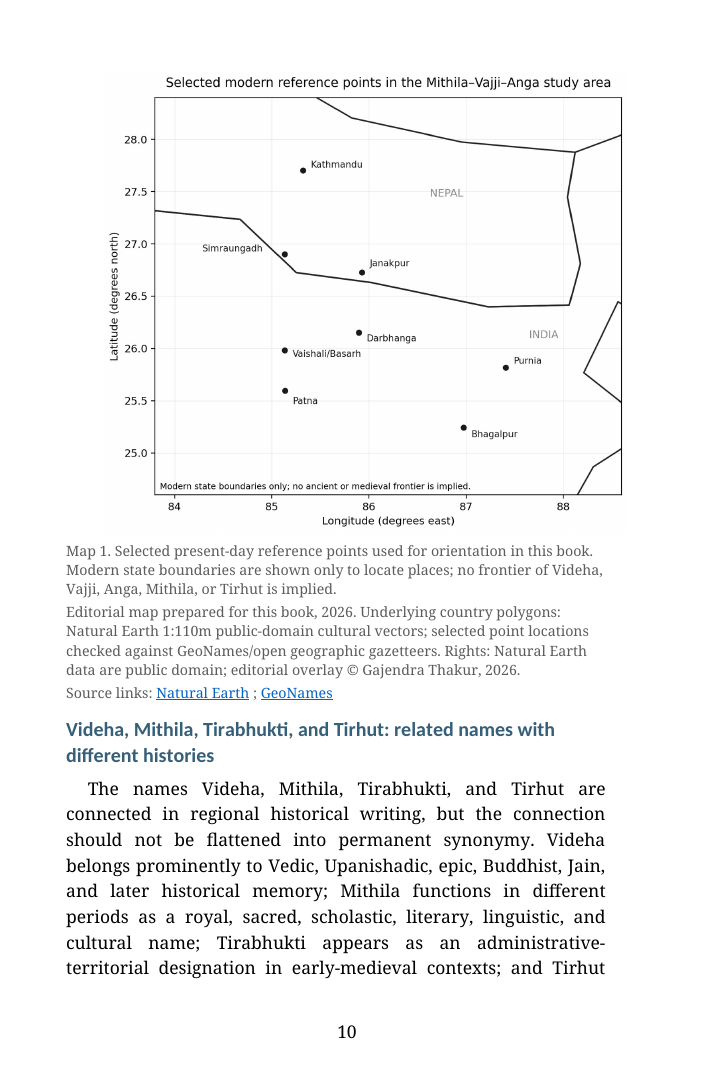
Mithila · Vajji · Anga
Chapter-specific source notes
- Primary chapter witness. Gajendra Thakur, Decoding the Panji of Mithila — Volume III, formal Chapter 15, PDF pp. 184-198; formal Chapter 15. The HTML transcription is generated from the commit-pinned source PDF and retains the chapter boundary recorded in this edition.
- Internal structure. The repository source-heading inventory records 18 subordinate headings for this chapter: “Index Link Box”; “Chapter overview”; “Entry 62: Mahishi-Pali opens the large Pali field”; “Entry 63: Continuation of the Mahishi-Pali opening”; “Entry 64: Mahishi to Sotipura”; “Entry 65: Mahishi-Pali through Dhane-Rampur”; “Entry 66: Ishahpur-Pali within the Mahishi field”; “Entry 67: Mahishi to Gangoli and Ishahpur”; ….
- Digital editorial method. The page keeps the preserved source text distinct from generated navigational, concordance, visual, and provenance apparatus. The synthetic reconstruction is explanatory only and is not evidence for an individual lineage or a determination of social or marital status.