Decoding the Panji of Mithila · Volume III · Chapter 16
Entries 79-99 - Balirajpur, Pahitola, Haripur, Bhattpura, Behat, Nagwar, Ghosaut, and Dharampur Index Link Box Index cluster: बलिराजपुर / पाहीटोल / हरिअम्ब / हरिपुर / भट्टपुरा / बेहट / नगवाड़ / घोसौत /
Chapter 16
Entries 79-99 - Balirajpur, Pahitola, Haripur,
Bhattpura, Behat, Nagwar, Ghosaut, and Dharampur
Index Link Box
Index cluster: बलिराजपुर / पाहीटोल / हरिअम्ब / हरिपुर / भट्टपुरा / बेहट / नगवाड़ / घोसौत /
धरमपुर.
Khand 2 source entries decoded: 79-99.
Principal source heading forms: “उपटीप बलिराजपुर-पाहीटोल”; “उपटीप बलिराजपुर सँ
पाहीटोल”; “उपटीप वलिराजपुर पाहीटोल”; “उपटीपसँ वलिराजपुर पाहीटोल हरिपुर”;
“उपटीप बलिराजपुर सँ हरीपुर भट्टपूरा”; “उपटीप बलिराजपुर सँ भट्टपूरा”; “उपटीप
बलिराजपुर सँ बेहट”; “वलिराजपुर सँ बेहट”; “उपटीप नगवाड़ घोसौत धर्मपुर”; and “उपटीप
नगवाडसँ .”
Index roots and routes: बलिराजपुर is the opening root, पाहीटोल is the repeated field, and the
chapter expands through हरिअम्ब, हरिपुर, भट्टपुरा, बेहट, नगवाड़, घोसौत, धरमपुर, सोदरपुर,
पाली, खण्डबला, माण्डर, नरउन, करमहा, खौआल, सुरगन, कु जौली, एकहरा, बेलउँ च, सकराढ़ी,
फनन्दह, पण्डु आ, दरिहरा, and वलियास.
Coverage status: Entries 79-99 decoded in this chapter. Entry 100 begins the Puwaripar-Ruchouli-
Ujan cluster and belongs to Chapter 17.
Chapter 15 closed with the Mahishi-Pali movement through
Pahitola, Mangrauni, and Jamdauli. Chapter 16 begins a
different field: Balirajpur-Pahitola, initially attached to
Hariamb and then extended through Haripur, Bhattpura,
Behat, Nagwar, Ghosaut, and Dharampur. The chapter is large
because the same root repeatedly throws out collateral lines,
daughter-links, learned titles, estate titles, and later settlement
memory.
The method remains the same as in the preceding chapters.
Every name is read through descent, place, marriage, title, and
branch-continuity. A person is never treated as a detached
biographical item. The question is always: whose son or
daughter is this person; which village is attached by सँ; which
Decoding the Panji of Mithila, Volume III | Page 197
Decoding the Panji of Mithila Volume III
title or house-marker is preserved; and whether the line
continues through सुता, सुतो, अपरा, a source number, or a new
heading.
Entries 79-99 are especially important because they show a
single index field expanding in several directions. Pahitola is
the repeated working field. Balirajpur supplies the opening
root. Haripur and Bhattpura appear as major sub-branches.
Behat forms a later sub-cluster, and the final entries move
toward Nagwar, Ghosaut, and Dharampur. The chapter must
therefore be read as a network, not as a straight list.
Chapter overview
Entries 79-83 open the Balirajpur-Pahitola material and
establish its learned and estate-marked houses. Entries 84-87
continue the same field through Raghunath Mishra, Mohan
the grammarian, Shambhunath-Vikal, Siddhinath, Janardan,
Durganath, and related descendant groups. Entry 88
introduces the Haripur sub-route. Entries 89-92 form the
Bhattpura block. Entries 93-97 carry the chapter toward Behat
and Behar. Entries 98-99 close the assigned range through
Nagwar, Ghosaut, Dharampur, and the final Nagwar heading.
The source repeatedly uses spellings such as बलिराजपुर,
वलिराजपुर, पाहीटोल, पाही टोल, भट्टपुरा, भट्टपूरा, बेहट, वेहर, नगवाड़, घोसौत, and
धरमपुर. A modern index may normalize these for search, but the
decoding must preserve the visible source forms when
discussing individual entries.
Entry 79: The Balirajpur-Pahitola opening
Entry 79 opens the new field with “उपटीप बलिराजपुर-पाहीटोल”
and “अथ बलिराज पुर हरिअमर ग्रामारम्भ.” This double signal is
important. Balirajpur is not only a place-name; it opens a
Harianb/Hariamb-connected branch that will repeatedly
Decoding the Panji of Mithila, Volume III | Page 198
Decoding the Panji of Mithila Volume III
return to Pahitola. The first line places Yaar or Raghudev in
relation to Ramanath, Vishnudatt, Gangadatt,
Mahamahopadhyaya Sachal or Bhavanidatt, and
Mahamahopadhyaya Vaiyakarana Mohan.
The presence of Mahamahopadhyaya and Vaiyakarana at
the opening shows that scholarship is part of the genealogical
identity. These titles are not commentary added later; they
appear in the source formula itself. The decoder must
therefore index the line both under descent and under
learned status.
The early branch moves through Mandar, Soderpur,
Darhara, Khandbala, Budhwal, Khaual, and Karamha.
Ramanath leads toward Kanhai or Ratinath; Vishnudatt and
Gangadatt open other lines; and the Sachal/Bhavanidatt-
Mohan complex attaches this chapter to the learned houses
already seen in earlier chapters. The chapter’s first rule is
therefore to keep Balirajpur, Hariamb, and Pahitola together
as a linked field.
Entry 80: Pahitola-Balirajpur continuation
Entry 80 is headed as a Pahitola-Balirajpur continuation. It
carries forward Chandranath, Bal Mukund, Mativir,
Prabhanath, Dhirnath, Mahavir, Pramathanath, Kalinath,
Priyanath, Vijayanath, Rishinath, Srishtinath, Sudhanath,
Kripanath, Vinaynath, Sinaynath, and Padmanath. The entry
is shorter than Entry 79, but it is important because it shows
the branch widening into several descendant groups.
The repeated route names Naruan, Khandbala, Pabouli,
Mandar, Harianb, Soderpur, and Valiyas show that this is not
an isolated continuation. It is a continuation by marriage-
route and branch-link. The incomplete “. . . सँ . . .” passages
Decoding the Panji of Mithila, Volume III | Page 199
Decoding the Panji of Mithila Volume III
must remain visible because they show where the source itself
does not supply a complete line.
Entry 81: Ujan and Garhbanaili enter the Balirajpur field
Entry 81 is explicitly tied to Balirajpur-Pahitola but it
names Vaidyanath Mishra, Ujan, and Garhbanaili. This is the
first strong expansion beyond the immediate Pahitola field.
Shivanath or Shivi, Sachal/Bhavanidatt, Khagadatt, Durgadatt,
Devanath, Baidyanath, Umanath, Vishwanath, Vinayaknath,
Padmanath, Dinanath, Dayanath, Adityanath, Udaynath, and
Abhaynath appear in this movement.
Ujan and Garhbanaili should not be treated as decorative
locations. Their presence tells the reader that the branch has
expanded into another settlement-memory while still
belonging to the Balirajpur-Pahitola cluster. The Panji records
this by attaching the new places to descent and marriage
formulae instead of giving a modern narrative explanation.
Entries 82-83: Gaurinath Mishra and Jaydev lines
Entry 82 names Gaurinath Mishra in the Balirajpur-
Pahitola field. The line includes Durgadatt, Babu Loknath,
Babu Murli or Girijanath, Yadunath, Anand, Govind, Haridev,
Sukhdev, Jaydev, Umanath, Gaurinath, Bhairav, Chitranath,
and Bechan. The status title “Babu” occurs several times and
should remain attached to the persons it qualifies.
The Gaurinath Mishra entry is a good example of title and
place working together. Khandbala, Maharaj Madhav Singh,
Maharaj Chhatra Singh, Darhara, Soderpur, Budhwal,
Mandar, Valiyas, and other routes appear beside the personal
names. The title does not replace descent; it locates a branch
socially within the descent network.
Entry 83 continues with Jaydev and the lines through
Muktinath, Veninath, Buddhinath, Siddhinath, Riddhinath,
Decoding the Panji of Mithila, Volume III | Page 200
Decoding the Panji of Mithila Volume III
Hemnath, Indunath, Manoj, Taraknath, Tulnath, Devkinath,
Lalitnath, Kashinath, Amarnath, Bhadranath, Chitranath,
Mayanath, Jivanath, Dhirnath, Virnath, and Upendranath. It is
a dense entry, but the same rule applies: preserve the
sequence and read every personal name through the nearest
descent and place marker.
Entry 84: Raghunath Mishra and the Raghunath branch
Entry 84 is headed under the Balirajpur-Pahitola field and
names Raghunath Mishra. It includes Bholanath or Tulanath,
Lakshminath, Ram or Dihanath, Lakshman or Dimbhnath,
Bharat or Balbhadra, Raghunath, Mathuranath, Kedarnath,
Meghnath, Sundar Kumar, Shachinath, Tejnath, Kripanath,
and Kamalnath.
The entry demonstrates a pattern found throughout this
book: a named personal anchor in the heading is not the
entire entry. It is the entry point into a larger family
movement. Raghunath Mishra helps locate the branch, but the
branch itself must be read through daughter-links, sons, place-
routes, and later partial continuations.
Entries 85-87: The learned Balirajpur-Pahitola
continuations
Entries 85-87 continue the same cluster with particular
density. Entry 85 includes Chhitna or Somnath, Madan, Sadan,
Bodhnath, Ajaynath, Vijaynath, Shaktinath or Keshilal, Mohan
the grammarian, Abhaynath, Siddhinath, Harshnath,
Gopinath, Gangnath, Durganath, Prajanath, Shambhunath or
Vikal, Indranath, Dharmanath, Thakurnath, and Tripranath.
The entry preserves both learned status and branch
continuity.
Entry 86 continues with Triptinath, Durganath, Prajanath,
Shambhunath-Vikal, Lutan-Kshatranath, Bhavanath,
Decoding the Panji of Mithila, Volume III | Page 201
Decoding the Panji of Mithila Volume III
Gokulnath, Jagdish, Dhananath, Jagannath, and Gopinath.
Several Khandbala and Soderpur links appear, along with
incomplete descendant markers. These should be read as
evidence of a continuing branch rather than as accidental
repetition.
Entry 87 brings Janardan, Durganath, Adyanath,
Radhanath, Shashinath, Buddhinath, Premnath, Subodhnath,
Rajnath, Devnath, Teknath, Dilipnath, Sudhir, Lekhnath,
Pavan Shekhar, and related descendants. The entry also
includes modern professional initials and education-linked
titles in places, showing that this record continues to absorb
later status markers without abandoning the Panji formula.
Entry 88: Haripur as a sub-route
Entry 88 introduces Haripur inside the Balirajpur-Pahitola
cluster and names Yanthranath Mishra. The entry moves
through Sitanath, Ratinath, Brajnath, Mantranath, Lilianath,
Shatanjiv, Bandhu, Durganath, Dinanath, Divanath,
Adityanath, Manik, Goshai, Damodar, Ugra, Muktinath, Pulkit,
Yanthranath, Matinath, Punyanath, Tejnath, Gurunath, and
Ganganath.
Haripur must be indexed as a sub-route, not as a separate
chapter-root. The heading keeps it under the Balirajpur-
Pahitola complex. The route names Pabouli, Sakaradhi,
Soderpur, Naruan, Khandbala, Pandua, Mandar, Valiyas,
Harianb, and Pali show the cross-movement that gives
Haripur its place inside the larger network.
Entries 89-92: Bhattpura expansion
Entries 89-92 form the Bhattpura block. Entry 89 explicitly
brings in Haripur-Bhattpura and includes Ugra or Kunjbihari,
Brajbihari, Avadhbihari, Thakur Balbhadra, Dhaneshwar,
Tameshwar, Parmeshwar or Ganesh, Meghnath, Prabhunath,
Decoding the Panji of Mithila, Volume III | Page 202
Decoding the Panji of Mithila Volume III
Chandranath, Shyamnath, Rangalal, Nirtlal, Panchmani, and
Bechan.
Entry 90 continues Bhattpura through Panchmani, Phaturi,
Nandan, Singheshwar, Mahavir, Jayvir, Ratanesh, Vinita,
Srinath or Chakku, Ugranath, Mitranath, Madan, Sadan,
Riddhinath, Singheshwar, Lekhnath, Mohanath,
Shambhunath, and Kamnath. The appearance of Singh and
Babu titles alongside Mishra names shows a social field wider
than a single scholastic lineage.
Entry 91 deepens the Bhattpura sequence through
Harshnath, Harsmani, Bachharan, Yogilal, Feku, Gunanath,
Kamalnath, Muktinath, Gopinath, Shaktinath, Nityanath,
Hemnath, Kiranath, Ramanath, and Premnath. Entry 92 then
adds Vaiyakarana Gopinath, Baidyanath, Indranath,
Netranath, Indunath, Chandranath, Anandnath, Shyamnath,
Professor Vidyanath, Chandan, and other related lines. These
entries are crucial for the index because Bhattpura appears
both as a place and as a branch field.
Entries 93-97: Behat and Behar movement
Entry 93 shifts to Balirajpur-Behat. Dullah, Urvibhar,
Girdhar, Kirtidhar, Bhagwandatt, Govind or Gauridhar,
Gangadhar, Chiranjeev or Hemghar, Madhav or Dharmdhar,
Anand or Moddhar, Jagdish or Dimbdhar, and related
descendants form the first Behat movement. The transition is
smooth because Pahitola and Balirajpur remain the
underlying field.
Entry 94 names Balirajpur-Behat and Behar. It includes
Giridhar, Damodar, Madanmohan, Khadgadhar, Mahidhar,
Satyadhar, Kamaladhar, Jivachh, Narsingh, Ramkrishna,
Devkrishna, Balkrishna, Kameshwar, Maheshdhar, Bhesdhar,
Mahavir, Kantir, Indudhar, and Vishwambhar. The variant
Decoding the Panji of Mithila, Volume III | Page 203
Decoding the Panji of Mithila Volume III
heading Behat/Behar should be preserved rather than silently
regularized.
Entries 95-97 continue the Behat field. Entry 95 carries
Balh, Durivaya or Chakradhar, Babu Halli or Haldhar,
Phanidhar, Lakshmidhar, Vaiyakarana Chunni or Shridhar,
Jyotishi Kalyandhar, Revatiraman, Pritinath, Vishwanath,
Madhusudan, Bhupendranath, and Ashok. Entry 96 adds
Vishwanath, Modnath, Bechnath or Chandranath, Taranath,
Arun, Lakshmidhar, Yogmani, Divanand, Chhitan, Thakkan,
and Taranand. Entry 97 continues with Vaiyakarana Chunti or
Shridhar, Vaiyakarana Baldev, Parashuram, Balbhadra,
Devkinandan, Harinand, Hemnath, Punyanath, and related
links.
The Behat group shows how a branch-field can continue
through repeated titles: Vaiyakarana, Jyotishi, Babu, and
estate-linked Singh names all occur within genealogical
formulae. These titles must be indexed as identifying markers,
but the primary reading remains descent and route.
Entries 98-99: Nagwar, Ghosaut, Dharampur, and the
closing movement
Entry 98 is headed “उपटीप नगवाड़ घोसौत धर्मपुर.” This heading is
the clearest sign that the final movement of Chapter 16 has left
the immediate Balirajpur-Pahitola and Behat fields and is now
closing through Nagwar, Ghosaut, and Dharampur. Kalānath,
Nanu, Vanshamani, Harsmani, Kulmani, Hrishikesh,
Amritkesh, Vaiyakarana Gopal, Harishmani, Muni, Phudan,
Parmeshwar, Jiveshwar, Gangeshwar, Satyanarayan,
Markandey, and related names appear in this closing section.
Entry 99 continues under Nagwar. It includes
Harishchandra, Ram, Kalyan Singh, Mansukh, Manik,
Goshain, Brajlal, Rangalal, Anant Singh, and several attached
Decoding the Panji of Mithila, Volume III | Page 204
Decoding the Panji of Mithila Volume III
daughter-lines and settlement routes. Since Entry 100 clearly
opens “उपटीप फवारिपार रूचौलि उजान,” Entry 99 must be treated as the
last entry of Chapter 16.
Cross-reference and route map for Entries 79-99
The principal route is Balirajpur-Pahitola:
Harianb/Balirajpur opens the field; Pahitola repeats as the
working village; Haripur and Bhattpura become internal sub-
routes; Behat/Behar form a later section; and Nagwar-
Ghosaut-Dharampur close the chapter. This is why the chapter
should be indexed under multiple place roots rather than
under Balirajpur alone.
Secondary routes include Soderpur, Pali, Khandbala,
Mandar, Naruan, Karamha, Khoaāl, Darhara, Valiyas, Pabouli,
Sakaradhi, Kujouli, Ekahara, Belauch, Pandua, Fanandah,
Suragan, and several estate-linked houses. The source uses
these names as relation markers. They identify the places
through which the marriage and descent network is
remembered.
Title and status map
The title map of this chapter is especially rich.
Mahamahopadhyaya, Vaiyakarana, Jyotishi, Babu, Thakur,
Maharaj, Singh, Professor, engineer-like initials, and modern
educational or professional markers appear inside the same
genealogical field. This confirms the central premise of
Volume III: Panji material cannot be understood by names
alone. Titles, places, branches, and marriage routes together
create identity.
The source also uses learned titles to distinguish otherwise
similar names. Mohan the grammarian, Chunni or Shridhar
the grammarian, Gopinath the grammarian, Jyotishi
Kalyandhar, and several Babu or Singh houses help keep
Decoding the Panji of Mithila, Volume III | Page 205
Decoding the Panji of Mithila Volume III
branches separate. These markers should be included in the
personal-name index and in the title/status index.
Important uncertainties
The chapter contains damaged or variant forms:
बलिराजपुर/वलिराजपुर, पाहीटोल/पाही टोल, हरिअम्ब/हरिअम्व, भट्टपुरा/भट्टपूरा, बेहट/बेहर,
नगवाड़/नगवाड, घोसौत, धरमपुर, and several broken source numbers.
The editorial rule is to preserve the source form in context
while choosing a normalized form only for the index.
Several passages contain ellipses or “. . . सँ . . .” formulae.
They are not to be completed by guesswork. A missing father,
son, or village is part of the source condition. The correct
decoding is to mark the branch and continue only where
visible evidence resumes.
Research summary
Chapter 16 decodes one of the major expansive clusters of
Khand 2. It begins with Balirajpur-Pahitola and Hariamb,
widens through Ujan and Garhbanaili, forms a Haripur sub-
route, develops a large Bhattpura block, turns toward Behat
and Behar, and closes through Nagwar, Ghosaut, and
Dharampur.
For the family researcher, the practical rule is strict: do not
lift a name from this chapter without its route. Raghudev,
Ramanath, Vishnudatt, Gangadatt, Sachal or Bhavanidatt,
Mohan the grammarian, Vaidyanath Mishra, Gaurinath
Mishra, Jaydev, Raghunath Mishra, Yanthranath Mishra,
Gopinath the grammarian, Professor Vidyanath, and the
Nagwar-Dharampur closing names all have to be read through
descent, place, marriage, title, and branch-continuity.
With Chapter 16 complete, the cumulative manuscript is
decoded through Entry 99. The next chapter begins at Entry
Decoding the Panji of Mithila, Volume III | Page 206
Decoding the Panji of Mithila Volume III
100 with the Puwaripar-Ruchouli-Ujan cluster, where the
source opens a new field through “उपटीप फवारिपार रूचौलि उजान” and
“अथ रूचौलि करमहा ग्रामारम्भ.”
Decoding the Panji of Mithila, Volume III | Page 207
Decoding the Panji of Mithila Volume IIISource structure and verification apparatus
Editorial source apparatus. This apparatus is descriptive, not interpretive. It records the source-controlled structure used to verify that this page corresponds to formal Chapter 16 of Decoding the Panji of Mithila — Volume III. The chapter text above is preserved from PDF pp. 198-209; formal Chapter 16 in the commit-pinned authoritative source. It is not merged with a neighboring chapter, appendix, annexure, or independent front/back-matter unit. The internal headings below come from the repository’s source-heading inventory and are retained as navigational and audit evidence; showing them here does not turn those headings into separate publications or add claims that are absent from the source.
Internal source headings
- Index Link Box
- Chapter overview
- Entry 79: The Balirajpur-Pahitola opening
- Entry 80: Pahitola-Balirajpur continuation
- Entry 81: Ujan and Garhbanaili enter the Balirajpur field
- Entries 82-83: Gaurinath Mishra and Jaydev lines
- Entry 84: Raghunath Mishra and the Raghunath branch
- Entries 85-87: The learned Balirajpur-Pahitola continuations
- Entry 88: Haripur as a sub-route
- Entries 89-92: Bhattpura expansion
- Entries 93-97: Behat and Behar movement
- Entries 98-99: Nagwar, Ghosaut, Dharampur, and the closing movement
- Cross-reference and route map for Entries 79-99
- Title and status map
- Important uncertainties
- Research summary
Source-text concordance
Entries · 79-99 · Balirajpur · Pahitola · Haripur · Bhattpura · Behat · Nagwar · Ghosaut · Dharampur · Index · Link · cluster · धरमप · Khand · decoded · Principal · heading · forms · roots · routes · opening · root · repeated · field · expands · नरउन · करमह · एकहर · Coverage · status · Entry · begins · Puwaripar-Ruchouli · Ujan · belongs · closed · Mahishi-Pali · movement · Mangrauni · Jamdauli · different · Balirajpur-Pahitola · initially · attached · Hariamb · extended · large · repeatedly · throws · collateral · lines · daughter-links · learned · titles · estate · later · settlement · memory · method · remains · preceding · chapters · Every · name · read · descent · place · marriage · title · branch-continuity · person · never · treated · detached · biographical · item · question · always · whose
Boundary verification. In the formal sequence this chapter follows Volume III Chapter 15, “Entries 62-78 - Mahishi, Pali, Ishahpur, Gangoli, Hatadh, Lohna, Pahitola, and Mangrauni Index Link Box Index cluster: महिषी / पाली / इशहपुर / गंगोली / हटाढ़ / लोहना / पाहीटोल / मंगरौनी /” and precedes Volume III Chapter 17, “Entries 100-119 - Ruchouli and the Puwaripar/Fawaripar Expansion Index Link Box Index cluster: रूचौली / पुवारिपार / फवारिपार / उजान / करमहा / नरूआड़-नडुआर / दुर्गागंज /”. The chapter extractor begins at the verified formal Chapter 16 marker and stops at the next verified formal chapter marker; for a final chapter it stops before recognized book-level back matter. The concordance above is generated only from distinct terms already present in this chapter’s preserved source text. It is provided for discovery, comparison, and audit, not as an automated judgment about persons, lineages, status, kinship, marriage eligibility, or historical truth.
Illustrated research apparatus
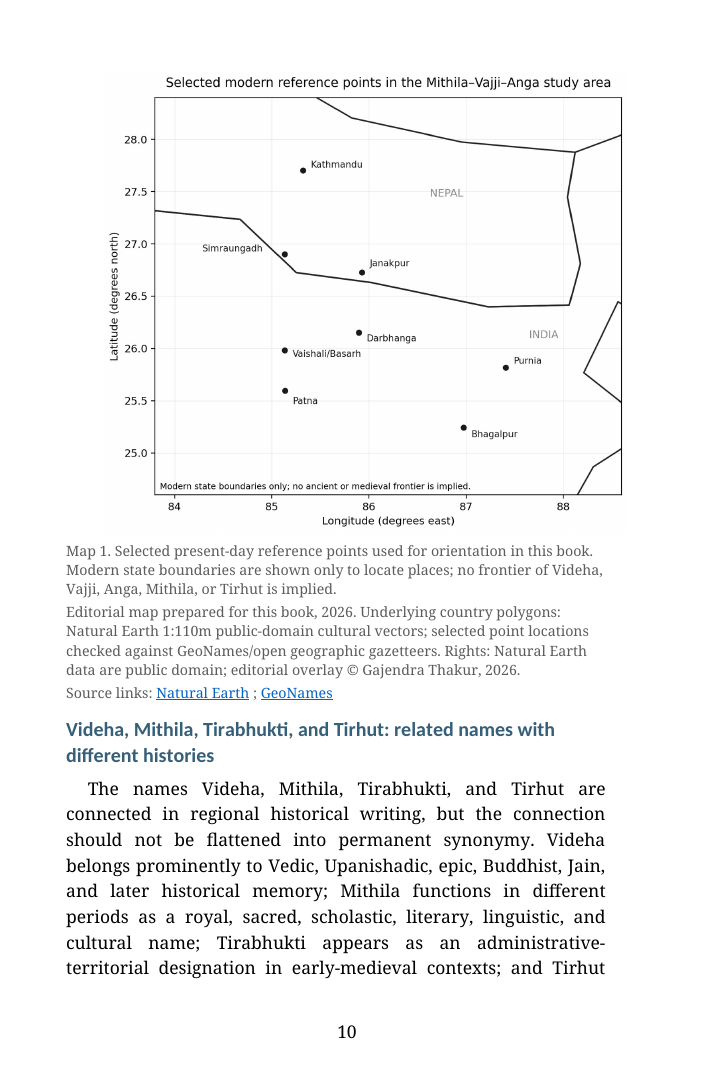
Mithila · Vajji · Anga
Chapter-specific source notes
- Primary chapter witness. Gajendra Thakur, Decoding the Panji of Mithila — Volume III, formal Chapter 16, PDF pp. 198-209; formal Chapter 16. The HTML transcription is generated from the commit-pinned source PDF and retains the chapter boundary recorded in this edition.
- Internal structure. The repository source-heading inventory records 16 subordinate headings for this chapter: “Index Link Box”; “Chapter overview”; “Entry 79: The Balirajpur-Pahitola opening”; “Entry 80: Pahitola-Balirajpur continuation”; “Entry 81: Ujan and Garhbanaili enter the Balirajpur field”; “Entries 82-83: Gaurinath Mishra and Jaydev lines”; “Entry 84: Raghunath Mishra and the Raghunath branch”; “Entries 85-87: The learned Balirajpur-Pahitola continuations”; ….
- Digital editorial method. The page keeps the preserved source text distinct from generated navigational, concordance, visual, and provenance apparatus. The synthetic reconstruction is explanatory only and is not evidence for an individual lineage or a determination of social or marital status.