Decoding the Panji of Mithila · Volume III · Chapter 17
Entries 100-119 - Ruchouli and the Puwaripar/Fawaripar Expansion Index Link Box Index cluster: रूचौली / पुवारिपार / फवारिपार / उजान / करमहा / नरूआड़-नडुआर / दुर्गागंज /
Chapter 17

  Entries 100-119 - Ruchouli and the Puwaripar/Fawaripar
Expansion
  Index Link Box
Index cluster: रूचौली / पुवारिपार / फवारिपार / उजान / करमहा / नरूआड़-नडुआर / दुर्गागंज /

बेहट-विठ्ठो / हाटी / कल्याणफर / कोइलखाहा.
Khand 2 source entries decoded: 100-119.
Principal source heading forms: “उपटीप फवारिपार रूचौलिसँ उजान”; “उपटीप पुवारिपार

रूचौलिसँ उजान”; “उपटीप पुवारिपार नड़आरसँ उजान”; “उपटीप पुवारिपार नडुआर सँ उजान
दुर्गागंज”; “उपटीप पुवारिपार बेहटसँ विठ्ठो”; “उपटीप फवरिपार बेहटसँ विठ्ठो”; “उपटीप
पुवारिपार बेहटसँ हाटी कल्याणफर”; and “पुवारिपार उपटीप बेहटसँ कल्याणफर
कोइलखाहा.”
Coverage decision: Entry 100 begins the Puwaripar-Ruchouli-Ujan cluster. Entry 119 closes this
chapter. Entry 120 begins the next Behat continuation and is reserved for Chapter 18.
Method: every name is read through descent, place, marriage, title, and branch-continuity. The
chapter must not detach Ruchouli, Naruar, Durgaganj, Behat, Vittho, Hati, Kalyanfar, or
Koilkhaha from the same movement.

  Chapter opening: a corridor, not a detached list
Chapter 17 decodes Entries 100-119. It forms the hinge
between the Balirajpur-Pahitola field of Chapter 16 and the
wider Behat-centered material that begins after Entry 120. The
movement is not a simple village list. It is a corridor: Ruchouli
and Ujan open it, Naruar and Durgaganj widen it, Behat and
Vittho become its later field, and Hati, Kalyanfar, and
Koilkhaha mark collateral routes inside it.

    The method remains unchanged. A person is never read
alone. Each name is read through descent, place, marriage,
title, and branch-continuity. The governing questions are:
whose son or daughter is the person; which village follows the
सँ marker; which learned, royal, professional, or household
title is attached; which अपरा clause opens a collateral line; and

                       Decoding the Panji of Mithila, Volume III | Page 208
                         Decoding the Panji of Mithila Volume III

whether a later heading is continuing the same branch or
beginning the next index field.

    The chapter also demonstrates why the Index must control
the reading. The same source range touches करमहा, रूचौली, नडुआर,
दुर्गागंज, बेहट, विठ्ठो, हाटी, कल्याणफर, कोइलखाहा, सोदरपुर, नरउन, पाली, खण्डबला,
माण्डर, दरिहरा, बुधवाल, सकराढ़ी, सुरगन, कु जौली, एकहरा, बेलउँ च, घोसौत, पबौली,
and वलियास. A single heading is therefore only the entrance to a
network.

  Entries 100-105: Ruchouli, Ujan, and the Puwaripar
opening
    Entry 100 begins with the source formula “पुवारिपार रूचौलि
उजान” and then gives “अथ रूचौलि करमहा ग्रामारम्भ.” This establishes
the first rule of the chapter: Ruchouli must be read under the
Karmahā root while Ujan and Puwaripar show the wider
regional field. Mahamahopadhyaya Rameshwar, Ruchidatt,
Ram, Mahinath, Chandradatt, Shivram, Chhabnu, and the
learned chain of Gangadatt, Manbodh or Lakshmidatt, and
Subodh or Bhavanidatt are therefore part of one structured
opening.

    Entry 101 continues the Puwaripar-Ruchouli-Ujan
structure through Ugri, Vanshidhar, Ramanath, Manbodh-
Lakshmidatt, Jagadvar, Dharmadatt, Khagesh or Manhar,
Girish or Kari, and several collateral branches. The source
uses many अपरा clauses. These clauses must not be flattened
into one continuous descent. Each marks a separate opening
inside the same family field.

    Entry 102 develops the Shyam or Rudradhar side of the
same cluster. Rajaram or Ghananath, Banaravdi, Jharkhandi,
Sundar, Keshav, Loknath or Lanhi, Jivanath, Digambar,
Pitambar, Nilambar, Sitambar, Vednath, and Brijnath appear
                    Decoding the Panji of Mithila, Volume III | Page 209
                    Decoding the Panji of Mithila Volume III

with dotted gaps and compressed reference numbers. These
incomplete formulae must be preserved, because they record
the structure even where names are missing.

   Entry 103 shows the Puwaripar cluster as a meeting point
of scholarship, village, and marriage identity. Pitambar, Gopal
Datt, Kashinath, Shivnath, Lilambar, Rupnath, Sitambar,
Krishnadatt, Subodh-Bhavanidatt, Ishdatt, Maheshdatt, and
the Vaidik Raja line appear here. Tisaut, Khandbala, Naruan,
Soderpur, Pabouli, Valiyas, and Mandar must all be indexed as
routes connected to the same Ruchouli-Ujan structure.

   Entry 104 is numbered inside the source as “५२. उपटीप
फवारिपार रूचौलिसँ उजान.” It continues through Giridhari, Vaidik
Badrinath, Lekhnath, Narasingh, Jagdish, Bhimnath, Uman or
Mukund, and daughter-lines linked to Khandbala, Surgan,
Soderpur, and Darhara. The entry confirms that learned titles
and estate/status vocabulary can occur inside the same
genealogical formula.

   Entry 105 closes the Ruchouli-Ujan sub-cluster by taking
Bhaiyan, Ram-Lakshman-Bharat-Shatrughna, and Raghunath-
Bharat strands into later branches. The source then reaches
Dilip and Pradip and touches Ishahpur, Parhat, Sakaradhi,
Sharadapur, and Valiyas. This is a boundary entry: it belongs
to Chapter 17 by numbering, but it anticipates the wider Behat
and Tarouni material that follows later.

  Entries 106-110: Naruar, Durgaganj, Katihar, and
estate/status transition
   Entry 106 begins the Naruar or Naddūar-Karmahā material
with “अथ नडुआर करमहा ग्रामारम्भ.” Dukhbhanjan, Murlidhar,
Matinath, Mitranath, Gokhulnath, Jaladhar, Haladhar,
Uvvidhar, Mahadev, Khojendra, Markandeya, Janardan,
Govardhan, and several daughter-links appear. This is not a
                Decoding the Panji of Mithila, Volume III | Page 210
                    Decoding the Panji of Mithila Volume III

digression from Ruchouli. It is the Karmahā branch expanding
through another village anchor.

   Entry 107 continues the same field through Amarnath,
Narendra Nath, Mahendra Nath, Bhavendra Nath, Devendra
Nath, Baichendra Nath, Buddhinath, Rajendra Nath,
Govardhan, Revati Nath, Brajnath, Vidyanath, and related
descendants. The heading is short, but the network is not.
Vaturi-Soderpur, Batiya-Darihara, Naruan, Khandbala,
Didhoy, and other routes must remain attached.

   Entry 108 brings Durgaganj and Katihar into the Naddūar-
Ujan sequence. Hemkar, Vaidya Shaktinath, Ramanath,
Umanath, Taranath, Tantranath, Mahipati, Raja Ramlochan,
Raja Durgaprasad, and Raja Buddhinath appear. The royal
titles in this passage are not decorative. They are part of the
genealogical evidence, especially when the branch reaches
Durgaganj and Katihar.

   Entry 109 extends the Durgaganj line toward the Maladwar
estate and Sonali. Raja Chhatranath, Raja Tanknath, Kumar
Baidyanath, Jayant or Ravindranath, Yashu or
Amarendranath, Kumar Karmanath, Kumar Sheshnath,
Kumar Rudranath, Professor Girindranath, and modern
markers such as M.B.B.S. appear together. The Panji register
here absorbs modern status without abandoning inherited
descent formulae.

   Entry 110 is short, but it must not be skipped. It continues
the Naddūar-Ujan-Durgaganj sequence through Snehanshu
Pratap and a Navtol link. Its function is to prevent a gap
between the Durgaganj material and the Behat-Vittho
transition that begins immediately afterward.

                Decoding the Panji of Mithila, Volume III | Page 211
                     Decoding the Panji of Mithila Volume III

  Entries 111-113: Behat-Vittho as the next principal field
   Entry 111 begins a major sub-cluster: “पुवारिपार बेहटसँ विठ्ठो.” The
source then opens “अथ बेहट करमहा ग्रामारम्भ.” This places Behat
under the Karmahā root and shifts the chapter from Ruchouli-
Naruar-Durgaganj toward Behat-Vittho. Sadu Jagannath,
Narayan Datt, Bhavani Datt, Krishna Datt, Lal Govind,
Hemdatt, Eknath, Chhakkan, Pushpi, Govardhan, Krishna
Madhav, Veni Madhav, Surya Madhav, and Chandra Madhav
form the first major Behat line.

   Entry 112 continues Behat-Vittho through Krishna Madhav,
Veni Madhav, Jivanath, Indranath, Sitaram or Loknath, Dr.
Yognath or Sindhu, Narnath or Bindu, Surya Madhav, Bittu or
Raghunath, Lekhnath, Bhupnath, Gopinath, and Kumudnath.
The presence of M.A. and Ph.D. beside older Panji formulae
shows how late educational identity is inserted into the old
genealogical frame.

   Entry 113 remains in Behat-Vittho and expands the line
through Lal or Ruchidatt, Bhikhiya, Govinddatt, Bachkan,
Mandhan, Baldev, Harinandan, Phaninath, Lakshminath,
Shaktinath, Shashinath, Nityanand, Purnanand, and
Shobhanand. The key point is continuity: the same source unit
contains sons, daughters, place-links, and repeated प्र. identity
markers.

  Entries 114-117: Hati, Kalyanfar, and Koilkhaha inside
the Behat field
   Entry 114 introduces Behat-Vittho with an additional Hati
connection. It begins with Gangadatt and Kavi Venidatt, then
develops Pyarelal or Shridatt, Chanchal or Somdatt, Fakir,
Bheshdatt, Dinanand, Shyam or Jivdatt, and the Kalyan-linked
strands. Hati is therefore not a stray addition; it is a sub-route
inside the Behat-Karmahā frame.

                 Decoding the Panji of Mithila, Volume III | Page 212
                     Decoding the Panji of Mithila Volume III

   Entry 115 continues through Shyam or Jivdatt,
Lakshminath, Kalanath, Mohanath, Lalitnath, Shashidatt or
Rank, Baidyanath, Gehanath, Girijanath, Kunj Nath, and
Medhanath. Many names are incomplete or dotted. These gaps
must be left visible, because the source preserves the branch
form even where the personal name is absent or damaged.

   Entry 116 brings Hati and Kalyanfar into clearer focus.
Gehanath, Girijanath, Kunj Nath, Meghanath, Nengdu or
Tekdatt, Chanchal or Somdatt, Damodar, Jhingur, Mahadev,
Devan, Gudra, and Kalyan appear. The phrase “कल्याणपुर ग्रामो”
confirms that Kalyanfar/Kalyanpur belongs in the place index,
not only in the personal-name stream.

   Entry 117 extends Kalyanfar toward Koilkhaha. Mahadev,
Baldev, Kamalnayan, Markandeya, Jaydev, Dukhharan,
Jivanath, Shri Vallabh or Chhatranath, Ashwini Kumar,
Acharya Shivshankar, and Rajesh show a dense branching
structure. The line repeatedly touches Valiyas, Naruan,
Sakaradhi, Khandbala, Soderpur, Mandar, and Kujouli while
still retaining the Behat affiliation.

  Entries 118-119: Closing the assigned range
   Entry 118 returns to Behat-Vittho and gives Devan,
Ramadatt, Murlidhar or Lakshmidatt, Shankar Datt, Brajlal,
Nandlal, Vanshidhar, Chumman, Dhodhan, Girijadatt, Kalru,
Jankinath, Radhanath, Shobhanath, and Revatinath. It is an
important closing entry because it connects Sakaradhi,
Budhwal, Valiyas, Khandbala, and Soderpur while remaining
under the Behat heading.

   Entry 119 closes the chapter range through Shobhanath or
Gopal, Kumudinath, Yognath, Dayanath, Jayanath, Eknath,
Brajlal, Muni, Bounu, Raghunath, Nandlal, Shyamlal,
Kanhaiyalal, Jayaditya, Motidatt, and Jhalanand or Lokpati.

                 Decoding the Panji of Mithila, Volume III | Page 213
                    Decoding the Panji of Mithila Volume III

The entry is not the end of Behat in the source. It is only the
end of the chapter assignment. Entry 120 begins the next
Behat continuation and must be handled in Chapter 18.

   The practical research rule is strict: a name from Entries
100-119 should never be cited without its place-marker and
branch context. Ruchouli, Puwaripar, Naruar, Durgaganj,
Behat, Vittho, Hati, Kalyanfar, and Koilkhaha are not separate
islands. They are stages of a connected movement in Khand 2.

  Research summary
   Chapter 17 decodes Entries 100-119 as a corridor of
transition. It starts with Ruchouli-Ujan, passes through Naruar
and Durgaganj, and then settles into Behat-Vittho with Hati,
Kalyanfar, and Koilkhaha as subsidiary fields. The chapter is
therefore essential for linking the earlier Balirajpur-Pahitola
material with the long Behat-centered sequence that follows.

   The coverage register is now complete through Entry 119.
Chapter 18 will begin from Entry 120 and continue the Behat-
centered Puwaripar expansion through Pokhrauni, Tarauni,
Anilpur, Gangora, Dumra, Simarwad, Parhat, Ujan,
Sharadapur, and Ishahpur.

   With Chapter 17 complete, the cumulative manuscript is
decoded through Entry 119. The next chapter begins with Entry
120 and the extended Behat-Pokhrauni-Tarauni-Anilpur
sequence.

                Decoding the Panji of Mithila, Volume III | Page 214
                            Decoding the Panji of Mithila Volume III
Source structure and verification apparatus
Editorial source apparatus. This apparatus is descriptive, not interpretive. It records the source-controlled structure used to verify that this page corresponds to formal Chapter 17 of Decoding the Panji of Mithila — Volume III. The chapter text above is preserved from PDF pp. 209-216; formal Chapter 17 in the commit-pinned authoritative source. It is not merged with a neighboring chapter, appendix, annexure, or independent front/back-matter unit. The internal headings below come from the repository’s source-heading inventory and are retained as navigational and audit evidence; showing them here does not turn those headings into separate publications or add claims that are absent from the source.
Internal source headings
- Index Link Box
- Chapter opening: a corridor, not a detached list
- Entries 100-105: Ruchouli, Ujan, and the Puwaripar opening
- Entries 106-110: Naruar, Durgaganj, Katihar, and estate/status transition
- Entries 111-113: Behat-Vittho as the next principal field
- Entries 114-117: Hati, Kalyanfar, and Koilkhaha inside the Behat field
- Entries 118-119: Closing the assigned range
- Research summary
Source-text concordance
Entries · 100-119 · Ruchouli · Puwaripar · Fawaripar · Expansion · Index · Link · cluster · करमह · हट-व · Khand · decoded · Principal · heading · forms · Coverage · decision · Entry · begins · Puwaripar-Ruchouli-Ujan · closes · next · Behat · continuation · reserved · Method · every · name · read · descent · place · marriage · title · branch-continuity · must · detach · Naruar · Durgaganj · Vittho · Hati · Kalyanfar · Koilkhaha · movement · opening · corridor · detached · list · decodes · hinge · Balirajpur-Pahitola · field · wider · Behat-centered · material · simple · village · Ujan · open · widen · become · later · mark · collateral · routes · inside · remains · unchanged · person · never · alone · governing · questions · whose · daughter · follows · marker · learned · royal · professional
Boundary verification. In the formal sequence this chapter follows Volume III Chapter 16, “Entries 79-99 - Balirajpur, Pahitola, Haripur, Bhattpura, Behat, Nagwar, Ghosaut, and Dharampur Index Link Box Index cluster: बलिराजपुर / पाहीटोल / हरिअम्ब / हरिपुर / भट्टपुरा / बेहट / नगवाड़ / घोसौत /” and precedes Volume III Chapter 18, “Entries 120-146 - Behat, Tarauni, Anilpur, Gangora, Dumra, Simarwad, Parhat, Ujan, Sharadapur, and Ishahpur Index Link Box”. The chapter extractor begins at the verified formal Chapter 17 marker and stops at the next verified formal chapter marker; for a final chapter it stops before recognized book-level back matter. The concordance above is generated only from distinct terms already present in this chapter’s preserved source text. It is provided for discovery, comparison, and audit, not as an automated judgment about persons, lineages, status, kinship, marriage eligibility, or historical truth.
Illustrated research apparatus
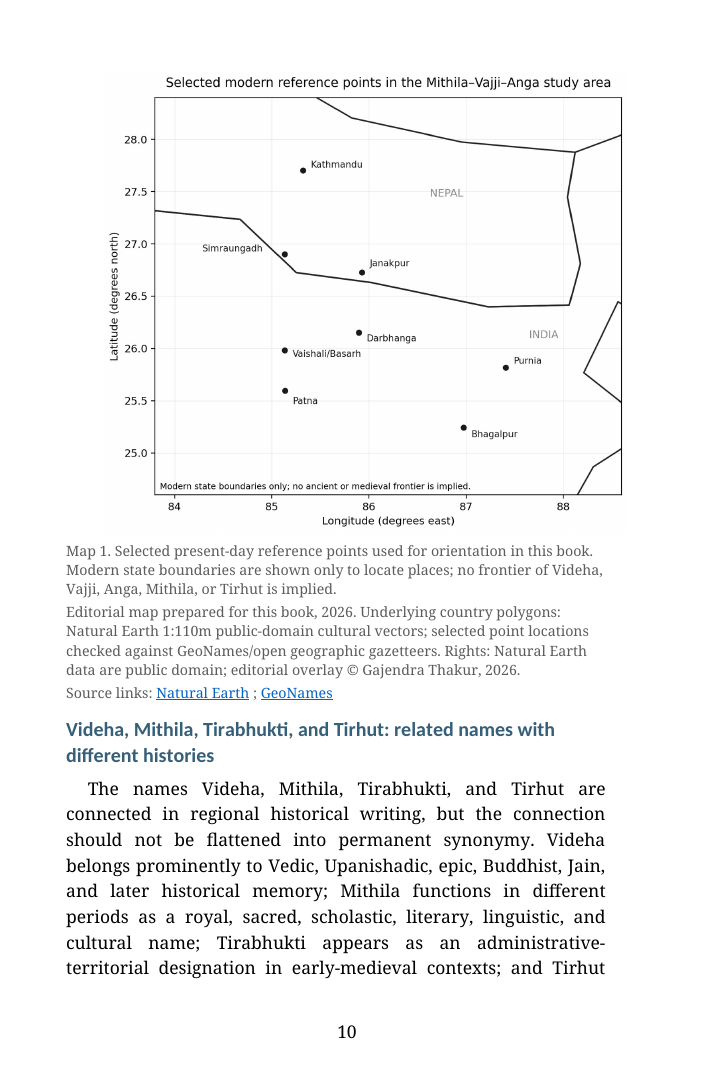
Mithila · Vajji · Anga
Chapter-specific source notes
- Primary chapter witness. Gajendra Thakur, Decoding the Panji of Mithila — Volume III, formal Chapter 17, PDF pp. 209-216; formal Chapter 17. The HTML transcription is generated from the commit-pinned source PDF and retains the chapter boundary recorded in this edition.
- Internal structure. The repository source-heading inventory records 8 subordinate headings for this chapter: “Index Link Box”; “Chapter opening: a corridor, not a detached list”; “Entries 100-105: Ruchouli, Ujan, and the Puwaripar opening”; “Entries 106-110: Naruar, Durgaganj, Katihar, and estate/status transition”; “Entries 111-113: Behat-Vittho as the next principal field”; “Entries 114-117: Hati, Kalyanfar, and Koilkhaha inside the Behat field”; “Entries 118-119: Closing the assigned range”; “Research summary”.
- Digital editorial method. The page keeps the preserved source text distinct from generated navigational, concordance, visual, and provenance apparatus. The synthetic reconstruction is explanatory only and is not evidence for an individual lineage or a determination of social or marital status.