Decoding the Panji of Mithila · Volume III · Chapter 18
Entries 120-146 - Behat, Tarauni, Anilpur, Gangora, Dumra, Simarwad, Parhat, Ujan, Sharadapur, and Ishahpur Index Link Box
Chapter 18

  Entries 120-146 - Behat, Tarauni, Anilpur, Gangora,
Dumra, Simarwad, Parhat, Ujan, Sharadapur, and
Ishahpur
  Index Link Box
Index cluster: बेहट / पुवारिपार / पोखरौनी / तरौनी / अवाम / अनलपुर / परियाम्ब-बुधवाल /

गंगोरा / डुमरा / दीप / महुआ-खौआल / मुराजपुर / सिमरवाड़ / परहट / उजान / शारदापुर /
इशहपुर / लोहना-सकराढ़ी.
Khand 2 source entries decoded: 120-146.
Principal source heading forms: “पुवारिपार उपटीप बेहटसँ”; “उपटीप पुवारिपार बेंहटसँ

पोखरौनी”; “उपटीप पुवारिपार तरौनीसँ अवाम”; “उपटीप पुवारिपार अनलपुरसँ”; “उपटीप
पुवारिपार पीयामसँ”; “पुवारिपार उपटीप गंगोरा सँ लालगंज”; “उपटीप पुवारिपार डुमरासँ”;
“उपटीप पुवारिपार सिमरवाड़ सँ”; and “उपटीप-पुवारिपार परहटसँ इशहपुर.”

Coverage decision: Entry 120 continues the Behat-centered Puwaripar field after the close of
Chapter 17. Entry 146 closes this chapter with Parhat-Ishahpur and the Lohna-Sakaradhi
opening. Entry 147 begins the next Ratauli cluster and is reserved for Chapter 19.
Method: every name is read through descent, place, marriage, title, and branch-continuity. The
chapter must keep Behat, Pokhrauni, Tarauni, Anilpur, Gangora, Dumra, Simarwad, Parhat,
Ujan, Sharadapur, Ishahpur, and Lohna-Sakaradhi as linked stages of one expanding network.

  Chapter opening: Behat after the early expansion
Chapter 18 decodes Entries 120-146. It continues from the
subsequent sections after the early Ruchouli-Puwaripar
expansion of Chapter 17. The line now moves into additional
settlements, scholarly branches, and marriage networks:
Behat continues, Pokhrauni and Tarauni open, Anilpur enters,
Gangora and Dumra develop large branches, Simarwad and
Parhat become route-points, and the closing passage reaches
Ishahpur and Lohna-Sakaradhi.

    The method remains the same. Every name must be read
through descent, place, marriage, title, and branch-continuity.
A name without its father, village, title, marital route, or अपरा
branch loses its Panji meaning. The chapter therefore does not

                       Decoding the Panji of Mithila, Volume III | Page 215
                        Decoding the Panji of Mithila Volume III

translate the entries into a flat list. It reads each heading as a
doorway into a governed network.

   This chapter is also a reminder that the Index is the control
register. Behat does not remain a single village block. It
becomes an index-field moving through Puwaripar,
Pokhrauni, Tarauni, Avam, Anilpur, Gangora, Dumra, Deep,
Mahua-Khaual, Murajpur, Simarwad, Parhat, Ujan,
Sharadapur, Ishahpur, and Lohna-Sakaradhi. These names
are not merely places; they are genealogical anchors.

  Entries 120-121: the Behat continuation and Pokhrauni
   Entry 120 continues the Behat-centered sequence begun in
the previous chapter. Kanhaiyalal, Chandralal, Padmalal,
Ganeshdatt, Nityanath, Durganath or Shakrinath, Mukund or
Netranath, Kanhaiyaji or Shankar, Badarinath, Vidyanand,
Vinayanand, Muni, Ramadatt, Jhalhan, Premdev, Devnath,
Kirtinath, and Nathuk appear in a tightly compressed field.
The place-links move repeatedly through Sarisab, Khandbala,
Pabouli, Naruan, Darhara, Soderpur, Mandar, and Karmahā.

   The key social feature of Entry 120 is continuity through
status. Maharaja Maheshwar Singh, Maharajadhiraj
Rameshwar Singh Bahadur, Babu Harshadhari Singh, Babu
Baladatt Singh, and Rai Bahadur Srinath are not separate
historical notes. They are title-bearing nodes in a genealogical
sequence. The title must be kept with the descent and place-
link that carries it.

   Entry 121 carries the Behat continuation into Pokhrauni.
Kirtinath is described through a wide marriage field,
including the explicit note that he had twelve marriages.
Dukhmochan, Vaidya Mitranath, Shitaladatt, Chiranjiv,
Prajapati, Pitambar, Chaudhuri Nand, Shivshankar,
Devshankar, Babu, Babunath, Jayanath, Premnath,

                 Decoding the Panji of Mithila, Volume III | Page 216
                    Decoding the Panji of Mithila Volume III

Chandranath, and Indranath all appear through repeated
daughter-lines and collateral routes. The phrase “एते कीर्तिनाथ
द्वादश विवाह” is therefore structurally important: marriage is not
incidental; it is one of the devices by which branch-continuity
is preserved.

  Entries 122-124: Tarauni, Avam, and the movement
toward Purnia-Araria
   Entry 122 opens Tarauni under the Karmahā field with “अथ
तरौनी करमहा ग्रामारम्भ.” Kalar, Veni, Baduki, Ram, Lakshman,
Mimansak Yogadatt, Gaurinath, Riddhinath, Hotrinath,
Loknath, Padmapati, Giridhari, Madhav, Shital, and Ramapati
or Dharan appear. This is a scholarly branch as well as a
descent branch: the word Mimansak attached to Yogadatt is a
title of learned identity inside the genealogical flow.

   Entry 123 continues Tarauni toward Ujan, Hati, and Avam.
Shrinayaran, Ishanarayan, Rudranarayan, Dharmanarayan,
Shrishtinarayan, Krishn Gopal, Nandgopal, Lalgopal, and
Jageshwar or Bhaiyaji appear with repeated movements into
Soderpur, Khandbala, Valiyas, Belauch, Darhara, and Naruan.
The entry shows how a Tarauni line can remain Karmahā-
linked while becoming visible through multiple settlements.

   Entry 124 carries the Tarauni-Avam line toward Basaiti in
Purnia and Araria. Dwarkanath, Ajaynath, Jayanath,
Badarinath, Udaynath, Bhagwandatt, Kamaladatt, Ratandatt,
Ramandatt, Damandatt, Sumandatt, Riddhipati, Bhimnath,
Jivanath, and Rudranath or Phuchkun appear. Modern and
regional geography enters the Panji here without breaking the
formula. The line extends outward, but it remains readable
only through its descent and marriage markers.

                Decoding the Panji of Mithila, Volume III | Page 217
                    Decoding the Panji of Mithila Volume III

  Entries 125-126: Jhanjharpur and Lakhnour as branch
fields
   Entry 125 opens the Jhanjharpur field with “अथ झंझारपुर करमहा
ग्रामारम्भ.” Yoganand, Shivanand, Vidyanand or Shital, Kunjana,
Chumman, Vishwanand, Jaynandan, Dinanand, Tekanand,
Khelanand, Paricheta or Devanand, Tulanand or Narayan,
Ravgendra or Bhavanand, and several daughter-lines appear.
This is a dense Karmahā-centered branch that touches
Darhara, Pabouli, Sakaradhi, Kujouli, Soderpur, Mandar,
Khandbala, and Digaunth-Soderpur.

   Entry 126 carries the Jhanjharpur material toward
Lakhnour. Dinanand, Ramanand, Yajnanand, Baidyanath,
Tekanand, Shardanand, Hemant, Krishna Mohan, Chirānand,
Khelanand, Jay Govind or Yashodanand, Bhodanand,
Vijayānand, Netranand, Devanandan or Harihar, Satyānand
or Dr. Digambar, and Punyānand or Vinod occur in a wide
scholarly and professional field. The presence of “Dr.” does
not detach the person from Panji structure; it adds a late layer
of recognition to the inherited line.

  Entries 127-130: Anilpur and Pariyamb-Budhwal
   Entry 127 closes the Jhanjharpur-Lakhnour run and leads
into the next opening. Jay Govind or Yashodanand, Girjanand,
Dharmanand, Premanand, Yamunanand, Chumman,
Jananand, and Durganand preserve the branch before Entry
128 opens Anilpur. The transition is important because it
shows that a new village heading often begins only after the
prior branch has been carried through its marriage links.

   Entry 128 opens Anilpur under Karmahā: “अथ अनलपुर करम्महा
ग्रामारम्भ.” Teknath, Jalpādatt, Babu Nanuk, Lal or Markandeya,
Lilanath, Chudanath, Gokhulnath, Somnath, Loknath, Kalru or
Lakshminath, Jaydatt, Kauskidatt, Thengni, Harakhu, Bhanjan,
                Decoding the Panji of Mithila, Volume III | Page 218
                    Decoding the Panji of Mithila Volume III

Devanand, Chhabnu, Rudradev, Mohan, Kala, Bhairav, Vacha,
and Thithar appear. The entry expands from Anilpur into
Soderpur, Khandbala, Valiyas, Reima, Naruan, Mandar,
Sharadapur, Ghosaut, Kujouli, and Pali.

   Entry 129 continues Anilpur and then opens Pariyamb-
Budhwal. Jwaladatt, Lakshmidatt, Ganga, Vamdev, Anand,
Ganai, Bhānudatt, Bachharu, Dulli, Chunni, Visni, Parashmani,
Hridaymani, Vidyamani, Shiromani, Baun or Chudamani, and
Keshav appear. Here the Behat-centered chapter has entered
another scholarly-marital network, where Budhwal is no less
important than Anilpur.

   Entry 130 continues Pariyamb. Adityamani, Vidyamani,
Chumman, Devkinandan, Achyutanand, Nityanand, Pyare,
Bachkan or Madhav, Yadunath, Bhailal, Buchan,
Raghunandan, Keshav, Gosain, Jhalhan or Sadanand, and
Phuddi or Balbhadra appear. The entry shows repeated
daughter-lines into Soderpur, Naruan, Mandar, Pabouli,
Khaual, and Khandbala. These repeated movements are
marriage evidence, not redundancy.

  Entries 131-133: Gangora and Lalganj
   Entry 131 opens Gangora under Budhwal with “अथ गंगौरा
बुधवाल ग्रामारम्भ.” Krishnadatt, Chhatranath, Vidyanath,
Parashmani, Bachharan or Vatseshwar, Kantu or Ratneshwar,
Vacha or Someshwar, Chandi or Chandeshwar, Nandishwar,
Vireshwar, Panchkauri or Bhuvaneshwar, Bhaiyo or
Modmani, Barji or Brajmani, Krishnamani, Nayanmani,
Tirthmani, Toshmani, Bagishwar, Rameshwar, Dhaneshwar,
and Girishwar appear. The cluster is rich in scholarly titles
and lateral marriage.

   Entry 132 continues Gangora-Lalganj and makes the
scholarly line explicit. Vacha or Sabheshwar leads to
                Decoding the Panji of Mithila, Volume III | Page 219
                    Decoding the Panji of Mithila Volume III

Mahamahopadhyaya Phanishwar and Mahamahopadhyaya
Manishwar. Kameshwar, Vaidya Shiveshwar, Ganeshwar,
Satishwar, and later modern markers including I.A.S.,
M.B.B.S., Professor, and L.L.B. are placed inside the same
genealogical grammar. The modern designations must not be
treated as detached biographies; they identify later members
of the same branch.

   Entry 133 keeps Gangora-Lalganj moving through
Ganeshwar, Arvindeshwar, Nandishwar, Tejeshwar, Vaidya
Lokeshwar, Gangeshwar, Durgeshwar, Parmeshwar or Lalaji,
Jhamneshwar, and Bhuvaneshwar or Panchkauri. The
important method point is that a place such as Lalganj
appears here not as a single settled endpoint, but as a
connector among Gangora, Budhwal, Khandbala, Soderpur,
Belauch, Kujouli, Sarisab, Pakaliya, and Ghosaut.

 Entries 134-137: Dumra, Deep, Mahua-Khaual, and
Murajpur
   Entry 134 opens Dumra under Budhwal. Kalanath,
Umanath, Jaynath, Manohar or Vacha, Tekanath, Shivnath,
Buddhinath, Gaurinath, Ganganath, Lalitnath, Vaidya
Chhatranath or Harihar, Vaidya Vishwanath, Vaidya Professor
Shashinath, and related names appear. The cluster shows how
the family line can include both ritual-scholarly identity and
modern professorial identity without changing its
genealogical syntax.

   Entry 135 continues Dumra toward Deep. Taranath or
Mohan, Padmanath, Motinath, Nakchhedi or Dharmanath,
Baidyanath or Chhatranath, Lekhnath, Tejnath, Kanjanath,
Indunath, Gopinath, Kailash, Aditya, Kashinath, Govindnath,
and Kedarnath appear. The line is read through repeated
daughter-marriages into Khandbala, Soderpur, Darhara,
Naruan, Pabouli, Kujouli, and Karmahā.
                Decoding the Panji of Mithila, Volume III | Page 220
                   Decoding the Panji of Mithila Volume III

   Entry 136 closes the Dumra-Deep movement and opens
Mahua-Khaual. Indunath, Kedarnath, Rajnath, Shaktinath,
Raghavnath, Gunanand, Apuchh, Navchandra, Devkrishna,
Lakshminath, Giridhari, Matinath, Sheshnath, Padmanath,
Durbhanjan, Harikrishna, Govind, Shukdev, Chandrashekhar,
and Thithar appear. The source itself notes the completion of
the Mahua-Khaual village unit, which helps mark the
boundary of this sub-section.

   Entry 137 opens Murajpur-Khaual and then Simarwad-
Khaual. Ratanpāni, Ramrudra, Hridayphool, Vanshi, Dular or
Nena, Yogmani, Tirthmani, Babunath, Kavi Hemnath, Vaidya
Modnath, Mahodukhi or Khangnath, Bhimnath, Jaynath,
Padmanath, Vishwanath, Durgadhar, Motranath, Ruchinath,
Raghnandan, Chhaban, Gokhulnath, Bālah, Bhaiya or
Lekhnath, and Gaurinath are part of this transition. The
movement shows how Khaual-linked branches connect to
Soderpur, Darhara, Pabouli, Sarisab, Kujouli, and Simarwad.

  Entries 138-146: Simarwad, Parhat, Ishahpur, and the
closing Lohna opening
   Entry 138 continues the Simarwad-Sarisab field. The visible
source carries the line through further daughter-links and
connected names, keeping Simarwad attached to the
Puwaripar expansion. The chapter treats this entry cautiously
because the source text is dense and damaged in places. The
correct method is to keep the settlement and branch frame
visible, not to invent missing names.

   Entries 139-145, in the same source range, carry the line
through further Puwaripar-linked settlements including
Parhat, Ujan, Sharadapur, and Ishahpur. These entries
function as route passages. They do not cancel Behat; rather,
they show that the Behat-centered Puwaripar network

               Decoding the Panji of Mithila, Volume III | Page 221
                     Decoding the Panji of Mithila Volume III

continues through secondary village anchors and marriage
connections.

   Entry 146 is the closing entry for Chapter 18. It appears
under “उपटीप-पुवारिपार परहटसँ इशहपुर” and then leads into the
Lohna-Sakaradhi opening. Gopal, Lilanath, Ranknath,
Ranganath, Jagmohan, Sundar or Durgadatt, Brajmohan, Ram-
Lakshman-Bharat-Shatrughna, Baidyanath, Jagdish,
Vishweshwar, Anil, Pramod, and Muninath or Umanath
appear. The source then clearly opens “अथ लोहन सकराढ़ी ग्रामारम्भ.”
That opening is a bridge to the next chapter, because Entry
147 begins the Ratauli cluster.

   The boundary is therefore deliberate: Chapter 18 stops at
Entry 146. Entry 147, beginning “अथ रतौली दरिहरा ग्रामारम्भ,” belongs
to the next chapter. This protects the index-wise organization
and prevents the Behat-Puwaripar chapter from absorbing the
Ratauli-Lohna-Shuklarahi cluster.

  Research summary
   Chapter 18 decodes Entries 120-146 as the continued Behat-
centered Puwaripar expansion. It begins with Behat and
Pokhrauni, moves through Tarauni, Avam, Anilpur, Pariyamb-
Budhwal, Gangora, Lalganj, Dumra, Deep, Mahua-Khaual,
Murajpur, Simarwad, Parhat, Ujan, Sharadapur, and
Ishahpur, and closes at the Lohna-Sakaradhi opening.

   The chapter’s main finding is that later settlement
movement and scholarly recognition do not replace descent.
They add layers to it. Titles such as Maharajadhiraj, Rai
Bahadur, Vaidya, Mimansak, Mahamahopadhyaya, Professor,
Doctor, I.A.S., M.B.B.S., and L.L.B. must be read with father,
place, marriage, and branch-continuity. The cumulative
manuscript is now decoded through Entry 146.

                 Decoding the Panji of Mithila, Volume III | Page 222
                   Decoding the Panji of Mithila Volume III

   With Chapter 18 complete, the cumulative manuscript is
decoded through Entry 146. The next chapter begins with Entry
147 and the Ratauli-Lohna-Shuklarahi field.

               Decoding the Panji of Mithila, Volume III | Page 223
                              Decoding the Panji of Mithila Volume III
Source structure and verification apparatus
Editorial source apparatus. This apparatus is descriptive, not interpretive. It records the source-controlled structure used to verify that this page corresponds to formal Chapter 18 of Decoding the Panji of Mithila — Volume III. The chapter text above is preserved from PDF pp. 216-225; formal Chapter 18 in the commit-pinned authoritative source. It is not merged with a neighboring chapter, appendix, annexure, or independent front/back-matter unit. The internal headings below come from the repository’s source-heading inventory and are retained as navigational and audit evidence; showing them here does not turn those headings into separate publications or add claims that are absent from the source.
Internal source headings
- Index Link Box
- Chapter opening: Behat after the early expansion
- Entries 120-121: the Behat continuation and Pokhrauni
- Entries 122-124: Tarauni, Avam, and the movement toward Purnia-Araria
- Entries 125-126: Jhanjharpur and Lakhnour as branch fields
- Entries 127-130: Anilpur and Pariyamb-Budhwal
- Entries 131-133: Gangora and Lalganj
- Entries 134-137: Dumra, Deep, Mahua-Khaual, and Murajpur
- Entries 138-146: Simarwad, Parhat, Ishahpur, and the closing Lohna opening
- Research summary
Source-text concordance
Entries · 120-146 · Behat · Tarauni · Anilpur · Gangora · Dumra · Simarwad · Parhat · Ujan · Sharadapur · Ishahpur · Index · Link · cluster · अनलप · परहट · इशहप · Khand · decoded · Principal · heading · forms · परहटस · Coverage · decision · Entry · continues · Behat-centered · Puwaripar · field · close · closes · Parhat-Ishahpur · Lohna-Sakaradhi · opening · begins · next · Ratauli · reserved · Method · every · name · read · descent · place · marriage · title · branch-continuity · must · keep · Pokhrauni · linked · stages · expanding · network · early · expansion · decodes · subsequent · sections · Ruchouli-Puwaripar · line · moves · additional · settlements · scholarly · branches · networks · open · enters · develop · large · become · route-points · closing · passage · reaches · remains · without
Boundary verification. In the formal sequence this chapter follows Volume III Chapter 17, “Entries 100-119 - Ruchouli and the Puwaripar/Fawaripar Expansion Index Link Box Index cluster: रूचौली / पुवारिपार / फवारिपार / उजान / करमहा / नरूआड़-नडुआर / दुर्गागंज /” and precedes Volume III Chapter 19, “Entries 147-158 - Ratauli, Lohna, Shuklarahi, Gangoli, Najira, Betia, and Ujan Index Link Box Index cluster: रतौली / दरिहरा / लोहना / शुक्लाराही / गंगोली / नजीरा / रानीफर / बेतिया /”. The chapter extractor begins at the verified formal Chapter 18 marker and stops at the next verified formal chapter marker; for a final chapter it stops before recognized book-level back matter. The concordance above is generated only from distinct terms already present in this chapter’s preserved source text. It is provided for discovery, comparison, and audit, not as an automated judgment about persons, lineages, status, kinship, marriage eligibility, or historical truth.
Illustrated research apparatus
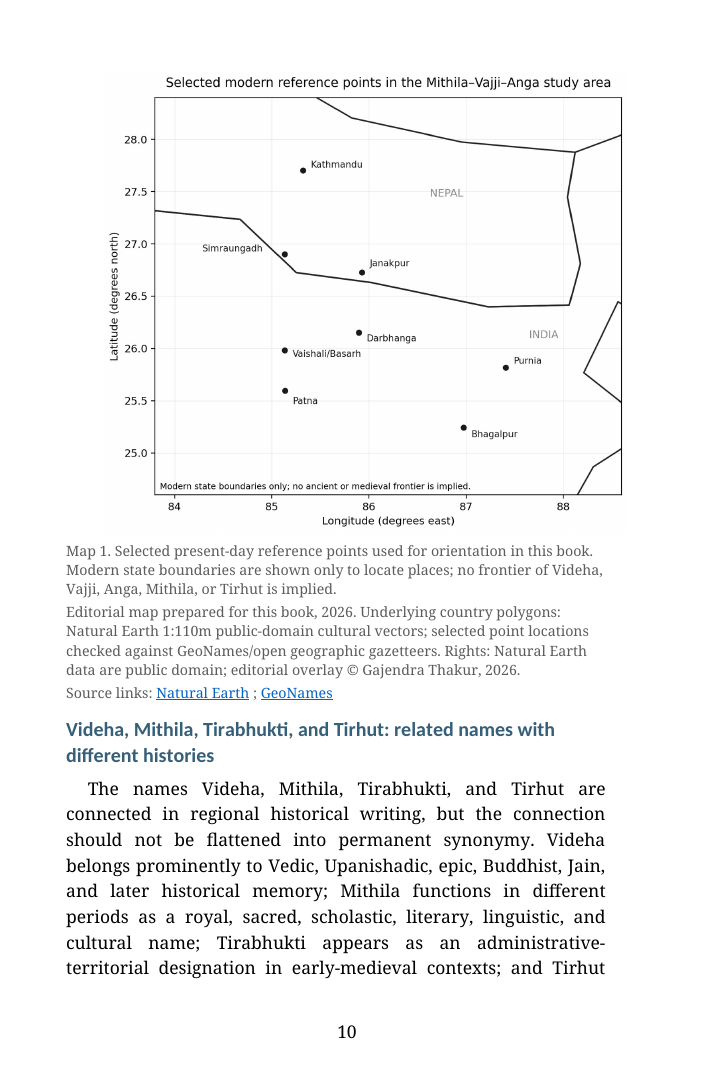
Mithila · Vajji · Anga
Chapter-specific source notes
- Primary chapter witness. Gajendra Thakur, Decoding the Panji of Mithila — Volume III, formal Chapter 18, PDF pp. 216-225; formal Chapter 18. The HTML transcription is generated from the commit-pinned source PDF and retains the chapter boundary recorded in this edition.
- Internal structure. The repository source-heading inventory records 10 subordinate headings for this chapter: “Index Link Box”; “Chapter opening: Behat after the early expansion”; “Entries 120-121: the Behat continuation and Pokhrauni”; “Entries 122-124: Tarauni, Avam, and the movement toward Purnia-Araria”; “Entries 125-126: Jhanjharpur and Lakhnour as branch fields”; “Entries 127-130: Anilpur and Pariyamb-Budhwal”; “Entries 131-133: Gangora and Lalganj”; “Entries 134-137: Dumra, Deep, Mahua-Khaual, and Murajpur”; ….
- Digital editorial method. The page keeps the preserved source text distinct from generated navigational, concordance, visual, and provenance apparatus. The synthetic reconstruction is explanatory only and is not evidence for an individual lineage or a determination of social or marital status.