Decoding the Panji of Mithila · Volume III · Chapter 19
Entries 147-158 - Ratauli, Lohna, Shuklarahi, Gangoli, Najira, Betia, and Ujan Index Link Box Index cluster: रतौली / दरिहरा / लोहना / शुक्लाराही / गंगोली / नजीरा / रानीफर / बेतिया /
Chapter 19

 Entries 147-158 - Ratauli, Lohna, Shuklarahi, Gangoli,
Najira, Betia, and Ujan
  Index Link Box
Index cluster: रतौली / दरिहरा / लोहना / शुक्लाराही / गंगोली / नजीरा / रानीफर / बेतिया /

उजान.
Khand 2 source entries decoded: 147-158.
Principal source heading forms: “रूतौली सँ”; “अथ रतौली दरिहरा ग्रामारम्भ”; “उपटीप

पुवारिपार रतौली सँ उजान”; “उपटीप पुवारिपार रतौली सँ मैवी”; “उपटीप पुवारिपार रतौली
सँ लोहना”; “लोहना शुक्लाराही”; “उपटीप फवारिपार रतौली सँ गंगोली”; “गंगोली नजीरा”;
“रानीफर बेतिया”; and “राती प्रखेतिया उजान.”

Coverage decision: Entry 147 begins the Ratauli-Darihira cluster after the Behat-Puwaripar
material closes. Entry 158 ends with the dated Ratauli-Darihira reading note. Entry 159 opens a
new Rajoura-Rampur cluster and is reserved for Chapter 20.
Documentary note: Entries 147-154 occur at the end of Genome-Vol-II_Final-01. Entries 155-158
continue at the opening of Genome-Vol-II_Final-02. The chapter treats both files as one
continuous Khand 2 sequence.
Method: every name is read through descent, place, marriage, title, and branch-continuity.
Ratauli is not isolated; it is read as a corridor linking Lohna, Shuklarahi, Gangoli, Najira, Betia,
and Ujan through repeated daughter-lines, collateral branches, and title-bearing nodes.

  Chapter opening: Ratauli after the Behat-Puwaripar
expansion
Chapter 19 decodes Entries 147-158. It continues from the
subsequent sections after the early expansion by following the
line as it moves into additional settlements, scholarly
branches, and marriage networks. The Behat-Puwaripar
chapter has ended at the threshold of Lohna-Sakaradhi; the
present chapter begins where the source opens Ratauli under
Darihira and then carries that branch through Lohna,
Shuklarahi, Gangoli, Najira, Betia, and Ujan.

    The method remains the same. Every name must be read
through descent, place, marriage, title, and branch-continuity.
A personal name is therefore never treated as a free-standing
biographical item. It belongs to a father-line, a village anchor,

                         Decoding the Panji of Mithila, Volume III | Page 224
                    Decoding the Panji of Mithila Volume III

a marriage relation, a title-bearing status, and a continuing
branch.

   This chapter also has a documentary responsibility. The
Ratauli material straddles the two source DOCX files. Entries
147-154 are found at the end of the first file, and Entries 155-
158 continue at the opening of the second file. There is no
genealogical break at the file boundary; the Panji sequence
continues smoothly.

  Entries 147-148: Ratauli-Darihira and the turn toward
Ujan
   Entry 147 opens with “अथ रतौली दरिहरा ग्रामारम्भ.” This phrase
makes Ratauli a new village-start, not a passing reference.
Bhavanath, Chumman or Tirthnath, Kumudnath, Tilkeshwar,
Bhupnarayan, Yadunarayan, Yajnanarayan, Devanarayan,
Shrinayaran, Sahadev, Mahadev, Govind Narayan, Ganesh,
and related lines appear through a compressed descent field.

   The entry uses repeated अपरा clauses to create collateral
sub-branches. Its marriage movement connects Ratauli with
Pali, Soderpur, Khandbala, Budhwal, Karmahā, Naruan,
Ghosaut, Onehara, and Mandar. These place names should not
be separated into independent topics. They are the marital
and collateral routes by which Ratauli is made legible in the
Panji.

   Entry 148 carries the same Ratauli field toward Ujan.
Raghubir, Badrinarayan, Shivdatt or Shambhu Narayan,
Vaidya Harinarayan, Ramgovind, Harigovind,
Jitendranarayan, Parashar, Vidyanath, Nanu, Ghurghur or
Toshnath, Chanchal, Lochan, Anant, and related figures create
a wide Ujan-facing branch. The entry shows a mixed structure
of sons, daughters, title-bearing persons, and cross-references
rather than a simple father-son ladder.

                Decoding the Panji of Mithila, Volume III | Page 225
                    Decoding the Panji of Mithila Volume III

  Entries 149-151: Maivi, Lohna, and Shuklarahi
   Entry 149 shifts the Ratauli material toward Maivi or
Maibi. Sadu Upadhyay Anand, Hiranand, Medhanand,
Modanand, Babu Phaninand, Fakiranand or Lokanand,
Gunanand or Mana, Mahant or Kirtinandan, Ganesh, Suresh,
Nityanand, Garibanand, Manikanandan, Motinandan,
Dhananand, and Lakshminandan appear in a learned and
title-bearing family cluster. Titles such as Sadu Upadhyay,
Vaidik, Babu, and Mahant are not decorative; they distinguish
persons inside a crowded branch.

   Entry 150 narrows the corridor toward Lohna. Neekanand,
Phalanand, Bodhanand, Dolanand, Girjanand, Taranand,
Ambikanand, Dinanand, Bhimanand, Medhanand, Chumman,
Feku or Ugranand, Babu Lokanand, Gokhulanand,
Mathuranand, and Mokshanand or Bular appear. The heading
shows that Lohna is now an active branch-route from Ratauli,
while repeated links to Khandbala, Soderpur, Karmahā, Pali,
Naruan, and Budhwal keep the branch attached to the larger
index field.

   Entry 151 explicitly adds Shuklarahi to the Ratauli-Lohna
section. Mokshanand or Bular, Gopanand, Mitranand, Vacha
or Lilanand, Chiranand or Ghoghi, Gananand, Purnanand,
Paramanand, Vinodanand, Shivanand, Jivanandan or
Chanchal, Gopinandan, Krityanand, Yatanand, Bhairavanand,
Krishnanand, Toyanand, Samiranand, and Devanand form a
long chain of sons, daughters, and collateral lines. Shuklarahi
should therefore be indexed as a branch qualifier of Lohna
within the Ratauli cluster.

  Entries 152-154: the Ujan return and the Gangoli bridge
   Entry 152 continues the Ratauli-Lohna-Shuklarahi line.
Chandranand, Chhitinandan or Manbharan, Vishwanand or

                Decoding the Panji of Mithila, Volume III | Page 226
                       Decoding the Panji of Mithila Volume III

Lal, Gopalji, Ramanand, Shyamanand, Ratanand,
Sharadanand, Hiranand, Baldev, Vijay, Manikanandan,
Motinandan, Diwan Jayanand, Keshav, Kanhai or Hemnath,
Srinath, Anand, Jagannath, and Vaidyanath appear in a
structure that combines learned titles, literary memory, and
marriage-links.

   The mention of an editor of Aryavarta inside the genealogy
is methodologically important. It shows how the Panji
incorporates modern public identity into traditional kinship
syntax. The title or occupation is not a biography replacing
descent; it is a late identifying layer attached to descent, place,
and marriage.

   Entry 153 returns the Ratauli material toward Ujan.
Bhailal, Vaidyanath, Chaturbhuj, Gopal, Jivanath, Vidhu or
Devanath, Modnath, Nanda, Yadunath, Abhayanath,
Hridaynath, Gopinath, Kulananand, Professor Chhatranath,
Kamalnath, Rajesh, Bhuvanath, Ramnath, Chandranath,
Padmanath, Mahinath, Vaneshwar, Chitreshwar,
Dharmeshwar, and Narayan appear across several relational
units. The return to Ujan after Lohna-Shuklarahi shows that
branch travel can loop back to an earlier anchor.

   Entry 154 moves from Ratauli toward Gangoli. Vaidya
Vikalu or Ratipati, Rudradatt, Krishnadatt, Bhawanidatt,
Ugradatt, Shivlal, Bachcha or Chandidatt, Chitrapati,
Damodar, Sanphul, Kirtinath, Harinath, Chitranath,
Balbhadra, Jaybhadra, Rambhadra, Subhadra, Kashinath,
Modnath, Khadganath, Netranath, Nandinath, Punyanath, and
Vidyanath mark the Gangoli continuation. This is the last
entry of the first source file and acts as a structural bridge into
the second file.

                   Decoding the Panji of Mithila, Volume III | Page 227
                    Decoding the Panji of Mithila Volume III

  Entries 155-156: Gangoli and Najira across the source-file
boundary
   Entry 155 continues directly in the second source file as
Ratauli-Gangoli-Najira. Nidhnath, Shivshankar or Rudranath,
Harishankar or Adyanath, Dayashankar, Ramashankar,
Shambhushankar, Vijayashankar, Gopalshankar,
Madanshankar, Vishnushankar, Jishnushankar, Vinay
Shankar, Govardhan, Markandeya, Thakkan, Lambodar,
Vidyanath, and Nagendranath carry forward the Gangoli
branch and make Najira part of the same chain.

   The file break therefore must not be mistaken for a
conceptual break. The second source file opens by continuing
the same Ratauli-Gangoli material. For this reason, the
cumulative manuscript must keep Chapter 19 as one
continuous chapter across both source documents.

   Entry 156 again names Ratauli-Gangoli and Najira.
Khagnath, Shulpani, Gadapani, Khadgapani, Yadav, Thithar,
Devkinandan, Garibanand, Damrupani, Padmapani, Feku or
Meghnath, Ganesh, Ramanand, Jagannath, Lakshman or
Tilanath, Balram, Fuddi or Jayanandan, Lakshminath,
Radhanath, Kamratna, Ramratna, Hemratna, Vidyaratan, and
Jayratna create a broad descent-and-alliance cluster. The
repeated links to Soderpur, Khaual, Pali, Pabouli, Karmahā,
Naruan, and Khandbala show that Najira is an indexed sub-
field of the Ratauli-Gangoli material.

  Entries 157-158: Betia, Rati Prakhetiya, Ujan, and the
dated closing note
   Entry 157 extends the same cluster toward Ranifar and
Betia. Thithar, Bengali or related forms, Tejnath, Madhav,
Thakkan, Butan, Harinath, Kishornath, Lilanath, Pushpanath,
and later names such as Achyutanand, Devkinandan,

                Decoding the Panji of Mithila, Volume III | Page 228
                    Decoding the Panji of Mithila Volume III

Rohiniraman, Gangadatt, Jyotirvid Aravi, Punyanand, and
Indranand connect the genealogy to elite, scholarly, and
regional markers. Betia indicates a wider regional reach, but
the formula keeps the branch within the Ratauli-Gangoli
framework.

   Entry 158 closes this chapter’s range with Ratauli, Rati
Prakhetiya, and Ujan. Achyutanand, Nutan Krishna or Nena,
Harikrishna, Amritnath, Rudranath, Durivaya, Mandhan,
Vaidya Govardhan, Nanddev or Nandan, Dinbandhu,
Mathura, Ishwaridatt, and Keshav appear before the final
dated note. That note records a reading or copying context in
2008, showing that the Panji was not merely a remote
inherited document but an active record still being read,
copied, and transmitted in the modern period.

   This closing note also supports the larger time-frame of the
book. The Panji preserves inherited descent, but its written
and copied life reaches the present era. Modern dates, titles,
and professional signs are therefore part of the documentary
layer, not an interruption of genealogy.

  Research summary
   Chapter 19 decodes Entries 147-158 as the Ratauli-centered
cluster moving through Darihira, Lohna, Shuklarahi, Gangoli,
Najira, Betia, and Ujan. The principal finding is that these
headings are not separate fragments. They are one corridor of
branch-continuity controlled by the Index.

   The chapter also confirms that Khand 2 must be read
across both source DOCX files as one continuous sequence.
Entry 154 closes the first file, and Entry 155 opens the second
file without a genealogical break. The cumulative manuscript
is now decoded through Entry 158. Chapter 20 will begin with
Entry 159, the Rajoura-Rampur cluster.

                Decoding the Panji of Mithila, Volume III | Page 229
                   Decoding the Panji of Mithila Volume III

  With Chapter 19 complete, the cumulative manuscript is
decoded through Entry 158. The next chapter begins with Entry
159 and the Rajoura-Rampur-Lohna field.

               Decoding the Panji of Mithila, Volume III | Page 230
                            Decoding the Panji of Mithila Volume III
Source structure and verification apparatus
Editorial source apparatus. This apparatus is descriptive, not interpretive. It records the source-controlled structure used to verify that this page corresponds to formal Chapter 19 of Decoding the Panji of Mithila — Volume III. The chapter text above is preserved from PDF pp. 225-232; formal Chapter 19 in the commit-pinned authoritative source. It is not merged with a neighboring chapter, appendix, annexure, or independent front/back-matter unit. The internal headings below come from the repository’s source-heading inventory and are retained as navigational and audit evidence; showing them here does not turn those headings into separate publications or add claims that are absent from the source.
Internal source headings
- Index Link Box
- Chapter opening: Ratauli after the Behat-Puwaripar expansion
- Entries 147-148: Ratauli-Darihira and the turn toward Ujan
- Entries 149-151: Maivi, Lohna, and Shuklarahi
- Entries 152-154: the Ujan return and the Gangoli bridge
- Entries 155-156: Gangoli and Najira across the source-file boundary
- Entries 157-158: Betia, Rati Prakhetiya, Ujan, and the dated closing note
- Research summary
Source-text concordance
Entries · 147-158 · Ratauli · Lohna · Shuklarahi · Gangoli · Najira · Betia · Ujan · Index · Link · cluster · Khand · decoded · Principal · heading · forms · Coverage · decision · Entry · begins · Ratauli-Darihira · Behat-Puwaripar · material · closes · ends · dated · reading · note · opens · Rajoura-Rampur · reserved · Documentary · 147-154 · occur · Genome-Vol-II · Final-01 · 155-158 · continue · opening · Final-02 · treats · files · continuous · sequence · Method · every · name · read · descent · place · marriage · title · branch-continuity · isolated · corridor · linking · repeated · daughter-lines · collateral · branches · title-bearing · nodes · expansion · decodes · continues · subsequent · sections · early · following · line · moves · additional · settlements · scholarly · networks · ended · threshold · Lohna-Sakaradhi · present
Boundary verification. In the formal sequence this chapter follows Volume III Chapter 18, “Entries 120-146 - Behat, Tarauni, Anilpur, Gangora, Dumra, Simarwad, Parhat, Ujan, Sharadapur, and Ishahpur Index Link Box” and precedes Volume III Chapter 20, “Entries 159-178 - Rajoura, Rampur, Lohna, Sihauli, Ishahpur, Raima, Gerki, Chanaur, and Lalganj Index Link Box Index cluster: रजौरा / रामपुर / लोहना / सिहौली / इशहपुर / रै मा / गेरकी / चणौर / पतनुका /”. The chapter extractor begins at the verified formal Chapter 19 marker and stops at the next verified formal chapter marker; for a final chapter it stops before recognized book-level back matter. The concordance above is generated only from distinct terms already present in this chapter’s preserved source text. It is provided for discovery, comparison, and audit, not as an automated judgment about persons, lineages, status, kinship, marriage eligibility, or historical truth.
Illustrated research apparatus
Mithila · Vajji · Anga
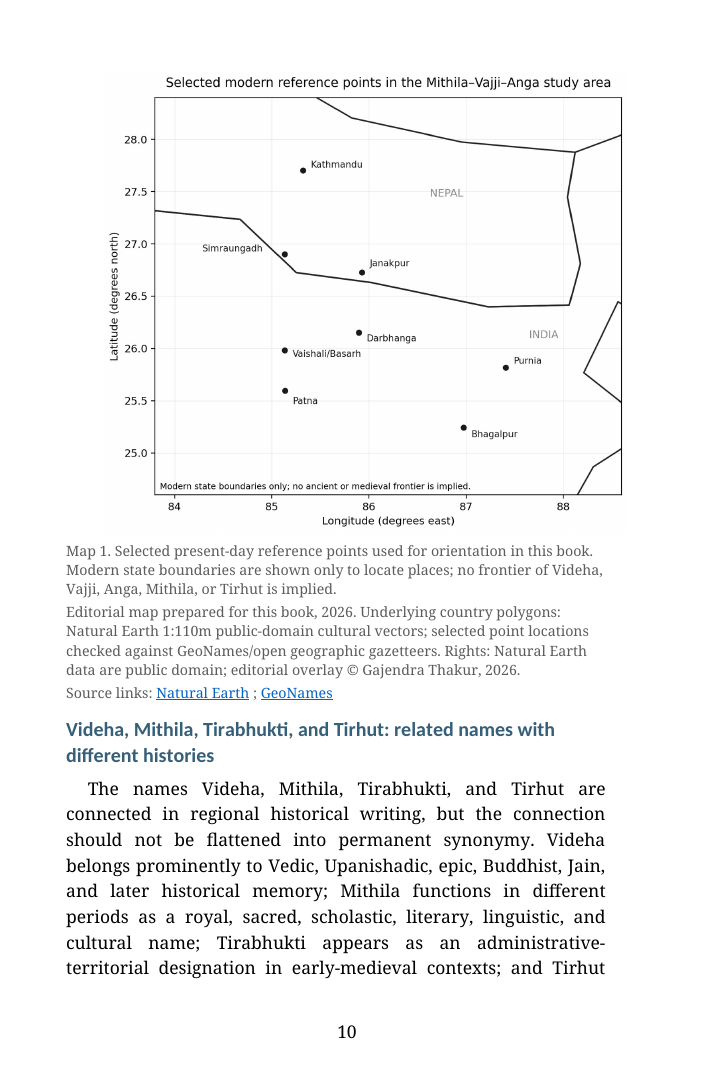
Chapter-specific source notes
- Primary chapter witness. Gajendra Thakur, Decoding the Panji of Mithila — Volume III, formal Chapter 19, PDF pp. 225-232; formal Chapter 19. The HTML transcription is generated from the commit-pinned source PDF and retains the chapter boundary recorded in this edition.
- Internal structure. The repository source-heading inventory records 8 subordinate headings for this chapter: “Index Link Box”; “Chapter opening: Ratauli after the Behat-Puwaripar expansion”; “Entries 147-148: Ratauli-Darihira and the turn toward Ujan”; “Entries 149-151: Maivi, Lohna, and Shuklarahi”; “Entries 152-154: the Ujan return and the Gangoli bridge”; “Entries 155-156: Gangoli and Najira across the source-file boundary”; “Entries 157-158: Betia, Rati Prakhetiya, Ujan, and the dated closing note”; “Research summary”.
- Digital editorial method. The page keeps the preserved source text distinct from generated navigational, concordance, visual, and provenance apparatus. The synthetic reconstruction is explanatory only and is not evidence for an individual lineage or a determination of social or marital status.