Decoding the Panji of Mithila · Volume III · Chapter 20
Entries 159-178 - Rajoura, Rampur, Lohna, Sihauli, Ishahpur, Raima, Gerki, Chanaur, and Lalganj Index Link Box Index cluster: रजौरा / रामपुर / लोहना / सिहौली / इशहपुर / रै मा / गेरकी / चणौर / पतनुका /
Chapter 20

  Entries 159-178 - Rajoura, Rampur, Lohna, Sihauli,
Ishahpur, Raima, Gerki, Chanaur, and Lalganj
  Index Link Box
Index cluster: रजौरा / रामपुर / लोहना / सिहौली / इशहपुर / रै मा / गेरकी / चणौर / पतनुका /

कनसम / लालगंज.
Khand 2 source entries decoded: 159-178.
Principal source heading forms: “उपटीप पुवारिपार रजौरासँ उजान”; “रजौरासँ रामपुर”;

“रजौरा गाम लोहना”; “सिहौलिसँ लोहना”; “सिहौलिसँ उजान”; “सिहौलिसँ गोधनपुरसँ

इशहपुर”; “सिहौलिसँ इशहपुर रै मा”; “सिहौलिसँ गोधनपुर गेरकी”; “सिहौलिसँ चणौर”;
“सिहौलिसँ लोहना इशहपुर”; “सिहौलिसँ इशहपुर रूपौली”; and “कनसम माण्डर-लालगंज.”

Coverage decision: Entry 159 opens the Rajoura-Ujan/Rampur field. Entry 178 closes with
Kansam-Mandar-Lalganj. Entry 179 opens the next Madari-Sharadapur cluster and is reserved
for Chapter 21.
Route logic: the chapter is Mandar-centered and Sihauli-centered. Rajoura, Lohna, Sihauli,
Ishahpur, Raima, Gerki, Chanaur, Patnuka, Kansam, and Lalganj are read as one expanding
branch field, not as disconnected places.
Method: every name is read through descent, place, marriage, title, and branch-continuity.
Uncertain dots, broken readings, double reference numbers, and modern titles are preserved as
documentary evidence.

  Chapter opening: Rajoura after the Ratauli-Gangoli
cluster
Chapter 20 decodes Entries 159-178. The source has just closed
the Ratauli-Gangoli-Najira-Betia-Ujan material, and it now
turns to Rajoura under the wider Puwaripar-Ujan movement.
The opening formula places Rajoura within a Mandar-
centered field, and the following entries extend that field
through Rampur, Lohna, Sihauli, Ishahpur, Raima, Gerki,
Chanaur, Rupauli, Patnuka, Kansam, and Lalganj.

    This chapter is one of the densest internal movements of
Khand 2. At the surface, the headings change quickly. Beneath
them, the same documentary grammar continues: a village-
opening formula is followed by sons, daughters, collateral
branches, marriage houses, internal reference numbers, titles,

                       Decoding the Panji of Mithila, Volume III | Page 231
                    Decoding the Panji of Mithila Volume III

and later modern identifiers. The reader must therefore keep
the entry number, source heading, and Index route together.

   The major interpretive point is that Rajoura and Sihauli are
not isolated geographical labels. They operate as organizing
fields. Mandar, Karamha, Soderpur, Pali, Naruan, Harianb,
Khandbala, Pabouli, Budhwal, Valias, Surgan, Kujouli, Ekhara,
Raima, Gerki, Chanaur, Patnuka, Kansam, and Lalganj become
legible through repeated relational movement.

  Entries 159-162: Rajoura, Rampur, and Lohna
   Entry 159 opens as “उपटीप पुवारिपार रजौरासँ उजान” and begins the
Rajoura field under Mandar. Dasharath is a central starting
point, and the line moves through Ramchandra, Shrikrishna,
Bandhu, Ghananand, Mandodari, Chand, Kulapati, Gangapati,
Prannath, Manik, Rupnath, Ratanpati, Damodar, Giridhar,
Banmali, Nandipati, Chhatrapati, Chiranjeev, Shatanjeev,
Tulapati, Sitanath, Dinanath, Keshinath, Sudhir, Suman, and
Umanath. The entry shows Rajoura tied to Ghosaut, Soderpur,
Karamha, Naruan, Pali, Khandbala, Budhwal, and Valias.

   Entry 160 continues Rajoura and shifts toward Rampur.
Tulapati, Siddhinath, Ramanand, Mahavir, Mohan, Prannath,
Babu or Gopal, Lakshman, Vachchu, Yadunandan,
Devnandan, Brajnandan, Dharmanandan, Chandranandan,
Mitranandan, Vibhunandan, Umanandan, Tilaknandan,
Neerjanandan, Paltunandan, and Setunandan appear. Rampur
is therefore not a separate interruption; it is an extension of
the same Rajoura field.

   Entry 161 continues Rajoura-Rampur with a panktika or
note-like insertion. Kantu, Tulanand, Mohanchandra,
Netranand, Lalan, Suman, Bhola, Mahananda, Chhitnendra,
Lakshminandan, Mohan, Gangoli-Manik, Kanhai or
Tulakrishna, Fakir, Falahari, Nakchhedi, Raghunandan,

                Decoding the Panji of Mithila, Volume III | Page 232
                    Decoding the Panji of Mithila Volume III

Vasudev, Hemkrishna, Babu Jan, Rupnath, Tikanath, Babu Jan,
Yadunath or Bachchi, and Ramanath appear. The entry shows
how Rajoura-Rampur spreads into Gangoli and other relation-
houses.

   Entry 162 names Rajoura village Lohna. Yadunath or
Bachchi, Falahari, Hemkrishna, Babu Jan, Abhayanath,
Harshanath, Lilanath or Gopal, Ramanath, Harinath,
Chandranath, Yognath, Manohar or Harshanath, Ganeshdatt,
Muktinath, Kalanath, Lakshman, Bharat, and Bhaktinath
belong to this Lohna-facing branch. Lohna becomes a new
active branch-route inside the Rajoura cluster.

  Entries 163-166: Sihauli, Lohna, and Ujan
   Entry 163 opens “अथ सिहौलि माण्डर ग्रामारम्भ.” This makes Sihauli
an explicit Mandar-linked village-start. Bhushan, Ragapati,
Raghupati, Khagapati, Vacha, Yajnapati, Nandipati,
Yashaspati, Narpati, Buchan, Mukund, Madhusudan,
Kameshwar or Umapati, Phanipati, Dinesh, Hedamba,
Punyapati, Satish, Ratan, Yaduvir, Bholanath, Ramesh, Keshav,
Madhav, and the grammarian Nandipati appear in a heavily
learned and title-bearing cluster.

   Entry 164 continues Sihauli toward Ujan. Narpati, Nidhi,
Balbhadra Upadhyay, Kashinath, Vishnudatt, Jaykrishna,
Amritkrishna or Kunkun, Ramanand, Lokanand, Rudranand,
Vidyanand, Shankaranand, Bhavkrishna, Badrinath,
Devkrishna or Muni, Lakshminath, Goravalnath, Tejnath,
Lilanath, and Dhananath appear. The title Upadhyay is
important because it helps distinguish a learned line within a
crowded register.

   Entry 165 continues Sihauli. Harishwar, Mahidhar, Hirai,
Judauna, Lakshminath, Janakinath, Janardan, Nena or
Khelapati, Premkar, Naiyayik Durgidhar, Gaurishankar the

                Decoding the Panji of Mithila, Volume III | Page 233
                     Decoding the Panji of Mithila Volume III

grammarian, Harinath, Chandranath, and poet Hirai appear.
The line is not only genealogical but also intellectual:
Naiyayik, grammarian, and poet identifiers are preserved by
the source and must remain visible in the decoding.

   Entry 166 carries Sihauli toward Ujan and adds a
complicated Kakarol-Madhubani-Purnea-Lalganj
environment. Shambhunath, Ugri, Bechan, Raghuwar, Vaidya
Thothi, Dullah, Balah, Mohan, Govind, Giridhari, Goshain,
Gopal, Haladhar, Rajendra or Bachchu, Vishwanath,
Bhagirath, Ramkrishna, Jyotirvid forms, and Kedar-related
lines are woven into a single, late, layered entry.

  Entries 167-171: Godhanpur, Ishahpur, Raima, and Gerki
   Entry 167 moves from Sihauli to Godhanpur and Ishahpur
and names Feku Jha. Jivanath or Judauna, Bhavdev, Gujar or
Ramdev, Durgadatt, Shivnath, Saheb, Subodh, Vishnunidhi,
Krishnanidhi or Lotni, Nandan, Teknath, Gyan, Ramkrishna,
Gopal, Vishnupati, Bechan, Bagadu, Kamaladat, Hridaydatt,
Raghuwar, Kishori, Yadunandan, Feku, Dinbandhu,
Ganganath, Muktinath or Kamla, and the multilingual literary
Govind Madhav appear. This is one of the chapter’s important
scholarly entries.

   Entry 168 continues Sihauli-Ishahpur. Vaidya Jivanath,
Shambhunath, Hiranath, Ishwarnath, Bodhnath, Govind the
linguist, Arvind, Akkū, Milindu, Nirmalendu, Anant, Bhuvan,
Suman, Gaurinath the Naishthik and social mediator,
Markandey, Shankar, Shubhankar, Muktinath or Kamla,
Mannu, and Radharaman appear. Modern descriptors such as
linguist and social worker are not extraneous; they are part of
the identifying layer of the Panji.

   Entry 169 links Sihauli-Ishahpur to Raima. Kishori,
Yadunandan, Jhotahu, Jagannath, Kashinath, Vishwanath,

                Decoding the Panji of Mithila, Volume III | Page 234
                   Decoding the Panji of Mithila Volume III

Shivnath, Bindunath, Vamshilal, Shilanath, Srimohan,
Harimohan, Lalit Mohan, Anand Mohan, Radhamohan,
Bholanath, Pramod, Subodh, Kamod, Bheshnath, Bhavnath,
and Lekhnath appear. The entry combines traditional descent
language with modern personal-name clusters.

   Entry 170 names the Sihauli-Raima line and Bhagwandatt
Jha. Bholanath or Radhanath, Dinanath, Latadu, Bhagwandatt,
Jaladhar, Mohan, Khadgi, Gangadhar, Shridhar, Bhagirath,
Jivadhar, Lakshman, Lila, Manohar, Vishnupati or Battaha,
Bachche, Kheli, Indranath, Chandranath, Harinath, and
Girijanath appear. Repeated daughter-lines connect the
branch to learned and estate-bearing families.

   Entry 171 connects Sihauli with Godhanpur and Gerki.
Chandranath, Abhayanath, Ubhayanath, Amarnath,
Kamalnath, Narendra Nath, Vijay, Ajay, Sanjay, Chand, Fakir,
Premnath, Dhirnath, Kumar Singh, Ratan Singh, Manik Singh,
Bhup Singh, Ram Singh, Mohan Singh, Narayan Singh, Jhalwa
or Shyam Singh, Raghunandan, Yadunandan, Nilkanth,
Dinbandhu, Rashbihari, Harnath or Taranand, and a later
sequence of Singh-Jha names mark a heavily status-bearing
entry.

  Entries 172-175: Chanaur as a large Sihauli-derived
branch
   Entry 172 opens Sihauli-to-Chanaur. Yadunandan,
Dinanand or Chhetan, Modanand or Badri, Umanand, Jagdish,
Vijayanand, Paramanand or Feka, Khelanand, Siddhinandan,
Bhavanand, Kulanand or Vinay, Punyanand or Kameshwar,
Nilkanth Singh, Kashinath or Achyutanand, Muni or
Rudranand, Kamalakant or Padmanand, Batesh or
Durganand, Ganesh or Devanand, and Mahesh or Harinandan
appear. Chanaur begins as a substantial internal section, not a
minor aside.
               Decoding the Panji of Mithila, Volume III | Page 235
                    Decoding the Panji of Mithila Volume III

   Entry 173 continues Chanaur. Bhutkun or Rudranand
Singh, Devkinandan or Bhutkun, Buchchi or Mohanand Singh,
Shashibhushan, Rajnandan, Piyushnath Singh, Durganand or
Batesh, Ramanand Singh, Mitranand Singh, Chhatranand
Singh, Batuknath, Indranand, Yamunanand, Lilanand, Navtol,
Sulhani, Ganesh or Devanand, Tantanand, Ambikanand,
Neekanand, Khadanand, Yadavanand Singh, and several
modern names appear. The mention of Navtol and Sulhani
anticipates the next chapter.

   Entry 174 again continues Sihauli-to-Chanaur. Dinbandhu’s
descendants are central: Nityanand or Gopinath, Dhananand
or Revatinath, Bhol or Yashodanand, Vedanand, Dayanand
Singh, Professor Ganganand Singh, Yamunandan Singh,
Krityanand Singh, Ratan Singh, Manik Singh, Bihari Singh,
Dinkar or Faturi Singh, Nidhikar or Moch Singh, Shaktinath
Singh, Bhimnath Singh, and Bhaktinath Singh. Professor and
Singh identifiers show the late-status layer of the register.

   Entry 175 extends the Chanaur sequence through Nidhikar
or Moch Singh, Bhup Singh, Vishnu Singh, Govind Singh or
Jhinguri, Jyotishi Dumani or Rudra Singh, Chitradhar,
Motidhar, Devanand, Jagannath, Pramodanand, Vinod,
Mukund, Jayanandan, Jagatanand, Dayanand, Sadanand, and
Medhapati. Soderpur, Karamha, Darhara, Pali, Valias, and
Khandbala remain constant relational bridges.

 Entries 176-178: Lohna-Ishahpur, Rupauli, Patnuka,
Kansam, and Lalganj
   Entry 176 returns explicitly to Sihauli-Lohna-Ishahpur.
Vaidik Jivapati, Manapati, Bulan, Bhol, Kashinath,
Shankarnath, Bauku or Bhojapati, Yajnapati, Yogapati,
Madhurapati, Mahipati, Yashapati, Bhagirath, Pashupati,
Shivdas, Ishdas, Sridatt, Thithar, Shyamu or Padmapati, Gudar
or Jayapati, Tekapati, Chitripati or Chitru, and Ganapati or
                Decoding the Panji of Mithila, Volume III | Page 236
                    Decoding the Panji of Mithila Volume III

Harapati appear. This entry restores the Lohna-Ishahpur
frame after the Chanaur expansion.

   Entry 177 joins Sihauli-Ishahpur with Rupauli and then
opens Patnuka under Mandar. Bhuvanpati, Punypati or
Thakkan, Fekan, Ram, Lakshman, Chandra Patti, Patnuka,
Bhawanidatt, Durivaya, Thengni, Bihari, Buchan or
Krishnadatt, Hanumandatt, Bhagwandatt, Banke or Hemkant,
Chubhi or Srikant, Bauku or Gopikant, Reti or Revati Kant, and
Balram appear. The important structural point is that the
entry contains a new village-opening formula inside the larger
movement.

   Entry 178 closes the range with Kansam-Mandar-Lalganj. It
continues from Balram through Jivanath or Chandrakant,
Vasant, Vinod, Prabodh, Chunni or Srikant, Revati Kant,
Hanumandatt, Bhagwandatt, Shukal, Damodar, Goraval,
Haladhar, Chandradhar, and then opens Kansam-Mandar.
Lalganj is therefore not an isolated ending; it completes a
Mandar-linked expansion that began at Rajoura and passed
through Sihauli, Ishahpur, Raima, Gerki, Chanaur, and
Patnuka.

  Genealogical meaning and research value
   Entries 159-178 show how a village cluster becomes a
network. Rajoura and Sihauli serve as organizing fields. The
same family lines move repeatedly through Mandar,
Karamha, Soderpur, Pali, Naruan, Harianb, Khandbala,
Pabouli, Budhwal, Valias, Surgan, Kujouli, Ekhara, Raima,
Gerki, and Chanaur. The source headings change, but the
social map is continuous.

   The chapter also shows the importance of titles and
modern identifiers. Upadhyay, Vaidik, Naiyayik, grammarian,
poet, linguist, social worker, professor, Singh, Thakur, Babu,

                Decoding the Panji of Mithila, Volume III | Page 237
                    Decoding the Panji of Mithila Volume III

Maharaj, Raja, and medical identifiers all appear as
identifying devices. They do not replace genealogy; they help
distinguish individuals whose personal names recur across
branches.

   Uncertain readings must remain visible. The source
contains dots, broken phrases, double slashes, incomplete
reference numbers, and variant forms such as
Rajoura/Rajaurā, Sihauli, Godhanpur, Ishahpur, Raima, Gerki,
Chanaur, Patnuka, Kansam, and Lalganj. The editor should not
silently repair these into a single modern spelling when the
source preserves variation.

   With Chapter 20 complete, the cumulative manuscript is
decoded through Entry 178. Chapter 21 begins at Entry 179,
where the source clearly opens the Madari-Sharadapur
cluster. The boundary is editorial, but the genealogical
network remains continuous.

   With Chapter 20 complete, the cumulative manuscript is
decoded through Entry 178. The next chapter begins with Entry
179 and the Madari-Sharadapur-Sulhani field.

                Decoding the Panji of Mithila, Volume III | Page 238
                           Decoding the Panji of Mithila Volume III
Source structure and verification apparatus
Editorial source apparatus. This apparatus is descriptive, not interpretive. It records the source-controlled structure used to verify that this page corresponds to formal Chapter 20 of Decoding the Panji of Mithila — Volume III. The chapter text above is preserved from PDF pp. 232-240; formal Chapter 20 in the commit-pinned authoritative source. It is not merged with a neighboring chapter, appendix, annexure, or independent front/back-matter unit. The internal headings below come from the repository’s source-heading inventory and are retained as navigational and audit evidence; showing them here does not turn those headings into separate publications or add claims that are absent from the source.
Internal source headings
- Index Link Box
- Chapter opening: Rajoura after the Ratauli-Gangoli cluster
- Entries 159-162: Rajoura, Rampur, and Lohna
- Entries 163-166: Sihauli, Lohna, and Ujan
- Entries 167-171: Godhanpur, Ishahpur, Raima, and Gerki
- Entries 172-175: Chanaur as a large Sihauli-derived branch
- Entries 176-178: Lohna-Ishahpur, Rupauli, Patnuka, Kansam, and Lalganj
- Genealogical meaning and research value
Source-text concordance
Entries · 159-178 · Rajoura · Rampur · Lohna · Sihauli · Ishahpur · Raima · Gerki · Chanaur · Lalganj · Index · Link · cluster · इशहप · कनसम · Khand · decoded · Principal · heading · forms · डर-ल · Coverage · decision · Entry · opens · Rajoura-Ujan · field · closes · Kansam-Mandar-Lalganj · next · Madari-Sharadapur · reserved · Route · logic · Mandar-centered · Sihauli-centered · Patnuka · Kansam · read · expanding · branch · disconnected · places · Method · every · name · descent · place · marriage · title · branch-continuity · Uncertain · dots · broken · readings · double · reference · numbers · modern · titles · preserved · documentary · evidence · opening · Ratauli-Gangoli · decodes · closed · Ratauli-Gangoli-Najira-Betia-Ujan · material · turns · wider · Puwaripar-Ujan · movement · formula · within · Mandar · centered · following · extend
Boundary verification. In the formal sequence this chapter follows Volume III Chapter 19, “Entries 147-158 - Ratauli, Lohna, Shuklarahi, Gangoli, Najira, Betia, and Ujan Index Link Box Index cluster: रतौली / दरिहरा / लोहना / शुक्लाराही / गंगोली / नजीरा / रानीफर / बेतिया /” and precedes Volume III Chapter 21, “Entries 179-195 - Madari, Sharadapur, Sulhani, Manglabani, Raima, Naduar, Naruar, Behat, and Navtol Index Link Box”. The chapter extractor begins at the verified formal Chapter 20 marker and stops at the next verified formal chapter marker; for a final chapter it stops before recognized book-level back matter. The concordance above is generated only from distinct terms already present in this chapter’s preserved source text. It is provided for discovery, comparison, and audit, not as an automated judgment about persons, lineages, status, kinship, marriage eligibility, or historical truth.
Illustrated research apparatus
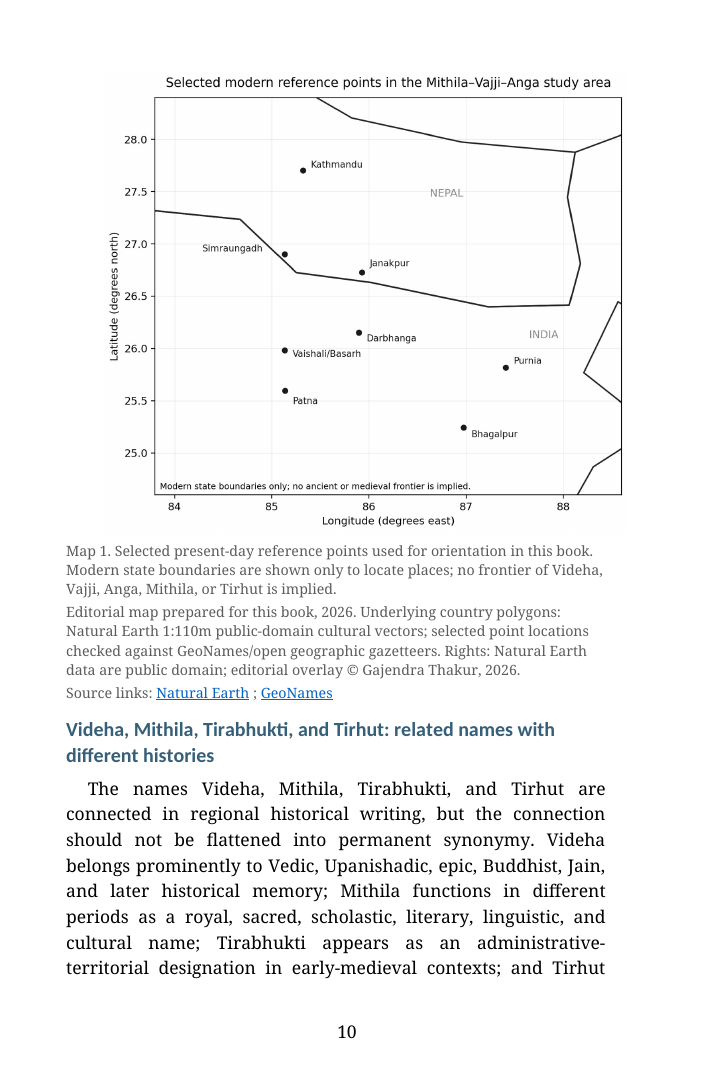
Mithila · Vajji · Anga
Chapter-specific source notes
- Primary chapter witness. Gajendra Thakur, Decoding the Panji of Mithila — Volume III, formal Chapter 20, PDF pp. 232-240; formal Chapter 20. The HTML transcription is generated from the commit-pinned source PDF and retains the chapter boundary recorded in this edition.
- Internal structure. The repository source-heading inventory records 8 subordinate headings for this chapter: “Index Link Box”; “Chapter opening: Rajoura after the Ratauli-Gangoli cluster”; “Entries 159-162: Rajoura, Rampur, and Lohna”; “Entries 163-166: Sihauli, Lohna, and Ujan”; “Entries 167-171: Godhanpur, Ishahpur, Raima, and Gerki”; “Entries 172-175: Chanaur as a large Sihauli-derived branch”; “Entries 176-178: Lohna-Ishahpur, Rupauli, Patnuka, Kansam, and Lalganj”; “Genealogical meaning and research value”.
- Digital editorial method. The page keeps the preserved source text distinct from generated navigational, concordance, visual, and provenance apparatus. The synthetic reconstruction is explanatory only and is not evidence for an individual lineage or a determination of social or marital status.