Decoding the Panji of Mithila · Volume III · Chapter 21
Entries 179-195 - Madari, Sharadapur, Sulhani, Manglabani, Raima, Naduar, Naruar, Behat, and Navtol Index Link Box
Chapter 21
 Entries 179-195 - Madari, Sharadapur,
Sulhani, Manglabani, Raima, Naduar, Naruar,
Behat, and Navtol
  Index Link Box
  Index cluster                                    माड़रि / शारदापुर / सुल्हनी / मंगलबनी-
                                               मंगरौनी / रै मा / नङु आर-नरूआड़ / बेहट /
                                               नवटोल
  Khand 2 source entries decoded                   179-195

  Principal source heading forms                   "उपटीप-पुवारिपार माड़रिसँ शारदापुर";

                                               "उपटीप-पुवारिपार सुल्हनीसँ मंगलबनी

                                               (मंगरौनी)"; "सुल्हनीसँ रै मा नङु आर"; "सुल्हनी

                                               नरउनसँ बेहट"; "सुल्हनीसँ बेहट नवटोल"
  Index roots/routes                               माड़रि-वलीयास, शारदापुर, हटाढ़, उजान,
                                               सुल्हनी-नरउन, मंगलबनी/मंगरौनी, रै मा,
                                               नङु आर/नरूआड़, चम्पानगर-ड्योढ़ी, बेहट,
                                               नवटोल
  Recurring relational villages                    पाली, सोदरपुर, करमहा, हरिअम्ब,
                                               खण्डबला, पबौली, बुधवाल, घुसौत, दरिहरा,
                                               सरिसब, खौआल, कु जौली, वलियास, माण्डर,
                                               नरउन
  Coverage status                                  Decoded through Entry 195; Entry 196
                                               begins the next त्रिपुरौली-दहौरा cluster and is

                                               not included here.

  Chapter overview
    Chapter 21 continues immediately after the Rajoura-Sihauli-
Chanaur-Lalganj expansion of Chapter 20. The new cluster begins
at Entry 179, where the source opens the Madari-Valiyas field

                       Decoding the Panji of Mithila, Volume III | Page 239
                     Decoding the Panji of Mithila Volume III

through the formula 'अथ माड़रि वलियास ग्रामारम्भ'. From that point the
material passes into Sharadapur, Sulhani, Manglabani or
Mangrauni, Raima, Naduar/Naruar, Behat, and Navtol.
    The range covered here is Entries 179-195. The first part of
the chapter explains the Madari-Sharadapur entries. The middle
part follows Sulhani and its Manglabani/Mangrauni and Raima
extensions. The final part decodes the Sulhani-Naduar/Naruar
and Sulhani-Behat/Navtol transition. The chapter stops before
Entry 196, where the source begins the next Tripurauli-Dahaura
opening.
   This cluster is especially important because it shows a second
type of movement inside Khand 2. Earlier chapters often moved
from one root village into several collateral villages. Here the
source repeatedly opens sub-fields inside the same larger
Puwaripar frame. The result is a layered map: Madari and
Sharadapur form one field, Sulhani and Manglabani another,
and Behat-Navtol a concluding transition into the next chapter.

 Entry 179: Madari-Valiyas and the Sharadapur
opening
   Entry 179 opens with Madari under Valiyas and links it with
Sharadapur, Hatadh, and Ujan. Harapati is the key opening point,
with Rudrapati, Mani or Vidyapati, and Nidhi or Dharapati
forming major descendants or branch markers. The entry then
brings in Indrapati, Jaga or Yagyapati, Ganapati, Bachche or
Nandipati, Gauripati, Dhanpati, Bhupati, Devapati, Lokapati,
Leshpati, Punyapati, Thakurpati, Mahavir, Girijapati, Yogapati,
and other names.
    The formula is not merely a list of persons. It shows Madari
as a Valiyas-connected house whose daughters and sons are
repeatedly tied to Pali, Soderpur, Harianb, Karamha, Khandbala,
Pabouli, and Budhwal. The source also preserves honorific and
estate-bearing forms such as Babu, Singh, Thakur, and Maharaj-
linked branches.

                 Decoding the Panji of Mithila, Volume III | Page 240
                   Decoding the Panji of Mithila Volume III

  Entry 180: Madari-Sharadapur continuation
   Entry 180 continues Madari-Sharadapur and develops the
Mani/Vidyapati and Son branch. Son, Bhaiyo Jha, Chandeshwar,
Rameshwar, Krishneshwar, Maheshwar, Yogeshwar, Ganganath,
Bholanath, Triloknath, Padmanath, Amarnath, Dinanath,
Adityanath, Jishnunath, Raghunath, Bodhnath, Umanath,
Baidyanath, Shashinath, and related forms appear.
    The structure is a repeated descent-and-marriage register.
Pali, Naruan, Soderpur, Karamha, Harianb, Khandbala, and
Baheradhi all occur as relational coordinates. The entry’s
importance lies in its dense multi-branch continuation of the
Sharadapur-linked Madari field rather than in a single linear
genealogy.

 Entries 181-182: Sharadapur-Ujan and closing
Madari-Sharadapur links
    Entry 181 continues Madari-Sharadapur toward Ujan. The
source carries forward Gauri Shankar, Shivshankar, Yogeshwar
or Yogapati, Durgapati, Devapati, Kanti or Bhuvanpati, Damodar
or Kirtipati, Punyapati, Kamalapati, Lakshmipati, Anant,
Bholashankar, Rajendra, Fuchchi or Modapati, Krishnaeshwar,
Kusheshwar,       Singheshwar,     Jiveshwar,      Vishweshwar,
Homeshwar, and Dineshwar. The entry is marked by repeated
references to Khandbala, Budhwal, Sarisab, Pali, and Karamha.
   Entry 182 continues the same Madari-Sharadapur field
through Markandey or Padmapati, Hempati, Videshwar,
Shivashwar, Kapileshwar, Kamal, Krishna Ji, and Thitharu or
Yashaspati. It functions as a closing and consolidation entry
before the source shifts to Sulhani. The genealogical grammar
remains the same: named person, father or branch, village-link,
and internal reference number.

 Entry   183:   Sulhani-Naruan                                    and   the
Manglabani/Mangrauni opening

               Decoding the Panji of Mithila, Volume III | Page 241
                    Decoding the Panji of Mithila Volume III

  Entry 183 opens a new field: Sulhani-Naruan with
Manglabani or Mangrauni. The formula ' अथ सुल्हनी नरउन ग्रामारम्भ'
identifies Sulhani under Naruan as the new village anchor. The
opening names Soni, Bhairavdatt, Chintamani, Chhotkani,
Mahobana, Bachchi, Keshav, Sadanand, Surendra, Radhakant,
Anant, Sridhar, Girdhar, Vanshidhar, Kamanath, Shrikant,
Baldev, Gadakar, Dayakar, Mohan, Madanmohan, Daman,
Ramanmohan, and others.
     This entry is a large transition from the Madari-Sharadapur
field into the Sulhani-Mangrauni field. It also preserves learned
titles such as Mahamahopadhyay and keeps the old pattern of
marriage links through Khaual, Harianb, Pandua, Mandar,
Darhara, Pali, Belauch, and Khandbala.

  Entry 184: Sulhani-Mangrauni-Raima
   Entry 184 continues the Sulhani-to-Mangrauni line and adds
Raima. The source mentions Gangesh, Bachchi, Chintamani,
Chhotkani, Lakshmidatt, Hardatt, Chumman, Somdatt, Gopal,
Tejnath, Chanchal or Chandranath, Dhatri or Chhatrinath,
Indranath, Amarnath, Bhavnath, Vasudev, Baldev, Shaktinath,
Kashinath, Taranath or Prakash, and Prabhash.
    The Raima extension is significant. It shows that Mangrauni is
not a terminal point but a bridge through which Sulhani lines
move toward Raima and then into the Naduar/Naruar sequence.
Missing sections and dotted names are frequent in this entry, so
the decoding preserves uncertainty rather than filling gaps.

 Entries        185-187:       Sulhani-Raima,
Nanguar/Naduar, and Naruar continuation
   Entry 185 is a difficult continuation of Sulhani-Raima and
Nanguar. It contains several broken lines and dotted omissions,
but it still preserves the thread through Harijiv, Balbhadra,
Jagannath, Bachharu, Kashi Nath, Ratan, Chhatrinath, Babu Nath,
Jahali, Krishnaram, Rishi, Durivaya, Nena, Raghuwar, Thengni,

                Decoding the Panji of Mithila, Volume III | Page 242
                    Decoding the Panji of Mithila Volume III

Buchan, Manmohan, Dinbandhu or Fuddi, Sambhunath or
Shobhnath, and Durganath.
   Entry 186 is explicitly marked Sulhani-to-Nanguar. It
continues through Abhayanath, Amlesh, Mithilesh, Raghuwar,
Thengni, Buchan, Shambhunath or Shobhnath, Durganath,
Patranath, Indunath, Prakashnath, Nakchhedi, Govind, Badri,
Taranath, Chandranath, Loknath, Kalnath, and Ganganath. The
source keeps both the Sulhani identity and the Nanguar/Naruar
movement active.
    Entry 187 continues the Naruar field. It moves through
Govind, Babuye or Badri, Taranath or Babuye, Chandranath,
Loknath, Kalnath or Kalru, Ganganath, Gopinath, Chhakan,
Vishwanath, Muktinath, Shivnath, Rattan or Ugranath,
Baidyanath, Bhavendranath, Shambhunath, Kulanath, Hemnath,
Dharmanath, Chetanath, Harinath or Kirtinath, Devanath or
Netrinath, Nityanath, and Lilanath. The entry is a classic example
of a crowded collateral branch, with multiple sons and daughter-
links recorded in compact formulae.

 Entries 188-190: Sulhani-Naruar, Champanagar-
Dyodhi, and status-bearing branches
    Entry 188 continues Sulhani-Naruar. Shivnath, Dinanath,
Balli, Durban, Kedarnath, Hemnath, Narnath, Jivanath, Harinath,
Buddhikar, Tejnath, Mohanath, Ganesh, Bhailal, Revatinath,
Saraskavi Kulapati, Lakshminath, Banka Umanath, Meghnath,
Dayanath, Bauku, Goshain, Gaurinath, and Bal Mukund appear.
The entry repeatedly ties the branch to Khandbala, Sakradhi,
Alay, Valiyas, Ghosaut, Sarisab, Mandar, and Soderpur.
   Entry 189 continues the Puwaripar-Sulhani-Nanguar
material. Gopal, Mahinath, Raghuwar, Ghurghur, Matinath,
Ugranath, Vanshinath, Revatinath, Tuna, Parashuram, Pramod,
Subodh, Balbodh, Tarannath, Mitranath, Bhagirath, Kalanath,
Vinod, Markandey, Baldev, Shukdev, Keshav, Punyanath, Jagdish,
Mahesh, Vilat, Ganesh, Tantranath, and Vishnunath are visible. It

                Decoding the Panji of Mithila, Volume III | Page 243
                   Decoding the Panji of Mithila Volume III

is one of the entries where the same family name-clusters recur
across several relational villages.
    Entry 190 names Champanagar Dyodhi and Babu Shaktinath
Singh within the Sulhani-Naruar frame. Buddhinath, Jagannath,
Pushpanath, Harshanath, Muni, Chhotku or Kalanath, Bachkan
or Prannath, Bulan or Ramanath, Tini, Faturi or Shobhnath,
Mahobittu, Madhusudan, Kantir or Ratinath, Kapileshwar,
Brahmanand, Bhagmanand, Mohanand, Vinodanand, Mithilesh,
Shambhunath, Fuchchi or Shaktinath, Amarnath, Vijaynath, and
other late-status names appear. The entry demonstrates how
estate, learned, and modern personal identifiers sit inside the
older Panji formula.

  Entries 191-195:             Sulhani-Behat                   and    Navtol
transition
    Entry 191 opens Sulhani-Naruan to Behat. Banka Umanath,
Jivan, Gadapani, Yognath, Jagadbandhu, Gopinath, Brajnath,
Baidyanath, Pachkauri or Lekhnath, Muktinath, Ganganath,
Shivnath, Eknath, Porvanath, Pinaknath, Balbhadra, Kalanath,
Ambikanath, Kashinath, and a series of daughter-links move the
branch through Behat. Behat here is a relational extension of
Sulhani-Naruan, not a separate chapter beginning.
    Entry 192 continues Sulhani-Behat and introduces Navtol.
Madan, Bam-bholi, Siddhinath, Chanchal, Dhirnath, Dayanath,
Shivendra Nath, Ravinath, Gehnath, Khagnath, Harinath,
Chetanath, Mayanath, Satinath, and related branches occur. This
entry prepares the source for the more explicit Navtol handling
of Entries 193-195.
   Entry 193 is marked Sulhani-to-Navtol. Bodhnath,
Vishwanath, Raghunandan or Arknath, Yadunath or Shobhnath,
Harinandan, Bhavanand, Mahanand, Kulanand, Ugranand,
Brajnandan, Sitanandan, Vidyanandan, Jitendra Nandan, Girish
Nandan,     Shivanandan,   Sachchidanand     or  Phaninath,
Shyamanand, Adyanand, Dharmanand, Ramanand, and
Professor Ishanath appear. The entry is valuable because it

               Decoding the Panji of Mithila, Volume III | Page 244
                         Decoding the Panji of Mithila Volume III

shows an explicitly scholarly continuation inside the Navtol
branch.
    Entry 194 continues Sulhani-Navtol. Nena or Indranath, Babu
Manmohan, Purandar or Tejnath, Fuddi or Ganganath,
Punyanath, Kamalnath, Shivnath, Durganath, Dinanath,
Amarnath, Vindunath, Sindhunath or Devinath, Tantranath,
Krishnaji or Chetanath, Dinanath or Chandrashekhar,
Riddhinath, Piyushnath, Jagdish, Tilaknath, Keshavnath,
Tanknath, Vardananand, Vimalnath, and others appear. The
source is heavily layered, and some family-links are incomplete.
   Entry 195 closes this chapter’s range. It remains in the
Sulhani-Behat-Navtol field and includes Modnath, Tejnath,
Hemnath, Vachaspati, Vimalnath, Vivek Nath, Khojnath,
Kumudnath, Suman, Shambhunath, Narayan, and then the
phrase beginning 'दहौरा अथ त्रिपुरौली नरउन ग्रामारम्भ'. That latter phrase
signals the next cluster. Therefore Chapter 21 stops before Entry
196, even though the end of Entry 195 already foreshadows
Tripurauli.

  Cross-reference and route map
    The dominant route of this chapter is: माड़रि-वलीयास -> शारदापुर ->
उजान -> सुल्हनी-नरउन -> मंगलबनी / मंगरौनी -> रै मा -> नङु आर / नरूआड़ -> चम्पानगर-
ड्योढ़ी -> बेहट -> नवटोल. The route is not linear in every entry, but it is
the best editorial map for reading Entries 179-195.
    The recurrent relational villages are पाली, सोदरपुर, करमहा, हरिअम्ब,
खण्डबला, पबौली, बुधवाल, घुसौत, दरिहरा, सरिसब, खौआल, कु जौली, वलियास, माण्डर,
नरउन, and सुरगन. These repeated places show the marriage and
branch-continuity pathways that link this chapter with earlier
chapters.
    The main title and status markers include महामहोपाध्याय, नैष्ठिक,
सरसकवि, प्रोफे सर, साहित्यकार, वैयाकरण, ज्योतिर्विद, बाबू, सिंह, ठाकु र, महाराज, and
ड्योढ़ी. The chapter therefore has both scholarly and landed-status
value for genealogical research.
                    Decoding the Panji of Mithila, Volume III | Page 245
                     Decoding the Panji of Mithila Volume III

  Important uncertainties
   Several entries contain ellipses or visibly incomplete
formulae. The decoding therefore avoids inventing missing
names. Where the source has dotted space, the chapter reads it as
an unresolved relationship rather than a recoverable fact.
   Place-forms such as माड़रि, शारदापुर, सुल्हनी, मंगलबनी, मंगरौनी, नङु आर,
नरूआड़, बेहट, नवटोल, and चम्पानगर-ड्योढ़ी should be indexed with variant
spellings. The source itself preserves more than one form, and
these forms are part of the documentary evidence.
   Entry 195 is a boundary entry. It still belongs to the Sulhani-
Behat-Navtol sequence, but it begins to point toward Tripurauli
and Dahaura. For editorial clarity, the Tripurauli material is
reserved for Chapter 22, starting with Entry 196.

  Research summary
     Chapter 21 decodes Entries 179-195 and completes the
Madari-Sharadapur-Sulhani-Behat-Navtol movement. It shows
how a cluster can begin with one village-opening formula and
then expand through several linked village fields without losing
its genealogical continuity.
    The chapter is especially useful for tracing learned families,
estate-connected branches, and movement between Naruan, Pali,
Soderpur, Karamha, Khandbala, Harianb, and Valiyas. The
entries show that Panji evidence should be read as a network of
descent, marriage, title, and place, not merely as a sequence of
names.
    With this chapter complete, Volume III is decoded through
Entry 195. The next chapter begins at Entry 196 with the
Tripurauli-Dahaura and related Naruan material.

                 Decoding the Panji of Mithila, Volume III | Page 246
                          Decoding the Panji of Mithila Volume III
Source structure and verification apparatus
Editorial source apparatus. This apparatus is descriptive, not interpretive. It records the source-controlled structure used to verify that this page corresponds to formal Chapter 21 of Decoding the Panji of Mithila — Volume III. The chapter text above is preserved from PDF pp. 240-248; formal Chapter 21 in the commit-pinned authoritative source. It is not merged with a neighboring chapter, appendix, annexure, or independent front/back-matter unit. The internal headings below come from the repository’s source-heading inventory and are retained as navigational and audit evidence; showing them here does not turn those headings into separate publications or add claims that are absent from the source.
Internal source headings
No subordinate heading was separately encoded in the repository source-heading inventory for this chapter.
Source-text concordance
Entries · 179-195 · Madari · Sharadapur · Sulhani · Manglabani · Raima · Naduar · Naruar · Behat · Navtol · Index · Link · cluster · गलबन · आर-नर · Khand · decoded · Principal · heading · forms · नरउनस · roots · routes · नरउन · नगर-ड · Recurring · relational · villages · करमह · Coverage · status · Entry · begins · next · included · overview · continues · immediately · Rajoura-Sihauli · Chanaur-Lalganj · expansion · opens · Madari-Valiyas · field · Decoding · Page · formula · point · material · passes · Mangrauni · range · covered · first · part · explains · Madari-Sharadapur · middle · follows · extensions · final · decodes · Sulhani-Naduar · Sulhani-Behat · transition · stops · Tripurauli-Dahaura · opening · especially · important · shows · second · type · movement · inside · Earlier · chapters · often · moved
Boundary verification. In the formal sequence this chapter follows Volume III Chapter 20, “Entries 159-178 - Rajoura, Rampur, Lohna, Sihauli, Ishahpur, Raima, Gerki, Chanaur, and Lalganj Index Link Box Index cluster: रजौरा / रामपुर / लोहना / सिहौली / इशहपुर / रै मा / गेरकी / चणौर / पतनुका /” and precedes Volume III Chapter 22, “Entries 196-207 - Tripurauli, Pude-Naruan, Mahrail, Koilkhaha, Dharampur, Phulgama, Gangoli, Khokha, Purnia, and Sotipura Index Link Box”. The chapter extractor begins at the verified formal Chapter 21 marker and stops at the next verified formal chapter marker; for a final chapter it stops before recognized book-level back matter. The concordance above is generated only from distinct terms already present in this chapter’s preserved source text. It is provided for discovery, comparison, and audit, not as an automated judgment about persons, lineages, status, kinship, marriage eligibility, or historical truth.
Illustrated research apparatus
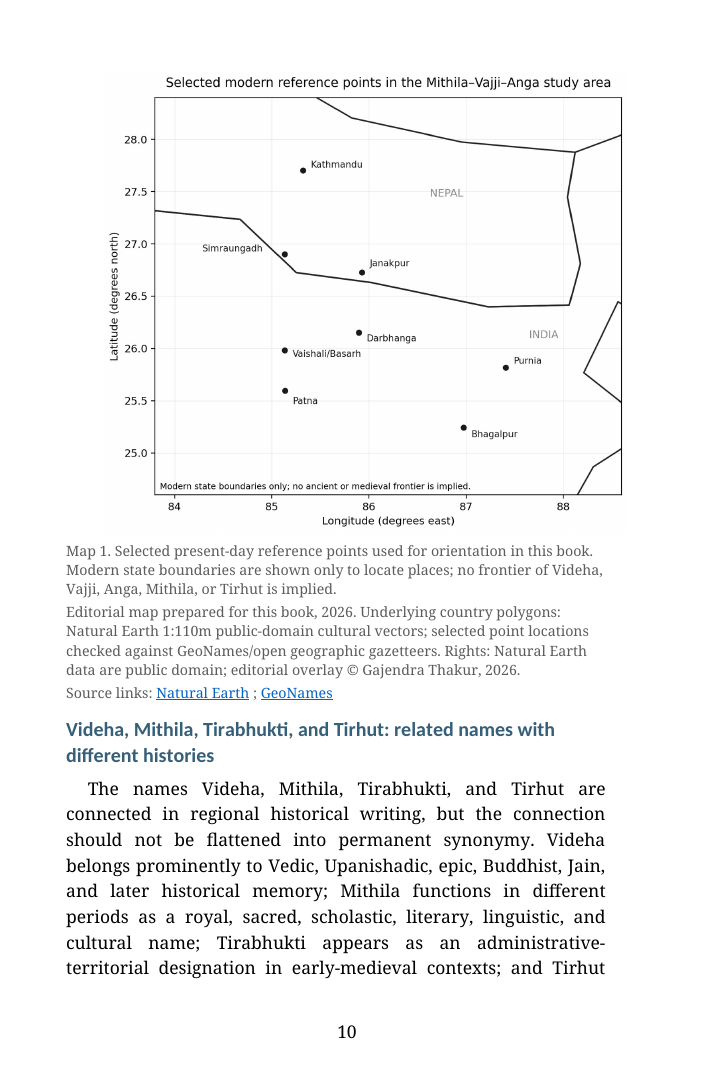
Mithila · Vajji · Anga
Chapter-specific source notes
- Primary chapter witness. Gajendra Thakur, Decoding the Panji of Mithila — Volume III, formal Chapter 21, PDF pp. 240-248; formal Chapter 21. The HTML transcription is generated from the commit-pinned source PDF and retains the chapter boundary recorded in this edition.
- Internal structure. The repository source-heading inventory records no separately encoded subordinate heading for this chapter.
- Digital editorial method. The page keeps the preserved source text distinct from generated navigational, concordance, visual, and provenance apparatus. The synthetic reconstruction is explanatory only and is not evidence for an individual lineage or a determination of social or marital status.