Decoding the Panji of Mithila · Volume III · Chapter 22
Entries 196-207 - Tripurauli, Pude-Naruan, Mahrail, Koilkhaha, Dharampur, Phulgama, Gangoli, Khokha, Purnia, and Sotipura Index Link Box
Chapter 22
 Entries 196-207 - Tripurauli, Pude-Naruan,
Mahrail, Koilkhaha, Dharampur, Phulgama,
Gangoli, Khokha, Purnia, and Sotipura
 Index Link Box
 Index cluster                                    त्रिपुरौली / दहौरा / पुड़े -नरउन / महरै ल /
                                              कोइलरवाहा-कोइलखाहा / धरमपुर /
                                              धानेरामपुर / फु लगामा / गंगोली / खौखा-
                                              पूर्णियाँ / सोतिपुरा
 Khand 2 source entries decoded                   196-207

 Principal source heading forms                   "उपटीप-पुवारिपार त्रिपुरौली सँ दहौरा";

                                              "उपटीप-पुवारिपार पुड़े पु सँ महरै ल"; "गंगौली

                                              फड़े सँ महरै ल कोइलरवाहा"; "पुड़े पुसँ
                                              कोइलरवाहा धानेरामपुरपु"; "पुड़े पूसँ फू लगामा,
                                              उजान, भट्टपूरा, पाहीटोल"; "पुड़े पुसँ गंगोली
                                              खौखा-पूर्णियाँसँ सोतिपुरा"
 Index roots/routes                              Tripurauli-Dahaura opening; Pude-Naruan
                                              branch; Mahrail; Koilkhaha/Koilwaha;
                                              Dharampur and Dhane-Rampur; Phulgama-
                                              Ujan-Bhattpura-Pahitola; Gangoli-Khokha-
                                              Purnia-Sotipura

 Recurring relational villages                    पाली, सोदरपुर, करमहा, हरिअम्ब,
                                              खण्डबला, दरिहरा, सरिसब, खौआल, कु जौली,
                                              घुसौत, वलियास, माण्डर, नरउन, बुधवाल,
                                              पबौली, तिसउँ त, अलय
 Coverage status                                  Decoded through Entry 207; Entry 208
                                              begins the next लोआम-सुरगन / दुर्गागंज-

                                              कटिहार cluster and is not included here.

 Chapter overview

                      Decoding the Panji of Mithila, Volume III | Page 247
                     Decoding the Panji of Mithila Volume III

   Chapter 22 begins where the previous Sulhani-Behat-Navtol
chapter ended. The source now gives the formula ' दहौरा अथ त्रिपुरौली
नरउन ग्रामारम्भ', and then follows the Tripurauli-Dahaura and Pude-
Naruan material through Mahrail, Koilkhaha or Koilwaha,
Dharampur, Dhane-Rampur, Phulgama, Ujan, Bhattpura,
Pahitola, Gangoli, Khokha, Purnia, and Sotipura.
    The range covered here is Entries 196-207. The movement is
not a single straight line. It begins with Tripurauli under Naruan,
turns toward Pude-Naruan, repeatedly touches Mahrail and
Koilkhaha, and then closes through Phulgama, Ujan, Bhattpura,
Pahitola, Gangoli, Khokha, Purnia, and Sotipura. The chapter
stops before Entry 208, where the Loam-Surgan and Durgaganj-
Katihar field begins.
    This is one of the most mobile sections of the Puwaripar
material. The entries show how a family stream can retain one
root identity while its marriage and branch references pass
through many settlements. For that reason the chapter should be
used together with the place index and the cross-reference map,
not only as a list of personal names.

 Entry 196: Tripurauli-Naruan and the Dahaura
opening
    Entry 196 opens with Tripurauli under Naruan and Dahaura.
Saraskavi Gunānand is the major opening anchor, followed by
Bholanath, Shridhar, Abhayanath, Pinaknath, Hridaynath,
Lilanath,   Yadunath,     Tulanath,    Baidyanath,   Premnath,
Vishwanath, Mitranath, and related branches. The entry
repeatedly ties Tripurauli to Harianb, Khaual, Ghosaut, Pandua,
Khandbala, Soderpur, Karamha, and Mandar.
   The genealogical logic of Entry 196 is important. It begins
from a learned or title-bearing ancestor and immediately records
sons, daughters, and marital connections. The use of professor,
Saraswati, and other scholarly identifiers shows that this is not
only a village list but a status-bearing family register.

                 Decoding the Panji of Mithila, Volume III | Page 248
                    Decoding the Panji of Mithila Volume III

  Entries 197-199: Pude-Naruan and Mahrail
   Entry 197 opens the Pude-Naruan material toward Mahrail.
Chhatripati, Kalanath, Rupnath, Mansukh, Gokhul, Lakshminath,
Mahob Bhavnath, Gopal, Babu Manohar, Babu Chumman,
Damodar, Chhotku, Raghuwar, Girdhar, Shivanandan, Duni,
Shrinath, Gaurinath, Baidyanath, Durganath, Sitanath, and later
Ganganath and Gananath appear. The source links them with
Darhara, Naruan, Soderpur, Khaual, Mandar, Harianb,
Khandbala, Karamha, and Behat.
    Entry 198 continues the Pude-Naruan-Mahrail branch.
Gananath, Indunath, Vishwanath, Chandranath, Nandnath,
Ramanath, Chhotku, Raghuwar, Badrinath, Faturi or Riddhinath,
Shivnandan, Jagannath, Amarnath, Duni or Ruchinath,
Chandinath, Khadganath, Bhimnath, Pashupati, Durganath,
Udaynath, Tantranath, Yantranath, Mantranath, and Shri Mohan
appear. The entry’s core value lies in preserving multiple
collateral lines under the Pude-Naruan field.
    Entry 199 continues Pude and brings Babu Chumman’s
descendants into view. Raghunandan, Bankhandi or Tejnath,
Kamalakant, Thakku or Kalanath, Gopinath, Janakinath,
Shyamanand, Riddhinath, Brajnath, Shashi Shekhar, Vidhu
Shekhar, Mihir Shekhar, Chandrashekhar, Kashinath, Umanath,
Arvind, Sundar, Modnath, Rakesh, Anil, Rajesh, Mathuranath,
Maninath, and Shyamsundar appear. The entry is dense, but the
route remains Pude-Naruan with Mahrail and allied villages in
the background.

  Entries 200-201: Puwaripar-Pude consolidation
   Entry 200 is marked by the simple heading ' उपटीप-पुवारिपार १००'.
It continues the Pude field through Shyamsundar, Vinod, Amar,
Baldev, Haridev, Sudhir, Jishnunath, Ramanath, Rajnath,
Sameernath, Motinath, Chetanath, Yug Nath, Mitranath,
Amarnath, Vibhutinath, Abhay, Vinay, Ajay, Chitranath,
Chandranath, Ramanath, Buddhinath, Mandhan, Vishwanath,
Chakranath, Ravinath or Manbharan, Mahadev, Badrinath, and

                Decoding the Panji of Mithila, Volume III | Page 249
                     Decoding the Panji of Mithila Volume III

Harshanath. The entry functions as a consolidation of several
earlier branches rather than as a new village opening.
   Entry 201 continues Pude. Shashinath, Ganesh, Mukund,
Durganath, Mahavir, Kashinath, Yognath, Girishnath, Bhaktinath,
Jaynath, Yashinath, Amritnath, Nityanath, Kshemnath, Hemnath,
Shantinath, Abhayanath, Mohan Ji, Govind Ji, Prakash Shankar,
Aditya, Rudranath, Mitranath, Kunjun or Tirthnath, Janardan or
Mahinath, Radhanath, Krishnaji or Netranath, and Shivanath
appear. The entry also prepares the way for the Gangoli-Mahrail-
Koilkhaha field of Entry 202.

 Entry 202:            Gangoli            branch,            Mahrail,   and
Koilkhaha
   Entry 202 is headed 'गंगौली फड़े सँ महरै ल कोइलरवाहा'. It attaches the
Gangoli branch to Mahrail and Koilkhaha/Koilwaha. Shivanath,
Veernath, Janardan or Mahinath, Markandey or Muktinath,
Meghanath, Matinath, Loknath, Mukund, Brajnath, Amarnath,
Acharya Mahavir, Manmohan, Chandramohan, Adityamohan,
Shashank Mohan, Vishwamohan, Suryamohan, Mimansak
Meghanath, Dharmanath, Ritu Nath, Devanath, Kedarnath,
Dayanath, Shambhunath, and Jitunath are named or implied.
    This entry is especially important for intellectual history. It
preserves the title Mimansak and references Acharya and other
learned forms while also keeping the old marriage-village
formula intact. The route from Gangoli to Mahrail and Koilkhaha
shows how scholarly households are still mapped through the
same Panji grammar of descent, village, and marriage.

 Entries 203-205: Koilkhaha, Dhane-Rampur,
Dharampur, and linked branches
   Entry 203 continues Pude toward Koilkhaha and Dhane-
Rampur. It records Vaiyakarana Matinath, Buddhinath,
Maholoknath, Kandū or Radhanath, Yadunath, Kanjnath,
Chitranath, Hemnath, Jagannath, Devinath, Shambhunath,
Somnath, Tantranath, Vishwanath, Modnath, Ganga Datt,

                 Decoding the Panji of Mithila, Volume III | Page 250
                    Decoding the Panji of Mithila Volume III

Ruchipati, Bholanath, Eknath, Teknath or Fūhi, Vair Radhanath,
and allied branches. The source also brings in Shastrarth
Martand Markandey and other scholarly references.
    Entry 204 continues the Pude-Naruan branch. It moves
through Devanath, Tejnath, Bholanand, Eknath, Baidyanath,
Jagannath, Taranath, Acharya Ramanath, Sahityakar Professor
Tantranath, Sachinath, Bodhnath or Sushil, Ravinath or Sunil,
and several MA/PhD-marked descendants. This entry is notable
for modern educational markers recorded inside a traditional
Panji frame.
    Entry 205 expands Pude toward Dharampur and Dhane-
Rampur. The entry refers to Ujan-Gangoli Tola, Chanaur-Sihauli-
Mandar, Sociologist Professor Ugranath, Revanath or Tulsinath,
Kumudnath or Bammol, Dharmanath or Kalidas, Bangaṭ or
Gangadhar, Shachinath, Arun, Tarun, Madhup, Parashar,
Chandranath, Gunanath, Lekhnath or Govind, Umanath,
Ratannath, Achyutanand, Mithilesh, Ajay, Brijnath, Bodhnath or
Mahavir,      Manmohan,        Chandramohan,         Adityamohan,
Bhubanmohan, and Suryamohan. The entry is a strong example
of late genealogical updating and professional self-description.

 Entries 206-207: Phulgama, Ujan, Bhattpura,
Pahitola, Gangoli, Khokha, Purnia, and Sotipura
    Entry 206 opens with Pude toward Phulgama, Ujan,
Bhattpura, and Pahitola. Jagannath, Shobhnath, Bhimnath,
Revatinath, Khadganath, Nityanath, Shobhnath or Bauk, Sitanath,
Samaliyanandan or Indranath, Harinath, Yogeshchandra,
Prakashchandra, Kripanath, Premnath, Hridaynath, Tekanath or
Fūhi, Loknath, Badrinath, Baldev, Gopal, Balbhadra, Motinath,
Hiranath, Ganesh, Dwarkanath, Shambhunath, Shubhnath,
Shankar, Ramabhadra, Virabhadra, Shyambhadra, Sanjay, and
Abhayanath appear. The route is not one village but a chain of
late branch movements across Phulgama, Ujan, Bhattpura, and
Pahitola.

                Decoding the Panji of Mithila, Volume III | Page 251
                          Decoding the Panji of Mithila Volume III

    Entry 207 closes the chapter with Pude to Gangoli, Khokha,
Purnia, and Sotipura. Hiranath, Vinayak, Pramod, Virabhadra,
Uday, Sanjiv, Ganesh, Vagish, Bauan, Vasant, Dharmanath, Ritu
Nath,    Devanath,    Dilip,  Pradip,   Dwarkanath,     Vikash,
Shambhunath, Achyutanath, Amit, Sumit, Vindunath, Lekhnath,
Matinath, Buddhinath, Radhanath, and Chanchal are named or
referenced. Several links remain dotted, so the entry must be
read as an incomplete but valuable closure to the Pude-Gangoli-
Khokha-Purnia-Sotipura field.
   Entry 207 is also the boundary marker. The next heading,
Entry 208, opens 'लोआमसँ दुर्गागंज कटिहार सौरियासँ ' and begins a new
Loam-Surgan-Durgaganj-Katihar cluster. That                                  new   cluster
belongs to Chapter 23 and is not decoded here.

  Cross-reference and route map
    The main route of Chapter 22 is: त्रिपुरौली-दहौरा -> पुड़े -नरउन -> महरै ल
-> कोइलरवाहा/कोइलखाहा -> धरमपुर / धानेरामपुर -> फु लगामा / उजान / भट्टपूरा /
पाहीटोल -> गंगोली / खौखा / पूर्णियाँ / सोतिपुरा.

    The recurrent relational villages are पाली, सोदरपुर, करमहा, हरिअम्ब,
खण्डबला, दरिहरा, सरिसब, खौआल, कु जौली, घुसौत, वलियास, माण्डर, नरउन, बुधवाल,
पबौली, तिसउँ त, and अलय. These places connect Chapter 22 backward
to the Sulhani and Madari material and forward to the Loam-
Durgaganj material.
    The main titles and status markers include सरसकवि, प्रोफे सर,
आचार्य, मिमांशक, वैयाकरण, साहित्यकार, समाजशास्त्री, शास्त्रार्थ मार्तण्ड, एम.ए.,
पीएच.डी., बाबू, सिंह, ठाकु र, महाराज, and राजा. Their recurrence confirms
that the Pude-Naruan cluster preserves both traditional and
modern status vocabulary.

  Important uncertainties
    Several lines in Entries 196-207 contain dotted blanks or
visibly incomplete marriage formulae. The decoding therefore

                      Decoding the Panji of Mithila, Volume III | Page 252
                       Decoding the Panji of Mithila Volume III

does not invent missing fathers, sons, or village names. A dotted
source position is treated as a real uncertainty in the evidence.
   The forms कोइलरवाहा, कोइलखाहा, खौखा, पूर्णियाँ , धानेरामपुर, फु लगामा, पुड़े ,
पुडै , नरउन, and नरूआड़ should be indexed with spelling variants.
Some are place variants, some are OCR or manuscript-
orthographic variants, and some may represent locally
differentiated forms.
   Entry 207 closes a cluster but also points forward. Because
Entry 208 begins a clear new Loam-Surgan-Durgaganj-Katihar
opening, the next chapter should begin there rather than
extending Chapter 22 further.

  Research summary
    Chapter 22 decodes Entries 196-207 and completes the
Tripurauli-Pude-Naruan-Mahrail-Koilkhaha-Dharampur-
Phulgama-Gangoli-Khokha-Purnia-Sotipura sequence. It shows
one of the most geographically wide branch expansions in this
portion of Khand 2.
   The chapter is particularly useful for tracing learned and
modern professional families because it preserves titles such as
Acharya, Mimansak, Vaiyakarana, Professor, Sociologist, and
MA/PhD within the older Panji formula of descent and marriage.
   With this chapter complete, Volume III is decoded through
Entry 207. Chapter 23 should begin at Entry 208 with the Loam-
Surgan, Sauria, Durgaganj, and Katihar cluster.

                   Decoding the Panji of Mithila, Volume III | Page 253
                           Decoding the Panji of Mithila Volume III
Source structure and verification apparatus
Editorial source apparatus. This apparatus is descriptive, not interpretive. It records the source-controlled structure used to verify that this page corresponds to formal Chapter 22 of Decoding the Panji of Mithila — Volume III. The chapter text above is preserved from PDF pp. 248-255; formal Chapter 22 in the commit-pinned authoritative source. It is not merged with a neighboring chapter, appendix, annexure, or independent front/back-matter unit. The internal headings below come from the repository’s source-heading inventory and are retained as navigational and audit evidence; showing them here does not turn those headings into separate publications or add claims that are absent from the source.
Internal source headings
No subordinate heading was separately encoded in the repository source-heading inventory for this chapter.
Source-text concordance
Entries · 196-207 · Tripurauli · Pude-Naruan · Mahrail · Koilkhaha · Dharampur · Phulgama · Gangoli · Khokha · Purnia · Sotipura · Index · Link · cluster · नरउन · इलरव · धरमप · Khand · decoded · Principal · heading · forms · roots · routes · Tripurauli-Dahaura · opening · branch · Koilwaha · Dhane-Rampur · Ujan-Bhattpura-Pahitola · Gangoli-Khokha · Purnia-Sotipura · Recurring · relational · villages · करमह · Coverage · status · Entry · begins · next · आम-स · included · overview · Decoding · Page · previous · Sulhani-Behat-Navtol · ended · gives · formula · follows · Pude · Naruan · material · Ujan · Bhattpura · Pahitola · range · covered · movement · single · straight · line · turns · toward · repeatedly · touches · closes · stops · Loam-Surgan · Durgaganj · Katihar · field · mobile · sections · Puwaripar · show · family
Boundary verification. In the formal sequence this chapter follows Volume III Chapter 21, “Entries 179-195 - Madari, Sharadapur, Sulhani, Manglabani, Raima, Naduar, Naruar, Behat, and Navtol Index Link Box” and precedes Volume III Chapter 23, “Entries 208-214 - Loam, Sauria, Durgaganj, Bhakharouli, Kanhauli, Ruchouli, and Katihar Index Link Box Index cluster लोआम / सुरगन / सौरिया / दुर्गागंज /”. The chapter extractor begins at the verified formal Chapter 22 marker and stops at the next verified formal chapter marker; for a final chapter it stops before recognized book-level back matter. The concordance above is generated only from distinct terms already present in this chapter’s preserved source text. It is provided for discovery, comparison, and audit, not as an automated judgment about persons, lineages, status, kinship, marriage eligibility, or historical truth.
Illustrated research apparatus
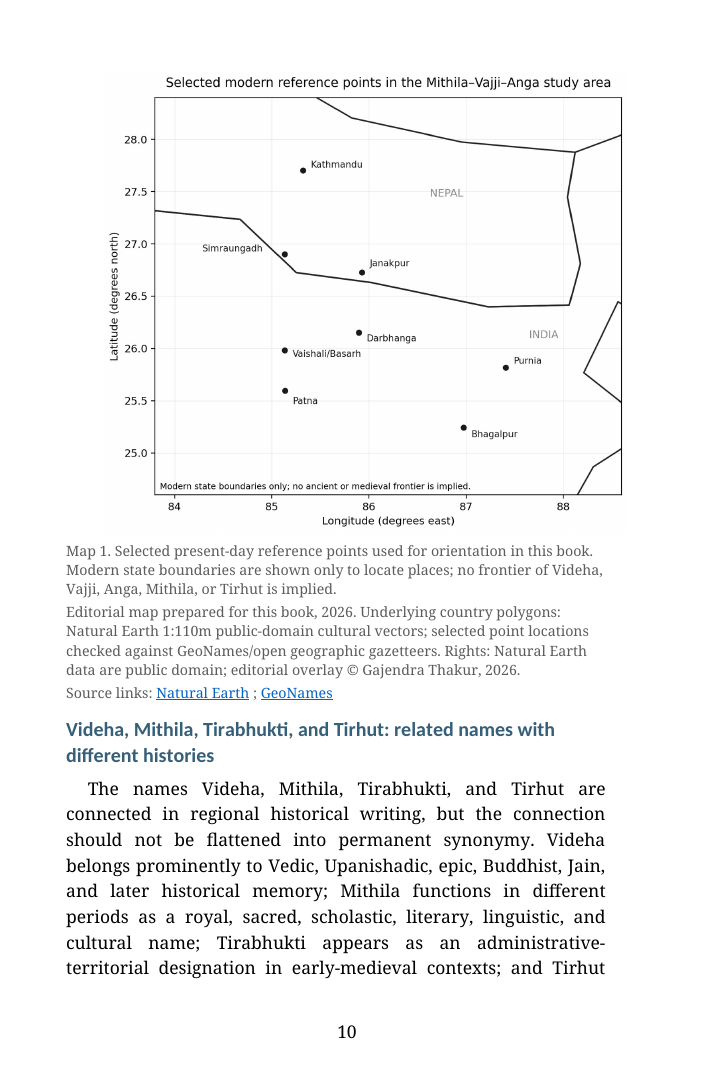
Mithila · Vajji · Anga
Chapter-specific source notes
- Primary chapter witness. Gajendra Thakur, Decoding the Panji of Mithila — Volume III, formal Chapter 22, PDF pp. 248-255; formal Chapter 22. The HTML transcription is generated from the commit-pinned source PDF and retains the chapter boundary recorded in this edition.
- Internal structure. The repository source-heading inventory records no separately encoded subordinate heading for this chapter.
- Digital editorial method. The page keeps the preserved source text distinct from generated navigational, concordance, visual, and provenance apparatus. The synthetic reconstruction is explanatory only and is not evidence for an individual lineage or a determination of social or marital status.