Decoding the Panji of Mithila · Volume III · Chapter 23
Entries 208-214 - Loam, Sauria, Durgaganj, Bhakharouli, Kanhauli, Ruchouli, and Katihar Index Link Box Index cluster लोआम / सुरगन / सौरिया / दुर्गागंज /
Chapter 23
 Entries 208-214 - Loam, Sauria, Durgaganj,
Bhakharouli, Kanhauli, Ruchouli, and Katihar
  Index Link Box
  Index cluster                                    लोआम / सुरगन / सौरिया / दुर्गागंज /
                                               कटिहार / भखरौली / विठ्ठो / भरवरौली /
                                               सरिसब / कन्हौली / उजान / रूचौली
  Khand 2 source entries decoded                   208-214

  Principal source heading forms                   "लोआमसँ दुर्गागंज कटिहार सौरियासँ ";

                                               "उपटीप-फवारिपार सौरिया लोआमसँ

                                               दुर्गागंज"; "उपटीप पुवारिपार भखरौलीसँ
                                               विठ्ठो"; "उपटीप पुवारिपार भरवरौली सँ
                                               सरिसब"; "उपटीप पुवारिपार कन्हौलीसँ
                                               उजान"; "उपटीप फवारिपार रूचौलिसँ
                                               कटिहार"
  Index roots/routes                             Loam-Surgan; Sauria-Loam-Durgaganj;
                                               Bhakharouli-Vittho; Bharwarauli-Sarisab;
                                               Kanhauli-Ujan; Ruchouli-Katihar

  Recurring relational villages                    पबौली, माण्डर, खौआल, करमहा, सोदरपुर,
                                               दरिहरा, नरउन, खण्डबला, हरिअम्ब, कु जौली,
                                               एकहरा, सरिसब, वलियास, बुधवाल, बेलउँ च,
                                               अलय
  Coverage status                                  Decoded through Entry 214; Entry 215
                                               begins the next खण्डबला-भौर-राजग्राम cluster

                                               and is not included here.

  Chapter overview
   Chapter 23 begins at Entry 208, where the source opens the
Loam-Surgan village field and explicitly links it with Durgaganj,
Katihar, and Sauria. The chapter then follows Entries 208-214
through the Loam-Sauria-Durgaganj cluster, the Bhakharouli-

                       Decoding the Panji of Mithila, Volume III | Page 254
                    Decoding the Panji of Mithila Volume III

Vittho branch, the Bharwarauli-Sarisab connection, the
Kanhauli-Ujan opening, and the Ruchouli-Katihar closing section.
   This is a compact but important chapter. It is not as long as
the Pude-Naruan chapter that precedes it, but it introduces
several clear village openings: लोआम सुरगन, भरवरौली कु जौली, कन्हौली
एकहरा, and रूचौलि एकहरा. These openings show that the chapter is
not merely a continuation of one prior line. It is a new route
cluster under the Puwaripar and Fawaripar registers.
    The entries repeatedly combine royal or landed status terms
with ordinary Panji marriage formulae. Names such as Raja
Devanarayan, Raja Shree Narayan Rai, Rai Ramnarayan, Rai
Roopnarayan, Rai Durganarayan, Rai Vednarayan, and Rai
Lakshminarayan stand beside the usual daughter, son, and
village references. The chapter therefore records both branch
descent and status-bearing public identity.

 Entry 208: Loam-Surgan, Durgaganj, Katihar,
and Sauria
   Entry 208 opens with 'अथ लोआम सुरगन ग्राम लिख्यते '. Rai Chilka,
also described as famous Chandranarayan, is the opening
anchor, followed by Raja Devanarayan, Raja Shree Narayan Rai,
Shyamanarayan Rai, Lalit Narayan Rai, Keerti Narayan, Rai
Ramnarayan, Rai Roopnarayan, Manik Narayan, Dri Gopal
Narayan, Chetan Narayan, Sanyanarayan, Kshetra Narayan,
Mahendra Narayan, Kishor Narayan, Phuchchi or Baldev
Narayan, Jai Narayan, Vir Narayan or Satyanarayan, and others.
    The route moves repeatedly through Pabouli, Mandar,
Karamha, Sarisab, Khaual, Naruan, Harianb, Soderpur, and Pali.
The entry has a clear Loam-Surgan identity, but its branch reach
is broad: Durgaganj, Katihar, Sauria, Pabouli, and other places
appear as relational anchors rather than as isolated references.
    A key feature of Entry 208 is the royal vocabulary. The use of
Raja and Rai does not replace genealogical grammar; it is
inserted into it. The source still reads descent through sons,

                Decoding the Panji of Mithila, Volume III | Page 255
                    Decoding the Panji of Mithila Volume III

daughters, and marital transfer, even when public titles are
present.

 Entry 209: continuation of the Loam-Sauria-
Durgaganj family field
   Entry 209 continues the previous Loam-Sauria sequence.
Keshavanand Narayan or Subhash, Prakash Narayan or Achyut
Narayan, Vijayanand Narayan, Dr. Satyanarayan, Udayanand
Narayan, Revatinarayan, Sanjiv, Samir, Premanand Narayan,
Chetan Narayan, Kishor Narayan, Anand or Manoj Narayan,
Kanchan Narayan or Chittanarayan, Kaushal Kishor Narayan,
Alok, Godu, Nitin, Golu, Hotri Narayan, Surendra Narayan, Manoj
Narayan,     Badri      Narayan,     Darshananand      Narayan,
Harendranarayan, Krishnanarayan, and related branches
appear.
    This entry is especially useful because it updates the older
Rai-Narayan line into a more modern naming pattern. Dr., IAS,
and IPS references show that the Panji continued to absorb late
public and professional markers. Yet the structure remains
traditional: each modern label is still framed by descent, marital
village, and reciprocal branch reference.
   Entry 209 also expands the relational map to Indrapur-
Khandbala,    Pahitola-Harianb,     Sihauli-Mandar,   Rajgram-
Khandbala, Tarouni, Lohna-Rajoura, Belauch, and Soderpur. The
Loam-Sauria line is therefore one of the connecting bridges
between    earlier   Rajoura-Sihauli    material    and   later
Katihar/Kanhouli/Ruchouli material.

 Entry 210: Sauria-Loam to Durgaganj and the
Bharwarauli-Kujauli opening
    Entry 210 is headed as Fawaripar Sauria-Loam to Durgaganj.
It begins with Krishnanand Narayan and Gyanendra Narayan,
then continues through Sonmani or Kamanarayan, Vednarayan,
Lakshminarayan, and related connections. The entry then opens

                Decoding the Panji of Mithila, Volume III | Page 256
                    Decoding the Panji of Mithila Volume III

'अथ भरवरौली कु जौली ग्राम लिख्यते ', shifting the chapter into the
Bharwarauli-Kujauli subfield.
   Under     the    Bharwarauli-Kujauli opening,   Meghakar,
Shobhakar, Shivkar, Dharanath, Būcha or Kishornath, Dinanath,
Khelanath, Muktinath, Lilanath, Vishwanath, Mohan Ji,
Lekhnath, Narayan, Damodar, Siddhikar, Amritkar, Vidyakar,
Bauk, Balar or Kalyankar, Sudhakar, Manmohan, Hetukar,
Tejkar, and related branches appear.
    The entry matters because it is both a continuation and a new
village opening. The chapter therefore treats Entry 210 as a
hinge: it keeps the Sauria-Loam-Durgaganj sequence alive, but
also begins the Bhakharouli/Bharwarauli material that continues
in the next two entries.

  Entry 211: Bhakharouli to Vittho
   Entry 211 carries the heading Bhakharouli to Vittho. It
continues the Bharwarauli-Kujauli field through Dinanath,
Muktinath, Lilanath, Vishwanath, Mohan Ji, Lekhnath, Narayan,
Damodar, Siddhikar, Amritkar, Vidyakar, Bauk, Kalyankar,
Sudhakar, Manmohan, Son, Indukar, Padmakar, Chitrakar,
Ratnakar, Gadakar, Pinakar, Divakar, and many collateral
descendants.
    This entry is dense because it records multiple daughter-lines
and many scholarly or professional descendants. The appearance
of Professor Hetukar, Dr. Chetkar, Principal, and other modern
identifiers shows again that the Panji is not frozen in an early
period. It accepts late educational and institutional titles while
preserving older marriage-route grammar.
   The entry also links Bhakharouli and Vittho to Khandbala,
Harianb, Darhara, Karamha, Soderpur, Budhwal, Mandar,
Naruan, Pabouli, Belauch, and other villages. The route is
therefore not only Bhakharouli-Vittho; it is a broad network
anchored in that heading.

  Entry 212: Bharwarauli to Sarisab

                Decoding the Panji of Mithila, Volume III | Page 257
                      Decoding the Panji of Mithila Volume III

   Entry 212 is headed Bharwarauli to Sarisab. Chitrakar,
Ratnakar, Lilakar, Lekhkar, Bhaktikar, Lokkar, Gadakar,
Professor Dr. Chetkar, Achyutkar, Buddhikar, Shankar, Pinakar,
Ramakar or Umakar, Dr. Yoganand, Upendrakar, Vinodanand or
Chandrakar, Sushil or Lalitkar, Dharmanand, Amarnath,
Gunakar, Pradip, Prabhas, Ramesh or Mitrakar, and Suresh
appear.
   The entry is notable for its strong intellectual and modern-
professional layer. It contains references to doctor, professor,
principal, musician, and military-style designation. These are not
separate from genealogy; they are recorded inside the same
branch formula with village and marriage links.
   Entry 212 also marks the shift toward the Kanhauli-Ujan and
Ruchouli-Katihar material. The end of the entry contains several
forward-looking links to Mangrauni, Gangoli, Chanaur, Sihauli,
Jhanjharpur, Bhor-Khandbala, and other nodes.

 Entry 213: Kanhauli-Ujan,                                Rashadh-Purnia,
Chanaur-Darbhanga-Katihar
   Entry 213 opens 'अथ कन्हौली एकहरा ग्रामारम्भ'. Bhavadatt, Damodar,
Manohar, Manmohan, Gudari or Dandapani, Dayanidhi,
Padmadatt, Ghurghur, Chakradatt, Muktidatt, Lakshminath,
Tejnath, Vindunath, Rajanath, Anandnath, Bhagwan, Dayanath,
Sudhirnath, Bhairavdatt, and other branches appear in the
Kanhauli-Ekhara field.
   The    entry      then       opens         'अथ      रूचौलि      एकहरा   ग्रामारम्भ'.
Mahamahopadhyaya Gangesh is the major learned anchor,
followed by Indranath, Dayanath, Janakinath, Lalitnath, Rai
Bahadur Srinath, Trailokyanath, Yagnath or Jagannath, Dr.
Amarnath, and connected descendants. This is a strong scholarly-
status sequence inside the Ruchouli-Ekhara branch.
   Because the heading also refers to Rashadh-Purnia, Chanaur-
Darbhanga, and Katihar, Entry 213 should be indexed under
more than one place heading. The chapter keeps Kanhauli and

                  Decoding the Panji of Mithila, Volume III | Page 258
                        Decoding the Panji of Mithila Volume III

Ruchouli as the immediate openings, but the research index
should also preserve the Purnia, Darbhanga, Chanaur, and
Katihar signals.

  Entry 214: Ruchouli to Katihar closing sequence
   Entry 214 continues the Ruchouli-Katihar branch. Umanath,
Devanath or Mister, Dr. Professor Abhayanath or Victor,
Ajaynath or Tipu, Anshunath or Chiku, Ratannath, Premnath,
Brajnath, Lakshminath, Jivannath or Vishwanath, Kamalnath,
and Kirannath appear.
    This closing entry is brief but important. It brings the
Ruchouli line toward Katihar and includes modern professional
markers such as doctor and professor. The branch also preserves
links to Karamha, Naruan, Surgan, Belauch, Mangrauni, Mahishi-
Pali, Budhwal, Valiyas, Darhara, and Sakaradhi.
   Entry 214 is the correct stopping point for Chapter 23. Entry
215 opens a new cluster under Khandbala, Bhor, and Rajgram, so
the next chapter should begin there rather than extending the
Loam-Sauria-Ruchouli-Katihar material further.

  Cross-reference and route map
    The main route of Chapter 23 is: लोआम-सुरगन -> सौरिया-लोआम-
दुर्गागंज -> कटिहार -> भरवरौली/भखरौली-कु जौली -> विठ्ठो -> भरवरौली-सरिसब ->
कन्हौली-उजान -> रूचौली-कटिहार.

    The most frequent relational villages are पबौली, माण्डर, खौआल,
करमहा, सोदरपुर, दरिहरा, नरउन, खण्डबला, हरिअम्ब, कु जौली, एकहरा, सरिसब, वलियास,
बुधवाल, बेलउँ च, अलय, पाली, तिसउँ त, घुसौत, and सकराढ़ी.

    The major titles and markers are राजा, राय, बाबू, सिंह, ठाकु र,
रायबहादुर, महामहोपाध्याय, डा., प्रो., प्रधानाचार्य, समाजशास्त्री, साहित्यकार, and
professional modern markers such as IAS and IPS. These markers
must be kept as status evidence, not treated as ornamental
additions.

                    Decoding the Panji of Mithila, Volume III | Page 259
                     Decoding the Panji of Mithila Volume III

  Important uncertainties
   Several portions of Entries 208-214 contain dotted blanks.
These are not omissions in this decoding; they are source-level
uncertainties. No missing father, son, spouse, or village has been
supplied without evidence.
   Place names should be indexed with variants. भखरौली and
भरवरौली occur in close proximity; रूचौलि and रूचौली are likely
orthographic variants; लोआम, सौरिया, दुर्गागंज, कटिहार, कन्हौली, उजान,
सरिसब, and विठ्ठो should all be retained as distinct searchable labels.

    Modern titles and English-letter qualifications in the source
should be preserved in notes and indexing. They mark late
additions and professional status, and help date the updating
history of the branch.

  Research summary
   Chapter 23 decodes Entries 208-214 and completes the Loam-
Surgan,      Sauria-Loam-Durgaganj,        Bhakharouli-Vittho,
Bharwarauli-Sarisab, Kanhauli-Ujan, and Ruchouli-Katihar
sequence.
    The chapter is especially valuable for the interaction between
older village-based Panji structure and modern public identity.
The recurring forms Raja, Rai, Rai Bahadur, Doctor, Professor,
Principal, Sociologist, and professional initials show that the
register continued to absorb later status without abandoning
traditional genealogical syntax.
   With Chapter 23 complete, Volume III is decoded through
Entry 214. Chapter 24 should begin at Entry 215 with the
Khandbala-Bhor-Rajgram-Hemnagar-Purnia cluster.

                 Decoding the Panji of Mithila, Volume III | Page 260
                           Decoding the Panji of Mithila Volume III
Source structure and verification apparatus
Editorial source apparatus. This apparatus is descriptive, not interpretive. It records the source-controlled structure used to verify that this page corresponds to formal Chapter 23 of Decoding the Panji of Mithila — Volume III. The chapter text above is preserved from PDF pp. 255-262; formal Chapter 23 in the commit-pinned authoritative source. It is not merged with a neighboring chapter, appendix, annexure, or independent front/back-matter unit. The internal headings below come from the repository’s source-heading inventory and are retained as navigational and audit evidence; showing them here does not turn those headings into separate publications or add claims that are absent from the source.
Internal source headings
No subordinate heading was separately encoded in the repository source-heading inventory for this chapter.
Source-text concordance
Entries · 208-214 · Loam · Sauria · Durgaganj · Bhakharouli · Kanhauli · Ruchouli · Katihar · Index · Link · cluster · भरवर · Khand · decoded · Principal · heading · forms · प-फव · roots · routes · Loam-Surgan · Sauria-Loam-Durgaganj · Bhakharouli-Vittho · Bharwarauli-Sarisab · Kanhauli-Ujan · Ruchouli-Katihar · Recurring · relational · villages · करमह · नरउन · एकहर · Coverage · status · Entry · begins · next · included · overview · opens · village · field · explicitly · links · follows · Loam-Sauria-Durgaganj · Decoding · Page · Vittho · branch · connection · opening · closing · section · compact · important · long · Pude-Naruan · precedes · introduces · several · clear · openings · show · merely · continuation · prior · line · route · Puwaripar · Fawaripar · registers · repeatedly · combine · royal · landed · terms · ordinary · marriage
Boundary verification. In the formal sequence this chapter follows Volume III Chapter 22, “Entries 196-207 - Tripurauli, Pude-Naruan, Mahrail, Koilkhaha, Dharampur, Phulgama, Gangoli, Khokha, Purnia, and Sotipura Index Link Box” and precedes Volume III Chapter 24, “Entries 215-224 - Khandbala, Bhaur, Rajgram, Hemnagar, Deodhi, Shubhankarpur, Uchouri, Garhbaneli, and Dhanoulia Index Link Box”. The chapter extractor begins at the verified formal Chapter 23 marker and stops at the next verified formal chapter marker; for a final chapter it stops before recognized book-level back matter. The concordance above is generated only from distinct terms already present in this chapter’s preserved source text. It is provided for discovery, comparison, and audit, not as an automated judgment about persons, lineages, status, kinship, marriage eligibility, or historical truth.
Illustrated research apparatus
Mithila · Vajji · Anga
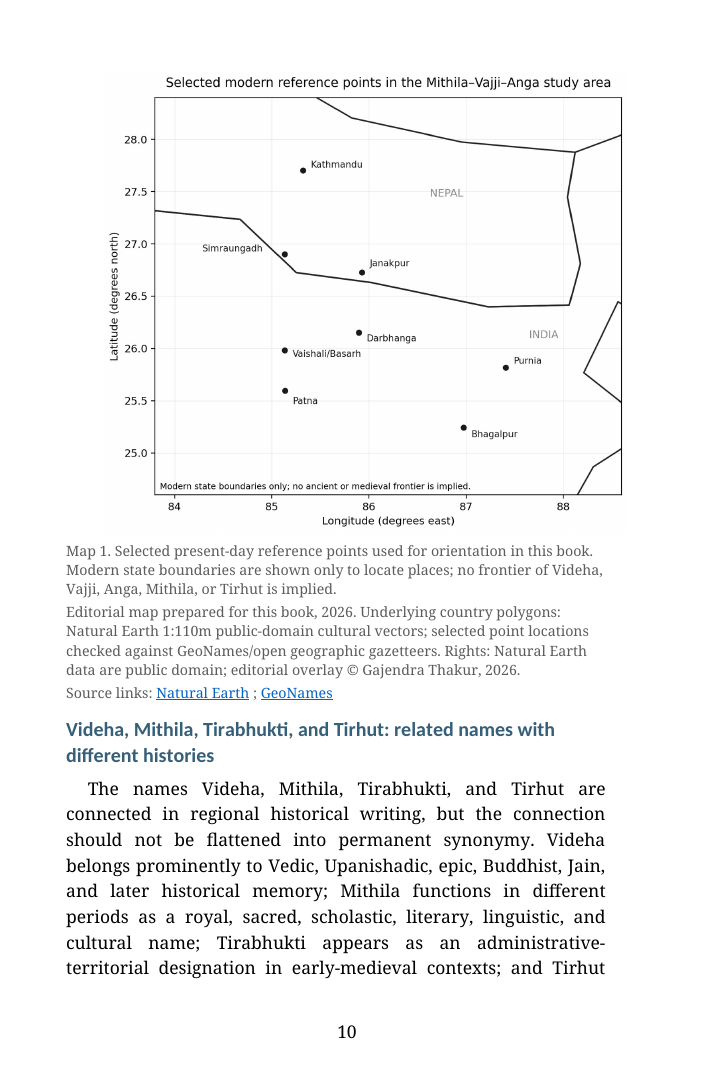
Chapter-specific source notes
- Primary chapter witness. Gajendra Thakur, Decoding the Panji of Mithila — Volume III, formal Chapter 23, PDF pp. 255-262; formal Chapter 23. The HTML transcription is generated from the commit-pinned source PDF and retains the chapter boundary recorded in this edition.
- Internal structure. The repository source-heading inventory records no separately encoded subordinate heading for this chapter.
- Digital editorial method. The page keeps the preserved source text distinct from generated navigational, concordance, visual, and provenance apparatus. The synthetic reconstruction is explanatory only and is not evidence for an individual lineage or a determination of social or marital status.