Decoding the Panji of Mithila · Volume IV · Chapter 3
The Logic of “From Village to Village”
Chapter 3
The Logic of “From Village to Village”

3.1 The Route Formula as the Spine of the Nagram
Panji
   The Nagram Panji cannot be understood if the phrase “from
village to village” is read merely as a geographical note. The
repeated formula, usually appearing in the form of one
settlement linked to another, is one of the main organizing
principles of the register. It is the spine on which names,
branches, marital connections, scholarly titles, and memory-
fragments are arranged. The formula may look small, but it
carries the weight of the archive.
   In a modern record, the expression “from X to Y” usually
means travel, migration, or transfer of residence. In the Panji,
it may mean any of these things, but it may also mean more. It
may mark a family’s older seat and later branch. It may show
a marriage relation. It may indicate the village by which a
man or branch was known to the Panjikars. It may identify a
line for purposes of matrimonial verification. It may also
preserve a remembered relationship between houses even
when the exact event behind the connection has become
obscure.
   For this reason, the route formula must be decoded rather
than translated mechanically. The word “from” should be
treated as a genealogical sign, not only as a preposition.
Whenever the Nagram Panji says, for example, Sandahpur to
Singhwar, Sandahpur to Shashipur, Mangrauni to Madari,
Hati to Satlakha, Tatail to Nanour, Rohar to Jhanjharpur, or
Bhakharouli to Porwarouni, the editor must ask: what kind of
relationship is being preserved here? Is the formula recording
origin,    destination,    marriage,     settlement,   branch

identification, or archival arrangement? Sometimes the
answer is clear. Sometimes the formula deliberately leaves the
relation compressed.

3.2 Village as Identity, Not Merely Location
   A village-name in the Nagram Panji is not merely a location
on the ground. It is a social identifier. A person may be
remembered through his father, through his son, through an
honorific, through a title, or through a village. The village
often performs the work of identification when the personal
name alone would be insufficient. Many names recur
throughout the Panji. A name such as Raghunath, Shyamalal,
Gopal,     Vishwanath,    Madhurapati,    Shivanandan,      or
Lakshminath cannot be understood without its village context.
   The village therefore functions like a genealogical surname,
but not in the modern sense. It does not necessarily replace
the family name; it locates the family within a network. A man
connected with Karmahā, Pali, Sarisab, Darihara, Satlakha,
Mandar, Khaowal, or Saurath is not merely being located. He
is being positioned in a recognized social and genealogical
field. The Panji’s reader was expected to know the importance
of such positioning.
   When this volume decodes a village formula, it will
therefore ask three questions. First, what is the literal village
relation stated in the entry? Second, what role does the village
play in identifying the person or branch? Third, does the same
village recur elsewhere in the same or related cluster? The
answer to the third question is often crucial, because repeated
village-names reveal the structure of the network.

3.3 The Difference Between Origin, Settlement,
and Affiliation
  The greatest danger in reading the route formula is to
assume that every “from X to Y” expression means migration

from an original homeland to a new settlement. Some entries
do record movement. But in a genealogical register,
movement is only one possible meaning. A village relation
may be ancestral, residential, marital, ritual, or classificatory.
  Origin means the older remembered seat of the family or
branch. Settlement means the later place where the family
became established. Affiliation means a recognized connection
that may arise from marriage, service, ritual association,
scholarly residence, or long social memory. In the Nagram
Panji, these categories can overlap. A family may originate in
one village, settle in another, marry repeatedly into a third,
and be known by a fourth because of a prominent ancestor.
   For example, when the entry names a person and then
gives a village relation after a sonship formula, the village
may identify the wife’s side, the linked branch, or the
comparative reference used by the Panjikar. If the same
person or his sons later appear in a different village sequence,
it does not automatically mean contradiction. It may mean
that the Panji is preserving another angle of the same social
network.
   This volume will avoid the phrase “migrated from” unless
the context supports it. In many cases, the safer English
wording will be “connected from X to Y,” “recorded in the X-Y
route,” “affiliated through the X-Y line,” or “entered under the
X-to-Y cluster.” Such phrasing preserves the source’s
complexity without reducing it to an unsupported historical
claim.

3.4 The Route Formula and Marriage Memory
   The Panji tradition is inseparable from marriage regulation.
In Mithila, genealogical memory was essential for determining
suitable marital relations and avoiding prohibited unions. The
village route in the Nagram Panji may therefore preserve not

only descent but also marriage memory. A village connected
to a name may mark the house into which a daughter was
married, the house from which a bride came, or the wider
field of matrimonial recognition.
  This is especially important where the entry moves through
sons and then attaches different villages to different branches.
Each branch may have its own marriage network. A single
ancestor may therefore open into several village routes
through his sons, grandsons, or descendants. The Panji’s
compact style often records this without explanation, because
the trained reader knew how to use the information.
   In this volume, whenever a village appears after a
descendant cluster, the possibility of marriage connection will
be considered. It will not be assumed in every case, but it will
not be ignored. The relationship between genealogy and
marriage is too central to the Panji tradition to be treated as
secondary. The register does not simply tell us who descended
from whom; it also tells us how families could be placed in
relation to one another.

3.5 Route Clusters and Branch Formation
   Some village routes in the Nagram Panji appear only
briefly. Others become clusters. A cluster is formed when
several entries share a route, a place, a recurring ancestor, or
a repeated set of linked villages. Sandahpur-Singhwar is a
cluster. Sandahpur-Shashipur becomes a cluster. Mangrauni,
Hati, Samauli, Balirajpur, Siwa, Kua, Rohar, Tatail, Rajanpura,
Bhakharouli, Malangia, and Ruchauli each function as clusters
in different parts of the source.
  A cluster is not necessarily a single family in the narrow
sense. It is a field of related entries. Within that field, there
may be several families, several branches, or several
remembered lines. The heading gives the reader an

orientation, but the internal structure must still be decoded.
Some clusters are built around a principal ancestor. Others
are built around a village-route. Others are built around a
sacred invocation heading. Still others are built around a
mixture of all three.
   Branch formation can be recognized when one ancestor’s
sons or descendants are repeatedly associated with different
named routes. The source may not say “this is Branch A” or
“this is Branch B” in modern terms. Instead, it will give names,
sons, villages, and repetitions. The branch must be inferred
from the pattern. The editor must be cautious: branch
formation is a reading of the structure, not always an explicit
statement in the text.

3.6 Repetition of Village Routes
   Repeated village routes are one of the most important clues
in the Nagram Panji. If a route recurs, it may mean that the
connection was strong, that several related branches used the
same route, or that the Panjikar returned to a previously
opened cluster to add another line. Repetition is not
automatically duplication. It is often the mechanism by which
the Panji preserves multiple angles of the same network.
   For example, if Shashipur appears in several consecutive
entries, each Shashipur entry must be read as a related but
distinct segment unless the text clearly shows that it is merely
a continuation of the same line. Likewise, when Hati, Samauli,
Balirajpur, Tatail, Bhakharouli, or Malangia appears
repeatedly, the repetition may indicate the growth of that
village into a genealogical centre. The Panji records the centre
by returning to it.
   The editorial method in this volume will therefore
distinguish between three kinds of repetition: continuation,
recurrence, and duplication. Continuation means that the next

entry carries forward the previous line. Recurrence means
that the same village or name returns in another related
context. Duplication means that the same information is
repeated without significant new function. Only the third
should be treated as duplication, and even then the repetition
should be noted rather than erased.

3.7 Place-Names as Evidence of Regional
Expansion
   The Nagram Panji shows Mithila as a wide and mobile
social world. It includes not only central Mithila villages but
also references toward Purnea, Champaran, Betia, Uttar
Pradesh, Rajasthan, Jamshedpur, and other regions. These
references must be read carefully. They show that the
genealogical memory of Mithila travelled with families,
scholars, priests, service-holders, and marriage networks.
  A place outside the narrow heartland does not make the
entry less Maithil. On the contrary, it shows the reach of
Maithil identity. The Panji’s purpose was to preserve lineage
and relation wherever the family was remembered. If a
branch moved, served, studied, married, or settled outside the
older village zone, the record could absorb that fact.
   The route formula therefore gives evidence for historical
movement without always explaining the cause of movement.
It may not tell us why a family came to Purnea or Betia or
Jamshedpur, but it preserves that the relation existed. Later
analytical chapters will group such references to show the
outward spread of the Nagram-linked families.

3.8 The Sacred Route and the Secular Route
   In the later sections of the Nagram material, many entries
begin with invocations such as Om followed by a sacred name.
These sacred headings do not cancel the village route; they
frame it. The entry may begin with a sacred invocation and

then proceed into the same dense genealogical structure:
person, sons, villages, cross-references, and branches. The
sacred and the secular are not separate worlds in the Panji.
They are joined in the act of recording memory.
  The sacred heading may organize a group of entries,
sanctify the record, or serve as a mnemonic marker. But after
the heading, the route formula continues to do its work. A line
may be introduced under Rameshwar, Vasukinath, Kedarnath,
Kapileshwar, Adidev, Trilochan, or another sacred name, yet
the genealogical evidence still lies in the pattern of persons
and villages.
   This volume will therefore treat sacred headings as
structural elements, not as ornamental phrases. At the same
time, it will not overstate them. A sacred heading does not
automatically mean that the family belonged to a particular
temple or priestly office. The text must show such a
connection before it can be asserted. The safer reading is that
sacred headings mark and sanctify sections of the register.

3.9 The Role of Cross-References in Village Logic
  The Nagram Panji often contains numbered references,
including B-references and other parenthetical numbers.
These references are part of the route logic. They show that
one entry may depend on another register, another page,
another branch, or another remembered cluster. A route is
therefore not always self-contained. It may point outward.
  When a route entry includes a cross-reference, the reader
should understand that the Panji is creating a network of
verification. The entry says, in effect: this person or branch
should also be checked in that other place. Such cross-
references are essential for avoiding mistaken identity. The
same name may appear in many places; the cross-reference
helps determine which occurrence belongs to which branch.

   In this volume, cross-references will be preserved as part of
the explanation. If the available source does not allow the
reference to be fully resolved, the unresolved state will be
stated openly. A cross-reference that cannot yet be checked is
still valuable evidence because it shows that the original
compiler or copyist recognized a relation beyond the
immediate line.

3.10 The Route Formula and Time
  The Panji rarely gives dates in the modern historical
manner. Time is embedded in descent, in sequence, in titles,
and sometimes in occupation. When a route moves from older
names to modern identifiers such as lawyer, engineer, doctor,
or other professional labels, the reader can sense
chronological layering. But the Panji does not always
announce that one generation has ended and another has
begun. The route must be read as a sequence of memory.
   The phrase “from village to village” may therefore contain
time as well as space. A family connected from one village to
another may represent an older seat and a later residence. A
branch attached to a modern place may represent a recent
extension of an older line. A repeated village may preserve an
old connection that continued across generations.
   This does not mean that every route can be dated precisely.
It means that the route formula provides relative chronology.
The order of names, the appearance of modern titles, the
presence of cross-references, and the recurrence of
descendants can help establish a sequence. Later chapters will
use this method when reading large clusters.

3.11 Editorial Translation of Village Routes
  Because this volume is in English, the route formula must
be translated carefully. A literal translation may be clear but
misleading. The expression “from X to Y” will be retained

where it is the simplest faithful form, but explanatory prose
will often clarify that the meaning may include origin,
affiliation, settlement, marriage connection, or archival
classification.
  For example, the heading “Sandahpur to Singhwar” should
not be expanded into “the family migrated from Sandahpur to
Singhwar” unless the entry gives enough evidence for
migration. A better decoding may say: “This entry is recorded
under the Sandahpur-Singhwar route. The route appears to
preserve a recognized connection between the Sandahpur line
and the Singhwar-associated branch.” This wording keeps the
source’s meaning open while still making it intelligible.
   Similarly, a heading such as “Bhakharouli to Chikni, Purnea,
Danga, Dhagjari” should be read as a multi-place cluster. It
may contain several linked settlements or branches. The
English explanation must not force all of them into one
straight road. The Panji’s geography is networked, not linear.

3.12 When a Village-Route Contains Several
Villages
  Some headings contain not two places but several. This is
especially important in later sections where entries include
multiple place names such as Purnea, Danga, Dhagjari,
Haripur, Mahishi, Lagma, Sanha, or other linked locations. A
multi-place heading usually signals a complex cluster. It may
record a chain of affiliation, a later spread of a branch, or the
association of several remembered houses under one entry.
  The editor must not reduce such a heading to only the first
and last place. Every place named in the heading must be
preserved. If the internal text later clarifies the role of one
place, that role should be explained. If the role remains
unclear, the place should still be recorded in the route table
and village index.

  This is where the index at the end of the project will be
especially important. A place that appears once in a multi-
place heading might otherwise be missed. The cumulative
index will allow the final manuscript to be checked against
every visible route-name, branch-name, and village reference.

3.13 Errors, Variants, and Village-Name Stability
   Village-names in the Nagram Panji appear in variant forms.
Some variants may reflect older spelling. Some may reflect
scribal habit. Some may reflect local pronunciation. Some may
be the result of damaged copying or later transcription. The
editor must not assume that every variation is an error. At the
same time, the editor must not treat every variation as a
separate place without evidence.
  The safe method is to preserve the source form and, where
possible, provide a normalized identification in explanation or
index. If a form is clearly a variant of a better-known village,
the relationship can be noted. If the reading is uncertain, it
should be marked as uncertain. If two similar forms may
represent different places, both should be retained until
evidence permits consolidation.
   This is particularly important for names that recur across
several clusters. A small spelling variation may either be
harmless or significant. Only context can decide. The editor’s
task is to make the decision visible, not to hide it behind silent
normalization.

3.14 The Route Formula as Social Cartography
  The Nagram Panji may be described as a social map. It does
not draw rivers, roads, and boundaries in the modern
cartographic manner. Instead, it maps relations. One village is
connected to another through a person. One family is
connected to another through a branch. One line is linked to
another through marriage. One scholar is associated with a

place through reputation. One modern professional is
attached to an older lineage through descent.
   This social cartography is one of the most valuable features
of the Panji. It shows how Mithila remembered itself not as a
set of isolated settlements but as a web. The same village may
appear as origin in one entry, destination in another, marriage
connection in a third, and cross-reference in a fourth. This is
not confusion. It is the nature of a living genealogical map.
   The analytical chapters at the end of this volume will turn
this social cartography into tables: major village nodes, major
route-lines, repeated places, external regions, blank entries,
and unresolved references. But the interpretive chapters must
first explain how the map is made.

3.15 Applying the Method to the Next Cluster
   The next chapter will move from method to persons and
social roles. It will explain how titles, honorifics, occupations,
and learned designations function inside the route formula.
This is necessary because a village-route alone does not
complete the identity of a person. A man may be identified by
village and father, but also by title, scholarship, ritual role, or
modern profession.
   After that, the volume will return to the opening Nagram
cluster in detail. The Sandahpur-Singhwar and Sandahpur-
Shashipur entries will then be decoded with the full method:
route, ancestor, sons, branches, village links, titles, blanks, and
cross-references. The reader will see how the small formula
“from village to village” controls the entire architecture of the
Panji.
  The central lesson of this chapter is therefore this: in the
Nagram Panji, place is never passive. A village-name is
evidence. A route is an argument. A repeated place is a signal.

A multi-place heading is a network. To read the Panji properly,
one must learn to read geography as genealogy.
Source structure and verification apparatus
Editorial source apparatus. This apparatus is descriptive, not interpretive. It records the source-controlled structure used to verify that this page corresponds to formal Chapter 3 of Decoding the Panji of Mithila — Volume IV. The chapter text above is preserved from PDF pp. 36-47; formal Chapter 3 in the commit-pinned authoritative source. It is not merged with a neighboring chapter, appendix, annexure, or independent front/back-matter unit. The internal headings below come from the repository’s source-heading inventory and are retained as navigational and audit evidence; showing them here does not turn those headings into separate publications or add claims that are absent from the source.
Internal source headings
- 3.1 The Route Formula as the Spine of the Nagram Panji
- 3.2 Village as Identity, Not Merely Location
- 3.3 The Difference Between Origin, Settlement, and Affiliation
- 3.4 The Route Formula and Marriage Memory
- 3.5 Route Clusters and Branch Formation
- 3.6 Repetition of Village Routes
- 3.7 Place-Names as Evidence of Regional Expansion
- 3.8 The Sacred Route and the Secular Route
- 3.9 The Role of Cross-References in Village Logic
- 3.10 The Route Formula and Time
- 3.11 Editorial Translation of Village Routes
- 3.12 When a Village-Route Contains Several Villages
- 3.13 Errors, Variants, and Village-Name Stability
- 3.14 The Route Formula as Social Cartography
- 3.15 Applying the Method to the Next Cluster
Source-text concordance
Logic · Village · Route · Formula · Spine · Nagram · cannot · understood · phrase · read · merely · geographical · note · repeated · usually · appearing · form · settlement · linked · another · main · organizing · principles · register · names · branches · marital · connections · scholarly · titles · memory · fragments · arranged · look · small · carries · weight · archive · modern · record · expression · means · travel · migration · transfer · residence · mean · things · mark · family’s · older · seat · later · branch · show · marriage · relation · indicate · known · Panjikars · identify · line · purposes · matrimonial · verification · preserve · remembered · relationship · houses · even · exact · event · behind · connection · become · obscure · reason · must · decoded · rather
Boundary verification. In the formal sequence this chapter follows Volume IV Chapter 2, “The Language of the Panji: Terms, Abbreviations, and Formulae The Nagram Panji cannot be understood merely by” and precedes Volume IV Chapter 4, “Persons, Titles, and Social Roles in the Nagram Panji”. The chapter extractor begins at the verified formal Chapter 3 marker and stops at the next verified formal chapter marker; for a final chapter it stops before recognized book-level back matter. The concordance above is generated only from distinct terms already present in this chapter’s preserved source text. It is provided for discovery, comparison, and audit, not as an automated judgment about persons, lineages, status, kinship, marriage eligibility, or historical truth.
Illustrated research apparatus
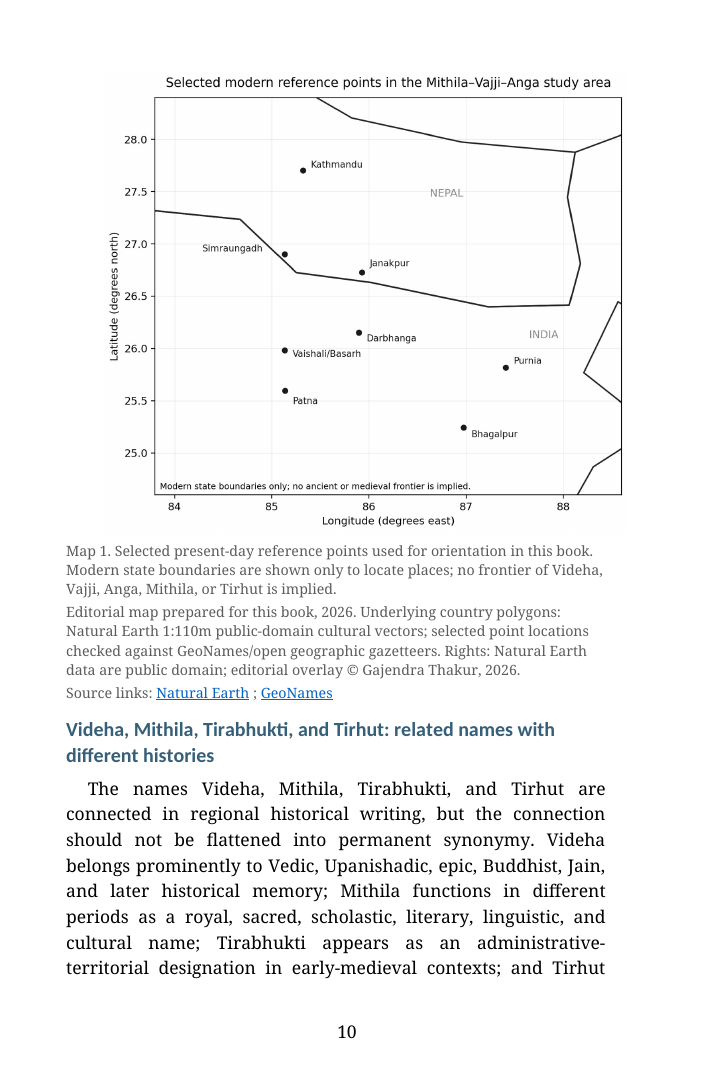
Mithila · Vajji · Anga
Chapter-specific source notes
- Primary chapter witness. Gajendra Thakur, Decoding the Panji of Mithila — Volume IV, formal Chapter 3, PDF pp. 36-47; formal Chapter 3. The HTML transcription is generated from the commit-pinned source PDF and retains the chapter boundary recorded in this edition.
- Internal structure. The repository source-heading inventory records 15 subordinate headings for this chapter: “3.1 The Route Formula as the Spine of the Nagram Panji”; “3.2 Village as Identity, Not Merely Location”; “3.3 The Difference Between Origin, Settlement, and Affiliation”; “3.4 The Route Formula and Marriage Memory”; “3.5 Route Clusters and Branch Formation”; “3.6 Repetition of Village Routes”; “3.7 Place-Names as Evidence of Regional Expansion”; “3.8 The Sacred Route and the Secular Route”; ….
- Digital editorial method. The page keeps the preserved source text distinct from generated navigational, concordance, visual, and provenance apparatus. The synthetic reconstruction is explanatory only and is not evidence for an individual lineage or a determination of social or marital status.