Decoding the Panji of Mithila · Volume IV · Chapter 4
Persons, Titles, and Social Roles in the Nagram Panji
Chapter 4
Persons, Titles, and Social Roles in the Nagram
Panji

4.1 Why a Name Alone Is Not Enough
   The Nagram Panji does not identify a person by name alone.
A name is only the first layer of recognition. Around the name
stand father, son, village, title, branch, profession, sacred
context, and sometimes a nickname or alternate name.
Without these surrounding markers, a modern reader may
mistake one person for another, especially because many
names recur across the register.
   This chapter explains how persons are socially positioned in
the Nagram Panji. The purpose is not merely to translate titles.
It is to show how titles and roles help the reader decode
identity. A man called Gopal, Vishwanath, Ramanath,
Madhurapati, Shivanandan, Shyamalal, or Lakshminath may
appear in several places. His actual identity depends on the
attached relations: whose son he is, which branch he belongs
to, which village-route names him, and what title or office is
joined to his name.
   The Panji therefore works with a layered identity system.
The first layer is personal name. The second is descent. The
third is village affiliation. The fourth is social title. The fifth is
cross-reference. A stable reading emerges only when all these
layers are kept together. If one layer is isolated and treated as
complete, the genealogy may be distorted.

4.2 The Person as a Relational Being
   In modern documents, an individual is often identified by a
fixed surname, date of birth, and address. In the Panji, the
person is relational. He is someone’s son, the descendant of a

branch, the holder of a title, or the member of a village-route.
Even when a personal name appears prominent, it is rarely
free-standing. The Panji places him inside a chain.
  This relational method reflects the purpose of the register.
The Panji was not designed to celebrate isolated biography. It
was designed to preserve lineage and regulate social memory.
A person mattered because he formed a link between
ancestors and descendants, between one village and another,
between one marriage network and another, and between
older reputation and later continuation.
    For this reason, the English decoding in this volume will
avoid turning every named figure into a separate biographical
subject. Instead, the person will be read as a node. A node may
connect upward to a father, downward to sons, sideways to
marriage branches, outward to villages, and historically to
titles or occupations. This is the correct way to read the
Nagram Panji.

4.3 Sonship Markers and the Grammar of Descent
   The most frequent social relation in the Panji is sonship.
Forms equivalent to 'son of' and 'sons of' are constantly used
to move from one generation to the next. These forms may
appear in different spellings or grammatical shapes, but their
function is to establish descent. They tell the reader that the
following name belongs to the next genealogical level.
   The difficulty is that the Panji often lists several sons in
rapid succession. A single ancestor may be followed by two,
three, four, or more sons, and each son may then open
another branch. Modern punctuation is not always available
to separate them. The editor must therefore rely on the
relational markers, the sequence of names, and the repeated
village formulae.

   In the English chapters, sonship will be decoded carefully.
Where the source clearly lists sons, the explanation will say so.
Where the source appears to move to a grandson or later
descendant, the explanation will mark the shift. Where the
relation is uncertain, the uncertainty will be preserved. This is
essential because the difference between son, grandson,
descendant, and collateral branch is not minor; it changes the
genealogy.

4.4 Branch Names, House Names, and
Remembered Lines
  The Panji frequently treats a family branch almost like a
person. A branch may be introduced through an ancestor,
then known by a later figure, a nickname, or a village.
Sometimes the branch-name becomes more important than
the original personal name. This is especially true where a
descendant became famous, where a house acquired a title, or
where a village association became the chief identifying mark.
   The editor must therefore distinguish between an
individual name and a branch label. A name followed by
several descendants may be an individual. But the same name,
when repeatedly used as a heading or organizing marker, may
also function as the remembered name of a house. The Panji
does not always explicitly say which is intended. Context must
decide.
   This volume will use terms such as 'branch', 'line', 'house',
or 'cluster' only when the source pattern supports them. It will
not impose modern family-tree categories where the Panji
gives a looser memory. The goal is to clarify without flattening
the source.

4.5 Honorific Titles: Thakur, Chaudhary, Pandit,
and Related Markers
   Honorific titles appear throughout the Nagram material.
Titles such as Thakur, Chaudhary, Pandit, and related
abbreviated forms do more than decorate a name. They show
social position, household recognition, scholarly identity,
ritual status, or local authority. In some entries the title is
inherited; in others it may be attached to a particular person
because of learning, office, or reputation.
   The abbreviated form often written as 'th.' must be treated
with care. It usually points to a title or honorific equivalent to
Thakur, but its precise function depends on context. It may
mark the principal person in an entry, a respected
householder, or a recognized branch-holder. Similarly, forms
suggesting Chaudhary or Pandit may indicate status, title,
function, or learned identity. They should not be translated
loosely without explanation.
   In this volume, such titles will usually be retained in
transliterated form when a direct English equivalent would be
misleading. For example, 'Thakur' should not be translated
simply as 'lord' or 'landlord' in every case. Its genealogical and
social function is more specific than either English word.
'Pandit' likewise should not be reduced merely to 'scholar',
because in Mithila it may carry ritual, textual, and social
implications.

4.6 Scholarly and Ritual Designations
  The Nagram Panji preserves a world in which learning was
a major marker of identity. Designations connected with
scholarship, astrology, ritual expertise, teaching, or scriptural
authority occur in many places. Some entries preserve forms
corresponding to Jyotishi, Mahamahopadhyaya, Upadhyaya,
Vaidya, Acharya, Sahityacharya, and similar designations.

These must be read as part of the social history of Mithila’s
learned lineages.
   A scholarly title may identify an individual’s learning. It
may also identify a family reputation. A house known for
ritual service, astrology, Sanskrit learning, medical learning,
or literary scholarship could retain that mark across entries.
In such cases, the title is not merely biographical; it is
genealogical evidence. It tells us how the family was
remembered.
  The English explanation will therefore preserve these
designations wherever possible and explain their likely
function. If the title is clear, it will be identified. If the
abbreviation is uncertain, it will be left cautiously. If a title
appears with a modern occupation, both will be explained,
because the coexistence of older and newer markers is one of
the most important features of this Panji.

4.7 Priestly, Astrological, and Learned Authority
    Mithila’s Panji tradition cannot be separated from learned
authority. The Panjikars themselves belonged to a culture in
which genealogy, ritual purity, marriage regulation, textual
learning, and social recognition were interdependent. When
the Nagram Panji records a person with a learned or ritual
title, it is placing him within that culture of authority.
   Astrological and priestly designations are especially
important because marriage, ritual timing, and genealogical
verification were connected. A family known for such work
could become a point of reference beyond its immediate
household. A learned man might therefore appear not only as
a descendant but as a marker of the branch’s prestige.
   This volume will not automatically assume that every
learned title implies priestly office. Nor will it assume that
every ritual designation implies high textual scholarship. The

Panji’s words must be read according to context. But the
general point remains: learned and ritual titles are not
ornamental. They are evidence of social function.

4.8 Royal, Administrative, and Local Authority
Titles
  Some titles in the Nagram Panji suggest local authority,
administrative recognition, or elite household status. Words
equivalent to Raja, Babu, Chaudhary, Rai, and other
designations may appear in different contexts. Their meaning
can vary widely. In one entry, a title may be part of a name. In
another, it may signal rank. In another, it may preserve local
respect rather than formal office.
    The editor must therefore avoid both exaggeration and
minimization. It would be wrong to treat every occurrence of
Raja as proof of kingship. It would also be wrong to ignore the
status implied by the title. The safer method is to record the
title, identify its possible role, and examine whether the
surrounding entry supports a formal or honorific reading.
    Similarly, Babu may indicate respect, household standing,
or a later social mode of address. It may not be a genealogical
title in the strict sense, but in a Panji it still helps identify the
person. Such markers are part of the social texture of the
record and should not be silently removed.

4.9 Modern Professions inside an Older
Genealogical Form
  One of the remarkable features of the Nagram material is
the presence of modern occupational markers. Entries may
include lawyer, engineer, doctor, principal, teacher, or similar
designations. These references show that the Panji did not end
with the old scholastic world. It continued to absorb newer
forms of identity.

   The appearance of a modern profession does not break the
traditional form of the Panji. Rather, it shows the adaptability
of the register. The same genealogical grammar that records
sons, villages, and titles can also record an engineer or a
doctor. This is evidence of continuity through change. The
family remains inside the old lineage structure, while the
person’s modern role is added as a new identifying layer.
   In decoding such entries, the modern profession will be
treated as an identifier, not as the main genealogy. For
example, if a person is marked as a lawyer or engineer, that
helps distinguish him from others of the same name. But his
genealogical place still depends on the father, branch, and
village-route. The profession clarifies the node; it does not
replace the lineage.

4.10 Nicknames, Alternative Names, and the
Marker “pr.”
  The Panji frequently preserves alternate names, familiar
names, or names by which a person was popularly known.
These may be introduced by abbreviations such as 'pr.' or by
placement in the entry. The likely function is often equivalent
to 'called', 'known as', 'alias', or 'popularly named'. Such
markers are extremely valuable because they connect formal
genealogy with lived social memory.
   A person may have a formal Sanskritic name and a shorter
household name. He may be known in one village by one
name and in another context by another. A branch may
preserve a nickname because that is how the person was
remembered by the community. The Panji does not treat these
alternate names as trivial. It records them because they help
identification.
   In English, this volume will generally explain 'pr.' as 'known
as' or 'also called' when context supports that reading. Where

the abbreviation is uncertain, it will be retained and
discussed. The goal is to preserve the source marker while
making the identity legible to the reader.

4.11 Collective Suffixes and Grouped Sons
   Many entries list several names followed by a collective
indication that they belong together. A group of sons may be
given in a compact sequence before the entry moves to one of
them. In some cases the cluster ends with a suffix or marker
suggesting that all the preceding names are included. The
reader must recognize when a group has been formed.
  This is especially important because the Panji may then
expand only one member of the group while leaving others
unexpanded. A modern reader may think the unexpanded
names are incomplete, but the source may simply be
recording them as members of the group. Conversely, a name
that appears after the group may belong to the next relation,
not to the same group. The sequence must be read carefully.
   In this volume, grouped names will be unpacked in
explanatory prose. Where the source lists several sons, they
will be named as a group. If one is then expanded, the
explanation will say so. This prevents the common error of
treating every name in a line as being on the same
genealogical level.

4.12 Female Presence in a Male-Line Register
   The Panji is primarily organized through male descent, but
it is not without female presence. Women often appear
indirectly through marriage relations, daughter-giving and
daughter-taking connections, or references to sons born
through a particular alliance. In some places the language
may indicate daughters, wives, or related female-linked
branches, though the form is compressed.

   A responsible decoding must therefore not say that women
are absent from the Panji. They are often structurally present
even when not individually named. Marriage routes, village
affiliations, and branch connections frequently depend on
women’s movement between houses. The male-line register
preserves this movement indirectly.
   When the source clearly names or implies a female relation,
this volume will explain it. Where the relation is only inferred
through village-route and matrimonial logic, the inference will
be stated cautiously. The point is not to force modern
expectations into the source, but to recognize that the social
network recorded by the Panji could not exist without
women’s genealogical role.

4.13 Social Rank and Genealogical Caution
    Titles can easily tempt the reader into overinterpretation. A
title may look grand, but its meaning may be local. A scholarly
designation may be precise in one context and honorific in
another. A modern profession may distinguish a person but
not change his genealogical status. The editor must therefore
handle every title with restraint.
   Genealogical caution means that titles should be recorded
faithfully, translated carefully, and interpreted only as far as
the source permits. If the Panji gives a person as Thakur, the
edition may preserve Thakur. If it gives a person as
Mahamahopadhyaya, that high scholarly designation should
be noted. If it gives a person as engineer or doctor, that
modern identifier should be retained. But no additional status
should be invented.
  This caution is especially necessary because the Panji
concerns real families and remembered ancestors. A modern
edition must not inflate, erase, or rearrange social status. It
must explain the evidence as evidence.

4.14 When Title and Name Become Inseparable
  In many traditional records, title and name become
inseparable. A person may be remembered not simply as
'Madhurapati' or 'Vagish' but as a titled figure whose title is
part of his identity. Later descendants may refer to him by
that combined form. The Panji often preserves such combined
memory.
  The same is true of learned titles and honorifics. A famous
scholar may be remembered through his designation as much
as through his given name. A respected householder may be
remembered through Thakur or Babu. A professional
descendant may be remembered through Vakil, Engineer, or
Doctor. These words are part of the identifying apparatus of
the entry.
   In English prose, this volume will not strip titles away for
stylistic simplicity. If the title is part of the source identity, it
will remain visible. The explanation may then clarify whether
it is an honorific, a scholarly title, a profession, or an
uncertain marker.

4.15 The Role of Place in Social Status
   A title rarely stands alone in the Nagram Panji. It is usually
joined to a place. A learned man from one village, a Thakur of
another, a branch connected through a third, a professional
descendant settled in a fourth: these combinations create
social identity. Place and title together make the person
legible.
   This is why a chapter on titles must follow the chapter on
village-routes. The route tells us where the person is placed in
the network. The title tells us how he was recognized within
that network. The two must be read together. A title without
place may be ambiguous; a place without title may be
incomplete; together they form a stronger identification.

  Later decoding chapters will therefore present persons
through combined identifiers: name, father, branch, village-
route, title, and cross-reference. This will make the entries
readable while preserving their original structure.

4.16 Modern English Treatment of Traditional
Titles
   Because this book is in English, a consistent editorial policy
is necessary. Some titles will be translated, some
transliterated, and some explained rather than translated. The
choice depends on whether English has an adequate
equivalent. Many Mithila titles do not have exact English
equivalents. Literal translation may mislead more than it
helps.
   For example, Pandit may be left as Pandit and explained as
a learned or ritual title depending on context.
Mahamahopadhyaya should usually be retained because it is a
specific scholastic honor. Jyotishi may be explained as
astrologer, but the traditional connotation should not be lost.
Vakil may be rendered as lawyer when the context is modern.
Engineer and Doctor can be translated directly because they
are modern professional markers. Thakur and Chaudhary
should generally be retained with explanation rather than
flattened into English rank-words.
  This policy will give the English reader clarity without
removing the cultural texture of the Panji. The book is English
in language, but it must remain faithful to the Maithil
genealogical world it explains.

4.17 Titles as Chronological Clues
   Titles can also help establish relative chronology. Older
entries may emphasize lineage, village, ritual learning, and
traditional honorifics. Later entries may include modern
professions such as lawyer, engineer, doctor, or principal. This

does not produce exact dates, but it provides a chronological
texture.
   When an entry includes a modern profession, it probably
belongs to a more recent genealogical layer than an entry that
only gives older formulae. When a branch moves from
traditional learned titles to modern educational or
professional markers, the Panji is silently recording social
change. It shows the movement from scholastic and ritual
authority into modern education, law, medicine, engineering,
and administration.
   This volume will use such clues carefully. It will not date an
entry solely by a title. But it will note when titles indicate a
later layer of family memory. This is particularly important
because the Nagram material reaches into a period where old
and modern identities coexist.

4.18 The Ethics of Naming
  To decode a Panji is to handle names with responsibility. A
name in a genealogical register is not an abstract word. It
belongs to a remembered person and to families who may still
identify with that memory. The editor must therefore avoid
careless   normalization,    unnecessary   translation,    or
speculative identification.
  If a name is written in a variant form, the source form
should be respected. If a name appears damaged, that damage
should be acknowledged. If an honorific is attached, it should
be retained. If an alternate name is given, both forms should
be preserved. If two persons share a name, they should not be
merged unless the source supports the merger.
   This principle is especially important in a volume that aims
to leave nothing unexplained. Explaining everything does not
mean deciding everything. Sometimes the correct explanation

is that the source preserves uncertainty. The name must be
left open until better evidence appears.

4.19 Preparing for the First Detailed Decoding
  The next chapters will apply the principles of the first four
chapters to the opening Nagram material. The reader has now
been given the basic tools: the meaning of the Panji form, the
grammar of abbreviations, the logic of village-routes, and the
function of titles and social roles. With these tools, the
Sandahpur-Singhwar and Sandahpur-Shashipur entries can
be opened carefully.
    The first detailed decoding will not merely list the names
again. It will identify the heading, explain the route, separate
the principal nodes, trace the sonship lines, mark the village
affiliations, preserve the uncertain gaps, and note the social
titles. It will show how a compact Panji entry can be expanded
into a readable genealogical analysis.
   The method is deliberate because the source is difficult. A
reader who has not learned the code may see only a dense
crowd of names. A reader who has learned the code will see
structure: ancestor, branch, village, title, relation, memory,
and uncertainty. That structure is the heart of the Nagram
Panji.

4.20 Summary: Personhood in the Nagram Panji
  The Nagram Panji understands a person through
connection. Name, father, son, branch, village, title,
profession, and cross-reference all help define identity. None
should be ignored. A modern reader may want a single fixed
identifier, but the Panji gives a layered one. That is not a
weakness. It is the way the register preserves social reality.
  Titles and roles must therefore be decoded with the same
care as names and villages. Thakur, Chaudhary, Pandit,
Jyotishi, Mahamahopadhyaya, Vaidya, Vakil, Engineer, Doctor,

and similar markers are not peripheral. They help locate
persons within a changing Maithil world. They show
continuity from traditional learning to modern professions,
from village-based identity to wider regional movement.
  The central lesson of this chapter is that no person in the
Panji stands alone. Every person is a point in a network. To
decode the Nagram Panji is to recover that network without
simplifying it beyond recognition. The next chapter will begin
the first extended decoding of the opening route: Nagram,
Sandahpur, Singhwar, and the earliest connected branches.
Source structure and verification apparatus
Editorial source apparatus. This apparatus is descriptive, not interpretive. It records the source-controlled structure used to verify that this page corresponds to formal Chapter 4 of Decoding the Panji of Mithila — Volume IV. The chapter text above is preserved from PDF pp. 48-61; formal Chapter 4 in the commit-pinned authoritative source. It is not merged with a neighboring chapter, appendix, annexure, or independent front/back-matter unit. The internal headings below come from the repository’s source-heading inventory and are retained as navigational and audit evidence; showing them here does not turn those headings into separate publications or add claims that are absent from the source.
Internal source headings
- 4.1 Why a Name Alone Is Not Enough
- 4.2 The Person as a Relational Being
- 4.3 Sonship Markers and the Grammar of Descent
- 4.4 Branch Names, House Names, and Remembered Lines
- 4.5 Honorific Titles: Thakur, Chaudhary, Pandit, and Related Markers
- 4.6 Scholarly and Ritual Designations
- 4.7 Priestly, Astrological, and Learned Authority
- 4.8 Royal, Administrative, and Local Authority Titles
- 4.9 Modern Professions inside an Older Genealogical Form
- 4.10 Nicknames, Alternative Names, and the Marker “pr.”
- 4.11 Collective Suffixes and Grouped Sons
- 4.12 Female Presence in a Male-Line Register
- 4.13 Social Rank and Genealogical Caution
- 4.14 When Title and Name Become Inseparable
- 4.15 The Role of Place in Social Status
- 4.16 Modern English Treatment of Traditional Titles
- 4.17 Titles as Chronological Clues
- 4.18 The Ethics of Naming
- 4.19 Preparing for the First Detailed Decoding
- 4.20 Summary: Personhood in the Nagram Panji
Source-text concordance
Persons · Titles · Social · Roles · Nagram · Name · Alone · Enough · identify · person · first · layer · recognition · Around · stand · father · village · title · branch · profession · sacred · context · sometimes · nickname · alternate · Without · surrounding · markers · modern · reader · mistake · another · especially · many · names · recur · across · register · explains · socially · positioned · purpose · merely · translate · show · help · decode · identity · called · Gopal · Vishwanath · Ramanath · Madhurapati · Shivanandan · Shyamalal · Lakshminath · appear · several · places · actual · depends · attached · relations · whose · belongs · village-route · office · joined · therefore · works · layered · system · personal · second · descent · third · affiliation · fourth · fifth · cross-reference
Boundary verification. In the formal sequence this chapter follows Volume IV Chapter 3, “The Logic of “From Village to Village”” and precedes Volume IV Chapter 5, “Reading Gaps, Blanks, and “Rikta””. The chapter extractor begins at the verified formal Chapter 4 marker and stops at the next verified formal chapter marker; for a final chapter it stops before recognized book-level back matter. The concordance above is generated only from distinct terms already present in this chapter’s preserved source text. It is provided for discovery, comparison, and audit, not as an automated judgment about persons, lineages, status, kinship, marriage eligibility, or historical truth.
Illustrated research apparatus
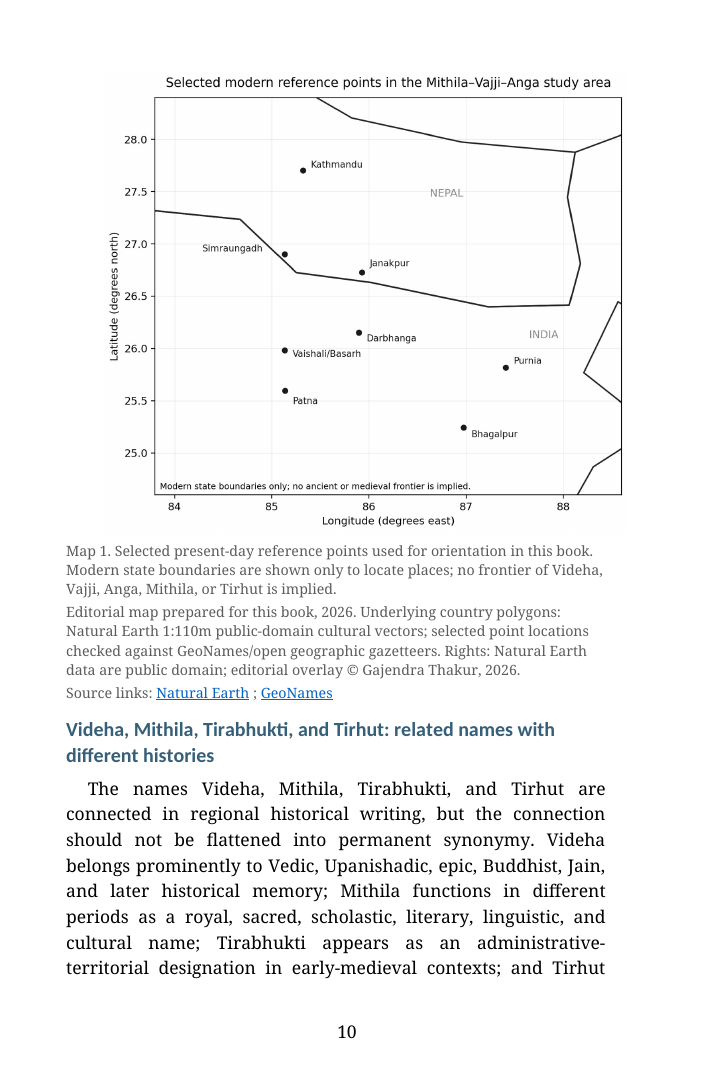
Mithila · Vajji · Anga
Chapter-specific source notes
- Primary chapter witness. Gajendra Thakur, Decoding the Panji of Mithila — Volume IV, formal Chapter 4, PDF pp. 48-61; formal Chapter 4. The HTML transcription is generated from the commit-pinned source PDF and retains the chapter boundary recorded in this edition.
- Internal structure. The repository source-heading inventory records 20 subordinate headings for this chapter: “4.1 Why a Name Alone Is Not Enough”; “4.2 The Person as a Relational Being”; “4.3 Sonship Markers and the Grammar of Descent”; “4.4 Branch Names, House Names, and Remembered Lines”; “4.5 Honorific Titles: Thakur, Chaudhary, Pandit, and Related Markers”; “4.6 Scholarly and Ritual Designations”; “4.7 Priestly, Astrological, and Learned Authority”; “4.8 Royal, Administrative, and Local Authority Titles”; ….
- Digital editorial method. The page keeps the preserved source text distinct from generated navigational, concordance, visual, and provenance apparatus. The synthetic reconstruction is explanatory only and is not evidence for an individual lineage or a determination of social or marital status.