Decoding the Panji of Mithila · Volume IV · Chapter 5
Reading Gaps, Blanks, and “Rikta”
Chapter 5
Reading Gaps, Blanks, and “Rikta”

5.1 Why Absence Must Be Read
   A genealogical register does not speak only through names.
It also speaks through absence. In the Nagram Panji, gaps,
dotted spaces, damaged names, incomplete village references,
and entries marked as rikta are not accidents to be brushed
aside. They are part of the surviving record. A responsible
decoding must therefore explain not only what is present but
also what is missing.
  Modern readers often expect a genealogy to be complete.
They want an ancestor, a father, a son, a village, and a
continuous line. The Panji does not always provide such
completeness. Sometimes the compiler knew that a relation
existed but did not possess the name. Sometimes the name
existed in the older memory but had become unreadable in
the available copy. Sometimes the lineage was known only
through a village-route. Sometimes an entry was reserved for
a branch but left empty. These absences reveal the history of
the document itself.
   The purpose of this chapter is to establish the editorial
discipline for reading such absences. This is essential before
the detailed decoding begins. Without a clear policy, the
temptation would be to fill blanks, smooth over uncertainty,
or remove empty entries. That would make the book easier to
read but less faithful to the Panji. Volume IV will not do that. It
will preserve the signs of incompleteness and explain their
possible meanings.

5.2 The Meaning of Dotted Gaps
  Dotted gaps are among the most frequent signs of
incompleteness in the Nagram material. They usually indicate

that some part of the expected formula is missing: a name, a
father, a village, a title, a branch, or a continuation. In a
compact Panji entry, even a small omission can alter the
interpretation. A missing father may prevent the line from
being securely placed. A missing village may obscure whether
the entry records origin, marriage, or settlement. A missing
son may break the sequence of descent.
   The dots should not be interpreted as decorative
punctuation. They are visible markers of absence. They show
that the scribe or compiler preserved the shape of the entry
even when the content was incomplete. In this sense, the gap
is honest. It tells the reader: something belonged here, but the
record no longer gives it clearly.
   In the English decoding, dotted gaps will be handled in a
simple way. If the missing element can be identified by
grammar but not by name, the explanation will say, for
example, that the name of the father is missing, or that the
village after the route-marker is not preserved. If the kind of
missing element is unclear, the gap will be described more
cautiously. No name will be supplied merely because it seems
likely.

5.3 “Rikta” as an Archival Statement
   The word rikta, meaning empty or vacant, carries special
importance. An entry marked rikta is not the same as an entry
that never existed. It is an entry whose place in the sequence
has been acknowledged but whose content is absent. The
number, heading, or route may be preserved, while the
internal genealogical detail is missing. This tells us that the
register’s architecture remained known even where the
content had dropped out.
  A rikta entry can have several possible explanations. The
branch may have had no recorded continuation. The details

may have been lost before copying. The compiler may have
left space for later completion. The relevant family may have
been known by name but not available for verification. Or the
entry may have been part of a numbering system copied from
an older register in which the original text was already
missing.
   This volume will never delete rikta entries. They will be
listed, indexed, and explained. They are important for cross-
checking coverage at the end of the book. When the final
index is supplied, every rikta heading must be accounted for,
even though there is no full genealogy to decode within it.

5.4 Blank Does Not Mean Unimportant
    A blank entry may seem unimportant because it contains
little or no information. But in a Panji, even the existence of
the heading may be valuable. It may preserve a village-name,
a route, an invocation heading, a number, or the memory of
an expected branch. The absence of names does not erase the
evidence supplied by the heading itself.
  For example, a heading may tell us that a particular village-
route belonged within the Nagram sequence even though the
names are missing. Another heading may preserve a sacred
invocation tied to a section. Another may show that the
numbering of the register passed through a branch now
empty. Such details help reconstruct the organization of the
Panji.
   The editor must therefore ask two questions of every blank.
First: what is missing? Second: what remains? The remaining
material may be small, but it may still be useful. Volume IV
will treat blank entries as fragments of structure, not as
useless debris.

5.5 Broken Names and Damaged Readings
   Many names in the Nagram material appear in damaged,
variant, or uncertain forms. Some may be the result of scribal
habits. Some may reflect local pronunciation. Some may come
from copying errors. Some may be affected by later
digitization or transcription. The editor must distinguish, as
far as possible, between a genuine local form and a damaged
reading.
  The safest principle is to preserve the source form while
explaining uncertainty. If a name appears as a recognizable
variant, the note may identify the likely standard form. But if
the reading is genuinely uncertain, it should not be
normalized. A wrong normalization can create a false
ancestor, merge two different persons, or hide a local form
that has historical value.
  This is especially important in a register where names
recur. A damaged form of one name may resemble another
common name. If the editor silently changes it, the branch
may be connected to the wrong person. Therefore, when a
reading is doubtful, the uncertainty will be visible in the
English explanation.

5.6 Variant Spellings of Villages
   Village names are particularly vulnerable to variation. The
same place may be written with slightly different spellings in
different entries. Some differences may reflect pronunciation.
Others may reflect scribal inconsistency. Some may result
from the difficulty of representing local place-names in
compact Panji writing. In a genealogical register, such
variation is normal.
   The danger lies in treating every spelling difference as a
different place, or in treating every similar-looking name as
the same place. Both errors are possible. A small difference

may be insignificant, but it may also point to a different
village. The decision must depend on surrounding evidence:
the route, the associated family, the neighboring entries, and
repeated patterns elsewhere in the Panji.
  This volume will therefore use cautious place-identification.
The source form will be preserved where necessary. A likely
normalized form may be given in explanation, but only when
the context supports it. The village index at the end of the
project will be essential for checking such variants.

5.7 Incomplete Village-Routes
  Sometimes the Panji gives the beginning of a route but not
the end. Sometimes it gives the destination but leaves the
origin unclear. Sometimes the formula is interrupted by a
damaged name or dotted gap. Such incomplete route-lines
must be handled carefully because the route formula is one of
the main organizing principles of the Nagram Panji.
   An incomplete route may still tell us something. If the origin
is preserved, it may identify the branch’s starting point. If the
destination is preserved, it may show a known connection. If a
middle element is missing, the surrounding entries may help
reconstruct the probable pattern. But reconstruction must not
become invention.
  In the detailed chapters, incomplete routes will be
described in terms of what is secure and what is not. The
explanation may say that the entry begins from a given village
but the destination is missing, or that a destination is named
but the earlier affiliation is unclear. Such statements are more
useful than false certainty.

5.8 Cross-References with Missing Context
  The Nagram Panji includes numbered references and B-
references. These often point to another part of the register,
another folio, another branch, or a related entry. But a cross-

reference is not always fully resolvable from the immediate
line. Sometimes the referenced material is not visible in the
same section. Sometimes the number is damaged or
ambiguous. Sometimes the reference survives but its target
remains uncertain.
   A cross-reference with missing context should be preserved
exactly. It should not be ignored simply because it cannot be
resolved at once. The reference may become meaningful later
when the index, appendix, or another entry is checked. It may
also be valuable evidence of the register’s internal
architecture.
  In this volume, cross-references will be collected and
indexed. When their function is clear, it will be explained.
When their function is unclear, the uncertainty will be stated.
The final cross-checking index promised at the end of the
project will be especially useful for verifying whether these
references have been fully accounted for.

5.9 Repetition and Apparent Duplication
  One common source of confusion is repetition. The same or
similar entry may appear more than once, or the same name
may recur in a different branch. A modern editor may be
tempted to remove what appears to be duplication. That
would be dangerous. In a Panji, repetition may have a
function.
    A repeated name may represent a different person bearing
the same name. A repeated branch may be recorded because
it is relevant to more than one village-route. A repeated village
may appear because different sons or descendants established
separate connections with it. A repeated title may indicate
continuity of status within a family. Even an apparently
repeated blank may preserve a separate place in the register’s
sequence.

   Therefore, this volume will not remove repetitions. It will
explain them. If two entries appear to refer to the same
branch, the explanation may note the likely overlap. If they
clearly belong to different contexts, the distinction will be
preserved. Apparent duplication is not an editorial defect; it is
often a clue to the Panji’s networked structure.

5.10 Names Without Fathers
   Sometimes a person is named without a clearly preserved
father. This creates difficulty because father-son relation is the
backbone of the Panji. A fatherless name may be an
independent branch-holder, a damaged continuation, a
known person whose father was assumed, or a name inserted
from oral memory without full genealogical detail.
   The editor must not automatically attach such a name to the
nearest preceding person. Proximity in the line is evidence,
but it is not always decisive. The syntax, markers, village-
route, and branch context must all be considered. If the
connection remains uncertain, the English decoding must say
so.
  A name without a father can still be valuable. It may
preserve a remembered figure, a title-holder, a local ancestor,
or a marriage connection. But it must be handled as
incomplete evidence unless the surrounding grammar makes
the relation clear.

5.11 Fathers Without Clear Descendants
   The opposite problem also occurs. A person may be named
as a father or principal node, but the descendant sequence
after him may be incomplete. Sons may be partly listed, a
branch may be broken, or the entry may move away before
the line is finished. This can happen when the source has lost
part of the record or when the compiler recorded only the
relevant descendant for a particular route.

  Such entries remind us that the Panji is not always a full
biological genealogy. It is a practical genealogical register. It
records what was needed for recognition, marriage, affiliation,
or branch identification. A father may be named only because
one descendant’s connection had to be preserved.
   In the decoding chapters, these entries will not be expanded
beyond the evidence. The explanation will identify the named
father, the preserved descendants, and the point at which the
record becomes incomplete.

5.12 The Problem of “Apara” and Secondary
Branches
   The marker corresponding to apara or apra often
introduces another branch, another son, another relation, or
an additional line. It is one of the most important indicators
for reading the Nagram Panji. But it also creates difficulty
because what follows may not always be parallel to what
came before. Sometimes it introduces another son; sometimes
another wife-line or branch; sometimes a collateral extension;
sometimes simply an additional genealogical note.
   When apara appears near a gap, the difficulty increases.
The editor must decide whether the missing portion belonged
to the previous branch or to the new one. This cannot be done
mechanically. The surrounding names and village markers
must be read carefully.
  In this volume, apara will usually be explained as 'another
branch' or 'another line' unless the precise relation is clear.
This avoids falsely converting every apara into a simple
biological sonship marker. The Panji’s own flexibility must be
respected.

5.13 Sacred Headings with Sparse Entries
  Some sacred invocation headings are followed by
substantial genealogical material. Others are followed by
sparse or empty entries. The difference itself matters. A sacred
heading may have served as an archival divider even when
the genealogical content under it was later lost or never fully
entered.
  The editor should not assume that a sparse sacred entry is
meaningless. The invocation may identify a section, preserve
an older register division, or mark a remembered place in the
sequence. The heading may also help connect neighboring
entries even where internal names are absent.
  For this reason, sacred headings will be retained in the
English book. They will be translated or explained, but not
removed. When they occur with little or no genealogical
content, the lack of content will be noted rather than silently
passed over.

5.14 Modern Additions and Incomplete Recent
Memory
  The Nagram material includes modern titles and
professions in some places. Modern entries can also be
incomplete. A recent professional marker such as lawyer,
engineer, doctor, principal, or similar designation may appear
with a partial lineage. This shows that modernity did not
automatically make the record more complete. Family
memory could still be uneven.
    Modern additions may also have been inserted into older
genealogical frameworks. They can appear beside older titles,
traditional village-routes, and sacred headings. This
coexistence creates a layered text. The editor must identify the
modern marker while preserving the older structure around
it.

   When a modern entry is incomplete, it will be handled
under the same rules as older entries. No missing father,
village, or branch will be invented. The modern marker will
be explained, but the gap will remain visible.

5.15 Editorial Notes Without Overloading the
Reader
   A book that explains every gap can easily become
unreadable if the notes are too heavy. The challenge is to
preserve all uncertainty without burying the reader under
repetitive warnings. This volume will therefore use a balanced
method. Major uncertainties will be explained in the main
text. Repeated minor gaps will be summarized. Complete lists
will be placed in appendices and indexes.
   For example, if a chapter contains many dotted gaps, the
first few may be explained in detail to show the pattern. Later
instances may be grouped: 'several names in this cluster are
missing in the source.' But the appendix will still record each
incomplete entry. This allows the book to remain readable
while preserving full coverage.
  The final index supplied for cross-checking will be used to
verify that no entry has disappeared merely because it was
incomplete. The promise to leave nothing unexplained means
that every blank must be visible somewhere in the book’s
apparatus.

5.16 The Difference Between Explanation and
Completion
   This chapter rests on a crucial distinction: to explain a gap
is not to complete it. Explanation clarifies what kind of
absence appears in the source. Completion supplies missing
content. The first is necessary; the second is dangerous unless
supported by evidence.

   For example, if an entry reads as though a father’s name is
missing, the explanation may say that the father’s name is
absent. It should not supply a father from another entry
unless the cross-reference is secure. If a village appears in a
damaged form, the note may say that it resembles a known
village-name. It should not silently replace the source form
with a modern spelling unless the identification is certain.
  This distinction will guide every decoding chapter. The book
will be explanatory, not speculative. It will open the source
without pretending to repair every damage in it.

5.17 How Gaps Help Reconstruct the Panji’s
History
   The pattern of gaps can tell us something about the history
of the register. If many gaps occur in a particular cluster, that
may suggest a damaged source section, a weakly preserved
branch, or a copied framework without complete content. If
gaps occur mainly in names but not villages, the geographical
structure may have survived better than the personal lineage.
If villages are missing but names remain, the family memory
may have survived while the route-memory weakened.
   These patterns cannot always be proved, but they can guide
analysis. A register is itself a historical object. Its omissions,
repetitions, and damaged readings show how memory
travelled through manuscripts, oral correction, copying, and
later compilation.
   Volume IV will therefore treat gaps not only as problems
but as evidence. They show where memory was strong, where
it weakened, and where the archive preserved the shape of a
lost detail.

5.18 Preparing for Detailed Decoding
  The first five chapters have established the method needed
for the rest of the book. Chapter 1 introduced the Nagram
Panji as a map of memory. Chapter 2 explained its language
and abbreviations. Chapter 3 explained village-routes. Chapter
4 explained persons, titles, and social roles. This chapter has
explained how to read what is missing.
   The detailed decoding can now begin. The next chapter will
return to the opening section of the source and examine the
first Nagram entries: Sandahpur to Singhwar. It will not
simply repeat the names. It will show how the heading, route,
person-names, sonship markers, village affiliations, titles,
cross-references, and gaps work together.
   This preparation is necessary because the Nagram Panji is
dense. Once the reader understands the code, even a difficult
line becomes readable. The aim is to make that code visible
throughout the volume.

5.19 Summary: The Discipline of Incompleteness
  The Nagram Panji preserves both memory and the limits of
memory. Gaps, blanks, dotted spaces, damaged names,
incomplete    village-routes,    uncertain     cross-references,
repeated entries, and rikta headings are all part of the archive.
They must not be erased in the name of clarity. They must be
explained.
  The rule for this volume is therefore clear: preserve the
source, identify the structure, explain the uncertainty, and
avoid false completion. Where the Panji gives a name, the
name will be read. Where it gives a village, the route will be
explained. Where it gives a title, the social marker will be
decoded. Where it gives a blank, the blank will be recorded.
Where it gives a cross-reference, the reference will be retained
for later checking.

   Only this method can do justice to a voluminous
genealogical source. A complete decoding is not a fantasy of
perfect certainty. It is a disciplined account of what the source
gives, what it withholds, and what its silences reveal. With
that discipline in place, the book can now enter the first major
Nagram cluster in detail.
Source structure and verification apparatus
Editorial source apparatus. This apparatus is descriptive, not interpretive. It records the source-controlled structure used to verify that this page corresponds to formal Chapter 5 of Decoding the Panji of Mithila — Volume IV. The chapter text above is preserved from PDF pp. 62-74; formal Chapter 5 in the commit-pinned authoritative source. It is not merged with a neighboring chapter, appendix, annexure, or independent front/back-matter unit. The internal headings below come from the repository’s source-heading inventory and are retained as navigational and audit evidence; showing them here does not turn those headings into separate publications or add claims that are absent from the source.
Internal source headings
- 5.1 Why Absence Must Be Read
- 5.2 The Meaning of Dotted Gaps
- 5.3 “Rikta” as an Archival Statement
- 5.4 Blank Does Not Mean Unimportant
- 5.5 Broken Names and Damaged Readings
- 5.6 Variant Spellings of Villages
- 5.7 Incomplete Village-Routes
- 5.8 Cross-References with Missing Context
- 5.9 Repetition and Apparent Duplication
- 5.10 Names Without Fathers
- 5.11 Fathers Without Clear Descendants
- 5.12 The Problem of “Apara” and Secondary Branches
- 5.13 Sacred Headings with Sparse Entries
- 5.14 Modern Additions and Incomplete Recent Memory
- 5.15 Editorial Notes Without Overloading the Reader
- 5.16 The Difference Between Explanation and Completion
- 5.17 How Gaps Help Reconstruct the Panji’s History
- 5.18 Preparing for Detailed Decoding
- 5.19 Summary: The Discipline of Incompleteness
Source-text concordance
Reading · Gaps · Blanks · Rikta · Absence · Must · Read · genealogical · register · speak · names · speaks · Nagram · dotted · spaces · damaged · incomplete · village · references · entries · marked · accidents · brushed · aside · part · surviving · record · responsible · decoding · therefore · explain · present · missing · Modern · readers · often · expect · genealogy · complete · want · ancestor · father · continuous · line · always · provide · completeness · Sometimes · compiler · knew · relation · existed · possess · name · older · memory · become · unreadable · available · copy · lineage · known · village-route · entry · reserved · branch · left · empty · absences · reveal · history · document · purpose · establish · editorial · discipline · essential · detailed · begins · Without
Boundary verification. In the formal sequence this chapter follows Volume IV Chapter 4, “Persons, Titles, and Social Roles in the Nagram Panji” and precedes Volume IV Chapter 6, “Sandahpur to Singhwar: The Opening Genealogical Frame”. The chapter extractor begins at the verified formal Chapter 5 marker and stops at the next verified formal chapter marker; for a final chapter it stops before recognized book-level back matter. The concordance above is generated only from distinct terms already present in this chapter’s preserved source text. It is provided for discovery, comparison, and audit, not as an automated judgment about persons, lineages, status, kinship, marriage eligibility, or historical truth.
Illustrated research apparatus
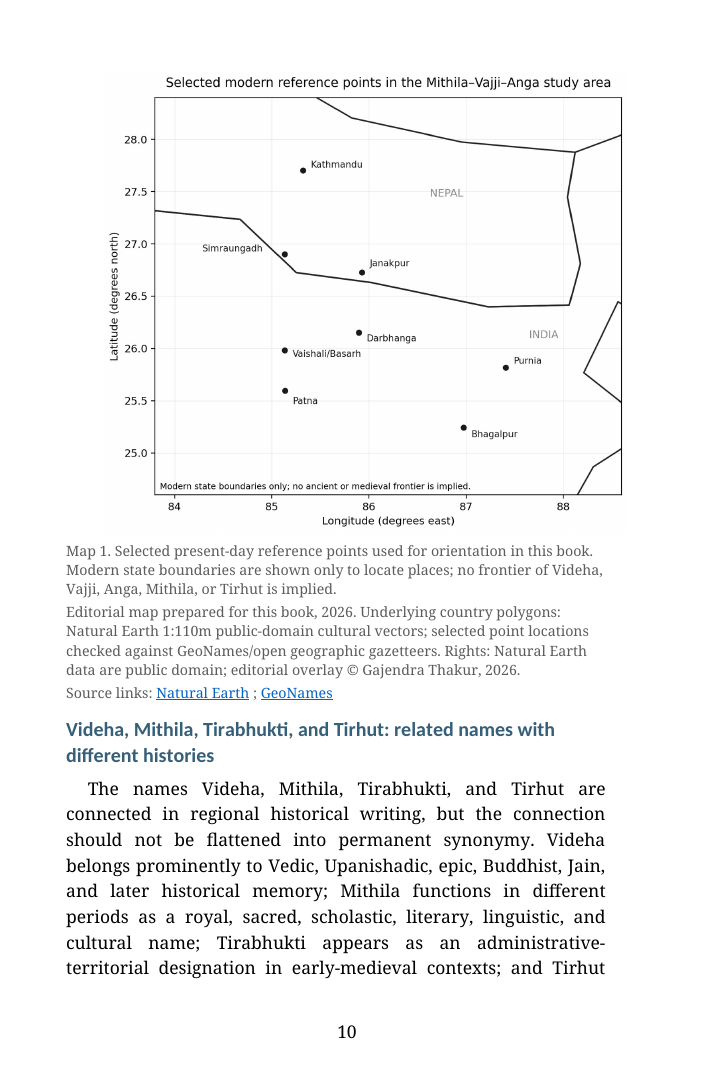
Mithila · Vajji · Anga
Chapter-specific source notes
- Primary chapter witness. Gajendra Thakur, Decoding the Panji of Mithila — Volume IV, formal Chapter 5, PDF pp. 62-74; formal Chapter 5. The HTML transcription is generated from the commit-pinned source PDF and retains the chapter boundary recorded in this edition.
- Internal structure. The repository source-heading inventory records 19 subordinate headings for this chapter: “5.1 Why Absence Must Be Read”; “5.2 The Meaning of Dotted Gaps”; “5.3 “Rikta” as an Archival Statement”; “5.4 Blank Does Not Mean Unimportant”; “5.5 Broken Names and Damaged Readings”; “5.6 Variant Spellings of Villages”; “5.7 Incomplete Village-Routes”; “5.8 Cross-References with Missing Context”; ….
- Digital editorial method. The page keeps the preserved source text distinct from generated navigational, concordance, visual, and provenance apparatus. The synthetic reconstruction is explanatory only and is not evidence for an individual lineage or a determination of social or marital status.