Decoding the Panji of Mithila · Volume IV · Chapter 6
Sandahpur to Singhwar: The Opening Genealogical Frame
Chapter 6
Sandahpur to Singhwar: The Opening
Genealogical Frame

6.1 Why the First Entry Matters
    The detailed decoding of the Nagram Panji begins with the
route Sandahpur to Singhwar. This opening is not a casual
beginning. It establishes the method by which the entire
Nagram material must be read. The heading announces a
route, the body gives a sequence of names, and the line then
expands through sons, secondary branches, village affiliations,
titles, and gaps. In compressed form, it gives the reader the
grammar of the whole Panji.
  The opening entry is especially important because it names
Nagram and immediately links it to Sandahpur and Singhwar.
The Panji does not begin by presenting Nagram as a self-
contained village. It begins by placing Nagram within a route
of relationship. This tells us that the Nagram Panji is not
simply a list of families who lived at one place. It is a network
record. Its basic unit is not only the person or the village, but
the relation between persons and villages.
   A modern reader may ask why the first line does not offer a
neat genealogical tree. The answer lies in the nature of Panji
writing. The Panji was designed for trained genealogical
reading. It assumes that the reader can recognize when a
name is a principal node, when a phrase introduces a son,
when another branch begins, when a village connection is
inserted, and when a missing portion interrupts the sequence.
The purpose of this chapter is to slow down the opening
cluster and show how such a line works.

6.2 The Heading: Nagram, Sandahpur, and
Singhwar
   The heading may be rendered in English as: Nagram: from
Sandahpur to Singhwar. The expression 'from Sandahpur to
Singhwar' should not be reduced automatically to a modern
migration statement. It may indicate origin and settlement,
branch affiliation, marriage route, or genealogical
classification. In the opening context, it serves first as a route-
marker. The family material that follows belongs to a
remembered connection between these places.
  The fact that the word Nagram appears with Sandahpur
and Singhwar is significant. It shows that Nagram is the
khanda or organizing section, while Sandahpur and Singhwar
mark the specific branch-route. This distinction will recur
throughout the book. A large section may carry one name,
while individual entries within it carry many route headings.
The reader must therefore distinguish the section-name from
the entry-route.
  The opening heading also uses a form indicating that the
Nagram western-side material is being written or registered.
This suggests not merely a genealogical note but an archival
act: the compiler is placing a branch within the written
Nagram record. The entry is therefore both a family statement
and a register statement.

6.3 The Formula of Registration
   The first entry contains a phrase equivalent to 'it is written'
or 'is being recorded.' Such formulae are easy to overlook, but
they are important. They tell us that the Panji is conscious of
itself as a written archive. It is not merely repeating oral
memory; it is converting memory into register form.
  The formula also warns us that the entry may have been
copied from an earlier source. When a genealogical record

says that a branch is written under a particular route, it may
preserve the arrangement of a previous register. This helps
explain why the entries sometimes contain cross-references,
numbered references, and incomplete portions. The Panji is a
layered text, not a single fresh composition.
   In the decoding chapters, whenever such a formula occurs,
it will be treated as an editorial clue. It may identify the start
of a branch, the beginning of a village-cluster, or the
continuation of a larger record. The formula belongs to the
architecture of the Panji.

6.4 The First Named Node: Aankhi and His
Descendant Cluster
   The first major personal node in the opening entry is
Aankhi. The entry then moves quickly through names
associated with him, including Lal, Gunakar, Udan,
Parashmani, and Hiraka. The compactness of this sequence is
typical of Panji writing. The names are not presented with
modern punctuation, so the reader must identify the
relational markers around them.
   Aankhi appears as the senior point from which the line
begins. Lal is then connected as a son or descendant, and
Gunakar appears with a marker suggesting an alternate or
public name in the sequence. Udan, Parashmani, and Hiraka
also belong to this early cluster. The exact relation of every
name must be handled carefully, because the Panji’s
compressed wording may place several sons and sub-
branches together without fully repeating the relational word
each time.
  The early cluster immediately shows the central problem of
decoding: a name cannot be read in isolation. It must be read
with the marker before it, the village after it, and the branch

that follows. Aankhi is not only an individual name. He is the
opening anchor of a genealogical movement.

6.5 Karmahā and the Nanu-Gangesh Link
   The opening entry soon brings in Karmahā and a person
named Nanu, whose son is given as Gangesh. This small
segment is important because it shows how the Panji embeds
one branch within another through village affiliation.
Karmahā is not merely a place-name placed for ornament; it
tells the reader where this relationship is to be situated.
   The formula may be read as indicating that from Karmahā,
Nanu’s son Gangesh is connected to the line. The Panji does
not pause to explain whether this is a marriage connection, a
branch affiliation, or another form of genealogical relation.
The surrounding structure suggests that the relation is
relevant to the Sandahpur-Singhwar branch, but the precise
historical mechanism must not be over-specified unless
confirmed elsewhere.
   This is one of the first examples of the decoding principle
established in earlier chapters: explain the structure, but do
not invent missing detail. We can say that the entry connects
Karmahā, Nanu, and Gangesh within the opening cluster. We
should not add an unsupported story of migration or marriage
beyond what the register gives.

6.6 Padua, Pashupati, Lal, Girdhari, and Abadh
Bihari
   The next important movement brings in Padua and
Pashupati, and then returns to the line of Lal, whose sons
include Girdhari and Abadh Bihari. This movement shows
how the Panji can move from a village-linked reference back
to the main descendant sequence. The reader must follow the
grammar rather than expecting a modern paragraph break.

  Lal’s descendants form one of the major early lines in this
opening entry. Girdhari and Abadh Bihari are not marginal
names. They become the basis for further branching. Through
them the record extends toward Hariam, Prannath, Darihara,
Shivdatt, Naroun, Kavi Sukhani, Hansdatt, Karmahā, Sarisab,
Pali, and other connected places and persons.
   The presence of Padua and Pashupati at this point also
suggests the register’s habit of interleaving village and
personal identity. A line may name a person and then
immediately place him within a village relation. The village
relation helps locate the person in the Panji’s social map.

6.7 The Girdhari Branch and the Role of Missing
Names
   The branch of Girdhari begins with a gap. The entry
indicates Girdhari’s daughter or descendant relation, but the
name immediately following is incomplete in the source. This
is not a minor defect. It affects how the branch is read. The
record then moves to Naroun and names Kavi Sukhani’s son
Hansdatt. The gap therefore appears at a point of transition.
  The correct editorial response is not to fill the missing
name. The structure can be described: Girdhari’s branch has
an incomplete personal element, after which the record
connects Naroun, Kavi Sukhani, and Hansdatt. The missing
portion must remain visible because it may represent a lost
name or a lost relational connector.
   This example shows why Chapter 5 was necessary. A blank
in the opening entry is not an inconvenience to be removed; it
is part of the historical condition of the record. It tells us that
the compiler or surviving copy preserved the place of a
relation even when the full name was not secure.

6.8 Kavi Sukhani and the Intellectual Marker
  The title Kavi attached to Sukhani deserves attention. It
indicates that the person was remembered not only by
personal name but also by an intellectual or literary
designation. In the Panji, such titles can function as identifiers.
They help distinguish one person from another and show how
reputation became part of genealogical memory.
  Sukhani’s sons or descendant names include Dharmadatt,
Hridayadatt, Cheta, and Hansdatt. The sequence suggests that
Sukhani is a significant node within the branch. Hansdatt then
appears again as the father or ancestor of further names,
including Babujan. This makes the Kavi Sukhani cluster
important for understanding the early Sandahpur-Singhwar
network.
  The title Kavi also reminds us that the Panji is not merely
biological. It records social recognition. A man’s scholarly,
poetic, ritual, or professional identity could become the very
means by which he was remembered in the register.

6.9 Hansdatt, Babujan, Sarisab, Sahib, and Dullah
   The Hansdatt line moves toward Babujan, Sarisab, Sahib,
and Dullah. The formula suggests that Babujan is connected as
Hansdatt’s son or descendant, and that Sarisab supplies the
village context for Sahib and Dullah. Again, the line is dense,
and the relation must be read through the repeated sonship
markers and village phrases.
   This portion is important because it shows how the opening
entry quickly widens beyond the first named ancestor. The
line is no longer only Aankhi to Lal or Lal to Girdhari. It now
contains a secondary cluster linked through Kavi Sukhani and
Hansdatt. The genealogy is branching laterally as well as
vertically.

  The movement to Sarisab and Pali also shows how the same
entry can connect multiple village nodes. The Panji does not
create a separate chapter for each village. It carries them
inside the genealogical line. A decoding must therefore extract
the village network from within the prose of the entry.

6.10 Abadh Bihari, Gopal, Devanath, Kirtinath,
and Jajival
  The branch of Abadh Bihari introduces Gopal. Gopal then
becomes the ancestor or node through which Devanath,
Kirtinath, and Jajival-related material appears. This is one of
the clearest examples of the opening entry’s branching
method. A son becomes a new node, and that node receives
his own village-linked descendants.
   Karmahā appears again in connection with Devanath and
Kirtinath. Jajival appears in the next linked phrase. The
recurrence of Karmahā is noteworthy. It suggests that this
village is not an incidental mention but an important
recurring affiliation in the early Nagram network. Whether it
marks residence, marriage, or branch identity in each
instance must be judged locally, but its recurrence should be
indexed carefully.
   Gopal’s line then leads toward Babnu, whose public or
alternate name is given as Teknarayan. This transition
introduces another major node in the opening entry. The
phrase 'pr.' before Teknarayan likely indicates an alternate or
publicly known name. The decoding must preserve both
names because one may be the domestic or lineage name and
the other the recognized public form.

6.11 Babnu, Teknarayan, Tisaut, Jagannath, and
Motinandan
  Babnu, also identified as Teknarayan, becomes the next
branch-holder. The entry links him with Tisaut, Jagannath,
Girdhari,   Soderpur,    and   Motinandan.     This    cluster
demonstrates the complexity of a Panji branch in miniature: a
person with an alternate name, a village marker, a descendant
or relation named Jagannath, and further links to Girdhari
and Motinandan.
   The appearance of Girdhari here should not automatically
be confused with the earlier Girdhari son of Lal. The name
may recur in another generation or relation. The Panji often
reuses names across branches. A careful decoding must avoid
merging persons merely because the names are identical. Only
the surrounding father, village, and branch context can
establish identity.
   Motinandan’s connection with Soderpur adds another
village node. The opening entry thus creates a network
involving Sandahpur, Singhwar, Karmahā, Padua, Hariam,
Darihara, Naroun, Khandwala, Sarisab, Pali, Jajival, Tisaut,
Soderpur, and other places. This is why the first entry is so
important: it already contains the logic of a wide relational
geography.

6.12 The Krishn Gopal, Vanshidhar, Nageshwar,
and Narmadeshwar Extension
   The branch of Babnu/Teknarayan continues with a relation
to Karmahā, where Ghuran’s son Krishn Gopal appears. The
entry then brings in Baliyas and Vanshidhar, followed by
another branch containing Nageshwar and Narmadeshwar.
These names show how a single entry can contain several sub-
branches after the primary node has been established.

   The marker introducing another branch is important here.
It signals that the text is no longer simply continuing one
straight line. It is adding another line connected to the same
earlier node. Nageshwar and Narmadeshwar therefore
require separate attention. Nageshwar later has a son
Amarnath, and Narmadeshwar has his own associated
branch, including connections with Pali, Krishna, Gangadhar,
Soderpur, Bhairav, Tisaut, Kamal Nayan, Ghanshyam Sundar,
Baliyas, Raghunath, Pali, Chunchun, Govind, Jaleshwar, Gulab,
and Jyotishi Ram.
  This is one of the points where the opening entry becomes
very dense. The decoder must decide where one branch ends
and another begins. The safest method is to follow the explicit
branch markers, sonship markers, and repeated village
formulas.

6.13 Nageshwar and Amarnath: A Smaller but
Clear Branch
   Nageshwar’s line is comparatively clearer because the entry
gives Amarnath as his son. Amarnath is then linked with Alay,
Chaudhary Mitralal, and Vakil Harikant. This small segment is
valuable because it contains both lineage and social-title
information. Chaudhary and Vakil are not genealogical
markers alone; they identify status and profession.
   The presence of Vakil Harikant suggests a more recent or
modernizing layer within the lineage. A lawyer remembered
inside the Panji shows that the register continued to absorb
modern professions. The old genealogical grammar remained
in use, but the social world it recorded was changing.
  This also illustrates the principle discussed in Chapter 4. A
professional title in the Panji must be treated as an identifying
marker. It helps distinguish the person and situates him in
social history. It should not be ignored as an external addition.

6.14 Narmadeshwar and the Multiplication of
Collateral Lines
   Narmadeshwar’s portion is more complicated. It contains
several additional lines, many of them introduced through
village markers and secondary branch indicators. Pali,
Krishna, Gangadhar, Soderpur, Bhairav, Tisaut, Kamal Nayan,
Ghanshyam Sundar, Baliyas, Raghunath, Chunchun, Govind,
Jaleshwar, Gulab, and Jyotishi Ram appear in this extension.
   The structure suggests that Narmadeshwar is a node from
which multiple collateral lines are being registered. Some are
likely descendant lines; others may be marriage or affiliated
branches. Because the Panji does not expand every relation in
modern prose, the English decoding must present the cluster
carefully: it must name the preserved links, identify the
apparent sequence, and avoid pretending that every relation
is equally certain.
   The appearance of Jyotishi Ram near the end of the first
entry is also important. Like Kavi Sukhani and Vakil Harikant,
it shows that titles and scholarly or professional identities are
part of the genealogical record. The Panji remembers not only
who was born from whom, but also how people were known.

6.15 The Second Sandahpur-Singhwar Entry:
Udan, Rohini, Badan, and Prannath
  The second entry under Sandahpur to Singhwar does not
simply repeat the first. It continues and rearranges the
network. Udan appears again, now with a branch connected to
Darihara, Rohini, and Badan. The entry also mentions Sarisab
and Prannath, and another branch connected to Hariam and
Prannath, followed by Darihara and Shivdatt.
  This shows how a person or branch already named in one
entry may be further clarified in a later entry. The Panji often
works cumulatively. It may not give all information at once. A

later entry can extend, parallel, or correct the earlier one.
Therefore, the reader must not isolate entry one from entry
two; both belong to the opening Sandahpur-Singwar frame.
  The recurrence of Prannath and Shivdatt is noteworthy.
They appear as significant names within the village network.
Their placement across Hariam and Darihara connections
should be indexed and compared in later cross-checking.

6.16 Harshmani, Hira, Bacha, Bal Mukund, Raja,
Gana, and Chhedi
  The second entry introduces Harshmani, also identified
through Hira, and then Bacha. Bacha’s line includes Bal
Mukund, Raja, Gana, and Chhedi. This sequence forms
another major cluster in the Sandahpur-Singhwar material.
Each of these names later generates its own descendant or
collateral line.
  The phrase identifying Harshmani with Hira again
demonstrates the importance of alternate names. A person
may be remembered by one formal name and one popular or
shortened name. If the edition keeps only one, it loses the link
by which another branch may recognize the person. Therefore
both must be preserved in the decoding.
   Bal Mukund, Raja, Gana, and Chhedi are not merely listed
as names. They become branch points. Bal Mukund links to
Padua, Buddhinath, Thadu, and Karmahā. Raja links to
Mangnu or Munindranarayan. Gana and Chhedi lead into
later branching in the third entry. The second and third
Sandahpur-Singhwar entries must therefore be read as one
developing cluster.

6.17 Bal Mukund and Raja: Padua, Buddhinath,
Thadu, and Shyamnath
   Bal Mukund’s branch is associated with Padua, Buddhinath,
Thadu, and Karmahā/Shyamnath. The same pattern then
appears in connection with Raja, whose line includes Mangnu,
also identified as Munindranarayan. The repetition of Padua,
Thadu, Karmahā, and Shyamnath suggests either a shared
relationship or a repeated branch formula.
  A careless reading might treat the repeated formula as
accidental duplication. A better reading sees it as a sign that
Bal Mukund and Raja are connected through the same or
parallel village affiliations. Whether this indicates two
brothers linked to the same marital network or a repeated
genealogical note must be determined with caution.
   Munindranarayan then has a son Kedar Nath, and Kedar
Nath’s line becomes one of the most developed parts of the
second entry. This transition from Bal Mukund and Raja to
Kedar Nath marks the movement from an older branch point
to a later, more expansive descendant cluster.

6.18 Kedar Nath and the Major Descendant
Cluster
  Kedar Nath’s descendants include Baidyanath, Yadunath,
Radhikaraman, Yashodanand, and Lalit Kumar. The Panji then
connects these names with Belounch, Harimohan, Soderpur,
Ramdatt, Chandrabhushan, Janaki Jeevan, Fanandah,
Gunānand, Bhairavdatt, Kaushal Kishor, Baliyas, Chaturbhuj,
Vaidya Padmanabh, Pabauli, Ramanand, Karmahā, Mukund,
Baldev, Naroun, Siddhinath, Dhirnath, Pali, Vijaynath,
Nilambar, and Rupnath.
   This is a large and important cluster. It demonstrates the
full density of the Nagram Panji: one named descendant,
Kedar Nath, opens into a network of sons and collateral

branches. Several village connections are embedded inside the
sequence. Some names carry titles, such as Vaidya
Padmanabh. Others appear as village-linked descendants. The
result is a compact but wide genealogical map.
  The English decoding must not flatten this cluster into a
simple list. It must show the internal hierarchy: Kedar Nath as
the node, his sons as sub-nodes, and the village-linked
branches that follow them. In later appendices, this cluster
should be converted into a lineage table and a village-route
table for easier cross-checking.

6.19 The Third Sandahpur-Singhwar Entry:
Yashodanand, Lalit Kumar, Gana, and Chhedi
   The third entry continues the Sandahpur-Singhwar frame.
It begins with Khandwala and Babu Thakurpati Singh, then
returns to Yashodanand and Lalit Kumar. Yashodanand’s
branch includes Surgan, Vedanand Narayan, Chetanarayan,
Mandar, and Ram. Lalit Kumar’s branch includes Naroun,
Dharmanath, Nityanath, Mandar, and Shatanjiv.
   This entry proves that the earlier Kedar Nath cluster was
not complete in the previous paragraph. The Panji returns to
names already introduced and gives additional branches. This
is a common feature of the register. A node may be named in
one entry and then expanded in the next. The decoder must
therefore read across entry boundaries.
  The same entry develops the lines of Gana and Chhedi.
Gana’s line includes Ghusaut, Kalanath, Jayvallabh, Baliyas,
Kanhai, Mandar, Jamahir, Bhagwandatt, Hariam, Bodhnath,
Ghusaut again, Rupnath, Pradyumna, Modnath, and Bhaiu.
Chhedi’s line includes Kamalakant, Bhairavkant, Shobhakant,
and Jagdish. This is the point at which the opening Sandahpur-
Singhwar cluster becomes a highly branched genealogy.

6.20 Chhedi’s Sons and the Kant-Name Cluster
   Chhedi’s descendants form a striking cluster of names
ending in Kant: Kamalakant, Bhairavkant, Shobhakant,
Jagdish, Shambhukant, Shyamakant, Ramakant, Gopikant,
Krishnakant, Durgakant, Premkant, Umakant, and others in
the wider sequence. The recurrence of this naming pattern
may indicate a family naming style, a particular generational
cluster, or a remembered branch identity.
  The Panji then links these names with Fanandah, Bhailal,
Khelnath, Soderpur, Dukarvi, Ghusaut, Faturi, Ramanand,
Belounch, Sundar, Alay, Achyutanand Singh, Khoaāl,
Baidyanath, Amaul, Ghanshyam, Rudanand, Khandwala,
Bhushan, Pandua, Nathuni, Balbhadra, Soderpur, and other
names and places. This portion is exceptionally dense and will
require careful tabulation in the appendix.
   The editorial principle is to keep the Kant-name cluster
visible as a cluster. If the names are scattered without
explanation, the reader loses the pattern. If they are over-
systematized without evidence, the genealogy becomes
artificial. The correct method is to preserve the sequence,
show the apparent branch structure, and mark uncertain
transitions.

6.21 The Fourth Entry and the Continuation of the
Chhedi-Jagdish Line
   The fourth entry is marked mainly by a section number, but
it continues the same family material. It includes Krishnakant,
Mohar, Hiraji, Benipur, Shobhakant, Siddhinath, Jagdish,
Murli Manohar, Kailash, Prakash, Subhash, Tisaut,
Jaynarayan, Vakil Pitambar, Belounch, Kumar, Udruni,
Bodhnarayan, Pakshadhar Narayan, Karmahā, Chunchun,
Sakraarhi, Padmanath, Rangnath, and Palatan.

   The appearance of Vakil Pitambar is another modern
professional marker. Like Vakil Harikant earlier, it shows the
continued updating of the genealogical record. The Panji’s old
structure contains more recent social identities. This mixture
should be treated not as inconsistency but as evidence of
continuity.
   The fourth entry also shows that a heading may be minimal
while the genealogical content remains important. It cannot
be skipped merely because the heading is less descriptive. In a
cumulative decoding, such continuation entries must be
attached to the preceding branch unless the source clearly
begins a new one.

6.22 What the Opening Sandahpur-Singhwar
Frame Teaches Us
   The first four entries teach several essential lessons. First, a
Panji heading is a route-marker, not a modern chapter title.
Second, a name becomes meaningful only when read with its
relation marker and village context. Third, alternate names
and titles must be preserved. Fourth, gaps and dotted portions
are part of the record. Fifth, repeated names should not be
merged without evidence. Sixth, a branch may begin in one
entry and continue in the next.
  The Sandahpur-Singhwar frame also demonstrates the scale
of the Nagram Panji. Even before the source reaches
Shashipur, it has already introduced a wide network of people
and places. The opening cluster contains senior nodes, sons,
collateral branches, scholars, lawyers, village routes, cross-
references, and incomplete portions. It is therefore a
miniature of the whole volume.
  For the final book apparatus, this opening cluster should
generate at least three tables: a personal-name table, a village-
route table, and a branch-outline table. The final index

supplied at the end of the project can then be used to verify
that every person, village, title, blank, and cross-reference
from this opening section has been covered.

6.23 Provisional Branch Outline of the Opening
Cluster
   A provisional outline may be useful before the book moves
to the Sandahpur-Shashipur material. The outline should not
be treated as a final family tree, because several relations
remain compressed or uncertain. It is a reading aid, not a
replacement for the source.
  The opening may be understood as beginning with Aankhi
and the early cluster including Lal, Gunakar, Udan,
Parashmani, and Hiraka. Lal’s line includes Girdhari and
Abadh Bihari. Girdhari’s branch touches the Kavi Sukhani-
Hansdatt line. Abadh Bihari’s line leads toward Gopal,
Devanath, Kirtinath, Babnu/Teknarayan, Krishn Gopal,
Nageshwar, Narmadeshwar, and their extensions. The second
entry returns to Udan and expands through Harshmani/Hira,
Bacha, Bal Mukund, Raja, Mangnu/Munindranarayan, Kedar
Nath, and Kedar Nath’s sons. The third and fourth entries
develop the branches of Gana, Chhedi, the Kant-name cluster,
Jagdish, Siddhinath, Kailash, and related descendants.
   This outline shows the logic of the chapter. The purpose is
not to force a perfect tree where the source is compressed, but
to reveal the structure enough for the reader to follow the
genealogy.

6.24 Summary
  The Sandahpur-Singhwar entries open the Nagram Panji
with a dense but highly instructive genealogical frame. They
show the route-based organization of the register, the
importance of village affiliation, the use of alternate names,
the role of titles, the problem of repeated names, and the need

to preserve gaps. They also introduce major nodes that will
remain important for later cross-checking: Aankhi, Lal,
Girdhari,   Abadh    Bihari,    Gopal,  Babnu/Teknarayan,
Nageshwar, Narmadeshwar, Harshmani/Hira, Bacha, Bal
Mukund, Raja, Munindranarayan, Kedar Nath, Gana, Chhedi,
and the Kant-name cluster.
  This chapter has decoded the opening genealogical frame
rather than merely summarizing it. The next chapter will
move into the Sandahpur-Shashipur and Shashipur-Pindaruch
material, where the same method will be applied to a new
secondary centre. Shashipur will emerge not as an isolated
destination but as a major node in the Nagram network.
Source structure and verification apparatus
Editorial source apparatus. This apparatus is descriptive, not interpretive. It records the source-controlled structure used to verify that this page corresponds to formal Chapter 6 of Decoding the Panji of Mithila — Volume IV. The chapter text above is preserved from PDF pp. 75-91; formal Chapter 6 in the commit-pinned authoritative source. It is not merged with a neighboring chapter, appendix, annexure, or independent front/back-matter unit. The internal headings below come from the repository’s source-heading inventory and are retained as navigational and audit evidence; showing them here does not turn those headings into separate publications or add claims that are absent from the source.
Internal source headings
- 6.1 Why the First Entry Matters
- 6.2 The Heading: Nagram, Sandahpur, and Singhwar
- 6.3 The Formula of Registration
- 6.4 The First Named Node: Aankhi and His Descendant Cluster
- 6.5 Karmahā and the Nanu-Gangesh Link
- 6.6 Padua, Pashupati, Lal, Girdhari, and Abadh Bihari
- 6.7 The Girdhari Branch and the Role of Missing Names
- 6.8 Kavi Sukhani and the Intellectual Marker
- 6.9 Hansdatt, Babujan, Sarisab, Sahib, and Dullah
- 6.10 Abadh Bihari, Gopal, Devanath, Kirtinath, and Jajival
- 6.11 Babnu, Teknarayan, Tisaut, Jagannath, and Motinandan
- 6.12 The Krishn Gopal, Vanshidhar, Nageshwar, and Narmadeshwar Extension
- 6.13 Nageshwar and Amarnath: A Smaller but Clear Branch
- 6.14 Narmadeshwar and the Multiplication of Collateral Lines
- 6.15 The Second Sandahpur-Singhwar Entry: Udan, Rohini, Badan, and Prannath
- 6.16 Harshmani, Hira, Bacha, Bal Mukund, Raja, Gana, and Chhedi
- 6.17 Bal Mukund and Raja: Padua, Buddhinath, Thadu, and Shyamnath
- 6.18 Kedar Nath and the Major Descendant Cluster
- 6.19 The Third Sandahpur-Singhwar Entry: Yashodanand, Lalit Kumar, Gana, and Chhedi
- 6.20 Chhedi’s Sons and the Kant-Name Cluster
- 6.21 The Fourth Entry and the Continuation of the Chhedi-Jagdish Line
- 6.22 What the Opening Sandahpur-Singhwar Frame Teaches Us
- 6.23 Provisional Branch Outline of the Opening Cluster
- 6.24 Summary
Source-text concordance
Sandahpur · Singhwar · Opening · Genealogical · Frame · First · Entry · Matters · detailed · decoding · Nagram · begins · route · casual · beginning · establishes · method · entire · material · must · read · heading · announces · body · gives · sequence · names · line · expands · sons · secondary · branches · village · affiliations · titles · gaps · compressed · form · reader · grammar · whole · especially · important · immediately · links · begin · presenting · self · contained · placing · within · relationship · tells · simply · list · families · lived · place · network · record · basic · unit · person · relation · persons · villages · modern · offer · neat · tree · answer · lies · nature · writing · designed · trained · reading · assumes · recognize · name
Boundary verification. In the formal sequence this chapter follows Volume IV Chapter 5, “Reading Gaps, Blanks, and “Rikta”” and precedes Volume IV Chapter 7, “The Aankhi-Lal-Gunakar-Udan-Gangesh Lineage”. The chapter extractor begins at the verified formal Chapter 6 marker and stops at the next verified formal chapter marker; for a final chapter it stops before recognized book-level back matter. The concordance above is generated only from distinct terms already present in this chapter’s preserved source text. It is provided for discovery, comparison, and audit, not as an automated judgment about persons, lineages, status, kinship, marriage eligibility, or historical truth.
Illustrated research apparatus
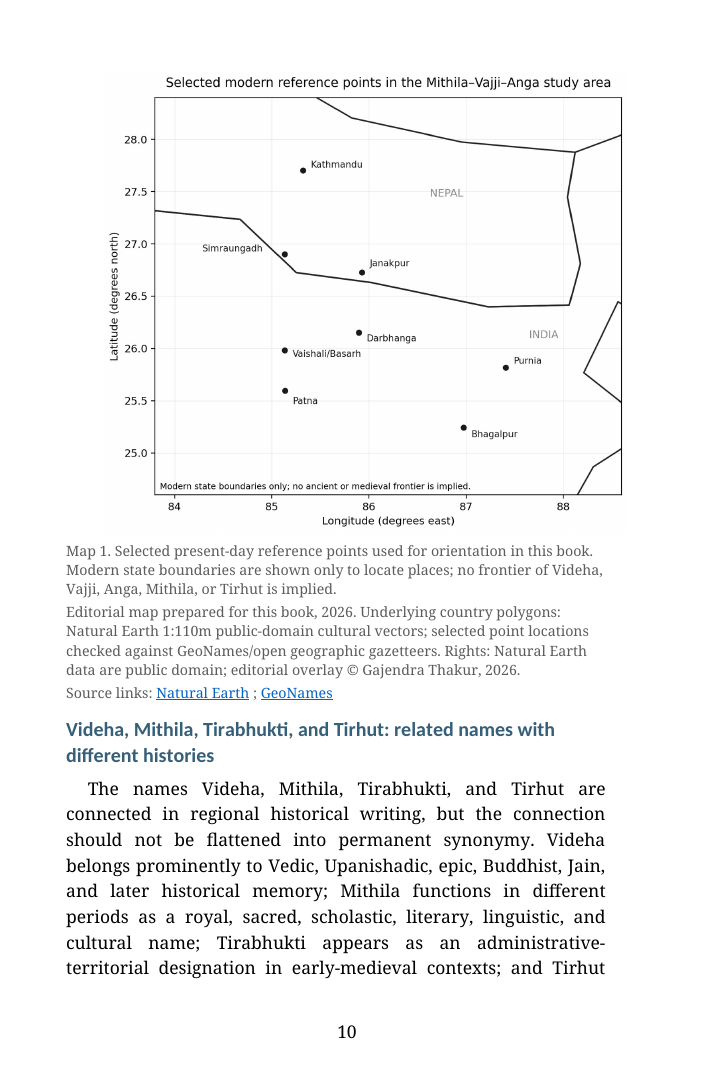
Mithila · Vajji · Anga
Chapter-specific source notes
- Primary chapter witness. Gajendra Thakur, Decoding the Panji of Mithila — Volume IV, formal Chapter 6, PDF pp. 75-91; formal Chapter 6. The HTML transcription is generated from the commit-pinned source PDF and retains the chapter boundary recorded in this edition.
- Internal structure. The repository source-heading inventory records 24 subordinate headings for this chapter: “6.1 Why the First Entry Matters”; “6.2 The Heading: Nagram, Sandahpur, and Singhwar”; “6.3 The Formula of Registration”; “6.4 The First Named Node: Aankhi and His Descendant Cluster”; “6.5 Karmahā and the Nanu-Gangesh Link”; “6.6 Padua, Pashupati, Lal, Girdhari, and Abadh Bihari”; “6.7 The Girdhari Branch and the Role of Missing Names”; “6.8 Kavi Sukhani and the Intellectual Marker”; ….
- Digital editorial method. The page keeps the preserved source text distinct from generated navigational, concordance, visual, and provenance apparatus. The synthetic reconstruction is explanatory only and is not evidence for an individual lineage or a determination of social or marital status.