Decoding the Panji of Mithila · Volume IV · Chapter 7
The Aankhi-Lal-Gunakar-Udan-Gangesh Lineage
Chapter 7
The Aankhi-Lal-Gunakar-Udan-Gangesh Lineage

7.1 The Need for a Close Reading of the First
Lineage Cluster
   The previous chapter explained the Sandahpur-Singhwar
entries as the opening genealogical frame of the Nagram Panji.
This chapter now moves closer. It takes the first cluster of
names not as a list but as a compact lineage statement. The
cluster beginning with Aankhi and moving through Lal,
Gunakar, Udan, Parashmani, Hiraka, Nanu, and Gangesh is
short in written space but large in genealogical implication.
   This cluster must be treated carefully because it teaches the
reader how the Panji compresses generational order. Several
persons appear in quick succession, with relational markers
distributed across the phrase rather than repeated before
every name. The trained Panji reader was expected to know
where one relation ends and another begins. A modern
English explanation must slow the sequence down and reveal
the logic beneath the compression.
   The aim of this chapter is therefore not to make a final
modern family tree by force. The aim is to establish a
disciplined reading of the cluster. Where the source is clear,
the relation will be stated clearly. Where the source is
compact, the structure will be explained without pretending
more certainty than the record allows. Where a name may
represent an alternate identity, a branch-name, or a title-
bearing form, that possibility will be preserved.

7.2 The Opening Anchor: Aankhi as a
Genealogical Node
   Aankhi appears at the beginning of the first substantial
personal cluster. In a Panji entry, the first named person after
the heading often serves as the anchor through which the
following sequence is organized. This does not always mean
that the person is the oldest recoverable ancestor in the entire
tradition, but it does mean that for this particular entry he is
the point from which the branch is opened.
  The importance of Aankhi is therefore structural. He gives
the reader a starting node. The names that follow must be
read in relation to this node or to the immediately succeeding
sub-nodes. The Panji does not give a modern sentence saying,
'Aankhi had the following sons.' Instead, it offers a compressed
chain in which sonship, branch, and village affiliation are
embedded together.
   The name Aankhi also reminds us that Panji names are
often preserved in local or traditional forms. A modern editor
should not smooth such names into Sanskritized or
standardized forms unless there is a clear source reason to do
so. The name as recorded is part of the genealogy. It may
preserve a family memory, a regional pronunciation, or a
register convention.

7.3 Lal and the Beginning of the Main Descent
Line
  After Aankhi, the entry introduces Lal. Lal becomes one of
the first strong descendant points in the cluster. The later
appearance of Girdhari and Abadh Bihari in relation to Lal
shows that Lal is not a passing name but a major internal
node. From him the branch begins to divide into lines that will
continue through the opening entries.

  The Panji’s treatment of Lal is typical. It does not isolate him
in a modern biographical paragraph. Instead, it places him
inside a moving chain. The reader sees him through his sons
or descendants, through village associations, and through the
subsequent branches that emerge. Lal is therefore important
not because much is said about his personal life, but because
the entry uses him to organize later names.
  In the final genealogical apparatus of this book, Lal should
be indexed as a principal node under the Sandahpur-
Singhwar opening. His name should also be cross-checked
against later occurrences, because repeated names may or
may not refer to the same person. At this stage, he belongs
specifically to the Aankhi opening cluster.

7.4 Gunakar and the Problem of Prakrit, Public,
or Alternate Names
   The name Gunakar appears early in the sequence, with a
marker that may indicate a public, alternative, or register-
recognized form. In many Panji entries, such markers are
crucial. A man may be remembered by a formal name, a
household name, a title-name, a shortened name, or a public
name used in the register. The Panji often preserves these
alternatives because identity in genealogical practice required
recognition by more than one form.
   The English reader should therefore not treat Gunakar as
an accidental addition. His presence in the early cluster
suggests that the register wanted this form of the name to be
remembered. If the marker indicates 'pr.' or a similar
abbreviation, it may point to a known alternative name. The
exact expansion of the abbreviation must be handled in the
glossary, but the function is already visible: it helps identify
the person within a larger social memory.

   This is one reason why the volume will preserve
abbreviations in the notes rather than silently translate them
away. A translation that merely says 'also called' may help the
reader, but the original marker must be remembered because
it is part of the Panji’s technical language. Gunakar is
therefore both a name and a lesson in how identity is
recorded.

7.5 Udan, Parashmani, and Hiraka: Parallel
Names or Sequential Descent?
   The early cluster also includes Udan, Parashmani, and
Hiraka. Their position creates a typical Panji problem: are
these names to be read as brothers, descendants in sequence,
collateral names, or compactly listed members of a branch?
The source does not pause to give a modern explanatory
sentence. It places them together in a compressed genealogical
field.
  The safest reading is to treat them as part of the same early
branch cluster associated with Aankhi and Lal, while avoiding
a forced hierarchy unless the relational markers clearly
demand it. In some Panji passages, a series of names after a
sonship marker may represent a group of sons. In other
passages, the sequence moves from one man to his son and
then to another descendant. Context decides the matter.
   Here, Udan becomes especially important because a later
entry returns to Udan and expands his branch through Rohini,
Badan, Harshmani or Hira, and Bacha. That later expansion
suggests that Udan is not a minor name. He is a remembered
node whose line required additional explanation. Parashmani
and Hiraka, however, must be kept visible as part of the early
cluster even if their later expansion is less explicit in the first
entry.

7.6 The Karmahā Connection: Nanu and Gangesh
   The first entry soon brings in Karmahā, Nanu, and Gangesh.
This is a small but important unit. It tells us that the opening
branch cannot be understood only through personal names. It
must be read through place-based affiliation. Karmahā marks
the social and genealogical location of the Nanu-Gangesh
relation.
   A literal modern rendering would say that from Karmahā,
Nanu’s son Gangesh is brought into the record. But the
genealogical meaning is wider than that literal phrase. The
expression may preserve a branch location, a marital
connection, or a recognized affiliation. It shows that Gangesh
is not floating in the record as an isolated name; he is situated
through Karmahā and through Nanu.
   The Nanu-Gangesh unit also demonstrates the Panji’s habit
of placing a smaller lineage inside a larger route. The main
heading remains Sandahpur to Singhwar, but within that
heading the entry can include Karmahā, Padua, Hariam,
Darihara, Naroun, Sarisab, Pali, and other places. The large
route contains smaller route-points. This layered geography is
one of the defining features of the Nagram material.

7.7 How to Read Village Insertions Without
Distorting the Lineage
   A recurring danger in Panji interpretation is to treat every
village insertion as if it were a simple statement of migration.
Karmahā in the Nanu-Gangesh unit may indicate residence,
origin, affiliation, marriage relation, or archival placement.
Without additional evidence, one should not convert it into a
narrative such as 'Nanu migrated from Karmahā' or 'Gangesh
settled at Karmahā.' The Panji gives a relation, and the editor
must not over-explain it beyond the source.

   The proper method is to record the structure: Karmahā is
the village marker; Nanu is the father or senior point; Gangesh
is identified through Nanu; the whole unit is embedded in the
Sandahpur-Singhwar opening. This gives the reader the
maximum reliable information without inventing an
unsupported story.
  This method will be repeated throughout the book. The
Panji is full of village insertions. Some are clearly route
headings; some are subordinate affiliations; some are
connected with marriage; some may preserve settlement
memory. The index and route tables at the end of the book
should therefore classify each place occurrence carefully
rather than simply listing place names alphabetically.

7.8 Padua and Pashupati: A Secondary Opening
Within the First Cluster
   After the Karmahā-Nanu-Gangesh unit, the record brings in
Padua and Pashupati. This again shows the layered nature of
the entry. The Panji does not finish one modern paragraph
before beginning another. It moves through genealogical and
village cues. Padua becomes another point of connection
inside the same opening frame.
   Pashupati is connected with Padua, and this connection
stands near the branch of Lal. The exact relation should be
preserved in its compact form, but its function is clear: it links
the early Aankhi-Lal cluster to another recognized village-
person unit. The reader should see it as part of the same
network rather than as a stray note.
   Padua will recur in later sections of the Nagram material.
For that reason, the appearance of Padua in the opening
cluster is significant. It shows that the early Sandahpur-
Singhwar frame already contains routes and affiliations that

will matter elsewhere. The final index should cross-reference
Padua from this chapter to later Padua occurrences.

7.9 Girdhari and Abadh Bihari: The Two Visible
Sons of Lal
   The entry then identifies Girdhari and Abadh Bihari in
relation to Lal. These two names create the first clearly visible
division of the Lal branch. Girdhari’s line and Abadh Bihari’s
line both continue into further names and village affiliations,
but they do so in different ways.
   Girdhari’s branch is marked by an incomplete personal
element and then moves toward Naroun, Kavi Sukhani, and
Hansdatt. Abadh Bihari’s branch moves toward Gopal,
Devanath, Kirtinath, Babnu or Teknarayan, Krishn Gopal,
Nageshwar, and Narmadeshwar. The distinction matters. If
the reader does not separate Girdhari and Abadh Bihari, the
entire opening cluster becomes confused.
   This is one of the places where a tabular form will
eventually be useful. In the prose chapter, the relation can be
explained; in the appendix, the two branches can be placed
side by side. The index provided later by the author can then
be used to check whether all names under both branches have
been accounted for.

7.10 The Girdhari Branch and the Missing Name
Before Naroun
   The Girdhari branch contains a gap before the Naroun
connection. The source indicates that Girdhari’s line
continues, but the name or relation at that point is incomplete.
The next recoverable unit brings in Naroun and Kavi
Sukhani’s son Hansdatt. This produces a partially broken but
still meaningful branch.

   The blank must be preserved. It is not editorial failure; it is
documentary honesty. The register knows that something
belongs there. It leaves a space because the name or phrase
was unavailable, damaged, or uncertain in the source
tradition. To fill it by guessing would create a false ancestor or
a false relation.
  The correct explanation is therefore: Girdhari’s branch
contains an incomplete element, after which the record
connects the line to Naroun and to Kavi Sukhani’s son
Hansdatt. The chapter should not state more than that. A later
cross-reference may clarify the gap; until then, the gap
remains part of the record.

7.11 Kavi Sukhani, Hansdatt, and the Intellectual
Memory of the Line
  The appearance of Kavi Sukhani is one of the most
revealing features of the opening cluster. The title Kavi
indicates that Sukhani was remembered by a poetic or literary
designation. In a genealogical record, such a title helps
identify the person and preserve his social reputation. It also
shows that the Panji remembers qualities and public roles, not
only biological descent.
  Sukhani’s descendants include names such as Dharmadatt,
Hridayadatt, Cheta, and Hansdatt. Hansdatt then appears as a
further node, with Babujan connected to him. The line thus
moves from an intellectual marker to a descendant branch.
The title Kavi is not ornamental; it helps locate the branch
within remembered social identity.
   This cluster should be handled with special care in the
index. Kavi Sukhani should appear under personal names and
also under titles or designations. Hansdatt should appear both
as a descendant of Sukhani and as a node for later

continuation. Such double indexing is necessary because Panji
identity is relational.

7.12 The Abadh Bihari-Gopal Line
   The Abadh Bihari branch is more directly expansive in the
first entry. Abadh Bihari leads to Gopal, and Gopal becomes a
major node. Through Gopal the entry moves toward Karmahā,
Devanath, Kirtinath, Jajival, Nanu, Babnu or Teknarayan,
Tisaut, Jagannath, Girdhari, Soderpur, Motinandan, and
related names and places.
  Gopal’s importance lies in the way the Panji uses him to
organize a widening branch. The record does not give a
modern biography of Gopal. It gives his genealogical
consequence. His descendants and connected villages create a
path through the entry. In Panji terms, that is often more
important than narrative detail.
   The repeated connection with Karmahā is also notable.
Karmahā appears earlier with Nanu and Gangesh and then
again within the Gopal line through Devanath and Kirtinath.
This repetition may indicate a strong affiliation between the
opening Sandahpur-Singhwar cluster and Karmahā. It may
also reflect multiple separate connections. The two
possibilities must remain distinct until the larger index and
cross-checking are complete.

7.13 Babnu, Teknarayan, and the Function of
Alternative Identification
  Within the Gopal line, Babnu appears with Teknarayan as
an associated or alternative identification. This is a typical
Panji feature. A person may be known by a household name
and a formal name, or by a shorter and a fuller form. The
register preserves both because recognition depended on both
memory and formal identity.

   The form Babnu/Teknarayan should therefore be treated as
one of the important identity-pairs in the opening cluster. If
later entries mention only one form, the index should connect
them. But the editor must also avoid assuming identity in
every occurrence of Babnu or Teknarayan elsewhere in the
Panji. The connection is secure in this local context; wider
identity requires cross-checking.
  Teknarayan’s branch continues through Krishn Gopal and
other descendants. This shows that the alternative
identification is not incidental. It belongs to a line that
becomes genealogically active. The reader should therefore
remember Babnu/Teknarayan as a node, not as a minor
variant.

7.14 Krishn Gopal, Nageshwar, and
Narmadeshwar
   The branch from Babnu/Teknarayan moves through Krishn
Gopal and then toward Nageshwar and Narmadeshwar. These
names mark another expansion of the Abadh Bihari-Gopal
line. The Panji connects them with Karmahā, Baliyas, Khoaāl,
Jaybhadra, Aniruddha, Pali, Shaktinath, Alay, Chaudhary
Mitralal, Vakil Harikant, and other names and places.
  Nageshwar and Narmadeshwar appear as significant sub-
nodes because their descendants or connected branches are
separately named. Nageshwar leads toward Amarnath.
Narmadeshwar leads into a sequence involving Pali, Krishna,
Gangadhar, Soderpur, Bhairav, Tisaut, Kamal Nayan,
Ghanshyam Sundar, Baliyas, Raghunath, and other branch
connections.
  The appearance of professional and title markers near this
section, such as Chaudhary and Vakil, shows again that the
Panji preserves social identity along with lineage. These
markers should be indexed because they may help distinguish

one person from another in a record where names repeat
frequently.

7.15 Repetition of Villages in the First Cluster
   The first cluster contains a remarkable number of village
references: Sandahpur, Singhwar, Karmahā, Padua, Hariam,
Darihara, Naroun, Khandwala, Sarisab, Pali, Tisaut, Soderpur,
Baliyas, Khoaāl, Alay, and others. This is not excessive detail; it
is the heart of the Panji’s method. A lineage is remembered
through places as well as persons.
   The reader should notice that some villages occur more
than once. Karmahā, Pali, Soderpur, and Baliyas recur in
different parts of the cluster. Repetition may indicate strong
repeated affiliation, multiple marriages, related branches, or
later additions. The interpretation depends on the specific
local context. The final route table should therefore record
each occurrence separately, not merely once.
  A village in the Panji is a node of social memory. It may
represent where a branch was known, where a marriage
connection was recognized, where a learned or ritual relation
existed, or where a descendant line was placed in the register.
The first cluster already shows this principle in miniature.

7.16 The Importance of Titles: Chaudhary and
Vakil in the Opening Cluster
  The first entry includes title-bearing names such as
Chaudhary Mitralal and Vakil Harikant. These references are
important because they show that the Panji was not frozen in
an ancient past. It continued to absorb social distinctions and
modern professional identities.
  Chaudhary may mark local status, social rank, or a
recognized family designation. Vakil identifies a legal
profession or role. When such titles appear in a genealogical

record, they help the reader distinguish persons and situate
them in a social world. They also give evidence of the period
in which the branch was updated or remembered.
  The title should not be separated from the name in the
index. Vakil Harikant should be indexed under Harikant and
under the occupational marker Vakil. Chaudhary Mitralal
should be indexed under Mitralal and under Chaudhary. This
will help the final cross-checking process.

7.17 The Editorial Treatment of Variant Spellings
   The Nagram material contains many names that may
appear in more than one spelling or local form. This is true of
personal names, village names, and titles. The first cluster
already shows the need for a consistent editorial method. The
English volume should preserve the recorded form in
discussion, while also offering a normalized form where
necessary for indexing.
  For example, a name may appear in a Maithili or Sanskritic
shape, or in a local phonetic form. A village may be spelled in
more than one way across entries. The editor should not erase
such variation. Instead, the final index can use a main form
with cross-references from variants. This method preserves
the source while making the book usable.
  In the prose chapters, the preferred method will be to give
the most readable English transliteration and, where needed,
mention the source form. In tables, the source form and
normalized form can be placed side by side. This will be
especially important for repeated names such as Gopal, Nanu,
Nageshwar, Narmadeshwar, Kirtinath, and Shaktinath.

7.18 What the First Cluster Reveals About Panji
Memory
   The Aankhi-Lal-Gunakar-Udan-Gangesh cluster reveals
several features of Panji memory. First, memory is
genealogical: persons are preserved through relation. Second,
memory is geographical: villages are inseparable from names.
Third, memory is social: titles and reputations are recorded.
Fourth, memory is layered: a single entry can preserve older
names, later branches, professional markers, and incomplete
traces.
   The cluster also shows that the Panji does not always
distinguish sharply between direct descent, collateral relation,
and affiliated branch in the way a modern diagram would.
The record assumes a reader who understands the
conventions. The task of this volume is to make those
conventions visible without damaging the original structure.
  The first cluster is therefore not merely the beginning of the
Nagram Panji. It is a methodological key. If the reader learns
how to read Aankhi, Lal, Gunakar, Udan, Nanu, Gangesh,
Girdhari,    Abadh       Bihari,   Gopal,    Babnu/Teknarayan,
Nageshwar, and Narmadeshwar, the reader will be better
prepared for the much larger clusters that follow.

7.19 Provisional Reading of the Cluster
  A cautious provisional outline may be stated as follows.
Aankhi stands as the opening anchor. Lal emerges as a major
descendant node. Gunakar is preserved as a recognized name
or identity form within the early sequence. Udan, Parashmani,
and Hiraka belong to the same early cluster, with Udan
becoming important in later expansion. Karmahā connects
Nanu and Gangesh to the branch. Padua and Pashupati form
another village-person unit near the early sequence. Lal’s line
divides visibly through Girdhari and Abadh Bihari.

   Girdhari’s branch contains a missing or incomplete element
and then connects to Naroun, Kavi Sukhani, Hansdatt, and the
later descendants of Sukhani. Abadh Bihari’s branch proceeds
through Gopal. Gopal’s line expands through Devanath,
Kirtinath, Babnu/Teknarayan, Krishn Gopal, Nageshwar,
Narmadeshwar, and their connected villages and descendants.
   This outline is provisional because the source remains
compressed. It is meant to guide reading, not to replace the
original entry. The final index and cross-reference checking
may refine individual connections, but the broad structure is
clear enough to serve as the basis for the next chapters.

7.20 Summary
   This chapter has decoded the first personal cluster of the
Nagram Panji. It has shown that the sequence beginning with
Aankhi and moving through Lal, Gunakar, Udan, Nanu,
Gangesh, Girdhari, Abadh Bihari, Gopal, Babnu/Teknarayan,
Nageshwar, and Narmadeshwar is not a simple list. It is a
compact genealogical structure containing descent, village
affiliation, alternate identity, intellectual designation,
professional title, and missing memory.
   The chapter has also established the editorial method for
close reading. Names will be separated carefully. Village
insertions will be explained without being over-interpreted.
Titles will be preserved. Blanks will remain visible. Variants
will be indexed. Repeated names will be cross-checked rather
than automatically merged.
  The next chapter will continue the close decoding by
turning to Girdhari, Abadh Bihari, Gopal, Babnu/Teknarayan,
Nageshwar, and Narmadeshwar as a developing branch
system. It will show how the early cluster grows into a wider
network before the book moves fully into the Shashipur
material.
Source structure and verification apparatus
Editorial source apparatus. This apparatus is descriptive, not interpretive. It records the source-controlled structure used to verify that this page corresponds to formal Chapter 7 of Decoding the Panji of Mithila — Volume IV. The chapter text above is preserved from PDF pp. 92-106; formal Chapter 7 in the commit-pinned authoritative source. It is not merged with a neighboring chapter, appendix, annexure, or independent front/back-matter unit. The internal headings below come from the repository’s source-heading inventory and are retained as navigational and audit evidence; showing them here does not turn those headings into separate publications or add claims that are absent from the source.
Internal source headings
- 7.1 The Need for a Close Reading of the First Lineage Cluster
- 7.2 The Opening Anchor: Aankhi as a Genealogical Node
- 7.3 Lal and the Beginning of the Main Descent Line
- 7.4 Gunakar and the Problem of Prakrit, Public, or Alternate Names
- 7.5 Udan, Parashmani, and Hiraka: Parallel Names or Sequential Descent?
- 7.6 The Karmahā Connection: Nanu and Gangesh
- 7.7 How to Read Village Insertions Without Distorting the Lineage
- 7.8 Padua and Pashupati: A Secondary Opening Within the First Cluster
- 7.9 Girdhari and Abadh Bihari: The Two Visible Sons of Lal
- 7.10 The Girdhari Branch and the Missing Name Before Naroun
- 7.11 Kavi Sukhani, Hansdatt, and the Intellectual Memory of the Line
- 7.12 The Abadh Bihari-Gopal Line
- 7.13 Babnu, Teknarayan, and the Function of Alternative Identification
- 7.14 Krishn Gopal, Nageshwar, and Narmadeshwar
- 7.15 Repetition of Villages in the First Cluster
- 7.16 The Importance of Titles: Chaudhary and Vakil in the Opening Cluster
- 7.17 The Editorial Treatment of Variant Spellings
- 7.18 What the First Cluster Reveals About Panji Memory
- 7.19 Provisional Reading of the Cluster
- 7.20 Summary
Source-text concordance
Aankhi-Lal-Gunakar-Udan-Gangesh · Lineage · Need · Close · Reading · First · Cluster · previous · explained · Sandahpur-Singhwar · entries · opening · genealogical · frame · Nagram · moves · closer · takes · names · list · compact · statement · beginning · Aankhi · moving · Gunakar · Udan · Parashmani · Hiraka · Nanu · Gangesh · short · written · space · large · implication · must · treated · carefully · teaches · reader · compresses · generational · order · Several · persons · appear · quick · succession · relational · markers · distributed · across · phrase · rather · repeated · every · name · trained · expected · know · relation · ends · another · begins · modern · English · explanation · slow · sequence · reveal · logic · beneath · compression · therefore · make · final · family · tree · force
Boundary verification. In the formal sequence this chapter follows Volume IV Chapter 6, “Sandahpur to Singhwar: The Opening Genealogical Frame” and precedes Volume IV Chapter 8, “Girdhari, Abadh Bihari, Gopal, Teknarayan, and the Expansion of the Singhwar Branch”. The chapter extractor begins at the verified formal Chapter 7 marker and stops at the next verified formal chapter marker; for a final chapter it stops before recognized book-level back matter. The concordance above is generated only from distinct terms already present in this chapter’s preserved source text. It is provided for discovery, comparison, and audit, not as an automated judgment about persons, lineages, status, kinship, marriage eligibility, or historical truth.
Illustrated research apparatus
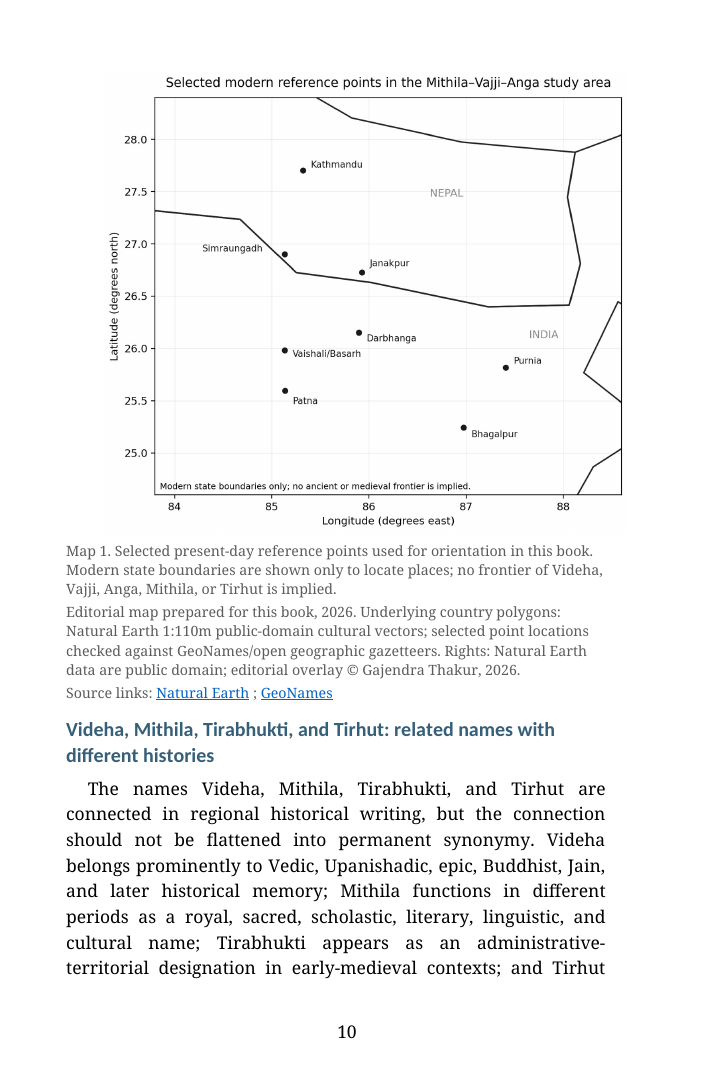
Mithila · Vajji · Anga
Chapter-specific source notes
- Primary chapter witness. Gajendra Thakur, Decoding the Panji of Mithila — Volume IV, formal Chapter 7, PDF pp. 92-106; formal Chapter 7. The HTML transcription is generated from the commit-pinned source PDF and retains the chapter boundary recorded in this edition.
- Internal structure. The repository source-heading inventory records 20 subordinate headings for this chapter: “7.1 The Need for a Close Reading of the First Lineage Cluster”; “7.2 The Opening Anchor: Aankhi as a Genealogical Node”; “7.3 Lal and the Beginning of the Main Descent Line”; “7.4 Gunakar and the Problem of Prakrit, Public, or Alternate Names”; “7.5 Udan, Parashmani, and Hiraka: Parallel Names or Sequential Descent?”; “7.6 The Karmahā Connection: Nanu and Gangesh”; “7.7 How to Read Village Insertions Without Distorting the Lineage”; “7.8 Padua and Pashupati: A Secondary Opening Within the First Cluster”; ….
- Digital editorial method. The page keeps the preserved source text distinct from generated navigational, concordance, visual, and provenance apparatus. The synthetic reconstruction is explanatory only and is not evidence for an individual lineage or a determination of social or marital status.