Decoding the Panji of Mithila · Volume IV · Chapter 8
Girdhari, Abadh Bihari, Gopal, Teknarayan, and the Expansion of the Singhwar Branch
Chapter 8
Girdhari, Abadh Bihari, Gopal, Teknarayan, and
the Expansion of the Singhwar Branch

8.1 From an Opening Cluster to a Branch System
   The preceding chapter treated the Aankhi-Lal-Gunakar-
Udan-Gangesh cluster as the first close-reading exercise of the
Nagram Panji. That cluster introduced the reader to the basic
technique of the register: a compact chain of names, relational
signs, village insertions, and remembered identities. The
present chapter follows the next stage of the same opening
material. It examines how Lal's line expands through Girdhari
and Abadh Bihari, and how Abadh Bihari's branch becomes
especially important through Gopal, Babnu or Teknarayan,
Krishn Gopal, Nageshwar, and Narmadeshwar.
   This chapter is important because the Panji now moves
from the first genealogical anchor into a wider system. The
record does not merely say that a man had sons. It shows how
a branch becomes visible through village connections,
repeated names, subordinate lineages, and further marriage
or affiliation markers. What began as a compact opening
cluster begins to look like a branching map.
   The key discipline remains the same: no relation should be
forced beyond the evidence of the entry. The Panji is highly
compressed. It gives enough information to identify nodes and
links, but it does not always provide modern explanatory
prose. The task of this chapter is to unfold the structure while
preserving the original uncertainty where it exists.

8.2 Lal as the Point of Division
   Lal is the point at which the opening line begins to divide
visibly. The record associates Lal with Girdhari and Abadh

Bihari. These two names do not merely follow Lal in a
sequence; they form the first clear expansion of his branch. In
a modern genealogical chart, Lal would be treated as the
parent or senior node through whom the two lines become
intelligible.
  It is important, however, to remember that the Panji does
not always speak in the grammar of modern charts. It gives a
compressed formula. The editor must therefore use chart-
language cautiously. For explanatory purposes, Girdhari and
Abadh Bihari may be treated as branch-holders under Lal, but
the original entry should remain the controlling evidence.
  The division after Lal also shows why the Nagram Panji
cannot be read name by name in isolation. Girdhari and
Abadh Bihari are significant because their branches continue.
A name becomes genealogically meaningful when later
material returns to it, expands it, or connects it to villages and
descendants. Lal's importance is therefore proved by the
branches that issue from him.

8.3 Girdhari: The Branch with an Incomplete
Opening
   Girdhari appears as one of the early branch-holders, but his
line contains a missing or incomplete element. The Panji
indicates that something belongs at the point where one
expects a descendant or associated name, but the record is not
complete. Such omissions must not be erased. They are part of
the source.
   The incomplete opening of Girdhari's branch is instructive.
It shows that the Panji preserves not only information but also
the limits of information. A blank may indicate a damaged
manuscript, an omitted name, an uncertain memory, or a
deliberate space for a known but unrecorded relation. The
editor cannot choose one explanation without evidence.

  After the incomplete point, the line connects to Naroun,
Kavi Sukhani, and Hansdatt. This movement suggests that
Girdhari's branch was not forgotten; rather, it was preserved
through a later recognized connection. The missing element is
therefore a gap within a living branch, not a sign that the
branch was irrelevant.

8.4 Naroun, Kavi Sukhani, and the Scholarly
Memory of the Branch
   The appearance of Kavi Sukhani is one of the most
significant features of the Girdhari branch. The word 'Kavi' is
not a mere ornament. In the Panji context it marks a
remembered intellectual or literary identity. A person so
identified was preserved not only as a descendant but also as
someone known by a cultural role.
   The association with Naroun gives the branch a village
coordinate. The name Kavi Sukhani, joined with Naroun and
then with Hansdatt, shows how the Panji ties literary or
scholarly memory to genealogical descent and village
affiliation. This is a small but valuable example of how the
Panji records the intellectual world of Mithila.
  A careful index should therefore treat Kavi Sukhani under
both personal name and title. He should appear under
Sukhani and also under the occupational or honorific marker
Kavi. If the final index supplied later contains only the
personal name but not the title, the cross-checking process
should add the title reference.

8.5 Hansdatt and the Descendants of Sukhani
  Hansdatt functions as the continuing point in the Sukhani
branch. The Panji records Sukhani's sons or associated
descendants, including names such as Dharmadatt,
Hridayadatt, Cheta, and Hansdatt. The form of the entry

suggests a group of names preserved under the Sukhani
memory.
   Here again, the editor must distinguish between a secure
local structure and an over-precise modern reconstruction.
The Panji clearly preserves a group related to Sukhani. It also
clearly gives Hansdatt as one of the important names in that
group. But the exact internal hierarchy of every name must be
stated only where the relational markers make it certain.
   The importance of Hansdatt is strengthened by later
connection with Babu Jan or Babujan, and by further village
references such as Sarisab and Pali. These linked names and
places show that the Sukhani-Hansdatt line was not merely a
side note. It entered the wider network of the opening
Singhwar material.

8.6 Sarisab, Sahab, Dullah, Pali, and Bhawanidatt
  The Girdhari-related material includes a sequence involving
Sarisab, Sahab, Dullah, Pali, and Bhawanidatt. This part of the
entry illustrates the way subordinate village clusters enter a
branch. Sarisab and Pali are not random places; they are
coordinates through which the branch is remembered.
  Sahab and Dullah appear within this connected structure.
The editor should not detach them from the village markers. A
Panji name without its village affiliation may lose much of its
meaning. In the final route table, Sarisab and Pali should be
recorded as part of the Girdhari-Sukhani-Hansdatt context
unless later cross-checking assigns a more precise sub-branch.
  Bhawanidatt is also important because the name 'Datt'
appears repeatedly in the opening Nagram material. Datt
names may belong to different persons and different
branches. Therefore, Bhawanidatt in this local context should
be indexed specifically with the associated route and branch,

not merged automatically            with   other   Bhawanidatt
occurrences elsewhere.

8.7 Abadh Bihari: The More Expansive Branch
   While Girdhari's branch contains important scholarly and
village-linked material, Abadh Bihari's branch becomes the
more expansive structure in the opening Singhwar cluster.
The Panji associates Abadh Bihari with Gopal, and from Gopal
the line opens into a wider series of names and village
relations.
  Abadh Bihari therefore functions as a major branch-holder
under Lal. His importance is not merely that he is named; his
importance lies in the fact that his line continues and
multiplies. Through Gopal, the record brings in Devanath,
Kirtinath, Babnu or Teknarayan, Krishn Gopal, Nageshwar,
Narmadeshwar, and several village connections.
   The Abadh Bihari branch is a good example of how the
Panji constructs depth. A short phrase can open into many
levels. A reader who passes too quickly over Abadh Bihari will
miss one of the central branch systems of the first Nagram
entry.

8.8 Gopal as the Structural Pivot
  Gopal is the pivot of Abadh Bihari's branch. The entry
moves from Abadh Bihari to Gopal and then to the later
expansion. In the logic of the Panji, Gopal is a point through
which several later relations become readable.
   Gopal's branch is connected with Karmahā through
Devanath and Kirtinath. This is important because Karmahā
has already appeared earlier in the opening cluster. Repetition
of the same village within a nearby branch may indicate a
strong recurring affiliation. It may also indicate several
separate links to the same place. The editor must keep both
possibilities open until the full index is checked.

  Gopal should therefore be indexed as a major node in the
Sandahpur-Singhwar opening. All later names in this branch
should be cross-referenced back to Gopal where the source
supports that structure.

8.9 Devanath and Kirtinath: The Karmahā Link
   The Gopal branch includes Devanath and Kirtinath in
relation to Karmahā. This small unit is one of the clearest
examples of the Panji's village-person linking method. The
place-name frames the genealogical memory. The personal
names are not simply names; they are names situated within a
village-affiliation structure.
   Devanath appears as a senior point through whom
Kirtinath is remembered. Kirtinath then becomes part of the
line leading toward later names. The exact wording of the
source must be preserved in notes or tables, but the English
explanation can identify the probable structure: Devanath and
Kirtinath form a Karmahā-associated unit within Gopal's
branch.
   This unit also shows why the book must include route
tables. If a reader looks only at the personal-name index, the
importance of Karmahā may not be visible. But if the route
table records every Karmahā occurrence, the repeated
significance of that place in the opening Nagram material will
become clear.

8.10 Jajival, Nanu, and the Need for Cross-Branch
Caution
   Near the Devanath-Kirtinath unit, the record introduces
Jajival and Nanu. Nanu has already appeared earlier in the
opening cluster in connection with Karmahā and Gangesh.
This repetition requires caution. The same name may refer to
the same person, a different person, or a repeated family
name preserved in another branch.

   The editor should not assume identity merely because the
name is the same. In the Panji world, repeated names are
common. A name such as Nanu may occur in more than one
generation or branch. The proper method is to attach each
occurrence to its local context and then compare them during
final indexing.
   Jajival also needs careful handling. It appears as a village or
affiliation marker within the branch. It should be indexed as a
place occurrence associated with the Gopal-Devanath-
Kirtinath context. If later occurrences of Jajival appear
elsewhere, they should be cross-checked but not automatically
merged.

8.11 Babnu and Teknarayan: One Identity or a
Linked Pair?
   The Gopal branch then introduces Babnu with Teknarayan
as an associated form. This is one of the most important
identity problems in the opening section. The Panji often
preserves a household or familiar name together with a
formal name, public name, or register name. Babnu and
Teknarayan appear to function as such a linked pair in this
local context.
   For practical reading, the pair may be treated as Babnu,
also known or identified as Teknarayan, unless later evidence
requires a different interpretation. The final index should
therefore include entries under both Babnu and Teknarayan,
with cross-references between them. This will prevent the
reader from treating them as unrelated names.
  At the same time, the editor must avoid a universal
assumption. Not every Babnu in the Panji is necessarily this
Babnu, and not every Teknarayan is necessarily the same
person. Identity is local before it is global. The opening branch

gives a secure local link; broader identity must be established
through cross-reference.

8.12 Krishn Gopal and the Further Expansion of
Teknarayan's Line
  The line from Babnu or Teknarayan continues through
Krishn Gopal. This continuation proves that the Babnu-
Teknarayan pair is not incidental. It is a genealogically active
node. Krishn Gopal becomes a further point through which
the branch extends into additional village connections and
descendants.
    The name Krishn Gopal itself deserves attention. It
combines a devotional or traditional naming pattern with the
already important name Gopal. Such compound names may
reflect family naming habits, religious sentiment, or later
differentiation between persons who shared a common name.
The editor should preserve the compound rather than shorten
it.
   Krishn Gopal's placement also helps the reader understand
generational layering. The branch has moved from Lal to
Abadh Bihari, from Abadh Bihari to Gopal, from Gopal to
Babnu/Teknarayan, and then to Krishn Gopal. This is the kind
of internal depth that a modern family chart can eventually
display, but the prose must first explain how the source
implies it.

8.13 Baliyas and Vanshidhar: A Lateral Village
Connection
   Within the Krishn Gopal area the record brings in Baliyas
and Vanshidhar. The relation appears as another village-
person insertion, showing how a branch can be extended
laterally through a place and a named individual. Baliyas

therefore becomes part of the map of the Gopal-Teknarayan
branch.
   Vanshidhar is a name that may appear in multiple parts of
the Panji. In this local entry, the name should be tied
specifically to Baliyas and to the Krishn Gopal branch. If a
later Vanshidhar appears elsewhere, the final index must keep
the occurrences distinct unless the surrounding evidence
connects them.
   This example reinforces the rule that every place-name
must be read as a genealogical coordinate. A branch is not
fully explained until its places have been recorded. The reader
should therefore think of the Panji as a network diagram in
words, not as a list of isolated descendants.

8.14 Nageshwar and Narmadeshwar: Two
Important Sub-Nodes
  After Krishn Gopal, the branch moves toward Nageshwar
and Narmadeshwar. These two names become important
because the record continues through them. They are not
merely names in a list; they function as sub-nodes within the
Abadh Bihari-Gopal expansion.
   Nageshwar leads toward Amarnath. Narmadeshwar leads
into a more extended set of village and personal links
involving Pali, Krishna, Gangadhar, Soderpur, Bhairav, Tisaut,
Kamal Nayan, Ghanshyam Sundar, Baliyas, Raghunath, and
other connections. The branch therefore divides again,
producing a multi-line structure.
  For the final apparatus, Nageshwar and Narmadeshwar
must be treated as separate index nodes. Their relationship to
Krishn Gopal should be shown, but their descendants and
connected villages should also be separately traceable. This
will allow the reader to follow either sub-branch without
returning constantly to the beginning of the entry.

8.15 Khoaāl, Jaybhadra, and Aniruddha
  The Nageshwar-Narmadeshwar area includes Khoaāl,
Jaybhadra, and Aniruddha. This is another place-person unit.
Khoaāl functions as the village coordinate; Jaybhadra and
Aniruddha give the personal relation through which the
branch is remembered.
   Aniruddha is a name of considerable genealogical
importance in many Maithil contexts. Here, however, the
editor must not import outside assumptions. The Aniruddha of
this entry must first be treated as the Aniruddha connected
with Jaybhadra and Khoaāl in the opening Nagram branch.
Wider identification can only come from cross-checking.
   Khoaāl should also be indexed carefully. The village
appears in several parts of the source. A route table will help
distinguish whether Khoaāl is functioning as a recurring
marriage-affiliation place, a branch location, or a repeated
settlement marker in different contexts.

8.16 Nageshwar to Amarnath
   Nageshwar's line proceeds toward Amarnath. The
simplicity of this statement should not hide its significance. A
short Panji phrase can carry the weight of a full generational
link. In a modern chart, this would appear as a clear descent
relation or branch continuation. In the Panji, it is given
compactly.
   Amarnath should be treated as a descendant or continuing
node under Nageshwar in this local context. If the source later
gives additional details about Amarnath or persons connected
with him, those details should be brought into the final index
and cross-reference tables.
  The Nageshwar-Amarnath connection also shows that some
sub-branches are short in the surviving text while others are

longer. A short branch is not necessarily less important. It may
simply be less fully preserved in the available record.

8.17 Narmadeshwar's Branch: Pali, Krishna,
Gangadhar, and Soderpur
   The Narmadeshwar branch is more elaborate. It includes a
connection through Pali, Krishna, Gangadhar, and Soderpur,
with Bhairav also appearing in the sequence. This part of the
entry demonstrates how the Panji moves from one sub-node
into a layered village structure.
   Pali is a recurring place in the opening material. Its
appearance in the Narmadeshwar branch should therefore be
recorded with particular care. It may represent a matrimonial
or branch affiliation, and it may connect this sub-branch with
other Pali-linked entries. The final route table should mark
this occurrence separately.
   Krishna and Gangadhar should be read as part of the same
local sequence. Soderpur and Bhairav then widen the
connection. Again, the editor should not flatten the sequence
into a vague statement such as 'the family was connected with
Pali and Soderpur.' The order of names and places matters
because it reveals the internal movement of the branch.

8.18 Tisaut, Kamal Nayan, and Ghanshyam
Sundar
   Another part of the Narmadeshwar branch includes Tisaut,
Kamal Nayan, and Ghanshyam Sundar. The pairing of a
village marker with a named father-son or branch sequence is
typical of the Panji. The entry gives the reader enough to
locate this part of the family within a recognized village
relation.
  Kamal Nayan and Ghanshyam Sundar are names that
should be preserved in full. Compound names in the Panji

often help distinguish persons. Shortening them would make
cross-checking harder. The final name index should include
Kamal Nayan under K and Nayan if a dual index is later
desired, and Ghanshyam Sundar under Ghanshyam and
Sundar if necessary.
  Tisaut should be treated as a significant place occurrence in
the opening Singhwar branch. It appears alongside other
important village markers and should not be lost in the prose.
In the final apparatus, Tisaut will help reconstruct the spatial
network of the Narmadeshwar line.

8.19 Pali, Chunchun, Govind, Jaleshwar, Gulab,
and Jyoti Ram
  The later part of the Narmadeshwar-associated material
includes additional Pali and Baliyas connections, with names
such as Chunchun, Govind, Jaleshwar, Gulab, and Jyoti Ram.
These names show the continuing spread of the branch into
several smaller lines.
   Chunchun and Govind appear in a Pali-Soderpur context.
Jaleshwar and Gulab appear in another Pali-linked context.
Jyoti Ram appears with a Baliyas-related marker. Each of
these should be preserved as a local unit in the final
genealogical tables.
   The repeated Pali marker is especially important. It may
indicate that Pali is a strong recurring affiliation in the
Narmadeshwar branch. But it may also represent separate
relations. The final cross-checking index supplied later by the
user will be useful for confirming whether these Pali
occurrences should be grouped or treated as separate sub-
entries.

8.20 The Second Sandahpur-Singhwar Entry: Udan
Revisited
  The next Sandahpur-Singhwar entry returns to Udan and
expands his branch through Rohini and Badan. This return
shows that the Panji does not always finish one person
completely before moving to another. A name may appear in
the first entry and then be taken up again in a later numbered
entry for additional explanation.
   Udan's branch includes Darihara, Rohini, Badan, Sarisab,
and Prannath, followed by another connection through
Hariam and Prannath. This repetition of Prannath in two
village contexts must be handled cautiously. It may refer to
the same person through different affiliations, or to repeated
names in related lines. The editor should preserve the
distinction until the broader evidence is checked.
  The return to Udan confirms the importance of cross-entry
reading. A single numbered entry is not always self-contained.
The Nagram Panji must be read both locally and cumulatively.
This is why the book is being built cumulatively chapter by
chapter, and why a final index will be essential for coverage
checking.

8.21 Harshmani, Hira, Bacha, and the Karmahā-
Darihara Link
   The second entry also introduces Harshmani, also identified
as Hira, and then Bacha. Bacha's line connects with Karmahā,
Chitradhar, Riddhi, Darihara, and Babnu. This is another
example of alternate identity and village-linked expansion.
  Harshmani/Hira should be indexed under both forms. If the
marker indicates a public or alternate name, the index should
preserve that relationship. Bacha should be treated as a
continuing node. The Karmahā-Darihara connection under

Bacha should be recorded separately from the earlier
Karmahā references under Gopal and Nanu.
  This part of the entry is also a warning against
oversimplification. Karmahā appears in multiple contexts:
Nanu-Gangesh, Devanath-Kirtinath, Bacha-Chitradhar-Riddhi,
and other points. These may represent a coherent network,
but the final shape of that network must be established by
comparison, not assumption.

8.22 Balamukund, Raja, Gana, and Chhedi
   Bacha's branch opens into Balamukund, Raja, Gana, and
Chhedi. These names form one of the most important internal
expansions of the second Sandahpur-Singhwar entry. The
Panji connects them again with Karmahā, Devanath, Kirtinath,
Jajival, Nanu, Padua, Buddhinath, Thadu, and Shyamnath.
  Balamukund appears as a branch-holder whose line
includes Padua and Buddhinath-Thadu connections. Raja
appears with Mangan or Munindranarayan and a similar
Padua-Thadu-Karmahā-Shyamnath pattern. This repetition
suggests either parallel branches or a repeated affiliation
through the same village network.
  Gana and Chhedi become especially important in the next
chapter because their lines extend into Yashodanand, Lalit
Kumar, Kamalakant, Bhairavkant, Shobhakant, Jagdish, and
several later descendants. For now, the reader should
recognize Balamukund, Raja, Gana, and Chhedi as major
branch names within the Udan-Harshmani-Bacha expansion.

8.23 Kedar Nath, Baidyanath, Yadunath,
Radhikaramana, Yashodanand, and Lalit Kumar
  The second and third Sandahpur-Singhwar entries bring in
Kedar Nath and then a cluster of sons or descendants:
Baidyanath, Yadunath, Radhikaramana, Yashodanand, and

Lalit Kumar. This is a major generational cluster and should
be treated with care.
   Each of these names opens into further branches.
Baidyanath is associated with Balaji in one form and with
later lines through Mukund and Baldev. Yadunath,
Radhikaramana, Yashodanand, and Lalit Kumar also receive
their own village-linked connections. The Panji is not merely
listing sons; it is preparing a set of later expansions.
  This cluster demonstrates how quickly the Nagram Panji
grows. A single node such as Kedar Nath can become the
source of many subordinate lines. In the final tables, Kedar
Nath should appear as a major node under the second
Sandahpur-Singhwar entry, with each named descendant
assigned a separate sub-line.

8.24 What the Singhwar Expansion Shows
   The Singhwar expansion shows the Panji's power and
difficulty. Within a small number of entries, the record moves
from Lal to Girdhari and Abadh Bihari, from Abadh Bihari to
Gopal, from Gopal to Teknarayan, Krishn Gopal, Nageshwar,
and     Narmadeshwar,      and   then    returns     to  Udan,
Harshmani/Hira, Bacha, Balamukund, Raja, Gana, Chhedi,
Kedar Nath, and their descendants.
   The effect is cumulative. The reader begins with a few
names and soon encounters a full network of places:
Karmahā, Padua, Hariam, Darihara, Naroun, Sarisab, Pali,
Jajival, Tisaut, Soderpur, Baliyas, Khoaāl, Alay, Belauch,
Pabouli, Kujouli, Fanandah, and others. The branch is
therefore not only genealogical but geographical.
  This is why Volume IV must be long. A short summary
would destroy the structure. The Panji's meaning lies in the
details: the exact position of a name, the village that
accompanies it, the title attached to it, the blank that

interrupts it, and the later entry that resumes it. Nothing can
be left unexplained without damaging the record.

8.25 Summary
  This chapter has followed the expansion of the opening
Singhwar branch through Girdhari, Abadh Bihari, Gopal,
Teknarayan, Krishn Gopal, Nageshwar, Narmadeshwar, and
the related Udan-Bacha-Kedar Nath cluster. It has shown how
the Panji moves from a compact opening into a branching
network.
  The chapter has also established several rules for the rest of
the book. First, repeated villages must be recorded separately
before being grouped. Second, alternate names such as
Babnu/Teknarayan and Harshmani/Hira must be indexed
under both forms. Third, titles such as Kavi, Chaudhary, Vakil,
Vaidya, and similar markers must be preserved. Fourth,
repeated personal names must not be merged without
evidence. Fifth, every branch must be read both locally and
cumulatively.
   The next chapter will continue the close reading by moving
deeper into the Shashipur material. There the Panji shifts
from the Sandahpur-Singhwar expansion toward Sandahpur-
Shashipur and the Shashipur-Pindaruch and Shashipur-
Survana clusters. The same method will be applied: identify
the heading, unfold the names, preserve the places, explain
the abbreviations, and keep all uncertainty visible.
Source structure and verification apparatus
Editorial source apparatus. This apparatus is descriptive, not interpretive. It records the source-controlled structure used to verify that this page corresponds to formal Chapter 8 of Decoding the Panji of Mithila — Volume IV. The chapter text above is preserved from PDF pp. 107-122; formal Chapter 8 in the commit-pinned authoritative source. It is not merged with a neighboring chapter, appendix, annexure, or independent front/back-matter unit. The internal headings below come from the repository’s source-heading inventory and are retained as navigational and audit evidence; showing them here does not turn those headings into separate publications or add claims that are absent from the source.
Internal source headings
- 8.1 From an Opening Cluster to a Branch System
- 8.2 Lal as the Point of Division
- 8.3 Girdhari: The Branch with an Incomplete Opening
- 8.4 Naroun, Kavi Sukhani, and the Scholarly Memory of the Branch
- 8.5 Hansdatt and the Descendants of Sukhani
- 8.6 Sarisab, Sahab, Dullah, Pali, and Bhawanidatt
- 8.7 Abadh Bihari: The More Expansive Branch
- 8.8 Gopal as the Structural Pivot
- 8.9 Devanath and Kirtinath: The Karmahā Link
- 8.10 Jajival, Nanu, and the Need for Cross-Branch Caution
- 8.11 Babnu and Teknarayan: One Identity or a Linked Pair?
- 8.12 Krishn Gopal and the Further Expansion of Teknarayan's Line
- 8.13 Baliyas and Vanshidhar: A Lateral Village Connection
- 8.14 Nageshwar and Narmadeshwar: Two Important Sub-Nodes
- 8.15 Khoaāl, Jaybhadra, and Aniruddha
- 8.16 Nageshwar to Amarnath
- 8.17 Narmadeshwar's Branch: Pali, Krishna, Gangadhar, and Soderpur
- 8.18 Tisaut, Kamal Nayan, and Ghanshyam Sundar
- 8.19 Pali, Chunchun, Govind, Jaleshwar, Gulab, and Jyoti Ram
- 8.20 The Second Sandahpur-Singhwar Entry: Udan Revisited
- 8.21 Harshmani, Hira, Bacha, and the Karmahā-Darihara Link
- 8.22 Balamukund, Raja, Gana, and Chhedi
- 8.23 Kedar Nath, Baidyanath, Yadunath, Radhikaramana, Yashodanand, and Lalit Kumar
- 8.24 What the Singhwar Expansion Shows
- 8.25 Summary
Source-text concordance
Girdhari · Abadh · Bihari · Gopal · Teknarayan · Expansion · Singhwar · Branch · Opening · Cluster · System · preceding · treated · Aankhi-Lal-Gunakar · Udan-Gangesh · first · close-reading · exercise · Nagram · introduced · reader · basic · technique · register · compact · chain · names · relational · signs · village · insertions · remembered · identities · present · follows · next · stage · material · examines · Lal's · line · expands · Bihari's · becomes · especially · important · Babnu · Krishn · Nageshwar · Narmadeshwar · moves · genealogical · anchor · wider · record · merely · sons · shows · visible · connections · repeated · subordinate · lineages · marriage · affiliation · markers · began · begins · look · like · branching · discipline · remains · relation · forced · beyond · evidence · entry · highly · compressed
Boundary verification. In the formal sequence this chapter follows Volume IV Chapter 7, “The Aankhi-Lal-Gunakar-Udan-Gangesh Lineage” and precedes Volume IV Chapter 9, “Shashipur as a Secondary Centre”. The chapter extractor begins at the verified formal Chapter 8 marker and stops at the next verified formal chapter marker; for a final chapter it stops before recognized book-level back matter. The concordance above is generated only from distinct terms already present in this chapter’s preserved source text. It is provided for discovery, comparison, and audit, not as an automated judgment about persons, lineages, status, kinship, marriage eligibility, or historical truth.
Illustrated research apparatus
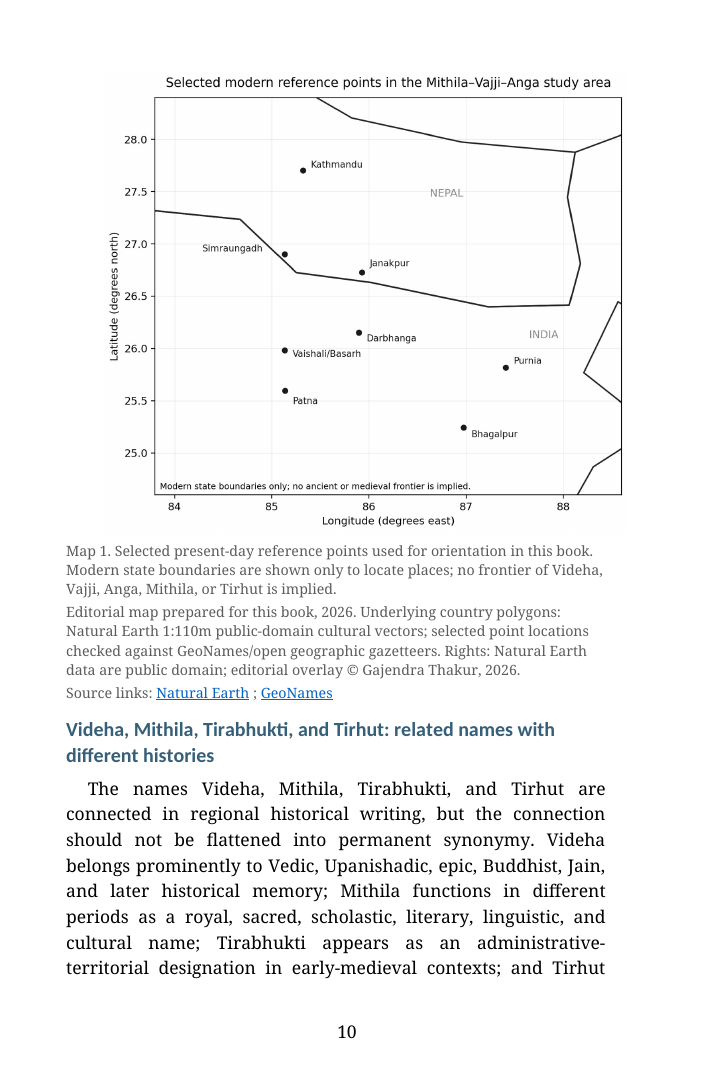
Mithila · Vajji · Anga
Chapter-specific source notes
- Primary chapter witness. Gajendra Thakur, Decoding the Panji of Mithila — Volume IV, formal Chapter 8, PDF pp. 107-122; formal Chapter 8. The HTML transcription is generated from the commit-pinned source PDF and retains the chapter boundary recorded in this edition.
- Internal structure. The repository source-heading inventory records 25 subordinate headings for this chapter: “8.1 From an Opening Cluster to a Branch System”; “8.2 Lal as the Point of Division”; “8.3 Girdhari: The Branch with an Incomplete Opening”; “8.4 Naroun, Kavi Sukhani, and the Scholarly Memory of the Branch”; “8.5 Hansdatt and the Descendants of Sukhani”; “8.6 Sarisab, Sahab, Dullah, Pali, and Bhawanidatt”; “8.7 Abadh Bihari: The More Expansive Branch”; “8.8 Gopal as the Structural Pivot”; ….
- Digital editorial method. The page keeps the preserved source text distinct from generated navigational, concordance, visual, and provenance apparatus. The synthetic reconstruction is explanatory only and is not evidence for an individual lineage or a determination of social or marital status.