Decoding the Panji of Mithila · Volume IV · Chapter 9
Shashipur as a Secondary Centre
Chapter 9
Shashipur as a Secondary Centre

9.1 The Turn from Singhwar to Shashipur
  After the opening Sandahpur-Singhwar material, the
Nagram Panji turns toward Sandahpur-Shashipur. This is not
a minor shift of place-name. It marks the emergence of
Shashipur as a secondary centre within the Nagram network.
The record now begins to gather several families, branches,
and village affiliations around Shashipur, just as the earlier
entries gathered them around Singhwar.
   The heading 'Sandahpur to Shashipur' must therefore be
read as a structural signal. The Panji is not merely saying that
one person moved from Sandahpur to Shashipur. It is opening
a new cluster. The reader should expect a fresh internal
arrangement of names, sons, titles, and village relations, while
still remembering that this cluster remains connected with the
Nagram field established earlier.
  In the earlier Singhwar entries, the reader encountered Lal,
Girdhari, Abadh Bihari, Gopal, Teknarayan, Nageshwar,
Narmadeshwar, Udan, Bacha, Kedar Nath, and several other
branch-holders. In the Shashipur turn, the register introduces
another set of major names: Bandhu, Madhurapati, Narpati,
Bachh, Shivanandan, Chitradhar, Chandīdatt, Fatur Ram,
Lakshman, Raghunath, Shashinath, Tikanath, Muktinath,
Damodar, Bodhu, Harik, and others. The density remains the
same, but the centre of gravity changes.

9.2 Why Shashipur Matters
  Shashipur matters because it functions as a receiving and
organizing point. Many entries in the Panji are village-route
entries. Some routes are small and local; others become the
basis of large family clusters. Shashipur belongs to the latter

category. It receives names from Sandahpur, but then
develops its own branches and sub-branches.
  A secondary centre in the Panji is not necessarily secondary
in importance. It is secondary only in the order of
presentation. Once Shashipur appears, it begins to organize a
considerable amount of genealogical material. It becomes a
place through which several descendants are remembered
and several other villages are connected.
   For the purpose of decoding, a secondary centre must be
treated as a node. A node is a point from which lines radiate.
In this chapter, Shashipur will be treated as such a node. The
chapter will not reduce the material to a single linear descent.
Instead, it will identify the principal branch-holders and show
how their names attach to further places and descendants.

9.3 Bandhu, Madhurapati, and Narpati
   The Shashipur section opens with Bandhu, whose sons or
associated descendants include Madhurapati and Narpati.
This opening is important because it gives the first internal
division of the Shashipur cluster. Bandhu should therefore be
treated as a principal node in the Sandahpur-Shashipur route.
   Madhurapati is the more visibly developed branch in the
immediate sequence. The Panji links him to Bachh and
Shivanandan. The presence of two names following
Madhurapati suggests that his branch becomes the working
line for the next stage of the entry. Narpati is named alongside
him and should not be omitted, even if the following material
develops Madhurapati more strongly.
   The editorial rule here is simple: a name mentioned as part
of the opening division must be preserved even if the
surviving entry gives more detail for another name. The Panji
often records unequal amounts of information for different

descendants. Unequal information does not mean unequal
genealogical existence. It only reflects the state of the record.

9.4 Bachh and Shivanandan: First Expansion
under Madhurapati
   Bachh and Shivanandan appear under the Madhurapati
line. Bachh becomes especially important because his branch
opens into Chitradhar, Chandīdatt, Fatur Ram, and Lakshman.
Shivanandan is also present and must be retained in the
genealogical structure, but the available sequence
immediately develops Bachh's line in greater detail.
  This pattern is common in the Panji. A father or branch-
holder may have multiple sons listed, but the register may
expand only one or two of them at that point. Other sons may
be developed later, or not at all in the surviving record. The
editor must neither invent absent expansions nor suppress the
named but less-developed branches.
   The Shashipur material also shows how names that appear
simple at first become gateways into complex networks. Bachh
is not merely a name; he is the point through which several
later branches are read. If Bachh is omitted from an index or
table, the structure of the Shashipur cluster collapses.

9.5 Chitradhar, Chandīdatt, Fatur Ram, and
Lakshman
   The line of Bachh includes Chitradhar, Chandīdatt, Fatur
Ram, and Lakshman. Each of these names requires separate
treatment. Chitradhar is followed by a developed line
including Raghunath, Shashinath, Tikanath, and Muktinath.
Chandīdatt becomes important in later Shashipur-Pindaruch
material. Fatur Ram and Lakshman also remain part of the
internal structure.

  The presence of these four names shows that Bachh's
branch is not a narrow line but a multi-branch formation. A
modern family chart would likely place the four names at the
same generational level under Bachh, but the Panji itself must
remain the authority. Where the wording clearly marks
sonship, the chart may reflect it; where the sequence is
compact, the explanatory prose should preserve caution.
  The name Chandīdatt deserves special attention because it
reappears in relation to the Shashipur-Pindaruch and
Bachkun Thakur section. Such recurrence is not accidental. It
suggests that the Panji is building a bridge from the
Sandahpur-Shashipur entry into the next Shashipur branch.
The reader should therefore remember Chandīdatt as a
continuing node.

9.6 Chitradhar’s Fourfold Branch: Raghunath,
Shashinath, Tikanath, and Muktinath
  Chitradhar's branch is one of the clearest expansions in the
early Shashipur section. The Panji gives Raghunath,
Shashinath, Tikanath, and Muktinath as the important names
under him. These names mark a fourfold division, and each
should be indexed separately.
   Raghunath is immediately developed through further links
involving Ghusaut, Biku, Babulal, Darihara, and Manik. This
shows that Raghunath's branch was not merely listed; it
carried active village connections. The sequence then brings
in Damodar and Bodhu, making the branch more complex.
  Shashinath also receives later attention. The Panji
associates him with Mandar, Rudradhar, Ishannath, Karmahā,
Lalpani, Satlakha, Ratanū, Arjun, Kujouli, Eknath, Alay, Shital,
Madan, Babulal, Ekhara, Durgadatt, Vanshidhar, and Shridatt.
This set of names and places makes Shashinath a major
secondary node within the Shashipur cluster.

   Muktinath is likewise significant. His line includes
Vighnesh, Dinesh, Bhavesh, and Mahesh, and later names such
as Umash or Umesh, Pilu, Naresh, Purna, and other connected
branches. Muktinath therefore must be treated as one of the
most important Chitradhar descendants.

9.7 Raghunath, Damodar, Bodhu, and the Mandar-
Karmahā Link
  Raghunath's branch contains a sequence in which Damodar
and Bodhu appear. Damodar is connected with Vanshidhar
and Yogindra, while Bodhu is connected with Narayandatt,
Damodar, Ghusaut, Nidhi, and later Harik. The entry is
compact, but it clearly preserves a branching structure rather
than a mere list.
   The Mandar-Karmahā link is important here. The Panji
connects names such as Rudradhar or Rudraghar, Ishannath,
and Lalpani with Mandar and Karmahā. These places have
already appeared elsewhere in the Nagram material. Their
repetition must be recorded carefully because they may
represent recurring matrimonial or affiliation routes.
  Damodar should be indexed in more than one local context.
There is Damodar under the Bachh-Chitradhar-Raghunath
branch, and there are other Damodar occurrences elsewhere
in the Nagram Panji. The index should not merge them
without local identifiers. The safer method is to index as
'Damodar, under Raghunath branch, Shashipur cluster' and
then cross-check other Damodar entries separately.

9.8 Harik and the Samauli-Pali Connection
   Harik appears as an additional branch connected with the
Bodhu line. The entry associates Harik with Samauli, Pali,
Bachchi, Chumman, Soderpur, and Murli. This is a valuable
example of a small but meaningful branch that would be easy
to overlook if the editor summarized too quickly.

  The Samauli-Pali pairing is especially significant because
Samauli becomes a major heading later in the Panji. Its
appearance here in the Shashipur material may show an
earlier or cross-linked affiliation. The final route table should
therefore include this Samauli occurrence under the
Shashipur cluster, not only under the later Samauli chapter.
   Harik's line also illustrates the importance of apparently
modest names. A large genealogical book is built from many
such small nodes. If they are omitted, the final index may
appear impressive but remain incomplete. This volume's
principle is therefore to preserve the small branch as carefully
as the large one.

9.9 Shashinath and the Wide Secondary Web
  Shashinath's branch is one of the densest parts of the early
Shashipur material. It moves through Mandar and Karmahā,
then through Satlakha and Kujouli, then through Alay and
Ekhara. The sequence may appear difficult because it
combines several place-relations in one compressed chain.
   The first part of the Shashinath line connects Mandar,
Rudradhar, Ishannath, and Karmahā-Lalpani. This suggests a
strong relation between the Shashinath line and the Mandar-
Karmahā axis. The next part connects Satlakha, Ratanū, Arjun,
Kujouli, and Eknath. This widens the branch into another
village network.
  The later part involving Alay, Shital, Madan, Babulal,
Ekhara, Durgadatt, Vanshidhar, Alay again, and Shridatt
shows how a single branch can move through repeated place
markers. The repetition of Alay should not be dismissed as
accidental. It may indicate more than one Alay-linked relation,
or a return to an earlier place within the same sub-branch.
The final apparatus should preserve both occurrences.

9.10 Muktinath and the Vighnesh-Dinesh-Bhavesh-
Mahesh Cluster
  Muktinath's branch is marked by the names Vighnesh,
Dinesh, Bhavesh, and Mahesh. This cluster is important
because it continues the Chitradhar line into a new
generational layer. The Panji then develops Vighnesh through
Bachcha or Umash/Umesh, Pilu, Naresh, Purna, and related
names.
   The presence of Bishfi or Visfi and Fani Lal in this part of
the entry adds another important place-person link. Such a
link must be preserved in the route table. It may also help
distinguish this Vighnesh branch from other Vighnesh
occurrences in the wider Panji.
   Dinesh is later associated with Buchai and Badrinath, while
Bhavesh appears elsewhere in the Shashipur-Pindaruch
context. Mahesh is named as part of the initial cluster but may
not receive equal expansion in the immediately surviving text.
All four names should be indexed, but with notes indicating
the extent of surviving detail.

9.11 The Shashipur Entry as a Model of Panji
Expansion
  The Sandahpur-Shashipur entry demonstrates one of the
most important characteristics of the Nagram Panji: a route
heading can contain a complete internal genealogy. What
begins as a single heading soon unfolds into several branch-
holders, many sons, and numerous village links.
   The reader must therefore resist the temptation to treat
headings as simple labels. A heading is the doorway into a
cluster. The cluster must be opened patiently. Names must be
separated, village markers identified, and repeated terms
checked against later occurrences.

   This is also why the chapter structure of this book moves
slowly. A quick summary of the Shashipur entry would say
only that Bandhu's line proceeds through Madhurapati and
related descendants. That would be technically true but
genealogically inadequate. The real historical value lies in the
detailed structure of the branch.

9.12 Shashipur-Pindaruch and Bachkun Thakur:
The Next Branch
  After the main Sandahpur-Shashipur entry, the Panji moves
to Shashipur-Pindaruch and Bachkun Thakur. This shift
confirms that Shashipur is becoming an organizing centre.
The same place now receives another named branch, and that
branch draws on names already seen in the earlier Shashipur
material.
  Chandīdatt appears here as a significant connector. From
Chandīdatt, the entry moves to Baidyanath, then to Manik,
Mathuranath, Pali, Fakiran, and further branches such as
Haldhar and Bachanū. This shows that Chandīdatt's earlier
appearance under Bachh was not incidental. He becomes the
bridge into a new Shashipur-Pindaruch unit.
  The phrase involving Bachkun Thakur should be retained
as a branch designation. It may identify a known house, a
remembered title-holder, or a branch-name attached to a
person. The final title index should therefore include Bachkun
Thakur, not merely Bachkun as a personal name.

9.13 Baidyanath, Manik, Mathuranath, and the
Pali-Fakiran Link
  In the Shashipur-Pindaruch material, Baidyanath becomes
an important node. He is associated with Manik and
Mathuranath, and the line reaches Pali and Fakiran. This is

another example of the Panji's compact village-person
grammar.
   Manik and Mathuranath should be read together in this
local context. Pali and Fakiran provide the village or affiliated
relational markers. Since Pali has already appeared in the
earlier Shashipur material and in the Singhwar material, this
occurrence must be indexed separately and then cross-
checked later.
  Baidyanath is a recurring name across the Nagram Panji.
This local Baidyanath must not be merged with other
Baidyanath figures unless the source explicitly connects them.
The final index should use qualifiers: Baidyanath under
Shashipur-Pindaruch; Baidyanath under Kedar Nath's branch;
Baidyanath under later sacred-heading sections; and so on.

9.14 Haldhar, Bachanū, Yugal Kishor, and the
Hariam-Rakhwari Link
  The Baidyanath line includes Haldhar and Bachanū.
Haldhar's branch leads to Yugal Kishor and a Hariam-
Rakhwari connection involving Nenān and Jamahir. This is a
good example of how a small sub-branch can preserve a
specific village route.
  The mention of Rakhwari is important because Rakhwari
appears elsewhere in the Nagram material as a heading or
route element. Its occurrence here should therefore be
recorded in the village index. The same place may appear in
several chapters, but each appearance has a different
genealogical context.
  Bachanū, also identified with Sudhakar in some form, opens
another branch involving Baliyas, Govardhan, and Damodar.
This branch should be kept distinct from Damodar in the
Raghunath line. The Panji uses repeated names constantly,
and the editor's duty is to localize them carefully.

9.15 Fatur, Krishnakant, and Harivansh
   The Shashipur-Pindaruch entry also includes Fatur, whose
line leads to Krishnakant and then Harivansh. This part
connects with Fanandah, Ravinath, Raja, Sakradhī, Bhawani,
Karmahā, Nathe, Balel, Pabouli, and Gopal. It is a dense
sequence and should be decoded as a complete unit.
   Krishnakant should be treated as a significant local branch-
holder. His son or descendant Harivansh connects the branch
to Karmahā and Pabouli. These place markers help locate this
branch within the larger Nagram geography. Since Karmahā
has already appeared repeatedly, the editor must note the
specific Krishnakant-Harivansh context.
   The presence of names such as Raja and Bhawani in this
line also requires caution. They may appear elsewhere in the
Panji. The index should therefore include local qualifiers. The
guiding principle remains: repeated names are not identical
unless the Panji makes them identical.

9.16 Ram, Jyotishi Bachkun, Gayadatt, and
Munika
  The entry next introduces Ram and his associated
descendants or branch-names: Jyotishi Bachkun, Gayadatt,
and Munika. The title Jyotishi is important. It marks Bachkun
not merely as a genealogical name but as a person or branch
remembered through astrological or calendrical expertise.
  Jyotishi Bachkun connects with Mandar, Ishannath,
Jamahir, Alay, Chaudhary Shyam Lal, Ekhara, Babunath,
Panchhi, Sakradhī, and Meghanath. This is a wide and
meaningful network. The title should therefore be retained in
the title index, and the name should be cross-referenced
under Bachkun.
   The branch also includes Umesh and Bhavesh, with further
village links involving Baliyas, Ghoghi, Lutan, Hariam, Bhau,

Darihara, Madhusudan, Yadav, and Madhav. These names
show that the Bachkun branch is not a small appendix; it is a
developed Shashipur sub-network.

9.17 Shashipur-Survana Thakur
  The next Shashipur section is marked by Survana Thakur.
This heading should be preserved as a branch designation.
The Panji often remembers families through such named
branches, and the title Thakur may indicate a house, status, or
recognized line rather than merely a casual honorific.
  The Survana Thakur material begins by continuing from
Gayadatt and Lakshman, then moves to Shivanandan and
Sarvanarayan. Sarvanarayan becomes a major node with
several descendants: Bhaiyalal, Naubatlal, Mahā or Maho
Kulanand, and others. The branch then expands into Thaknu
or Bhawanand, Bachcha or Vedanand, Mangan or Kashikant,
Madankant, Sadankant, Modkant, Pramodkant, Vijendrakant,
Kumudkant, Bhagwatikant, and Bharatikant.
  This is one of the places where the Panji visibly approaches
a more recent naming world. Names ending in -kant appear in
a series and may represent a later generation or a more
modern naming pattern. The editor should preserve the
names exactly and avoid imposing older genealogical
assumptions on them.

9.18 Sarvanarayan, Bhaiyalal, Naubatlal, and
Kulanand
  Sarvanarayan is the main structural node in the Survana
Thakur section. His descendants or associated branches
include Bhaiyalal, Naubatlal, and Kulanand. The record
connects them with Padua, Pashupati, Kedar, Pali, Jyotishi
Durgadatt, Darihara, Raghunath, Chitradhar, and other names
and places.

   Bhaiyalal receives special development through Thaknu or
Bhawanand, Bachcha or Vedanand, and Mangan or Kashikant.
This suggests that Bhaiyalal's branch is especially important
within the Survana Thakur material. Naubatlal and Kulanand
must also be preserved, even where the surviving text gives
less immediate expansion.
  The use of alternate names is especially frequent in this
section.   Thaknu/Bhawanand,      Bachcha/Vedanand,      and
Mangan/Kashikant should all be indexed under both forms. If
the index later supplied by the user contains only one form,
the cross-checking stage should add the missing alternate
name.

9.19 The Kashikant and Kant-Named Descendants
  The Mangan or Kashikant branch introduces a long list of
Kant-named descendants: Madankant, Sadankant, Modkant,
Pramodkant, Vijendrakant, Kumudkant, Bhagwatikant, and
Bharatikant. This is a major modernizing cluster and should
be treated as a distinct sub-section in the genealogical tables.
   The Panji then continues through Madankant to
Ramankant, Jivkant, and Sunilkant, and through other Kant-
named lines such as Nishikant, Navinkant, Manikant,
Ajaykant, Sanjaykant, Vijaykant, Pradipkant, Samirkant,
Bhaveshkant, Vinodkant, Rajeshkant, and others. The
recurrence of the suffix -kant makes this section visually easy
to recognize but genealogically easy to confuse.
  The index must be especially careful here. Each Kant-name
should receive an individual entry. The branch table should
group them under Kashikant or the appropriate intermediate
ancestor. A simple alphabetical index will not be enough; the
genealogical grouping must also be retained.

9.20 Why the Shashipur Cluster Must Be Treated
Slowly
   The Shashipur material proves that the Nagram Panji
cannot be decoded by headings alone. A single Shashipur
heading may contain multiple sub-branches, several repeated
villages, alternate names, titles, and later generational layers.
If the editor merely lists the headings, the internal structure
disappears.
  This chapter has therefore treated Shashipur as a secondary
centre. It has shown how the Sandahpur-Shashipur entry
develops through Bandhu, Madhurapati, Bachh, Chitradhar,
Raghunath, Shashinath, Muktinath, and others; how the
Shashipur-Pindaruch entry develops through Chandīdatt,
Baidyanath,    Haldhar,    Bachanū,     Fatur,   Krishnakant,
Harivansh, Ram, Jyotishi Bachkun, and Gayadatt; and how the
Shashipur-Survana Thakur entry opens a large Sarvanarayan-
Bhaiyalal-Kashikant line.
  The practical consequence is clear. The final index must
include Shashipur not only as a place but as a major
organizing node. Under Shashipur there should be sub-entries
for Sandahpur-Shashipur, Shashipur-Pindaruch, Bachkun
Thakur, Survana Thakur, Sarvanarayan, Kashikant, and the
Kant-named descendants.

9.21 Summary
   Shashipur is the first major secondary centre in the Nagram
Panji. It receives the Sandahpur line, develops its own
branches, and becomes the base for several later sub-clusters.
The chapter has shown that Shashipur cannot be reduced to a
single route or a single family line. It is a network node.
  The main interpretive points are these: Bandhu opens the
Sandahpur-Shashipur cluster; Madhurapati and Bachh carry
the line forward; Chitradhar creates a fourfold branch

through Raghunath, Shashinath, Tikanath, and Muktinath;
Chandīdatt links the material to Shashipur-Pindaruch;
Bachkun Thakur and Survana Thakur mark named branches;
Sarvanarayan and Kashikant become major later nodes; and
the Kant-named descendants require careful indexing.
  The next chapter will continue with the Shashipur-
Pindaruch and Shashipur-Survana material in still greater
detail, focusing especially on Bachkun Thakur, Baidyanath,
Haldhar, Krishnakant, Jyotishi Bachkun, Sarvanarayan,
Kashikant, and the wide network of later descendants.
Source structure and verification apparatus
Editorial source apparatus. This apparatus is descriptive, not interpretive. It records the source-controlled structure used to verify that this page corresponds to formal Chapter 9 of Decoding the Panji of Mithila — Volume IV. The chapter text above is preserved from PDF pp. 123-136; formal Chapter 9 in the commit-pinned authoritative source. It is not merged with a neighboring chapter, appendix, annexure, or independent front/back-matter unit. The internal headings below come from the repository’s source-heading inventory and are retained as navigational and audit evidence; showing them here does not turn those headings into separate publications or add claims that are absent from the source.
Internal source headings
- 9.1 The Turn from Singhwar to Shashipur
- 9.2 Why Shashipur Matters
- 9.3 Bandhu, Madhurapati, and Narpati
- 9.4 Bachh and Shivanandan: First Expansion under Madhurapati
- 9.5 Chitradhar, Chandīdatt, Fatur Ram, and Lakshman
- 9.6 Chitradhar’s Fourfold Branch: Raghunath, Shashinath, Tikanath, and Muktinath
- 9.7 Raghunath, Damodar, Bodhu, and the Mandar-Karmahā Link
- 9.8 Harik and the Samauli-Pali Connection
- 9.9 Shashinath and the Wide Secondary Web
- 9.10 Muktinath and the Vighnesh-Dinesh-Bhavesh-Mahesh Cluster
- 9.11 The Shashipur Entry as a Model of Panji Expansion
- 9.12 Shashipur-Pindaruch and Bachkun Thakur: The Next Branch
- 9.13 Baidyanath, Manik, Mathuranath, and the Pali-Fakiran Link
- 9.14 Haldhar, Bachanū, Yugal Kishor, and the Hariam-Rakhwari Link
- 9.15 Fatur, Krishnakant, and Harivansh
- 9.16 Ram, Jyotishi Bachkun, Gayadatt, and Munika
- 9.17 Shashipur-Survana Thakur
- 9.18 Sarvanarayan, Bhaiyalal, Naubatlal, and Kulanand
- 9.19 The Kashikant and Kant-Named Descendants
- 9.20 Why the Shashipur Cluster Must Be Treated Slowly
- 9.21 Summary
Source-text concordance
Shashipur · Secondary · Centre · Turn · Singhwar · opening · Sandahpur-Singhwar · material · Nagram · turns · toward · Sandahpur-Shashipur · minor · shift · place-name · marks · emergence · within · network · record · begins · gather · several · families · branches · village · affiliations · around · earlier · entries · gathered · heading · Sandahpur · must · therefore · read · structural · signal · merely · saying · person · moved · cluster · reader · expect · fresh · internal · arrangement · names · sons · titles · relations · still · remembering · remains · connected · field · established · encountered · Girdhari · Abadh · Bihari · Gopal · Teknarayan · Nageshwar · Narmadeshwar · Udan · Bacha · Kedar · Nath · branch-holders · register · introduces · another · major · Bandhu · Madhurapati · Narpati · Bachh · Shivanandan
Boundary verification. In the formal sequence this chapter follows Volume IV Chapter 8, “Girdhari, Abadh Bihari, Gopal, Teknarayan, and the Expansion of the Singhwar Branch” and precedes Volume IV Chapter 10, “The Shashipur-Pindaruch and Shashipur-Survana Branches”. The chapter extractor begins at the verified formal Chapter 9 marker and stops at the next verified formal chapter marker; for a final chapter it stops before recognized book-level back matter. The concordance above is generated only from distinct terms already present in this chapter’s preserved source text. It is provided for discovery, comparison, and audit, not as an automated judgment about persons, lineages, status, kinship, marriage eligibility, or historical truth.
Illustrated research apparatus
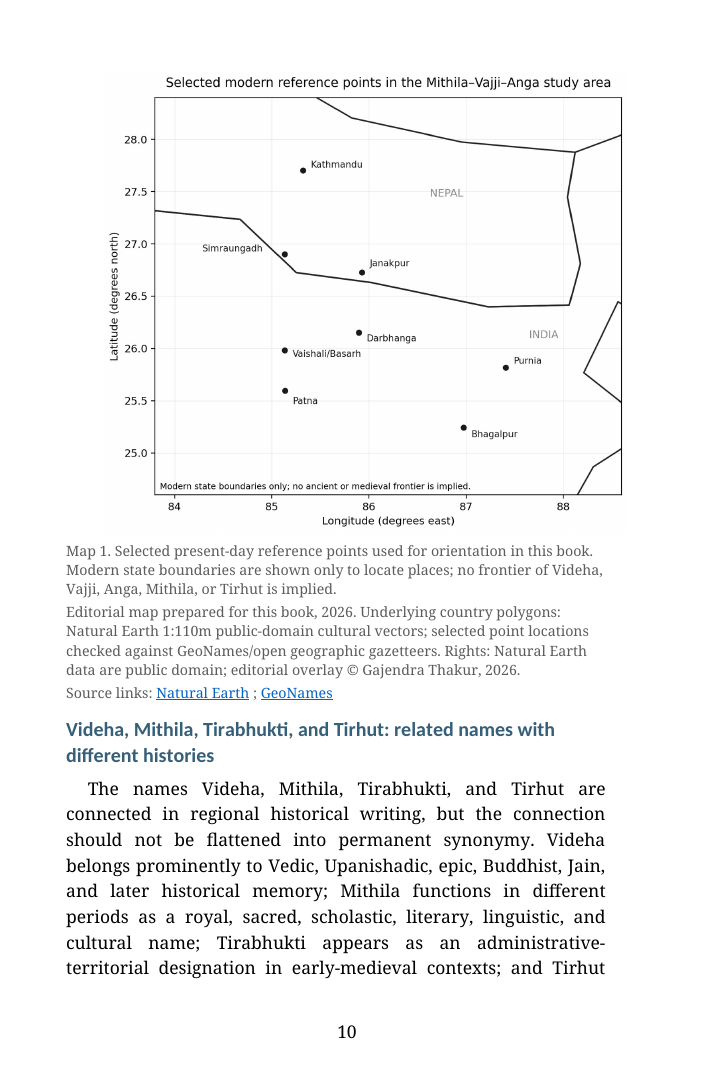
Mithila · Vajji · Anga
Chapter-specific source notes
- Primary chapter witness. Gajendra Thakur, Decoding the Panji of Mithila — Volume IV, formal Chapter 9, PDF pp. 123-136; formal Chapter 9. The HTML transcription is generated from the commit-pinned source PDF and retains the chapter boundary recorded in this edition.
- Internal structure. The repository source-heading inventory records 21 subordinate headings for this chapter: “9.1 The Turn from Singhwar to Shashipur”; “9.2 Why Shashipur Matters”; “9.3 Bandhu, Madhurapati, and Narpati”; “9.4 Bachh and Shivanandan: First Expansion under Madhurapati”; “9.5 Chitradhar, Chandīdatt, Fatur Ram, and Lakshman”; “9.6 Chitradhar’s Fourfold Branch: Raghunath, Shashinath, Tikanath, and Muktinath”; “9.7 Raghunath, Damodar, Bodhu, and the Mandar-Karmahā Link”; “9.8 Harik and the Samauli-Pali Connection”; ….
- Digital editorial method. The page keeps the preserved source text distinct from generated navigational, concordance, visual, and provenance apparatus. The synthetic reconstruction is explanatory only and is not evidence for an individual lineage or a determination of social or marital status.