Decoding the Panji of Mithila · Volume IV · Chapter 10
The Shashipur-Pindaruch and Shashipur-Survana Branches
Chapter 10
The Shashipur-Pindaruch and Shashipur-Survana
Branches

10.1 Why Chapter 10 Returns to Shashipur
  The preceding chapter established Shashipur as a
secondary centre within the Nagram Panji. That was
necessary before the reader could understand the two branch
formations that now require closer treatment: the Shashipur-
Pindaruch branch associated with Bachkun Thakur, and the
Shashipur-Survana     Thakur    branch     associated    with
Sarvanarayan, Bhaiyalal, Kashikant, and the later Kant-named
descendants.
   These two branches are not minor additions to the
Sandahpur-Shashipur      entry.  They     are   independent
expansions of the Shashipur node. The first expansion moves
through     Chandīdatt,   Baidyanath,  Haldhar,    Bachanū,
Krishnakant, Harivansh, Jyotishi Bachkun, Gayadatt, and
related lines. The second expansion moves through Survana
Thakur, Shivanandan, Sarvanarayan, Bhaiyalal, Naubatlal,
Kulanand, Bhawanand, Vedanand, Kashikant, and a wide later
network of Kant-named descendants.
   The purpose of this chapter is therefore more specific than
the previous one. Chapter 9 explained why Shashipur matters.
Chapter 10 explains how the Shashipur branches work
internally. It treats the branches as documentary units, not as
loose lists of names. The reader should watch for three things:
the branch-designating title, the principal genealogical node,
and the village-route attachments that show how the branch
spread.

10.2 What Is Meant by Shashipur-Pindaruch
  The expression Shashipur-Pindaruch should be read as a
route-name and branch-marker. It does not simply mean that
the two villages are mentioned together. It marks a
genealogical context in which the Shashipur line becomes
connected with Pindaruch. The Panji then identifies a
remembered figure or house-name, Bachkun Thakur, through
which this branch is organized.
  In many Panji entries, a place-pair serves as the heading for
a specific cluster. The place-pair tells the reader where the
family memory is to be located. The branch-name then tells
the reader how the cluster is recognized. Thus Shashipur-
Pindaruch and Bachkun Thakur should be understood
together: the first is the place-route frame, and the second is
the branch identity.
   The editor should not separate the place-route from the
branch-name. If Bachkun Thakur is indexed without
Shashipur-Pindaruch, the context is lost. If Shashipur-
Pindaruch is indexed without Bachkun Thakur, the branch
loses its human marker. The proper index form should
therefore include both: Shashipur-Pindaruch: Bachkun
Thakur branch.

10.3 Chandīdatt as the Bridge into the Pindaruch
Branch
  The Shashipur-Pindaruch material opens from Chandīdatt.
This is significant because Chandīdatt had already appeared
within the earlier Shashipur cluster under Bachh. His
reappearance here shows that the Panji is not beginning an
unrelated list. It is continuing and reclassifying an existing
branch through a new route and a new named house.
  Chandīdatt's importance lies in his bridging function. He
connects the Sandahpur-Shashipur material to the Shashipur-

Pindaruch expansion. From him the register moves to
Baidyanath, and from Baidyanath to other descendants and
village connections. If Chandīdatt is omitted from the branch
table, the reader will not understand why the Pindaruch
branch belongs to the Shashipur sequence.
  The safest way to represent this in a genealogical table is to
place Chandīdatt under the earlier Bachh line, then create a
subheading        under         Chandīdatt       for        the
Shashipur-Pindaruch/Bachkun Thakur branch. This preserves
both continuity and local identity.

10.4 Baidyanath: The First Major Node under
Chandīdatt
   Baidyanath is the first major node in the Shashipur-
Pindaruch branch. The Panji associates him with Manik and
Mathuranath, and then with Pali and Fakiran. This is a small-
looking sequence, but it carries several layers: a named
descendant, an internal branch, and two village or affiliation
markers.
   Because Baidyanath is a frequently recurring name in the
Nagram Panji, his local placement is crucial. This Baidyanath
is not to be automatically identified with other Baidyanath
figures appearing elsewhere. The proper method is to identify
him as Baidyanath of the Chandīdatt-Shashipur-Pindaruch
branch, and only later compare him with other Baidyanath
entries if the index or cross-references make such comparison
necessary.
   The Manik-Mathuranath pair should also be preserved.
Manik appears in many Panji contexts; Mathuranath too may
appear elsewhere. In this branch, however, they belong to the
Baidyanath expansion. The Pali-Fakiran association helps
localize them.

10.5 Haldhar and Bachanū: Two Paths from the
Baidyanath Line
   The Baidyanath branch next includes Haldhar and
Bachanū. These two names should be treated as separate
paths. Haldhar leads to Yugal Kishor and to a Hariam-
Rakhwari connection. Bachanū, also appearing with the
alternate or explanatory form Sudhakar, leads into Baliyas,
Govardhan, and Damodar.
   Haldhar's path is especially useful for understanding how a
small sub-branch records a precise route. The connection with
Hariam and Rakhwari links the Shashipur-Pindaruch branch
to places that appear elsewhere in the Nagram material. This
shows that the Panji often uses a branch entry to preserve a
cross-link that would be lost if the reader followed only the
main heading.
   Bachanū's path shows a different type of problem: alternate
naming. If Bachanū is identified with Sudhakar, the index
must include both forms. The genealogical table should not
silently choose one and discard the other. A Panji name may
carry a household nickname, a formal name, and a
remembered alternate. All may be needed for cross-checking.

10.6 Fatur, Krishnakant, and Harivansh
   The Pindaruch branch also contains Fatur, Krishnakant,
and Harivansh. This sequence is important because it moves
the branch through another line of descent and another set of
village affiliations. Krishnakant becomes the visible centre of
the sequence, and Harivansh appears as the next significant
descendant.
  Krishnakant's branch is associated with Fanandah,
Ravinath, Raja, Sakradhī, Bhawani, Karmahā, Nathe, Balel,
Pabouli, and Gopal. The sequence is compact, but the pattern

is clear: a named line is being attached to a series of villages
and persons that locate it within the wider Nagram field.
  The editor should separate Fatur's branch from the earlier
Fatur Ram under Bachh unless the source explicitly links
them. The similarity of names may tempt a merger, but
genealogical editing must be conservative. A name can repeat
in different lines. The safest index form is therefore: Fatur,
under Shashipur-Pindaruch; Fatur Ram, under Bachh line.

10.7 Ram, Jyotishi Bachkun, Gayadatt, and
Munika
   Another important part of the Pindaruch material
introduces Ram and the associated names Jyotishi Bachkun,
Gayadatt, and Munika. Here the title Jyotishi is especially
important. It identifies Bachkun not merely by personal name
but through a learned or professional role connected with
astrology, calendrical calculation, or ritual timing.
  Jyotishi Bachkun should be indexed under both Bachkun
and Jyotishi. The title is part of the memory of the person or
branch. If removed, the entry loses information about the
social role through which the family was known. This is one of
the reasons Volume IV includes a title and honorific index in
addition to a personal name index.
  The branch then moves through Mandar, Ishannath,
Jamahir, Alay, Chaudhary Shyam Lal, Ekhara, Babunath,
Panchhi, Sakradhī, Meghanath, Umesh, Bhavesh, Baliyas,
Ghoghi, Lutan, Hariam, Bhau, Darihara, Madhusudan, Yadav,
and Madhav. This is not a random accumulation. It is the
documentary web of the Jyotishi Bachkun branch.

10.8 How to Chart the Pindaruch Branch
  The Pindaruch branch should be charted in a layered form.
The top line should read: Shashipur-Pindaruch / Bachkun

Thakur branch. Below it, Chandīdatt should be placed as the
bridge from the earlier Shashipur line. Under Chandīdatt,
Baidyanath should appear as the first major node.
  Under Baidyanath, the table should show Manik-
Mathuranath and the Pali-Fakiran association, then Haldhar
and Bachanū as separate paths. Under Haldhar, Yugal Kishor
and the Hariam-Rakhwari link should appear. Under
Bachanū/Sudhakar, Baliyas-Govardhan-Damodar should be
recorded. A separate path should record Fatur-Krishnakant-
Harivansh, and another should record Ram-Jyotishi Bachkun-
Gayadatt-Munika.
  This charting method avoids two errors. It avoids flattening
the branch into a mere list, and it avoids over-building a
family tree where the source has not supplied every
generation clearly. The chart should remain a guided
reconstruction, not an invented certainty.

10.9 The Meaning of Shashipur-Survana Thakur
  The second major branch in this chapter is the Shashipur-
Survana Thakur branch. Like Bachkun Thakur, Survana
Thakur should be treated as a branch designation. The title
Thakur marks a remembered house or recognized branch
identity. It may also carry social status, but the editor should
not reduce it to a modern title without context.
   The Survana Thakur section continues the Shashipur field
and then builds a major branch through Shivanandan and
Sarvanarayan. The Panji associates Shivanandan with
Sarvanarayan and then develops Sarvanarayan's descendants
or associated names in detail. This makes Sarvanarayan the
first major organizing node of the Survana branch.
  The heading must therefore be indexed at three levels:
Shashipur as the place node; Survana Thakur as the branch
designation; Sarvanarayan as the principal genealogical node.

If any one of these is missing, the branch will be difficult to
recover from the final index.

10.10 Sarvanarayan and the First Survana
Division
  Sarvanarayan's branch includes Bhaiyalal, Naubatlal, and
Kulanand. These names form the first visible division under
the Survana branch. The Panji then develops Bhaiyalal more
extensively, but the other names should still be retained in the
table and index.
  The rule here is the same as in earlier chapters: more detail
does not always mean greater genealogical importance. It may
simply mean that the surviving record had more information
for one branch. Naubatlal and Kulanand should not be
suppressed because Bhaiyalal receives fuller treatment.
   Sarvanarayan's placement also shows the relation between
traditional naming and later expansions. The branch begins
with a compact lineage statement, then opens into a larger set
of descendants, alternate names, and modern-sounding
names. This makes the Survana branch one of the most useful
parts of the Nagram Panji for studying continuity across
generations.

10.11 Bhaiyalal, Bhawanand, Vedanand, and
Kashikant
   Bhaiyalal is the most developed early descendant in the
Survana branch. His line contains Thaknu or Bhawanand,
Bachcha or Vedanand, and Mangan or Kashikant. These
alternate forms are important. They may reflect household
names, formal names, scribal clarification, or known variants
within the family memory.
  Bhawanand, Vedanand, and Kashikant should each receive
index entries, with cross-references to Thaknu, Bachcha, and

Mangan respectively where appropriate. If the user later
supplies an index that contains only one side of an alternate
name, the cross-checking stage should add the missing
counterpart.
   Kashikant is particularly important because he opens the
large Kant-named cluster. The branch should therefore be
represented as Bhaiyalal -> Bhawanand / Vedanand /
Kashikant, with Kashikant receiving a separate sub-table for
later descendants.

10.12 The Kant-Named Cluster as a Modernizing
Genealogical Layer
  The Kant-named cluster includes Madankant, Sadankant,
Modkant,     Pramodkant,     Vijendrakant,      Kumudkant,
Bhagwatikant, Bharatikant, and then later names such as
Ramankant, Jivkant, Sunilkant, Nishikant, Navinkant,
Manikant, Ajaykant, Sanjaykant, Vijaykant, Pradipkant,
Samirkant, Bhaveshkant, Vinodkant, Rajeshkant, and others.
  The recurrence of the suffix -kant makes the cluster visually
coherent. It may indicate a naming preference within a family
generation or set of related branches. But visual coherence
should not be mistaken for simplicity. Every Kant-name is a
separate indexable unit. The table must show their grouping,
but the index must allow each name to be found
independently.
  This cluster is also a useful example of how the Panji
absorbs later naming styles. The presence of such names does
not weaken the traditional character of the record. It shows
that the Panji continued to register family memory as naming
conventions changed.

10.13 Madankant and the Ramankant-Jivkant-
Sunilkant Line
   Madankant is the first major name in the Kant cluster to
receive further development. His line includes Ramankant,
Jivkant, and Sunilkant. These names should be grouped under
Madankant in the genealogical table and indexed separately.
  The register connects these names with places such as
Sakradhī, Vanshmani, Lakshmikant, Panichobh, and Sone Lal.
Such place-person links must be preserved. They show that
the Kant-named cluster is not an abstract modern list; it
remains embedded in the same village-route grammar as the
older sections.
   The appearance of Lakshmikant in this context requires
special caution. Because Lakshmikant can also appear
elsewhere as a personal name, the index should specify his
local relation under the Madankant branch.

10.14 Sadankant, Nishikant, and Navinkant
   Sadankant's branch includes Nishikant and Navinkant. The
available record may not expand every descendant equally,
but the names must be preserved. A name without expansion
is still a genealogical datum.
  Nishikant and Navinkant should be indexed as descendants
or associated names under Sadankant. If the final supplied
index contains them separately but does not connect them to
Sadankant, the cross-checking stage should add that relation.
The user-supplied index will therefore become a useful tool
not only for confirming coverage but for detecting missed
branch connections.
  The same rule applies to all minimally expanded names in
the Kant cluster: absence of detail does not justify omission.
The Panji's brief mention is itself the evidence.

10.15 Modkant, Manikant, Ajaykant, Sanjaykant,
and Vijaykant
   The Modkant branch introduces Manikant, Ajaykant,
Sanjaykant, and Vijaykant. This group should be treated as a
separate sub-branch rather than merged into the wider Kant
list without structure. The names may appear together
because they belong to one generation or one household
branch.
  Manikant is especially important because the base-name
Manik appears earlier in the Panji. However, Manikant is not
the same as Manik. The suffix changes the name and likely the
generation. The index should therefore distinguish Manik,
Manikant, and any other related forms.
  Ajaykant, Sanjaykant, and Vijaykant are modern-sounding
names and likely belong to a later layer of the genealogy. They
should still be treated with the same seriousness as older
names. The Panji does not become less authoritative when it
records later generations; it becomes more valuable as a
bridge between older and newer family memory.

10.16 Pramodkant, Pradipkant, and Samirkant
   Pramodkant's line includes Pradipkant and Samirkant.
These names continue the modernizing pattern of the Kant
cluster. Their inclusion shows that the Survana branch
extended into a period of more recent naming conventions
and possibly more recent documentary additions.
  The editor should not try to Sanskritize, normalize, or
modernize these names beyond the source. Pradipkant should
remain Pradipkant if that is the form of the record; Samirkant
should remain Samirkant. Variants can be noted, but the
source-form must remain visible.
  In the final apparatus, Pramodkant should be indexed as
the parent or branch-holder for Pradipkant and Samirkant

where the source supports that relation. The entries should
also be cross-checked against the name index supplied at the
end of the project.

10.17 Vinodkant, Bhaveshkant, Rajeshkant, and
Later Branches
  The    later   Kant-named     lines include    Vinodkant,
Bhaveshkant, Rajeshkant, and other names. Some of these
may have little expansion in the immediate text; others may
be linked to villages or further descendants. The editorial
method remains the same: preserve the names, localize them,
and avoid unsupported merging.
  Rajeshkant appears in a branch connected with Pali,
Meghanath, Jhalanath, Khandbala, and Meghakant. This is an
example of a later-sounding personal name still operating
within the older Panji formula of village affiliation and lineage
connection.
  Bhagwatikant and Bharatikant also deserve attention.
Bharatikant appears with a connection involving Baliyas,
Sharadanand,       Vindhyanath,        Soderpur,      and
Mahamahopadhyaya Umesh. Such titles and place links show
that even in the later Kant cluster, scholarly or honorific
memory remains part of the genealogy.

10.18 How to Avoid Confusion in the Survana
Branch
  The Survana branch is easy to confuse because many
names share the suffix -kant, and because several names are
mentioned briefly. The solution is not to simplify the branch
artificially, but to chart it in layers. The table should begin
with Shashipur-Survana Thakur, then Shivanandan, then
Sarvanarayan, then Bhaiyalal, Naubatlal, and Kulanand.

  Under Bhaiyalal, the table should show Bhawanand,
Vedanand, and Kashikant. Under Kashikant, it should show
the first Kant-named group: Madankant, Sadankant, Modkant,
Pramodkant, Vijendrakant, Kumudkant, Bhagwatikant, and
Bharatikant. Under these, the later names should be placed
according to the source sequence.
  The final index should include both a straight alphabetical
index and a branch index. An alphabetical index alone will
scatter the Kant-names across many pages. A branch index
will preserve their family grouping. Both are necessary.

10.19 Editorial Treatment of Titles in These
Branches
  Two titles are especially important in this chapter: Thakur
and Jyotishi. Thakur appears in Bachkun Thakur and Survana
Thakur. Jyotishi appears with Bachkun. These titles should not
be silently dropped. They are part of how the branches were
remembered.
   Thakur may mark a respected family branch, a
remembered title-holder, or a household identity. Jyotishi
indicates a learned function. Both titles help convert bare
names into social persons. The Panji does not merely say that
a person existed; it often tells how that person was recognized.
    The final title index should therefore include Bachkun
Thakur, Survana Thakur, Jyotishi Bachkun, and any other
titled forms appearing in these sections. Where the same base-
name appears with and without title, both forms should be
cross-referenced.

10.20 Places Requiring Index Entries from This
Chapter
  The places requiring index entries from this chapter include
Shashipur, Pindaruch, Pali, Fakiran, Hariam, Rakhwari,

Baliyas, Fanandah, Sakradhī, Karmahā, Pabouli, Mandar, Alay,
Ekhara, Darihara, Satlakha, Khandbala, Panichobh, and
Soderpur. Some of these have already appeared in earlier
chapters; that is precisely why they must be indexed with local
qualifiers.
   A village index for a Panji book should not merely list a
village once. It should list every major context in which the
village appears. For example, Karmahā appears in the
Singhwar material, the Shashipur material, the Pindaruch
branch, and the Survana/Kant material. Each occurrence may
represent a different line or relation.
  At the end of the project, the user-supplied index can be
compared against this chapter's local place list. Any missing
place, alternate spelling, or unqualified repeated place can
then be corrected.

10.21 Summary
  This chapter has decoded the two major Shashipur branch
formations: Shashipur-Pindaruch/Bachkun Thakur and
Shashipur-Survana Thakur. The first branch is organized
through Chandīdatt, Baidyanath, Haldhar, Bachanū, Fatur,
Krishnakant, Harivansh, Ram, Jyotishi Bachkun, Gayadatt, and
Munika. The second is organized through Shivanandan,
Sarvanarayan, Bhaiyalal, Bhawanand, Vedanand, Kashikant,
and the large Kant-named cluster.
  The main lesson is that named branches are not decorative
headings. They are archival units. Bachkun Thakur and
Survana Thakur are keys to understanding how Shashipur
branches were remembered. Pindaruch and Survana do not
merely add place-names; they define contexts of genealogical
organization.
  The next chapter will continue with the later Shashipur
branches and modernizing names, paying particular attention

to how the Panji records newer generations without
abandoning older genealogical grammar.
Source structure and verification apparatus
Editorial source apparatus. This apparatus is descriptive, not interpretive. It records the source-controlled structure used to verify that this page corresponds to formal Chapter 10 of Decoding the Panji of Mithila — Volume IV. The chapter text above is preserved from PDF pp. 137-150; formal Chapter 10 in the commit-pinned authoritative source. It is not merged with a neighboring chapter, appendix, annexure, or independent front/back-matter unit. The internal headings below come from the repository’s source-heading inventory and are retained as navigational and audit evidence; showing them here does not turn those headings into separate publications or add claims that are absent from the source.
Internal source headings
- 10.1 Why Chapter 10 Returns to Shashipur
- 10.2 What Is Meant by Shashipur-Pindaruch
- 10.3 Chandīdatt as the Bridge into the Pindaruch Branch
- 10.4 Baidyanath: The First Major Node under Chandīdatt
- 10.5 Haldhar and Bachanū: Two Paths from the Baidyanath Line
- 10.6 Fatur, Krishnakant, and Harivansh
- 10.7 Ram, Jyotishi Bachkun, Gayadatt, and Munika
- 10.8 How to Chart the Pindaruch Branch
- 10.9 The Meaning of Shashipur-Survana Thakur
- 10.10 Sarvanarayan and the First Survana Division
- 10.11 Bhaiyalal, Bhawanand, Vedanand, and Kashikant
- 10.12 The Kant-Named Cluster as a Modernizing Genealogical Layer
- 10.13 Madankant and the Ramankant-Jivkant-Sunilkant Line
- 10.14 Sadankant, Nishikant, and Navinkant
- 10.15 Modkant, Manikant, Ajaykant, Sanjaykant, and Vijaykant
- 10.16 Pramodkant, Pradipkant, and Samirkant
- 10.17 Vinodkant, Bhaveshkant, Rajeshkant, and Later Branches
- 10.18 How to Avoid Confusion in the Survana Branch
- 10.19 Editorial Treatment of Titles in These Branches
- 10.20 Places Requiring Index Entries from This Chapter
- 10.21 Summary
Source-text concordance
Shashipur-Pindaruch · Shashipur-Survana · Branches · Returns · Shashipur · preceding · established · secondary · centre · within · Nagram · necessary · reader · understand · branch · formations · require · closer · treatment · Pindaruch · associated · Bachkun · Thakur · Sarvanarayan · Bhaiyalal · Kashikant · later · Kant-named · descendants · minor · additions · Sandahpur-Shashipur · entry · independent · expansions · node · first · expansion · moves · Chandīdatt · Baidyanath · Haldhar · Bachanū · Krishnakant · Harivansh · Jyotishi · Gayadatt · related · lines · second · Survana · Shivanandan · Naubatlal · Kulanand · Bhawanand · Vedanand · wide · network · purpose · therefore · specific · previous · explained · matters · explains · work · internally · treats · documentary · units · loose · lists · names · watch · three · things · branch-designating · title · principal · genealogical
Boundary verification. In the formal sequence this chapter follows Volume IV Chapter 9, “Shashipur as a Secondary Centre” and precedes Volume IV Chapter 11, “Shashipur Later Branches and Modernizing Names”. The chapter extractor begins at the verified formal Chapter 10 marker and stops at the next verified formal chapter marker; for a final chapter it stops before recognized book-level back matter. The concordance above is generated only from distinct terms already present in this chapter’s preserved source text. It is provided for discovery, comparison, and audit, not as an automated judgment about persons, lineages, status, kinship, marriage eligibility, or historical truth.
Illustrated research apparatus
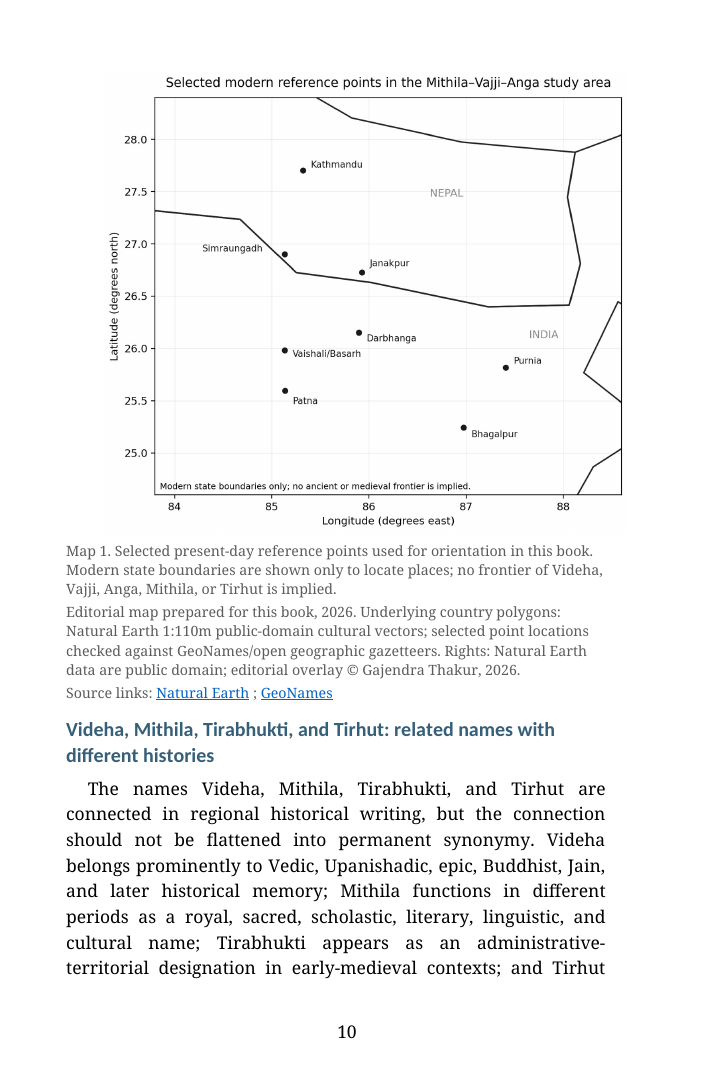
Mithila · Vajji · Anga
Chapter-specific source notes
- Primary chapter witness. Gajendra Thakur, Decoding the Panji of Mithila — Volume IV, formal Chapter 10, PDF pp. 137-150; formal Chapter 10. The HTML transcription is generated from the commit-pinned source PDF and retains the chapter boundary recorded in this edition.
- Internal structure. The repository source-heading inventory records 21 subordinate headings for this chapter: “10.1 Why Chapter 10 Returns to Shashipur”; “10.2 What Is Meant by Shashipur-Pindaruch”; “10.3 Chandīdatt as the Bridge into the Pindaruch Branch”; “10.4 Baidyanath: The First Major Node under Chandīdatt”; “10.5 Haldhar and Bachanū: Two Paths from the Baidyanath Line”; “10.6 Fatur, Krishnakant, and Harivansh”; “10.7 Ram, Jyotishi Bachkun, Gayadatt, and Munika”; “10.8 How to Chart the Pindaruch Branch”; ….
- Digital editorial method. The page keeps the preserved source text distinct from generated navigational, concordance, visual, and provenance apparatus. The synthetic reconstruction is explanatory only and is not evidence for an individual lineage or a determination of social or marital status.