Decoding the Panji of Mithila · Volume IV · Chapter 11
Shashipur Later Branches and Modernizing Names
Chapter 11
Shashipur Later Branches and Modernizing
Names

11.1 Scope of This Chapter
  This chapter restarts the work after Chapter 10 with
exclusive coverage of the later Shashipur material. It does not
summarize the whole Shashipur cluster again; it examines
only those entries that follow the Bachkun Thakur and
Survana Thakur material and that continue the Shashipur
sequence through entries (9), (10), and (11). The controlling
source here is the Nagram Panji sequence in which the record
moves from Raman Kant, Jeev Kant, Sunil Kant, Sadan Kant,
Mod Kant, Promod Kant, Vinod Kant, Kumud Kant, Bhagwati
Kant, Bharati Kant, Naubat Lal, Maho Kulanand, Fakiran,
Babue, Jagdish, Bhagwat, Ayodhyanath, and Nandan. The
index logic used here is not a loose appendix; it is a way to test
every place and lineage marker against the broader Genome
Mapping framework.
   The chapter has four tasks. First, it separates the later
Shashipur branches so that repeated Kant-names do not
collapse into one vague family mass. Second, it explains how
partial and dotted entries should be read without inventing
missing data. Third, it maps the villages named in the entries
to the gotra-mool-moolgram logic of the master index where
the index gives a stable classification. Fourth, it marks the
items that must later be checked against the final user-

supplied index: personal names, village routes, titles, blank
entries, and cross-references.
   The later Shashipur sequence is valuable precisely because
it shows how a Panji can move from older, compact lineage
memory to more modern, name-heavy branch formation. The
names ending in -kant look comparatively recent in tone, but
the Panji does not detach them from older village and mool
affiliations. This is why the chapter title mentions
modernizing names but does not treat them as outside the
Panji tradition. They are modernizing inside the Panji
grammar.

11.2 Source Position: From Survana Thakur to
Later Shashipur
   The preceding chapter ended with the Shashipur-Survana
Thakur branch. The transition is not abrupt. The source first
records Gaya Datt, Lakshman, Shivnandan, Sarvanarayan,
Bhaiyalal, Naubat Lal, Maho Kulanand, Bhawanand,
Vedanand, Kashikant, and the first set of Kant-named
descendants. Then it moves into entry (9), which is headed
simply Shashipur. That simplicity is misleading. The entry is
actually a continuation of the branch begun earlier, not a
fresh village beginning.
   Entry (9) begins with Raman Kant and then names Jeev
Kant and Sunil Kant, but both Jeev Kant and Sunil Kant are
accompanied by dotted or incomplete relation-forms. This
means the Panji preserves their position in the branch while
admitting that the details available to the compiler were
incomplete. A modern editor must not convert these dotted
spaces into certainty. The correct treatment is to record them
as named branch-points with incomplete descendant data.
  The entry then turns to Sadan Kant, who is said to have
Nishikant and Navin Kant. The mention of Baroni, Parhat, and

Beherarhi in this section indicates that this later Shashipur
branch was being placed in a much wider regional network.
The link with Parhat is important because the master index
associates Sakaradhi with Parhat and Lohna. Even where the
Panji does not explicitly state a gotra at this point, the index
logic helps the reader understand why Parhat matters as a
classification-bearing place.

11.3 Entry (9): Raman Kant, Jeev Kant, Sunil Kant,
and the Problem of Incomplete Branches
   The first part of entry (9) must be read as a cluster of
branch labels rather than as a fully expanded genealogy.
Raman Kant is linked with a relation involving Narun,
Dharmanath, Nityanath, Mandar, and Shatanjiv. The index
classifies Narun under the Parashar side and associates it with
Tripurauli, Sulhani, and Pure; it classifies Mandar within the
Kashyap-associated grouping and connects it with Rajoura,
Sihouli, Patanuka, and Kansam. Thus a short Panji statement
carries two distinct index resonances: one through Narun and
another through Mandar.
   Jeev Kant and Sunil Kant follow, but each is marked by
dotted blanks. The source indicates that the compiler knew
where these persons belonged but lacked, or did not enter, the
full son-village chain. This is a crucial feature of Panji
interpretation. A name with blanks is not useless; it is an
anchor. It prevents the person from disappearing from the
lineage even when the associated details are uncertain.
   The practical editorial rule is therefore this: Raman Kant
should receive a full indexed entry because his associated
places are visible; Jeev Kant and Sunil Kant should receive
indexed name entries with a note: 'branch position preserved;
associated relation incomplete in the source.' This distinction
is more accurate than either omitting the names or falsely
reconstructing their descendants.

11.4 Entry (9): Sadan Kant, Nishikant, Navin Kant,
and the Baroni-Parhat-Beherarhi Connection
   The next branch in entry (9) is Sadan Kant, whose sons are
Nishikant and Navin Kant. The Panji places this branch in
connection with Baroni, Parhat, and Beherarhi. The index
logic is again useful. Parhat appears in the master index as a
moolgram associated with Sakaradhi; Beherarhi appears
repeatedly in later Nagram material as a place of affiliation,
and Baroni is a regional marker that should not be ignored
merely because it appears inside a compact branch statement.
   Nishikant and Navin Kant are followed by dotted entries.
This suggests that their branch identity was preserved but the
expanded descent was not supplied. Since both names are tied
to Sadan Kant, they should be listed under the Sadan Kant
branch in the personal-name index, and also cross-referenced
under the Shashipur later branch heading.
   The branch demonstrates a common Panji pattern: a father
is named; sons are named; the line is placed in a village
network; but the descendants of the sons are left incomplete.
That pattern should be explained in the book rather than
silently flattened. The fact that the Panji gives the sons but not
the details means the sons were important enough to
preserve. The absence of further detail is part of the
documentary state of the record.

11.5 Entry (9): Mod Kant and the Manohar-
Manikant-Ajaykant-Sanjaykant-Vijaykant Line
   The Mod Kant branch is more developed than the
immediately preceding incomplete branches. Mod Kant is
followed by Manohar, Manikant, Ajay Kant, Sanjay Kant, and
Vijay Kant. The branch is then connected with Karmaha,
Hitnath, Bhaktinath, Soderpur, and Ravelanand. The place
logic is important. Karmaha is one of the major mool-classified

places in the index, and the index associates it with Ruchauli,
Naruar, Behat, Tarauni, Jhanjharpur, and Anathpur. Soderpur
is also a major classificatory place in the index, connected
with Sarisab, Mani, Digaun dh, Kanhauli, Hati, Tetarihar, and
Katka.
   This means that the Mod Kant branch is not simply a list of
modern-sounding names. It is a branch embedded in two
strong index-bearing place systems: Karmaha and Soderpur.
Hitnath and Bhaktinath act as local lineage connectors, while
Ravelanand appears as the Soderpur-side linkage. Because the
Panji records these places with the branch, the final index
must include the Mod Kant branch under Shashipur,
Karmaha, Soderpur, and the personal names Manohar,
Manikant, Ajay Kant, Sanjay Kant, and Vijay Kant.
  The source then gives dotted entries for Manikant, Ajay
Kant, and Sanjay Kant. The correct editorial response is the
same as before: preserve their names, identify their branch
position under Mod Kant, and state that their later relations
are not completed in the source. A future cross-check against
the user's index should verify whether any of these names
appear elsewhere with fuller detail.

11.6 Entry (10): Promod Kant, Pradeep Kant,
Sameer Kant, and the Darihara-Soderpur Link
   Entry (10) begins with a continuation of the Vijay Kant
material and then gives Promod Kant, whose sons are Pradeep
Kant and Sameer Kant. This branch is linked with Darihara,
Vidyadhar, Kashinath, Soderpur, and Indranand. The index
classifies Darihara with Ratauli; Soderpur belongs to a larger
cluster associated with Sarisab, Mani, Digaun dh, Kanhauli,
Hati, Tetarihar, and Katka. Thus the branch links a Darihara-
side relation with a Soderpur-side relation.

   Pradeep Kant and Sameer Kant are then followed by dotted
entries. Here again the source distinguishes between branch-
presence and branch-completion. The names should not be
ignored because their descendant lines are not expanded. In a
genealogical index they must be entered as named
descendants of Promod Kant, with the note that the source
does not complete their subsequent relation-fields.
   The Darihara-Soderpur combination is significant because it
shows how the later Kant-named branch is being held inside
older moolgram logic. The names Pradeep and Sameer have a
relatively modern ring, but the record attaches them to older
classificatory geography. This is one of the clearest examples
in the chapter of modernizing names entering a conservative
genealogical frame.

11.7 Entry (10): Vinod Kant, Bhavesh Kant, Rajesh
Kant, Bhagwati Kant, and Bharati Kant
   The later part of entry (10) continues with Vinod Kant,
Bhavesh Kant, another Vinod Kant form, Kumud Kant, Rajesh
Kant, Bhagwati Kant, and Bharati Kant. The source is difficult
here because some names are repeated and some branches
are partially blank. The editor must not assume that every
repeated name is a scribal error. Repetition may indicate a
branch-name, a same-name descendant, or a resumed line
after an interruption.
  Vinod Kant is linked with Bhavesh Kant and another Vinod
Kant form, with Satlakha, Lakshmikant, Durganath, Karmaha,
and Jagannath appearing in the same structure. Satlakha,
Karmaha, and the Lakshmikant-Durganath-Jagannath chain
require careful indexing. Satlakha appears repeatedly in the
Nagram material as a significant place marker; Karmaha
carries mool-index weight; and Lakshmikant is both a name
and a recurring genealogical sign in several parts of the
Nagram records.

   Kumud Kant is followed by Rajesh Kant, and Rajesh Kant is
linked with Pali, Meghanath, Jhalanath, Khandbala, and
Meghakant. Pali and Khandbala are both index-bearing places.
The index identifies Pali with Mahishi, Mangrauni, and
Jamdauli; it identifies Khandbala with Bhor. Therefore Rajesh
Kant's line must be cross-indexed under Pali, Khandbala,
Meghanath, Jhalanath, and Meghakant.
    Bhagwati Kant and Bharati Kant appear toward the end of
the entry. Bhagwati Kant is linked with Baliyas, Sharadanand,
Vindhyanath, Soderpur, and Mahamahopadhyaya Umash.
Bharati Kant is linked with Belaunch, Shobhanath, and an
incomplete final name. Here titles and places both matter. The
title Mahamahopadhyaya must be indexed because it
indicates learned status, while Baliyas, Soderpur, and
Belaunch must be indexed as place-relations.

11.8 Entry (11): Naubat Lal and the Return to
Older Relational Density
   Entry (11) shifts away from the Kant-heavy naming field
and returns to a denser older style. It begins with Naubat Lal
and places him with Alay, Jaylal, Ritalal also known as
Chumman, Padua, and Pan Thadu. The presence of an
alternate name introduced by 'pr.' is important. Ritalal and
Chumman should be indexed together, not separately as
unrelated persons. The entry also brings in Padua and Pan
Thadu, which should be retained as place and title markers
respectively.
   Naubat Lal's line then gives Lakshmikant, Kamalakant,
Gayakant, Brajkankant, and Uki, with Mandar, Yogadhar,
Hanumandatt, Sarisab, and Raghuvar appearing in the
relational chain. This connects the branch to both Mandar and
Sarisab, two major index-bearing nodes. The master index
identifies Mandar with Rajoura, Sihouli, Patanuka, and
Kansam; it also identifies Sarisab with Khangur, Sakuri, and

Jonki. Therefore this single part of the entry should be treated
as a junction between two index systems.
  Maho Kulanand then appears with Satlakha, Bhikhiya,
Jyotishi Dwarikanath, Pabouli, and Bhailal. The title Jyotishi
must be preserved. Dwarikanath should be indexed both as a
personal name and as a learned-title bearer. Pabouli is
another mool-related village and must not be treated as a
passing locality.

11.9 Entry (11): Fakiran, Mohan Lal, Babue,
Ghutki, Revati Raman, and Muni
   The next portion of entry (11) begins with Fakiran. Fakiran
is linked with Alay, a pathak-form Duwari, Pathak
Babunandan, Darihara, and Nidhi. The words and names here
show several layers: place, title, personal name, and relation.
Pathak must be treated as a title or lineage designation, not as
an ordinary given name. Darihara again invokes the index
logic connecting Darihara with Ratauli.
   The entry then gives Mohan Lal and Babue, connected with
Pali, Machal, Shyamalal, Sarisab, and Nanu. Babue then has
Ghutki also known as Revati Raman, and Muni, with
Mahnaura, Khoa l, Bholanath, Mukund, Belaunch, and Mani.
This sequence contains two alternate-name moments: Ghutki
and Revati Raman, and possibly Babue as a remembered
household or branch name. These should be handled with 'see
also' cross-references in the final index.
  The Khoa l and Belaunch markers are significant. The index
associates Khoa l with Mahua, Murajpur, and Simarwar, while
Belaunch appears elsewhere as a recurring place-relation in
the Nagram material. This branch therefore preserves both a
named-person sequence and a classification-bearing
geography.

11.10 Entry (11): Bala, Jagdish, Bhagwat,
Ayodhyanath, and the Final Nandan Branch
   The latter part of entry (11) continues with Bala, whose son
is Jagdish. Jagdish is linked with Nahas, Khoa l, Bave, Kalar,
Hariam, Manmohan, Padua, and Jagatmani. The phrase
involving Jagatmani is followed by a kasthut marker,
indicating a statement of attestation or remembered assertion.
This must be preserved in the notes because it changes the
status of the entry: it is not merely a list but a recorded
assertion within the Panji tradition.
   The entry then records an additional relation through
Babulal, Chandra, Budhwal, and Shambhu. Jagdish's line also
includes Azhouli, Narun, Keshav, Bachcha, Darihara, and
Bhagwandatt. Again the index logic is visible: Narun connects
to the Parashar grouping, while Darihara carries the Ratauli
association. These place links provide the classification frame
for a branch that otherwise looks like a dense chain of
personal names.
  Bhagwat's son Sundar is then linked with Darihara,
Bhawan, Deonath, Pali, and Ramanath. Ayodhyanath's sons
are Lala, Bala, Bhola, and Nandan. Lala is associated with
Bachcha also known as Chandra Dev, Pali, Shyamnath, Ram,
Soderpur, and Mitranath. Bachcha/Chandra Dev is then linked
with Jagaur, Mandar, Thithar, Yaddu, and Pali. Bhola has a
partial Khoa l-Belaunch relation. Nandan is linked with
Vishwanath, Baliyas, Chitranath, Shambhunath, Mangrauni,
Pali, and Govardhan.
   This final portion of entry (11) is one of the clearest
examples of why the later Shashipur material needs exclusive
coverage. It contains several branches, multiple alternative
names, cross-village routes, titles, partial blanks, and index-
relevant moolgram references. If it is merely summarized, the
structure disappears.

11.11 Coverage Matrix for Entries (9)-(11)
   The following working matrix records how this chapter
treats the later Shashipur material. It is not a final index; it is a
coverage-control table. The final user-supplied index should
later be checked against these rows.
 Panji entry   Primary branch    Key names            Index logic / places Editorial action
                                 preserved

 9             Raman Kant        Raman Kant, Jeev     Narun, Mandar        Index Raman fully;
               branch            Kant, Sunil Kant                          preserve Jeev Kant
                                                                           and Sunil Kant as
                                                                           incomplete branch
                                                                           anchors.

 9             Sadan Kant branch Sadan Kant,          Baroni, Parhat,      Index under
                                 Nishikant, Navin     Beherarhi            Shashipur and
                                 Kant                                      Parhat; mark
                                                                           dotted descendant
                                                                           fields.

 9             Mod Kant branch   Mod Kant,            Karmaha,             Cross-index under
                                 Manohar,             Soderpur             Karmaha and
                                 Manikant, Ajay                            Soderpur; record
                                 Kant, Sanjay Kant,                        incomplete sub-
                                 Vijay Kant                                branches.

 10            Promod Kant       Promod Kant,         Darihara, Soderpur Preserve
               branch            Pradeep Kant,                           modernizing
                                 Sameer Kant                             names; map to
                                                                         older place logic.

 10            Vinod/Kumud/      Vinod Kant,          Satlakha,            Do not merge
               Bharati branch    Bhavesh Kant,        Karmaha, Pali,       repeated Vinod
                                 Rajesh Kant,         Khandbala,           forms; index titles
                                 Bhagwati Kant,       Baliyas, Soderpur,   and places.
                                 Bharati Kant         Belaunch

 11            Naubat Lal branch Naubat Lal,          Alay, Padua,         Create see-also
                                 Ritalal/Chumman,     Mandar, Sarisab      references for
                                 Lakshmikant,                              alternate names.
                                 Kamalakant,
                                 Gayakant,
                                 Brajkankant

 11            Maho Kulanand /   Maho Kulanand,       Satlakha, Pabouli,   Index title-bearers
               Fakiran branch    Jyotishi             Alay, Darihara       separately; retain
                                 Dwarikanath,                              Pathak as
                                 Fakiran, Pathak                           title/lineage
                                 Babunandan                                marker.

 11            Babue to Nandan   Babue,             Khoa l, Belaunch,      Record as the
               branch            Ghutki/Revati      Hariam, Soderpur,      densest late
                                 Raman, Muni, Bala, Mandar, Baliyas,       Shashipur
                                 Jagdish,           Mangrauni, Pali        continuation;
                                 Ayodhyanath, Lala,                        preserve kasthut
                                 Bhola, Nandan                             and incomplete
                                                                           fields.

11.12 Index Logic Applied to the Chapter
  The chapter applies the master index in three ways. First, it
uses the gotra-mool-moolgram framework as a classification
guide. When a place such as Narun, Mandar, Darihara,
Sakaradhi, Karmaha, Soderpur, Sarisab, Pali, Khandbala, or
Khoa l appears, the entry is not treated as a casual place
reference. It is checked against the index's larger moolgram
organization.
   Second, the chapter uses the index to distinguish branch
geography from simple migration. A place may mark origin,
settlement, marriage, or branch affiliation. The Panji itself
does not always explain which one is intended. The index does
not remove the need for interpretation, but it gives a stable
frame for deciding why a place-name has weight.
   Third, the chapter uses the index to prepare for final
verification. Every branch treated here must later be checked
against the user's complete index. The check should ask: Is the
person listed? Is the village listed? Is the title listed? Is the
alternate name linked? Is the blank preserved? Is the route
connected to the correct chapter?

11.13 Items to Carry Forward to the Final Index
  The personal-name index must include Raman Kant, Jeev
Kant, Sunil Kant, Sadan Kant, Nishikant, Navin Kant, Mod
Kant, Manohar, Manikant, Ajay Kant, Sanjay Kant, Vijay Kant,
Promod Kant, Pradeep Kant, Sameer Kant, Vinod Kant,
Bhavesh Kant, Kumud Kant, Rajesh Kant, Bhagwati Kant,
Bharati Kant, Naubat Lal, Ritalal, Chumman, Lakshmikant,
Kamalakant, Gayakant, Brajkankant, Maho Kulanand,
Fakiran, Pathak Babunandan, Mohan Lal, Babue, Ghutki,
Revati Raman, Muni, Bala, Jagdish, Bhagwat, Ayodhyanath,
Lala, Bhola, Nandan, and the other names attached to these
branches.

  The village index must include Shashipur, Narun, Mandar,
Baroni, Parhat, Beherarhi, Karmaha, Soderpur, Darihara,
Satlakha, Pali, Khandbala, Baliyas, Belaunch, Alay, Padua,
Sarisab, Pabouli, Khoa l, Mahnaura, Nahas, Hariam, Budhwal,
Azhouli, Jagaur, and Mangrauni. Each should be indexed
under the relevant branch rather than only alphabetically.
  The title index must include Thakur where retained from
the preceding branch logic, Jyotishi Dwarikanath, Pathak
Babunandan, and Mahamahopadhyaya Umash. Titles are not
to be normalized away. They show how knowledge, status,
and lineage were recorded in the Panji.

11.14 Summary
   The later Shashipur branches show the Panji in transition.
The source preserves modernizing names, especially the
extensive Kant-named sequence, but it anchors those names
in older village and moolgram logic. Raman Kant, Sadan Kant,
Mod Kant, Promod Kant, Vinod Kant, Kumud Kant, Bhagwati
Kant, Bharati Kant, Naubat Lal, Maho Kulanand, Fakiran,
Babue, Jagdish, Ayodhyanath, and Nandan are not isolated
names. They belong to a structured branch field.
  The major editorial lesson of this chapter is that incomplete
branches must still be covered. A dotted field does not cancel a
person from the genealogy. It records the limits of available
memory. The correct decoding is therefore to preserve the
name, identify the branch position, map the visible villages,
and state the incompleteness clearly.
  This chapter has therefore restored exclusive coverage to
the post-Chapter-10 sequence. The next chapter should begin
only after entry (11), with Sandahpur to Katka, and should
continue the same method: one source segment, one chapter,
one cumulative DOCX, and constant checking against the
master index logic.
Source structure and verification apparatus
Editorial source apparatus. This apparatus is descriptive, not interpretive. It records the source-controlled structure used to verify that this page corresponds to formal Chapter 11 of Decoding the Panji of Mithila — Volume IV. The chapter text above is preserved from PDF pp. 150-162; formal Chapter 11 in the commit-pinned authoritative source. It is not merged with a neighboring chapter, appendix, annexure, or independent front/back-matter unit. The internal headings below come from the repository’s source-heading inventory and are retained as navigational and audit evidence; showing them here does not turn those headings into separate publications or add claims that are absent from the source.
Internal source headings
- 11.1 Scope of This Chapter
- 11.2 Source Position: From Survana Thakur to Later Shashipur
- 11.3 Entry (9): Raman Kant, Jeev Kant, Sunil Kant, and the Problem of Incomplete Branches
- 11.4 Entry (9): Sadan Kant, Nishikant, Navin Kant, and the Baroni-Parhat-Beherarhi Connection
- 11.5 Entry (9): Mod Kant and the Manohar-Manikant-Ajaykant-Sanjaykant-Vijaykant Line
- 11.6 Entry (10): Promod Kant, Pradeep Kant, Sameer Kant, and the Darihara-Soderpur Link
- 11.7 Entry (10): Vinod Kant, Bhavesh Kant, Rajesh Kant, Bhagwati Kant, and Bharati Kant
- 11.8 Entry (11): Naubat Lal and the Return to Older Relational Density
- 11.9 Entry (11): Fakiran, Mohan Lal, Babue, Ghutki, Revati Raman, and Muni
- 11.10 Entry (11): Bala, Jagdish, Bhagwat, Ayodhyanath, and the Final Nandan Branch
- 11.11 Coverage Matrix for Entries (9)-(11)
- 11.12 Index Logic Applied to the Chapter
- 11.13 Items to Carry Forward to the Final Index
- 11.14 Summary
Source-text concordance
Shashipur · Later · Branches · Modernizing · Names · Scope · restarts · work · exclusive · coverage · material · summarize · whole · cluster · examines · entries · follow · Bachkun · Thakur · Survana · continue · sequence · controlling · Nagram · record · moves · Raman · Kant · Jeev · Sunil · Sadan · Promod · Vinod · Kumud · Bhagwati · Bharati · Naubat · Maho · Kulanand · Fakiran · Babue · Jagdish · Bhagwat · Ayodhyanath · Nandan · index · logic · used · loose · appendix · test · every · place · lineage · marker · broader · Genome · Mapping · framework · four · tasks · First · separates · repeated · Kant-names · collapse · vague · family · mass · Second · explains · partial · dotted · read · without · inventing · missing · data · Third · maps
Boundary verification. In the formal sequence this chapter follows Volume IV Chapter 10, “The Shashipur-Pindaruch and Shashipur-Survana Branches” and precedes Volume IV Chapter 12, “Sandahpur to Katka: The First Post- Shashipur Expansion”. The chapter extractor begins at the verified formal Chapter 11 marker and stops at the next verified formal chapter marker; for a final chapter it stops before recognized book-level back matter. The concordance above is generated only from distinct terms already present in this chapter’s preserved source text. It is provided for discovery, comparison, and audit, not as an automated judgment about persons, lineages, status, kinship, marriage eligibility, or historical truth.
Illustrated research apparatus
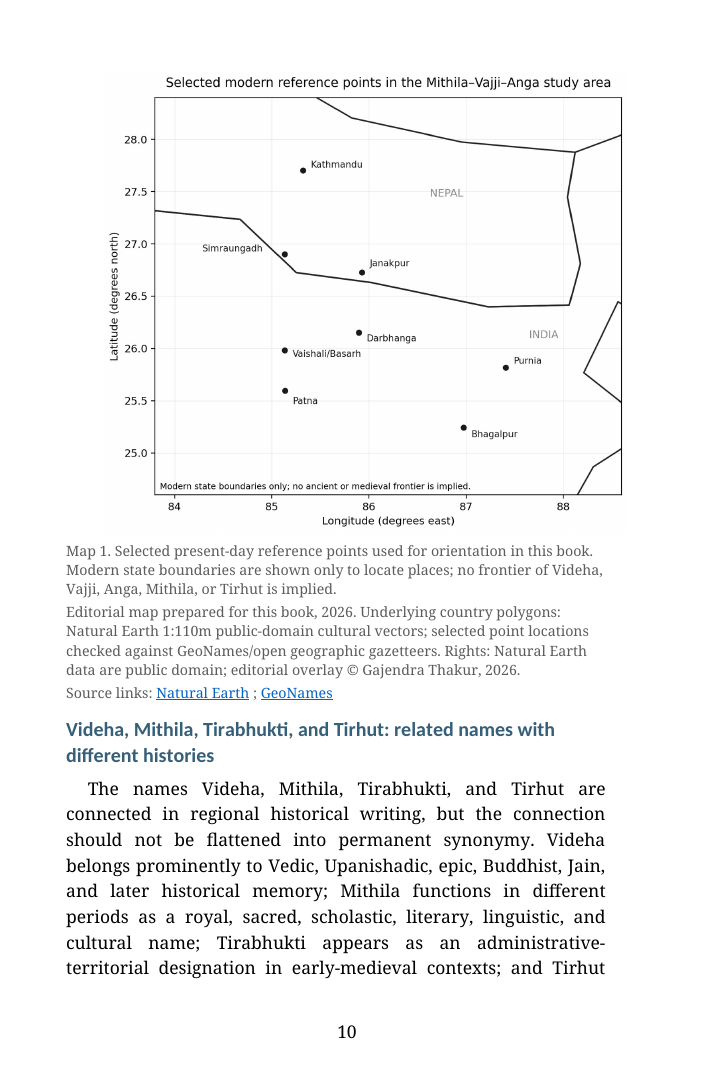
Mithila · Vajji · Anga
Chapter-specific source notes
- Primary chapter witness. Gajendra Thakur, Decoding the Panji of Mithila — Volume IV, formal Chapter 11, PDF pp. 150-162; formal Chapter 11. The HTML transcription is generated from the commit-pinned source PDF and retains the chapter boundary recorded in this edition.
- Internal structure. The repository source-heading inventory records 14 subordinate headings for this chapter: “11.1 Scope of This Chapter”; “11.2 Source Position: From Survana Thakur to Later Shashipur”; “11.3 Entry (9): Raman Kant, Jeev Kant, Sunil Kant, and the Problem of Incomplete Branches”; “11.4 Entry (9): Sadan Kant, Nishikant, Navin Kant, and the Baroni-Parhat-Beherarhi Connection”; “11.5 Entry (9): Mod Kant and the Manohar-Manikant-Ajaykant-Sanjaykant-Vijaykant Line”; “11.6 Entry (10): Promod Kant, Pradeep Kant, Sameer Kant, and the Darihara-Soderpur Link”; “11.7 Entry (10): Vinod Kant, Bhavesh Kant, Rajesh Kant, Bhagwati Kant, and Bharati Kant”; “11.8 Entry (11): Naubat Lal and the Return to Older Relational Density”; ….
- Digital editorial method. The page keeps the preserved source text distinct from generated navigational, concordance, visual, and provenance apparatus. The synthetic reconstruction is explanatory only and is not evidence for an individual lineage or a determination of social or marital status.