Decoding the Panji of Mithila · Volume IV · Chapter 12
Sandahpur to Katka: The First Post- Shashipur Expansion
Chapter 12
Sandahpur to Katka: The First Post-
Shashipur Expansion
12.1 Scope of This Chapter
   This chapter resumes the Nagram decoding exactly after the
later Shashipur branches covered in Chapter 11. Its exclusive
field is the Sandahpur-Katka cluster: entry (12), entry (13), and
entry (14). The chapter does not move into Banailli, Purnea,
Rahua, Khangur, Nahar, or Pilkhwar; those materials begin
after this cluster and must receive their own later chapters.
This correction is important because the Panji does not permit
a rushed jump from one route-cluster to another. Each
numbered block is a compact archive, and even a single line
may contain several generations, multiple village connections,
and unresolved blanks.
  The source moves from the Shashipur material into
Sundahpur/Sandahpur-Katka. The heading of entry (12) gives
the route, and the next two entries continue the same
genealogical field through unnamed or partly named sub-
blocks. Entry (14) then states Sandahpur to Katka again, with
explicit cross-reference numbers and a fresh internal opening
through Chetharu. Taken together, these three entries form
the first major post-Shashipur expansion of the volume.
  The index logic used here is twofold. First, every place-
marker is read against the master Genome Mapping index,
especially Soderpur, Katka, Mandar, Baliyas, Karmaha,
Pabouli, Ekhara, Darihara, Sakararhi, Narun, Khaual,
Satlakha, and other recurring moolgram markers. Second, the
chapter separates actual genealogical descent from route or
marriage affiliation. The source often uses the same village-

name in multiple functions; the editor must not flatten all of
them into one meaning.

12.2 Entry (12): The Sandahpur-Katka Opening
   Entry (12) opens with the Sandahpur to Katka formula. The
first named node is Narpati, whose sons are Khushihal Singh
and Dhane. This is not a loose pair of names; it is the
beginning of a genealogical fork. The form shows Narpati as
the upper node, after which Khushihal and Dhane become the
active branches. Baliyas, Khantar, Lakshman, Pabouli, and
Ramakant are then brought into the record. The presence of
Baliyas and Pabouli immediately places the line within the
moolgram geography known from the index.
   Khushihal is then expanded. He is linked with Satlakha,
Pitambar, Paramanand, Babhania, and Mani. The editorial
point is that the text is not merely naming sons; it is recording
the social pathway by which Khushihal's branch is
understood. Satlakha, Pitambar, Paramanand, Babhania, and
Mani must all be carried forward to the final index, because
they are not incidental words. They are relational anchors.
   The entry then gives Babulal as another son or branch.
Babulal is linked with Babhania, Chaturbhuj, Nidhi, Sakararhi,
and Sudhakar. This portion contains a typical Panji
compression: Babulal is presented, then the village and father-
son formula follows without the modern punctuation that
would make the hierarchy visually obvious. The safest reading
is to treat Babulal as a branch-node, while Babhania,
Chaturbhuj, Nidhi, Sakararhi, and Sudhakar form the
affiliated relation-chain attached to him.
  Riti Narayan and Bhagwan Datt then appear as further
branches. They are linked with Ekhara, Devdatt, Chhatrapati,
and Pabouli. The repeated use of Pabouli in the chapter
matters because the master index identifies Pabouli as part of

the wider moolgram system. The repetition does not prove
identity between all Pabouli-linked persons, but it does
identify a recurring route of affiliation.

12.3 Entry (12): Babulal, Dhanakdhari,
Dharanidhar, and the Oda-Ekhara Line
   The Babulal line next gives Dhanakdhari and Dharanidhar.
The entry then moves through Oda, Ekhara, Devdatt, Vicha,
Pali, Bhawanidatt, Jhitan, Karmaha, and Chitradhar. This is a
dense place-and-person chain, and it must be decoded slowly.
Dhanakdhari and Dharanidhar appear as named descendants
or branch-holders. Oda and Ekhara establish a route or
affiliation; Devdatt and Vicha belong to the internal relational
chain; Pali, Bhawanidatt, Jhitan, Karmaha, and Chitradhar
extend the genealogical field.
   The index logic is especially important here. Ekhara is not
an isolated village-marker; the index places Ekhara in relation
to Kanhauli and Ruchauli. Karmaha likewise belongs to a large
cluster of moolgram associations, including Ruchauli, Naruar,
Behat, Tarauni, Jhanjharpur, and Anathpur. Thus, when the
Panji says Ekhara or Karmaha, the name carries a
classification value beyond the immediate line.
   The entry then moves to Dhanushdhari and Jagdish. Jagdish
is linked with Ojholi, Narun, Vaidyanath, Deonath, and related
connections. Narun is one of the major mool markers in the
master index, associated with Tripurauli, Sulhani, and Pude.
The appearance of Narun in this Sandahpur-Katka cluster
shows that the route is not confined to one local geography. It
enters the older mool system and must therefore be indexed
as both a place-marker and a genealogical classifier.

12.4 Entry (12): Govind, Ratidhar, Paran,
Gokulnath, and the Child-Branch
   The next major node is Govind. His line gives Ratidhar,
Paran, and Gokulnath. These names are attached to Herarhi or
Beherarhi, Shrikrishna, Balbhadra, Ekhara, and Ratidev. The
use of Balbhadra is noteworthy because Balbhadra Thakur
also appears in the index's old laukik and chaugola
framework. The chapter does not assume that every
occurrence is the same individual; instead it records the
resonance and requires final index verification.
  Paran then opens a smaller but important branch through
Balak, Ramlal, and Chhaban. This is followed by Ekhara, Hari,
Gharani, Katai, and Kamalapati. The naming field mixes
simple personal names with names that may later become
family identifiers. It also demonstrates how the Panji nests
short branches inside larger ones. Paran is a branch of
Govind; Balak, Ramlal, and Chhaban are sub-branches; Katai
and Kamalapati define an additional route or relation.
   Balakram is then expanded through Jayanath, Bhawanath,
Rudranath, Mangrauni, Pali, Hira, Manbodh, Ekhara, and
Jude. This is a significant example of a route becoming a
memory web. Mangrauni and Pali both recur widely in the
Nagram and index materials, and therefore this one sentence
must be covered in the final village index. It should not be
compressed simply as 'Balakram's descendants.' The village
field is part of the meaning.

12.5 Entry (12): Bhawanath, Pani-Chobh,
Yadupati, Bhikhiya, and the Lal Branch
  The Bhawanath portion is one of the most difficult parts of
entry (12), because it turns quickly through Panichobh,
Yadupati, Bhikhiya, Mandar, Dharmeshwar, Premnath, Pali,
Krishna, and then the reference number 111. The editor must

preserve the internal uncertainty of this sequence. The
presence of Yadupati and Bhikhiya shows a continuing
person-line; Mandar, Dharmeshwar, and Premnath introduce
a new relational context; Pali and Krishna complete the local
chain.
   The entry then moves to Lal, whose sons are Jayanram,
Durbhil, and Hemnath. Their relation brings Mandar, Karu,
Ramakant, Kujouli, Ganganand, Bachharu, Darihara, and
Indrapati into the same record. This is precisely the kind of
dense Panji line that becomes unreadable if treated only as a
list. Mandar and Darihara are major index categories; Kujouli
is linked in the index with Bhakharouli; and Baliyas, Pabouli,
Ekhara, and Karmaha already appear in the earlier parts of
this cluster. Entry (12) is therefore not a local note; it is a
junction of several moolgram pathways.

12.6 Entry (13): Chhaban, Chakori/Tulakrishna,
Garib Nandan, and Buleli
   Entry (13) continues the Sandahpur-Katka field without a
fresh place-route heading. Its opening node is Chhaban.
Chhaban is linked with Ghousaut, Theghu, Janaki Nath,
Darihara, and Dinanand. The absence of a new route title does
not mean the entry is unimportant. It means the scribe or
compiler continued the previous genealogical field under the
next number.
  The entry then mentions an additional line through Pali and
Khela. Nathe gives Chhakori or Chhako ri, also called
Tulakrishna, together with Garib Nandan and Buleli. These
names are followed by Hariamb, Anu, Mahesh, Soderpur, and
Kamalapati. The source is showing branch multiplication:
Nathe is the apparent node, Chhakori/Tulakrishna, Garib
Nandan, and Buleli are sub-branches, and Hariamb and
Soderpur supply the relational geography.

  Chhakori's son is Shankardatt, linked with Karmaha, Chan,
Pashupati, Darihara, Yadupati, Shivdatt, and Soderpur. This is
one of the clearest points where index logic is necessary.
Karmaha, Darihara, and Soderpur are not random place
references. The index uses them as moolgram anchors.
Therefore, Shankardatt's placement is simultaneously
genealogical and classificatory.

12.7 Entry (13): Garib, Nandan, Nehali, Rank
Mani, and the Extended Darihara-Karmaha Field
   Garib's son is Chengana or Chengan, connected with
Belaunch, Ratipati, Lakshmidhar, Hariamb, Bhagirath, and
Bachharu. This part of the line again demonstrates the Panji's
habit of placing a small named branch inside a large village
network. Belaunch and Hariamb should both appear in the
final route index.
   Nandan then opens a wider sub-branch: Snehi, Harkhu,
Sheetal, Gharam, and Saburdatt. These are linked with
Sakararhi, Maniram, Badalu, Ekhara, and Jayshiv. Buleli's son
Nehali is then connected with Karmaha, Bikhal, Kulanand,
Darihara, and Lakshmikant. Nehali's branch continues
through Rank Mani, Mani, and Krishna, with Karmaha,
Jeevanath, Shambhunath, Sakararhi, and Gujar. This is not a
marginal detail; it is an extended branch network and
requires separate index entries for each major name.
  Rank Mani then gives Ganeshdatt, Prayagdatt, Mahadev,
and Durgadatt, with Hariamb, Kashinath, and Nathe. Nathe
reappears in connection with Darihara, Mahesh, Mina, and
the reference D.82/5, followed by Alay and Bhikhni. The
reappearance of Nathe shows the need for careful cross-
checking. It may be the same branch resumed, or a related
sub-branch identified through the same name. The final index
must not merge these without evidence.

12.8 Entry (13): Ganeshdatt, Chandi, Harisingh,
and the Karanakar Citation
   Ganeshdatt is linked with Tarauni, Karmaha, Hari, and
Chandi. Chandi is then expanded through Baliyas, Bhaiyan,
Lal, Gangouli, and Lochan. The sequence then gives Chandi's
line through Darihara, Bhawan, Bachh, Beherarhi, Tejan,
Mathuranath, Mandar, and Jeevan. The source finishes this
sub-field with Krishna, Darihara, Varju, Samphool, Jajib al,
and Krishnamani.
   The phrase that resembles a citation or attestation through
Karunakar must be preserved. Such forms often indicate that
a relation is confirmed, cited, or remembered through another
named authority or branch. This volume will not over-
translate it; instead it will note that the entry provides an
attestation-like closure to a dense line. At the final index stage,
Karunakar should be placed in the personal-name index and
also checked for any corresponding occurrence elsewhere.

12.9 Entry (14): Chetharu and the Second
Sandahpur-Katka Statement
  Entry (14) repeats the Sandahpur to Katka heading and
includes reference numbers. It begins with Chetharu, whose
sons are Sanphool, Manphool, and Hirphool. Sakararhi,
Vanshi, Umanath, Budhwal, and Paramanand follow. The
repeated place-route title indicates that this is not merely a
continuation of entry (13), but a renewed or parallel
Sandahpur-Katka branch.
  Sanphool's sons are Gangadatt, Modi, and Mathuranath.
They are connected with Uchati, Mahipati, Prabhunath,
Narun, Ghanshyam, and Kamalanand. Hirphool's line includes
Kewal, Radhe, and Madhav, with Karmaha, Jagan, and Kalar.
The Kalar line moves through Darihara, Bani, Hit, Jeevanath,
Karmaha, Ghanshyam, Badali, Jajib al, and Dukhni. This is a

highly layered structure; several of these names will need
final checking against the index and the later chapter
materials.
   Kewal's line gives Babuji and Dinanath, with Belaunch,
Baburaiya,     Tulsidatt,  and    Panichobh.   Babuji's   son
Madhusudan is then linked with Narun, Shashishekhar,
Shankardatt, Kujouli, and Nityanand. Madhusudan's sons are
Jeevanath and Nidhanath, connected with Pali, Chhotku,
Sundar, Khaual, and Gopal. The point is that the Chetharu
branch is not a short afterthought. It deserves full coverage
because it joins the Sandahpur-Katka route to Narun, Kujouli,
Pali, Khaual, Baliyas, Ghousaut, and Mandar.

12.10 Entry (14): Dinanath, Radhe, Bhayji,
Janardan, Chakradhar, and Jayveer
  Dinanath's son Durgadatt repeats the Narun-Shashishekhar-
Shankardatt-Kujouli-Nityanand path. Radhe then gives Bhayji,
connected with Belaunch, Baburaiya, Tulsidatt, and
Panichobh. Durgadatt's branch includes Satouli, Satlakha,
Bataha, Manilal, Takwal, and Bachchelal. Madhav's branch
includes Panichobh, Manik, Pitambar, Baliyas, Rudradatt,
Shambhu, Uchiti, and Siddhi.
   Bhayji's sons are Rajeshwar, Janardan, Chakradhar,
Vallabhadra, Jayabhadra, and Subhadra. Their relation
includes Karmaha, Shambhunath, Chandidatt, Soderpur,
Taradatt, and Bhayji again. Janardan's son Mahindra is linked
with Sakararhi, Kripanidhi, Jaydatt, Bhikshuk Nath, and Jajib
al. Chakradhar then gives Jayveer, linked with Malichham,
Beherarhi, Bhayji, Dinanath, Pabouli, and Artinath. Jayveer
continues through Ekhara, Kirtinath, Vishwanath, Pali, and
Babue.
   The repetition of Bhayji within the entry deserves caution.
It may be a branch-name, a personal name, or a relational

return. It should not be silently harmonized. In the final index,
Bhayji must receive its own entry, with a note that it occurs
both as a named branch and as part of a relation-chain inside
the Sandahpur-Katka cluster.

12.11 The Modern Addendum: Singheshwar,
Suryanarayan, Shrinayaran, Arun, Arvind, Anita,
Ajit, Vivek, and Dipesh
   Entry (14) closes with a striking modern-style addendum. It
mentions Katka and Sandahpur again, then gives Singheshwar
and his sons Suryanarayan and Shrinayaran. Suryanarayan's
line includes Arun and Kalirav; Shrinayaran's line includes
Arvind, his wife Anita, and Ajit. The entry then mentions a
location near Atarbel or Atrabell, Kamalakant Jha, Chakauti,
Arvind's sons Vivek and Dipesh, and Kaligaon with
Krishnanand Jha.
  This part of the entry differs in tone from the earlier
compact hereditary formulae. It reads like a later insertion or
modern genealogical update. The presence of a wife-name,
Anita, and names such as Arun, Arvind, Ajit, Vivek, and Dipesh
shows that the Panji is not frozen in an ancient register. It
absorbed modern family information where available. This is
precisely why Volume IV must treat every stratum of the
source. Older moolgram grammar and newer household
memory coexist in the same line.
   The editorial rule is therefore simple: modern names are
not to be excluded from the Panji merely because they look
recent. They are part of the record. At the same time, their
form must be identified as a later genealogical layer so that
the reader does not confuse them with older branch
classifications.

12.12 Index Logic Applied to Entries (12)-(14)
  The Genome Mapping index helps this chapter in several
ways. It identifies Soderpur as a major moolgram field
associated with Sarisab, Digaun dh, Kanhauli, Mani, Hati,
Tetarihar, and Katka. This is essential because Soderpur and
Katka both appear repeatedly in the Sandahpur-Katka
material. The index also places Mandar in relation with
Rajoura, Sihouli, Patnuka, and Kansam; Baliyas with Madari;
Narun with Tripurauli, Sulhani, and Pude; Kujouli with
Bhakharouli; and Ekhara with Kanhauli and Ruchauli.
   The old laukik/chaugola framework also matters. The index
preserves old names such as Bharathiya, Bhadai Jha, Babhan
Jha, Pitambar Jha, Dasharath Mishra, Raghuni Jha, Narayan
Jha, Devai Jha, Gangadhar Jha, Rudrapati Jha, Babu Mishra,
Balbhadra Thakur, Ramdev Mishra, Shankar Rai, Godhai Jha,
Vishweshwar Mishra, Jatesh Jha, Damu Jha, Shiv Mishra, Vir
Thakur, Moti Jha, Rohar Madhav Mishra, Sadai Mishra, Bholan
Jha, Narpati Jha, Bhikhari Jha, Madhav Jha, Hemangad Rai,
Surgan Raghunandan Pathak, and others. These names create
a control background for later verification.
  The index also records that the Pachbaripar laukik and
shreni system was fixed and published under the authority of
Maharajadhiraj of Mithila, and that fifteen shreni were
created amid controversy over Panji recognition. This note is
important for the Sandahpur-Katka entries because the
chapter contains repeated branch and village markers that
could later fall into shreni or laukik verification. The book
must therefore keep narrative explanation and index control
together.

12.13 Coverage Matrix for Chapter 12
  Primary source entries covered: entry (12), entry (13), and
entry (14) of the Sandahpur-Katka cluster.

  Principal name nodes: Narpati; Khushihal Singh; Dhane;
Babulal; Dhanakdhari; Dharanidhar; Govind; Ratidhar; Paran;
Gokulnath; Balakram; Bhawanath; Lal; Chhaban; Nathe;
Chhakori/Tulakrishna; Garib Nandan; Buleli; Nehali; Rank
Mani; Ganeshdatt; Prayagdatt; Mahadev; Durgadatt; Chetharu;
Sanphool; Manphool; Hirphool; Kewal; Radhe; Madhav;
Babuji; Dinanath; Madhusudan; Jeevanath; Nidhanath; Bhayji;
Janardan; Chakradhar; Jayveer; Singheshwar; Suryanarayan;
Shrinayaran; Arun; Arvind; Anita; Ajit; Vivek; Dipesh.
  Principal village and route markers: Sandahpur; Katka;
Baliyas; Pabouli; Satlakha; Babhania; Sakararhi; Ekhara;
Katai; Karmaha; Oda; Pali; Soderpur; Ojholi; Narun;
Beherarhi; Mandar; Kujouli; Darihara; Ghousaut; Hariamb;
Belaunch; Panichobh; Takwal; Uchati; Khaual; Malichham;
Chakauti; Kaligaon.
   Cross-reference and uncertainty markers: entry reference
389/2 in the first Sandahpur-Katka opening, 234/3 and 238/2 in
the Chetharu entry, D.82/5 in the Nathe-Rank Mani field, and
several dotted or incomplete fields. All must be retained for
final audit.

12.14 Items to Carry Forward to the Final Index
   The personal-name index must include all principal names
listed in the coverage matrix, but it must also include
secondary names such as Khantar, Lakshman, Ramakant,
Paramanand, Mani, Chaturbhuj, Nidhi, Sudhakar, Riti
Narayan, Bhagwan Datt, Devdatt, Chhatrapati, Vicha, Jhitan,
Chitradhar, Vaidyanath, Deonath, Shrikrishna, Balbhadra,
Ratidev, Hari, Gharani, Kamalapati, Hira, Manbodh, Jude,
Yadupati,   Bhikhiya,   Dharmeshwar,    Premnath,      Karu,
Ganganand, Bachharu, Indrapati, Janaki Nath, Dinanand,
Shankardatt, Chengana, Ratipati, Lakshmidhar, Snehi,
Harkhu, Sheetal, Gharam, Saburdatt, Bikhal, Kulanand,
Shambhunath, Gujar, Kashinath, Chan, Chandi, Lal, Lochan,

Bani, Hit, Badali, Dukhni, Tulsidatt, Shashishekhar, Nityanand,
Sundar, Gopal, Kripanidhi, Jaydatt, Bhikshuk Nath, Artinath,
Vishwanath, and Krishnanand.
  The village index must include not only the heading places
Sandahpur and Katka, but also every subordinate village
marker, because the Sandahpur-Katka cluster is valuable
precisely for its dense relational geography. The final cross-
check should compare these markers with the Genome
Mapping moolgram index and with the later village-route
entries of the source.
   The title and role index should note where Thakur, Pandit,
Jyotishi, Vaidya, Vakil, Engineer, and other categories occur in
surrounding chapters, but Chapter 12 itself is more dominated
by branch and village grammar than by occupational titles. Its
strongest contribution is genealogical density rather than title
history.

12.15 Summary
   The Sandahpur-Katka cluster is the first major expansion
after the Shashipur sequence. It is not a short bridge to later
regional entries. It contains its own internal genealogy,
beginning with Narpati and extending through Khushihal
Singh, Babulal, Govind, Chhaban, Nathe, Nehali, Rank Mani,
Chetharu, Sanphool, Hirphool, Bhayji, and modern
descendants such as Arun, Arvind, Ajit, Vivek, and Dipesh.
  The chapter also shows why the index must guide the
decoding. Sandahpur-Katka repeatedly touches moolgram
categories such as Soderpur, Mandar, Baliyas, Narun, Kujouli,
Ekhara, Karmaha, Darihara, Sakararhi, and Pabouli. Without
the index, these would look like ordinary place names. With
the index, they become part of a larger system of Mithila's
genealogical classification.

   The next chapter should begin only after this cluster:
Banailli and Purnea with Mitranath Jha, followed by the
Rahua-Badhwas and Khangur-Nahar materials. Those later
entries must not be folded into Chapter 12, because the goal
from this point onward is exclusive coverage, one chapter at a
time, with index logic.
Source structure and verification apparatus
Editorial source apparatus. This apparatus is descriptive, not interpretive. It records the source-controlled structure used to verify that this page corresponds to formal Chapter 12 of Decoding the Panji of Mithila — Volume IV. The chapter text above is preserved from PDF pp. 163-175; formal Chapter 12 in the commit-pinned authoritative source. It is not merged with a neighboring chapter, appendix, annexure, or independent front/back-matter unit. The internal headings below come from the repository’s source-heading inventory and are retained as navigational and audit evidence; showing them here does not turn those headings into separate publications or add claims that are absent from the source.
Internal source headings
- 12.1 Scope of This Chapter
- 12.2 Entry (12): The Sandahpur-Katka Opening
- 12.3 Entry (12): Babulal, Dhanakdhari, Dharanidhar, and the Oda-Ekhara Line
- 12.4 Entry (12): Govind, Ratidhar, Paran, Gokulnath, and the Child-Branch
- 12.5 Entry (12): Bhawanath, Pani-Chobh, Yadupati, Bhikhiya, and the Lal Branch
- 12.6 Entry (13): Chhaban, Chakori/Tulakrishna, Garib Nandan, and Buleli
- 12.7 Entry (13): Garib, Nandan, Nehali, Rank Mani, and the Extended Darihara-Karmaha Field
- 12.8 Entry (13): Ganeshdatt, Chandi, Harisingh, and the Karanakar Citation
- 12.9 Entry (14): Chetharu and the Second Sandahpur-Katka Statement
- 12.10 Entry (14): Dinanath, Radhe, Bhayji, Janardan, Chakradhar, and Jayveer
- 12.11 The Modern Addendum: Singheshwar, Suryanarayan, Shrinayaran, Arun, Arvind, Anita, Ajit, Vivek, and Dipesh
- 12.12 Index Logic Applied to Entries (12)-(14)
- 12.13 Coverage Matrix for Chapter 12
- 12.14 Items to Carry Forward to the Final Index
- 12.15 Summary
Source-text concordance
Sandahpur · Katka · First · Post · Shashipur · Expansion · Scope · resumes · Nagram · decoding · exactly · later · branches · covered · exclusive · field · Sandahpur-Katka · cluster · entry · move · Banailli · Purnea · Rahua · Khangur · Nahar · Pilkhwar · materials · begin · must · receive · chapters · correction · important · permit · rushed · jump · route-cluster · another · numbered · block · compact · archive · even · single · line · contain · several · generations · multiple · village · connections · unresolved · blanks · moves · material · Sundahpur · heading · gives · route · next · entries · continue · genealogical · unnamed · partly · named · blocks · states · explicit · cross-reference · numbers · fresh · internal · opening · Chetharu · Taken · together · three · form · major
Boundary verification. In the formal sequence this chapter follows Volume IV Chapter 11, “Shashipur Later Branches and Modernizing Names” and precedes Volume IV Chapter 13, “Banailli, Purnea, Badhwas-Sarisab, Rahua, and the Empty Boundary: Entries (15)-(19)”. The chapter extractor begins at the verified formal Chapter 12 marker and stops at the next verified formal chapter marker; for a final chapter it stops before recognized book-level back matter. The concordance above is generated only from distinct terms already present in this chapter’s preserved source text. It is provided for discovery, comparison, and audit, not as an automated judgment about persons, lineages, status, kinship, marriage eligibility, or historical truth.
Illustrated research apparatus
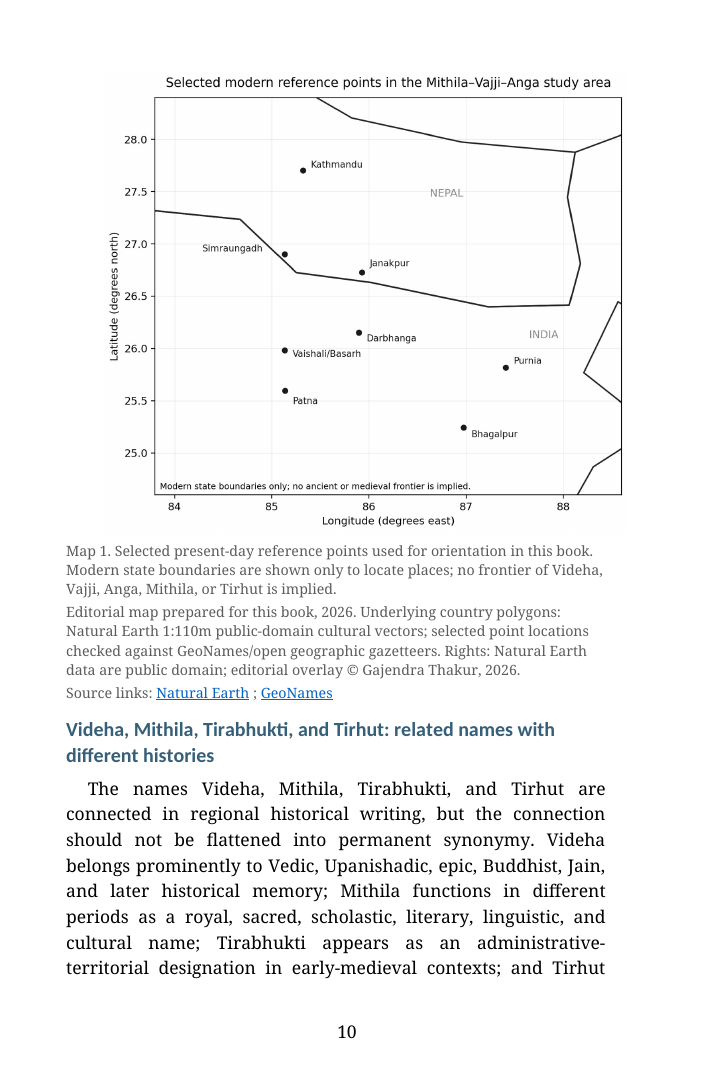
Mithila · Vajji · Anga
Chapter-specific source notes
- Primary chapter witness. Gajendra Thakur, Decoding the Panji of Mithila — Volume IV, formal Chapter 12, PDF pp. 163-175; formal Chapter 12. The HTML transcription is generated from the commit-pinned source PDF and retains the chapter boundary recorded in this edition.
- Internal structure. The repository source-heading inventory records 15 subordinate headings for this chapter: “12.1 Scope of This Chapter”; “12.2 Entry (12): The Sandahpur-Katka Opening”; “12.3 Entry (12): Babulal, Dhanakdhari, Dharanidhar, and the Oda-Ekhara Line”; “12.4 Entry (12): Govind, Ratidhar, Paran, Gokulnath, and the Child-Branch”; “12.5 Entry (12): Bhawanath, Pani-Chobh, Yadupati, Bhikhiya, and the Lal Branch”; “12.6 Entry (13): Chhaban, Chakori/Tulakrishna, Garib Nandan, and Buleli”; “12.7 Entry (13): Garib, Nandan, Nehali, Rank Mani, and the Extended Darihara-Karmaha Field”; “12.8 Entry (13): Ganeshdatt, Chandi, Harisingh, and the Karanakar Citation”; ….
- Digital editorial method. The page keeps the preserved source text distinct from generated navigational, concordance, visual, and provenance apparatus. The synthetic reconstruction is explanatory only and is not evidence for an individual lineage or a determination of social or marital status.