Decoding the Panji of Mithila · Volume IV · Chapter 13
Banailli, Purnea, Badhwas-Sarisab, Rahua, and the Empty Boundary: Entries (15)-(19)
Chapter 13
Banailli, Purnea, Badhwas-Sarisab, Rahua, and
the Empty Boundary: Entries (15)-(19)

13.1 Scope of This Chapter
   This chapter continues the corrected one-chapter-at-a-time
method after Chapter 12. It covers only entries (15), (16), (17),
(18), and (19) of the Nagram material. It does not move into
the Khangur sequence, which begins after the empty entry
(19). That later Khangur material must receive its own chapter
because it opens a new route-cluster and a new Sarisab-based
field of index logic.
   The chapter therefore has a narrow but important scope.
Entry (15) is a bare heading, 'Sandahpur se,' with no
developed genealogy. Entry (16) opens a major Badhwas-
Sarisab cluster under the external heading 'Banailli, Purnea,
Mitranath Jha.' Entry (17) continues that same cluster,
expanding the descendants of Chhoti or Jai Krishna and
moving through Pandua, Beherarhi, Baliyas, Jajival, Darihara,
Satlakha, Soderpur, Sakuri-Pali, and other linked places. Entry
(18) gives Rahua-Badhwas and Ugranath Jha. Entry (19) is
explicitly empty. The chapter treats all five units as a single
transitional section between Sandahpur-Katka and Khangur-
Nahar.
   The master index logic is essential here because the source
does not merely name persons. It places the section in a
classificatory field. Badhwas is connected in the index with
Sarisab; Sarisab is one of the important Shandilya-related
mool locations, and the index also records Khangur, Sakuri,
and Jonki under the Sarisab cluster. Thus even before the text
reaches the Khangur entries, the Badhwas-Sarisab heading

prepares the reader for a Sarisab-centered extension of the
Nagram record.

13.2 Entry (15): The Suspended Sandahpur
Heading
   Entry (15) consists only of a heading: 'Sandahpur se.' This
must not be dismissed as a printing accident. It is best read as
a suspended or incomplete heading placed between the fully
developed Sandahpur-Katka material and the next
externalized entry. The Panji sometimes preserves a heading
even when the expected genealogical content is not present.
The heading is therefore a boundary marker.
  Its function is editorial and archival. It tells the reader that
the compiler was still within the Sandahpur field, or at least
within the after-effect of that field, but did not enter a separate
genealogical expansion under this numbered item. Such a
heading should be indexed as an incomplete Sandahpur entry,
not merged into the preceding Sandahpur-Katka section and
not omitted.
   The correct final index treatment is: 'Sandahpur se - entry
(15), incomplete heading; see also entries (12)-(14), Sandahpur-
Katka, and entry (16), Badhwas-Sarisab/Banailli-Purnea
transition.' This preserves the source order and prevents
future readers from assuming that entry (15) was accidentally
skipped.

13.3 Entry (16): Banailli, Purnea, Mitranath Jha
and the Beginning of the Badhwas-Sarisab Cluster
   Entry (16) is headed 'Banailli, Purnea, Mitranath Jha,' but
the actual genealogical opening says that the Badhwas-Sarisab
village is being written. This double framing matters. 'Banailli,
Purnea, Mitranath Jha' appears as an external or identifying
heading, while 'Badhwas Sarisab gram likhyate' gives the

internal village-archival frame. The entry must therefore be
indexed under both Banailli/Purnea/Mitranath Jha and
Badhwas-Sarisab.
   The first major person in the section is Kamalapati, whose
sons are Dharanidhar and Krishnadev. The source then links
the line through Karmaha, Madhusudan, Raghunath, Mandar,
Mani, Hariamb, Vamani, Soderpur, and Shivdev. The
movement is dense but patterned. Kamalapati is the node;
Dharanidhar and Krishnadev are primary sons; the following
relations supply the village and descent network.
   The master index gives the reason why Badhwas-Sarisab
must be treated carefully. In the shreni material, Badhwas
appears with Sarisab and Dharanidhar's son Bhanjan Jha in
the first shreni list. This is not an accidental resemblance; it
confirms that the Badhwas-Sarisab field is important in the
classificatory   record.     The    chapter   therefore   treats
Dharanidhar, Bhanjan, and related names as cross-check
items for the final index.

13.4 Dharanidhar, Shivdatt, Bhanjan, and Chilka:
The First Major Expansion
  Dharanidhar's branch is expanded through Shivdatt,
Bhanjan, and Chilka. The line links Karmaha with
Lakshmipati and Devanand, and Khandbala with Balkrishna.
Bhanjan then receives his own descendant statement,
including Matinandan also known as Khushi, and a Narun-
Pabouli relation. The Panji here uses a familiar method: a
principal son is named, then his sons or related branch-
holders are unfolded, then village connections are supplied.
   Bhanjan is especially significant because the index's shreni
logic gives Badhwas-Sarisab with Dharanidhar's son Bhanjan
Jha as a first-shreni item. The Panji entry and the index
therefore reinforce each other. The chapter must preserve this

relation in both directions: from source text to index, and
from index back to source text. Bhanjan should not be treated
as a minor passing name.
   Chilka is named but not expanded with the same detail as
Bhanjan. That imbalance is not unusual. The Panji often gives
fuller development to the branch most relevant to the route or
record at hand. Chilka should be indexed as a named branch
under Dharanidhar, with a note that the major expansion in
this entry falls on Bhanjan.

13.5 Krishnadev, Chan, Nidhi, and the Pandua-
Vabhaniyam-Mandar-Alay Network
   Krishnadev's branch begins with Chan and Nidhi. Chan is
linked with Pandua, Pashupati, and Vabhaniyam-Bhagirath.
Nidhi is linked with Mandar-Anand and Alay-Bhagirath. These
are not isolated place references; each place belongs to the
wider Panji geography. Pandua, Vabhaniyam, Mandar, and
Alay appear across the Nagram material as recurring relation-
sites.
   Chan's branch then moves through Babunath, Sakaradhi,
Lakshmipati, Jaydatt, Vabhaniyam, and Bandhav. The
repeated Sakaradhi and Vabhaniyam markers show that the
branch is being anchored in moolgram logic rather than
merely narrated as a family story. The master index classifies
Sakaradhi with Parhat and Lohna, while Vabhaniyam appears
among the principal mool designations in the broader gotra-
mool scheme. Thus the entry carries both genealogy and
classification.
  The source also gives additional Chan connections through
Ghusaut, Baliyas, Kujouli, and Ghusaut again. The repetition of
Ghusaut is meaningful because Ghusaut is one of the principal
mool names in the master index and is associated there with

Nagwar. Such repetition should therefore be retained in the
final village-route index rather than smoothed away.

13.6 Thithar, Jagaddhar, Manikrishna, Chhoti/Jai
Krishna, Buddhinath, and Mitranath
  The entry next gives Thithar, linked with Baliyas,
Raghupati, Nath, Budhwal, and Bachharu. Thithar's son
Jagaddhar is then connected with Darihara, Bhavadatt,
Kanhai, Hariamb, and Santoshmani. This is another compact
example of the two-sided Panji pattern: a named descendant
and a set of village affiliations.
   Jagannath's branch is then recorded through Manikrishna
and Chhoti, also called Jai Krishna. Manikrishna is linked with
Narun, Umanand, Khoa l, and Chintamani. Manikrishna's own
branch connects Karmaha, Raghunath, Jivanath, Baliyas, and
Kashinath. The places are not casual. Narun and Khoa l belong
to identifiable index groupings, while Karmaha and Baliyas
are major recurring mool and route markers.
   Chhoti or Jai Krishna is one of the key names in entry (16).
His line leads to Buddhinath and then to Mitranath.
Buddhinath is connected with Alay, Vishwanath, Chaudhary
Devanand, Darihara, and Ramakant. Mitranath is connected
with Darihara, Pinakpani, Rameshwar, Budhwal, and
Khagesh. Because the heading itself names Mitranath Jha, this
is not a minor sub-branch. It is the line through which the
external heading and the internal genealogy meet.

13.7 Mitranath, Bhukhi, and the Link from
Banailli-Purnea Back to the Panji Core
   Mitranath is the key connector between the heading and
the genealogical body. The entry gives Mitranath's relations
through Karmaha-Jagan-Gharanath, Sarisab-Prannath, and
also through Bhukhi, who is linked with Khoa l, Lotani,

Narayandatt, Budhwal, Panche, Jhaua, Alay, Garib, Rupnath,
Sakaradhi, and Premnath. The result is a dense network that
returns repeatedly to major index-bearing places.
   This is exactly why the chapter must not reduce entry (16)
to 'Banailli, Purnea, Mitranath Jha.' That phrase is only the
heading. The substance of the entry is the Badhwas-Sarisab
genealogy through Kamalapati, Dharanidhar, Krishnadev,
Bhanjan, Chan, Nidhi, Jagannath, Manikrishna, Chhoti/Jai
Krishna, Buddhinath, Mitranath, and Bhukhi.
   For final indexing, Mitranath requires three entries: one
under Banailli/Purnea as the external identifier, one under
Badhwas-Sarisab as the source village frame, and one under
his own place-linked descendant chain. Bhukhi should be
treated as a subordinate but important branch because he
carries several index-visible place references.

13.8 Entry (17): The Continuation of Chhoti/Jai
Krishna
   Entry (17) is not a fresh independent village beginning. It
continues the Chhoti or Jai Krishna branch. The entry opens
with sons including Eknath, Rupnath, Kewal Krishna, and
others. It then gives Pandua, Anand, Chhoti/Devanand,
Beherarhi, and Mahamahopadhyaya Bhikhi. This continuation
confirms that the preceding entry was too large to fit under a
single numbered unit in a simple way.
  Eknath's branch includes Govind, Bhola, and Yadav, with
Baliyas-Dharadhar-Khushihal         and     Jajival-Lakshmidhar.
Govind's line includes Indranand also called Bhailal, Munshi
Budhanand, Darihara, Vanshidhar, Hemnath, Karmaha, and
Gangadatt. The title 'Munshi' must be retained. It records a
social role or learned-office identity within the genealogy.
   Indranand/Bhailal then links with Darihara-Ishannath-
Jhingur and Pali-Ramanath, followed by Manmohan,

Brajmohan, and Yadunandan through Satlakha, Babu Jan,
Ghutar, Soderpur, and Kanhai. This sequence is a good
example of how the Panji stores parallel branches: the first
line names the sons, the following lines attach them to villages
and relational anchors.

13.9 The Sakuri-Pali Vyakaran Line and the
Question of Learned Identity
    A significant part of entry (17) mentions Manmohan's son
Aniruddha and Maharudra, connected with Sakuri-Pali and a
grammarian, Shridatt, son of the grammarian Manbharan.
This is not a routine place reference. The word 'Vyakaran' or
grammarian is a learned identity and should be indexed as a
title or scholarly marker.
   The master index includes Sakuri within the Sarisab cluster,
and the Panji here links Sakuri with Pali. This compound
location strengthens the chapter's view that entries (16) and
(17) are part of a Sarisab-related transitional field, not a
random Purnea digression. The genealogical record is also
preserving intellectual status through the grammarian
marker.
  The final index should therefore include: Sakuri-Pali;
Shridatt; Vyakaran Manbharan; Aniruddha; Maharudra; and
the cross-link to Sakaradhi-Ramapati. It should also note that
the scholarly identity appears inside the family line, not as a
separate biographical note.

13.10 Kewal Krishna, Rudranand,
Bodhanand/Vidhan, and the Later Sons of Jai
Krishna
  The entry then records Kewal Krishna's sons Rudranand
and Bodhanand, also styled Vidhan. This line is connected
with Mandar, Medhanad, and an incomplete field. The branch

is significant because it combines a named descendant
sequence with an unresolved place relation. The unresolved
part must be preserved as such.
   The continuation then gives another set of sons of Chhoti/Jai
Krishna: Dhanesh Lal, Bhuvanesh, Jatesh, and Batesh. These
are linked with Narun-Harihar-Pathak Hiru and Jajival-
Pashupati. Kulanand follows through Karmaha-Ramapati-
Lakshmidhar and Belaunch-Ravedu. Dhanesh then gives
Bholanath and Deonath through Karmaha-Dukhni-Bhikhi and
Ekhara-Faiku. The entry is structurally dense, but its logic
remains consistent: named sons, then relational village
frames.
   The end of the entry records Ramananath, Janakinath,
Dharmanath, Baldev, Shridev also called Buda, and a Keati-
Tisaunt connection through Vacha and Bhimdatt. Since
Tisaunt appears in the master index's laukik and shreni
materials, the reference should not be dropped. It belongs to
the larger classification layer of the record.

13.11 Entry (18): Rahua-Badhwas and Ugranath
Jha
  Entry (18) is headed 'Rahua Badhwas se Ugranath Jha.' It is
shorter than entries (16) and (17), but it is not marginal. It
returns explicitly to the Badhwas field and connects it with
Rahua. The entry mentions Ugranath Jha, Sakaradhi, Kariye,
Beherarhi, Baburam, Chandidatt, Pabouli, Shyamalal, Yatesh,
Budhwal, Raiya, Hasnu, Soderpur, Brahmadatt, Batesh,
Darihara, Chanan, Mohan, Pali, and Hira.
   The recurrence of Badhwas after the long Badhwas-Sarisab
entry confirms that Badhwas is a controlling locality for this
transitional chapter. The entry is shorter because it is focused
on Ugranath Jha and his immediate relational network. Its
source value lies in linking Rahua to the Badhwas field and in

preserving the Sakaradhi, Beherarhi, Pabouli, Budhwal,
Soderpur, Darihara, and Pali connections.
   For final index purposes, Ugranath Jha should be entered
under Rahua, Badhwas, and the relevant village relations.
Batesh is also significant because he appears immediately
before Ugranath in the entry, and his sonship relation is one
of the lines by which the Ugranath statement is made.

13.12 Entry (19): Rikta as a Boundary Before
Khangur
   Entry (19) is marked empty. Its position is important. It
closes the Banailli-Purnea/Badhwas-Rahua transitional section
and stands immediately before the opening of the Khangur to
Nahar sequence. This means the empty entry acts as a
documentary boundary.
  A rikta entry should not be removed from the book. It must
be listed in the final empty-entry appendix as: 'Entry (19), after
Rahua-Badhwas-Ugranath Jha and before Khangur-Nahar; no
genealogical text supplied.' The absence tells the reader that
the numbered sequence reserves a place for a record that was
not available, not that the sequence should be renumbered.
   The empty entry is also a reminder that the Panji preserves
the structure of memory even when the content is missing.
For a genealogical archive, that is valuable information. It
allows the editor to keep the source order honest.

13.13 Coverage Matrix for Entries (15)-(19)
   This matrix is a working coverage-control device. It records
the source units covered in this chapter and the index logic
that must be carried forward. It is not a substitute for the final
index, but it prevents these entries from disappearing inside a
larger narrative.
 Entry        Source unit   Primary names /   Index logic   Editorial action
                            items

 15        Sandahpur se         No expanded           Sandahpur           Index as
                                genealogy             boundary after      incomplete
                                                      Katka               heading; do not
                                                                          merge silently.

 16        Banailli, Purnea,    Kamalapati,           Badhwas-Sarisab;    Treat as main
           Mitranath Jha /      Dharanidhar,          Karmaha; Mandar;    Badhwas-Sarisab
           Badhwas-Sarisab      Krishnadev,           Hariamb;            cluster; cross-index
                                Bhanjan, Chan,        Soderpur;           Banailli/Purnea
                                Nidhi, Jagannath,     Khandbala; Narun;   and Mitranath.
                                Manikrishna,          Pabouli;
                                Chhoti/Jai Krishna,   Sakaradhi;
                                Buddhinath,           Vabhaniyam;
                                Mitranath, Bhukhi     Ghusaut; Baliyas;
                                                      Kujouli

 17        Continuation of      Eknath, Rupnath,      Pandua; Beherarhi; Preserve learned-
           Chhoti/Jai Krishna   Kewal Krishna,        Baliyas; Jajival;  title markers; treat
                                Govind, Bhola,        Darihara;          as continuation,
                                Yadav,                Karmaha;           not separate
                                Indranand/Bhailal,    Satlakha;          village beginning.
                                Budhanand,            Soderpur; Sakuri-
                                Manmohan,             Pali; Sakaradhi;
                                Brajmohan,            Narun; Belaunch;
                                Yadunandan,           Ekhara; Tisaunt
                                Aniruddha,
                                Maharudra,
                                Shridatt, Vyakaran
                                Manbharan,
                                Kulanand,
                                Dhanesh Lal,
                                Bhuvanesh, Jatesh,
                                Batesh

 18        Rahua-Badhwas to Ugranath Jha,             Rahua; Badhwas;     Index under
           Ugranath Jha     Kariye, Baburam,          Sakaradhi;          Rahua, Badhwas,
                            Chandidatt,               Beherarhi; Pabouli; and Ugranath Jha;
                            Shyamalal, Yatesh,        Budhwal;            preserve short but
                            Raiya, Hasnu,             Soderpur;           complete branch.
                            Brahmadatt,               Darihara; Pali
                            Batesh, Chanan,
                            Mohan

 19        Rikta                No genealogical       Boundary before     List in empty-entry
                                text                  Khangur-Nahar       appendix; do not
                                                                          renumber or omit.

13.14 Index Items to Carry Forward
  The personal-name index must include Kamalapati,
Dharanidhar, Krishnadev, Shivdatt, Bhanjan, Chilka,
Matinandan/Khushi, Chan, Nidhi, Babunath, Thithar,
Jagaddhar, Jagannath, Manikrishna, Chhoti/Jai Krishna,
Buddhinath, Mitranath, Bhukhi, Eknath, Rupnath, Kewal
Krishna, Govind, Bhola, Yadav, Indranand/Bhailal, Munshi
Budhanand,     Manmohan,      Brajmohan,   Yadunandan,

Aniruddha, Maharudra, Shridatt, Vyakaran Manbharan,
Rudranand, Bodhanand/Vidhan, Dhanesh Lal, Bhuvanesh,
Jatesh, Batesh, Kulanand, Bholanath, Deonath, Ramananath,
Janakinath, Dharmanath, Baldev, Shridev/Buda, Ugranath Jha,
Kariye, Baburam, Chandidatt, Shyamalal, Yatesh, Raiya,
Hasnu, Brahmadatt, Chanan, Mohan, and Hira.
  The village and route index must include Sandahpur,
Banailli, Purnea, Badhwas, Sarisab, Karmaha, Mandar, Mani,
Hariamb, Soderpur, Khandbala, Narun, Pabouli, Pandua,
Vabhaniyam, Sakaradhi, Ghusaut, Baliyas, Kujouli, Budhwal,
Darihara, Alay, Khoa l, Satlakha, Beherarhi, Jajival, Pali,
Sakuri-Pali, Belaunch, Ekhara, Tisaunt, Rahua, and the
boundary before Khangur.
  The title and status index must include Pathak, Munshi,
Vyakaran, Mahamahopadhyaya, Chaudhary, and any
preserved pr. or alternate-name forms. These are not
decorative; they explain how the Panji records intellectual,
administrative, and social status inside lineage memory.

13.15 Summary
   Entries (15)-(19) form a transition. Entry (15) leaves a
suspended Sandahpur heading. Entries (16) and (17) create a
large Badhwas-Sarisab and Banailli-Purnea cluster centered
around Kamalapati, Dharanidhar, Krishnadev, Chhoti/Jai
Krishna, Buddhinath, and Mitranath. Entry (18) gives the
shorter Rahua-Badhwas-Ugranath Jha line. Entry (19) closes
the section as an empty boundary before Khangur.
   The chapter also shows why the Genome Mapping index
must be used actively. The index confirms that Badhwas-
Sarisab is not an incidental phrase, and it supplies the
classificatory logic through Sarisab, Sarisab-related places,
shreni references, and repeated moolgram associations.
Without this index logic, the chapter would look like a heavy

name-list. With it, the section becomes        a   controlled
genealogical and classificatory bridge.
  The next chapter should begin with entry (20), Khangur to
Nahar, and continue through the first Khangur cluster without
mixing it with the already completed Badhwas-Sarisab
material.
Source structure and verification apparatus
Editorial source apparatus. This apparatus is descriptive, not interpretive. It records the source-controlled structure used to verify that this page corresponds to formal Chapter 13 of Decoding the Panji of Mithila — Volume IV. The chapter text above is preserved from PDF pp. 176-187; formal Chapter 13 in the commit-pinned authoritative source. It is not merged with a neighboring chapter, appendix, annexure, or independent front/back-matter unit. The internal headings below come from the repository’s source-heading inventory and are retained as navigational and audit evidence; showing them here does not turn those headings into separate publications or add claims that are absent from the source.
Internal source headings
- 13.1 Scope of This Chapter
- 13.2 Entry (15): The Suspended Sandahpur Heading
- 13.3 Entry (16): Banailli, Purnea, Mitranath Jha and the Beginning of the Badhwas-Sarisab Cluster
- 13.4 Dharanidhar, Shivdatt, Bhanjan, and Chilka: The First Major Expansion
- 13.5 Krishnadev, Chan, Nidhi, and the Pandua-Vabhaniyam-Mandar-Alay Network
- 13.6 Thithar, Jagaddhar, Manikrishna, Chhoti/Jai Krishna, Buddhinath, and Mitranath
- 13.7 Mitranath, Bhukhi, and the Link from Banailli-Purnea Back to the Panji Core
- 13.8 Entry (17): The Continuation of Chhoti/Jai Krishna
- 13.9 The Sakuri-Pali Vyakaran Line and the Question of Learned Identity
- 13.10 Kewal Krishna, Rudranand, Bodhanand/Vidhan, and the Later Sons of Jai Krishna
- 13.11 Entry (18): Rahua-Badhwas and Ugranath Jha
- 13.12 Entry (19): Rikta as a Boundary Before Khangur
- 13.13 Coverage Matrix for Entries (15)-(19)
- 13.14 Index Items to Carry Forward
- 13.15 Summary
Source-text concordance
Banailli · Purnea · Badhwas-Sarisab · Rahua · Empty · Boundary · Entries · Scope · continues · corrected · one-chapter-at-a-time · method · covers · Nagram · material · move · Khangur · sequence · begins · entry · later · must · receive · opens · route-cluster · Sarisab-based · field · index · logic · therefore · narrow · important · bare · heading · Sandahpur · developed · genealogy · major · Badhwas · Sarisab · cluster · external · Mitranath · expanding · descendants · Chhoti · Krishna · moving · Pandua · Beherarhi · Baliyas · Jajival · Darihara · Satlakha · Soderpur · Sakuri-Pali · linked · places · gives · Rahua-Badhwas · Ugranath · explicitly · treats · five · units · single · transitional · section · Sandahpur-Katka · Nahar · master · essential · merely · name · persons · classificatory · connected · Shandilya-related · mool · locations
Boundary verification. In the formal sequence this chapter follows Volume IV Chapter 12, “Sandahpur to Katka: The First Post- Shashipur Expansion” and precedes Volume IV Chapter 14, “Khangur to Nahar, Danga, Pilkhwar, and the First Khangur Expansion: Entries (20)-(24)”. The chapter extractor begins at the verified formal Chapter 13 marker and stops at the next verified formal chapter marker; for a final chapter it stops before recognized book-level back matter. The concordance above is generated only from distinct terms already present in this chapter’s preserved source text. It is provided for discovery, comparison, and audit, not as an automated judgment about persons, lineages, status, kinship, marriage eligibility, or historical truth.
Illustrated research apparatus
Mithila · Vajji · Anga
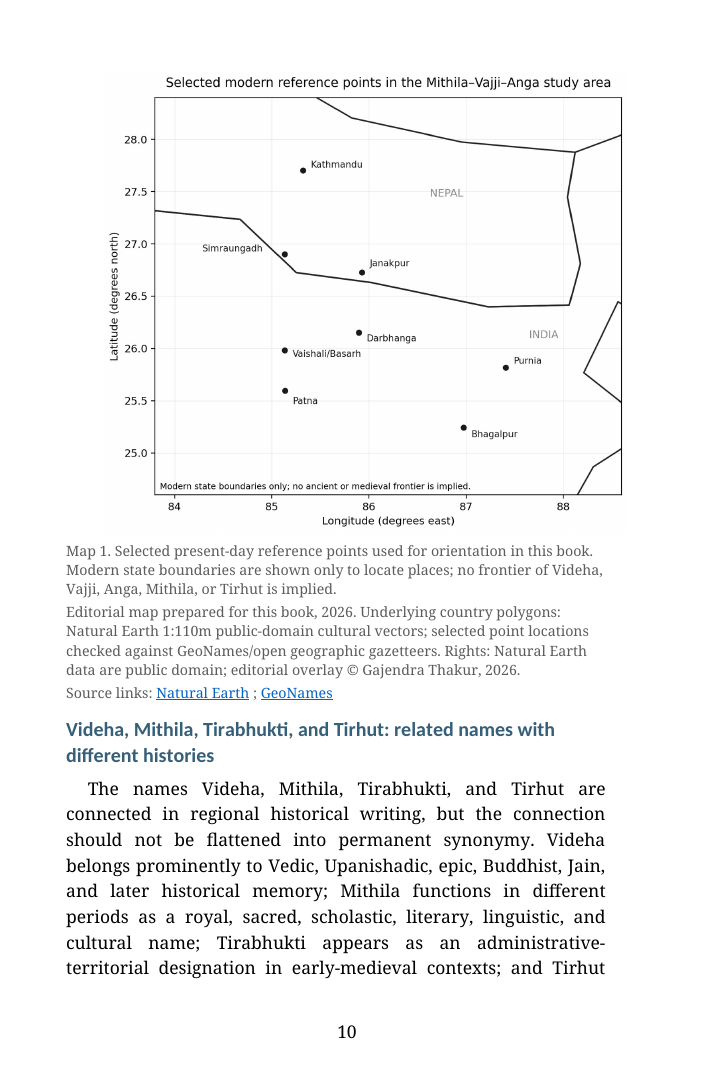
Chapter-specific source notes
- Primary chapter witness. Gajendra Thakur, Decoding the Panji of Mithila — Volume IV, formal Chapter 13, PDF pp. 176-187; formal Chapter 13. The HTML transcription is generated from the commit-pinned source PDF and retains the chapter boundary recorded in this edition.
- Internal structure. The repository source-heading inventory records 15 subordinate headings for this chapter: “13.1 Scope of This Chapter”; “13.2 Entry (15): The Suspended Sandahpur Heading”; “13.3 Entry (16): Banailli, Purnea, Mitranath Jha and the Beginning of the Badhwas-Sarisab Cluster”; “13.4 Dharanidhar, Shivdatt, Bhanjan, and Chilka: The First Major Expansion”; “13.5 Krishnadev, Chan, Nidhi, and the Pandua-Vabhaniyam-Mandar-Alay Network”; “13.6 Thithar, Jagaddhar, Manikrishna, Chhoti/Jai Krishna, Buddhinath, and Mitranath”; “13.7 Mitranath, Bhukhi, and the Link from Banailli-Purnea Back to the Panji Core”; “13.8 Entry (17): The Continuation of Chhoti/Jai Krishna”; ….
- Digital editorial method. The page keeps the preserved source text distinct from generated navigational, concordance, visual, and provenance apparatus. The synthetic reconstruction is explanatory only and is not evidence for an individual lineage or a determination of social or marital status.