Decoding the Panji of Mithila · Volume IV · Chapter 14
Khangur to Nahar, Danga, Pilkhwar, and the First Khangur Expansion: Entries (20)-(24)
Chapter 14
Khangur to Nahar, Danga, Pilkhwar, and the First
Khangur Expansion: Entries (20)-(24)

14.1 Scope of This Chapter
   This chapter begins where Chapter 13 deliberately stopped:
after the empty entry (19) and at the opening of the Khangur
sequence. It covers only entries (20), (21), (22), (23), and (24). It
does not move into entry (25), where Pilkhwar becomes a
separate heading, and it does not absorb the later Khangur-
Bhatsimar material, which will require its own chapter.
  The source announces the new cluster through the heading
'Khangur se Nahar' and immediately adds that Khangur-
Sarisab village is being written. This is the key to the chapter.
Khangur is not only a place-name in the running Panji; in the
Genome Mapping index it belongs to the Sarisab cluster.
Therefore this chapter must be read as the first full Khangur-
Sarisab expansion after the Badhwas-Sarisab transition.
   Entries (20)-(24) create a large and highly connected field.
Entry (20) establishes the Khangur-Sarisab base. Entry (21)
moves to Nahar and Purnea, giving Ramanjit and
Ravindranath. Entry (22) extends Khangur toward Danga and
Kailakh through Tofi Jha. Entry (23) moves toward Pilkhwar
through Jamahir Jha. Entry (24) is a separate continuation that
links Chaturbhuj, Ruchi, Raiya, Shyamraj, and further
descendants to Sakaradhi, Hariamb, Narun, Alay, Darihara,
Baliyas, Soderpur, Satlakha, and other places. The chapter
treats all five entries as a single Khangur opening section.

14.2 The Index Logic of Khangur-Sarisab
  The master index identifies Sarisab as a principal location
and records Khangur, Sakuri, and Jonki under it. That means a

heading such as 'Khangur-Sarisab' cannot be reduced to a bare
route. It is also a classificatory statement. Khangur belongs to
the Sarisab field, and Sarisab itself carries gotra, mool, mool-
gram, laukik, and shreni implications.
   This chapter therefore uses two levels of reading. The first
level is the local genealogy: who is named, whose son is
named, which descendants appear, and which place-relations
are attached. The second level is index logic: how Khangur fits
within Sarisab and how the recurring villages in the entries
connect with the master classification. Both levels are
required. Without the first, the persons disappear; without the
second, the village logic becomes unintelligible.
   The index also lists several recurring moolgram
correspondences relevant to this chapter: Khoa l with Mahua,
Murajpur, and Simarwad; Sakaradhi with Parhat and Lohna;
Darihara with Ratauli; Mandar with Rajoura, Sihouli, Patnuka,
and Kansam; Baliyas with Madari; Narun with Tripurauli,
Sulhani, and Pude; Surgan with Loam; Kujouli with
Bhakharouli; and Ekhara with Kanhauli and Ruchauli. These
correspondences do not mean every occurrence has identical
significance, but they give the reader the classification map
within which the Panji is operating.

14.3 Entry (20): Khangur to Nahar and the Panch
Jayashiv Line
   Entry (20) opens with the formula that the Khangur-Sarisab
village is being written. The first node is Panch Jayashiv. His
sons or branch-holders are given as Panch Balbhadra,
Bhaiyan, Jhonti, and Chhabna. This arrangement creates a
fourfold opening structure inside the Khangur-Sarisab field.
The entry then attaches Khoa l-Dharadhar-Soni and Hariamb-
Jagannath to this cluster.

   The line of Panch Balbhadra is expanded through Panch
Chandramani, Panch Nanu, Nendan, and Chanai. The entry
links this branch with Darihara-Harijiv-Rohini and Hariamb-
Bhavkrishna. Chandramani's branch moves through
Harkhamani and Bhulan, with Pali-Bachharu-Umadatt and
Sarisab-Bhola. The repeated use of Sarisab confirms that the
heading is not merely formal; the cluster repeatedly returns to
Sarisab as a reference point.
  Harkhamani is linked through Baliyas-Bhikhiya-Jaydatt and
Kujouli-Ray Anand. A further Gopal branch is linked with Pali-
Bhavanidatt-Ramanath and Soderpur-Nandishwar. Other
branches connect Malichham-Beherarhi, Darihara, Alay,
Baliyas, Karmaha, Kujouli, Soderpur, Pali, Sakaradhi, and
other places. The genealogy is dense, but the pattern is
consistent: a Khangur-Sarisab core is being linked outward
through major mool and route markers.

14.4 Bhulan, Gangadhar, Nanu, Jagaddhar, and
Bhuvaneshwaridatt
  The Bhulan portion of entry (20) deserves special attention.
Bhulan's descendants are linked with Alay-Shyamlal-Shivlal
and Baliyas-Dukhiya. Another branch gives Gangadhar
connected through Karmaha-Jahali-Vishnudatt and Kujouli-
Eknath. The Karmaha-Kujouli combination is important
because both appear repeatedly in the index logic of mool and
mool-gram distribution.
   Panch Nanu then gives Jagaddhar, who is connected with
Karmaha-Chitradhar-Gauridatt       and   Soderpur-Umapati.
Jagaddhar's son Panch Bhuvaneshwaridatt is then connected
to Pali-Umadatt-Kamaladatt and Khandbala-Thanu. These are
not casual additions. They place the Nanu-Jagaddhar branch
within a network of recognized places: Karmaha, Soderpur,
Pali, and Khandbala.

  Bhuvaneshwaridatt's own branch connects Budhwal-
Durgadatt-Mukund with Sarisab-Panch Thithar. The return to
Sarisab at this point is a structural closure within entry (20).
The entry begins with Khangur-Sarisab and repeatedly folds
branches back into Sarisab-related memory. This is why the
chapter treats entry (20) as the foundation of the Khangur-
Sarisab section.

14.5 Entry (21): Nahar, Purnea, Ramanjit, and
Ravindranath
  Entry (21) is headed 'Nahar, Purnea, Ramanjit,
Ravindranath.' It continues the Khangur field while shifting
the external marker toward Nahar and Purnea. The branch
begins with Shivkrishna, also styled Bachcha, and Shri
Krishna, also styled Kedarnath. The entry links them with
Sakaradhi-Chandradatt-Fuddi, also styled Markandeya, and
Pali-Khuda, also styled Vishnudatt.
  Shivkrishna's branch is connected with Karmaha-Bholi-
Narsingh and Surgan-Durganarayan. Kedarnath's branch is
much larger, giving Hemnath, Kumudnath, Ganganath,
Vaidyanath, Jagannath, and Shantinath. These names attach
the Nahar-Purnea line to Pali, Bachcha, Kantir or Kantir-pr.
Vishwanath, and Pandua. The naming pattern suggests that
the entry is preserving a modern or semi-modern branch
under a traditional genealogical form.
   Ravindranath appears as the son of Hemnath and is linked
with Ghusaut-Bachharu-Brajmohan and Soderpur-Gangadhar.
The line 'Ravindranath pr. Ramanji' gives an identity bridge
between the heading's Ramanjit/Ravindranath and the
internal genealogy. Even when later details are blank, the
Panji preserves the identity marker. The final index should
therefore include both Ramanjit and Ravindranath, with
cross-reference to Hemnath, Nahar, Purnea, Ghusaut, and
Soderpur.

14.6 Bhaiyan and the Nahar Continuation: Manik,
Babunath, Babu, Bhuni, and Kalanath
  The second half of entry (21) turns back to Bhaiyan.
Bhaiyan's son Bhikhiya is connected with Satlakha-Ramapati-
Manik and Karmaha-Bhaiya. Another Bhaiyan branch gives
Babunath through Mandar-Shivdatt-Meghnath and Jajival-
Shambhupati. A further branch gives Babu through Khoa l-
Ganapati-Garib and Soderpur-Lochan.
  The entry then adds several 'apara' branches: Kujouli-
Rameshwar-Ankhi;     Pali-Kanhai;     Ekhara-Bana-Girdhar;
Budhwal-Dinbandhu-Gonan; Satlakha-Prannath; Khoa l-
Raghunath-Durgadatt; Jajival-Umapati; Mandar-Damodar-
Gujar; Ekhara-Dasharath; and a royal or estate-linked Uini
connection with Maharaj Lakshminarayan and Brajnarayan,
then Ghusaut-Manbodh. This is not disorder; it is the Panji's
way of preserving multiple relational exits from a central
Bhaiyan branch.
   For index purposes, this part of entry (21) is important
because it contains many of the recurrent moolgram and
village markers that appear in the Genome Mapping index. It
must therefore be indexed not only under Nahar and
Ravindranath, but also under Satlakha, Karmaha, Mandar,
Jajival, Khoa l, Soderpur, Kujouli, Pali, Ekhara, Budhwal, Uini,
and Ghusaut.

14.7 Entry (22): Khangur to Danga, Kailakh, and
Tofi Jha
  Entry (22) is headed 'Khangur se Danga, Kailakh, Tofi Jha.' It
begins with a continuation from Baliyas-Jivi, then Narun-
Saheb-Chanchal, Panichobh-Khedan, and Babunath's son
Dinanath through Baliyas-Bhagirath-Sukhni and Pali-
Bhavaditya. The entry is clearly moving the Khangur cluster

toward Danga and       Kailakh     while   preserving   multiple
relational branches.
  Dinanath's branch gives Aniruddha, linked with Narun-
Pakhiya-Babunath and Hariamb-Kishornath. Aniruddha's line
continues    through    Hariamb-Bhavanidatt-Nandalal   and
Pandua-Babue. The source then introduces Tofi, along with
Gosain and Hakru, connected through Alay-Duvari-Panch
Sarvasva and Sarisab-Machal. Tofi is therefore not merely a
name in the heading; he appears inside the genealogy and
must be cross-indexed under Khangur, Danga, Kailakh, Alay,
Sarisab, and the relevant descendant relations.
  The Tofi branch includes further links through Hariamb-
Machal-Yogi,    Satlakha-Nanu,     and    Nakchhed    through
Belaunch-Sonmani-Nene and Pali-Hirphul. These connections
demonstrate how a named laukik-style or family identifier in
a heading can become the organizing signal for a detailed
branch. The chapter should preserve the heading-name Tofi
Jha and the internal Tofi branch as one connected unit.

14.8 Kalanath, Radhe, Bandhu, Venidatt,
Hridayram, and Somdatt
   The end of entry (22) continues with Kalanath, linked
through Mandar-Ratnu-Jagannath and Hariamb-Khushihal.
Radhe's branch connects with Baliyas-Bandhu-Venidatt.
Bandhu's son Venidatt is then linked with Bithual-Umapati-
Hridayram. Hridayram's line moves through Narun-Manhar-
Narpati and Pandua-Jiveshwar. This is a chain of remembered
relations, not a single straight descent line.
  Venidatt's branch continues through Pali-Manbodh-Durlabh
and Darihara-Shridatt. Somdatt is linked with Ekhara-Bodh-
Shivnandan and Pali-Chhabnu. The entry ends with a
Darihara-Harishwar 'kasthut' or attested statement. This kind
of ending signals that the branch had an acknowledged

relation or attestation, even if the modern reader cannot fully
reconstruct the archival background.
   For the final index, Kalanath, Radhe, Bandhu, Venidatt,
Hridayram, Somdatt, and Harishwar must be retained. The
village index must include Mandar, Hariamb, Baliyas, Bithual,
Narun, Pandua, Pali, Darihara, and Ekhara. The presence of
'kasthut' should be noted in the technical glossary because it
indicates attested or recorded status within the Panji idiom.

14.9 Entry (23): Khangur to Pilkhwar and Jamahir
Jha
  Entry (23) is headed 'Khangur se Pilkhwar, Jamahir Jha.' It
opens with Jhonti's son Batuhan, connected through Khoa l-
Shivram-Gana and Jajival-Nandalal. Other branches include
Babuni     and    Gumani    through    Belaunch-Chaturbhuj-
Dharmadatt and Vabhaniyam-Ratan. The branch then gives
Girdhari and Kunj through Belaunch-Harishwar-Diman
Ratnapati.
   Diman Ratnapati receives an important expansion: he is
linked with Jalay-Madan-Ghanshyam and Digho-Mani, and
then with Karmaha-Narayan-Andi and Ekhara-Bhamar.
Batuhan's son Chhakkauri is linked with Karmaha-
Rudramani-Bhola and Satlakha-Bhanu. Chhakkauri's son
Jamahir is the central figure of the heading. He is connected
with Ekhara-Janakinath-Babujan and Narun-Bechan.
  The Jamahir branch then connects Panichobh-Paramani-
Kapileshwar and Khandbala-Kulmani. This confirms that the
heading-name Jamahir is not merely a topical label but the
main internal branch marker. The final index must therefore
place Jamahir Jha under Khangur, Pilkhwar, Ekhara, Narun,
Panichobh, and Khandbala.

14.10 Babuni, Gumani, Chhabna, Kanhaiya,
Bhailal, Jaydatt, and the Royal Uini Link
   Entry (23) continues beyond Jamahir. Babuni is linked with
Darihara-Rohini-Badan and Ekhara-Chhatrapati. Gumani's son
Bechu is linked through Uchiti-Hiranand-Mana and Baliyas-
Mahipati. Another Jhonti branch gives a Beherarhi-Belaunch-
Devidatt-Ray Hriday Singh relation and an Allari-Dalbhanjan
relation. These are additional exits from the same Khangur-
Pilkhwar field.
  Chhabna's sons Bhikhiya and Bauku are then connected
with Hariamb-Hrishi-Shubh pati and Baliyas-Girish. The line
further gives Kanhaiya and Bhailal, linked with Uini and
Maharaj Lakshminarayan's son Babu Teg Bahadur, and with
Karmaha-Teki. This royal or estate-linked Uini reference must
be indexed separately because it signals a relation that is not
merely village-local.
   The end of the entry mentions Jaydatt through Baliyas-
Girish-Bhanudatt and Alay-Chaudhary Nityanand; Bhikhiya
through Darihara-Shridatt-Brajnath and Karmaha-Dayanidhi;
Bauku's sons Chhotkani and Arjun through Khoa l-Jagyapati-
Lakshminath and Soderpur-Umai; and further lines through
Yognath, Darihara, Ekhara, Kanhaiya, and Jaydatt. This is a
full branch web and must not be collapsed into a brief
Jamahir note.

14.11 Entry (24): Chaturbhuj, Ruchi, Raiya,
Shyamraj, and the Transitional Closure
  Entry (24) is not named by a village heading in the same
way as the previous entries, but it begins with a reference
number and gives Panch Chaturbhuj's sons Ruchi, Raiya, and
Shyamraj. Ruchi is connected with Sakaradhi-Mohan-
Dandpani and Hariamb-Vedu. Another branch gives Narpati
through Uchiti-Mahipani-Rajaram and Narun-Keshav. This

entry therefore continues the Khangur logic while preparing
later Pilkhwar and Bhatsimar material.
  Ruchi's son Harpati and Chhechhan are linked with Alay-
Madhu-Devkinandan,        Darihara-Neelkanth,   Sakaradhi-
Narsingh-Pati, Alay-Anath, Karmaha-Chhabnu-Chitradhar, and
Pabouli-Upendra. Raiya's son Gunanidhi is linked with
Baliyas-Devanand-Fakir and Soderpur-Haridev. Gunanidhi's
sons Brahmadatt, Krishnadatt, and Chandidatt then connect
Baliyas-Dharadhar-Dhir with Jajival-Bhaiyaram.
   The entry continues through Pyare, Jaggi, Andi, Raghunath,
Gangoli, Kriparam, Darihara, Durbhiksha, Kujouli, and
Machal. Shyamram's line gives Gane, Khokhe, and Nare
through Belaunch-Vir-Gokulnath and Khoa l-Matiram. Gane,
also called Gangadatt, gives Manik and Jhotan through
Satlakha-Ramchandra-Neelambar and Pali-Chilka. The close of
the entry gives Khokhe's sons Thakurdatt and Saburdatt
through Darihara-Govardhan-Raghunath and Karmaha-
Jaynath. Entry (24) therefore functions as a transitional
closure: it completes this first Khangur expansion and
prepares the separate Pilkhwar heading of entry (25).

14.12 Coverage Matrix for Entries (20)-(24)
   The following matrix records the source units covered in
this chapter and the index logic that must be carried into the
final cross-check. It is deliberately narrow: it covers only
entries (20)-(24).
 Entry       Source unit        Primary names /    Index logic         Editorial action
                                items

 20          Khangur to Nahar / Panch Jayashiv,    Sarisab-Khangur;    Treat as
             Khangur-Sarisab    Balbhadra,         Khoa l; Hariamb;    foundation of
             village beginning  Bhaiyan, Jhonti,   Darihara; Pali;     Khangur-Sarisab
                                Chhabna,           Baliyas; Kujouli;   cluster; cross-index
                                Chandramani,       Karmaha;            Sarisab and
                                Nanu, Nendan,      Soderpur;           Khangur.
                                Chanai,            Budhwal;
                                Harkhamani,        Khandbala
                                Bhulan,
                                Gangadhar,
                                Jagaddhar,

                                Bhuvaneshwaridat
                                t

 21         Nahar, Purnea,      Shivkrishna/      Nahar; Purnea;     Index under
            Ramanjit,           Bachcha, Shri     Sakaradhi; Pali;   Nahar/Purnea and
            Ravindranath        Krishna/Kedarnath Karmaha; Surgan; Ravindranath;
                                , Hemnath,        Ghusaut; Soderpur; preserve identity
                                Ravindranath/Ram Satlakha; Mandar; bridge to Ramanjit.
                                anji, Bhaiyan,    Jajival; Khoa l;
                                Bhikhiya,         Ekhara; Uini
                                Babunath, Babu,
                                Bhuni, Kalanath,
                                Radhanath

 22         Khangur to Danga, Dinanath,              Danga; Kailakh;      Treat Tofi as
            Kailakh, Tofi Jha Aniruddha, Tofi,       Baliyas; Narun;      heading-name and
                              Gosain, Hakru,         Panichobh; Pali;     internal branch;
                              Nakchhed,              Hariamb; Pandua;     note kasthut at
                              Kalanath, Radhe,       Alay; Sarisab;       close.
                              Bandhu, Venidatt,      Belaunch; Mandar;
                              Hridayram,             Bithual; Darihara;
                              Somdatt                Ekhara

 23         Khangur to          Batuhan, Babuni,     Pilkhwar; Khoa l;  Do not collapse to
            Pilkhwar, Jamahir   Gumani, Girdhari,    Jajival; Belaunch; one name; index
            Jha                 Kunj, Diman          Vabhaniyam; Jalay; full branch web,
                                Ratnapati,           Digho; Karmaha;    including Uini
                                Chhakkauri,          Ekhara; Narun;     royal connection.
                                Jamahir, Bechu,      Panichobh;
                                Chhabna,             Khandbala; Uini
                                Kanhaiya, Bhailal,
                                Jaydatt, Bauku

 24         Chaturbhuj          Chaturbhuj, Ruchi,   Sakaradhi;           Treat as
            continuation        Raiya, Shyamraj,     Hariamb; Uchiti;     transitional
                                Harpati,             Narun; Alay;         closure before
                                Chhechhan,           Darihara;            entry (25)
                                Gunanidhi,           Karmaha; Pabouli;    Pilkhwar; carry
                                Brahmadatt,          Baliyas; Soderpur;   unresolved
                                Krishnadatt,         Jajival; Gangoli;    references
                                Chandidatt, Pyare,   Satlakha; Pali       forward.
                                Jaggi,
                                Gane/Gangadatt,
                                Manik, Jhotan,
                                Khokhe,
                                Thakurdatt,
                                Saburdatt

14.13 Index Items to Carry Forward
  The personal-name index must include Panch Jayashiv,
Balbhadra, Bhaiyan, Jhonti, Chhabna, Chandramani, Nanu,
Nendan, Chanai, Harkhamani, Bhulan, Gangadhar, Jagaddhar,
Bhuvaneshwaridatt,        Shivkrishna/Bachcha,       Shri
Krishna/Kedarnath,    Hemnath,      Ravindranath/Ramanji,
Ramanjit, Bhikhiya, Babunath, Babu, Bhuni, Kalanath,

Radhanath, Dinanath, Aniruddha, Tofi, Gosain, Hakru,
Nakchhed, Radhe, Bandhu, Venidatt, Hridayram, Somdatt,
Batuhan, Babuni, Gumani, Girdhari, Kunj, Diman Ratnapati,
Chhakkauri, Jamahir, Bechu, Kanhaiya, Bhailal, Jaydatt,
Bauku, Chaturbhuj, Ruchi, Raiya, Shyamraj, Harpati,
Chhechhan, Gunanidhi, Brahmadatt, Krishnadatt, Chandidatt,
Pyare, Jaggi, Gane/Gangadatt, Manik, Jhotan, Khokhe,
Thakurdatt, and Saburdatt.
  The village and route index must include Khangur, Sarisab,
Nahar, Purnea, Danga, Kailakh, Pilkhwar, Khoa l, Hariamb,
Darihara, Pali, Baliyas, Kujouli, Malichham, Beherarhi, Alay,
Karmaha,     Soderpur,    Budhwal,     Satlakha, Khandbala,
Sakaradhi, Panichobh, Mandar, Jajival, Surgan, Ghusaut,
Pandua, Ekhara, Uini, Narun, Belaunch, Jalay, Digho, Uchiti,
Vabhaniyam, Bithual, Gangoli, and Pabouli.
  The title and status index must include Panch, pr. forms,
Gosain, Chaudhary, Maharaj, and kasthut. These markers
should be retained as source signals, not translated away into
generic modern prose.

14.14 Summary
  Entries (20)-(24) establish the first full Khangur-Sarisab
expansion of the Nagram Panji. Entry (20) begins with Panch
Jayashiv and the Khangur-Sarisab village frame. Entry (21)
moves to Nahar and Purnea with Ramanjit and Ravindranath.
Entry (22) carries the cluster toward Danga, Kailakh, and Tofi
Jha. Entry (23) shifts toward Pilkhwar and Jamahir Jha. Entry
(24) closes the first Khangur cluster through Chaturbhuj,
Ruchi, Raiya, Shyamraj, and their branches.
   The index logic is decisive. The master index places
Khangur under the Sarisab field, and the chapter's repeated
village markers show the practical operation of that
classification. The chapter therefore does not treat Khangur as

merely one village-route. It treats it as a Sarisab-linked
genealogical zone that opens a major new part of the Nagram
material.
  The next chapter should begin with entry (25), Pilkhwar,
and then continue through entries (26)-(29) if the scope
remains manageable, because those entries continue the
Khangur-Pilkhwar-Bhatsimar expansion begun here.
Source structure and verification apparatus
Editorial source apparatus. This apparatus is descriptive, not interpretive. It records the source-controlled structure used to verify that this page corresponds to formal Chapter 14 of Decoding the Panji of Mithila — Volume IV. The chapter text above is preserved from PDF pp. 188-199; formal Chapter 14 in the commit-pinned authoritative source. It is not merged with a neighboring chapter, appendix, annexure, or independent front/back-matter unit. The internal headings below come from the repository’s source-heading inventory and are retained as navigational and audit evidence; showing them here does not turn those headings into separate publications or add claims that are absent from the source.
Internal source headings
- 14.1 Scope of This Chapter
- 14.2 The Index Logic of Khangur-Sarisab
- 14.3 Entry (20): Khangur to Nahar and the Panch Jayashiv Line
- 14.4 Bhulan, Gangadhar, Nanu, Jagaddhar, and Bhuvaneshwaridatt
- 14.5 Entry (21): Nahar, Purnea, Ramanjit, and Ravindranath
- 14.6 Bhaiyan and the Nahar Continuation: Manik, Babunath, Babu, Bhuni, and Kalanath
- 14.7 Entry (22): Khangur to Danga, Kailakh, and Tofi Jha
- 14.8 Kalanath, Radhe, Bandhu, Venidatt, Hridayram, and Somdatt
- 14.9 Entry (23): Khangur to Pilkhwar and Jamahir Jha
- 14.10 Babuni, Gumani, Chhabna, Kanhaiya, Bhailal, Jaydatt, and the Royal Uini Link
- 14.11 Entry (24): Chaturbhuj, Ruchi, Raiya, Shyamraj, and the Transitional Closure
- 14.12 Coverage Matrix for Entries (20)-(24)
- 14.13 Index Items to Carry Forward
- 14.14 Summary
Source-text concordance
Khangur · Nahar · Danga · Pilkhwar · First · Expansion · Entries · Scope · begins · deliberately · stopped · empty · entry · opening · sequence · covers · move · becomes · separate · heading · absorb · later · Bhatsimar · material · require · announces · cluster · immediately · adds · Sarisab · village · written · place-name · running · Genome · Mapping · index · belongs · Therefore · must · read · full · Badhwas-Sarisab · transition · create · large · highly · connected · field · establishes · Khangur-Sarisab · base · moves · Purnea · giving · Ramanjit · Ravindranath · extends · toward · Kailakh · Tofi · Jamahir · continuation · links · Chaturbhuj · Ruchi · Raiya · Shyamraj · descendants · Sakaradhi · Hariamb · Narun · Alay · Darihara · Baliyas · Soderpur · Satlakha · places · treats · five
Boundary verification. In the formal sequence this chapter follows Volume IV Chapter 13, “Banailli, Purnea, Badhwas-Sarisab, Rahua, and the Empty Boundary: Entries (15)-(19)” and precedes Volume IV Chapter 15, “Pilkhwar, Bhatsimri, Ranitole and the Later Khangur Expansion”. The chapter extractor begins at the verified formal Chapter 14 marker and stops at the next verified formal chapter marker; for a final chapter it stops before recognized book-level back matter. The concordance above is generated only from distinct terms already present in this chapter’s preserved source text. It is provided for discovery, comparison, and audit, not as an automated judgment about persons, lineages, status, kinship, marriage eligibility, or historical truth.
Illustrated research apparatus
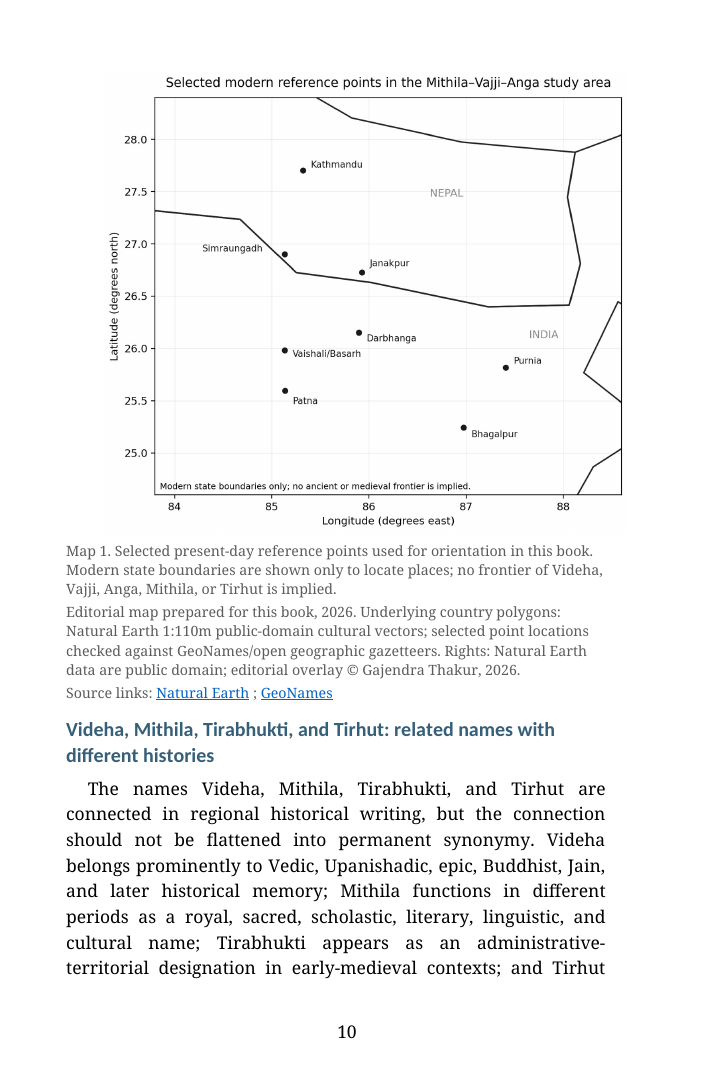
Mithila · Vajji · Anga
Chapter-specific source notes
- Primary chapter witness. Gajendra Thakur, Decoding the Panji of Mithila — Volume IV, formal Chapter 14, PDF pp. 188-199; formal Chapter 14. The HTML transcription is generated from the commit-pinned source PDF and retains the chapter boundary recorded in this edition.
- Internal structure. The repository source-heading inventory records 14 subordinate headings for this chapter: “14.1 Scope of This Chapter”; “14.2 The Index Logic of Khangur-Sarisab”; “14.3 Entry (20): Khangur to Nahar and the Panch Jayashiv Line”; “14.4 Bhulan, Gangadhar, Nanu, Jagaddhar, and Bhuvaneshwaridatt”; “14.5 Entry (21): Nahar, Purnea, Ramanjit, and Ravindranath”; “14.6 Bhaiyan and the Nahar Continuation: Manik, Babunath, Babu, Bhuni, and Kalanath”; “14.7 Entry (22): Khangur to Danga, Kailakh, and Tofi Jha”; “14.8 Kalanath, Radhe, Bandhu, Venidatt, Hridayram, and Somdatt”; ….
- Digital editorial method. The page keeps the preserved source text distinct from generated navigational, concordance, visual, and provenance apparatus. The synthetic reconstruction is explanatory only and is not evidence for an individual lineage or a determination of social or marital status.