Decoding the Panji of Mithila · Volume IV · Chapter 15
Pilkhwar, Bhatsimri, Ranitole and the Later Khangur Expansion
Chapter 15
Pilkhwar, Bhatsimri, Ranitole and the Later
Khangur Expansion
Exclusive coverage in this chapter: Nagram Panji entries (25),
(26), (27), (28), and (29), continuing after the
Khangur-Danga/Pilkhwar/Jamahir cluster covered in Chapter
14.
This chapter continues the Khangur sequence and treats the
group of entries in which the Panji moves from Pilkhwar to
the more elaborate Bhatsimri and Ranitole extensions. The
previous chapter stopped at entry (24), where the Chaturbhuj-
Ruchi-Raiya-Shyamraj continuation closed the first large
Khangur expansion. The present chapter begins with entry
(25), headed Pilkhwar, and follows the record through entry
(29), where Khangur branches are carried toward Ranitole,
Baidyanath Jha, Amauli, Haldhar Jha, Sirsia in Purnea, and
Nar Singh Jha. This is not merely a change of place-name. It
marks a further widening of the Khangur-Sarisab network
into named houses, specialist titles, grammatical learning, and
eastern regional memory.
15.1 Entry (25): Pilkhwar as a Continuation Point,
Not a Fresh Beginning
Entry (25) is headed Pilkhwar, but its function is not to
create a wholly separate genealogy. It continues the line
already opened through Khangur and Pilkhwar. The first
visible movement concerns Thakur Datt and Sabur Datt. The
entry then turns toward Jayanath, also marked through the
form Jana or Janak in the source, and carries the line through
Harinandan. The compact formula contains multiple village
markers: Karmaha, Soderpur, Pali, Sarisab, Baliyas, Hariamb,
Babhaniyam, Didho, Khoa l, and Khandbala. These are not
decorative place references. They are the relational
coordinates by which the branch is located inside the wider
Panji system.
The index logic confirms why Pilkhwar must be read under
the Khangur-Sarisab stream rather than as a disconnected
locality. In the Genome Mapping index, Sarisab is associated
with Khangur, Sakuri and Jonki; this gives the Khangur
branch its moolgram framework. The Panji entry then adds
operational linkage by connecting specific descendants with
additional mools and villages. Thus the chapter does not treat
Pilkhwar as an isolated village note; it reads Pilkhwar as a
nodal continuation within the Sarisab-Khangur genealogical
field.
The movement from Thakur Datt to Sabur Datt and then
through Jayanath and Harinandan also shows how the Panji
frequently works through a relay structure. One name is
introduced as a branch-holder, the next as a descendant or
linked person, then the place formula gives another
connection. The chain is not a prose biography. It is a compact
index of eligibility, memory, and connection. The reader
should therefore not ask, “Why is every personal detail
absent?” The Panji gives the details it was designed to
preserve: descent, branch, relational village, and sometimes a
title or alternative name.
15.2 Entry (26): The Unfinished Khangur Heading
and the Narapati Branch
Entry (26) is headed simply “Khangur to ...” with the
destination suspended. This is a classic Panji form in which
the heading preserves a route-opening without completing the
second place in the title. The body of the entry supplies the
real information. It begins with Narapati and lists Umanath,
Ramanath, the grammarian Rupnath, and related
descendants. The presence of “Vaiyakaran” is especially
important. It tells us that the branch preserved the memory of
grammatical learning, not merely biological descent. The Panji
therefore records both genealogy and intellectual identity.
The Narapati branch moves through Mandar, Baliyas,
Ekhara, Narun, Babhaniyam, Darihara, Pabouli, Sakararhi,
Pali, Belauch and Khoa l. When checked against the index
logic, these names are not random. Mandar belongs to a
cluster associated with Rajo ra, Sihouli, Patanuka and Kansam;
Baliyas is tied to Madari; Narun is associated with Tripurauli,
Sulhani and Pude; Ekhara is linked with Kanhauli and
Ruchauli; Khoa l is tied with Mahua, Murajpur and Simarwar.
The entry is therefore a miniature map of inter-mool
connection.
The title “Vaiyakaran” attached to Rupnath should be
preserved in English as “grammarian,” with the Indic term
also retained where useful. Such a title indicates learned
status. It should not be treated as a surname. In the same way,
when a later entry calls another person a grammarian or a
jyotishi, the title is not merely ornamental; it tells the reader
how the individual or branch was remembered within the
intellectual culture of Mithila.
15.3 Entry (27): Khangur to Bhatsimri and the
Khantar Line
Entry (27), “Khangur to Bhatsimri,” is one of the dense
genealogical knots of this section. It opens with Chhokar and
then expands through Khantar and Chhitar. Khantar becomes
the main internal node, and through him the record gives
Babunath, Ranknath, Hridaynath, the grammarian Matinath,
and other lines. The repeated appearance of Belauch, Pali,
Khoa l, Pabouli, Soderpur, Budhwal, Panichobh, Satlakha,
Darihara, Alay, Karmaha, Tisaunt, Sarisab and Sakararhi
shows that Bhatsimri is not a single terminal settlement. It is a
web of branch relations.
The Panji gives special weight to learned identity in this
entry. “Vaiyakaran Matinath” appears as part of the Khantar
branch, and later the entry brings in “Vaiyakaran Eknath.”
This repeated learned marker suggests that grammatical
scholarship was a recognized feature of the branch memory.
The Nagram Panji is therefore not only a marriage and
descent record; it is also an intellectual register. Where the
record says “Vaiyakaran,” this volume will treat it as a
meaningful social and scholarly label.
The internal structure of entry (27) may be reconstructed in
five layers. First, Chhokar opens the branch. Second, Khantar
and Chhitar divide the initial direction. Third, Khantar
produces several named lines, including Babunath, Ranknath,
Hridaynath and Matinath. Fourth, the grammarian line of
Eknath, Kashinath and Mathuranath enters with further
descendants. Fifth, later descendants such as Siddhinath,
Srinath, Raghunath, Yadunath, Brajnath, Ravinath, Shashinath
and Harshanath extend the branch across several village ties.
Because of its density, this entry should never be
summarized merely as “Khangur to Bhatsimri.” Its
genealogical value lies in the way it preserves multiple sub-
branches under one route heading. The route-heading is the
door; the body of the entry is the house.
15.4 Entry (28): The Second Bhatsimri Register
and the Suvansh-Harivansh Continuation
Entry (28) continues the Bhatsimri material but begins with
Hiran and his sons Suvansh and Harivansh. This is a new sub-
register within the same geographical logic. It should be read
as a continuation of the Bhatsimri cluster, not as a correction
of the previous entry. The Panji often reopens the same place
with a new branch because one heading cannot carry all
related lines in a single chain.
The entry then records Harivansh, Ratinath, Adinath,
Kanhu, the learned Raghunath, Yadunath, Brajnath,
Gokulnath, Dwarikanath, Ayodhyanath, Kalanath, Ravinath,
Shashinath, Ramanath also known as Amir ilal, Vinodanand,
Paramanand, and other descendants. The place network
includes Pali, Soderpur, Baliyas, Panichobh, Soderpur again,
Khoa l, Kujouli, Karmaha, Satlakha, Babhaniyam, Narasam-
Baliyas, Sangram-Ekhara, Budhwal, Jajiwal, Ghusa ut and
Sarisab. This is another example of a route heading becoming
a multi-village matrix.
The presence of names such as Vinodanand and
Paramanand shows the stylistic shift toward later names
ending in -anand, while older patterns such as Ratinath,
Adinath, Gokulnath and Dwarikanath remain in use. This
coexistence of older and later naming habits is one of the signs
that the Panji preserves a long genealogical memory rather
than a single chronological snapshot.
The phrase indicating “Karmaha kasthut” near the Kalanath
line is also significant. A kasthut note should be read as a form
of attestation, confirmation, or recognized standing within a
branch context. It should not be silently omitted. In this
volume, such notes are treated as internal signals that a
particular relation or branch had archival or community
recognition.
15.5 Entry (29): Khangur to Ranitole, Amauli,
Sirsia and the Purnea Extension
Entry (29) is especially important because it explicitly
widens the geography. The heading links Khangur with
Ranitole and names Baidyanath Jha; it further mentions
Amauli, Haldhar Jha, Sirsia in Purnea, and Nar Singh Jha. This
indicates a later extension of the Khangur field into eastern or
northeastern settlement memory. Purnea is not merely an
incidental note; it marks the widening of Mithila-linked
genealogical identity into a regional frontier where Maithil
families were settled, remembered, and classified.
The entry begins from Madhupati and names Kalanath,
Modnath, Bachha or Kishornath, and their links through Khoa
l, Hariamb, Babhaniyam, Satlakha, Gangouli, Karmaha,
Sarisab, Mandar, Hariamb again, Budhwal, Darihara and
Sakararhi. It then introduces Shyamnath and Baidyanath,
followed by Manohar and Haldhar. Haldhar becomes a key
name because the heading itself associates the wider
extension with Haldhar Jha of Amauli and Sirsia. The branch
further continues through Mayanath and Nar Singh,
indicating that the Purnea-related memory is genealogically
embedded, not merely geographic.
This entry must be read together with the index’s broader
shreni and laukik framework. The index does not merely list
names; it shows how locality, recognized person, branch
identity and status could combine. Where the Panji gives
Ranitole, Amauli, Sirsia and Purnea in the heading, it is doing
precisely this kind of work: preserving the place by which a
branch became identifiable. In some cases, the place may be
the origin, in others the later settlement, in others the socially
remembered label. The safest reading is to preserve the route,
explain the possibilities, and avoid forcing a single modern
category on it.
15.6 Index Logic Applied to Chapter 15
The index logic for this chapter rests on three principles.
First, Khangur is to be understood under the Sarisab-linked
moolgram framework, because the index places Khangur
within the Sarisab field. Second, the numerous place names in
the entries must be checked against their own moolgram
associations rather than treated as ordinary map references.
Third, titles such as Vaiyakaran and branch markers such as
kasthut must be preserved because they carry the internal
authority of the Panji.
Sarisab-Khangur: the controlling frame for the Khangur
entries, especially entries (25) through (29).
Pilkhwar: a continuation node within the Khangur branch,
not an isolated chapter of genealogy.
Bhatsimri: a dense sub-cluster requiring two consecutive
entries, one centered on Khantar and learned
Matinath/Eknath lines, the other on Hiran, Suvansh and
Harivansh.
Ranitole-Amauli-Sirsia-Purnea: the widened regional
memory of the Khangur branch, preserved through
Baidyanath Jha, Haldhar Jha and Nar Singh Jha.
Learned markers: Vaiyakaran attached to Rupnath,
Matinath and Eknath must be retained as evidence of
intellectual identity within the branch.
15.7 Coverage Note
This chapter covers entries (25), (26), (27), (28), and (29)
only. It begins at Pilkhwar and ends with the Khangur-
Ranitole-Amauli-Sirsia-Purnea extension. Entry (30), “Khangur
to Pilkhwar,” belongs to the next chapter and is intentionally
not decoded here. This preserves the one-chapter-at-a-time
method and prevents the later Khangur material from being
compressed into a false summary.Source structure and verification apparatus
Editorial source apparatus. This apparatus is descriptive, not interpretive. It records the source-controlled structure used to verify that this page corresponds to formal Chapter 15 of Decoding the Panji of Mithila — Volume IV. The chapter text above is preserved from PDF pp. 200-206; formal Chapter 15 in the commit-pinned authoritative source. It is not merged with a neighboring chapter, appendix, annexure, or independent front/back-matter unit. The internal headings below come from the repository’s source-heading inventory and are retained as navigational and audit evidence; showing them here does not turn those headings into separate publications or add claims that are absent from the source.
Internal source headings
- 15.1 Entry (25): Pilkhwar as a Continuation Point, Not a Fresh Beginning
- 15.2 Entry (26): The Unfinished Khangur Heading and the Narapati Branch
- 15.3 Entry (27): Khangur to Bhatsimri and the Khantar Line
- 15.4 Entry (28): The Second Bhatsimri Register and the Suvansh-Harivansh Continuation
- 15.5 Entry (29): Khangur to Ranitole, Amauli, Sirsia and the Purnea Extension
- 15.6 Index Logic Applied to Chapter 15
- 15.7 Coverage Note
Source-text concordance
Pilkhwar · Bhatsimri · Ranitole · Later · Khangur · Expansion · Exclusive · coverage · Nagram · entries · continuing · Khangur-Danga · Jamahir · cluster · covered · continues · sequence · treats · group · moves · elaborate · extensions · previous · stopped · entry · Chaturbhuj · Ruchi-Raiya-Shyamraj · continuation · closed · first · large · present · begins · headed · follows · record · branches · carried · toward · Baidyanath · Amauli · Haldhar · Sirsia · Purnea · Singh · merely · change · place-name · marks · widening · Khangur-Sarisab · network · named · houses · specialist · titles · grammatical · learning · eastern · regional · memory · Point · Fresh · Beginning · function · create · wholly · separate · genealogy · line · already · opened · visible · movement · concerns · Thakur · Datt · Sabur · turns · Jayanath
Boundary verification. In the formal sequence this chapter follows Volume IV Chapter 14, “Khangur to Nahar, Danga, Pilkhwar, and the First Khangur Expansion: Entries (20)-(24)” and precedes Volume IV Chapter 16, “Khangur to Pilkhwar, Yamsam and Dihiya: The Transition from Branch Genealogy to Modern Memory”. The chapter extractor begins at the verified formal Chapter 15 marker and stops at the next verified formal chapter marker; for a final chapter it stops before recognized book-level back matter. The concordance above is generated only from distinct terms already present in this chapter’s preserved source text. It is provided for discovery, comparison, and audit, not as an automated judgment about persons, lineages, status, kinship, marriage eligibility, or historical truth.
Illustrated research apparatus
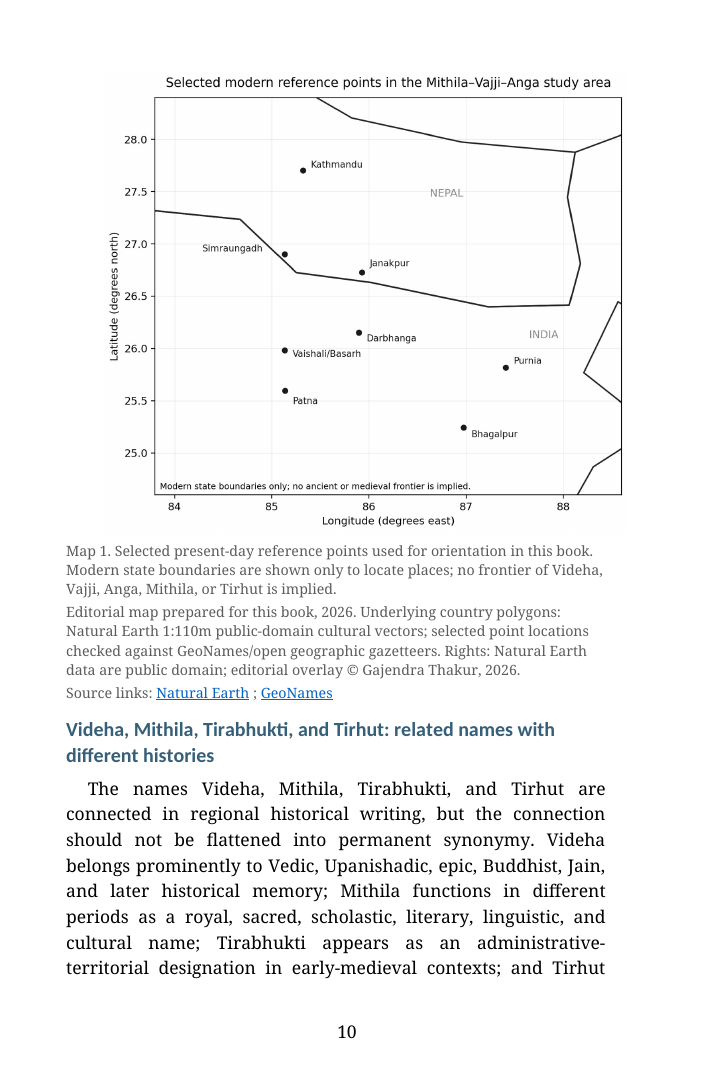
Mithila · Vajji · Anga
Chapter-specific source notes
- Primary chapter witness. Gajendra Thakur, Decoding the Panji of Mithila — Volume IV, formal Chapter 15, PDF pp. 200-206; formal Chapter 15. The HTML transcription is generated from the commit-pinned source PDF and retains the chapter boundary recorded in this edition.
- Internal structure. The repository source-heading inventory records 7 subordinate headings for this chapter: “15.1 Entry (25): Pilkhwar as a Continuation Point, Not a Fresh Beginning”; “15.2 Entry (26): The Unfinished Khangur Heading and the Narapati Branch”; “15.3 Entry (27): Khangur to Bhatsimri and the Khantar Line”; “15.4 Entry (28): The Second Bhatsimri Register and the Suvansh-Harivansh Continuation”; “15.5 Entry (29): Khangur to Ranitole, Amauli, Sirsia and the Purnea Extension”; “15.6 Index Logic Applied to Chapter 15”; “15.7 Coverage Note”.
- Digital editorial method. The page keeps the preserved source text distinct from generated navigational, concordance, visual, and provenance apparatus. The synthetic reconstruction is explanatory only and is not evidence for an individual lineage or a determination of social or marital status.