Decoding the Panji of Mithila · Volume IV · Chapter 23
Jamuni, Pachahi, Kanhauli, and Mahiya: From the Jajival Register to the Soderpur-Kanhauli and Mahiya Lines
Chapter 23
Jamuni, Pachahi, Kanhauli, and Mahiya:
From the Jajival Register to the
Soderpur-Kanhauli and Mahiya Lines
23.1 Scope of This Chapter
   This chapter continues exactly from the point where
Chapter 22 stopped. Chapter 22 opened the Jamuni-Jajival
register at entry (109). Chapter 23 takes that register forward
through entries (110), (111), (112), and (113), then records the
rikta closure at entry (114). It then moves to Pachahi and
Panni in entries (115) and (116), opens the Kanhauli-Soderpur
register in entry (117), follows the large Kanhauli-to-
Mangrauni sequence through entries (118) to (123), reads the
Kanhauli-to-Pindaruch material in entry (124), and finally
opens the Mahiya-Soderpur register from entries (125) to
(131).
   The chapter is deliberately limited to entries (110) through
(131). It does not move into the next later cluster. The purpose
is to preserve the one-chapter-one-cluster discipline restored
after Chapter 10: each chapter must decode a distinct block of
the source, explain its internal lineages, mark its village logic,
and record its index implications without prematurely
absorbing later material.
   This chapter is also important because it contains a
transition in archival texture. The Jamuni material continues
the Jajival frame; Pachahi creates a short but independent
gramaram bha; Kanhauli is explicitly brought under the
Soderpur grammar; Kanhauli-Mangrauni becomes a large
expansion with modern titles and public professions; and
Mahiya is introduced as another Soderpur-linked gramaram

bha. The result is not a simple chain, but a layered movement
from one village-register to another.

23.2 Entries (110), (111), and (112): Jamuni to Ehu
Continued
   Entry (110) continues the Jamuni-to-Ehu line begun in the
previous chapter. Its first named figure is Ratnadev, also
represented through the familiar abbreviated form Ratta. His
branch moves through Madhusudan, Bachcha, and
Ripusudan, with Darihara and Panichobh appearing as
important relational markers. The line is not only a descent-
list; it also records the pairings by which the Jamuni house is
placed within the broader network of Mithila villages.
   The same entry then brings in Gauri Datt, whose sons or
connected descendants include Sone and Fuddhi. The Sone-
Fuddhi movement is significant because it introduces further
links with Baliyas, Pali, and Samaya-Pali. The entry then
proceeds to Harikant, Krishnakant, Shivrudra, Rajnath,
Rajvanshi, Jalp Datt, Nilkanth, Shrikanth, Sitikanth, and
Marukant. The repetition of the -kant names should not be
treated as ornament. It signals a later naming style within the
line and helps distinguish this layer from the older compact
forms.
   Entry (111) continues Jamuni to Ehu without reopening a
new gramaram bha. It begins by completing the Rajvanshi-
Govind Datt line. Keshav Nath, Godhai, Dol, Lalit, Loknath,
Shyam Datt, Balbhadra, Chhatramani, and Hakuk appear in
this section. The entry also contains learned and professional
markers such as Ayurvedacharya and the English
abbreviation J.E. These should be preserved as signs of the
later documentary layer. They show that the Panji was still
recording social status, learning, and profession after the
older scholastic title-system had already mixed with modern
educational and occupational labels.

   The second half of entry (111) moves through Bandi,
Shobhi, Durgadatt, Pakshadhar, Umanath, Manohar, and
Bhayaji. It then introduces Shivni and her line: Murari,
Bhagirath, Nityanand, Badlu, Bodhram, and related branches.
This is one of the dense places where the reader must not
flatten the entry into a single male descent. The Panji is also
registering daughter-lines, marital links, and houses that
become visible through the “suta” formula.
   Entry (112) completes this Jamuni-to-Ehu block. It continues
Bodhram, Bhagirath, Nandlal, Nityanand, and then moves
through Yar, Kaladhar, Manorathi, and Nanga. The Kaladhar
line includes Bhaiya, Mikhi, Babunath, Jaymani, Nandinath,
Grihinath, Badrinath, and Gopinath. Bhikhi leads to
Manmohan, Govind, and Ramanath. The Jamuni register
therefore closes not by one clean terminal name, but by
several branch-threads that show how the house was
distributed through different village relations.
   The index logic for these entries is controlled by the Jamuni-
Jajival references. The Genome Mapping index separately
preserves Jamuni-Jajival references, which means that Jamuni
is not a casual occurrence in the source. It belongs to the
indexed structure of the Nagram material and must be
retained as a distinct village-register in the final place index.

23.3 Entry (113) and Entry (114): Jamuni to Gamail
and the Rikta Marker
  Entry (113) shifts from Jamuni to Gamail. The branch opens
with Manorathi and gives Shyamlal, Dular, Vaidya Chengni,
and related names. Vaidya Chengni is especially important
because the title Vaidya identifies a learned or medical-social
role. The Panji does not merely list names; it preserves the
character by which the branch was known.

  The entry then turns to Naga and his sons or descendants
Bholi and Muni, and then to Bhagwati, Bhaiyaram, Hira, and
Chira. The Chira line is then carried through Tulsi Datt,
Shatanjiv, Rameshwar, and associated routes. This is a
compact but important example of how the Panji uses a single
route-heading to preserve multiple family nodes. It is not
enough to say “Jamuni to Gamail”; the internal nodes of
Manorathi, Vaidya Chengni, Naga, Bhagwati, Hira, Chira, Tulsi
Datt, and Shatanjiv must all be indexed.
  Entry (114) is marked rikta. This must not be treated as an
editorial mistake or omitted from the book. A rikta entry tells
the reader that the Panji had a numbered place for an entry
but the substantive genealogy was not recorded in the
available source. Its presence after Jamuni-Gamail is a sign of
archival incompletion. It should appear in the final rikta
appendix, with the note that the empty entry occurs after the
Jamuni-Gamail section and before the Pachahi opening.

23.4 Entry (115) and Entry (116): Pachahi to Barha
and the Panni Rikta
   Entry (115) opens a new frame: “atha Pachahi gram
likhyate.” This phrase matters. It signals the beginning of a
village-register, not merely a continuation of Jamuni. The
heading gives Pachahi to Barha, and the line begins with
Gonan and his sons or connected descendants Chalbali and
Dharmadatt. Chalbali leads to Harshadatt and Balel, also
known through Ishwardatt. Dharmadatt leads to Bhairav Datt
and Bhim Datt.
   The Pachahi register then expands through Singheshwar,
Bhagwan Datt, and further marital or village links. The entry
is not long compared with the Kanhauli and Mahiya sections
that follow, but it is structurally complete enough to deserve
independent treatment. Pachahi should therefore not be

hidden under Jamuni or Kanhauli. It is a short village node
between the Jamuni block and the Kanhauli-Soderpur block.
   Entry (116) is Panni and is marked rikta. Its position
immediately after Pachahi suggests that the source expected a
related or adjacent entry, but the available text gives no
genealogy. As with entry (114), the blank must remain visible.
The final book should record entry (116) in the rikta appendix
as “Panni, entry (116), empty after Pachahi-Barha.”

23.5 Entry (117): Kanhauli to Dhanga and the
Soderpur Frame
   Entry (117) is a major structural turn because it explicitly
opens “Kanhauli Soderpur gram.” This is the point at which
the chapter moves from the Jamuni-Jajival world into the
Soderpur-linked Kanhauli register. In the Genome Mapping
index, Soderpur is not an isolated name; it is associated with a
cluster of moolgram villages including Sarisab, Mani, Digaun
dh, Tetarihar, Kanhauli, Katka, and Hati. This index logic
confirms why Kanhauli must be read through Soderpur rather
than treated as a random place-name.
  The entry begins with Mohan and gives Maheshwar,
Rameshwar, Chhoti or Harishwar, and Dhireshwar.
Rameshwar leads to Vaidya Parameshwar, Vighneshwar, and
Nandishwar. The Parameshwar line includes Tufani, Arti
Nath, Tilkeshwar, Halleshwar, Balleshwar, Vaidya Janaki
Nath, Jaya Nath, Vaidya Nath, and further branches. This
section is a dense example of the Panji’s occupational and
honorific layering: Vaidya is repeatedly used, and the sons’
names carry both Sanskritic and local genealogical forms.
   The entry closes with the Ram-Lakshman-Bharat-
Shatrughna-Ganesh-Kartikeya group under Vaidyanath,
followed by Rama and his connection with Baliyas and Pali.
This cluster is easy to misread as a mere list of epic names. In

the Panji, however, these names are genealogical persons
placed within marital and village relations. Their mythic
resonance does not reduce their archival function.

23.6 Entries (118), (119), (120), (121), (122), and
(123): Kanhauli to Mangrauni
  Entries (118) to (123) form one of the longest and most
important blocks in this chapter. Entry (118) is headed
Kanhauli to Mangrauni and begins from Kartikeya, whose
descendants include Bhavanand, Dinanand, and Dharanand.
The entry also records Balleshwar, Vighneshwar, Babujan,
Bansidhar, Someshwar, Dukkhi or Lootneshwar, Shiveni,
Bhairav Datt, Nirsu, Indranand, Paramanand, Jago, Feku,
Gokul, Hingu, Badrinarayan, Ghananjay, Govind, Madhav,
Girija, Pitambar, and Kedarnath. This density shows that
Kanhauli-Mangrauni had become a branching network rather
than a single line.
   Entry (119) continues the same movement through
Nandishwar. Nandishwar’s branch includes Bhaiya, Babuji,
Badri, Tuni, Murli, Yognath, Nena, Hanuman Datt, Apuchh,
Baddhi, Tilkeshwar, Bhikhan, Purushottam, Manohar,
Yadunandan, and Jayanandan. The repeated references to
Pali, Pandua, Sakararhi, Narun, Ekhara, and Darihara
demonstrate that the Kanhauli register is not self-contained; it
is tied to the standard village-grid of the Panji.
  Entry (120) is a later and more modern layer of the
Kanhauli-Mangrauni block. Jayanandan leads to Gopiraman,
Revatiraman, Abhiraman, and Rohiniraman. Their branches
then move into Gauriraman, Govindraman, Radharaman,
Shambhuraman, Shivraman, Kashiraman, Sharadaraman,
Saraswatiraman,    Ratnanand,    Professor   Vivekanand,
Prabhanand, Leelanand, Jyotiraman, and Shriraman. The
presence of “Professor Vivekanand” should be preserved

exactly as a modern professional marker embedded in a
traditional Panji entry.
   Entry (121) continues the Kanhauli-Mangrauni block
through Nirsu, Suryanath, Amol, Bajrang, Indranand or Inai,
Chandranand, Keshav, Paramanand, Dharmanand, Ugranand,
Gitanand, Bholanand, Maheshanand, Ganganand or Manoj,
Kirtinath, Anil, and Rajesh. This entry is significant for the
way it brings modern given names such as Rahul Kumar and
Raj Kumar into the same genealogical language that records
older names like Dharmanand and Keshav. The Panji’s
structure has not changed; its naming environment has
widened.
   Entry (122) continues Dharmanand and Dukkhi-
Lootneshwar. It includes Bhaskaranand, Shankaranand,
Adityanath, Shivanand, Ushanand, Bhargavanand, Bhaiya,
Chandra or Sadde, Jage, Hingu, Girija, Rajendra, Sheetal,
Dayavant, Justice Amarnath, Kamalnath, Professor Triloknath,
I.A.S. Bindunath, and others. This is one of the clearest signs of
modern status being entered into the Panji. Justice, Professor,
and I.A.S. are not external notes; they are part of the recorded
identity of the line.
    Entry (123) completes the immediate continuation by
recording I.A.S. Bindunath and Dayavant’s line through
Shashinath, Kishornath, and Damna. The entry is short, but it
is not insignificant. It shows that the previous entry’s modern
titles were not casual insertions; they continue into a family
branch that the Panji wanted to preserve.

23.7 Entry (124): Kanhauli to Pindaruch
   Entry (124) turns from Kanhauli-Mangrauni to Kanhauli-
Pindaruch. Yognath is the central node. The entry lists links
through Pali, Baliyas, Darihara, Jalay, Uini, Beherarhi, Ghusa
ut, and other place-markers. It also includes Gulab, Shyam,

Mau or Fakir, Ramanand, Khelanand, Aniruddha, Chunchun,
Harimohan, Madanmohan, Vishnumohan, Krishnamohan,
Suryamohan, Chandramohan, Girindramohan, and Nirsu.
   Pindaruch has already appeared earlier in the Nagram
material, but here it is not part of the Shashipur cluster. It is
now a destination within the Kanhauli-Soderpur branch. This
is a good example of why the final index must distinguish
between place-name recurrence and lineal identity. The same
village-name can occur in different genealogical contexts.
  The entry also has a visible modern layer through names
such    as   Harimohan,      Madanmohan,        Vishnumohan,
Krishnamohan,      Suryamohan,       Chandramohan,        and
Girindramohan. These names, while more recent in flavor,
remain governed by the same Panji logic: they are placed
through sonship, marriage, and village-route affiliation.

23.8 Entries (125), (126), (127), (128), (129), (130),
and (131): The Mahiya-Soderpur Register
   Entry (125) opens with “atha Mahiya Soderpur gramaram
bha.” This is another formal village-register beginning. Mahiya
is therefore not a stray continuation after Kanhauli; it begins a
Soderpur-linked register of its own. The line begins with
Basudev and Bhavani Datt, and then moves through Bhaiya,
Harpati, Thothari or Raghupati, Mahesh Datt, Ganesh Datt,
Gopal, Lal, Bhatuk, Krishnadatt, Mathuranath, Dulari,
Premnath, and Rama. The entry is dense and must be indexed
both under Mahiya and under Soderpur.
  Entry (126) continues Mahiya and names Dath,
Paramanand Jha, Tharhi, and Vishwanath Jha in its heading. It
completes the line from the previous entry through
Paramanand, Lal, Nena, Jyotishi Hibharan, Damodar,
Madhusudan, Chaturbhuj, Shribhuj, Jagadbhuj or Vishwanath,
Hirbhuj, Vaidya Budhu, and Mathuranath. The presence of

Jyotishi, Mahopadhyaya, and Vaidya markers shows that the
Mahiya register is not simply domestic descent; it also
remembers learned identity.
   Entry (127) moves Mahiya to Mangrauni. It begins with
Bhaiya and gives Rajmani, Bholanath, Durikanath, Govind,
Kishor, Purandar, Sadanand, Harpati, Nanu, Rohini,
Shaktinath, Jayapati, Bihari, Gumani, Girdhari, Hridayapati,
Revatinath, Madhusudan, Dukhmochan, and related branches.
This entry is important because it shows Mahiya joining the
Mangrauni route, a connection that had already been
significant in the Kanhauli block. Mangrauni therefore
functions as a repeated route-node across more than one
register.
   Entry (128) is headed Mahiya to Chakauti. The preserved
text is short and partly suspended. It includes the continuation
from Nanu, Vaidya Buddhinath, and associated links to
Darihara, Sarisab, and Karmaha. Because the entry is
incomplete in the visible source, it should be indexed as a
short Mahiya-Chakauti entry rather than expanded artificially.
  Entry (129) gives Mahiya to Jamsam and also names
Durmmil Jha and Tharhi Chandramani Jha. Rohini leads to
Durmmil and Shrikant. Jayapati leads to Lakshminath and
Chandramani. The entry then expands through Bachharan,
Damodar, Kashi, Prabhunath, Jivnath, Chumman, Gangadhar,
Krishna, Arjun, Ganesh, Bihari, Hridayapati, Revatinath, and
several daughter-linked branches. The Jamsam and Tharhi
references must both be preserved in the place index.
   Entry (130) is headed Mahiya to Pokhrauni, with
Dukhmochan Jha, Sakhua, and Son Jha named in the heading.
It continues Hridayapati and Revatinath, then turns to
Dukhmochan, Ghonghi, Manhar, Son, Devkinandan, and
Gangadhar. It contains multiple cross-reference-like numeric
notations and should be checked carefully in the final index

stage. It is a good example of how the Panji combines route,
person, and cross-reference in a single compact entry.
   Entry (131) is a short continuation headed Pachahi to
Mahiya. It begins with Luchmani, Gangadhar, Baidyanath,
Khokhe, Vaidya Gan, and Shashi. Because the entry is visibly
incomplete and the tool-read window ends shortly after it
begins, this chapter records only the portion available here
and does not extend beyond entry (131). The next chapter
should begin from the following source line, after entry (131),
so that the cumulative sequence remains accurate.

23.9 Index Logic and Coverage Note for Chapter
   The index logic of Chapter 23 rests on four controls. First,
Jamuni must be indexed through the Jajival frame. The
Genome Mapping index contains Jamuni-Jajival references,
confirming that Jamuni is a recognized indexed node. Second,
Kanhauli must be indexed through Soderpur, because the
index places Kanhauli within the Soderpur moolgram cluster.
Third, Mahiya must be treated as a Soderpur gramaram bha
because the source itself introduces it in that form. Fourth, the
recurring routes to Mangrauni, Pindaruch, Jamsam, Tharhi,
Pokhrauni, and Chakauti must be treated as route-nodes, not
as interchangeable place repetitions.
   The place index for this chapter should include Jamuni,
Ehu, Gamail, Pachahi, Barha, Panni, Kanhauli, Dhanga,
Mangrauni, Pindaruch, Mahiya, Dath, Tharhi, Chakauti,
Jamsam, Pokhrauni, Sakhua, Pachahi-Mahiya, Soderpur,
Jajival, Darihara, Pali, Baliyas, Khoa l, Sakararhi, Karmah a,
Pandua, Narun, Har iamb, Ghusa ut, Alay, Satlakha, and
Panichobh.
 The personal-name index should include Ratnadev or Ratta,
Madhusudan, Bachcha, Ripusudan, Gauri Datt, Sone, Fuddhi,

Harikant, Krishnakant, Shivrudra, Rajnath, Rajvanshi, Jalp
Datt, Nilkanth, Shrikanth, Sitikanth, Marukant, Keshav Nath,
Govind Datt, Balbhadra, Bandi, Shobhi, Durgadatt,
Pakshadhar, Umanath, Shivni, Murari, Bhagirath, Nityanand,
Bodhram, Manorathi, Vaidya Chengni, Naga, Bhagwati, Hira,
Chira, Tulsi Datt, Shatanjiv, Gonan, Chalbali, Dharmadatt,
Harshadatt, Bhairav Datt, Bhim Datt, Mohan, Rameshwar,
Vaidya Parameshwar, Vighneshwar, Nandishwar, Tufani,
Vaidya Janaki Nath, Jaya Nath, Vaidyanath, Kartikeya,
Bhavanand, Someshwar, Dukkhi, Lootneshwar, Gopiraman,
Revatiraman,      Abhiraman,       Rohiniraman,    Professor
Vivekanand, I.A.S. Bindunath, Justice Amarnath, Professor
Triloknath, Yognath, Ramanand, Khelanand, Harimohan,
Krishnamohan, Suryamohan, Girindramohan, Basudev,
Bhavani Datt, Mahesh Datt, Ganesh Datt, Lal, Mathuranath,
Paramanand Jha, Vishwanath Jha, Rajmani, Harpati, Jayapati,
Dukhmochan Jha, Son Jha, Baidyanath, Khokhe, and Shashi.
  The rikta appendix must include entry (114), Jamuni after
Gamail, and entry (116), Panni after Pachahi. The uncertain
and incomplete portions of entries (128), (130), and (131)
should be flagged for final cross-checking when the full index
audit is performed. Coverage for this chapter is limited to
entries (110), (111), (112), (113), (114), (115), (116), (117), (118),
(119), (120), (121), (122), (123), (124), (125), (126), (127), (128),
(129), (130), and (131).
Source structure and verification apparatus
Editorial source apparatus. This apparatus is descriptive, not interpretive. It records the source-controlled structure used to verify that this page corresponds to formal Chapter 23 of Decoding the Panji of Mithila — Volume IV. The chapter text above is preserved from PDF pp. 264-274; formal Chapter 23 in the commit-pinned authoritative source. It is not merged with a neighboring chapter, appendix, annexure, or independent front/back-matter unit. The internal headings below come from the repository’s source-heading inventory and are retained as navigational and audit evidence; showing them here does not turn those headings into separate publications or add claims that are absent from the source.
Internal source headings
- 23.1 Scope of This Chapter
- 23.2 Entries (110), (111), and (112): Jamuni to Ehu Continued
- 23.3 Entry (113) and Entry (114): Jamuni to Gamail and the Rikta Marker
- 23.4 Entry (115) and Entry (116): Pachahi to Barha and the Panni Rikta
- 23.5 Entry (117): Kanhauli to Dhanga and the Soderpur Frame
- 23.6 Entries (118), (119), (120), (121), (122), and (123): Kanhauli to Mangrauni
- 23.7 Entry (124): Kanhauli to Pindaruch
- 23.8 Entries (125), (126), (127), (128), (129), (130), and (131): The Mahiya-Soderpur Register
- 23.9 Index Logic and Coverage Note for Chapter 23
Source-text concordance
Jamuni · Pachahi · Kanhauli · Mahiya · Jajival · Register · Soderpur-Kanhauli · Lines · Scope · continues · exactly · point · stopped · opened · Jamuni-Jajival · entry · takes · forward · entries · records · rikta · closure · moves · Panni · opens · Kanhauli-Soderpur · follows · large · Kanhauli-to · Mangrauni · sequence · reads · Kanhauli-to-Pindaruch · material · finally · Mahiya-Soderpur · deliberately · limited · move · next · later · cluster · purpose · preserve · one-chapter-one-cluster · discipline · restored · must · decode · distinct · block · explain · internal · lineages · mark · village · logic · record · index · implications · without · prematurely · absorbing · important · contains · transition · archival · texture · frame · creates · short · independent · gramaram · explicitly · brought · Soderpur · grammar · Kanhauli-Mangrauni · becomes · expansion
Boundary verification. In the formal sequence this chapter follows Volume IV Chapter 22, “Sakuri-Gangoli, Bhadgam, Damodarpur, Ramnagar-Khajuri, and Jamuni-Ehu Chapter 21 brought the Badhiyam-Parvapalli material” and precedes Volume IV Chapter 24, “Hasauli, Hati, Digaun, Raiyam, and the Return to Sarisab: Soderpur Registers after Mahiya This chapter continues the Nagram decoding after the”. The chapter extractor begins at the verified formal Chapter 23 marker and stops at the next verified formal chapter marker; for a final chapter it stops before recognized book-level back matter. The concordance above is generated only from distinct terms already present in this chapter’s preserved source text. It is provided for discovery, comparison, and audit, not as an automated judgment about persons, lineages, status, kinship, marriage eligibility, or historical truth.
Illustrated research apparatus
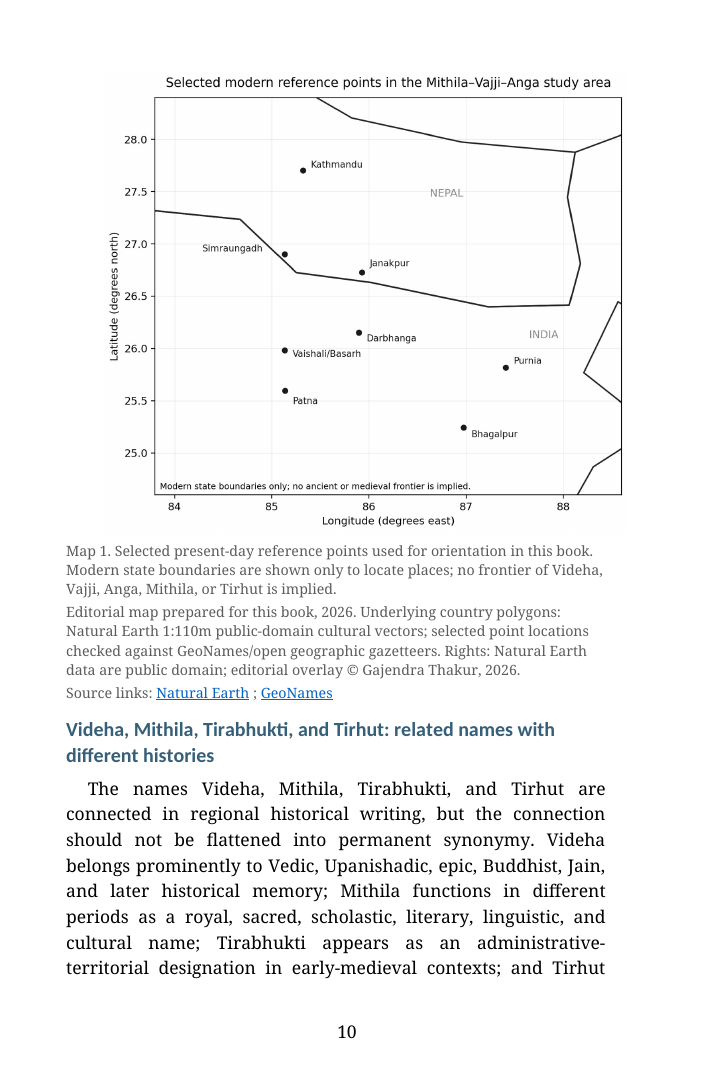
Mithila · Vajji · Anga
Chapter-specific source notes
- Primary chapter witness. Gajendra Thakur, Decoding the Panji of Mithila — Volume IV, formal Chapter 23, PDF pp. 264-274; formal Chapter 23. The HTML transcription is generated from the commit-pinned source PDF and retains the chapter boundary recorded in this edition.
- Internal structure. The repository source-heading inventory records 9 subordinate headings for this chapter: “23.1 Scope of This Chapter”; “23.2 Entries (110), (111), and (112): Jamuni to Ehu Continued”; “23.3 Entry (113) and Entry (114): Jamuni to Gamail and the Rikta Marker”; “23.4 Entry (115) and Entry (116): Pachahi to Barha and the Panni Rikta”; “23.5 Entry (117): Kanhauli to Dhanga and the Soderpur Frame”; “23.6 Entries (118), (119), (120), (121), (122), and (123): Kanhauli to Mangrauni”; “23.7 Entry (124): Kanhauli to Pindaruch”; “23.8 Entries (125), (126), (127), (128), (129), (130), and (131): The Mahiya-Soderpur Register”; ….
- Digital editorial method. The page keeps the preserved source text distinct from generated navigational, concordance, visual, and provenance apparatus. The synthetic reconstruction is explanatory only and is not evidence for an individual lineage or a determination of social or marital status.