Decoding the Panji of Mithila · Volume IV · Chapter 24
Hasauli, Hati, Digaun, Raiyam, and the Return to Sarisab: Soderpur Registers after Mahiya
Chapter 24
Hasauli, Hati, Digaun, Raiyam, and the Return to
Sarisab: Soderpur Registers after Mahiya
This chapter continues the Nagram decoding after the
Mahiya material completed in Chapter 23. Its exclusive source
span is entries (132) through (152). It does not treat the next
entry, (153), beyond noting that the following chapter should
begin there. The internal movement is important: the source
leaves Mahiya with a rikta marker, opens Hasauli as a
Soderpur gramaram bha, proceeds through Hati, Digaun, and
Raiyam as Soderpur registers, and then returns to Sarisab in a
Soderpur register-form. The chapter therefore has to be read
as a Soderpur-controlled sequence rather than as a collection
of isolated village notes.
The editorial problem in this span is not simply the number
of names. It is the presence of several formal gramaram bha
openings, several modern professional additions, one or more
explicitly empty entries, and repeated cross-village marriage-
route formulae. The decoding below preserves those
differences. A formal village-register opening is treated as a
new village node; a rikta entry is retained as a numbered but
empty slot; and modern titles such as Dr., Prof., M.M., M.B.B.S.,
and university or professional identifiers are treated as
indexable status markers rather than as decorative additions.
24.1 Entry (132): The Mahiya Residue and a Rikta
Slot
Entry (132) is headed “Mahiya se” and is marked rikta. It
belongs structurally to the Mahiya block that precedes it, but
no lineage text is preserved under it in the present source.
Because the entry has its own number and its own empty
status, it must be carried into the final appendix of rikta
entries. It should not be merged with the preceding Mahiya-to-
Pachahi entry, and it should not be silently omitted.
The genealogical meaning of the rikta marker is modest but
important: the compiler preserved the existence of a slot in
the sequence but did not preserve, or did not copy, the
associated details. This is exactly the sort of blank that later
index users need to see, because a missing entry can
otherwise be mistaken for an editorial gap in this book rather
than a gap already present in the transmitted Panji material.
24.2 Entries (133) and (134): Hasauli-Soderpur,
Tharhi, Chakauti, and the Modern Addendum
Entry (133) opens formally: “atha Hasauli Soderpur
gramaram bha.” This heading defines Hasauli as a Soderpur
village-register beginning. The entry begins with Bhavan and
his son Lal, then opens lateral sons such as Chanchal and Babu
or Chandradatt and Ganeshdatt. The formulae continue in the
usual Panji manner: each son or branch is followed by
marriage or affiliational links through Mandar, Khoa l,
Darihara, Jajival, Naruar, Karamaha, Pali, and Pabouli. The
line also contains forms such as Babu-pr., Jangi-pr.,
Maheshdatt, Mahadevdatt, Dinanath, Radhakant, and
Lakshmikant. These are not to be flattened into a single list:
they are branch-holders within the Hasauli opening.
The first Hasauli entry also shows how abbreviations carry
identity. The repeated “pr.” probably marks a popularly used
or alternative name. Therefore “Babu pr. Chandradatt” and
“Jangi pr. Maheshdatt” should be indexed under both the
formal and the practical names. The line also preserves
learned-status memory through M.M. Theghu, M.M.
Chitradhar, and related references. These must be placed in
the title/status index, because the Nagram Panji often uses
learning and office titles as identifiers when the personal
name alone is insufficient.
Entry (134) continues Hasauli but gives a more specific
route: Hasauli to Tharhi, with Bokai Jha, Chakauti, and Lootan
Jha. The branch turns around Kali, Krishnadatt-pr. Bokai,
Suresh, Ganeshdatt, Gauridatt, Hanumandatt, Shridatt,
Lootan, and Jagyapati. It also contains an important
modernizing addendum after the Hasauli-Soderpur line. The
addendum names Sonelal, Ghanshyam, Sri Nandan, Devendra,
Indrakant, Chandrakant, Dr. Shashikant, Dr. Gaurikant,
Maheshkant, Dr. Abhaykant, Mayank, Sarita, and a further
chain through Gajraj Chaudhary, Indrajit, Madhusudan,
Gulan, Upendranarayan, and Dr. Ramesh Kumar. This passage
must be carried as a later family continuation, not treated as a
scribal intrusion, because it is introduced under the same
Hasauli-Soderpur heading and gives living or recent
genealogical extensions.
In index terms, Hasauli is not separately visible in the
earliest moolgram list available in the control index, but the
source itself explicitly places it under Soderpur. The final
place index should therefore list Hasauli with the note
“Soderpur register in source,” while also indexing Tharhi,
Chakauti, and Nagram as route or settlement markers
attached to the Hasauli branch.
24.3 Entries (135), (136), (137), and (138): Hati-
Soderpur, Kailakh, Amoun, and a Rikta Closure
Entry (135) opens “atha Hati Soderpur gramaram bha.” This
is a second formal Soderpur opening in the chapter. The line
begins from Uttam and then branches through Bhushan and
Abhiram. Bhushan leads to Atmaram and Chhotkani;
Chhotkani leads to the sataranjbaj Babu Nath; and Babu Nath
leads to Divakar and Prabhakar. Abhiram brings in Budhan-
pr. Chhatrapati, Keshav, Madhusudan, Babunandan,
Prabhunandan, Yadunandan, Manohar, and related children.
The recurring links to Baliyas, Budhwal, Fanandah, Khoa l,
Harhiamb, Khandbala, Pandua, Pali, Pabouli, and Soderpur
show that Hati is being mapped through the same inter-village
marriage grammar as the preceding Hasauli material.
Entry (136) gives Hati to Kailakh and names Prabhu Mishra,
Amoun, and Katihar. It is not merely a continuation of Hati; it
is a route-specific branch. Prabhunandan, Bhavdatt,
Mahopadhyay Madhusudan, Raghunandan, Srinandan,
Girinandan, Shivanandan, Bhavanandan, Ganganand, Boku,
Markandey, Shivanandan, and Devanand appear in the
sequence. The heading’s reference to Amoun and Katihar is
important for the geographical index because it pushes the
Hati-Soderpur line outward from the older village register
toward eastern and modern administrative spaces.
Entry (137) continues Hati without a new destination in the
heading. It begins with Rameshwar and includes
Modanarayan, Burju, Gunanidhi, Mayanidhi, Babura-pr.
Khadganarayan, Lal, Gopal, Mukti Nath, Achamit, Balbhadra,
Krishnamohan, Gunanidhi, Dayanidhi, Bhujanidhi, and
Ghanshyam. The entry shows a denser network of nested
descendants, but the controlling village remains Hati. Entry
(138), headed Hati and marked rikta, closes the Hati block
with a numbered empty place. Like entry (132), it should be
retained in the rikta appendix.
The control index confirms Hati as part of the Soderpur
cluster. For this reason, Hati should be indexed both as a
source village-register opening and under the Soderpur
moolgram frame. Hati to Kailakh and Hati to Amoun/Katihar
should then appear as subroutes rather than as independent
mool entries.
24.4 Entries (139), (140), (141), and (142): Digaun-
Soderpur, Nahar-Nagram, and Dath
Entry (139) opens “atha Digaun Soderpur gramaram bha”
and also names Nahar and Nagram. The source gives a branch
reference, “276/3,” and then begins with Bechu-pr. Hiranand.
The descendants and collateral branches include Pakhiya,
Kachchu, Vanshidhar, Rupnath, Hridaynath-pr. Shyamnath,
Maniknandan, Modanand, Vidyanand, Nityanand, Jivanand,
Jyotishi Bachanand, Sachanand, Indranand, Jayanand,
Taranand, Sitanand, Dayanand, Vakil Shankaranand,
Chaturanand, Kalikanand, Kamaravyanand, and others. The
entry is one of the most status-rich passages in this chapter,
because it includes Jyotishi, Vakil, and a political notation for
Shankaranand as C.P.M. (M.P.).
Entry (140) continues the Digaun section. It carries forward
Ambikanand, Vivekanand, Sachanand, Indranand,
Shobhanand, Ghananand, Chandranand, Jayanand,
Gokulanand, Modanand, Madhusudan-pr. Baidyanath, Kedar,
and Achyutanand-pr. Sadanand. The source is partly
suspended at the end of the entry, which is why the next entry
begins by completing the line through Darihara and Budhwal.
Entry (141) continues Digaun through Kamalpani, Pyare,
Kachchu, Batahuk, Vanshidhar, Rupnath, Hridaynath-pr.
Shyamnath, Gopal, Harijiv, Rameshwar, Lochan, Jayshiv,
Nehal, Prem, Mansukh, Thothi, and Tejnath. Entry (142) then
gives Digaun to Dath. It continues through Nathe, Jalpada tt,
Thothi, Raghuvir, Janardan-pr. Parbhu, Tejnath, Prem, Badan,
Grihimani, Mansukh, Gehnath, Lal, Gangadhar, and Lochan.
The Dath heading must be indexed as a route marker inside
the Digaun-Soderpur block.
The index explicitly includes Digaun under Soderpur, so the
Digaun entries are not to be reassigned to the earlier Sarisab
or Khangur sections merely because Sarisab appears
repeatedly in marriage formulae. The distinction is between
the register-opening village, which is Digaun-Soderpur, and
the marriage-route villages that follow within each branch.
24.5 Entries (143), (144), (145), (146), (147), (148),
(149), and (150): Raiyam-Soderpur and the
Rajhara Modern Layer
Entry (143) opens “atha Raiyam Soderpur gramaram bha”
and is headed Raiyam to Kailakh, naming Shivkumar Mishra
of Hemnagar in the Dharmapur country. The source begins
with Chalbali and Babunath, then gives Chhotkinma, Bachchu,
Premnidhi, Bhaiya-pr. Dayanidhi, Mohan, Kanhai, and a line
through Babunath, Babulal, Dukrawa, Hari, Bhutti, Murari,
and Shivkumar. The modern continuation through
Shivkumar, Dilip, Vinod, and Sirsia is especially important
because it links the older Raiyam register to recent named
individuals and settlements.
Entry (144) continues Raiyam. It gives Dukrawa, Bachcha,
Bachnu, Bua, Ramchandra, Krishnachandra, Ganeshchandra,
Hari, and the larger Chhotkinma branch through Giridhari,
Brajvihari, Luche-pr. Raskari, Kunj Bihari, Babu an-pr. Awadh
Bihari, and others. The entry contains multiple broken or
suspended clauses, but the relationship-chain is still
recoverable because the repeated “suta/suto” grammar keeps
the descent sequence visible.
Entry (145) is headed Raiyam to Ramnagar-Mangrauni. It
continues the Luche-pr. Raskari line through Gopal, Lalji,
Dukhmochan, Yadunandan, Mahavir, Anant, Ugramohan,
Jagatanand, Lakshmikant, Umakant, Kunj Bihari, Bachchu,
Badan, Shivanandan, Harsamani, Premnidhi, Dayanidhi,
Chandramani, Mohan, Bholanath, and Baidyanath. Entry
(146), another Raiyam continuation, carries Bholanath
through Bechan, Vishwanath, Adinath, Rabadganath, Nehnath,
Hari, Bhavanand, Ramanand, and a later Shaktiraypur-Naruar
branch.
Entry (147) gives Raiyam to Satlakha-Ganjhara. It continues
through Hibhiran, Bhuvaneshwaridatt, Parameshwaridatt,
Lakshmidatt, Venidatt, Ramanand, Haranand, Haranand’s
later line, Harinandan, Trilochan, Chhota, Indrapati, Bhikhiya,
Shambhunath, Apuchh, Durgadatt, Kamaladatt-pr. Kalikadatt,
and Kapiladatt. Entry (148) gives Raiyam to Rajhara and
names Bhagwandatt, Ganeshdatt, Damodar, M.M. Jayadev,
Madhusudan, M.M. Dr. Umesh, Ramesh, Prof. Jayakant, Prof.
Krishnakant, Vijaykant, Prabhakant, and Prof. Sudhakant. The
phrase identifying Prof. Jayakant as a writer of the history of
Maithili literature must be retained as a title/status note
because it identifies a scholarly role in the modern layer of the
Panji.
Entry (149) continues Raiyam-Rajhara through Sudhakant,
Ramesh, Jaynandan, Raghunandan-pr. Hiraji, and Srikrishna.
Entry (150), also Raiyam to Rajhara, is marked rikta. It closes
the Raiyam block with a numbered empty entry. The final
index should therefore contain Raiyam-Kailakh, Raiyam-
Ramnagar-Mangrauni, Raiyam-Satlakha-Ganjhara, Raiyam-
Rajhara, Hemnagar, Dharmapur, and Sirsia as place or route
markers, and should place Dr., Prof., M.M., ex-university office,
and writer-status entries under the title index.
24.6 Entries (151) and (152): Sarisab-Soderpur,
Betia, Ranipur, and Pilkhwar
Entry (151) begins “atha Sarisab Soderpur gramaram bha”
and is headed Sarisab to Betia country, Ranipur. This heading
is genealogically delicate. Sarisab has already functioned
elsewhere as a major mool with Khangur, Sakuri, and Jonki
under it, but the present source also opens a Sarisab-Soderpur
register. The editorial solution is to preserve both levels:
Sarisab as a major mool in the general index, and Sarisab-
Soderpur as the immediate register label for this chapter’s
entries.
The entry begins from Mahinath and names Phul and
Sheshadhar. Phul leads to Gadadhar, Vidyadhar, and
Dayadhar. Gadadhar leads to Ramdatt and Shitaladatt; then
the line moves through Shridhar, Bawan, Ramkumar,
Bachharan, Sadhu, Kali Kumar, Shri Kumar, Prasanna Kumar,
Naveen Kumar, Chiranjeev, Prajapati, Pitambar, and other
descendants. Modern professional notations are again present,
including M.B.B.S. for Shri Kumar. These should not be
discarded, because they help identify twentieth-century or
later continuations of the older Sarisab-Soderpur lineage.
Entry (152) continues Sarisab to Ranipur and Pilkhwar. It
begins by completing the preceding line through
Pabouli/Baliyas and then gives Pitambar, Vinod Kumar,
Shridhar, Narayandatt, Upendra Kumar, Bhupendra Kumar,
Vidyadhar, Hanuman, Gopal, Dayadhar, Sheshadhar,
Kauskidatt, Gulab, Ghanshyam, Bandhu, Jivan, Kirtinath,
Lakshman, Chhotka, Faturi, and Kuli. This entry closes the
chapter’s Sarisab-Soderpur material and sets up the next
entry, (153), which begins a new Sarisab-Rashadh heading.
24.7 Index Logic for Chapter 24
The controlling index logic is Soderpur. The Genome
Mapping index places Soderpur with Sarisab, Digaun,
Kanhauli, Hati, and related villages. Therefore Hasauli, Hati,
Digaun, Raiyam, and Sarisab in this chapter should be read as
register openings under or alongside the Soderpur frame,
according to the source’s own headings. Hati and Digaun are
explicitly supported by the index; Raiyam also appears as a
Soderpur-linked indexed item. Sarisab requires dual indexing
because it is both a major mool elsewhere and a Soderpur
register in the present source span.
The chapter also shows how modern professional titles
enter the Panji. Dr., Prof., M.M., Mahopadhyay, Jyotishi, Vakil,
M.B.B.S., and university-related notations do not change the
descent grammar, but they are crucial identity markers. They
should be indexed under a title/status appendix while the
same person is also retained in the personal-name index.
24.8 Coverage Matrix
Entries Register / route Main names and Index control Editorial action
nodes
132 Mahiya No preserved Mahiya residue Carry as rikta
lineage under the
numbered slot
133-134 Hasauli-Soderpur; Bhavan, Lal, Source-defined Index Hasauli and
Tharhi; Chakauti Chanchal, Soderpur register modern addendum
Chandradatt, separately
Ganeshdatt, Bokai,
Lootan, Sonelal,
Devendra, Dr.
Shashikant, Dr.
Gaurikant, Dr.
Abhaykant
135-138 Hati-Soderpur; Uttam, Bhushan, Hati under Entry 138 to rikta
Hati-Kailakh; Abhiram, Soderpur appendix
Amoun/Katihar Atmaram,
Chhotkani, Babu
Nath,
Prabhunandan,
Madhusudan,
Devanand,
Rameshwar,
Gunanidhi
139-142 Digaun-Soderpur; Bechu/Hiranand, Digaun under Preserve
Nahar/Nagram; Pakhiya, Kachchu, Soderpur professional and
Dath Vanshidhar, political markers
Vidyanand,
Nityanand, Jyotishi
Bachanand, Vakil
Shankaranand,
Jalpada tt
143-150 Raiyam-Soderpur; Chalbali, Raiyam linked to Entry 150 to rikta
Kailakh; Babunath, Soderpur in index appendix; titles to
Mangrauni; Shivkumar, Dilip, status index
Satlakha-Ganjhara; Vinod, Dayanidhi,
Rajhara Mahavir, M.M.
Jayadev, Dr.
Umesh, Prof.
Jayakant, Prof.
Krishnakant
151-152 Sarisab-Soderpur; Mahinath, Phul, Sarisab dual: Retain both levels
Betia/Ranipur; Sheshadhar, major mool and in final index
Pilkhwar Gadadhar, Soderpur register
Vidyadhar, here
Dayadhar,
Shitaladatt, Shri
Kumar M.B.B.S.,
Pitambar, Vinod
Kumar,
Narayandatt
24.9 Index Items to Carry Forward
Place and route index:
Mahiya; Hasauli; Tharhi; Chakauti; Nagram; Hati; Kailakh;
Amoun; Katihar; Digaun; Nahar; Dath; Raiyam; Hemnagar;
Dharmapur; Sirsia; Ramnagar; Mangrauni; Satlakha;
Ganjhara; Rajhara; Sarisab; Betia; Ranipur; Pilkhwar.
Soderpur as the controlling frame for Hasauli, Hati, Digaun,
Raiyam, and the Sarisab-Soderpur register in this chapter.
Kailakh appears in both Hati and Raiyam routes and should
therefore be cross-referenced by route, not collapsed into a
single family line.
Personal-name index:
Hasauli: Bhavan, Lal, Chanchal, Chandradatt, Ganeshdatt,
Jangi, Maheshdatt, Mahadevdatt, Dinanath, Radhakant,
Lakshmikant, Bokai, Suresh, Gauridatt, Shridatt, Lootan,
Sonelal, Ghanshyam, Sri Nandan, Devendra, Indrakant,
Chandrakant, Shashikant, Gaurikant, Maheshkant,
Abhaykant, Mayank, Sarita, Ramesh Kumar.
Hati: Uttam, Bhushan, Abhiram, Atmaram, Chhotkani, Babu
Nath, Divakar, Prabhakar, Chhatrapati, Keshav, Madhusudan,
Babunandan, Prabhunandan, Yadunandan, Bhavdatt,
Mahopadhyay Madhusudan, Raghunandan, Srinandan,
Ganganand, Markandey, Devanand, Rameshwar,
Modanarayan, Gunanidhi, Mayanidhi.
Digaun: Bechu/Hiranand, Pakhiya, Kachchu, Vanshidhar,
Rupnath, Hridaynath/Shyamnath, Maniknandan, Modanand,
Vidyanand, Nityanand, Jivanand, Jyotishi Bachanand,
Sachanand, Indranand, Jayanand, Taranand, Vakil
Shankaranand, Chaturanand, Jalpada tt, Raghuvir,
Janardan/Parbhu.
Raiyam: Chalbali, Babunath, Chhotkinma, Bachchu,
Premnidhi, Dayanidhi, Shivkumar, Dilip, Vinod, Dukrawa,
Giridhari, Brajvihari, Kunj Bihari, Yadunandan, Mahavir,
Dukhmochan, Lakshmikant, Umakant, M.M. Jayadev, Dr.
Umesh, Ramesh, Prof. Jayakant, Prof. Krishnakant, Vijaykant,
Prabhakant, Prof. Sudhakant.
Sarisab-Soderpur: Mahinath, Phul, Sheshadhar, Gadadhar,
Vidyadhar, Dayadhar, Ramdatt, Shitaladatt, Shridhar,
Ramkumar, Sadhu, Kali Kumar, Shri Kumar, Prasanna
Kumar, Naveen Kumar, Pitambar, Vinod Kumar,
Narayandatt, Upendra Kumar, Bhupendra Kumar, Kauskidatt,
Gulab, Bandhu, Jivan, Kirtinath, Lakshman, Faturi, Kuli.
Rikta appendix:
Entry (132), Mahiya se, rikta.
Entry (138), Hati se, rikta.
Entry (150), Raiyam to Rajhara, rikta.
Title/status index:
M.M. / Mahamahopadhyay / Mahopadhyay references in
Hasauli, Hati, and Raiyam.
Jyotishi Bachanand in the Digaun block.
Vakil Shankaranand and the C.P.M. (M.P.) marker in the
Digaun block.
Dr. Shashikant, Dr. Gaurikant, Dr. Abhaykant, Dr. Umesh,
Prof. Jayakant, Prof. Krishnakant, Prof. Sudhakant, and
M.B.B.S. Shri Kumar in the modern extensions.
24.10 Transition to the Next Chapter
This chapter stops before entry (153). The next chapter
should begin with Sarisab to Rashadh, where Keshavnath
Mishra and Shivnagar Khagnath Mishra open the next
Sarisab-centered unit. That next entry should not be backfilled
into the present chapter because the present chapter’s
editorial function is to close the Soderpur sequence from
Mahiya through Hasauli, Hati, Digaun, Raiyam, and the first
Sarisab-Soderpur register.Source structure and verification apparatus
Editorial source apparatus. This apparatus is descriptive, not interpretive. It records the source-controlled structure used to verify that this page corresponds to formal Chapter 24 of Decoding the Panji of Mithila — Volume IV. The chapter text above is preserved from PDF pp. 275-286; formal Chapter 24 in the commit-pinned authoritative source. It is not merged with a neighboring chapter, appendix, annexure, or independent front/back-matter unit. The internal headings below come from the repository’s source-heading inventory and are retained as navigational and audit evidence; showing them here does not turn those headings into separate publications or add claims that are absent from the source.
Internal source headings
- 24.1 Entry (132): The Mahiya Residue and a Rikta Slot
- 24.2 Entries (133) and (134): Hasauli-Soderpur, Tharhi, Chakauti, and the Modern Addendum
- 24.3 Entries (135), (136), (137), and (138): Hati-Soderpur, Kailakh, Amoun, and a Rikta Closure
- 24.4 Entries (139), (140), (141), and (142): Digaun-Soderpur, Nahar-Nagram, and Dath
- 24.5 Entries (143), (144), (145), (146), (147), (148), (149), and (150): Raiyam-Soderpur and the Rajhara Modern Layer
- 24.6 Entries (151) and (152): Sarisab-Soderpur, Betia, Ranipur, and Pilkhwar
- 24.7 Index Logic for Chapter 24
- 24.8 Coverage Matrix
- 24.9 Index Items to Carry Forward
- 24.10 Transition to the Next Chapter
Source-text concordance
Hasauli · Hati · Digaun · Raiyam · Return · Sarisab · Soderpur · Registers · Mahiya · continues · Nagram · decoding · material · completed · exclusive · span · entries · treat · next · entry · beyond · noting · following · begin · internal · movement · important · leaves · rikta · marker · opens · gramaram · proceeds · returns · register-form · therefore · read · Soderpur-controlled · sequence · rather · collection · isolated · village · notes · editorial · problem · simply · number · names · presence · several · formal · openings · modern · professional · additions · explicitly · empty · repeated · cross-village · marriage · route · formulae · preserves · differences · village-register · opening · treated · node · retained · numbered · slot · titles · Prof · university · identifiers · indexable · status · markers · decorative
Boundary verification. In the formal sequence this chapter follows Volume IV Chapter 23, “Jamuni, Pachahi, Kanhauli, and Mahiya: From the Jajival Register to the Soderpur-Kanhauli and Mahiya Lines” and precedes Volume IV Chapter 25, “Sarisab, Gaur, Bali, Jagaur, and Khori: Soderpur Registers before Sukhet”. The chapter extractor begins at the verified formal Chapter 24 marker and stops at the next verified formal chapter marker; for a final chapter it stops before recognized book-level back matter. The concordance above is generated only from distinct terms already present in this chapter’s preserved source text. It is provided for discovery, comparison, and audit, not as an automated judgment about persons, lineages, status, kinship, marriage eligibility, or historical truth.
Illustrated research apparatus
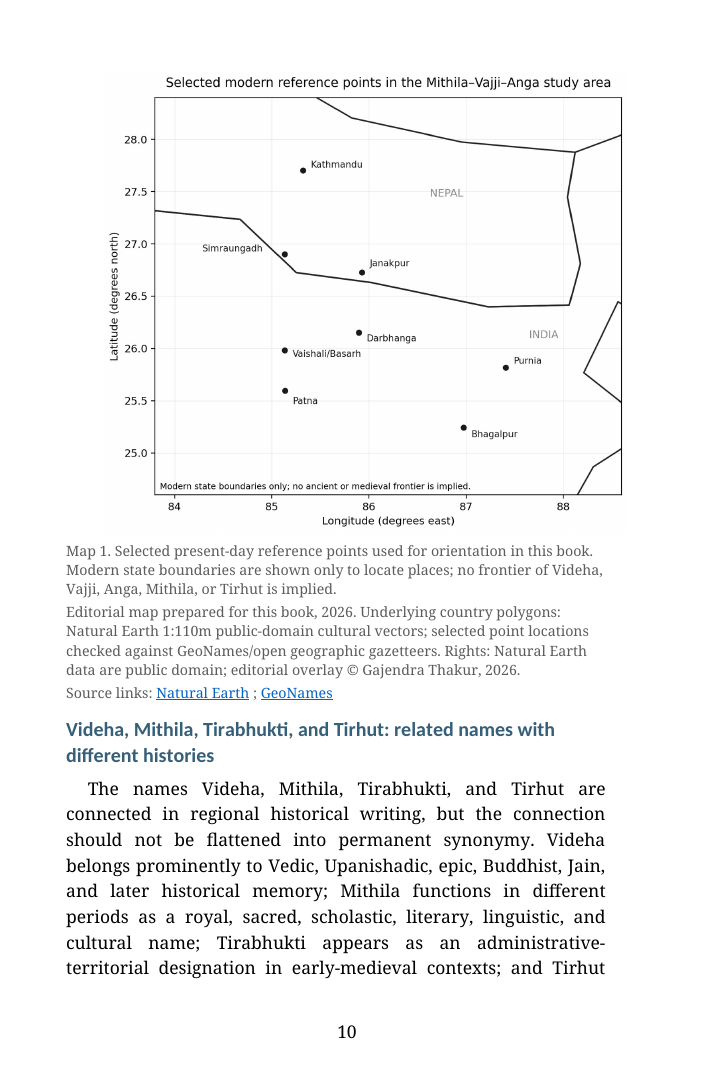
Mithila · Vajji · Anga
Chapter-specific source notes
- Primary chapter witness. Gajendra Thakur, Decoding the Panji of Mithila — Volume IV, formal Chapter 24, PDF pp. 275-286; formal Chapter 24. The HTML transcription is generated from the commit-pinned source PDF and retains the chapter boundary recorded in this edition.
- Internal structure. The repository source-heading inventory records 10 subordinate headings for this chapter: “24.1 Entry (132): The Mahiya Residue and a Rikta Slot”; “24.2 Entries (133) and (134): Hasauli-Soderpur, Tharhi, Chakauti, and the Modern Addendum”; “24.3 Entries (135), (136), (137), and (138): Hati-Soderpur, Kailakh, Amoun, and a Rikta Closure”; “24.4 Entries (139), (140), (141), and (142): Digaun-Soderpur, Nahar-Nagram, and Dath”; “24.5 Entries (143), (144), (145), (146), (147), (148), (149), and (150): Raiyam-Soderpur and the Rajhara Modern Layer”; “24.6 Entries (151) and (152): Sarisab-Soderpur, Betia, Ranipur, and Pilkhwar”; “24.7 Index Logic for Chapter 24”; “24.8 Coverage Matrix”; ….
- Digital editorial method. The page keeps the preserved source text distinct from generated navigational, concordance, visual, and provenance apparatus. The synthetic reconstruction is explanatory only and is not evidence for an individual lineage or a determination of social or marital status.