Decoding the Panji of Mithila · Volume IV · Chapter 26
Sukhet, Katka, and Rohar: Soderpur Registers from Lagama to Kachhuwa
Chapter 26
Sukhet, Katka, and Rohar: Soderpur Registers from
Lagama to Kachhuwa
This chapter continues the cumulative Volume IV decoding
from the point deliberately reserved at the end of Chapter 25. Its
exclusive source span is entries (170) to (185). It begins with the
formal Sukhet-Soderpur opening, moves into the Katka-Soderpur
register, and then carries the Rohar-Soderpur material through
Kachhuwa, Bhawanipur, and Nagram-linked continuations. Entry
(186), the Pachadhi gram opening, is not decoded here and is
reserved for the next chapter.
The common editorial problem in this span is not the absence
of structure, but the compression of too many route clues into
long genealogical sentences. The source repeatedly uses formulae
such as “atha Sukhet Soderpur gramaram bha,” “atha Katka
Soderpur se gramaram bha,” and “atha Rohar Soderpur se
gramaram bha.” These formulae are not ornamental. They
establish the register frame under which the personal names,
marriage routes, professional titles, and village migrations must
be indexed.
A second feature of the span is the density of modern and late-
modern status markers. Sukhet includes numbered Nagram-style
references and title-like abbreviations; Katka includes
Mahamahopadhyay, doctor, judge, ministerial, and legal/medical
markers; Rohar preserves both older kinship formulae and
modern bureaucratic or scholarly references. For the final index,
these must be separated from the genealogical names: a name
may be indexed as a person, a title-marker, and a route node at
the same time.
26.1 Entries (170) and (171): Sukhet-Soderpur,
Lagama, and the Krishna-Named Expansion
Entry (170) begins with the formal Sukhet-Soderpur opening.
The source introduces Sukhet with Lagama and the numbered
markers “mo. na. sha.” and “a.mu. sha.” The principal line begins
with Mahogoi, then moves through Kalakrishna-pr. Bachanu,
Machal, and Lochana. The first editorial action is to treat Sukhet
as a Soderpur register, not as a free-standing isolated village note.
The entry then gives a large son-sequence under Machal:
Hemkrishna-pr. Bathan, Totakrishna, Pitambar, Vaidya Ratan,
Chhatrapati, Babue, Vanshidhar, Shivkrishna, and Navakrishna.
The marriage or affiliation routes attached to this line include
Darihara, Harijiv, Rohini, Hariamb, and Hridayaram. These
routes show the older Panji grammar of linking a personal line to
a moolgram route by the formula “X se Y sut Z dau.”
The same entry continues through Bachchu-pr. Hitakrishna
and then through Rudrakrishna, Udayakrishna, Indrakrishna,
Yogakrishna, and Ugrakrishna. The repeated Krishna names are
not accidental repetition. They form the internal naming spine of
this Sukhet branch, and therefore the final index should not
collapse them under a single “Krishna family” heading. Each
form must be carried separately, with cross-references to Sukhet-
Soderpur and Lagama.
Entry (171), headed Sukhet, continues the same source family.
Yogakrishna gives Balakrishna and Gopalkrishna; Ugrakrishna
gives Gopikrishna, Vijaykrishna, Pramodkrishna, and related
descendants. The entry also names Prakashkrishna, Abhimanyu,
Yogendra, Dighosh, Bhavesh, Pandua, Modanand, Vidyanand,
Phanandah, and Indramani-pr. Bhola. The end of the entry is
broken in the source, but the line clearly remains Sukhet-linked
and should be indexed under the same Soderpur control.
The crucial point for this pair of entries is that Sukhet is an
active register opening. It should not be treated as an appendix to
the previous Khori material. The chapter therefore starts a new
index run at entry (170), with Sukhet, Lagama, Mahogoi,
Kalakrishna, Bachanu, Machal, and Lochana as the first carried-
forward items.
26.2 Entries (172) and (173): Katka-Soderpur and the
Parasharma/Supaul Branch
Entry (172) opens with the formula “atha Katka Soderpur se
gramaram bha.” This makes Katka a Soderpur-controlled register
for the purposes of Volume IV. The entry begins with Gonu,
whose sons include Umapati and Jyotishi Bhairavdatt. It then
moves through Babunandan, Bhuvanandan, Gangaram, Bhairav,
Ramakant, Gopikant, Narhari, Garibnath, Bhulan, Venidatt,
Nidhi, and related lines.
The main editorial difficulty in entry (172) is that several apra
or apar lines are embedded in a single paragraph. Babunandan’s
descendants take routes through Pali, Sarisab, Khoa l, Darihara,
Baliyas, Pabouli, Ghusaut, and other nodes. Gangaram’s line adds
Phanandah and Sakararhi, while Narhari’s branch moves
through Garibnath, Bhulan, Vaidyanath, Ramkrishna,
Chintamani, and Venidatt. These routes require entry-level sub-
indexing rather than a single Katka heading.
Entry (173) moves Katka to Parasharma, marked with Supaul.
The line continues through Venidatt’s Bhailal, Bhulan, Lakshman,
Pritam, Jaydev, Mahesh, Bholanath, Babunath, Matinath,
Shyamnath, Harinath, Nenan, Vaidya Jasu, and their routes. The
phrase “Parasharma (Supaul)” should be preserved as a
geographical note, because it distinguishes this branch from the
later Katka routes to Motipur, Pilkhad, and Pratapur.
The Parasharma entry includes a useful warning for the
indexer: the same names recur in other registers, but here they
belong to the Katka-Soderpur frame. Bholanath and Harinath
should not be merged with namesakes in Sarisab or Khori. They
should be indexed with the route tag
“Katka-Parasharma/Supaul.”
26.3 Entries (174) to (179): Katka to Motipur, Pilkhad,
Pauna, and Pratapur
Entry (174), headed Katka to Krailakh/Motipur, begins with
Purandar and then Dharani, Pashupati, Janardan, Kamalnayan,
Jaykrishna, Gokulnath, Dullah, Balha, Manruchi, Giridhari,
Jyotishi Babua, Aniruddha, Jaydev, Harinath, Bhavnath,
Narendra, Devendra, Vijayendra, Shailendra, and Dwijendra.
This is one of the densest entries in the chapter and contains
several modern markers: doctor, M.B.B.S., M.D., judge, high court,
state minister, and administrative-political references.
For editorial purposes, entry (174) must be split into three
index layers. The first layer is the older genealogical sequence
under Purandar. The second layer is the route layer: Pali,
Satlakha, Mandar, Soderpur, Pabouli, Hariamb, Pandua, and
allied moolgram names. The third layer is the modern status
layer: Doctor Mohan, M.B.B.S., M.D.; the high court chief justice
reference; and the ministerial note attached to Aniruddha. None
of these status labels should replace the person’s genealogical
placement.
Entry (175) continues Katka through Krailakh/Motipur and
Satlakha-Naksari. It includes Narendra, Yoginath, Balha, Jalpade,
Faturi, Kalar, Manruchi, Gokulnath, Shambhunath, Ratinath,
Janardan, Shobhan, Vaishnav, Kala, Ratish, Dukhia, Amritnath,
Mandhan, Mahadhan, Haladhar, Sonay, and related routes. The
entry’s repeated use of apra lines requires a careful branch
register: Balha, Jalpade, and Faturi should be treated as separate
descent nodes rather than as one continuous undivided string.
Entry (176), Katka to Pilkhad, moves through Sarisab-linked
Guninidhi, Krishnadatt, Kalar, Brahmadatt, Badari, Dullah, Lalit,
Harshadatt, Kanhai, Kashi Nath, Vaidyanath, Bandhu, Basawan,
Saburdatt, Parashmani, Vaiju, Vishwanath, Harinath, Musahar,
Gatinath, Umanath, Taranath, Ramanath, Kalanath, and related
names. Pilkhad appears here as a route destination inside the
Katka register; it is not the earlier Pilkhwar branch of Khangur or
Sarisab.
Entry (177), Katka to Pilrawad/Pauna, continues from
Parashmani and includes Bhagwandatt, Jagdatt, Manmohan,
Vishnupati, Umanath, Shivdatt, Dayaram, Kodai, Thakurdatt,
Dharanath, Dwarikanath, Musan, Govind, Bachanu, Dullah,
Shambhudatt, Mani, Hira, and several apra lines. Pauna should
be carried as a place note, while Pilrawad/Pilkhad should be
cross-referenced to avoid confusion with Pilkhwar.
Entries (178) and (179), Katka to Pratapur, complete this Katka
block. Entry (178) runs through Dullah, Kamaladatt, Babujan,
Nanu, Bandhu, Sahib, Jahal, Basan, Dharmadatt, Binu, Ishanath,
Dinanath, Gudar, and related descendants. Entry (179) continues
the same Pratapur block with Sarisab-Tilkeshwar, Sonay,
Raghuram, Dubari, Indramani, Poshan, Hanumandatt,
Vidyanath, and related apra lines. The correct editorial action is
to close the Katka block after entry (179), because entry (180)
opens a new Rohar-Soderpur register.
26.4 Entries (180) to (185): Rohar-Soderpur,
Kachhuwa, Bhawanipur, and Nagram
Entry (180) opens the Rohar-Soderpur register, headed Rohar
to Kachhuwa with Shivnand Mishra. The line begins with
Pashupati and then Lal, Madhav, Shyamram, Manik, Sanath,
Nehal, and several Mishra lines. The source also names Haringi,
Matinath, Durga Datt, Uma, Ram, Nawab Maharaja, Madhusudan,
Shivnand, Gangesh, Hathi, Chandidatt, Parameshwaridatt, and
related descendants.
The entry mixes ordinary lineage names with honorific or
status-inflected labels. “Mishra,” “Nawab Maharaja,” and the
repeated use of title-like personal identifiers should be indexed
as status-bearing descriptors, but the genealogical anchors
remain Pashupati, Lal, Haringi, Matinath, and Madhav. The entry
also carries clear route links to Tisaunt, Mandar, Pali, Sakararhi,
Satlakha, Karamha, Belauch, Sarisab, Baliyas, and Budhwal.
Entry (181), Rohar with Nagram, continues through
Kunjbihari, Rasbihari, Chhatradhari, Giridhari, Brajbihari,
Awadh Bihari-pr. Puna, Harigovind, Pitambar, Vallabh,
Janakinath, Punyanand, Panchanand, Babua-pr. Ramchandra,
Dular Chandra-pr. Umeshchandra, and related lines. The heading
explicitly marks Nagram, so this entry must be cross-indexed
both under Rohar and under Nagram.
Entry (182), Rohar to Kachhuwa, continues the Kachhuwa
frame. It includes Chhavichandra, Manik, Bhairavdatt,
Dharmadatt, Babunath, Pyare, Dayanidhi, Navnidhi, Jaykant,
Sanath, Ugranarayan, Rudramani, Indramani-pr. Bathan,
Radhakant, Kamalakant, Umakant, Gaurikant, Chhotakant,
Krishnadatt, Manoranjan, Gopal, Shrikant, Nehal, Hemnath, Raja,
Muni, and related names. The large cluster should be indexed as
a continuation, not as a separate Kachhuwa family detached
from Rohar.
Entry (183) gives Rohar/Bhawanipur/Kachhuwa/Bhawanipur.
It includes Kalika Prasad, Devi Prasad, Anand Kishor, Yugal
Kishor, Naval Kishor, Girwar Kishor, Nandan Kishor, Parwan
Kishor, Dharmanarayan, Yogindranarayan, Harinarayan,
Subhendra Narayan, Mahendra Narayan, Shobhendra Narayan,
Surendra Narayan, Shailendra, Vijayendra, and several modern
descendants. The repeated Narayan names form the core of the
Bhawanipur continuation and require a separate sub-index.
Entry (184), Rohar to Bhawanipur/Nagram, continues the
Bhawanipur-Nagram line through Upendra Narayan, Ram
Mohan, Shyam Naresh, Naval Kishor, Rajendra Narayan,
Giridhari, Taradatt, Jyotishi Shivnandan, Girwar Kishor,
Nagendra Narayan, Kamal Narayan, Amarendra Narayan, and
Kedar Narayan. The entry uses several Nagram-style numbered
references, which should be kept as source-control markers
rather than silently removed.
Entry (185), Rohar, closes this chapter’s source span. It
includes Nandan Kishor, Jagdish Narayan, Satish Narayan,
Gajendra Narayan, Devendra Narayan, Manik, Bahoran,
Govinddatt, and related routes. Because entry (186) begins a new
Pachadhi gram, the chapter stops here. Rohar’s line has now
moved from Kachhuwa through Bhawanipur and Nagram into a
late branch with several Narayan-name descendants.
26.5 Index Logic for Chapter 26
The primary index control remains Soderpur. Sukhet, Katka,
and Rohar are all treated in the source as Soderpur registers. The
Genome Mapping index separately contains Sukhet-Soderpur,
Katka-Soderpur, and Rohar-Soderpur control references, which
confirms that these are not merely incidental place names.
The chapter also requires strong route discipline. Katka recurs
with Parasharma/Supaul, Krailakh/Motipur, Satlakha-Naksari,
Pilkhad/Pilrawad/Pauna, and Pratapur. Rohar recurs with
Kachhuwa, Bhawanipur, and Nagram. These route labels should
be carried as separate subentries, because collapsing them would
erase the very function of the Panji route formula.
A title/status index is especially important here. Jyotishi
Bhairavdatt, Mahamahopadhyay or M.M. references, Doctor
Mohan, M.B.B.S., M.D., high court chief-justice reference,
ministerial note, Vaidya Jasu, Nawab Maharaja, Jyotishi
Shivnandan, and other titles must be preserved. These labels
record social and educational claims in addition to descent.
26.6 Coverage Matrix
Entry Source unit Primary names / Index logic Editorial action
items
(170)-(171) Sukhet-Soderpur / Mahogoi, Soderpur register; Begin a new
Lagama Kalakrishna-pr. Sukhet-Soderpur chapter span;
Bachanu, Machal, control; Lagama index Krishna-
Lochana, and numbered name sequence
Hemkrishna, markers retained separately
Totakrishna,
Pitambar, Vaidya
Ratan, Chhatrapati,
Rudrakrishna,
Udaykrishna,
Indrakrishna,
Yogakrishna,
Ugrakrishna,
Gopikrishna,
Vijaykrishna,
Pramodkrishna,
Prakashkrishna
(172)-(173) Katka-Soderpur Gonu, Umapati, Katka as Soderpur Separate Katka
Entry Source unit Primary names / Index logic Editorial action
items
and Katka- Jyotishi gram; core from
Parasharma/Supau Bhairavdatt, Parasharma/Supau Parasharma/Supau
l Babunandan, l as route subentry l route
Bhuvanandan,
Gangaram,
Narhari,
Garibnath, Bhulan,
Venidatt, Bhailal,
Lakshman, Pritam,
Jaydev, Mahesh,
Bholanath,
Harinath
(174)-(179) Katka routes to Purandar, Dharani, Katka-Soderpur Close Katka block
Motipur, Naksari, Pashupati, with multiple route at entry (179)
Pilkhad, Pauna, Janardan, destinations and before Rohar
and Pratapur Kamalnayan, modern titles begins
Giridhari, Babua,
Aniruddha, Doctor
Mohan, Devendra,
Vijayendra,
Shailendra, Balha,
Jalpade, Faturi,
Kalar, Gokulnath,
Shambhunath,
Dullah,
Kamaladatt,
Bandhu, Sahib,
Jahal, Binu,
Ishanath,
Raghuram, Dubari,
Indramani
(180)-(185) Rohar-Soderpur, Pashupati, Lal, Rohar as Soderpur Stop at entry (185);
Kachhuwa, Madhav, gram; Kachhuwa, reserve Pachadhi
Bhawanipur, Shyamram, Manik, Bhawanipur, and entry (186) for next
Nagram Sanath, Nehal, Nagram as chapter
Haringi, Matinath, route/branch tags
Shivnand Mishra,
Janakinath,
Punyanand,
Panchanand,
Umeshchandra,
Manik,
Bhairavdatt,
Dharmadatt,
Ugranarayan,
Radhakant, Kalika
Prasad, Anand
Kishor,
Dharmanarayan,
Upendra Narayan,
Rajendra Narayan,
Nandan Kishor,
Gajendra Narayan
26.7 Index Items to Carry Forward
Place and route index:
Sukhet / Sukhait; Lagama; Soderpur; Katka; Parasharma;
Supaul; Krailakh / Kailakh; Motipur; Satlakha-Naksari;
Pilkhad; Pilrawad; Pauna; Pratapur; Rohar; Kachhuwa;
Bhawanipur; Nagram.
Repeated supporting moolgram and route nodes: Pali,
Sarisab, Darihara, Khoa l, Baliyas, Pabouli, Ghusaut,
Sakararhi, Phanandah, Belauch, Hariamb, Budhwal,
Karamha, Jajival, Mandar, Naruan, Pandua, Tisaunt, and
Gangauli.
Soderpur is the controlling frame for Sukhet, Katka, and
Rohar in this chapter. Route destinations should be recorded
under each entry rather than merged by similar place-name
spelling.
Personal-name index:
Sukhet: Mahogoi, Kalakrishna-pr. Bachanu, Machal, Lochana,
Hemkrishna-pr. Bathan, Totakrishna, Pitambar, Vaidya Ratan,
Chhatrapati, Babue, Vanshidhar, Shivkrishna, Navakrishna,
Rudrakrishna, Udaykrishna, Indrakrishna, Yogakrishna,
Ugrakrishna, Gopikrishna, Vijaykrishna, Pramodkrishna,
Prakashkrishna, Abhimanyu, Yogendra.
Katka: Gonu, Umapati, Jyotishi Bhairavdatt, Babunandan,
Bhuvanandan, Gangaram, Bhairav, Ramakant, Gopikant,
Narhari, Garibnath, Bhulan, Venidatt, Nidhi, Bhailal,
Lakshman, Pritam, Jaydev, Mahesh, Bholanath, Harinath,
Purandar, Dharani, Pashupati, Janardan, Kamalnayan,
Giridhari, Babua, Aniruddha, Harinath, Doctor Mohan,
Devendra, Vijayendra, Shailendra, Dwijendra, Balha, Jalpade,
Faturi, Kalar, Shambhunath, Ratinath, Dullah, Kamaladatt,
Bandhu, Sahib, Jahal, Binu, Ishanath, Raghuram, Dubari,
Indramani, Poshan.
Rohar: Pashupati, Lal, Madhav, Shyamram, Manik, Sanath,
Nehal, Haringi, Matinath, Durgadatt, Uma, Ram, Nawab
Maharaja, Madhusudan, Shivnand Mishra, Gangesh, Hathi,
Chandidatt, Parameshwaridatt, Kunjbihari, Rasbihari,
Chhatradhari, Giridhari, Brajbihari, Awadh Bihari,
Janakinath, Punyanand, Panchanand, Umeshchandra,
Chhavichandra, Bhairavdatt, Dharmadatt, Babunath, Pyare,
Dayanidhi, Navnidhi, Jaykant, Ugranarayan, Radhakant,
Kamalakant, Umakant, Gaurikant, Kalika Prasad, Devi Prasad,
Anand Kishor, Dharmanarayan, Yogindranarayan, Upendra
Narayan, Rajendra Narayan, Nandan Kishor, Jagdish
Narayan, Satish Narayan, Gajendra Narayan, Devendra
Narayan.
Title/status index:
Jyotishi: Bhairavdatt, Shivnandan, and other jyotishi markers
in the Rohar/Nagram sequence.
Vaidya markers: Vaidya Ratan and Vaidya Jasu, along with
related learned-status references.
Modern professional markers: Doctor Mohan, M.B.B.S., M.D.,
high court chief-justice reference, ministerial reference, and
bureaucratic/political notes in the Katka block.
Honorific and social markers: M.M., Mahamahopadhyay,
Nawab Maharaja, Mishra, and Prasad/Narayan style
formations in Rohar-Bhawanipur.
26.8 Transition to the Next Chapter
This chapter stops at the end of entry (185). The next chapter
should begin with entry (186), “Pachadhi gram,” because the
source opens a new register there. The Pachadhi material should
not be mixed back into Rohar or Katka, even when personal
names or route labels recur.Source structure and verification apparatus
Editorial source apparatus. This apparatus is descriptive, not interpretive. It records the source-controlled structure used to verify that this page corresponds to formal Chapter 26 of Decoding the Panji of Mithila — Volume IV. The chapter text above is preserved from PDF pp. 296-305; formal Chapter 26 in the commit-pinned authoritative source. It is not merged with a neighboring chapter, appendix, annexure, or independent front/back-matter unit. The internal headings below come from the repository’s source-heading inventory and are retained as navigational and audit evidence; showing them here does not turn those headings into separate publications or add claims that are absent from the source.
Internal source headings
- 26.1 Entries (170) and (171): Sukhet-Soderpur, Lagama, and the Krishna-Named Expansion
- 26.2 Entries (172) and (173): Katka-Soderpur and the Parasharma/Supaul Branch
- 26.3 Entries (174) to (179): Katka to Motipur, Pilkhad, Pauna, and Pratapur
- 26.4 Entries (180) to (185): Rohar-Soderpur, Kachhuwa, Bhawanipur, and Nagram
- 26.5 Index Logic for Chapter 26
- 26.6 Coverage Matrix
- 26.7 Index Items to Carry Forward
- 26.8 Transition to the Next Chapter
Source-text concordance
Sukhet · Katka · Rohar · Soderpur · Registers · Lagama · Kachhuwa · continues · cumulative · decoding · point · deliberately · reserved · exclusive · span · entries · begins · formal · Sukhet-Soderpur · opening · moves · Katka-Soderpur · register · carries · Rohar-Soderpur · material · Bhawanipur · Nagram-linked · continuations · Entry · Pachadhi · gram · decoded · next · common · editorial · problem · absence · structure · compression · many · route · clues · long · genealogical · sentences · repeatedly · uses · formulae · atha · gramaram · ornamental · establish · frame · personal · names · marriage · routes · professional · titles · village · migrations · must · indexed · second · feature · density · modern · late · status · markers · includes · numbered · Nagram-style · references · title-like · abbreviations · Mahamahopadhyay · doctor · judge
Boundary verification. In the formal sequence this chapter follows Volume IV Chapter 25, “Sarisab, Gaur, Bali, Jagaur, and Khori: Soderpur Registers before Sukhet” and precedes Volume IV Chapter 27, “Pachadhi, Kodariya, Sakuri, Phuldaha, Parhi, Haripur, Samaya, and Jamdauli”. The chapter extractor begins at the verified formal Chapter 26 marker and stops at the next verified formal chapter marker; for a final chapter it stops before recognized book-level back matter. The concordance above is generated only from distinct terms already present in this chapter’s preserved source text. It is provided for discovery, comparison, and audit, not as an automated judgment about persons, lineages, status, kinship, marriage eligibility, or historical truth.
Illustrated research apparatus
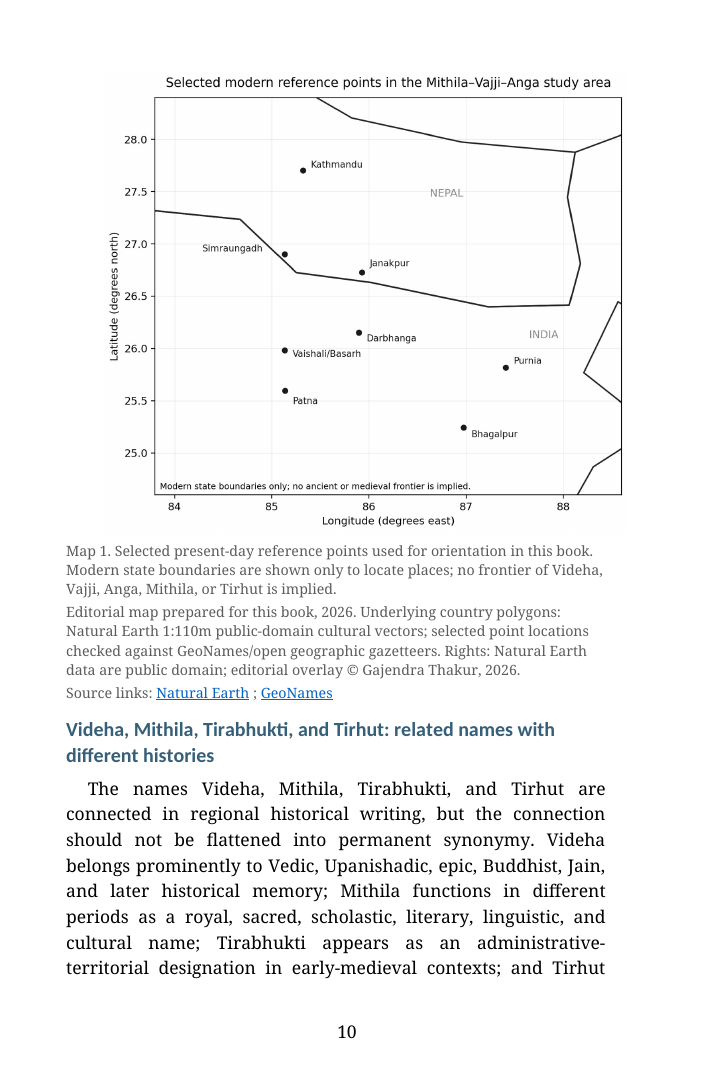
Mithila · Vajji · Anga
Chapter-specific source notes
- Primary chapter witness. Gajendra Thakur, Decoding the Panji of Mithila — Volume IV, formal Chapter 26, PDF pp. 296-305; formal Chapter 26. The HTML transcription is generated from the commit-pinned source PDF and retains the chapter boundary recorded in this edition.
- Internal structure. The repository source-heading inventory records 8 subordinate headings for this chapter: “26.1 Entries (170) and (171): Sukhet-Soderpur, Lagama, and the Krishna-Named Expansion”; “26.2 Entries (172) and (173): Katka-Soderpur and the Parasharma/Supaul Branch”; “26.3 Entries (174) to (179): Katka to Motipur, Pilkhad, Pauna, and Pratapur”; “26.4 Entries (180) to (185): Rohar-Soderpur, Kachhuwa, Bhawanipur, and Nagram”; “26.5 Index Logic for Chapter 26”; “26.6 Coverage Matrix”; “26.7 Index Items to Carry Forward”; “26.8 Transition to the Next Chapter”.
- Digital editorial method. The page keeps the preserved source text distinct from generated navigational, concordance, visual, and provenance apparatus. The synthetic reconstruction is explanatory only and is not evidence for an individual lineage or a determination of social or marital status.