Decoding the Panji of Mithila · Volume IV · Chapter 32
Mangrauna, Ahil, and Rakhwari under the Hariamb Line: Descent, Titles, and Marriage Circuits
Chapter 32. Mangrauna, Ahil, and Rakhwari
under the Hariamb Line: Descent, Titles, and
Marriage Circuits
   This chapter continues the cumulative decoding from the
point reserved after Chapter 31. It covers entries (266) through
(283). The governing rule remains the same: no name is read
as an isolated label. Each name is read through descent, place
of origin, marriage destination, title or professional marker,
and branch-continuity. The sequence begins with Mangrauna-
Hariamb, passes through the Ahil-Hariamb register, and then
opens the Rakhwari-Hariamb material up to the Janadh-
Maksoodpur continuation. Entry (284), where the text moves
into Akusi-Tankwal, is not absorbed here and is reserved for
the next chapter.

32.1 Entry (266): Mangrauna-Hariamb as a Short but
Complete Opening Register
   Entry (266) begins with the formula “ath Mangrauna
Hariamb gramarambh.” The phrase is decisive: Mangrauna is
not merely a place mentioned in passing but a gramarambh, a
register-opening settlement within the Hariamb/Hariamv line.
The first named ancestor is Chilka, whose son is Jeevan.
Jeevan is placed into the wider network through a marriage or
relational link with Khoa l, Narayandatt, and Padmapati, and
through the Sarisab-Raghunath connection. Thus the first
motion of the chapter is not a bare father-son formula. It
immediately binds Mangrauna to Khoa l, Padmapati, and
Sarisab.
   Jeevan’s descent is expanded through Yoginath, Nanu,
Babunath, and Kedarnath. These names must be read as
sibling or close-branch markers under Jeevan, with Soderpur
entering through Mohan’s daughter and Dhireshwar, and with
Darbhanga/Darihira-side Bhikhari also functioning as a

marriage or recognition marker. Yoginath then opens another
strand through Bhikhan, Bhairav, and Bhoolna. The title “M.
M. Jyotishi Gunishwar” attached in the same environment is
important: it places this branch among learned and
astrological houses, not only among village lineages. Bhikhan
is carried toward Prannath and Tilkeshwar; Bhairav is carried
through Musahar and then Lutan; Lutan is linked to Khoa l,
Sufal, Yuvaraj, and Hariamb-Khagdatt. This compact entry
therefore does three things at once: it establishes Mangrauna
as Hariamb, records descent from Chilka and Jeevan, and
shows the learned and marriage routes by which the line
remained visible.

32.2 Entries (267)–(271): The Five Rikta Markers after
Mangrauna
   Entries (267), (268), (269), (270), and (271) are all marked
rikta. They should not be deleted from interpretation. In a
Panji register, rikta is a structural marker. It records the
existence of an expected slot or numbered entry whose body
is absent or left blank in the copied source. These five rikta
markers directly follow the Mangrauna-Hariamb opening.
Their placement suggests that the manuscript or register
expected several Mangrauna-related subdivisions or cross-
references, but the preserved text did not supply narrative
detail for them. The cumulative volume therefore preserves
them as numbered absences, not as mistakes.

32.3 Entry (272): Ahil-Hariamb and the Madhwa-
Umakant Mishra Line
   Entry (272) begins the Ahil-Hariamb register with
Yashodhar and his sons or branch descendants Jeevanath,
Dhani, and Ghoghna. The first marriage network links the
family to Soderpur, where Basudev, son of Shivdev, is named.
Jeevanath then produces or carries Basudev, Roma, and Umai.

Basudev is connected to Belaunch through Manhar and
Dharu, and to Pali through Purrawu. The Panji is thus marking
Ahil as Hariamb while at the same time fastening it to
Soderpur, Belaunch, and Pali.
   Jeevanath’s secondary branches are also recorded.
Manganik is attached to Pawali through Kulpati and
Purushottam, with Satlakha and Ruchai marking the other
side. Devidatt is attached to Khoa l through Andi and Harishiv,
and to Karmah through Hadi. Basudev’s line then moves
through Chaita and Babunu, while Modan creates another
branch through Belaunch, Ratnapati, Kamal, and Khoa l-
Hemangad. Chaita produces Narayandatt and Saburdatt.
Narayandatt is carried to Satlakha through Daya and Bana
and to Pawali through Lal; he also gives the Thakurdatt-
Bhimadatt-Jalpadatt set, linked to Darihara through
Ghanaram and Atmaram and to Karmah through Bhikham.
Banmalik continues the line through Uki-Mandar and
Yogadhar, then through Ekahara-Hemkar. Banmalik’s sons
Umakant and Vishnukant move into Pawali, Ekan, Kanhai,
and Karmah-Devidatt, with Umakant tied to Kasraud-Ekhara,
Devinandan, Chaturanand, and Soderpur-Bachhai. Vishnukant
is tied to Khoa l, Vanshamani, Devakinandan, and Soderpur-
Shankar. The entry therefore justifies its title: Ahil is read
through Madhwa and Umakant Mishra, but the actual family
map is wider and moves through multiple marriage stations.

32.4 Entry (273): Ahil to Bhawanipur, Rohar,
Bhatsimar, and Chanpura
  Entry (273) continues Ahil but changes the outer
destinations: Bhawanipur, Rohar, Bhatsimar, and Chanpura
appear in the heading, along with Keval Mishra, Anant
Mishra, and Sadhu Mishra. Saburdatt now becomes the point
of descent. His descendants Govinddatt, Ishwardatt, and
Ganeshdatt are connected to Jajival through Hira and Chira,

and to Pali through Bodh. Govind produces Keval and
Shrikrishna. Keval is linked to Jagaur-Mandar through
Giridhari, Channa/Chandraddatt, and Khandbala-Jirakkhavan,
while Shrikrishna is linked to Satlakha-Jagannath-Ramnath
and Tarauni-Karmah-Ravinath.
   Ganeshdatt     produces      Anantanand      and     Kishor.
Anantanand’s son Jaldhar is linked to Khoa l, Bhayalal, Babuji,
and Ekhara. The entry then records Nand Kishor and Raghav,
linked through Jajival, Parmeshwaridatt, Tejnarayan, and
Karmah-Bihari. Chandrakant and Loknath are placed with
Baliyas and Jamuni-Shridhar, and with Karmah-Jalpadatt.
Modan and Babunu then introduce further links through
Jajival, Baliyas, Dharadhar, Dhir, Karmah, Shubhpat,
Saburdatt, Belaunch, and Ankhi. Umai brings in Chhatradhar,
Manchit, and Shyamnath, with Narun-Hridayram-Baburam
and Soderpur-Mahesh. Devi Datt continues through
Lakshminath; Lakshminath through Shrinath; Shrinath
through Khoa l-Dharmpati-Nehal and Hariamb-Khadag.
Shrinath also produces Sadhu and Sadanand, who connect
through Soderpur-Kalikadatt-Bakhedi, Belaunch-Kulmani,
Digho-Fakiran-Babue, Khoa l-Mukund, and Jajival-Tulsidatt-
Shatanjiv. This is a dense marriage circuit, and each name
must be kept in the tree rather than reduced to a list.

32.5 Entries (274) and (275): Chhapra-Gandharpa,
Kalikadatt, Halo, Pawna, and Dhamiyapatti
  Entry (274) turns back to Dhani and carries the line toward
Chhapra desh and Gandharpa with Kalikadatt Mishra. Dhani’s
sons are Vaiyakaran Gangadatt and Devidatt, joined through
Baliyas, Gunakar, Durgadatt, Tisaut, and Anand. The title
“Vaiyakaran” is not decorative; it identifies a learned
grammatical branch. Dhani also carries Kushal and
Chhatrpati, with Belaunch-Harishankar-Purushottam and
Kujouli-Mandan serving as network markers. Kushal’s son

Kanhai is linked to Sakararhi, P. Yogi, P. Tarapati, and
Belaunch-Janaknandan. Kanhai’s son Lalaji is connected to
Baliyas-Bhavi-Premnath and Pali-Dinanath. Lalaji’s son
Kalikadatt links to Jajival-Lakshminath-Raghu and Khoa l-
Prandhan. Kalikadatt then yields Badrinath, Kedarnath, and
Bhawanath, with Soderpur-Vishwanath-Khagnath and Khoa l-
Chaudhary Bhaira. Trivenikant and Chandrakant extend the
branch into Mandar-Chakradhari-Kalar and Hariamb-
Bhayalal; Badrinath and Kedarnath again create links through
Khoa       l-Prannath-Shrinandan,      Oda-Ekhara-Lilanand,
Khandbala-Hemadatt, and Devakinandan.
   Entry (275) is headed by Ahil to Halo, Vidyanath Mishra,
Pawna, Bhayalal Mishra, and Dhamiyapatti. The central
person is Chhatrpati, whose son Parshmani is linked to
Soderpur through Dhani and Shyam, and to Pali through Kala.
Parshmani connects to Jajival-Kamalnayan-Atmaram and
Karmah-Chitradhar. Vidyanath, another son in the line, is
linked to Satlakha-Balkaram-Saheb and Karmah-Deonath,
with further ties to Mandar-Bani-Ram and Hariamb-
Durganath. The Dhodhan branch supplies Toti, Rama, and
Bhairav; Toti is linked to Belaunch-Bhavdev-Jadav and
Panichobh-Kangali; Bhairav produces Dharbharan, who links
to    Narun-Ganapati-Lakshmidatt        and     Baliyas-Nakdu.
Dharbharan’s son Bhayalal is linked to Khoa l-Jagyapati-
Chaudhary Kari and Sarisab-Machal. Arjadatt, Baidyanath,
Brajnath, Dullah, and Ratnapati then fill out the Dhamiyapatti
and Pawna side through Digho, Khoa l, Pandua, Budhwal,
Sarisab, Pali, Darihara, Soderpur, Belaunch, and Hariamb.

32.6 Entries (276) and (277): Rakhwari-Hariamb and
the Jadsaini-Tharhi Branch
  Entry (276) opens Rakhwari-Hariamb with the formula
“Rakhwari Hariamb gramarambh.” The branch begins with
Chhavani and his sons Saheb, Nilambar, and Bhanjan. Saheb

produces Harshadatt, who is linked to Soderpur-Badli-
Harinandan and Khoa l-Hari. Harshadatt then gives Theghi,
Gunananand, Kantikar, and Giridhari through Soderpur-
Andu-Khedan and Belaunch-Tunanand. Theghi is especially
important because his branch reaches Khori-Soderpur
through Keshav and Bhaiyan, and to Baliyas-Hridaynandan.
Nilambar produces Ganeshdatt, who links to Soderpur-Dharu-
Hemkar and Mandar-Gonu; Ganeshdatt’s descendants include
Bodhan, Bachchu/Amritnath, and Bhayalal through Baliyas-
Bandhu-Baburaiya and Narun-Ghanshyam-Buddhi. Bodhan
then creates the Banmali-Kishor branch through Soderpur-
Medhakar-Lalit and Narun-Tota. Bachchu/Amritnath ties to
Satlakha-Ratnu-Badrinath and Soderpur-Jankinath.
   Bhanjan’s line includes Vishnudatt, Nenan, and Nidhi
through      Mandar-Chhatrpati-Devan         and    Budhwal-
Madhurapati. Nenan produces Sitaram, Jamahir, and
Kanchan; Sitaram gives Jageshwar, who is tied to Belaunch-
Ankhi-Hridaymani and Soderpur-Jangli. Jageshwar produces
Buch, Babuji, and Bhaiyan, with Buch linked to Sakararhi-
Narayandatt-Anupalal and Pawali-Harihardatt, and Babuji
linked to Khoa l-Bachchi-Kishori and Pali-Ramanath-Govind,
with Ekhara-Dwarika also noted. Entry (277) then continues
the Jadsaini-Tharhi branch through Jamahir. Jamahir’s
children Madhusudan, Manohar, and Jagdish are placed
through     Soderpur-Mansukh-Lal      and    Mandar-Ugradatt.
Madhusudan and Manohar both connect to Digho-Chandidatt-
Baidyanath and Baliyas-Jairam. Jagdish produces Jatadhar and
Mahidhar through Pandua-Tholhi-Bhalle and Pali-Gudar.
Nidhi’s son Dular links to Sakararhi-Kamalapati-Sudhakar and
Panichobh-Pritam, and Dular’s line connects again to Baliyas,
Jajival, Darbhanga/Darihara, Alay, Satlakha, Soderpur, Ekhara,
Sukhet-Soderpur, and Gangauli.

32.7 Entries (278), (279), and (280): Rakhwari through
Tharhi, Rahika, and the Nagram Mark
   Entry (278) continues the Rakhwari material toward Tharhi-
Rahika. Abhiram’s descendants Durgadatt, Thadu, and
Bhavdatt are linked through Satlakha-Naro-Mahesh and
Budhwal-Chaturbhuj.       Durgadatt     produces     Hemnath,
Shashinath, and Babu Jan; Hemnath’s son Apuch is linked to
Soderpur-Dhanesh-Gokulnath-Deonath           and     Belaunch-
Sanphul, while Apuch’s branch continues through Khandbala-
Kalanath-Lal and Karmah-Hallu. Shashinath is linked to
Darihara-Rohini-Nanu and Ekhara-Karunakar. Babu Jan’s son
Dukhmochan connects to Mahanora-Khoa l-Bholanath-
Krishna and Gangauli-Nandi. Thadu gives Jhonti; Jhonti gives
Jhingur, Gopal, and Ram through Darihara-Shridatt-Brajnath
and Karmah-Mayanidhi. Daya Ram then leads to Jeevan and
Dukhiya; Jeevan produces Babunath, Tejnath, and Ugranath
through Katai-Lakshmikant-Rakkan and Pali-Chhabnu. The
later names Thakurdatt, Ramadatt, Hare, Gudar, Muni,
Dwarkanath, and Burhan/Tejnath widen the register through
Sakararhi, Pali, Baliyas, Jajival, Khoa l, Soderpur, Belaunch,
and Narun.
  Entry (279) continues Ugranath through Kashi Nath,
Nakchhedi, Shakti Nath, Yadu Nath, Adinath, and Shivnath.
Kashi Nath is linked to Darihara-Gauridatt-Babue and Pali-
Chandradev; Nakchhedi to Sona, Dunai, and Ajbalal through
Soderpur-Nandishwar-Murli and Ekhara-Bhikhari; Adinath to
Dukhmochan, Niranjan, Baua, Phuchchi, and Hitu through
Soderpur-Hridaypati-Harshanath      and      Panichobh-Pyare.
Shivnath is tied to Satlakha-Pradyumn-Gonan-Gopal and
Karmah-Hari-Hiralal, while the Thakurdatt and Ramadatt
branches return to Pawali, Pali, Pandua, Jajival, Mandar, and
Baliyas. Entry (280) bears an explicit Rakhwari-Tharhi-
Nagram marker. Shubhpat produces Babuni and Subodh;

Babuni produces Atmaram through Darihara-Nehal-Barju and
Kujouli-Gangadatt. Subodh produces Baidyanath through
Satlakha-Rirvi-Bhanu and Soderpur-Chilka. Baidyanath
produces Bilat, Bhuvneshwar, Gopal, Govind, and Lataru,
extending the line through Sakararhi, Pawali, Khandbala,
Karmah, Baliyas, Pali, Bisfi, Ghusa ut, Soderpur, Mandar,
Sarisab, Khoa l, Gangauli, and Sukhet-Soderpur. This is a clear
example of the user’s rule: the names make sense only when
descent and marriage destinations are read together.

32.8 Entries (281), (282), and (283): Rakhwari to
Haripur, Bhojparoli, Janadh, and Maksoodpur
  Entry (281) takes Rakhwari toward Haripur. Bachhai’s sons
Harishwar and Arjun are placed through Khoa l-Damodar-
Bhavdev and Pali-Vishwambhar. Harishwar’s sons Ratnapati
and Chandrapati are linked to Ekhara-Mahi-Ram and Alay-
Das. Ratnapati produces Bhai, Baburaiya, Khadganath, and
Lala through Khoa l-Ani-Mahi and Budhwal-Narottam. Bhai
produces Loknath and Durganath through Sarisab-Sadashiv-
Saheb and Babhania-Baidyanath. Loknath leads to Yogi
through Soderpur-Nenu-Barju and Uchati-Prabhunath, while
Durganath produces Thothan, Bodhan, and Giridhari through
Narun-Mani-Chhatri and Babhania-Saheb. Giridhari is carried
through Baliyas-Manik-Prabhuraj and Ghusa ut-Babu.
Khadganath, Lala, Babuan, Raja, Dulli, Baiju, Manganik, and
Darbari then carry the same Haripur-connected line into
Belaunch, Pali, Soderpur, Ghusa ut, Karmah, and Budhwal.
  Entry (282) takes the same Rakhwari branch toward
Bhojparoli, Janadh, Jawad, and Maksoodpur. Chandrapati
produces Bechan and Bhikhari through Sakararhi-Shyam-Hari
and Pali-Narayan. Bechan branches into Dandapani and
Kamalpani       through    Gangauli-Kriparam-Pakshadhar,
Nagurdah-Shripati-Bhaiyaram, Kujouli-Abhiram, and Karmah-
Chan. Bechan also has Thothan and Bodhan, with Bodhan

producing Somdatt through Ghauri-Khandbala-Bachchi-
Kirtinath and Mandar-Pakhiya. Arjun’s son Hemai produces
Harinarayan through Soderpur-Budan-Babu and Panichobh-
Lakshmi. The Krishnadatt strand introduces Lala, Manranjan,
and Horil through Belaunch-Vir-Govindram and Baliyas-
Mahesh. Lala produces Kashi Nath, who produces
Mahadevdatt and Parmeshwaridatt, with Mandar-Raghunath-
Nanu and Pali-Gauri. Mahadevdatt leads to Rajkumar and
Kedar Nath, while Manranjan leads to Vishwanath, Fakir,
Ishwaridatt, Mohan, Hridaynath, and Gopal through Khoa l-
Chan-Sitaram and Karmah-Chira. This entry is an extended
marriage map of the Rakhwari-Hariamb branch.
   Entry (283) closes this chapter’s coverage by continuing
Rakhwari toward Janadh-Maksoodpur. Mohan produces
Shyam Sundar through Darihara-Kira-Ishwardatt and Takwal-
Datt. Hridaynath produces Shankar Dayal through Baliyas-
Gaurinandan-Sufal and Soderpur-Harpati. Gopal produces Nar
Singh     through    Darihara-Gauridatt-Babue   and    Pali-
Chandradev, and Nar Singh is linked onward through
Satlakha-Matinath-Bhaiya-Raghuni and Soderpur-Jhadula.
Horil produces Durgadatt, Kamaladatt, and Bhagwandatt
through     Darihara-Manbodh-Poshan      and   Pali-Madhav.
Durgadatt’s Madhav and Raghuvar branches connect to Khoa
l-Sitaram-Mangaladatt, Kujouli-Gangadatt, Digho-Chitradhar-
Raghunath, Mandar-Ishanath, Sakararhi-Shyamlal-Bokan, and
Karmah-Bharthi. Bhagwandatt’s descendants Lakshman,
Sundar, Kishori, Nandalal, and Baldev return the line to
Soderpur-Mansukh-Lal, Mandar-Ugradatt, Janata, Munidatt,
Nandakumar, Khoa l, and Shivnarayan. This closes the
Rakhwari section without entering the next Akusi-Tankwal
register.

32.9 Index Logic and Coverage Note for Chapter 32
   The index logic applied in this chapter is threefold. First,
Mangrauna is kept under Hariamb, because the source gives
“Mangrauna Hariamb gramarambh” and the index separately
remembers Mangrauna-Hariamb as a named node. Second,
Ahil is treated as a Hariamb register in the source chapter
even though the master index also preserves Ahil under Khoa
l in other cross-reference locations; this means Ahil must be
read as a family node moving across moolgram and marriage
lines rather than flattened into one label. Third, Rakhwari is
treated as Hariamb because both the source and the index
identify “Rakhwari Hariamb gramarambh,” with Jadsaini,
Tharhi, Rahika, Haripur, Janadh, and Maksoodpur functioning
as successive outward branches.
  Coverage in this chapter is exclusive: entries (266) through
(283) have been decoded here. Entries (267) through (271)
have been preserved as rikta markers. The next chapter
should begin with entry (284), “Akusi to Nahar-Lalpur,” where
the line turns away from Rakhwari-Hariamb and opens Akusi-
Tankwal before moving onward to Gandouli-Jalay and
Nagwad-Ghusa ut.
Source structure and verification apparatus
Editorial source apparatus. This apparatus is descriptive, not interpretive. It records the source-controlled structure used to verify that this page corresponds to formal Chapter 32 of Decoding the Panji of Mithila — Volume IV. The chapter text above is preserved from PDF pp. 346-355; formal Chapter 32 in the commit-pinned authoritative source. It is not merged with a neighboring chapter, appendix, annexure, or independent front/back-matter unit. The internal headings below come from the repository’s source-heading inventory and are retained as navigational and audit evidence; showing them here does not turn those headings into separate publications or add claims that are absent from the source.
Internal source headings
- 32.1 Entry (266): Mangrauna-Hariamb as a Short but Complete Opening Register
- 32.2 Entries (267)–(271): The Five Rikta Markers after Mangrauna
- 32.3 Entry (272): Ahil-Hariamb and the Madhwa-Umakant Mishra Line
- 32.4 Entry (273): Ahil to Bhawanipur, Rohar, Bhatsimar, and Chanpura
- 32.5 Entries (274) and (275): Chhapra-Gandharpa, Kalikadatt, Halo, Pawna, and Dhamiyapatti
- 32.6 Entries (276) and (277): Rakhwari-Hariamb and the Jadsaini-Tharhi Branch
- 32.7 Entries (278), (279), and (280): Rakhwari through Tharhi, Rahika, and the Nagram Mark
- 32.8 Entries (281), (282), and (283): Rakhwari to Haripur, Bhojparoli, Janadh, and Maksoodpur
- 32.9 Index Logic and Coverage Note for Chapter 32
Source-text concordance
Mangrauna · Ahil · Rakhwari · Hariamb · Line · Descent · Titles · Marriage · Circuits · continues · cumulative · decoding · point · reserved · covers · entries · governing · rule · remains · name · read · isolated · label · place · origin · destination · title · professional · marker · branch-continuity · sequence · begins · passes · Ahil-Hariamb · register · opens · Rakhwari-Hariamb · material · Janadh · Maksoodpur · continuation · Entry · text · moves · Akusi-Tankwal · absorbed · next · Mangrauna-Hariamb · Short · Complete · Opening · formula · gramarambh · phrase · decisive · merely · mentioned · passing · register-opening · settlement · within · Hariamv · first · named · ancestor · Chilka · whose · Jeevan · placed · wider · network · relational · link · Khoa · Narayandatt · Padmapati · Sarisab-Raghunath · connection · Thus · motion
Boundary verification. In the formal sequence this chapter follows Volume IV Chapter 31, “Balirajpur-Hariamb and Siva-Hariamb: Settlements, Scholarly Lines and Marriage Networks, Entries (248)- (265)” and precedes Volume IV Chapter 33, “Akusi-Tankwal, Gandauli-Jalay, and the Opening Nagwad-Ghusaut Register”. The chapter extractor begins at the verified formal Chapter 32 marker and stops at the next verified formal chapter marker; for a final chapter it stops before recognized book-level back matter. The concordance above is generated only from distinct terms already present in this chapter’s preserved source text. It is provided for discovery, comparison, and audit, not as an automated judgment about persons, lineages, status, kinship, marriage eligibility, or historical truth.
Illustrated research apparatus
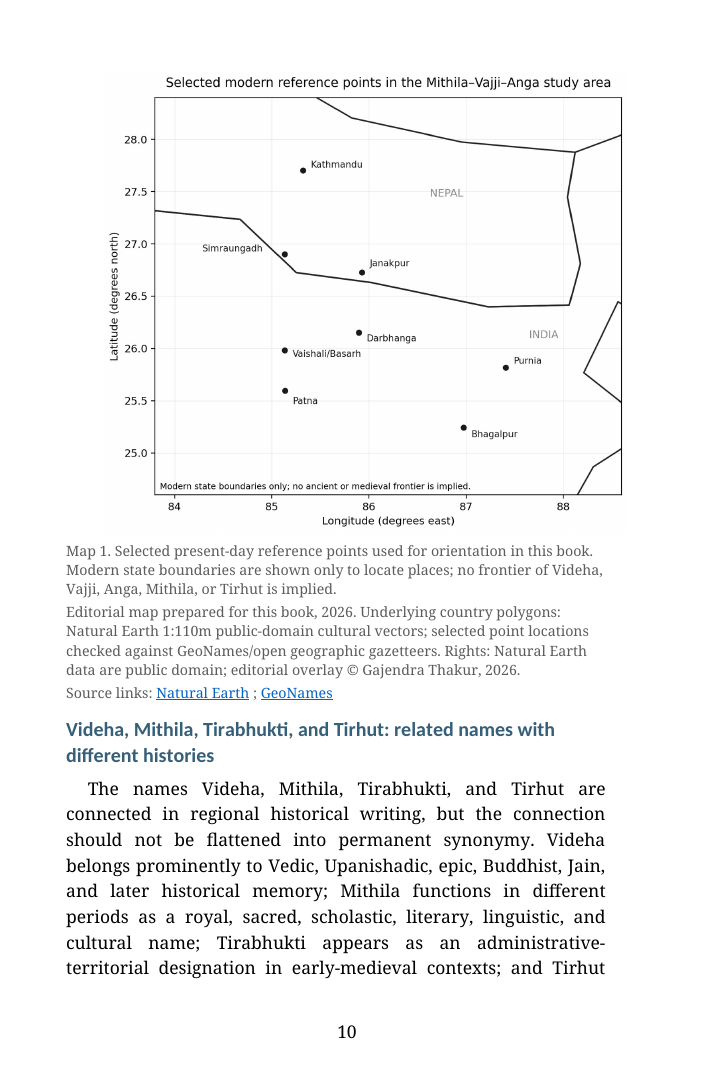
Mithila · Vajji · Anga
Chapter-specific source notes
- Primary chapter witness. Gajendra Thakur, Decoding the Panji of Mithila — Volume IV, formal Chapter 32, PDF pp. 346-355; formal Chapter 32. The HTML transcription is generated from the commit-pinned source PDF and retains the chapter boundary recorded in this edition.
- Internal structure. The repository source-heading inventory records 9 subordinate headings for this chapter: “32.1 Entry (266): Mangrauna-Hariamb as a Short but Complete Opening Register”; “32.2 Entries (267)–(271): The Five Rikta Markers after Mangrauna”; “32.3 Entry (272): Ahil-Hariamb and the Madhwa-Umakant Mishra Line”; “32.4 Entry (273): Ahil to Bhawanipur, Rohar, Bhatsimar, and Chanpura”; “32.5 Entries (274) and (275): Chhapra-Gandharpa, Kalikadatt, Halo, Pawna, and Dhamiyapatti”; “32.6 Entries (276) and (277): Rakhwari-Hariamb and the Jadsaini-Tharhi Branch”; “32.7 Entries (278), (279), and (280): Rakhwari through Tharhi, Rahika, and the Nagram Mark”; “32.8 Entries (281), (282), and (283): Rakhwari to Haripur, Bhojparoli, Janadh, and Maksoodpur”; ….
- Digital editorial method. The page keeps the preserved source text distinct from generated navigational, concordance, visual, and provenance apparatus. The synthetic reconstruction is explanatory only and is not evidence for an individual lineage or a determination of social or marital status.