Decoding the Panji of Mithila · Volume IV · Chapter 33
Akusi-Tankwal, Gandauli-Jalay, and the Opening Nagwad-Ghusaut Register
Chapter 33. Akusi-Tankwal, Gandauli-Jalay,
and the Opening Nagwad-Ghusaut Register
    This chapter continues from the stopping point fixed at the
end of Chapter 32. It covers entries (284) through (290),
including the continuation of entry (290) immediately before
the heading of entry (291). The field now shifts from the
Hariamb materials of Rakhwari into three new settlement
frames: Akusi under Tankwal, Gandauli under Jalay, and
Nagwad under Ghusaut. The interpretive method remains
unchanged. Every person is treated as a point inside a chain of
descent, a settlement route, an affinal or marriage link, and an
ongoing branch register; dotted omissions and uncertain
readings are preserved as limits of the record, not silently
filled.

33.1 Entries (284) and (285): Akusi-Tankwal to Nahar-
Lalpur and Lalpur
   Entry (284) opens with the formula for Akusi, or Akuri in
the source spelling, as a Tankwal gramarambh. The heading
“Akusi to Nahar-Lalpur” therefore marks a new local register
rather than a casual mention of Lalpur. The founding branch
is introduced through Bachh, whose son Ravinath is linked by
marriage route to Sarisab through Mahadev and Ratinath, and
through Karmah-Dukhan on the other side. The first
important descent expansion is Ravinath’s sons: Badrinath,
Srinath, Garibnath, and Shambhunath. This four-name cluster
divides the Akusi line into parallel male branches, and the
following phrases then test each branch by marriage and
settlement circulation.
  Badrinath produces Kedarnath and Shashinath through
Khandbala-Madan-Krishnamohan        and   Baliyas-Girdhari.
Kedarnath then gives Kashi Nath and Vishwanath, attached to
Baliyas-Babulal-Hire and Budhwal-Nandalal. This is not a

mere list of sons. It shows how the Badrinath branch is carried
outward through Khandbala, Baliyas, and Budhwal, while the
underlying Akusi-Tankwal identity is retained. Srinath’s line is
carried by Meghnath, who is linked to Soderpur through
Babujan and Someshwar, and to Darihara through Gehnath.
Meghnath’s marriage route introduces the Oini courtly
connection: Babu Kanhaiya Narayan and Babu Khojendra
Narayan are named, with Budhwal-Vanshmani marking the
opposite side. This is a high-status cross-link, and it should be
read as an elite affinal connection rather than a simple village
annotation.
   Shambhunath generates a more complicated register. His
son Teti, also described as Chandranath, is attached to
Khandbala through Revati Nath and Artinath, and to Karmah
through Mandhan. Another daughter of Shambhunath links to
Darihara through Bhaiya and Raghuvar. The register then
introduces Bodhkrishna, whose sons Datt, Rudradatt, and
Gauridatt link Akusi to Jajival through Murari and Badlu, and
to Sakararhi through Narottam. Datt’s sons Babunath,
Shambhunath, and Gopinath move through Ekhara-Panai-
Hira and Soderpur-Keshav. Babunath’s son Vishwanath then
joins Darihara-Rajnu-Hanumandatt with Pali-Bechu, while
Vishwanath’s daughter returns to Soderpur through
Gokulnath, Devanath, and Kheden, and then to Darihara-
Juraun. The entry thus creates a double movement: Akusi as
the source register, and Soderpur, Darihara, Pali, Jajival, and
Sakararhi as the route network by which its branches are
authenticated.
  Entry (284) closes with Gopinath’s sons Dukhmocan,
Mitranath, and Jagannath. Dukhmocan is also associated with
Babua and Dinanath through Jajival-Atmaram-Gauridatt and
Budhwal-Hibharan. Babua is carried to Pawali through
Bholanath, Narsingh, and Harisingh, while Dinanath produces
Kanchinath and Kantinath through Mandar-Gopal-Umanath

and Belaunch-Sadanand. Jagannath is tied to Aniruddh, again
through Jajival-Atmaram-Gauridatt, showing that the same
Jajival link validates multiple descendants in this Akusi
branch.
  Entry (285) continues the Akusi material to Lalpur.
Aniruddh is linked to Dighoi through Khushihal, Babujan, and
Singheshwar, and then to Bhadual-Mandar through Keshav.
Kanchinath’s link to Mangrauni is present but dotted, which
means the route is known as a direction but not filled in this
copy. Kantinath is linked to Lalbagh-Narun and Baliyas-
Bhairav, with Ghusaut-Durganath completing the route.
Rudradatt’s son Hridaynath then shifts the branch toward
Darihara-Matiram-Madhurapati         and     Budhwal-Jangal.
Hridaynath’s sons Babulal and Bachchelal are the next inner
split. Babulal is connected through Baliyas-Hridaynandan-
Devi and Satlakha-Parmanand. Bachchelal produces Anant
and Vaiyakaran Ganesh; Anant is linked to Jajival-Devidatt-
Shivdatt and Baliyas-Lalitmani, while another Anant line goes
through Nahas-Khaual to Dullah, Bhagwandatt, Mahadev, and
Sarisab-Faturan-Lalji. Gauridatt’s daughter closes the Akusi
section through Sakararhi-Kamalapati-Bhola and Hariamb-
Khushihal. In short, entries (284) and (285) are not two
unrelated fragments: they are the Akusi-Tankwal foundation
and its Lalpur continuation, held together by repeated
Soderpur, Jajival, Pali, Baliyas, Darihara, and Hariamb
exchanges.

33.2 Entry (286): Gandauli-Jalay to Dashauth and
Kursau
   Entry (286) opens the Gandauli-Jalay register with the
formula “ath Gandauli Jalay gramarambh.” The primary
ancestor is Chaudhary Nehal, whose descendants are
Jagmohan, Dular, and Mohan Singh. Jagmohan’s son Pyarelal
links to Pawali-Ghananand-Durgadatt and Sakararhi-

Lakshman. Pyarelal then produces Sarvanarayan, Bachcha or
Harivansh Narayan, and Chumman. Sarvanarayan’s sons
Keshavnarayan and Vasudev Narayan show the first large
spread of the Gandauli line. Keshavnarayan is linked to
Jajival-Manasukh-Devidatt and Hariamb-Nena, while his own
son Harivallabh Narayan passes through Kujouli-Hema-
Raghunath and Pawali-Bholanath. Harivallabh’s daughter is
linked to Soderpur-Punyanand-Ramchandra and Khaual-
Lakshman.
   Vasudev Narayan is read through Baliyas-Halli-Baldev and
Pali-Gopinath-Ritunath-Kumar. The Bachcha or Harivansh
Narayan branch produces Yadunarayan through Darihara-
Parshi-Bhayalal and Khandbala-Bambholi. Yadunarayan’s son
Surendra Narayan is linked to Mandar-Shobhan-Dular and
Budhwal-Babujan. Surendra Narayan’s daughter then moves
to    Jajival-Rajnath-Nilkanth    and   Sakararhi-Chumman.
Chumman’s son Vishweshwar Narayan links to Darihara-
Khadgapani-Ratnapani and Soderpur-Lakshman. The second
son of Nehal, Chaudhary Dular, produces Chandranarayan,
Anant Narayan, Teknarayan, and Harinarayan; the marriage
route goes through Gangoli-Kriparam-Bandhav and Khaual-
Mani. Chandranarayan returns to Soderpur-Shyam-Baburai
and     Karmah-Mayanidhi.      Anant    Narayan     produces
Dharmanarayan and Haldhar Narayan through Khaual-
Jaydatt-Gopal and Soderpur-Matinath. Dharmanarayan, in
turn, produces Hridaynarayan and Arjun through Darihara-
Kanhai-Bachchu and Kujouli-Keshav. Entry (286) therefore
establishes Gandauli-Jalay as a Chaudhary-Narayan branch
with a wide and carefully cross-checked marriage network.

33.3 Entry (287): Gandauli through Mohan Singh,
Dashauth, and Kursau
  Entry (287) continues Gandauli toward Kursau and
Dashauth through Mohan Singh. His descendants are

Chitranarayan, Avadh Narayan, Govind Narayan, and Hit
Narayan. Chitranarayan is linked to Belaunch-Dharmadatt-
Dhairyanarayan      and    Uchati-Mana,   while    another
Chitranarayan line goes through Mandar-Nanu-Shyamlal and
Karmah-Bachkani. A second daughter connects to Sarisab-
Prannath-Kamaladatt and Karmah-Lalit. Avadh Narayan
produces Faujdar Narayan and Baldev Narayan through
Baliyas-Nikar-Fakiran and Narun-Phalgun. Faujdar Narayan’s
son Ramapati links to Belaunch-Kulmani-Shrimani and
Mandar-Banmali. Baldev Narayan connects to Soderpur-
Banmali-Chakradhar and Hariamb-Shyamnath.
  Avadh Narayan also has Raghuvar Narayan, whose son
Indra Narayan links to Mandar-Vishwanath-Pakhiya-Sonmani,
to Soderpur-Basaun-Parshi, and to Darihara-Jhaun. Indra
Narayan’s son Gajendra Narayan is separately named, with a
route through Mandar-Kunkun-Upadhyay Badrinath and
Khandbala-Shrimodan. The presence of Gajendra Narayan
marks a named branch point, not merely a passing individual:
the source gives enough surrounding route data to place him
within the Avadh-Raghuvar-Indra line. Govind Narayan
produces Krishna Narayan through Pandua-Garib-Ratnamani
and Khandbala-Thakur Nidhi. Krishna Narayan’s sons Babuji,
Kumarji, and Gulabji link to Darihara-Kanhai-Durmmil and
Hariamb-Manmohan. Hit Narayan produces Prasiddh
Narayan and Basudev Narayan through Gangoli-Devan-Anant
and Budhwal-Lalitlal. Prasiddh’s son Ugra Narayan is
connected to Baliyas-Raghuvir-Hanumandatt and Karmah-
Janaki; Ugra Narayan’s daughter returns to Sarisab-Gudar-
Manmohan, while another route marks Hariamb-Hemnath-
Apuch and Khandbala-Lal. Basudev Narayan produces
Shreshth Narayan, Upendra Narayan, and Rudra Narayan
through Ora-Ekhara-Sanphool-Manravaran and Soderpur-
Poshan. Entry (287) thus completes the Gandauli unit by
carrying the line into named Narayan branches,

professionalized honorific memory, and repeated Soderpur-
Hariamb-Baliyas circuits.

33.4 Entry (288): Nagwad-Ghusaut Opens toward
Akaur
  Entry (288) shifts the register again. The heading gives
Nagwad with Ghusaut, and the formula “Nagwad Ghusaut
gramarambh” makes this a new settlement opening. The first
named ancestor is Thakur Mannu. His sons Shashisherwar
and Ram form the primary division. Shashisherwar’s son
Dullah is linked to Kodariya through Parmanand and
Lakshmipati, and to Alay-Narottam. Dullah’s daughter then
moves through Baliyas-Chiranjeev-Bechu and Baheradhi-
Ratidhara. Ram’s children are Ishannath, Viku, and Sanphool,
again through Kodariya-Parmanand-Lakshmipati and Alay-
Narottam, which shows that the Kodariya link is not
accidental but a repeated validating connection for the
Nagwad-Ghusaut opening.
   Ram also has a Manik branch through Kujouli-Murali-
Rameshwar and Darihara-Nenu. Other branches go to
Soderpur-Shrikrishna-Goi and Alay-Bane; to Narun with a
dotted father and Ramapati; to Soderpur-Anand; to
Khandbala-Chaturbhuj-Kuli and Baheradhi-Shulpani; and to
Oini through Maharaj Lakshminarayan with Karmah-Ram.
Ishannath is linked to Darihara-Rohini-Shridatt and Pawali-
Upendra. Viku’s son Babulal passes through Belaunch-
Chaturbhuj-Dharmadatt and Karmah-Juraun. Babulal’s son
Keshav Narayan links to Darihara-Gangesh-Manik and
Sarisab-Shobhanath. Keshav Narayan’s sons Govardhan,
Jaylal, and Jagati then develop the next generation through
Pawali-Ekan-Hiralal and Pali-Shobhanath.
  Govardhan produces Tarasharan, Madhusudan, Janardan,
Balmukund, and Gangadhar through Darihara-Babnu-
Girdhari  and   Soderpur-Girdhari.  Tarasharan’s   son

Shubhankar is attached to Baliyas-Kanhai-Ishadatt and
Pawali-Musahar. A later Shivshankar branch points toward
Vindhi and Jhitki but remains partly dotted. Shubhankar’s
sons Rajendra, Jitendra, Narendra, Surendra, and Mahendra
are then named, and Rajendra’s descendants Naveen,
Praveen, and Sachindra are connected to Sima-Parhat-
Sakararhi through Doman and Lakshminath, and to Belaunch-
Sadanand. Entry (288) therefore begins Nagwad-Ghusaut by
joining old Thakur-descended memory to newer named
branches and to semi-modern naming patterns.

33.5 Entries (289) and (290): Nagwad to Akaur,
Kakraud, and Bhachhi
   Entry (289) continues Nagwad to Akaur. Madhusudan’s son
Murali is linked to Soderpur through Girdhari and Sonelal,
though the opposite side is dotted. Janardan produces Bhola,
also called Viranji, and Jagatanand through Darihara-Teknath-
Harshnath and Hariamb-Jamahir. Balmukund produces
Lakshmikant and Harinarayan through Sakararhi-Bokan-
Chhotkani and Hariamb-Ghonghri. Gangadhar’s daughter
returns to Baliyas-Gangadatt-Shridatt and Pali-Harisharan.
The entry then records later branches: Narendra’s son Rajesh
is placed at Chiknauta-Jagati through Pawali-Kishori-
Vishweshwar and Khaual-Vishweshwar; Jaylal’s daughter is
linked    to   Digho-Chitradhar-Raghunath      and   Mandar-
Ishannath; Lakshmikant’s daughter passes through Kujouli-
Haridev-Ramdev        and    Jajival-Harikant;  Harinarayan’s
daughter moves through Kodariya-Rambhadra-Raghuchand
and Pali-Kui. Bhola or Viranchi produces Shyamsundar and
Ramsundar, and a questioned Jajival-Riddhinath-Jagannath
route with Alay-Pillu is preserved as doubtful rather than
normalized.     Jagatanand      produces    Manmohan     and
Chandramohan           through        Soderpur-Harishchandra-
Kalishchandra, with the Baliyas side dotted. The entry closes

with Parmanand, Prabhakant, Jagati, and a branch of Jagati
through Aniruddh and Banmali.
   Entry (290) continues the same Nagwad field toward Akaur,
Kakraud, and Bhachhi. Aniruddh produces Chandrakant and
Prabhakant through Sakararhi-Muni-Bachnu and Pali-Gulab.
Banmali produces Krishna Kumar and Indra Kumar through
Narun-Keshav-Anant and Kodariya-Nunuprasad. Krishna
Kumar’s sons are explicitly modern in style: Mohan Kumar,
Prem Kumar, Pramod Kumar, Subodh Kumar, Amod Kumar,
and Prakash Kumar. Their route returns to Khaual-Prannath-
Devkinandan and Khandbala-Hemdatt. Indra Kumar’s
daughter     is   connected    to  Kodariya-Ganeshchandra-
Shubhchandra and Khaual-Nandkishor. Sanphool’s daughters
link to Soderpur-Mohan-Chhoti and Hariamb-Chilka, and
another branch to Khaual-Shivram-Saheb and Ekhara-Bala.
   The continuation immediately before entry (291) still
belongs to this Nagwad unit. Thakur Manik produces
Bhawanidatt through Baliyas-Dharadhar-Harishankar and
Ekhara-Indrapati. Bhawanidatt produces Bachchu through
Khaual-Digambar-Chhatrpati and Belaunch-Bhikhm. Bachnu
produces Lutan and Bihari through Soderpur-Tufani-Jaynath
and Mandar-Krishnamani. A daughter again repeats the
Soderpur-Jaynath route, while another Lutan line points to
Khaual-Nakchhed-Vishweshwar and Sarisab-Thithar. Jeevan
produces Raja through Soderpur-Kamdev-Chhakauri and
Alay-Vidyapati. Hiya’s descendants Lal, Vidyanath, and Gopal
move through Pawali-Purushottam-Ishannath and Narun-
Ratnu. Lal’s daughter links to Baliyas-Shambhunath-Durmmil
and Hariamb-Dayanath; Vidyanath’s son Janardan connects to
Digho-Balkaram-Bhawnath and Panichobh-Bhikhiya; and
Gopal produces Ramkrishna and Harivansh. This continuation
is important because it prevents entry (290) from being cut too
early. Only after these names does entry (291), “Nagwad to
Bhachhi-Rashadh-Berma,” begin.

33.6 Index Logic and Coverage Note for Chapter 33
   The index logic for this chapter is controlled by three
distinct local headings. Akusi is read under Tankwal, not
under the later Nagwad or Gandauli material, because the
source itself gives the Akusi-Tankwal gramarambh and the
index remembers Akusi-Tankwal as a separate node. Gandauli
is read through Jalay because the source gives the Gandauli-
Jalay gramarambh and the index preserves Jalay within the
relevant moolgram framework. Nagwad is read under
Ghusaut because both the source and the index pair Ghusaut
with Nagwad. This is why the chapter does not merge the
three sections into one undifferentiated settlement history.
   Coverage in this chapter is exclusive: entries (284) through
(290), including the two continuation lines before the heading
of entry (291), have been decoded here. Entry (291), “Nagwad
to Bhachhi-Rashadh-Berma,” begins the next chapter. The next
chapter should therefore remain within the Nagwad
continuation and proceed from entry (291) onward, following
the same method of descent, place, marriage route, title, and
branch continuity.
Source structure and verification apparatus
Editorial source apparatus. This apparatus is descriptive, not interpretive. It records the source-controlled structure used to verify that this page corresponds to formal Chapter 33 of Decoding the Panji of Mithila — Volume IV. The chapter text above is preserved from PDF pp. 356-364; formal Chapter 33 in the commit-pinned authoritative source. It is not merged with a neighboring chapter, appendix, annexure, or independent front/back-matter unit. The internal headings below come from the repository’s source-heading inventory and are retained as navigational and audit evidence; showing them here does not turn those headings into separate publications or add claims that are absent from the source.
Internal source headings
- 33.1 Entries (284) and (285): Akusi-Tankwal to Nahar-Lalpur and Lalpur
- 33.2 Entry (286): Gandauli-Jalay to Dashauth and Kursau
- 33.3 Entry (287): Gandauli through Mohan Singh, Dashauth, and Kursau
- 33.4 Entry (288): Nagwad-Ghusaut Opens toward Akaur
- 33.5 Entries (289) and (290): Nagwad to Akaur, Kakraud, and Bhachhi
- 33.6 Index Logic and Coverage Note for Chapter 33
Source-text concordance
Akusi-Tankwal · Gandauli-Jalay · Opening · Nagwad-Ghusaut · Register · continues · stopping · point · fixed · covers · entries · including · continuation · entry · immediately · heading · field · shifts · Hariamb · materials · Rakhwari · three · settlement · frames · Akusi · Tankwal · Gandauli · Jalay · Nagwad · Ghusaut · interpretive · method · remains · unchanged · Every · person · treated · inside · chain · descent · route · affinal · marriage · link · ongoing · branch · dotted · omissions · uncertain · readings · preserved · limits · record · silently · filled · Nahar · Lalpur · opens · formula · Akuri · spelling · gramarambh · Nahar-Lalpur · therefore · marks · local · rather · casual · mention · founding · introduced · Bachh · whose · Ravinath · linked · Sarisab · Mahadev · Ratinath · Karmah-Dukhan · side
Boundary verification. In the formal sequence this chapter follows Volume IV Chapter 32, “Mangrauna, Ahil, and Rakhwari under the Hariamb Line: Descent, Titles, and Marriage Circuits” and precedes Volume IV Chapter 34, “Nagwad-Ghusaut after Akaur: Bhachhi, Ranipur, Samaul, Masuriya, and Kakraud This chapter continues from the point reserved after”. The chapter extractor begins at the verified formal Chapter 33 marker and stops at the next verified formal chapter marker; for a final chapter it stops before recognized book-level back matter. The concordance above is generated only from distinct terms already present in this chapter’s preserved source text. It is provided for discovery, comparison, and audit, not as an automated judgment about persons, lineages, status, kinship, marriage eligibility, or historical truth.
Illustrated research apparatus
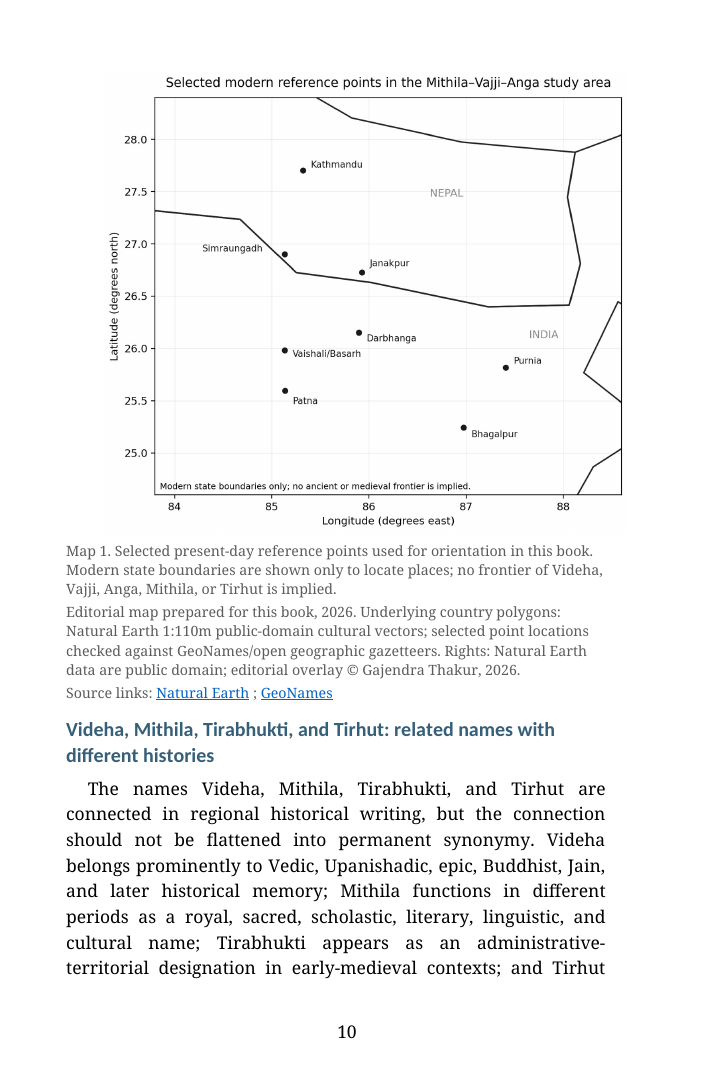
Mithila · Vajji · Anga
Chapter-specific source notes
- Primary chapter witness. Gajendra Thakur, Decoding the Panji of Mithila — Volume IV, formal Chapter 33, PDF pp. 356-364; formal Chapter 33. The HTML transcription is generated from the commit-pinned source PDF and retains the chapter boundary recorded in this edition.
- Internal structure. The repository source-heading inventory records 6 subordinate headings for this chapter: “33.1 Entries (284) and (285): Akusi-Tankwal to Nahar-Lalpur and Lalpur”; “33.2 Entry (286): Gandauli-Jalay to Dashauth and Kursau”; “33.3 Entry (287): Gandauli through Mohan Singh, Dashauth, and Kursau”; “33.4 Entry (288): Nagwad-Ghusaut Opens toward Akaur”; “33.5 Entries (289) and (290): Nagwad to Akaur, Kakraud, and Bhachhi”; “33.6 Index Logic and Coverage Note for Chapter 33”.
- Digital editorial method. The page keeps the preserved source text distinct from generated navigational, concordance, visual, and provenance apparatus. The synthetic reconstruction is explanatory only and is not evidence for an individual lineage or a determination of social or marital status.