Decoding the Panji of Mithila · Volume IV · Chapter 34
Nagwad-Ghusaut after Akaur: Bhachhi, Ranipur, Samaul, Masuriya, and Kakraud
Chapter 34. Nagwad-Ghusaut after Akaur:
Bhachhi, Ranipur, Samaul, Masuriya, and
Kakraud
   This chapter continues from the point reserved after
Chapter 33. It covers entries (291) through (295) only. The
governing register remains Nagwad-Ghusaut, but the line now
moves away from the early Akaur opening into Bhachhi-
Rashadh-Berma, Kakraud, Betia-Ranipur, Samaul, Masuriya of
Purnea, and the Samauli-Kakraud continuation. The method
remains unchanged: each name is read through descent,
place, marriage route, title, and branch-continuity. Entry (296),
where the source turns to Nagwad to Bhatsimari-Dhamdaha,
is not absorbed here and is reserved for the next chapter.

34.1 Entry (291): Nagwad to Bhachhi-Rashadh-Berma
  Entry (291) begins with the heading Nagwad to Bhachhi-
Rashadh, with Berma also named in the heading. The first line
resumes from the preceding Nagwad material and brings
Harivansh into the new destination frame. Harivansh is
connected through Pawali-Gauridatt-Kirtinath and Khoa l-
Amritnath. Janardan then produces Raghuvansh, although
part of the record is left dotted. Raghuvansh is carried toward
Mandar through Siddhinath and Babe, and toward Kodariya
through Amiya and Dharmadatt. The entry therefore begins
by moving a Nagwad line outward through Bhachhi and
Berma while still preserving the moolgram lattice: Baliyas,
Hariamb, Pawali, Khoa l, Mandar, Kodariya, and allied nodes
remain active.
   The next substantial descent is through Thakur Theghu,
whose son Bhikhari becomes a major branch point. Theghu is
linked to Digho through Babu and Chaturbhuj, and to Baliyas
through Ramchandra. A set of secondary or apara branches
follows:    Narun-Aniruddha-Ghanshyam      with    Kujouli-

Shubhankar; Umapati, Kinu, and Kulpati through Gangauli-
Raman-Lakshmikant and Baliyas-Shatanjiv; Janakinath
through     Mandar-Madhav-Chan          and     Karmah-Kisai;
Tulakrishna through Satlakha-Manhar-Keshav and Karmah-
Damodar; Chhatrpati through Soderpur-Mohan-Kulpati and
Darihara-Bhaura; Chhotkani through Soderpur-Haridev-Anath
and Alay-Chaudhary Vishweshwar; and Chanan through
Mandar-Raja-Krishnanand and Soderpur-Chudamani. The text
is not merely naming sons. It is placing each offshoot by a
double route: the descent line and the marriage or recognition
line.
  Bhikhari’s son Meghnath then carries the line forward.
Meghnath is linked to Ekhara through Bhagirath’s daughter
and Lakshmidhar, and to Baliyas-Ghanshyam. Meghnath’s son
Chitradhar, also read as Parshmani in the source, links to
Soderpur and Budhwal. Chitradhar’s own descendants are
further tied to Darihara-Rameshwar-Gokulnath and Pawali-
Surwai. The entry then lists another branch through
Jagannath, Dukhmochan, Vaiyakaran Khadganath, and
Vaiyakaran Tejnath. These titles identify a learned
grammatical line inside the Nagwad-Ghusaut register. Finally,
Thakur Umapati produces Mahidhar and Shambhunath.
Mahidhar is linked to Khoa l-Kamal-Gunakar and Hariamb-
Jagannath; Mahidhar’s sons Rupnath, Tilkeshwar, and Muni
move through Pandua-Nandishwar-Mansukh and Budhwal-
Bhaiyan. The incomplete ending is still legible as a branch-
continuity statement, not as a new register.

34.2 Entry (292): Nagwad to Kakraud and Betia-
Ranipur
  Entry (292) shifts to Nagwad to Kakraud and Betia, with
Ranipur in the heading. It first supplies a continuation from
the previous Mahidhar/Rupnath environment: Budhwal-
Bachharu and an apara branch through Amoldatt, linked to

Darihara-Hit-Jivanath and Pali-Karu. The important named
figure is Pandit Rupnath, whose son Pandit Pradyumna, also
called Modnath, is connected with Khandbala, Ugrasingh,
Mohansingh, and Pali-Bachha. This is a learned branch
because the repeated Pandit marker is attached to the descent
itself, not merely to a later biographical note.
   The line then branches through Aniruddha and
Shubhankar, linked to Baliyas-Jivan-Chitranath and Soderpur-
Modan. Pandit Modnath produces Ramchandra, Pandit
Gangadhar, Buchchi or Pitambar, and Girjanand; they are
linked to Mandar-Shobhan-Bhaiye and Tisaut-Bhaiyo. Pandit
Gangadhar’s sons Satyadev and Dwarikanath extend the line
into Khoa l-Nena-Tirthamani and Sarisab-Mukund. Satyadev’s
marriage reaches Baliyas through the lawyer Lakshminath,
while Dwarikanath is tied to Belaunch-Prabhunandan and
Soderpur-Sadhu. These are not secondary details: they show
how Ranipur and Betia are grafted onto the older Nagwad
skeleton.
  Pandit Aniruddha’s son Harinath introduces another line.
Harinath is linked to Khoa l-Dattu-Harkhu and Soderpur-
Gadadhar. Chulhai, an apara son, connects through Sakararhi-
Tekan-Bhikham      and   Jajival-Gopali.   Harinath’s  own
descendants include Indranath and Kapileshwar, also read
with Samrendranath in the source; their route is Sakararhi-
Kanhai-Durganand and Karmah-Kheli. Indranath and
Samrendranath are both tied to Digho-Mangnu-Kedarnath and
Fanandah-Gunanand. The repetition signals a shared
marriage circuit and marks the branch as continuous.

34.3 Entry (293): Nagwad to Samaul
  Entry (293) moves the register toward Samaul. Pandit
Muni’s son Gangesh links the Nagwad branch to Baliyas-Jivan-
Chitranath and Soderpur-Mohan. Gangesh’s descendants
connect to Darihara-Narayan-Trailokyanath and Budhwal-

Shambhu. Amoldatt’s son Babua is then tied to Belaunch-
Baburaiya-Neyan and Panichobh-Manik, and Babua’s son
Sadhu Ravinath connects to Sakararhi-Hridaynath-Bachchu
and Baheradhi-Venidatt. This portion preserves the transition
from the Kakraud-Betia material into the Samaul heading
without creating a new independent origin.
   Shambhunath’s line is the center of the entry. His
descendants Durmmil, Manmil, and Parshmani are linked to
Khoa l-Ratnakar-Ankhi and Karmah-Shambhunath. Durmmil
produces Faturi, Kishori, and Apuch, and is tied to Darihara-
Gauridatt-Lakshman and Sarisab-Bhavnath. Several apara
statements then preserve additional Shambhunath branches
through Darihara-Kul-Bacha, Soderpur-Mansukh, Mandar-
Ganesh-Batahu, Ekhara-Mahesh-Bhikshuk, and Karmah-
Shambhunath. The text also records Achchhadhar and Babua,
with an Oini royal connection through Babu Jagatnarayan and
Babu Manik Narayan, then Pali-Dinanath. The Oini notice is
important because it embeds a political or landed connection
inside the genealogical line.
   The end of the entry turns to Thakur Faturi and a later
learned/professional set. Faturi’s descendants are Ramanand,
Parmanand, Punyanand, Vakil Vidyanand, and Taranand.
Ramanand leads to Ghananand and Indranand, with
Belaunch-Bhushan-Sundar          and       Budhwal-Jaykrishna.
Parmanand has two lines: Pramanand through Jagati-Pawali-
Lalji-Radhakant and Baheradhi-Bhayaji, and Muktanand
through Khoa l-Babua-Shrinath and Sarisab-Janardan. Vakil
Vidyanand produces Shankaranand, who is linked to
Soderpur-Purushottam-Jaynandan and Hariamb-Musahar.
The title Vakil is part of the register’s modern continuity; it
marks the branch’s professional status while leaving it inside
the older Nagwad marriage network.

34.4 Entry (294): Nagwad to Samaul-Masuriya of
Purnea
  Entry (294 continues the Samaul material and adds
Masuriya in Purnea. Thakur Taranand’s descendants are
Ashanand, Hiranand, Jagatanand, and Vinodanand. The
source explicitly notes “1934 III M.A.” for Ashanand, then
records Girjanand. Hiranand’s line is even more strongly
modernized: the source names an M.A. Double Yashodanand,
Engineer Lalanand, Engineer Shyamanand, a pleader
Bannulal, an I.T. Commission Chhotu, and an M.A. branch
through Khoa l-Vanshamani-Lekhnath and Soderpur-Gosain.
These titles and offices must be preserved because they show
how the Panji continued to incorporate colonial and modern
professional identities without abandoning descent or
marriage logic.
    Jagatanand’s sons Satyanand and Somanand are tied to
Digho-Chhedi-Bhairav      and     Khoa    l-Kishor.   Acharya
Vinodanand leads to Ghurnanand and Raju; the destination
note through Ranti is incomplete, but the Acharya title marks
another learned branch. Kishori’s descendants Gokulanand,
Sadanand, Taskar, and Gunanand connect through Ekhara-
Vanshamani-Gharbharan          and     Khandbala-Brajumohan.
Thakur Apuch produces Suryanand, Shobhanand, and
Jivanand, who are linked to Khandbala-Mukund Singh-
Devaraj Singh and Babhaniyam-Rudi. Thakur Akshadhar’s son
Pakshadhar connects to Sarisab-Prannath-Kamaladatt and
Karmah-Lalit, while Durgadhar links to Sarisab-Bathan-
Chhakodi and Ekhara-Babu Jan. Pakshadhar’s descendants
Shivnandan, Brajnandan, Sarinandan, Ramnandan, and
Jaynandan are linked to Sakararhi-Tekan-Bhikham and
Jajival-Gopali. The entry closes by showing that even modern
titles such as M.A., engineer, pleader, I.T. Commission, and

Acharya are anchored by the same marriage formula as older
branches.

34.5 Entry (295): Nagwad to Samauli-Kakraud
   Entry (295) is headed Nagwad to Samauli, with Kakraud
also named. It returns to Parshmani, whose sons Luche and
Bula open the line. Luche, also read as Dharbharan in the
source, produces Raghunandan through a Pali route.
Raghunandan’s son Devanandan links to Mandar-Bihari
Singh-Faturi Singh and Fanandah-Son. Devanandan’s own
branch is tied to Belaunch-Singheshwar-Yugal Kishor and
Darihara-Shrikant. Mahesh’s son Ganganath is linked to
Sarisab-Kashinath-Siddhinath and Darihara-Bhikhari. This
first part shows the same branch standing in Nagwad,
Samauli, and Kakraud contexts, a typical Panji overlap that
must be resolved by branch-continuity rather than by forcing
a single locality.
   Kinu’s son Kishornath is tied to Sarisab-Kamalapati-Pandit
Krishnadev and Pandua-Pashupati. Janakinath’s son Posan
links to Jajival-Sadai-Umapati and Belaunch-Balchandra.
Posan’s descendants are Deonath, Nena, and Mathuranath.
Deonath produces Chunchun and Shrikant through Kujouli-
Ganganand-Bechan and Soderpur-Bhola. Nena’s son Bhaiyan
is attached to Sarisab-Machal-Fakiran and Khoa l-Bhagat.
Mathuranath’s son Shilanath is linked to Baliyas-Hemnarayan-
Jangali and Pali-Hiranand. Thakur Tulakrishna then supplies
another side branch through Ekhara-Ratipati-Mahidhar and
Satlakha-Pitambar. This entry closes the current chapter by
holding Samauli and Kakraud as destination labels inside the
Nagwad-Ghusaut line, not as the start of a fresh independent
section.

34.6 Index logic and coverage note
   The index logic remains centered on Nagwad-Ghusaut. The
index identifies Nagwad under the Ghusaut frame, and it also
recognizes Ghusaut as one of the Vatsa-related control
categories. Within that framework, Bhachhi, Kakraud,
Samaul/Samauli, and the later learned branches are read as
settlement or destination extensions of the Nagwad line. The
Samauli references in the index confirm that Samauli can
operate as a recognized Pali-linked node, which explains why
it appears here as a destination inside the Nagwad material
while also having its own earlier Pali register.
   This chapter therefore preserves the relational structure of
entries (291) through (295): father-son descent, apara
collateral branches, learned titles such as Vaiyakaran, Pandit,
Vakil, Acharya, professional titles such as engineer and M.A.,
and settlement routes through Baliyas, Pali, Soderpur, Jajival,
Sarisab, Khoa l, Darhara, Mandar, Khandbala, Satlakha,
Budhwal, Belaunch, Pawali, Karmah, Ekhara, Digho, Tisaut,
Fanandah, and Purnea. Entry (296), beginning Nagwad to
Bhatsimari-Dhamdaha, starts the next source movement and
is reserved for Chapter 35.
Source structure and verification apparatus
Editorial source apparatus. This apparatus is descriptive, not interpretive. It records the source-controlled structure used to verify that this page corresponds to formal Chapter 34 of Decoding the Panji of Mithila — Volume IV. The chapter text above is preserved from PDF pp. 365-371; formal Chapter 34 in the commit-pinned authoritative source. It is not merged with a neighboring chapter, appendix, annexure, or independent front/back-matter unit. The internal headings below come from the repository’s source-heading inventory and are retained as navigational and audit evidence; showing them here does not turn those headings into separate publications or add claims that are absent from the source.
Internal source headings
- 34.1 Entry (291): Nagwad to Bhachhi-Rashadh-Berma
- 34.2 Entry (292): Nagwad to Kakraud and Betia-Ranipur
- 34.3 Entry (293): Nagwad to Samaul
- 34.4 Entry (294): Nagwad to Samaul-Masuriya of Purnea
- 34.5 Entry (295): Nagwad to Samauli-Kakraud
- 34.6 Index logic and coverage note
Source-text concordance
Nagwad-Ghusaut · Akaur · Bhachhi · Ranipur · Samaul · Masuriya · Kakraud · continues · point · reserved · covers · entries · governing · register · remains · line · moves · away · early · opening · Rashadh-Berma · Betia-Ranipur · Purnea · Samauli-Kakraud · continuation · method · unchanged · name · read · descent · place · marriage · route · title · branch-continuity · Entry · turns · Nagwad · Bhatsimari-Dhamdaha · absorbed · next · Bhachhi-Rashadh-Berma · begins · heading · Rashadh · Berma · named · first · resumes · preceding · material · brings · Harivansh · destination · frame · connected · Pawali-Gauridatt-Kirtinath · Khoa · Amritnath · Janardan · produces · Raghuvansh · although · part · record · left · dotted · carried · toward · Mandar · Siddhinath · Babe · Kodariya · Amiya · Dharmadatt · therefore · moving · outward · still · preserving
Boundary verification. In the formal sequence this chapter follows Volume IV Chapter 33, “Akusi-Tankwal, Gandauli-Jalay, and the Opening Nagwad-Ghusaut Register” and precedes Volume IV Chapter 35, “Nagwad-Ghusaut Continued: Bhatsimari, Chapahi, Kaivalakh, Satlakha, and the Turn to Ananlpur-Karmaha”. The chapter extractor begins at the verified formal Chapter 34 marker and stops at the next verified formal chapter marker; for a final chapter it stops before recognized book-level back matter. The concordance above is generated only from distinct terms already present in this chapter’s preserved source text. It is provided for discovery, comparison, and audit, not as an automated judgment about persons, lineages, status, kinship, marriage eligibility, or historical truth.
Illustrated research apparatus
Mithila · Vajji · Anga
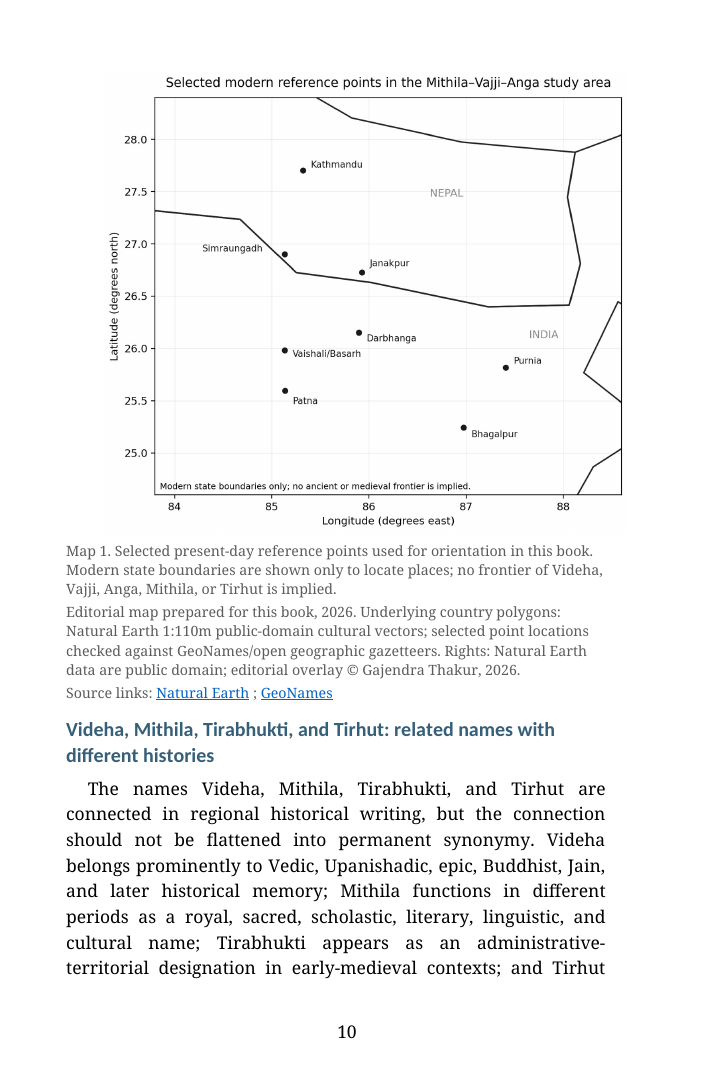
Chapter-specific source notes
- Primary chapter witness. Gajendra Thakur, Decoding the Panji of Mithila — Volume IV, formal Chapter 34, PDF pp. 365-371; formal Chapter 34. The HTML transcription is generated from the commit-pinned source PDF and retains the chapter boundary recorded in this edition.
- Internal structure. The repository source-heading inventory records 6 subordinate headings for this chapter: “34.1 Entry (291): Nagwad to Bhachhi-Rashadh-Berma”; “34.2 Entry (292): Nagwad to Kakraud and Betia-Ranipur”; “34.3 Entry (293): Nagwad to Samaul”; “34.4 Entry (294): Nagwad to Samaul-Masuriya of Purnea”; “34.5 Entry (295): Nagwad to Samauli-Kakraud”; “34.6 Index logic and coverage note”.
- Digital editorial method. The page keeps the preserved source text distinct from generated navigational, concordance, visual, and provenance apparatus. The synthetic reconstruction is explanatory only and is not evidence for an individual lineage or a determination of social or marital status.