Decoding the Panji of Mithila · Volume IV · Chapter 35
Nagwad-Ghusaut Continued: Bhatsimari, Chapahi, Kaivalakh, Satlakha, and the Turn to Ananlpur-Karmaha
Chapter 35. Nagwad-Ghusaut Continued:
Bhatsimari, Chapahi, Kaivalakh, Satlakha,
and the Turn to Ananlpur-Karmaha
   This chapter continues the Nagwad-Ghusaut register exactly
from the point reserved at the end of Chapter 34. It covers entries
(296) through (305) only. The first part remains within Nagwad,
but the destinations now become Bhatsimari-Dhamdaha,
Chapahi, Kaivalakh, Kakraud, and Satlakha. The second part
prepares the transition out of Nagwad by ending immediately

before entry (306), where Nagwad turns to Pilkhwar. Throughout
this chapter the method remains the same: each name is read as
a point in descent, a place-route, a marriage network, a title-
bearing branch, or a continuity marker.

35.1 Entry (296): Nagwad to Bhatsimari-Dhamdaha
   Entry (296) is headed Nagwad to Bhatsimari-Dhamdaha. It
opens with Chhotkani and then turns to Thakur Chhatrpati.
Chhotkani is linked through Sarisab-Madhupati-Kalanath and
Babhania-Ratan, which keeps the earlier Nagwad line tied to both
Sarisab and Babhania. Thakur Chhatrpati produces Loknath and
Shivnath through Baliyas-Pashupati-Vidyanath and Soderpur-
Gonu. A further Chhatrpati branch gives Jhontu, Dullah, and
Balha through Baliyas-Pashupati-Kashinath and Hariamb-Mohan.
Jhontu then produces Ram, Tarapati, and Hemkar, attached to
Pandua-Krishnapati-Bodh and Sarisab-Chan. In this way,
Bhatsimari-Dhamdaha is reached through a sequence of father-
son descent and repeated marriage controls, not by a single
village label.
   Thakur Ram is a dense branch-point inside the same entry. His
sons Mukund, Madhav, and Madhusudan are linked to Darihara-
Bhavesh-Vishnudatt and Sarisab-Chan. Another Ram branch
produces Krishna Lal through Sakararhi-Pandit Banai-Pandit
Jayanand and Soderpur-Chalbal. Additional Ram descendants,
Lutan, Nidhi, Raghuvir, and Jamahir, go through Sakararhi-
Bhainu-Ravanj-Nandeshwar and Sarisab-Ratinath. Mukund then
produces Keshav and Janardan through Mandar-Shobhan-Bhaiye
and Tisaut-Bhaiyo. Keshav carries the line through Baliyas-
Bahoran-Govardhan and Pali-Kanhai, while the later Keshav
continuations include Dhirendra and Virendra through Sarisab-
Shashidhar-Ramgopal and Baliyas-Madhusudan, and Bachchan
and Arjun through Darihara-Buddhinath-Digambar and
Budhwal-Ugradatt. Mahendra, placed at Karnapur-Sakuri, is also
preserved as a later branch, and his sons Mohan Ji and
Amarendra continue the modernized part of the descent.
Narendra, son of Thakur Janardan, leads through Narun-

Chhakkan-Shivnath and Khandbala-Sarvajit Singh; Narendra’s
son Surendragopal Ji is then linked to Dayori-Khandbala-
Muktinath and Hariamb-Shrinath. This final section makes Entry
(296) both a Bhatsimari-Dhamdaha settlement entry and a record
of later named scholarly or elite continuities.

35.2 Entries (297), (298), (299), and (300): Bhatsimari
and Chapahi
   Entry (297) continues Nagwad to Bhatsimari, with Chapahi in
the heading. It opens with Thakur Madhav and his sons Sahadev
and Gunjeshwar. The route is Digho-Hira-Bacha and Karmah-
Kirtinath. Gunjeshwar produces Narayan Ji through Sakararhi-
Dharanath-Nena and Sarisab-Nena. Another Gunjeshwar branch
gives Maheshwar through Baliyas-Babulal-Chaturbhuj and Pali-
Kulmani. Maheshwar’s sons Bhuvneshwar, Rameshwar, and
Parmeshwar move through Khandbala-Padmanabh Singh-
Dhuran Singh and Ghusaut-Faturi. Bhuvneshwar’s descendants
Mithilesh, Ashutosh, and Prasanna Kumar are linked to Khaual-
Komalkant-Trivenikant and Ghusaut-Kumar, while Rameshwar’s
descendants Gangesh, Avadhesh, and Arivlesh are linked to
Sarisab-Madan Gopal-Shambhugopal. These names show how the
Chapahi branch is not isolated: it pulls in Sarisab, Ghusaut,
Khandbala, Khaual, and Pali.
   The same entry also develops Thakur Madhusudan. His sons
Damodar, Balbhadra, Munar or Achyutanand, and others pass
through Kujouli-Jhadula-Natthu and Pali-Hibharan. A separate
line of Yashodhar, also read as Munai, and Gangadhar, also read
as Kunai, goes through Mandar-Shobhan-Dun and Budhwal-
Babujan. Thakur Damodar then produces Lakshmikant,
Jaymohan, Brajmohan, Ugramohan, and Rupmohan through
Baliyas-Shyamlal-Shriraman        and       Soderpur-Durmmil.
Lakshmikant’s descendants Padmakant, Vinodkant, and
Vinaykant     pass     through    Belaunch-Mushan-Baidyanath-
Shobhanath and Khandbala-Gudan Singh. Padmakant’s sons
Hemkant, Sumankant, Subhakant, Sujankant, Neerajkant,
Sudhan, and Sadankant extend the branch through Khandbala-

Babu Ushapati Singh and Mandar-Jhotahu. The record marks a
clear transition into titled and modern naming, but the older
Panji structure is still the same: father, son, moolgram
connection, and marriage route.
   Entry (298) takes Chapati/Chapahi forward through Thakur
Jaymohan. His descendants Vijaymohan, Abhaymohan, and
Sanjaymohan       repeat     the   Belaunch-Mushan-Baidyanath-
Shobhanath and Khandbala-Gudan Singh route. Vijaymohan is
further carried through Sihauli-Mandar-Vedanand Singh-
Dayasundar Singh and Ruchauli-Karmaha. Brajmohan’s son
Ashutosh Kant connects to Jajival-Tirthadatt-Loknath and
Karmah-Saday. The Gaurhanpur and Madhepur-Khandbala notes
are partly dotted, but they preserve a remembered outward
settlement direction. Ugramohan’s sons Pramod and Subodh are
linked through Ekhara-Parmanand-Shobhanath and Fanandah-
Manmohan. Pramod’s son Kundan is recorded through
Gaurhanpur-Sihauli-Mandar and the Abhayanath line. Subodh
and Rupmohan then continue through Belaunch-Mushan-Tejnath
and Jajival-Adinath-Dinanath, with an additional note for
Narayan Mahamahopadhyaya Sadde as kasthut. The final
modern fragment, including Sanju and the children Puja and
others, shows the living extension of the branch.
   Entry (299) continues Chapahi through Thakur Bathha. His
descendants Anupmohan, Chandramohan, Krishnamohan,
Dukhmohan, and the Sugawna-resident line hold the later
Chapahi frame. Chandramohan’s descendants Sudhir and Sushil
are linked to Pandua-Pandit Kashinath-Kirtinath and Sarisab-
Nena; Dukhmohan repeats that Pandua-Kashinath-Kirtinath and
Sarisab-Nena path. Munar or Achyutanand then gives
Indramohan, Gyanmohan, Rudramohan, Ugranand, and
Jivanand through Khaual-Vanshamani-Bhaiyanath and Sarisab-
Munan. Indramohan produces Govind and Gopal through Digho-
Thakur     Mangnu-Chaudhary    Kedarnath    and   Belaunch-
Harimohan. Gyanmohan’s Ashok Mohan, Alok Mohan, and
Surendra Mohan attach to Kujouli-Parmanand-Jagatanand and

Khaual-Gonu. Ugranand’s Kailash and Mahesh move through
Khandbala-Gaurinath-Umanath      and      Karmah-Gaurinath.
Jivanand’s Bhavanand and Dinanand connect with Narun-
Shivnath-Gaurinath and Khandbala-Babu Dhanpati Singh. The
entry ends with Yashodhar or Bhunai, Harimohan and Babuan,
and the Madan Mohan-Surya Mohan-Anand Mohan set. These
names keep Chapahi linked to Sakararhi, Kujouli, Satlakha,
Pawali, and Jajival.
  Entry (300) is the Saurath-linked Chapahi entry. Gangadhar or
Kunai produces Raghunandan, Shivnandan, and Yadunandan.
Raghunandan is linked through Ekhara-Damodar-Manmohan
and Ghusaut-Akshadhar; his sons Ravinandan and Ratinandan
appear in dotted continuation. Shivnandan produces Rajnandan
and Bhrigunandan through Sakararhi-Dukhiya-Shrinandan.
Yadunandan is linked to Teldiha-Pawali-Bhupnath-Shrinath,
while a Pokhrauni note remains dotted. Krishnalal then produces
Basaun, Baidyanath, Adinath, and Ravinath through Jajival-
Mansukh-Devidatt and Hariamb-Nena. Another branch through
Parmanand links to Soderpur-Pakshadhar-Lal and Karmah-
Dayanath. Ravinath’s descendants Hingu or Lakshminarayan,
Shrishtidhar, Purushottam, and the later Ghanshyam of
Taraunidari show how Chapahi-Saurath is carried into Pandua,
Sarisab, Sakararhi, and Karmah.

35.3 Entries (301) and (302): Nagwad to Kaivalakh
   Entry (301) turns the Nagwad register toward Kaivalakh. It
opens with Thakur Lutan and then Thakur Nidhi. Nidhi’s sons
Shridhar and Mohan are linked through Baliyas-Bacha-Jayram
and Soderpur-Nandishwar. Shridhar produces Haridev and
Jyotishi Shivanandan through Ekhara-Babunath-Anand and Pali-
Gumani. The Jyotishi title is important: it identifies a learned sub-
branch while still keeping the descent inside the Nagwad-
Ghusaut register. Jyotishi Shivanandan’s son Vidyapati is linked
to Darihara-Raghuvar-Lala and Pali-Jhotan. Tarapati’s line goes
through     Khaual-Modnarayan-Bachharan           and      Baheradhi-
Kamalpani; another Tarapati branch produces Lal and Gudar

through Mandar-Bhavesh-Vanshamani and Belaunch-Dhaniram.
The Gudar branch links to Darihara-Rajje-Bachchi and Karmah-
Jalpadatt, while later references through Hemkar, Narsingh,
Gopal, Dullah, Lakshman, Krishnadatt, Shyam, Bhagwandatt,
Anand, Vishweshwar, Gokul, and Shukdev show the widening of
Kaivalakh into multiple marriage routes.
  Entry (302) continues Kaivalakh. Thakur Anand produces
Babuni, Gangadhar, and Murari through Baliyas-Gangadhar-
Mani and Ekhara-Hridaymani. Gangadhar’s line is tied to Baliyas-
Babulal-Vagish and Soderpur-Babu. Thakur Gokul then produces
Yadunath and Kapileshwar through Darihara-Ballu-Bholi and
Narun-Manbharan.         Yadunath’s     descendants    Rudranand,
Ugranand, and Kripanand are linked to Darihara-Ram-Gulli and
Soderpur-Babu. Rudranand leads to Santosh, Vinay, and Bhaskar
of Pushkar-Bhramarpur. Ugranand produces Vivekanand,
Sharadanand, and Sachchidanand through Pandua-Pandit
Kashinath-Pandit Kirtinath. Kripanand is tied to Udanpur-Jajival
in a dotted form. Kapileshwar’s sons Chandranand and
Nityanand are placed through Bhuri Garh-Khandbala, and the
modern note for Professor Chandranandan and Professor
Nityanand gives the branch a later educational identity. The
Kaivalakh section therefore combines priestly, jyotishi, and
professorial titles with the older route grammar of the Panji.

35.4 Entries (303), (304), and (305): Nagwad through
Chanan, Kakraud, and Satlakha
   Entry (303) is an unqualified Nagwad continuation, but
internally it is dominated by Thakur Chanan and his many apara
branches. Thakur Balah first connects through Sarisab-
Hemangad-Hireshwar and Ekhara-Upadhyay Jyotishi Gunishwar.
Chanan then produces Bhaiya through Baliyas-Pashupati-
Mahabal-Kashinath and Hariamb-Mohan. A branch through
Bacha and Buddhi links to Ekhara-Kavinandan and Upadhyay
Jyotishi Harishwar, with Pali-Sonmani. Another Bawan branch
again uses Khaual-Raghunandan-Bhoranath and Fanandah-
Upadhyay Ishannath. Sanphul returns to Sakararhi-Pandit Yogi-

Pandit Tarapati and Belaunch-Janakinandan; Vaiyakaran
Thakurey goes to Darihara-Gang-Bachharu and Ekhara-Panai.
Bandhav, Pakhiya, Devanand, Sundar, Narun-Hridayram-Mani,
and other branches spread the Chanan line across Khaual,
Soderpur, Belaunch, Pawali, Karmah, Baliyas, and Sarisab. The
source then brings in Bhaiya’s sons Babujan and Ram Singh
through Kodariya-Lakshmipati-Diwan Bhawanidatt, Mandar-
Mahesh, and later Badrik through Baliyas-Bhagirath-Kiru and
Soderpur-Bachharu. Because the entry lists so many apara
routes, it must be read as a branch-map rather than as a simple
destination entry.
   Entry (304) identifies Nagwad to Kakraud. Thakur Dhan is its
first major node. His descendants connect to Soderpur-Pashupati-
Manik and Babhania-Manik; to Darihara-Raghunath-Vanshidhar
and Baheradhi-Maherman; to Khaual-Digambar-Kari and
Karmah-Nakdu; to Khaual-Jagyapati-Lakshminath and Soderpur-
Umai; to Khaual-Jivan-Bhagat and Pawali-Bhavdatt; to Satlakha-
Nilambar-Ankhi and Soderpur-Atmaram; and to Pawali-Andhar-
Meghnath in a dotted continuation. Mahamahopadhyaya Thakur
Vishwanath gives the learned center of the entry, with routes
through Khandbala-Chan-Bhulmani and Sakararhi-Ishwaridatt,
and through Mandar-Bani-Amritnath. The Madhurpati-Chhatari
continuation     joins    Ravual-Bandh-Bhanjan    and    Pawali-
Chandrapati, then Sarisab-Harpati-Durmiriv and Baliyas-Machal.
Thakur Lanaha produces Jagmohan and Kulmani through
Satlakha-Bhanu-Girdhar and Karmah-Vishnudatt. Kulmani’s son
Chiranjeev links to Baliyas-Amritnath-Krishnadev and Karmah-
Premnath. The later Thothan and Bawanu sections carry
Kakraud into Mandar, Darihara, Sakararhi, Narun, Jajival,
Pawali, and Pali, ending with the line of Lakshminarayan, son of
Babujan, before the next heading.
   Entry (305) is headed Nagwad to Satlakha and continues
directly out of the Kakraud material. It begins with Jaylal’s son
Manohar and Khandbala-Narayandatt. Hiramani’s descendants
Lakshmikant, Chhedu, and Shashikant connect to Kodariya-

Kanhaiyalal-Mukund Lal and Hariamb-Ram Krishna, with
another route through Darihara-Gehanath-Gulab and Karmah-
Jaynath. Lakshmikant produces Gaurikant and Dharani through
Belaunch-Lalit   Lal-Kapileshwar    and    Pandua-Avadhbihari.
Chhedu is linked to Khaual-Jhingur-Prannath and Digho-
Bhaiyalal; Gaurikant goes to Mandar-Mannu-Radharaman and
Pawali-Panchanand; Dharani goes to Darihara-Hiramani-
Shyamsundar and Soderpur-Gangadhar; and Shashikant goes to
Pandua-Avadhbihari-Janardan and Jajival-Bauk. Thakur Bachkan
and Thakur Mathuranath continue the descent through Khaual-
Bam-Maddu, Belaunch-Lalit Lal, and Soderpur-Amritnath-
Bachchelal with Budhwal-Dwarikanath. The entry ends with
Thakur Jayballabh, whose sons Kumar and Muni move through
Baliyas-Kaladhar-Kanhai and Ekhara-Hridaymani. Kumar’s sons
Shripati, Ramapati, Lakshmipati, and Prajapati attach to Pandua-
Ratnamani-Apuch and Pali-Kankamani, with Jajival-Babujan-
Bhaiyo and Hariamb-Parmanand repeated for Shripati and
Prajapati. Muni produces Suresh and Bhavdhar through Baliyas-
Babulal-Banmali and Pawali-Vishwanath. The last line, naming
Nakdu or Tulapati, Baldev, and Kamalapati, is kept as the bridge
into the next Nagwad entry.

35.5 Index Logic and Coverage Note for Chapter 35
   The index logic remains governed by Nagwad-Ghusaut. The
source has not yet left Nagwad; it is extending Nagwad through
Bhatsimari-Dhamdaha, Chapahi, Kaivalakh, Kakraud, and
Satlakha. The index remembers Nagwad under Ghusaut, and it
also recognizes Ghusaut as a higher Vatsa-linked control. Within
that frame, Kakraud and Kaivalakh appear as named scholarly or
settlement nodes, while Samauli and Satlakha function as route
controls that explain why the Nagwad lines repeatedly move
through Pali, Soderpur, Sarisab, Khandbala, and other moolgram-
linked destinations. The chapter therefore keeps Nagwad as the
governing register and reads each destination as an extension of
that register.

   Coverage in this chapter is exclusive: entries (296) through
(305) have been decoded here. Entry (306), “Nagwad to
Pilkhwar,” begins the next chapter. The next chapter should
therefore start with Nagwad-Pilkhwar and Nagwad-Rashadh
before following the source into the new Ananlpur-Karmaha
opening at entry (308).
Source structure and verification apparatus
Editorial source apparatus. This apparatus is descriptive, not interpretive. It records the source-controlled structure used to verify that this page corresponds to formal Chapter 35 of Decoding the Panji of Mithila — Volume IV. The chapter text above is preserved from PDF pp. 371-379; formal Chapter 35 in the commit-pinned authoritative source. It is not merged with a neighboring chapter, appendix, annexure, or independent front/back-matter unit. The internal headings below come from the repository’s source-heading inventory and are retained as navigational and audit evidence; showing them here does not turn those headings into separate publications or add claims that are absent from the source.
Internal source headings
- 35.1 Entry (296): Nagwad to Bhatsimari-Dhamdaha
- 35.2 Entries (297), (298), (299), and (300): Bhatsimari and Chapahi
- 35.3 Entries (301) and (302): Nagwad to Kaivalakh
- 35.4 Entries (303), (304), and (305): Nagwad through Chanan, Kakraud, and Satlakha
- 35.5 Index Logic and Coverage Note for Chapter 35
Source-text concordance
Nagwad-Ghusaut · Continued · Bhatsimari · Chapahi · Kaivalakh · Satlakha · Turn · Ananlpur-Karmaha · continues · register · exactly · point · reserved · covers · entries · first · part · remains · within · Nagwad · destinations · become · Bhatsimari-Dhamdaha · Kakraud · second · prepares · transition · ending · immediately · entry · turns · Pilkhwar · Throughout · method · name · read · descent · place-route · marriage · network · title · bearing · branch · continuity · marker · headed · opens · Chhotkani · Thakur · Chhatrpati · linked · Sarisab-Madhupati-Kalanath · Babhania-Ratan · keeps · earlier · line · tied · Sarisab · Babhania · produces · Loknath · Shivnath · Baliyas-Pashupati-Vidyanath · Soderpur · Gonu · gives · Jhontu · Dullah · Balha · Baliyas-Pashupati-Kashinath · Hariamb-Mohan · Tarapati · Hemkar · attached · Pandua-Krishnapati-Bodh · Sarisab-Chan · reached · sequence · father · repeated
Boundary verification. In the formal sequence this chapter follows Volume IV Chapter 34, “Nagwad-Ghusaut after Akaur: Bhachhi, Ranipur, Samaul, Masuriya, and Kakraud” and precedes Volume IV Chapter 36, “Nagwad to Pilkhwar and Rashadh, then Analpur-Karmaha before Tarouni”. The chapter extractor begins at the verified formal Chapter 35 marker and stops at the next verified formal chapter marker; for a final chapter it stops before recognized book-level back matter. The concordance above is generated only from distinct terms already present in this chapter’s preserved source text. It is provided for discovery, comparison, and audit, not as an automated judgment about persons, lineages, status, kinship, marriage eligibility, or historical truth.
Illustrated research apparatus
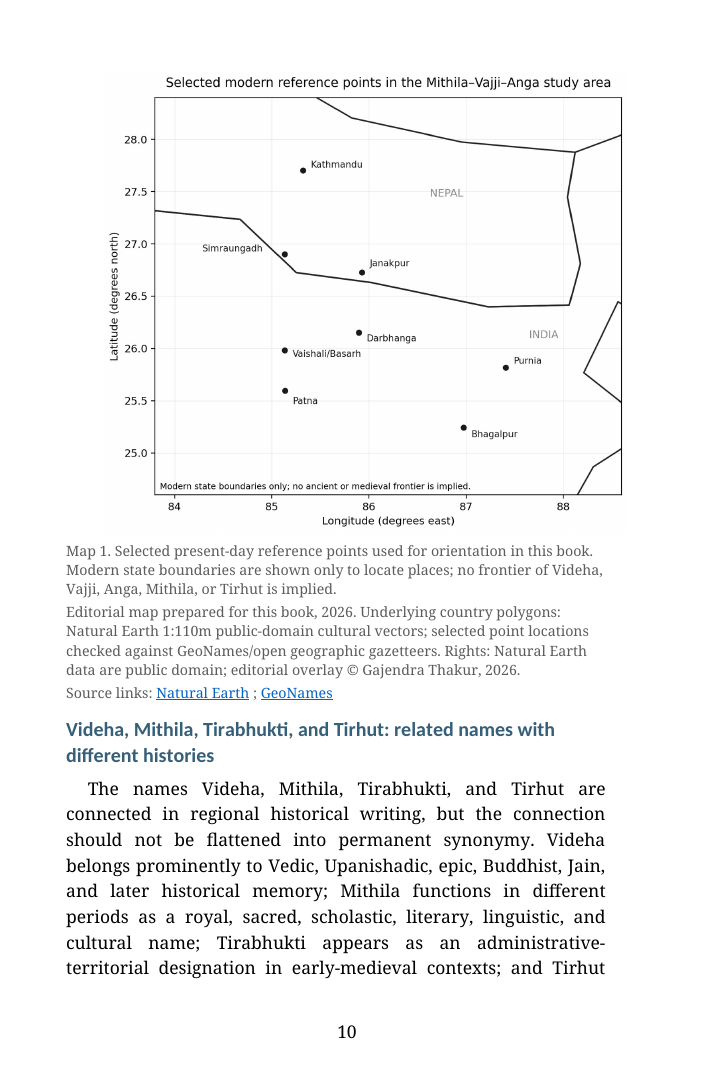
Mithila · Vajji · Anga
Chapter-specific source notes
- Primary chapter witness. Gajendra Thakur, Decoding the Panji of Mithila — Volume IV, formal Chapter 35, PDF pp. 371-379; formal Chapter 35. The HTML transcription is generated from the commit-pinned source PDF and retains the chapter boundary recorded in this edition.
- Internal structure. The repository source-heading inventory records 5 subordinate headings for this chapter: “35.1 Entry (296): Nagwad to Bhatsimari-Dhamdaha”; “35.2 Entries (297), (298), (299), and (300): Bhatsimari and Chapahi”; “35.3 Entries (301) and (302): Nagwad to Kaivalakh”; “35.4 Entries (303), (304), and (305): Nagwad through Chanan, Kakraud, and Satlakha”; “35.5 Index Logic and Coverage Note for Chapter 35”.
- Digital editorial method. The page keeps the preserved source text distinct from generated navigational, concordance, visual, and provenance apparatus. The synthetic reconstruction is explanatory only and is not evidence for an individual lineage or a determination of social or marital status.