Decoding the Panji of Mithila · Volume IV · Chapter 36
Nagwad to Pilkhwar and Rashadh, then Analpur-Karmaha before Tarouni
Chapter 36. Nagwad to Pilkhwar and Rashadh,
then Analpur-Karmaha before Tarouni
   This chapter begins at the point reserved at the end of Chapter
35. It covers entries (306) through (319) only. The first two entries
close the Nagwad-Ghusaut sequence by carrying it to Pilkhwar
and Rashadh. Entry (308) then opens a new gramarambh,
Analpur-Karmaha. The chapter follows that Analpur register
through Yamsam, Ranti-Motipur, Pilkhwar, Janadh-Sugawna,
Madar, Kalikapur-Supaul, Nahar, Rampura, and Manikauli, but it
stops before entry (320), where Tarouni-Karmaha begins as a
separate register.

36.1 Entry (306): Nagwad to Pilkhwar
   Entry (306) continues Nagwad to Pilkhwar. The opening line
brings Thakur Babulal into the sequence, but the operative
descent quickly moves through Thakur Shyamlal, whose sons
Jaylal and Kamalnath are attached to Darihara through Babnu
and Kanhai, and to Pali through Arjun. Jaylal is connected by
marriage to an incomplete Soderpur line ending in Madhusudan
and to Narun-Bachchi. Kamalnath is carried through Baliyas-
Girdhari-Lal and Jajival-Dharmadatt.
   Thakur Lakshminath then becomes the larger branch point.
His sons Bodhnath and Amritnath are placed through Darihara-
Shivdatt-Gauridatt    and    Pali-Arjun. Bodhnath    produces
Abhaynath, who is attached to Khoa l-Hardatt-Umapati and Pali-
Shaktinath. Abhaynath’s descendants include Durganath,
Deonath, Vindhyanath, and Jagannath. Durganath leads to
Yadunath and Ganeshnath through Khandbala-Shubhankar
Singh-Gudan Singh and Belaunch-Harihardatt. Yadunath is
further linked to a Soderpur-Anand Kishor-Chaudhary Nirsu line
and to Baliyas-Dhirnath.
  The Deonath and Vindhyanath branches show the late
expansion of this Nagwad line. Deonath’s sons Indranath and
Tejnath move through Jajival-Babujan-Bhaiyo and Hariamb-
Parmanand; Indranath is then tied to Soderpur through Dukarni,

Girja, and Pitambar, and to Kachhra-Pali-Mangnu. Vindhyanath
produces Baidyanath, Dinanath, Udaynath, and Dhairyanath
through Khoa l-Balbhadra-Mukund and Hariamb-Jageshwar.
Baidyanath’s sons Ganganath and Kashinath continue through
Jajival-Vishnukant-Vaiyakaran Sadanand and Pali-Babura. The
line ends with scholarly and modern notes, including
Dhairyanath’s son Kishornath, marked M.S.C., and Jagannath’s
link to Baliyas-Ram-Chandranand and Phanandah-Mangu.

36.2 Entry (307): Nagwad to Rashadh
   Entry (307) closes the Nagwad-Ghusaut coverage before the
new Analpur opening. Thakur Amritnath is linked through Khoa
l and the Mahamahopadhyaya line of Nenana/Jani, then to
Sarisab-Dinanath. Thakur Sanphul’s son Babuan is connected to
Jajival-Yar-Naga and Alay-Jhaudun. The principal scholarly
branch is through Vaiyakaran Thakure, whose sons Kavi
Matikant and Venikant are attached to Jajival-Chhokar-Babnu
and Pali-Hemkar. A collateral line of Vaiyakaran Raghunath and
Hemnath is also given.
   Kavi Matikant links to Darihara-Rohini-Badan and Digho-
Thakur Bachha. Venikant links to Soderpur-Atmaram-Rate and
Darihara-Nanu. Premdatt, an apara son, moves through Baliyas-
Jagannath-Lokeshwar and Ghusaut-Jivan. Hemnath’s son
Bachharu produces Brajmohan through Darihara-Rameshwar-
Gokulnath and Pabouli-Surwai. This Brajmohan line is heavily
marked by modern professional titles: Vakil Brajmohan, M.S.
Narendramohan, Pranmohan, Surendra Mohan, a principal and
lawyer, Virendra the lawyer, Yogendramohan, engineer
Nripendramohan, and additional late professional descendants.
The Rashadh entry therefore ends the Nagwad series by showing
how a traditional register absorbed advocates, engineers,
principals, and modern educational credentials without
abandoning the old descent and marriage formula.

36.3 Entry (308): Analpur-Karmaha opens
   Entry (308) begins with the formula “ath Analpur Karmaha
gramarambh.” This is a clear change of register. The first
ancestor is Chitradhar, whose descendants include Gauridatt,
Vaiyakaran Rajju, Vaiyakaran Riddhi, Pandit Neya or Hemnath,
Kanhai, Ram, and Mannu. The register immediately links
Chitradhar’s line to Pandua-Pandit Mathuresh-Pandit Vanshidhar
and Gangoli-Lakshmikant, with a collateral Hiramani branch
through Mandar-Chan-Moti and Soderpur-Bandhu.
   The entry is built by repeated apara expansions. Jalapadatt is
tied to Sakararhi-Yogi-Pandit Tarapati and Belaunch-
Janakinandan. Chanan links to Baliyas-Harijiv-Chilka and
Soderpur-Rameshwar. Shambhunath and Dinanath connect
through Pabouli-Hatthi-Upendra and Babhania-Chaturbhuj.
Kishori is taken through Gangoli-Lakshmikant-Kriparam and
Mandar-Bhikhari. Bholan is tied to Sakararhi-Abhinandan-
Umapati and Pandit Pali-Shulpani. Babunath links through
Satlakha-Narayan-Someshwar and Pali-Bhavesh. Other apara
sons    include      Vanshamani,       Narayandatt,      Vishnudatt,
Krishnakinkar, Guni, Jayanand, Ghoghan, Harangi, Vidyanath,
and Hemnath. This opening entry therefore works as a
genealogical inventory: it establishes the Analpur-Karmaha
descent field before the later destination-specific entries begin.

36.4 Entry (309): Analpur to Yamsam
   Entry (309) takes the Analpur line toward Yamsam. Bharathi’s
son Gudar is placed through Soderpur-Rameshwar-Nandishwar
and Pali-Jayadatt. Apara lines include Vishwanath through
Jajival-Gonan-Chalballi and Pali-Bhavadatt, and Siddhinath with
Abhaynath through Darihara-Purushottam-Ishwaridatt and
Karmaha-Purushottam. Another apara branch goes through Khoa
l-Dayan-Bharu and Hariamb-Jivan; Tanek goes through Darihara-
Rohini-Jhaun and Soderpur-Shyamram.
   The Bihari-Kedarnath line is also important. Kedarnath is tied
to   Sarisab-Prannath-Hridaynath       and   Darihara-Urvadhar.

Additional daughters move through Soderpur-Pashupati-Nehal
and Mandar-Ranjan, and through Darihara-Vishnudatt-Gehenath
and Ghusaut-Ghoghan. Kedarnath himself generates further
marriage paths to Soderpur-Nanu-Vaiyakaran Riddhinath, Pali-
Deonath, Mandar-Ramdhan-Thithar, and Karmaha-Harihardatt.
Dwarikanath and Jaynath continue the web through Baliyas-
Adinath-Bhikhari,   Khoa   l-Vaiyakaran   Hardatt-Kashinath,
Khandbala-Ratneshwar-Bammoli,     and   Baliyas-Revatiraman-
Lanha.

36.5 Entry (310): Analpur to Ranti and Motipur
   Entry (310) moves from Analpur toward Ranti, Jagatanandan,
and Motipur. Jaynath’s collateral daughters are linked to
Darihara-Manik-Bholanath, Hariamb-Ratnu, Dharora-Baliyas-
Goshain-Nanhku, and Panichobh-Vidyanand. Pyare is linked to
Dih-Darihara-Manik-Jalapadatt and Hariamb-Venidatt. Riddhi
connects to Sarisab-Ratinath-Bechan and Mandar-Ishannath,
with a separate Darihara-Shivdatt-Babnu and Sarisab-Kashinath
line.
   The Neya branch produces Kuber, Raghav, and Banmali
through Soderpur-Basudev-Bhawanidatt and Hariamb-Prannath.
Kuber’s sons Sundar and Gopal are tied to Basuari-Baliyas-
Pranpati-Kaladhar and Soderpur-Baburam. Sundar produces
Jagatanand and Chiranand, with Jagatanand leading to
Sharadanand through Chhamu-Sakararhi-Lakshminath-Gulab
and Karmaha-Rangalal. Sharadanand links to Nahas-Khoa l-
Rajeshwar-Dhananjay Chaudhary and Soderpur-Kishordatt. The
entry also preserves a medical/professional branch through
Mushan’s sons Ramkrishna and Dr. Baldev. Dr. Baldev’s
descendants     include    Chandrashekhar,      Indrashekhar,
Shashishekhar, and later names, and the entry ends by carrying
Chandrashekhar toward Sukhait-Khoa l-Chandranand.

36.6 Entries (311) and (312): Analpur to Pilkhwar and
Janadh-Sugawna
   Entry (311) continues Analpur toward Pilkhwar and names
Jaykrishna Jha and Mukund Jha of Bharam. It begins as a
continuation from the preceding Chandrashekhar line, then
moves to Raghav, linked with Khandbala-Vaiyakaran
Krishnaram-Thothi and Karmaha-Kalanath, and to Belaunch-
Fakiran-Manilal and Baliyas-Harinath. Kanhai’s descendants
Bhulan, Jagannath, and Baidyanath or Baiju are tied to Belaunch-
Bhavnath-Juraun and Phanandah-Dharanath. Baiju’s son
Jaykrishna is linked to Baliyas-Rai Rupnath-Raimohan Lal and
Budhwal-Babulal; Jaykrishna’s son Mahavir then connects to
Pandua-Thadu-Kanhai and Pali-Shaktinath.
   The same entry keeps Mannu’s descendants within the
Analpur field. Mannu produces Babue and Gopal through
Sarisab-Bhikhi-Bhavnath and Pandua-Chan. A royal or Oini-
linked branch is also noted through Babu Jagatnarayan and Babu
Hira or Hridaynarayan. Mukund, son of Babue, is linked to
Khandbala-Thanu-Hridaynidhi and Darihara-Dhira. Entry (312)
then carries the Analpur line to Janadh, Sugawna, Gotham, and
Deodiha-Kapileshwar Jha. Gopal’s sons Banmali and Nathuni
move through Baliyas-Vinma-Manmohan and Hariamb-
Kashinath. Hiramani’s son Mohanlal links to Soderpur-Kuli-
Bhaiyan and Budhwal-Vagish. Jalapadatt’s descendants Nilambar,
Achammat, Thakurdatt, Jyotidatt, and Raja carry the line through
Ahil-Khoa l-Lakshman-Hardatt and Sarisab-Chanan, and further
through Oini, Mandar, Jajival, Sakararhi, and other marriage
settlements.

36.7 Entries (313) and (314): Analpur to Madar, Ranti,
and Kalikapur-Supaul
   Entry (313) moves to Madar and names Balel Jha, while also
referring to the Ranti-Babulal lineage. Kishori’s son Nathe is
linked through Kujouli-Bachharu-Krishnadatt and Baheradhi-
Tejan. Nathe produces Mahiman, Balel, and Chumman. Mahiman

is connected to Dharora-Baliyas-Madan Singh-Muralidhar-Nanu
and Hariamb-Mansukh. Balel goes through Sakararhi-Sudhakar-
Krishnaram and Hariamb-Subodh, while Chumman goes through
Jajival-Kari-Bachchu and Khoa l-Nehal-Vidyanath. The entry then
restores the Babulal line through Balah’s son Manik. Manik
produces Babulal through Darihara-Harijiv-Rohini and Soderpur-
Raghuvir. Babulal’s sons Yashodhar, Gangadhar, Bokan, and Luni
branch through Pabouli-Bhaiyan-Horil and Sakararhi-Bachha.
   Entry (314) names Kalikapur of Supaul, Khamgara, and
Vanshidhar Jha. Kamalnayan’s son Gangadatt connects through
Mandar-Aniruddh-Hemkar and Karmaha-Devanand, while
another son Bachharu moves through Narun-Kavikrishna-
Sudarshan and Phanandah-Trilochan. Gangadatt’s son Sanphul is
linked to Baliyas-Girish-Bhanudatt and Hariamb-Barju. The
Bachdaru/Bachharu branch produces Bodhan and Poshan;
Bodhan connects with Sarisab-Sadashiv-Saheb and Hariamb-
Lakshmikant, while Poshan leads to Grihinath through Soderpur-
Pashupati-Madhav and Mandar-Ramakant. The Radhanath line
produces Gudar, Damodar, and Sundar, and the apara Radhanath
branch gives a Mahia-Soderpur line through Lala, Nanu, and
Manmohan, with the opposite route through Rakhwari-Hariamb-
Kirtinath. The Kalikapur entry thus stands as a late, multi-
settlement expansion of the Analpur-Karmaha register.

36.8 Entries (315), (316), (317), (318), and (319):
Analpur to Nahar, Rampura, Manikauli, and the close
before Tarouni
   Entry (315) is headed with “Shri Ganeshaya Namah” and
moves Analpur-Karmaha to Nahar. Loknath’s descendants are
Jivanath, Dayanath, and Vishwanath. Jivanath produces
Grihinath through Pandua-Rohan-Rudramani and Soderpur-
Harpati, with further daughters linked to Soderpur-Atmaram-
Rate, Darihara-Nanu, Jajival-Mansukh-Bhimdatt, and Karmaha-
Durivaya. Dayanath produces Eknath, Chetnath, and Yognath
through    Mandar-Ishannath-Jhingur    and    Takwal-Bachha.

Chetnath’s line leads to Janardan or Hitnath and Ritnath through
Belaunch-Chhaban-Nehnath and Dighoi-Hira. The entry also
notes modern education through Muktinath’s descendants:
Pramodnath, marked M.A., Modnath, Manojnath, and their
children Deepaknath and Prakashnath.
   Entry (316) continues Analpur to Nahar. Vishwanath’s
descendants Harinath, Nena, Premnath, Mukund, and Radhanath
are linked through Pandua-Mansukh-Balbhadra and Soderpur-
Pakhiya, with a parallel Darihara-Dhira-Bhagwandatt and
Hariamb-Poshan route. Harinath’s sons Taranath and Kamalnath
are tied to Mandar-Manik Singh-Bihari Singh and Soderpur-
Someshwar. Taranath’s descendants include Siddhinath,
Ishanath, and Dr. Professor Vednath, explicitly identified as a
writer of Maithili language and literature. Ishanath’s line
includes Shambhunath the advocate and Shivnath the advocate;
Dr. Professor Vednath’s sons Bhavtosh, Madhav, and Ashutosh
move through Mandar-Janardan-Vaiyakaran Durgadhar and Pali-
Mahamahopadhyaya Dr. Sir Ganganath.
   Entry (317) sends the same register to Rampura. Premnath’s
descendants Muktinath, Jagannath, Amritnath, and Satish or
Lilanath are connected through Digho-Bacha-Balmukund and
Pandua-Thadu. Muktinath produces Ganesh and Nagendra
through Khoa l-Yuvraj-Ghanshyam and Tisaut-Chiranjeev.
Ganesh’s descendants Sanjay and Mihir link to Narun-Pandit
Lutan-Pandit Nirsu or Vishwanath and Baliyas-Harishchandra.
Nagendra gives Shaktarnath, Pritinath, and Ashutosh Kumar
through      Baliyas-Murari-Amarkant     and   Pabouli-Dinath.
Jagannath’s sons Baidyanath and Vindhyanath are connected to
Khoa l-Aniruddh-Shivnandan and Soderpur-Bhairav; Vinod-like
late lines include Dr. Umesh in a dotted Gangoli relation. The
entry closes with Satish/Lilanath’s descendants Narendra,
Surendra, Virendra, Dhirendra, and Devendra through Parhat-
Sakararhi-Kanhai-Durganand and Palamu-Karmaha-Kheli.
  Entry (318) moves to Nahar-Manikauli. Radhanath’s sons
Tejnath, Shashinath, Dwarikanath, and Somnath are linked to

Mandar-Shambhu-Govardhan and Sarisab-Adinath. Tejnath goes
through Kujouli-Durganath-Chandranath and Narun-Surendra;
Shashinath through Sakararhi-Markandeya-Satyanarayan and
Ghusaut-Madhav. A second cluster begins with Jahli and
Jalapadatt, whose descendants Mahapurush and Vishnudatt lead
to Digho-Bhairavdatt-Narottam and Baliyas-Girish. Mahapurush
is tied again to Soderpur-Pashupati-Manik and Babhania-Bhani.
Nena’s descendants Jatadhar, Shashidhar, and Gangadhar draw
Darihara, Soderpur, Tat ail-Sakararhi, and Budhwal into the
same field; the end of the entry notes Brajnath and the Rohar
connection, and an apara Babue branch through Ayodhyanath
and Banmali.
   Entry (319) is the last Analpur unit included in this chapter.
Vishnudatt’s branches connect to Dharora-Baliyas-Muralidhar-
Nanu and Hariamb-Mansukh; Yashodhar and Feke go through
Kujouli-Janakinath-Eknath and Pandua-Pandit Chan. Yashodhar’s
Khuni branch is linked to Sakararhi-Kharanandeshwar-Lal and
Hariamb-Nena. Feke’s lines include Soderpur-Nandishwar-Teni,
Budhwal-Hemnath, and a Nirsu branch through Sakararhi-
Lekhnath-Babua and Karmaha-Ganeshdatt. Nirsu’s daughter then
connects    to    Darihara-Girdhari-Bechan    and    Khandbala-
Bachharan. With this, the Analpur-Karmaha chapter closes. Entry
(320), beginning with the formula for Tarouni-Karmaha, is left for
the next chapter.

36.9 Index Logic and Coverage Note for Chapter 36
   The index logic has two layers in this chapter. Entries (306)
and (307) remain under the already established Nagwad-Ghusaut
frame, because they continue Nagwad to Pilkhwar and Rashadh
before the register changes. Entry (308) supplies the new
controlling formula, “Analpur Karmaha gramarambh.” From that
point onward the entries are read under Karmaha, not under
Nagwad, even when they repeatedly draw in Soderpur, Pali,
Hariamb, Sarisab, Khoa l, Darihara, Mandar, and other marriage-
side settlements.

   Coverage in this chapter is exclusive: entries (306) through
(319) have been decoded here. Entry (320), “Tarouni to
Ramnagar,” begins the next chapter and should be read under
the Tarouni-Karmaha opening rather than as a continuation of
Analpur.
Source structure and verification apparatus
Editorial source apparatus. This apparatus is descriptive, not interpretive. It records the source-controlled structure used to verify that this page corresponds to formal Chapter 36 of Decoding the Panji of Mithila — Volume IV. The chapter text above is preserved from PDF pp. 380-388; formal Chapter 36 in the commit-pinned authoritative source. It is not merged with a neighboring chapter, appendix, annexure, or independent front/back-matter unit. The internal headings below come from the repository’s source-heading inventory and are retained as navigational and audit evidence; showing them here does not turn those headings into separate publications or add claims that are absent from the source.
Internal source headings
- 36.1 Entry (306): Nagwad to Pilkhwar
- 36.2 Entry (307): Nagwad to Rashadh
- 36.3 Entry (308): Analpur-Karmaha opens
- 36.4 Entry (309): Analpur to Yamsam
- 36.5 Entry (310): Analpur to Ranti and Motipur
- 36.6 Entries (311) and (312): Analpur to Pilkhwar and Janadh-Sugawna
- 36.7 Entries (313) and (314): Analpur to Madar, Ranti, and Kalikapur-Supaul
- 36.8 Entries (315), (316), (317), (318), and (319): Analpur to Nahar, Rampura, Manikauli, and the close before Tarouni
- 36.9 Index Logic and Coverage Note for Chapter 36
Source-text concordance
Nagwad · Pilkhwar · Rashadh · Analpur-Karmaha · Tarouni · begins · point · reserved · covers · entries · first · close · Nagwad-Ghusaut · sequence · carrying · Entry · opens · gramarambh · follows · Analpur · register · Yamsam · Ranti-Motipur · Janadh-Sugawna · Madar · Kalikapur-Supaul · Nahar · Rampura · Manikauli · stops · Tarouni-Karmaha · separate · continues · opening · line · brings · Thakur · Babulal · operative · descent · quickly · moves · Shyamlal · whose · sons · Jaylal · Kamalnath · attached · Darihara · Babnu · Kanhai · Pali · Arjun · connected · marriage · incomplete · Soderpur · ending · Madhusudan · Narun-Bachchi · carried · Baliyas · Girdhari-Lal · Jajival-Dharmadatt · Lakshminath · becomes · larger · branch · Bodhnath · Amritnath · placed · Shivdatt-Gauridatt · Pali-Arjun · produces · Abhaynath · Khoa · l-Hardatt-Umapati · Shaktinath · Abhaynath’s · descendants
Boundary verification. In the formal sequence this chapter follows Volume IV Chapter 35, “Nagwad-Ghusaut Continued: Bhatsimari, Chapahi, Kaivalakh, Satlakha, and the Turn to Ananlpur-Karmaha” and precedes Volume IV Chapter 37, “Tarouni-Karmaha: Ramnagar, Kaivalakh, Pindaruch, Virsayar, Nanour, and the Aama-Bounsi Extension”. The chapter extractor begins at the verified formal Chapter 36 marker and stops at the next verified formal chapter marker; for a final chapter it stops before recognized book-level back matter. The concordance above is generated only from distinct terms already present in this chapter’s preserved source text. It is provided for discovery, comparison, and audit, not as an automated judgment about persons, lineages, status, kinship, marriage eligibility, or historical truth.
Illustrated research apparatus
Mithila · Vajji · Anga
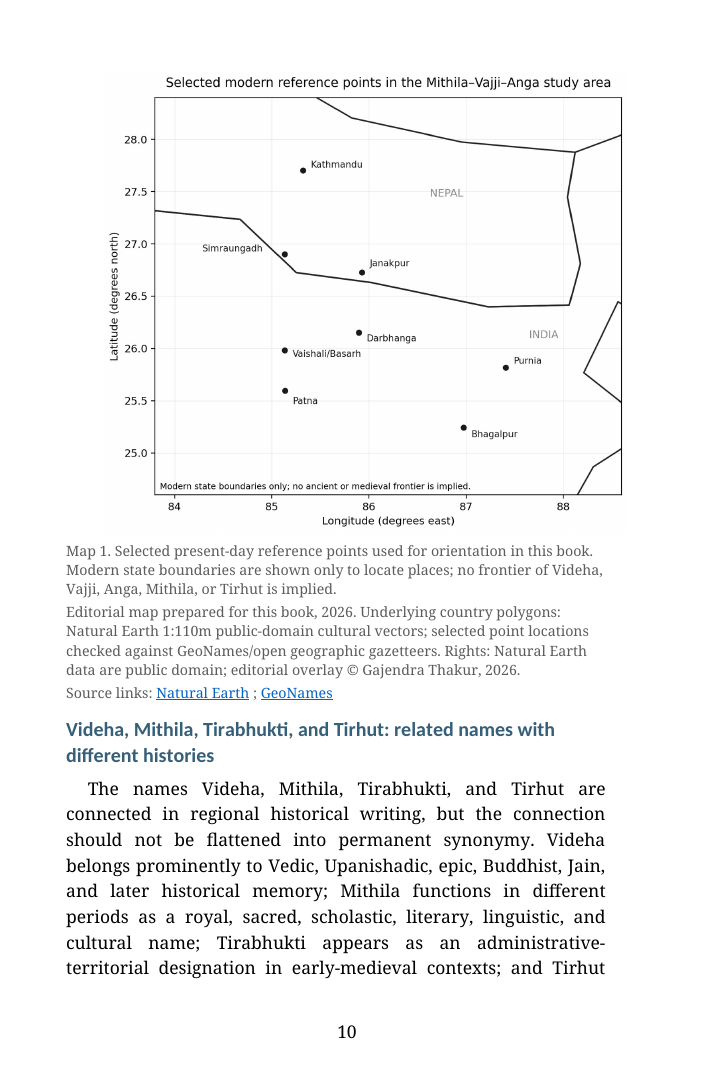
Chapter-specific source notes
- Primary chapter witness. Gajendra Thakur, Decoding the Panji of Mithila — Volume IV, formal Chapter 36, PDF pp. 380-388; formal Chapter 36. The HTML transcription is generated from the commit-pinned source PDF and retains the chapter boundary recorded in this edition.
- Internal structure. The repository source-heading inventory records 9 subordinate headings for this chapter: “36.1 Entry (306): Nagwad to Pilkhwar”; “36.2 Entry (307): Nagwad to Rashadh”; “36.3 Entry (308): Analpur-Karmaha opens”; “36.4 Entry (309): Analpur to Yamsam”; “36.5 Entry (310): Analpur to Ranti and Motipur”; “36.6 Entries (311) and (312): Analpur to Pilkhwar and Janadh-Sugawna”; “36.7 Entries (313) and (314): Analpur to Madar, Ranti, and Kalikapur-Supaul”; “36.8 Entries (315), (316), (317), (318), and (319): Analpur to Nahar, Rampura, Manikauli, and the close before Tarouni”; ….
- Digital editorial method. The page keeps the preserved source text distinct from generated navigational, concordance, visual, and provenance apparatus. The synthetic reconstruction is explanatory only and is not evidence for an individual lineage or a determination of social or marital status.