Decoding the Panji of Mithila · Volume IV · Chapter 37
Tarouni-Karmaha: Ramnagar, Kaivalakh, Pindaruch, Virsayar, Nanour, and the Aama-Bounsi Extension
Chapter 37

Tarouni-Karmaha: Ramnagar, Kaivalakh, Pindaruch,
Virsayar, Nanour, and the Aama-Bounsi Extension
   Coverage. This chapter continues exactly from the next source
segment after the Analpur-Karmaha chapter. It covers entries
(320) to (327) only. The governing register is Tarouni-Karmaha:
the source opens the segment with the formula "atha Tarouni
Karmaha gramarambh" and then lets the Tarouni line move
through Ramnagar, Kaivalakh, Pindaruch, Virsayar, Nanour, and
the Aama-Bounsi extension in Uttar Pradesh. The analysis stops
before the new Nadura/Naduar-Karmaha gramarambh at entry
(328), which belongs to the next chapter.
   Method. The reading follows the same rule used in the
previous chapters: each name is treated as a node in a descent-
and-marriage network. A phrase such as "X suta Y" is read as
descent, while "village-name san" indicates the marriage or
affiliating route through which the branch is being tied to
another settlement, mool, or sub-branch. Titles such as
Vaiyakaran, Jyotishi, Doctor, Professor, Advocate, Principal, and
M.A. are not decorative; they mark later scholarly or professional
status inside the same genealogical chain.

1. Entry (320): Tarouni to Ramnagar
   Entry (320) begins the Tarouni-Karmaha register. Parashuram
is the first organising ancestor in this block. His sons are Bhaiya,
Dukhan, Vishwanath, and Ratan, and the register immediately
anchors them through Sarisab, Naroun, and the wider marriage
field. Bhaiya is carried through the Balias route; Dukhan is
expanded through Soni, Baidyanath, Jagan or Jagannath, and
Kalanath; and the entry carefully separates an additional
Vishnudatt line that is joined through Soderpur and Khaual. This
is the first indication that the Tarouni branch is not a single
village-centred family, but a dispersed chain made legible
through marriage routes.

   The Soni line is important because it produces Shivnath,
Rudranath, and Deonath. Rudranath is then expanded through
Shitaladatt, Rajnath, Manbharan, Jaynath, and Trailokyanath.
The repeated links to Darhara, Pabauli, Sakararhi, Jajiwal, Balias,
and Pali show the branch working across several older Panji
circuits. The entry also records a Babanu/Babnu line connected
with Khori-Soderpur, Chilka, Bhaiyaram, and Babhanigam. The
entry therefore sets the Tarouni-Karmaha block inside a multi-
village matrix before any later scholarly or modern branch
appears.

2. Entry (321): Ramnagar continuation
  Entry (321) continues Ramnagar rather than opening a new
gramarambh. Rajnath is followed through Musha and
Manmohan, while Manbharan produces Muktinath, also named
Musahad in the source. The line moves through Darhara, Jajiwal,
Dharora-Balias, Dhenu-Pabauli, Ratouli-Darhara, Gangauli,
Khaual, Kujouli, and Soderpur. This kind of continuation is
characteristic of the Panji: the apparent village heading is stable,
but the living line is shown by its successive marriage and
descent turns.
   Deonath provides another dense sub-branch. Through Doman,
the line reaches Darhara and Soderpur; through other sons or
alternate sons it reaches Satlakha, Naroun, Pali, Sarisab, Balias,
Mandar, and Fanandah. Doman then generates further links
through Balias, Soderpur, and Digho. The register is not merely
recording names; it is preserving which route is to be followed if
one has to locate marriage eligibility, lineage memory, or branch
continuity.

3. Entry (322): Tarouni to Kaivalakh, Rajendra Jha
   Entry (322) carries the Tarouni stream into Kaivalakh and
names Rajendra Jha. Jagan, also read as Jagannath, produces
Dharanath,     Gokulnath,    Dayanand,   and     Mahapurush.
Mahapurush then leads to Govind and Shivi, with repeated links
through Belounch, Hariamb, Soderpur, Ghusaut, Sakararhi,

Mandar, Takbal, and Kujouli. The repetition of Mahapurush and
the doubled Soderpur-Ghusaut links in the source should be read
as branch reinforcement, not as accidental redundancy: the
register is making sure that the Kaivalakh branch remains
traceable from more than one marital route.
   Kalanath gives Shyamnath, Chhotkani, and Prabhunath.
Shyamnath is connected to Soderpur and Pali; Chhotkani opens
multiple sons: Faturi, Bhushan, Govind, Chhakodi, and the Halli-
Rabuni line. Chhakodi leads to Chandrashekhar, and
Chandrashekhar leads to Rajendra, from whom the entry takes
one of its named identities. Rajendra is then linked to Lohna-
Ratouli-Darhara and to the Pilkhwar-Sarisab frame. Thus
Rajendra Jha is not introduced as a stand-alone modern name; he
is positioned as a terminal or near-terminal figure in a long
Tarouni-Kaivalakh descent chain.

4. Entry (323): Tarouni to Pindaruch, Channu Jha
   Entry (323) shifts to Pindaruch and names Channu Jha. Rabuni
produces Ugreswar, Sonu or Rudreshwar, and Channu or
Chandeshwar. Ugreswar is attached through Soderpur, Belounch,
Pandua, and the Keshav route. Channu and Rameshwar continue
through Pandua, Belounch, Digho, and Ghusaut. The naming
pattern marks a branch in which the same core descent is being
triangulated through several respected marriage settlements.
   The entry then draws a second chain from Vishnudatt to
Shambhunath, and from Shambhunath to Jeevanath and
Jagannath. Jeevanath is tied to Sarisab and Ekhara; Jagannath to
Balias and Hariamb; and another link runs through Soderpur
and Balias. Raghudev produces Santoshi, Phuchari, and Dukhni.
Santoshi expands through Dayaram, Mayaram, Maniram, and
Sonmani; Mayaram produces Hari and Rama; and Hari produces
Chandidatt, Hiralal, Sona, Janaki, and Adinath. The whole entry is
a model of Tarouni branch proliferation: one named destination,
Pindaruch, contains both direct descent and several parallel
marriage expansions.

5. Entry (324): Tarouni to Virsayar
   Entry (324) continues the same wider family through Virsayar.
Chandidatt produces Babujan, who is connected with Darhara
and Baheradhi. Hiralal is linked through Belounch and Khaual.
Vaiyakaran Janakinath is especially important: the title marks
scholastic status, and his sons Srinath and Markandeya are
located through Khaual and Panichobh. Srinath then leads to
Ramchandra, Dinanath, and Baidyanath, who are tied to Hasauli-
Soderpur and Panichobh. The scholarly marker is therefore
embedded in a marriage network, not separated from it.
   The Rama branch gives Benidatt and Keval. Benidatt produces
Vishweshwar, Ratneshwar, and Rajeshwar, with links to Darhara,
Pali, Naroun, and other settlements. Vishweshwar then gives
Shiveshwar and Brahmeshwar; Brahmeshwar gives Devkant
through Yamsam-Balias and Ekhara. The entry closes with
incomplete or dotted continuation formulae, which should be
treated as preserved blanks in the register. They signal that the
branch existed in the remembered structure even where a later
scribe lacked full marriage or descent information.

6. Entry (325): Tarouni continuation, number 169
   Entry (325) is a long continuation without a fresh village-wide
opening. Maniram produces Devi, Mathuri, Gopi, and Badri. Gopi
produces Amritnath and Kedarnath, and Amritnath is carried
through Balias and Soderpur, while another route passes through
Chhamu-Sakararhi and Soderpur. Kedarnath links to Darhara
and Kujouli. Badri is tied to Khaual and Takbal, and another line
goes through Chhamu-Sakararhi and Darhara. The repeated
alternation between Soderpur, Darhara, Kujouli, Khaual, and
Sakararhi marks the continuing regulation of the Tarouni line by
external marriage houses.
   The Phuchari branch gives Modi, who gives Bholanath;
Bholanath gives Jhingur. The Raghudev line produces Judan or
Jurawan, Shivdatt, and Dhodhan or Bhanudatt. Jurawan then
produces Sanphool, Soni, Surwai, Chhatrapati, Sahib, Mandhan,

and Sonmani. Each of these lines is sent outward through
Soderpur, Uchati, Belounch, Karmah, Darhara, Babhanigam,
Satlakha, Jajiwal, Ekhara, and Pandua. The entry ends with
Sanphool giving Babulal through Ekhara and Pandua, preparing
the next Tarouni-to-Nanour entry.

7. Entry (326): Tarouni to Nanour
   Entry (326) opens from Babulal and carries the family to
Nanour. Babulal gives Madhukar and Chiranjeev. Madhukar is
attached through Belounch and Sarisab; Chiranjeev through
Jajiwal and Belounch. The Soni line gives Shyamlal and Ranglal.
Shyamlal then connects to Soderpur and Budhwal, and another
named son Triloknath reaches Sarisab and Panichobh. Ranglal
links through Balias and Soderpur, and Fekan links through
Darhara, Sarisab, Soderpur, and Panichobh. These lines show
how Nanour is not an isolated destination; it is made intelligible
by the same Tarouni-Karmaha web.
   The Surwai branch produces Bokan and Vidyanath. Bokan has
connections through Pabauli, Dharora-Balias, and Karmaha;
Vidyanath is tied to Kujouli and Balias. Chhatrapati, Sahib,
Mandhan, and the later Bokan-Lal-Faturi line extend the register
through Belounch, Jajiwal, Gangauli, Sakararhi, Darhara, Khaual,
Pabauli, and Pali. The entry is particularly rich in alternate sons
and daughters, and the reading must therefore keep every
"apara" marker in mind: it does not merely mean an extra
person, but an alternate descent route that could affect later
marriage calculation.

8. Entry (327): Tarouni to Aama-Bounsi, Uttar Pradesh
   Entry (327) carries the Tarouni line beyond the immediate
Mithila-centred village circuit to Aama-Bounsi in Uttar Pradesh.
Bachharan is followed through a Balias-Hariamb connection, and
Pritinath produces Harigovind and Paramanand. Harigovind
produces Ghanshyam, and Ghanshyam produces Badli and Vaiji.
Badli leads to Vaiyakaran Ranjan, whose sons Chudamani,
Jaymani, Chandramani, Krishnamani, and Rudramani are

attached through Balias and Pali. Chudamani then produces
Tulsidatt, Grihinath, and Yogdhar through Darhara, Soderpur,
and Panichobh. The title Vaiyakaran here matters because it
places learning inside the same descent unit.
  Paramanand gives Harinandan, Achyut, and Balbhadra.
Harinandan gives Vaiyakaran Ram; Ram gives Harikrishna;
Harikrishna gives Ramanath, Rudradatt, and Rohinidatt.
Ramanath produces Babunath and Gaurinath. The branch thus
reaches across Kujouli, Darhara, Balias, Pabauli, Karmah,
Soderpur, Belounch, and Mandar. The Aama-Bounsi note should
be read as geographic expansion, not genealogical rupture: the
family remains legible because the old Tarouni-Karmaha,
Soderpur, Balias, Pali, and Darhara relationships remain visible.

Branch-continuity and stopping point
   Entries (320) to (327) form a coherent Tarouni-Karmaha
chapter. The chapter begins with Parashuram and his immediate
sons, moves through Ramnagar, Kaivalakh, Pindaruch, Virsayar,
Nanour, and finally reaches Aama-Bounsi. The key line of
continuity is not one village alone, but a regulated sequence of
descent and marriage: Tarouni-Karmaha remains the register,
while Soderpur, Sarisab, Balias, Darhara, Pali, Khaual, Belounch,
Jajiwal, Sakararhi, Pabauli, Mandar, and Budhwal operate as
recurring validation points.
   The next source entry, (328), begins a fresh Nadura/Naduar-
Karmaha gramarambh. For that reason it is not included here. It
should begin the next chapter, where the control shifts from
Tarouni to Naduar while remaining within the wider Karmaha
framework.
Source structure and verification apparatus
Editorial source apparatus. This apparatus is descriptive, not interpretive. It records the source-controlled structure used to verify that this page corresponds to formal Chapter 37 of Decoding the Panji of Mithila — Volume IV. The chapter text above is preserved from PDF pp. 389-394; formal Chapter 37 in the commit-pinned authoritative source. It is not merged with a neighboring chapter, appendix, annexure, or independent front/back-matter unit. The internal headings below come from the repository’s source-heading inventory and are retained as navigational and audit evidence; showing them here does not turn those headings into separate publications or add claims that are absent from the source.
Internal source headings
- 1. Entry (320): Tarouni to Ramnagar
- 2. Entry (321): Ramnagar continuation
- 3. Entry (322): Tarouni to Kaivalakh, Rajendra Jha
- 4. Entry (323): Tarouni to Pindaruch, Channu Jha
- 5. Entry (324): Tarouni to Virsayar
- 6. Entry (325): Tarouni continuation, number 169
- 7. Entry (326): Tarouni to Nanour
- 8. Entry (327): Tarouni to Aama-Bounsi, Uttar Pradesh
- Branch-continuity and stopping point
Source-text concordance
Tarouni-Karmaha · Ramnagar · Kaivalakh · Pindaruch · Virsayar · Nanour · Aama-Bounsi · Extension · Coverage · continues · exactly · next · segment · Analpur-Karmaha · covers · entries · governing · register · opens · formula · atha · Tarouni · Karmaha · gramarambh · lets · line · move · Uttar · Pradesh · analysis · stops · Nadura · Naduar-Karmaha · entry · belongs · Method · reading · follows · rule · used · previous · chapters · name · treated · node · descent · and-marriage · network · phrase · suta · read · village-name · indicates · marriage · affiliating · route · branch · tied · another · settlement · mool · sub-branch · Titles · Vaiyakaran · Jyotishi · Doctor · Professor · Advocate · Principal · decorative · mark · later · scholarly · professional · status · inside · genealogical · chain · begins · Parashuram
Boundary verification. In the formal sequence this chapter follows Volume IV Chapter 36, “Nagwad to Pilkhwar and Rashadh, then Analpur-Karmaha before Tarouni” and precedes Volume IV Chapter 38, “Naduar-Karmaha: Tharhi, Bharam, Kachhuwa, and the Scholarly Naduar Branches”. The chapter extractor begins at the verified formal Chapter 37 marker and stops at the next verified formal chapter marker; for a final chapter it stops before recognized book-level back matter. The concordance above is generated only from distinct terms already present in this chapter’s preserved source text. It is provided for discovery, comparison, and audit, not as an automated judgment about persons, lineages, status, kinship, marriage eligibility, or historical truth.
Illustrated research apparatus
Mithila · Vajji · Anga
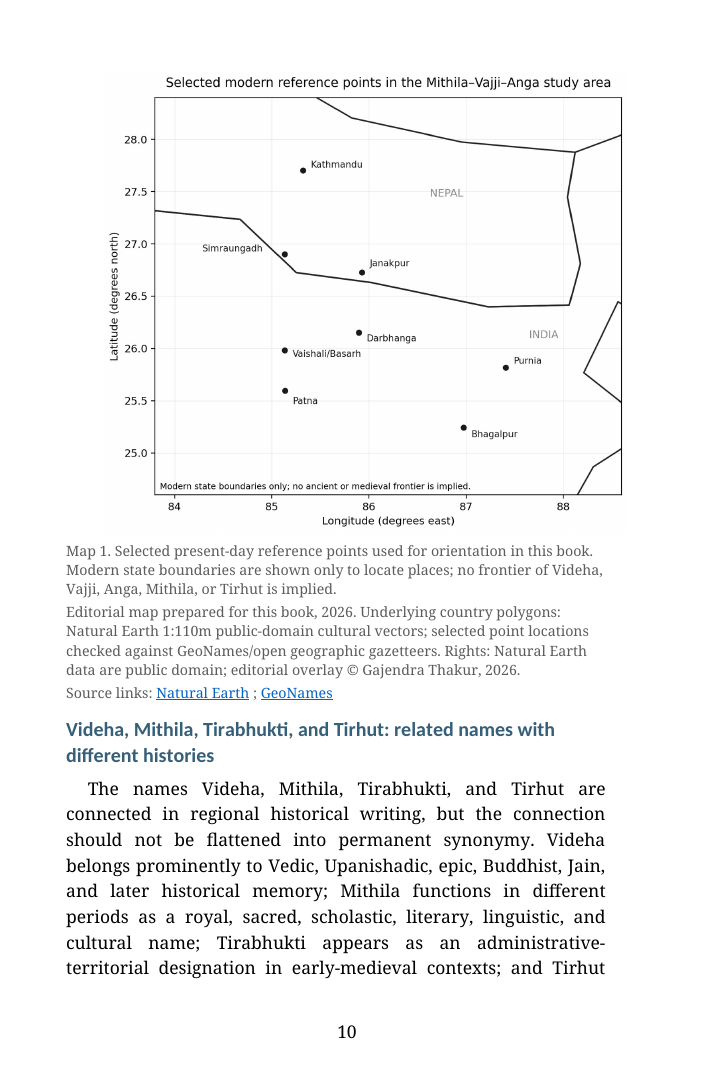
Chapter-specific source notes
- Primary chapter witness. Gajendra Thakur, Decoding the Panji of Mithila — Volume IV, formal Chapter 37, PDF pp. 389-394; formal Chapter 37. The HTML transcription is generated from the commit-pinned source PDF and retains the chapter boundary recorded in this edition.
- Internal structure. The repository source-heading inventory records 9 subordinate headings for this chapter: “1. Entry (320): Tarouni to Ramnagar”; “2. Entry (321): Ramnagar continuation”; “3. Entry (322): Tarouni to Kaivalakh, Rajendra Jha”; “4. Entry (323): Tarouni to Pindaruch, Channu Jha”; “5. Entry (324): Tarouni to Virsayar”; “6. Entry (325): Tarouni continuation, number 169”; “7. Entry (326): Tarouni to Nanour”; “8. Entry (327): Tarouni to Aama-Bounsi, Uttar Pradesh”; ….
- Digital editorial method. The page keeps the preserved source text distinct from generated navigational, concordance, visual, and provenance apparatus. The synthetic reconstruction is explanatory only and is not evidence for an individual lineage or a determination of social or marital status.