Decoding the Panji of Mithila · Volume IV · Chapter 38
Naduar-Karmaha: Tharhi, Bharam, Kachhuwa, and the Scholarly Naduar Branches
Chapter 38
Naduar-Karmaha: Tharhi, Bharam, Kachhuwa, and
the Scholarly Naduar Branches
   Coverage. This chapter continues from the point reserved at
the close of Chapter 37. It covers entries (328) to (335) only. The
controlling formula is the source phrase "atha Naduar Karmaha
gramarambh," which opens entry (328). The chapter therefore
remains within the wider Karmaha frame, but it shifts the village
focus from Tarouni to Naduar. Entry (335) is rikta; entry (336),
beginning Behat, is not included here and should open the next
chapter.
   Method. Every name is read as a node in the Panji network. A
"suta" phrase is treated as descent; an "apara" phrase marks an
additional or collateral branch; a village phrase with "san" is read
as a marriage, affinal, or affiliating route; titles such as Professor,
Mahamahopadhyaya,              Jyotishi,       Vaiyakaran,         and
Pradhanadhyapak are preserved as evidence of scholarly or
professional status; and dotted passages are retained as blank but
meaningful placeholders in the record.

1. Entry (328): Naduar to Tharhi
  Entry (328) opens the Naduar-Karmaha register. Umanand is
the first organising ancestor. His sons Mahipati and Shubhpati
are linked to Soderpur through Raghudev and Raghuram and
then to Pali through Raghu. A collateral Umanand line gives
Gaurikant, who is attached to Soderpur-Jaydev-Mahinath and to
Baliyas-Ram-Kamalakant. The first lines therefore declare both
descent and a two-sided marriage geography: Soderpur and Pali
on one side, Soderpur and Baliyas on the other.
   Mahipati produces Aditya and Dukhia. Aditya is linked
through Darihara-Theghu-Chitradhar and Jajival-Lakshmidhar. A
further Aditya branch gives Abhayanath, also named Gopal.
Abhayanath then produces Jagannath and Jayanath. Jagannath is
joined through Baliyas-Kaladhar-Mani and Ekhara-Hridaymani;

Jayanath is joined through Kujouli-Batuki-Govinddatt and Pali-
Bhairavi. This makes the early Naduar line a compact but dense
cluster of Darihara, Jajival, Baliyas, Ekhara, Kujouli, and Pali ties.
  Jayanath gives Kedarnath and Taranath. Kedarnath is
especially marked because his branch contains Professor
Bhavanath and Professor Siddhinath. Professor Bhavanath is
connected through Bisfi-Nanu-Mahesh and Hariamb-Mukund,
while Professor Siddhinath is placed in a Ravojpur-Nahas-Khaual
route with dotted spaces. The presence of two professorial titles
in this early Naduar block shows the register not merely
preserving older descent but continuing into a learned modern
family line.
   The Taranath branch gives Riddhinath, Vibhutinath, and
Hemnath. Riddhinath links through Rajanpura-Darihara-Nena-
Lakshmikant and Ghusaut-Deonath. Dukhia is linked to Kodariya
through Bhawanidatt and Parmeshwaridatt, and to Pali through
Bhawanidatt. Gaurikant then produces Hemkant, and Hemkant
produces Punyakant and Buddhikant through Khandbala-
Mahinath-Manchit and Darihara-Subodh. A further Punyakant
link reaches Satlakha-Ranjan-Jagmohan and Gangoli-Lochan-
Jivanath, with Budhwal-Thakuri also attached. The entry closes
by showing Naduar as a hub, not a narrow village list.

2. Entry (329): Naduar continuation, number 171
   Entry (329) continues the same Naduar-Karmaha formation.
Bachharu appears through the Aravi line, connected to Khaual-
Ghani-Parashuram and Jajival-Manhar. The Ankhi branch then
produces Tejnath, whose sons Manhar and Jayanath move
through     Bhadual-Mandar-Jivan-Puran     and    Pali-Veniram-
Chandradatt. The register adds further Tejnath sons Ratnath and
Triloknath through Kharka-Ekhara-Murlidhar-Mahidhar and
Baliyas-Kirtinath.
   Rudra produces Rohinidatt, who is connected with Belaunch-
Bhavdev-Bhaiya and Baliyas-Mahadev. Rohinidatt gives
Vishweshwar and Jholan. Vishweshwar gives Parmeshwar and

Parmanand through Khandbala-Dinbandhu-Bihari and Belaunch-
Deonath, while Jholan gives Keshav through the same
Khandbala-Dinbandhu-Bihari and Belaunch-Deonath frame. The
repetition matters: it is not scribal waste but a Panji way of
showing that two sibling lines are tied into the same marriage
corridor.
   Raghunath produces Harinath, Jivanath, and Umanath
through Mandar-Nilkanth-Mani and Soderpur-Madhav. Jivanath
produces Shambhunath and Buddhianath. Shambhunath is
expanded through several daughter and son lines: Khandbala-
Purushottam-Mahinath and Ekhara-Babudi; Khaual-Shivram-
Gana and Jajival-Lal; Sakararhi-Damodar-Gujar and Ekhara-
Dasharath; Satlakha-Narayan-Someshwar and Pali-Bhavesh;
Pabauli-Purushottam-Hiya   and      Kujouli-Abhiram; Khaual-
Mahesh-Bhaiya and Sarisab-Rambhadra; Narun-Bhairavdatt-
Mushai and Sakararhi-Umanath; and Ekhara-Bachharu-Mahesh
with Mandar-Shulpani. The entry is consequently one of the
densest marriage-mapping units in the Naduar group.
   The Prannath branch gives Vishnudatt and Kishori through
Sarisab-Bhramar-Shobhanath         and       Panichobh-Loknath.
Ramanath gives Bhoranath and Rajnath through Baliyas-Nakat-
Holi and Babhania-Madhurapati. Entry (329) therefore carries
the Naduar line from early descent into a wide east-west network
of Soderpur, Mandar, Baliyas, Sarisab, Satlakha, Pabauli, Khaual,
and Panichobh.

3. Entry (330): Unqualified Naduar continuation
   Entry (330) has a short heading but a long internal
continuation. Rajnath gives Musahad through Jajival-Mushari-
Ghonghai and Hariamb-Babuan. Badrinath gives Grihimani
through Belaunch-Bandhu-Bhavi and Mandar-Bechu. Shashinath
gives Bhairav, also called Dinanath, and Lal through Sakararhi-
Gangadhar-Babnu and Panichobh-Loknath. Srinath gives Jagnath
through Sakararhi-Tarapati-Ramanath and Jajival-Shubh pati.

  Jagnath then links to Rohar-Sakararhi-Manbodh-Horil and
Belaunch-Hridaynath. Mitranath produces Sarinath, also read as
Nandlal, through Soderpur-Badlu-Kashi and Pali-Ganganand.
Nandlal gives Mukund; Mukund is connected through Khaual,
Soderpur, Budhwal, and several stacked ancestors, including
Devakinandan, Kirtinath, Giridhari, Jaydatt, and Shambhunath.
The source compresses a long remembered chain into one line;
the chapter therefore reads it as a layered ancestry rather than a
simple list.
   Premnath produces Fakir, Bhaiyo, and Siddhinath through
Darihara-Garib-Chanan and Pali-Harinandan. Fakir produces
Gokul, Hare, and Dwarikanath through Satlakha-Bhanu-
Dharanidhar and Belaunch-Bhairavdatt. Bhaiyo produces
Chandranath through Kujouli-Bhawanidatt-Punyadatt and
Narun-Chengna. Chandranath then moves through Sarisab-
Devidatt-Siddhinath and Mahnaura-Khaual-Devakinandan. The
source also preserves a Soderpur-Keshavnath kasthut note,
indicating that a branch is being recorded but not fully
elaborated.
   The Buddhianath branch produces Jhotan, Dharmanath,
Shyamnath, and Amritnath through Pabauli-Chaturbhuj-
Chandrapati and Karmaha-Damodar. Jhotan links through
Khaual-Modnarayan-Datti and Belaunch-Panni. Dharmanath
gives Mahag through Soderpur-Mahinath-Sheshdhar and
Satlakha-Bechu, and another Dharmanath branch passes through
Soderpur-Mayanidhi and Khaual-Dinanath. Mahag then connects
to Jajival-Sanphul-Shobhanath and Pali-Shatrughna. This
completes the entry as an interlaced Naduar continuation, not a
fresh village start.

4. Entry (331): Naduar to Bharam, Lohar, and Shyam Sidhap
  Entry (331) gives the heading Naduar to Bharam, with Lohar
and Shyam Sidhap also named. Umanath produces Hemnarayan
and a collateral Nenan. Hemnarayan is connected through
Pandua-Harishwar-Krishnapati and Babhania-Krishnanand. The

collateral Nenan branch passes through Mandar-Narayan-
Bhavdev and Khandbala-Chaturbhuj.
   Hemnarayan produces Horil, Dukhia, Mannu or Bhoranath,
Pritinath, Hridaynath, Mandhan, and Bachharan. Horil gives
Chintamani, Chan, Bihar, Pandit Gudar, and Jhapti through
Sarisab-Hedu-Dharmapati and Pandua-Nandishwar. Chintamani
links to Baliyas-Pranpati-Kaladhar and Pali-Ishwaridatt, while a
collateral Chintamani son Dukhmochan links to Jajival-Mansukh-
Bhawanidatt and Darihara-Hridaynath. Dukhmochan produces
Satyadev and Sahadev, whose branches pass through Darihara-
Madhurapati-Shaligramdatt-Gudar and Baliyas-Bachharan.
   Chan produces Sone, Mahamahopadhyaya Muralidhar, and
Sundar through Sarisab-Machal-Fakiran and an Oini royal route
to Babu Rashiknarayan. The title Mahamahopadhyaya is
important: Muralidhar is not just another descendant but a
learned node remembered by rank. Sone produces Chunchun,
also called Bodhanand; Chunchun is connected through Pabauli
and then through Darihara-Ratnapani-Govardhan and Soderpur-
Mangu. Mahamahopadhyaya Muralidhar gives Shyam, who is
tied to Darihara-Ratnapani-Govardhan and Soderpur-Mangu, and
Shyam in turn reaches Pali-Raghunandan through Nehnath.
   Bihar connects through Soderpur-Sanath-Indramani and
Mandar-Ishannath. Bachchan is another collateral son, connected
through Sarisab-Chandramani-Bhulan and Pali-Deonath, and one
of his lines goes through Satlakha-Bhikhiya-Rameshwar and Pali-
Bhagwandatt. Entry (331) thus brings the Naduar line into
Bharam, Lohar, and Shyam Sidhap while retaining old scholarly
and royal memory through Mahamahopadhyaya and Oini
references.

5. Entry (332): Number 173 and the modern scholarly branch
  Entry (332) is headed only by the number 173, but it is not
empty. It gives a late scholarly and professional extension.
Devchandra     produces   Pradhanadhyapak    Mohanchandra,
marked M.A., through Pabauli-Buddhi-Ramanath and a

Nagwad/Karmaha-Premnath      link.    Mohanchandra       gives
Piyushchandra and Manikchandra, also read as Bhithhu, through
Khandbala-Meghakant-Bhairav and Hariamb-Chiranjeev.
   The line then records daughters Rashmilata and Vani and a
Betia-Belaunch connection through Lakshman and Kartiknath,
with a reference to Kumar Kundan Bharadwaj and a German-
language scholarly association attached to Piyushchandra.
Because the text is compressed and partly garbled, the safest
reading is not to force a modern biographical reconstruction, but
to preserve the signal: this branch carries higher education,
headmaster status, language scholarship, and wide marriage
links into the later Naduar record.
   Raghuchandra produces Satishchandra and Udaychandra
through Sarisab-Nena-Raghudev and Baliyas-Rupnath-Aniruddh.
Virchandra produces Shankar and Nehru through Baliyas-
Luchan-Aniruddh and Pabauli-Ramanand. Udaychandra gives
Prafulchandra, and Prafulchandra gives Sharatchandra through
Kanhauli-Soderpur-Dineshdatt. The entry then resumes the
Naduar-to-Bharam material with Pandit Gudar and his
descendants Mahavir, Jayvir, and Raghuvir, followed by Badru,
Nirsu, and Shiv.
   The second half of the entry returns to the earlier
Hemnarayan-Bharam structure. Mandhan produces Mathura,
Ghoghan, Mukund, and Madhav through Sarisab-Balbhadra-
Nanu and Karmaha-Gauridatt. Collateral links pass through
Khaual-Chaitu-Ravinath and Baliyas-Shivan. Mathura is tied to
Soderpur and Khaual; Ghoghan gives Paltan through Khandbala-
Vishnu Singh and Baliyas-Sonmani. Lutan gives Kashinath
through     Soderpur-Govind     and   Phanandah-Rukminidatt.
Ramchandra then produces Devchandra, Raghuchandra,
Virchandra, and Daychandra through Narun-Teni-Ratinath and
Kujouli-Ramanand. This confirms that the modern educational
lines are embedded in the older Bharam descent frame.

6. Entry (333): Naduar to Kachhuwa-Bharam
   Entry (333), introduced with "Om namah Maheshwaraya,"
moves Naduar to Kachhuwa and Bharam. Bachharan produces
Kheli, Saday, Bholi, Jyotishi Vidya, Jhallu, and Kira through
Khaual-Goshain-Benidatt and Khandbala-Gopinath. Collateral
sons Mahadhan and Thithar pass through Darihara-Shridatt-
Nanu and Soderpur-Shyam Ram. The opening therefore places
Bachharan at the centre of a broad ritual-scholarly and affinal
field.
   Kheli produces Jivanand, Anant, Ghananand, Jagdish,
Shobhanand, and Bhavanand through Khandbala-Thothi-
Jirkrawan and Pali-Hibharan. Another Kheli branch connects to
Kodariya-Bhuvaneshwaridatt-Chhatradhari       and    Karmaha-
Bharathi, while a Rabuni branch goes through Soderpur-Harangi-
Durgadatt and Baliyas-Raghuvir. Anant is tied to Baliyas-Hire-
Ishdatt and Pali-Nityanand. Jagdish carries an Oini royal link
through Babu Ravojendra Narayan and Babu Indranarayan, and
then through Jajival-Vishnukant. Bhavanand links to Jajival-
Babujan-Bhaiyo and Hariamb-Parmanand, while Shobhanand
reaches Pabauli-Buddhi-Ramanath and Karmaha-Premnath.
  Jyotishi Rabuni connects to Sakararhi-Meghnath-Tirthmani
and Soderpur-Thakurdatt. Saday is tied to Sarisab-Jivanath-
Thadu and Baheradhi-Chudamani, while Puny anand, a collateral
Saday son, moves through Khaual-Narayandatt-Neel and
Khandbala-Jagmohan. Puny anand in turn links to Baliyas-
Bahoran-Siddhinath   and    Pali-Gopinath.   Bholi   produces
Ramkrishna, Mohitkrishna, Bodhkrishna, Jaykrishna, Rajkrishna,
and Manmohan through Khandbala-Jhapti Singh and Jalay-
Pyarelal. A collateral Bholi line gives Vasudev and
Chandrashekhar through Gangoli-Baburaya-Babulal and Kujouli-
Batuki.
  Ramkrishna is linked through Mandar-Kunkun-Upadhyay
Badrinath and Khandbala-Shri Mohan. Mohitkrishna gives
Mahindra Narayan through Baliyas-Vanshidhar-Bhagirath and
Pabauli-Ajgaivinath, and Mahindra Narayan is then tied to

Narun-Chumman-Ramakant and Mandar-Badrinath. Entry (333)
is thus one of the key places where the Naduar-Karmaha register
combines jyotishi identity, royal Oini memory, and modern
Narayan-name branches.

7. Entry (334): Naduar under the invocation to Trilochana
  Entry (334), introduced by "Om namah Trilochanaya,"
continues Naduar without a new external village heading.
Bodhkrishna gives Indranath, Jagannath, Vaidyanath, and
Mrityunjaynath through Soderpur-Babue-Murali and Baliyas-
Janakinath. A collateral Bodhkrishna branch is attached to
Pabauli-Vishwanath-Dukharan and Ghusaut-Govardhan.
   Vasudev is linked through Baliyas-Mukund-Vaiyakaran
Chintamani and Tisaunt-Nakchhedi. Chandrashekhar is
connected through Sakararhi-Achyut-Durbbal and Hariamb-
Jhalli. Jyotishi Vidya gives Mohan through Khandbala-Vishnu
Singh-Shyam Singh and Mandar-Hibharan, while a collateral link
moves through Khaual-Ravinath-Nand and Pali-Bandhav. Mohan
gives Baldev and Jaydev through Pandua-Chhedi-Bhaiyan and
Belaunch-Keshav. Baldev then produces Pramod and Tham, with
the marriage line running through Raghubir and Hariamb-
Chiranjeev.
   The Nenan branch closes the included Naduar material. Nenan
produces Baburaya through Belaunch-Aniruddh-Harikrishna and
Gangoli-Raghu; he also produces Gopinath through Khaual-
Mahesh-Bhaiya and Hariamb-Rambhadra, and Ainthahu through
Narun-Nandan-Ramkrishna and Kujouli-Bachharu. Baburaya
gives Poshan and Grihinath through Gangoli-Kriparam-Bandhav
and Pali-Veniram. Gopinath gives Mukund through Kharka-
Ekhara-Krishnadatt-Dharmadatt and Pabauli-Rodhi. This final
entry brings the Naduar block back into a recognisable Karmaha
marriage geography: Baliyas, Ghusaut, Sakararhi, Hariamb,
Khaual, Pali, Gangoli, and Pabauli.

8. Entry (335): Rikta
   Entry (335) is marked rikta. It should not be treated as absence
from the chapter. In Panji logic, a rikta marker reserves or
acknowledges a register position whose details are not supplied
in the copied text. It marks the end of the present Naduar
sequence before the source moves to Behat.

9. Index Logic and Coverage Note for Chapter 38
   The index logic is controlled by Karmaha and, within it, by
Naduar. The general Karmaha frame includes Tarouni and
Analpur, but this chapter begins a distinct Naduar-Karmaha
gramarambh. The index also separately remembers Naduar-
Karmaha as a continuing unit. For that reason, entries (328) to
(335) have been read as a coherent Naduar chapter rather than
as an extension of Tarouni.
   Coverage is exclusive: entries (328), (329), (330), (331), (332),
(333), (334), and rikta entry (335) are decoded here. Entry (336),
headed Behat, begins the next chapter. The next chapter should
therefore shift from Naduar-Karmaha to Behat while still
watching for the wider Karmaha continuity.
Source structure and verification apparatus
Editorial source apparatus. This apparatus is descriptive, not interpretive. It records the source-controlled structure used to verify that this page corresponds to formal Chapter 38 of Decoding the Panji of Mithila — Volume IV. The chapter text above is preserved from PDF pp. 395-403; formal Chapter 38 in the commit-pinned authoritative source. It is not merged with a neighboring chapter, appendix, annexure, or independent front/back-matter unit. The internal headings below come from the repository’s source-heading inventory and are retained as navigational and audit evidence; showing them here does not turn those headings into separate publications or add claims that are absent from the source.
Internal source headings
- 1. Entry (328): Naduar to Tharhi
- 2. Entry (329): Naduar continuation, number 171
- 3. Entry (330): Unqualified Naduar continuation
- 4. Entry (331): Naduar to Bharam, Lohar, and Shyam Sidhap
- 5. Entry (332): Number 173 and the modern scholarly branch
- 6. Entry (333): Naduar to Kachhuwa-Bharam
- 7. Entry (334): Naduar under the invocation to Trilochana
- 8. Entry (335): Rikta
- 9. Index Logic and Coverage Note for Chapter 38
Source-text concordance
Naduar-Karmaha · Tharhi · Bharam · Kachhuwa · Scholarly · Naduar · Branches · Coverage · continues · point · reserved · close · covers · entries · controlling · formula · phrase · atha · Karmaha · gramarambh · opens · entry · therefore · remains · within · wider · frame · shifts · village · focus · Tarouni · rikta · beginning · Behat · included · open · next · Method · Every · name · read · node · network · suta · treated · descent · apara · marks · additional · collateral · branch · marriage · affinal · affiliating · route · titles · Professor · Mahamahopadhyaya · Jyotishi · Vaiyakaran · Pradhanadhyapak · preserved · evidence · professional · status · dotted · passages · retained · blank · meaningful · placeholders · record · register · Umanand · first · organising · ancestor · sons · Mahipati · Shubhpati
Boundary verification. In the formal sequence this chapter follows Volume IV Chapter 37, “Tarouni-Karmaha: Ramnagar, Kaivalakh, Pindaruch, Virsayar, Nanour, and the Aama-Bounsi Extension” and precedes Volume IV Chapter 39, “Behat-Karmaha, Majhaura- Karmaha, and Majhiyam-Karmaha: Entries (336)-(343)”. The chapter extractor begins at the verified formal Chapter 38 marker and stops at the next verified formal chapter marker; for a final chapter it stops before recognized book-level back matter. The concordance above is generated only from distinct terms already present in this chapter’s preserved source text. It is provided for discovery, comparison, and audit, not as an automated judgment about persons, lineages, status, kinship, marriage eligibility, or historical truth.
Illustrated research apparatus
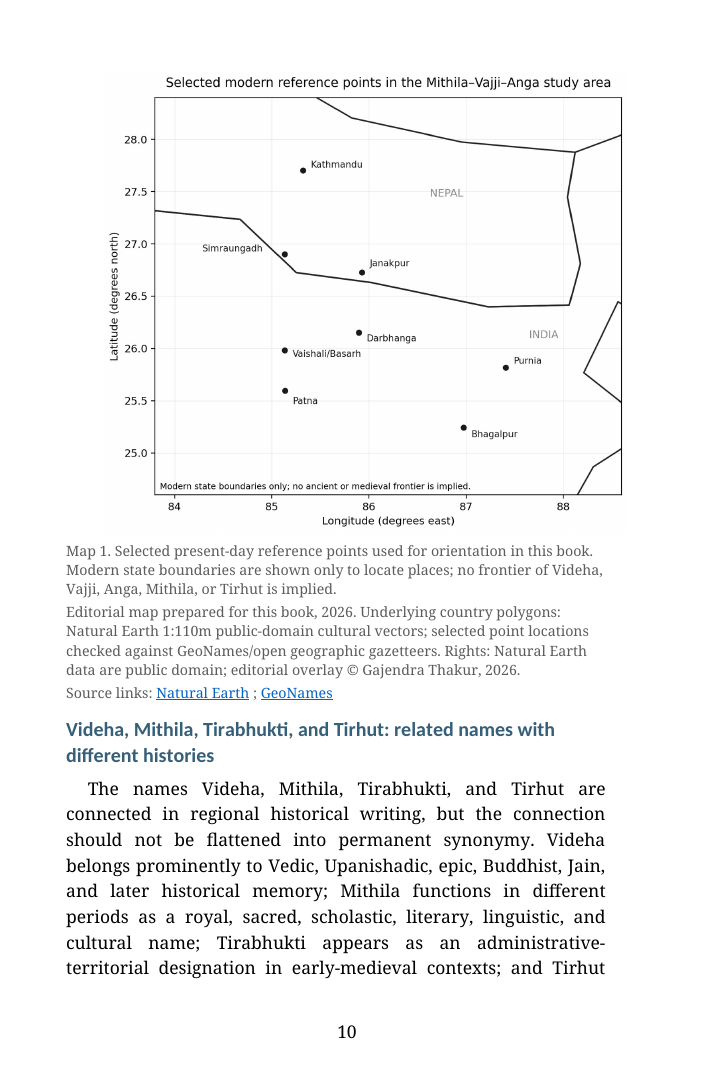
Mithila · Vajji · Anga
Chapter-specific source notes
- Primary chapter witness. Gajendra Thakur, Decoding the Panji of Mithila — Volume IV, formal Chapter 38, PDF pp. 395-403; formal Chapter 38. The HTML transcription is generated from the commit-pinned source PDF and retains the chapter boundary recorded in this edition.
- Internal structure. The repository source-heading inventory records 9 subordinate headings for this chapter: “1. Entry (328): Naduar to Tharhi”; “2. Entry (329): Naduar continuation, number 171”; “3. Entry (330): Unqualified Naduar continuation”; “4. Entry (331): Naduar to Bharam, Lohar, and Shyam Sidhap”; “5. Entry (332): Number 173 and the modern scholarly branch”; “6. Entry (333): Naduar to Kachhuwa-Bharam”; “7. Entry (334): Naduar under the invocation to Trilochana”; “8. Entry (335): Rikta”; ….
- Digital editorial method. The page keeps the preserved source text distinct from generated navigational, concordance, visual, and provenance apparatus. The synthetic reconstruction is explanatory only and is not evidence for an individual lineage or a determination of social or marital status.