Decoding the Panji of Mithila · Volume IV · Chapter 39
Behat-Karmaha, Majhaura- Karmaha, and Majhiyam-Karmaha: Entries (336)-(343)
Chapter 39
   Behat-Karmaha, Majhaura-
Karmaha, and Majhiyam-Karmaha:
       Entries (336)-(343)
    Coverage. This chapter continues exactly after the rikta
marker at entry (335). It covers entries (336) through (343)
only. The governing index frame remains Karmaha, but the
source now moves from Naduar into Behat, then into
Majhaura, and finally into Majhiyam. Entry (344), which
begins Mahishi under a Budhwal gramarambh, is deliberately
left for the next chapter because it changes the controlling
register.
    Method. The same Panji method is followed here. A name
is never treated as an isolated personal label. Each name is
read through descent, collateral branch, place of movement,
marriage connection, title, and continuity of the line. The
recurring words suta, suto, suata, apara, pr., dau, ddau, and
gramarambh are preserved in interpretation: they distinguish
the primary son-line, the collateral or additional branch, the
local route, and the formal opening of a new register.

1. Entry (336): Behat-Karmaha gramarambh
    Entry (336) opens with the formula for Behat under
Karmaha. Kirtinath is the first visible organising ancestor. His
line is divided into several sons or collateral sons: Ghonghi,
also marked pr. Chhatranath; Kliv or Kishornath; and
Buddhinath. Ghonghi is connected through the Jajival-
Padmapati-Nanu route and through Hariamb-Jeevan.
Kishornath is tied to Kujouli through Vagish and Hridaynath,
and to Baliyas through Vrajnath. Buddhinath is linked to
Baliyas through Rai Vagish and Chintamani, and to Ghusaut

through Bhaiya. The Behat opening therefore immediately
places the family inside the wider Karmaha network and not
merely inside one village.
    The Ghonghi branch continues through Dukhmochan.
Dukhmochan is linked to Mandar-Ishannath-Girdhari and
Kujouli-Hridaynath. His son Mitranath is carried through
Khaual-Sufal-Yuvraj and Hariamb-Ravgadatt. The same
Dukhmochan branch also gives Chandranath and Indranath,
who move through Kodariya-Raja-Kumar, Khaual-Ishwardatt,
and the associated marital routes. Mitranath is further
attached through Soderpur-Gadadhar-Shitaladatt and
Budhwal-Mukund. Tirthnath appears as another collateral
line through Khaual-Nand-Shivshankar and Digho-Muktinath.
Chandranath is read through Vatswal-Naroun-Shiv-Jaynath
and Panichobh-Bhai Ji, while Indranath passes through Rohar-
Sakararhi-Nandi-Lambodar and Panichobh-Radha, with an
additional Baliyas-Babulal-Lakshmikant and Soderpur-
Yogkrishna connection. The Behat entry is thus a compact but
dense map of marriage routes.

2. Entry (337): Behat continuation, number 175
    Entry (337) continues the Behat material rather than
beginning a new gramarambh. Gangadash produces Ramjiv
and Pitambar. Ramjiv produces Bhairavdatt; Bhairavdatt
produces Babunath; Babunath produces Bachharan; and
Bachharan produces Sudhakar. The line is carried through
Baliyas-Govind-Jagatanand and Soderpur-Ramapati at the top,
then through Mandar-Ghani-Saheb, Belaunch-Bhavanand,
Sakararhi-Jaykrishna-Buddhinath, and Hariamb-Chhawani.
Sudhakar is tied through Darihara-Mana-Parashmani and
Alay-Kalru. These clustered place names show that the Behat
line is being tested across several established mool and village
circuits.

   Pitambar gives Sanphool and Manphool. Sanphool
produces Gopinath through Sarisab-Rajaram-Harpati and
Baheradhi-Mahamahopadhyaya Bhikhi. The entry then
records collateral offspring: Pyarelal, Shyamnath, and
Keshavnath through Sakararhi-Jaykrishna-Kripanidhi and
Panichobh-Ratnu. Pyarelal connects to Belaunch-Jadav-
Bachchu and Karmaha-Shambhunath. Shyamnath links
through Soderpur-Indramani-Poshan and Satlakha-Kuli. The
entry closes with Behat still in motion, not as a separate family
fragment but as a sequence of descent lines tied into Soderpur,
Hariamb, Panichobh, Alay, and other marriage circuits.

3. Entry (338): Majhaura-Karmaha
gramarambh
   Entry (338) opens the Majhaura-Karmaha gramarambh.
Jagan is the ancestor at the head of the line. His sons include
Kalar and Purushottam, and the source then adds collateral
branches through Khagpati, Gunpati, Nakdu, Bhavan, Jaydatt,
and Saheb. Kalar is linked through Darihara-Badi-Hite and
Karmaha-Badni. Purushottam produces Bodhan through
Khaual-Mahi-Dayaram and Pali-Hemkar. Khagpati produces
Raja through Soderpur-Rameshwar-Nehal and Baliyas-
Lakshmidev. Gunpati produces Gharbharan through Sarisab-
Jayashiv-Chhaban and Baliyas-Bhanudatt; Gharbharan then
gives Bhagwandatt, whose connection reaches Soderpur-
Kodai-Thakurdatt and Pali-Shyamlal.
    The collateral line through Nakdu gives Lalit Lal through
Khaual-Bhora-Bodh and Alay-Kamalnayan. Lalit is attached to
Belaunch-Bachnu-Bhikhan and Pali-Bhavaditya, with another
Jajival-Shubhpat-Durmmil and Pali-Manbodh route. Lal gives
Babue through Darihara-Garibnath-Benidatt and Hariamb-
Nilambar. Bhanod is placed through Darihara-Bhanod-
Chhaban and Budhwal-Nakdu. Saheb produces Jivanath,
Premnath, Dayanath, Radhe or Bhavanath, and also

Ramanath, Jhaban, and Srinath. Jivanath is especially
important because it gives multiple connections: Ekhara-Jure-
Nakdu-Dharmadatt, Soderpur-Jiveshwar-Tengri, Khaual-
Jeevan-Badri Lal, and Khandbala-Kheli. Ramanath is tied to
Khaual-Bhavdev-Vidyapati and Ekhara-Vishwanath. The
Majhaura opening therefore expands from one gramarambh
into many marriage-confirmed sub-branches.

4. Entry (339): Majhaura continuation,
number 176
   Entry (339) continues Majhaura under number 176. Mohan
gives Bandi, while additional sons or branches include
Mahipati, Ramnarayan, Harpati, and Biso through Belaunch-
Damodar-Ramchandra and Karmaha-Vaidyanath. Bandi gives
Prannath, Jivanath, and Gokulnath through Darihara-Babhan-
Manohar and Jajival-Mohan. Prannath connects through
Khandbala-Bhora-Madhurapati and Pali-Badli. Jivanath
produces Manbodh and Banmali through Belaunch-Vir-
Gokulnath and Khaual-Matiram. Manbodh gives Badrinath
and Dhirnath through Belaunch-Kala-Kauskidatt and Baliyas-
Raghunath; Badrinath produces Bhaiyo through Sakararhi-
Bhavdev-Lalit and Pali-Babuni.
   The Ram branch gives Rudramani through Satlakha-Shivi-
Maddu and Hariamb-Krishnanand. Rudramani gives Hempati
and Bhola, and also several groups of sons or collateral names:
Gunanidhi, Dhannidhi, Kalanidhi, Dayanidhi, Mayanidhi, and
the second cluster Jaypani, Mahipani, Haripani, Chakrapani,
Khadgapani, and Dandapani. Hempati gives Lalpani; Lalpani
gives Babujan, Ladatt, and Chanchal through Baliyas-
Dharadhar-Chhakodi and Panichobh-Krishna. There is also a
Parshmani route through Baliyas-Bachharu-Machal and
Digho-Balram. Babujan connects to Naroun-Lakshmidatt-
Mushari and Pali-Shivan, while the Rabushan and Shivdatt
branches go through Baliyas-Harisingh and Karmaha-

Chitradhar. The entry’s density comes from this repeated use
of sons and collateral sons to keep the Majhaura family
continuously traceable.
    Jalpadas produces Bhushan and Muniya through Digho-
Bachh-Chandidatt and Sakararhi-Shyamlal. Hari is another
collateral son, linked through Ekhara-Gokulnath-Baduknath
and Hariamb-Parshmani. Bhushan gives Nirsu through
Khaual-Hemnath-Jalpadas and Belaunch-Ravinath. These
closing details prepare the transition into the next Majhaura
entry, where Muniya’s descendants become important.

5. Entry (340): Majhaura continuation
    Entry (340) continues the Majhaura line from Muniya.
Muniya produces Aniruddh through Sakararhi-
Ravradhaneshwar-Govind and Pali-Pandit Nena. Chanchal is
tied through Belaunch-Saheb-Kalar and Sakararhi-Shyamnath.
Harinandan is another collateral son through Ekhara-
Gokulnath-Baduknath and Hariamb-Parshmani; Parshmani
then links to Gangoli-Pakshadhar-Mohan and Karmaha-
Dukhia. The entry therefore brings the Muniya line back into
the same Karmaha and Hariamb web already seen in entries
(338) and (339).
    Bhola produces Shyamlal, Vedpani, and Amritpani through
Satlakha-Rishi-Bhanu and Soderpur-Chilka. Vedpani gives
Babujan through Soderpur-Umai-Rudradatt and Sakararhi-
Dhana. Shyamlal and Amritpani both receive additional place-
based ties: Shyamlal through Darihara-Mahesh-Tota and
Pabauli-Nidhi; Amritpani through Soderpur-Devidatt-
Hiramani and Karmaha-Mandhan. Gunanidhi gives Mannu
and Mani through Khaual-Matiram-Bachharu and Pali-
Gangadhar. Bhani then gives Teji, Gudar, and Nandi: Teji
produces Jagdhar through Darihara-Sanath-Saburdatt and
Pali-Bodhkrishna; Gudar produces Yashi through Satlakha-
Ranjan-Jagmohan and Gangoli-Jeevanath; Nandi links through

Belaunch-Rupnath-Hanumandatt and Gangoli-Jeevanath.
Dhannidhi gives Bhikhiya, Dukhia, Chhatrapati, and Tarapati
through Pabauli-Madhuni-Kamalapati-Kulpati and Baliyas-
Dhan. Dayanidhi gives Kauskidatt, Shankardatt, and
Murlidhar through Baliyas-Fakir-Kala and Belaunch-Yadav.
Mayanidhi finally produces another Kauskidatt through
Pabauli-Ramakant-Kalar and Mandar-Chhatrapati.

6. Entry (341): Majhaura to Bathanay
   Entry (341) carries Majhaura to Bathanay. Mahipani gives
Babujan, Nanu, and Chitradhar through Baliyas-Shubhpat-
Bhavesh and Khandbala-Bhoranath. Babujan, also glossed as
Nandan, connects through Khaual-Balkrishna-Sonma and
Gangoli-Bochan. Nanu has a Khaual-Bula-Sanath and
Belaunch-Ratatu route, with another Darihara-Manbodh and
Soderpur-Yaddu route. Chitradhar gives Batha through
Belaunch-Ratu-Mansa and Pali-Jiunt; Batha then connects
through Baliyas-Mahesh and Sarisab-Ramanath.
    Chakrapani produces Padmapani through Kujouli-
Pradyumn-Bhavesh and Soderpur-Mahinath. Padmapani gives
Ramkrishna through Soderpur-Pati-Mani and Khaual-Sonma.
Ramkrishna gives Sonenath through Darihara-Chanan-Mohan
and Pali-Hira. Sonelal gives Singheshwar through Pabauli-
Baburaya-Nena and Panichobh-Kanhai; Singheshwar is then
linked through Mandar-Ramkrishna-Keshav and Ghusaut-
Kulmani. Narayan gives Andi through Khaual-Beni-Manohar
and Baheradhi-Bhagirath. Andi produces Madhurapati,
Sabhapati, Hanth, and Mahantha through Khaual-Parmanand-
Gatiram and Hariamb-Bachharu. A second Andi branch gives
Raghunath and Bandhav through Ekhara-Ram-Bhramar and
Gangoli-Neel. Mandhan, Madhurapati, Sabhapati, Toti,
Hemkar, Shivnath, and Shivlal close the entry by tying the
same Bathanay-connected Majhaura branch to Sakararhi,
Kodariya, Jajival, Darhara, Belaunch, Gangoli, and Soderpur.

7. Entry (342): Majhaura continuation under
invocation
   Entry (342), introduced by another invocation, remains in
Majhaura. Teknath is tied to Soderpur-Chhakodi-Jangli and
Karmaha-Doman. Loknath gives Shivsharan through Pabauli-
Bhaiyan-Siddhi and Karmaha-Dukhia. Mahath has a branch
through Ekhara-Jayashiv-Ruchipati and Karmaha-Sadashiv,
and another through Dullah, Jhallu, and Bhavnath. Dullah
gives Khedan through Digho-Narpati-Kala and Belaunch-
Chiranjeev. Jhallu links through Khaual-Ram-Poshan and
Kujouli-Gokulnath, while Bhavnath goes through Baliyas-
Prema-Chaturanan and Gangoli-Pakshadhar.
    Fakir gives Babujan through Soderpur-Harinandan-Chhota
and Budhwal-Deokrishna; collateral Gamni and Bhagwandatt
pass through Dharora-Baliyas-Madan Singh-Muralidhar and
Pali-Manbodh. Mohardatt is linked through Pabauli-Bhatu-
Sitaram and Alay-Madhurapati. Babujan gives Singheshwar
and Feku through Soderpur-Chhakodi-Jagni and Karmaha-
Doman. Raghunath produces Babua, Dharmadatt, Brahmadatt,
and Ganeshdatt through Gangoli-Lakshmikant-Kriparam and
Alay-Purandar. Babua links through Darihara-Bhanod-
Chhaban and Naroun-Pathak Hiru. Dharmadatt produces
Benidatt through Khaual-Garib-Shital and Budhwal-
Sanphutan; Benidatt gives Lal, Shivi, and Kashi through
Khaual-Bhaiya-Soni and Sarisab-Bhaiyan. Shivi gives
Sadanand through Sakararhi-Gaddi-Vanshidhar and Jajival-
Pyare. Brahmadatt and Bandhav close the entry: Bandhav
produces Gokulnath and Kishornath through Baliyas-
Ravantar-Lakshman and Pabauli-Ramakant, with a Rohar-
Soderpur-Bhaiyaram-Mahidhar and Darihara-Shivdatt link for
Gokulnath.

8. Entry (343): Majhiyam-Karmaha to Kakraud

    Entry (343) begins a new internal gramarambh: Majhiyam
under Karmaha. Kalidas is the organising ancestor. His
children are Chilk, Meghakar, Chira, Bula, and Sanphool.
Meghakar produces Pahadi through Belaunch-Harishankar-
Nena and Khaual-Keshav; Pahadi is linked further through
Khaual-Lal-Raghunath and Soderpur-Bhikhari. Chira connects
through Belaunch-Harishankar-Bana and Darihara-Yadupati,
with a Gosain collateral through Khaual-Ramakant-Bhiravma
and Babhaniyam-Mahesh. Bula gives Saburi, Bhayanath, and
Baburam through Belaunch-Lala-Balchandra and Karmaha-
Vanshidhar. Saburi gives Dular and Rajnath through Sarisab-
Jayashiv-Jhonti and Khaual-Gana; Rajnath gives Shambhu
through Kujouli-Karu-Bhavanidatt and Pali-Gunanand.
    Baburam produces Kashi through Darihara-Madhan-
Kirtidhar and Kujouli-Rajaram-Kulpati. Kashi gives Dhairyi,
Parmeshwar, and Godhai through Naroun-Ratnu-Bhola and
Pali-Bhavaditya. Sanphool gives Doman and Hira through
Khaual-Matiram-Bhaiya and Karmaha-Mahinath; Hira
connects through Darihara-Raghunath-Manodhar and Pali-
Gannu, with another Khaual-Girpati-Rudra and Belaunch-Sosi
route. Badhai gives Raghu and Birbal, and also Chan. Raghu
produces Palar through Khandbala-Devidash; Birbal gives
Kalanand; Kulanand links through Darihara-Lakshmikant and
Pali-Shri Ram. Chan gives Garib and Kalar. Kalar produces
Deon; Deon produces Grihimani and Mani through Soderpur-
Durbmanjan and Alay-Kamalnayan. Grihimani gives Chhota;
Chhota gives Dukhmochan through Pabauli-Nena. Garib
produces Lakshmidatt through Ekhara-Bahude-Juro.
Lakshmidatt then gives Grihimani and Gharo through Baliyas-
Machal Singh, and Grihimani gives Harimohan through
Soderpur-Atmaram-Bachharan and Khaual-Bodh. This entry is
the final Karmaha-linked unit included in the chapter.

9. Branch-continuity and stopping point

   Entries (336) to (343) form one coherent movement. Behat
opens under Karmaha, Majhaura opens under Karmaha, and
Majhiyam opens under Karmaha. The chapter follows these
three stages without mixing in the next register. The passage
repeatedly returns to the same validating circuits: Jajival,
Hariamb, Kujouli, Baliyas, Ghusaut, Soderpur, Budhwal,
Khaual, Digho, Darhara, Panichobh, Satlakha, Pabauli,
Mandar, and Pali. These names are not decorative place
labels; they are the evidence by which the Panji fixes descent,
marriage, and branch legitimacy.
    Coverage is exclusive: entry (336), entry (337), entries (338)
to (342) of Majhaura, and entry (343) of Majhiyam have been
decoded here. Entry (344), headed Mahishi and opening a
Mahishi-Budhwal gramarambh, begins the next chapter. That
next unit must be treated under its own Budhwal control and
not folded back into the Karmaha chapter.
Source structure and verification apparatus
Editorial source apparatus. This apparatus is descriptive, not interpretive. It records the source-controlled structure used to verify that this page corresponds to formal Chapter 39 of Decoding the Panji of Mithila — Volume IV. The chapter text above is preserved from PDF pp. 404-412; formal Chapter 39 in the commit-pinned authoritative source. It is not merged with a neighboring chapter, appendix, annexure, or independent front/back-matter unit. The internal headings below come from the repository’s source-heading inventory and are retained as navigational and audit evidence; showing them here does not turn those headings into separate publications or add claims that are absent from the source.
Internal source headings
No subordinate heading was separately encoded in the repository source-heading inventory for this chapter.
Source-text concordance
Behat-Karmaha · Majhaura · Karmaha · Majhiyam-Karmaha · Entries · Coverage · continues · exactly · rikta · marker · entry · covers · governing · index · frame · remains · moves · Naduar · Behat · finally · Majhiyam · begins · Mahishi · Budhwal · gramarambh · deliberately · left · next · changes · controlling · register · Method · followed · name · never · treated · isolated · personal · label · read · descent · collateral · branch · place · movement · marriage · connection · title · continuity · line · recurring · words · suta · suto · suata · apara · ddau · preserved · interpretation · distinguish · primary · son-line · additional · local · route · formal · opening · opens · formula · Kirtinath · first · visible · organising · ancestor · divided · several · sons · Ghonghi · marked · Chhatranath
Boundary verification. In the formal sequence this chapter follows Volume IV Chapter 38, “Naduar-Karmaha: Tharhi, Bharam, Kachhuwa, and the Scholarly Naduar Branches” and precedes Volume IV Chapter 40, “Mahishi-Budhwal: Kailakh, Kachhuwa, Pokhrauni, Bhainsdiyar, and Parihari: Entries (344)-(351) Coverage. This chapter begins exactly where Chapter 39”. The chapter extractor begins at the verified formal Chapter 39 marker and stops at the next verified formal chapter marker; for a final chapter it stops before recognized book-level back matter. The concordance above is generated only from distinct terms already present in this chapter’s preserved source text. It is provided for discovery, comparison, and audit, not as an automated judgment about persons, lineages, status, kinship, marriage eligibility, or historical truth.
Illustrated research apparatus
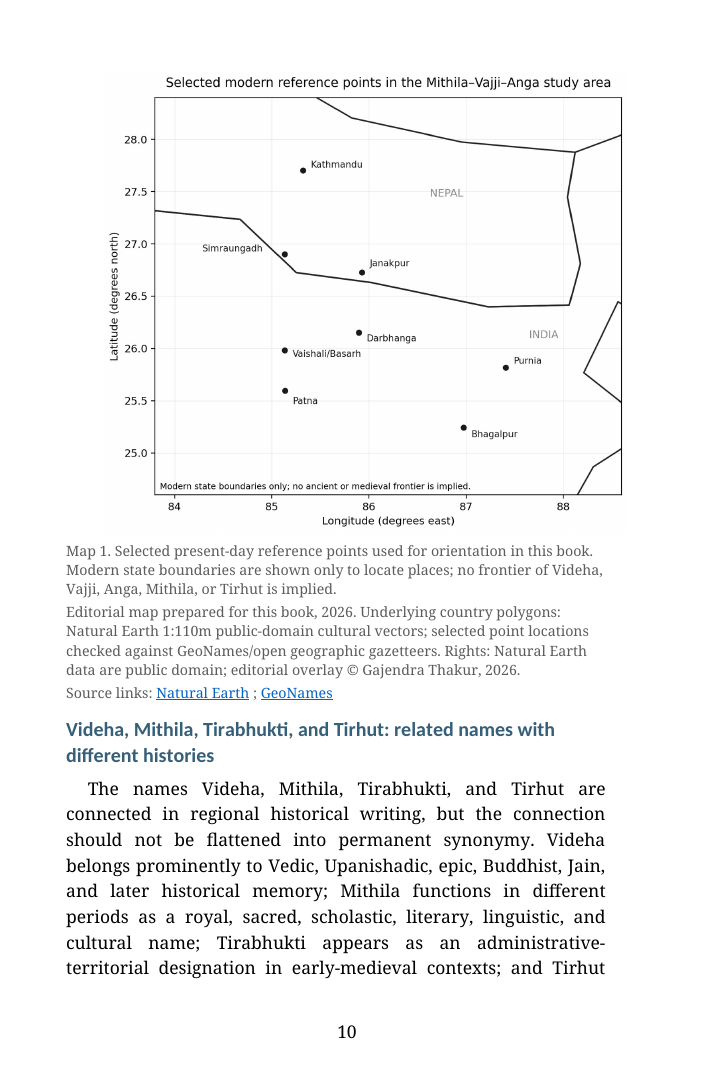
Mithila · Vajji · Anga
Chapter-specific source notes
- Primary chapter witness. Gajendra Thakur, Decoding the Panji of Mithila — Volume IV, formal Chapter 39, PDF pp. 404-412; formal Chapter 39. The HTML transcription is generated from the commit-pinned source PDF and retains the chapter boundary recorded in this edition.
- Internal structure. The repository source-heading inventory records no separately encoded subordinate heading for this chapter.
- Digital editorial method. The page keeps the preserved source text distinct from generated navigational, concordance, visual, and provenance apparatus. The synthetic reconstruction is explanatory only and is not evidence for an individual lineage or a determination of social or marital status.