Decoding the Panji of Mithila · Volume IV · Chapter 40
Mahishi-Budhwal: Kailakh, Kachhuwa, Pokhrauni, Bhainsdiyar, and Parihari: Entries (344)-(351) Coverage. This chapter begins exactly where Chapter 39
Chapter 40
    Mahishi-Budhwal: Kailakh,
Kachhuwa, Pokhrauni, Bhainsdiyar,
 and Parihari: Entries (344)-(351)
   Coverage. This chapter begins exactly where Chapter 39
stopped. Entry (344) opens a new Mahishi register, no longer
the earlier Mahishi-Pali series but Mahishi under Budhwal.
The chapter covers entries (344) through (351) only. Entry
(352), which begins Pariyam under Budhwal, is not included
and is reserved for the next chapter.
    Method. The reading remains genealogical and relational.
The words suta, suto, suita, apra, pr., th., dau, ddau, and
kasthut are treated as working Panji signs. A son-name is not
isolated from its marriage route; a marriage route is not
isolated from mool or moolgram; and a title such as Pathak,
Vaiyakaran, Jyotishi, I.P.S., I.A.S., doctor, or lawyer is read as
part of the same branch-continuity, not as external
biographical decoration.

1. Entry (344): Mahishi-Budhwal gramarambh,
Mahishi to Kailakh
   Entry (344) begins with an invocation and then states the
gramarambh formula for Mahishi under Budhwal. The
opening ancestor is Choudhary Jangal. His sons or branch-
names are Akhi, Nidhi, Buddhi, Jhotan, Ghanshyam, and
Aniruddh. The first route places the family through Pabauli-
Kulpati-Purushottam and Satlakha-Ruchai, so the register
begins by tying Mahishi-Budhwal to an already wide marriage
network rather than to a single isolated settlement.
   The Akhi branch gives Khagesh, Halla, Parashmani, and
Lakshminath through Ekhara-Dasharath-Chhotku and Pali-

Landan. Khagesh produces Babunandan, whose line moves
through Pabauli-Ramsinehi-Bhikshuk and Pali-Buddhinath.
Babunandan then gives Phudan through Belaunch-Sanphool-
Bhagwandatt and Karmaha-Kauskidatt. Phudan is carried
onward through Jajival-Atmaram-Gauridatt and Belaunch-
Hibharan. Halla produces Kalar through Darihara-Shivdatt-
Gauridatt and Dighoy-Balkaram; Kalar then passes through
Darihara-Nanu-Muni and Karmaha-Sanphool.
    Nidhi produces Shashinath and Amritnath through
Khaual-Vireshwar-Buddhi and Khandbala-Jayshiv. Buddhi
gives Hridaynath through Soderpur-Mahesh-Chhatrapati and
Pali-Revati Raman-Chaturbhuj. Jhotan produces Kashinath
through Khaual-Ghanshyam-Bhavadatt and Hariamb-
Dhodhan. Ghanshyam produces Gauridatt through Pabauli-
Gatiram-Giri-Akhi and Budhwal-Sanand. The source therefore
builds the first Mahishi-Budhwal cluster by repeatedly
sending its sons into Pali, Karmaha, Hariamb, Budhwal,
Soderpur, and Khandbala circuits.
   The second part of the entry turns to Bal Gopal. His sons
are Lakshman and Kalyan, linked through Sakararhi-Mandan-
Dase and Khandbala-Gopinath. Additional sons or collateral
descendants are Chaturbhuj, Harishwar, and Mahi through
Sakararhi-Gonu-Ramkrishna and Pabauli-Hari. Lakshman
gives Dinabandhu and Pranabandhu through Satlakha-
Manhar-Bhavesh and Pabauli-Mohan; Dinabandhu is tied
through Belaunch-Vir-Govind and Budhwal-Ram, while
Pranabandhu is tied through Darihara-Gang-Bachharu and
Naroun-Narpati. Kalyan is linked through Ekhara-Jagdish-
Bahudi and Satlakha-Devaki. Harishwar produces Hira
through Satlakha-Mohan-Devaki and Naroun-Bhavdev; Hira
gives Modi and Durgadatt through Mandar-Purandar-Sonu
and Khandbala-Dharu. Modi leads to Fakir and Girdhari
through Belaunch-Khagesh-Prabhakar and Baliyas-Vidyanath.

Durgadatt produces Shankardatt through Pandua-Pashupati-
Kedar and Pali-Durgadatt.

2. Entry (345): Mahishi to Kaivalakh,
Kachhuwa, Nityanand, and Shyam Sidhap
    Entry (345), under an invocation to Nandishwar, continues
the Mahishi-Budhwal line toward Kaivalakh, Kachhuwa,
Nityanand, and Shyam Sidhap. The entry begins from
Shankardatt. One Shankardatt branch is tied through Pabauli-
Trilochan-Adinath and Belaunch-Akhi. Another gives
Chhakodi through Sakararhi-Dinabandhu-Jaydatt and Pabauli-
Machal. A large collateral group follows: Vishnudatt,
Rudradatt, Faturi, Chhotkani, and Ramkrishna through
Sarisab-Ravantar-Eknath and Pali-Bodh.
    Chhakodi gives Halli, also marked pr. Haldhar, and Jalli,
also marked pr. Jaladhar, through Khaual-Modnarayan-Dattu
and Belaunch-Panni. Chhakodi also gives Madhusudan, linked
through Soderpur-Horil-Munidatt and Budhwal-Bhimdatt, and
Fuddi and Vidya through Soderpur-Basti-Bhagwandatt and
Darihara-Hanumandatt. Halli is tied through Khandbala-
Chhatramani-Chaturbhuj and Khaual-Balabhadra, and a Shivu
branch is tied through Soderpur-Gadadhar-Shridhar and Pali-
Bholanath. Shivu is then connected to the Sakuri-Baliyas line
of Machal, Kirtinath, Siddhinath, Bholanath, and the Pabauli-
Pathak-Shivnath-Shridhar route.
    Jalli produces Gangadhar through Sarisab-Fakiran-
Nandkishor and Panichobh-Bhayanath. A Nityanand branch
goes through Soderpur-Harangi-Durgadatt and Baliyas-
Raghuvir. Another line gives Bhesha, pr. Bheshnath, through
Darihara-Kanhai-Balle and Hariamb-Babujan. Gangadhar has
a Jajival-Shatanjiv-Rameshwar and Mandar-Bodhu route, and
another Belaunch-Prayagdatt connection. Nityanand also links
to Naroun-Pandit Jaymani-Maheshwar and Soderpur-

Dwarikanath. Bhairava, pr. Bheshnath, moves through
Darihara-Narayandatt-Trailokyanath and Budhwal-Shambhu.
   The modern-status line appears in the same genealogical
syntax. Gangadhar produces Mahavir I.P.S. (D.I.G.), Balvir,
Jayvir, and Jamuni through Jajival-Shatanjiv-Rameshwar and
Mandar-Bodhu. Faturi is tied through Naroun-Gunanidhi-
Pakhiya and Pali-Dharampati-Rohini. Mahavir is linked
through Nahas-Khaual-Chandrashekhar-Harikant and
Mahishi-Pali-Manmohan-Jaykant. The use of I.P.S. does not
detach Mahavir from the Panji frame; it shows a modern title
inserted within the old descent and marriage grammar.

3. Entry (346): Mahishi to Pokhrauni, Kailav,
and Amaun
    Entry (346) begins with an invocation and carries Mahishi
toward Pokhrauni, Kailav, and Amaun. It continues from the
Mahavir-Balvir material. Balvir, marked I.P.S., gives Arun
I.A.S. and Amit I.A.S. through Saurath-Badhiyam-Pabauli-
Chakradhar-Avadh Bihari and Naroun-Bachcha-Shivshankar.
The note also records a first I.A.S. daughter. This is another
example of a modern administrative title placed inside the
older Panji chain of sonship and marriage.
   The entry then returns to Mahi. Mahi gives Maniram, Ban,
and Karu through Khandbala-Babu-Ramkrishna and Khaual-
Chaturbhuj. Maniram produces Manranjan through Baliyas-
Shripati-Lakshmidev and Sarisab-Nandan. Manranjan gives
Mandhan and Nanu through Soderpur-Umanand-Bhavan and
Khaual-Chethadu. Mandhan gives Jaylal and Gudan through
Soderpur-Chalabali-Chhotakinma and Naroun-Ishwardatt.
Jaylal is tied through Baliyas-Bhikshuk-Tulsidatt and
Fanandah-Raja; his son Nageshwar is tied through Khaual-
Kari-Hira Lal and Pabauli-Premnath. Nageshwar produces
Singheshwar through Kujouli-Khagnath-Radhakant and
Baliyas-Bhaiyo, and Singheshwar is then linked through

Sulhni-Naroun-Ramesh-Taradatt and Nanyapur-Alay-
Choudhary Dular.
   Gudan is attached through Khaual-Bhutinath-Apuch and
Budhwal-Durgapati. Nanu passes through Darihara-
Urvvidhar-Muralidhar and Karmaha-Loknath. Ban is tied
through Jajival-Pitambar-Yar and Khaual-Basudev. The Pathak
branch enters through Parashuram, whose sons are Balkaram
and Vishnudatt. Balkaram gives Hridayram, Gopiram,
Chilkram, Mukraram, and Dular through Darihara-Ramakant-
Sonmani and Khandbala-Jaykrishna. Hridayram gives
Hemnath through Jajival-Chhakanu-Hirphool and Baliyas-
Prannath; Pathak Hemnath is then attached through Baliyas-
Brajnath-Bhulan and Naroun-Bala. Vishnudatt is tied through
Sakararhi-Raghupati-Khedan and Karmaha-Indrapati.

4. Entry (347): Mahishi to Bhainsdiyar
   Entry (347), invoking Gandiveshwar, carries Mahishi to
Bhainsdiyar. The first named ancestor is Pathak Baun,
described as jury in Calcutta H.C. His sons are Kamalnayan
and Lakshman through Ekhara-Krishnanand-Lal and
Darihara-Bhavdev. Kamalnayan gives Jaynath, Dular, and
Shyamnath through Darihara-Gati-Rojhan and Soderpur-
Bachharu. A collateral son Tejnath is tied through Soderpur-
Mahadev-Gopal and Sakararhi-Anand.
    Shyamnath gives Khadganath through Mandar-Pinakpani-
Narhari and Naroun-Ratnu. Khadganath gives Manohar
through Soderpur-Rameshwar-Mayanidhi and Khaual-
Dinanath. Tejnath is linked through Sakararhi-Raghupati-
Girpati and Pabauli-Tengari. Another son, Bodhnath, moves
through Darihara-Shulpani-Ram and Ghusaut-Sitaram.
Bodhnath gives Artinath through Baliyas-Hridayphool-
Hridaychandan and Naroun-Rupnath. Artinath produces
Muktinath, Kripanath, Gopinath, and Radhanath through
Tilay-Jhapat Singh-Suday Singh and Darihara-Jankinath.

    Muktinath produces Padmanath through Baliyas-Mani-
Babe and Karmaha-Daynath. Padmanath gives Shambhunath,
Ramanath, Amarnath, and Vibhutinath through Naroun-
Keshav-Surendra and Darihara-Lakshman. Shambhunath is
tied through Nahas-Khaual-Shivshankar-Digambar and Pali-
Yaddu. Kripanath gives Vaidyanath through Khandbala-
Mohan Singh-Padmanath Singh and Darihara-Gopinath.
Gopinath gives Vindhyanath, also under a Khandbala-
Padmanath Singh route, and Vindhyanath gives Ganeshnath
and Kanhaiya through Pabauli-Vedanand-Ramanand and Pali-
Kapileshwar. Radhanath produces Gaurinath, Basukinath,
Triyuginath I.P.S., and Ayodhyanath pr. Mohan Ji; the line is
further marked with Auditor General of Maharashtra
Government and Dr. G.P. of Rajasthan, and is tied through
Soderpur-Lakshmikant-Madhav and Mandar-Balki. Pathak
Lakshman closes the entry through Darihara-Ghanshyam-
Jaynarayan and Alay-Chandrapati.

5. Entry (348): Mahishi to Parihari, first
Parihari register
    Entry (348), invoking Bhunindra, moves Mahishi to
Parihari. Gangadhar produces Narayan, Hrishikesh,
Chakrapani, and Shulpani through Khaual-Deonath-
Vaidyanath and Soderpur-Pritinath. Chakrapani gives
Rohiniraman pr. Ganod, Jayshiv, and Uwari through Mandar-
Parashuram-Sitaram and Sakararhi-Pathak Ghanshyam.
Ganod gives Bholanath and Harikrishna through Pandua-
Gatiram-Duwai and Digho-Bhavesh. Bholanath is tied through
Satlakha-Kamal-Ganga and Baheradhi-Narayan.
    Harikrishna gives Bhaynath, Vidyanath, Adinath, and
Thithar pr. Dayanath through Satlakha-Kamal-Lochan and
Pali-Bhikhari-Nanu. Bhaynath gives Lal through Darihara-
Gunanidhi-Venidatt and Pabauli-Modi. Lal gives Dukhmochan
through Khandbala-Ugrasingh-Girdhar Singh and Darihara-

Hari. Dukhmochan gives Lakshmikant and Umakant through
Mandar-Chilka-Balki and Soderpur-Shankarnath. The entry
also records Ratidhar son Raghunath, linked through Pakaliya-
Hadi-Harikrishna. Raghunath gives Abhiram pr. Nakatu,
Thakuri, and Devkrishna pr. Mushna through Survet-
Sakararhi-Harikrishna-Andi and Sudri-Ram. Nakatu gives
Nidhi and Kamalpani through Mandar-Dayal-Raghunandan
and Hariamb-Sundar.
    Nidhi gives Nanu, Baburaya, Kanhai, and Amritnath
through Soderpur-Mahesh-Chhatrapati and Pali-Chaturbhuj.
Nanu, pr. Dull Raiya, gives Luchcha pr. Tirthamani through
Katma-Mandar-Rudraghar-Hridaynath and Soderpur-Bhaiyan.
Luchcha is tied through Pandua-Jiv-Jagatmani and Khandbala-
Thakur Bammoli. A further Luchcha branch gives Vanshmani
through Sukhait-Soderpur-Machal-Babue and Karmaha-
Shyamlal. Vanshmani then produces Nand Kishor and Umesh
pr. Bhutai through Naroun-Dhirnath-Ganesh and Khandbala-
Jhapti Singh. Umesh is linked through Satlakha-Hemnath-
Anupnath pr. Karpur, where the entry pauses and passes into
the next Parihari continuation.

6. Entry (349): Mahishi to Parihari, second
Parihari register
   Entry (349), again Mahishi to Parihari, continues the same
family terrain rather than shifting to a separate mool.
Kamalpani produces Gopal through Khandbala-Kulo-Mani and
Panichobh-Basaun. Additional offspring are Govind, Giridhari,
and Shivi through Ekdiha-Soderpur-Hiya-Dayan and
Sahshram-Darihara-Bachhai. Govind gives Durmochan
through Pabauli-Baburaya-Bhaiyo and Uchati-Horil.
Durmochan gives Jagdish Kinkar, Shyam Kinkar, Balabhadra,
and Buchan pr. an uncertain name through Soderpur-Bhatu-
Hirbhuj and Karmaha-Jhumak.

   Jagdish Kinkar gives Kumar Kishor through Naroun-
Dhirnath-Vaiyakaran Bachcha and Sarisab-Nandalal. Kumar
Kishor is attached through Darihara-Madhusudan-Tejnath and
Budhwal-Ramanand. Shyam Kinkar gives Mohan Ji pr.
Brajkishor through Baliyas-Hallali-Baldev and Digho-
Damodar. Mohan pr. Brajkishor is linked through Khandbala-
Ravinandan-Vishwanath and Pali-Rabusharu pr. Kulanand.
Balabhadra gives Bhola pr. Bhagat Kishor, Komal Kishor, and
Avadh Kishor through Kodariya-Sundar-Ramchandra and
Budhwal-Gudan. The entry ends with Bhola moving into a
Baliyas-Narayan route, which the next entry continues.

7. Entry (350): Mahishi to Parihari, third
Parihari register
    Entry (350), invoking Pramatha Natha, continues Mahishi
to Parihari. Giridhari is connected through Ekhara-Devidatt-
Bicha and Pali-Jhotan. Shivi is tied through Hasauli-Soderpur-
Chanchal-Babua and Pali-Chandradhatt-Gopal. Devkrishna pr.
Mushan gives Vidyanath through Khaual-Mahidhar-
Chhatrapati and Sakuri-Pali-Shripati. Bechu pr. Vidyanath
gives Ramanath through Ojholi-Naroun-Govind-Bhola and
Jamsam-Baliyas-Jagannath.
    Ramanath gives Khelanand pr. Chhito through Jajival-
Manmil-Jalpadas and Mahishi-Pali-Lal. Another son, Jhapat
Lal, is connected through Dahula-Mandar-Bhavani-
Vaidyanath. Chhito gives Shivshankar through Baliyas-
Teknath-Jankinath and Pali-Channa. Shivshankar gives
Upendra and Narayan through Baliyas-Ghonghi-Lutan and
Hariamb-Bhaiyo. The repeated return to Pali inside a Mahishi-
Budhwal chapter is important: it shows marriage or allied
route, not a change back to the earlier Mahishi-Pali register.

8. Entry (351): Mahishi to Parihari, fourth
Parihari register

   Entry (351), under an invocation to Parvati, is a short final
Parihari continuation. Jhapat Lal gives Harivansh and
Suvansh through Baliyas-Jankinath and Pali-Channa.
Harivansh is tied through Darihara-Prabhunath-Sudi and
Fanandah-Sundar. The final modern line names lawyer
Raghuvansh, whose son Ravishankar is connected with
Saroni-Rajanpura-Darihara and the Dr. Asarfi branch. This
brief entry closes the Mahishi-Parihari block by showing that
even modern professional identification remains embedded in
the same route-and-descent scheme.

9. Branch-continuity and stopping point
   Entries (344) to (351) form a coherent Mahishi-Budhwal
movement. The chapter begins with Mahishi to Kailakh and
moves through Kaivalakh, Kachhuwa, Nityanand, Shyam
Sidhap, Pokhrauni, Kailav, Amaun, Bhainsdiyar, and Parihari.
The governing register is Budhwal, but the routes constantly
mention Pali, Karmaha, Hariamb, Soderpur, Khandbala,
Ghusaut, Jajival, Satlakha, Pabauli, Baliyas, Mandar, Khaual,
and Darihara. This is the normal texture of Panji evidence:
mool control and marriage movement must be held together.
   Coverage is exclusive: entry (344), entry (345), entry (346),
entry (347), and the Parihari sequence (348), (349), (350), and
(351) have been decoded here. Entry (352), headed Pariyam
under Budhwal, starts a new register and must begin the next
chapter.
Source structure and verification apparatus
Editorial source apparatus. This apparatus is descriptive, not interpretive. It records the source-controlled structure used to verify that this page corresponds to formal Chapter 40 of Decoding the Panji of Mithila — Volume IV. The chapter text above is preserved from PDF pp. 413-421; formal Chapter 40 in the commit-pinned authoritative source. It is not merged with a neighboring chapter, appendix, annexure, or independent front/back-matter unit. The internal headings below come from the repository’s source-heading inventory and are retained as navigational and audit evidence; showing them here does not turn those headings into separate publications or add claims that are absent from the source.
Internal source headings
No subordinate heading was separately encoded in the repository source-heading inventory for this chapter.
Source-text concordance
Mahishi-Budhwal · Kailakh · Kachhuwa · Pokhrauni · Bhainsdiyar · Parihari · Entries · Coverage · begins · exactly · stopped · Entry · opens · Mahishi · register · longer · earlier · Mahishi-Pali · series · Budhwal · covers · Pariyam · included · reserved · next · Method · reading · remains · genealogical · relational · words · suta · suto · suita · apra · ddau · kasthut · treated · working · signs · son-name · isolated · marriage · route · mool · moolgram · title · Pathak · Vaiyakaran · Jyotishi · doctor · lawyer · read · part · branch-continuity · external · biographical · decoration · gramarambh · invocation · states · formula · opening · ancestor · Choudhary · Jangal · sons · branch · names · Akhi · Nidhi · Buddhi · Jhotan · Ghanshyam · Aniruddh · first · places · family · Pabauli · Kulpati-Purushottam
Boundary verification. In the formal sequence this chapter follows Volume IV Chapter 39, “Behat-Karmaha, Majhaura- Karmaha, and Majhiyam-Karmaha: Entries (336)-(343)” and precedes Volume IV Chapter 41, “Pariyam, Gangaura, and Dumra: Budhwal Continuities, Entries (352)- (358)”. The chapter extractor begins at the verified formal Chapter 40 marker and stops at the next verified formal chapter marker; for a final chapter it stops before recognized book-level back matter. The concordance above is generated only from distinct terms already present in this chapter’s preserved source text. It is provided for discovery, comparison, and audit, not as an automated judgment about persons, lineages, status, kinship, marriage eligibility, or historical truth.
Illustrated research apparatus
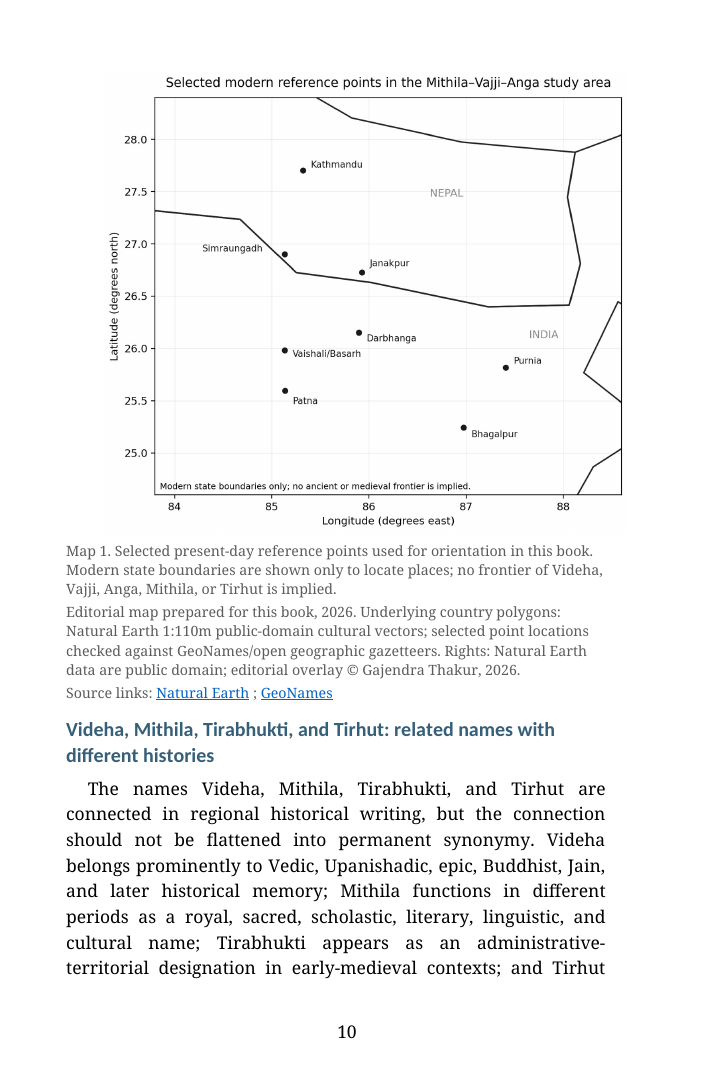
Mithila · Vajji · Anga
Chapter-specific source notes
- Primary chapter witness. Gajendra Thakur, Decoding the Panji of Mithila — Volume IV, formal Chapter 40, PDF pp. 413-421; formal Chapter 40. The HTML transcription is generated from the commit-pinned source PDF and retains the chapter boundary recorded in this edition.
- Internal structure. The repository source-heading inventory records no separately encoded subordinate heading for this chapter.
- Digital editorial method. The page keeps the preserved source text distinct from generated navigational, concordance, visual, and provenance apparatus. The synthetic reconstruction is explanatory only and is not evidence for an individual lineage or a determination of social or marital status.