Decoding the Panji of Mithila · Volume IV · Chapter 41
Pariyam, Gangaura, and Dumra: Budhwal Continuities, Entries (352)- (358)
Chapter 41
 Pariyam, Gangaura, and Dumra:
Budhwal Continuities, Entries (352)-
              (358)
1. Scope of the chapter
    This chapter begins exactly where the previous chapter
stopped: at entry (352), where the source opens a fresh
Budhwal-controlled register with the formula for Pariyam-
Budhwal gramarambh. It covers entries (352) to (358) only.
The movement is not random. First the Panji records Pariyam
under Budhwal, then a shorter Pariyam-Kailakh and Pariyam-
Biraul sequence, then the Gangaura-Budhwal branch, and
finally the Dumra-Budhwal gramarambh. Entry (357) is
preserved as an invocation-and-number marker without a
developed body. The chapter stops before entry (359), which
opens in the next source file with Vichadhi or Hulash and
therefore belongs to a later chapter.
   The governing logic remains the same: every name is read
through descent, place, marriage route, title, and branch-
continuity. The recurrent places—Sarisab, Belaunch, Kujouli,
Mandar, Khandbala, Pali, Hariamb, Darihara, Gangoli, Baliyas,
Soderpur, Satlakha, Jajival, Pabauli, Khaual, Sakararhi,
Panichobh, Ghusaut, Tisaut, and Naroun—are not incidental
local colour. They are the documentary grammar by which the
Panji validates the Budhwal branches.

2. Entry (352): Pariyam-Budhwal gramarambh
   Entry (352) begins with the formal formula: Pariyam under
Budhwal. The founding node is Pashupati, whose sons are
Brahmapati, Mahipati, Narpati, Medhapati, and Madhurapati.
The entry immediately anchors this cluster by a Sarisab route

through Apuch, son of Aman, and by a Belaunch route
through Babudi. Thus the opening statement is not merely
genealogical; it joins the house to a marriage-verified network.
   Brahmapati produces Saheb and Bachharu. Saheb is linked
through Kujouli-Gaurinath-Rami and Mandar-Babu, and
Saheb also gives a daughter or descendant line through
Darihara-Abhinandan-Keshav and Pabauli-Matiram.
Bachharu produces Parshmani and Ratan. Parshmani and
Ratan are placed through Khandbala-Purushottam-Bandhu
and Pali-Annu; Ratan is then placed separately through
Sarisab-Khantar-Eknath and Pali-Bodh. The apara branch
Chandrahas is attached through Baliyas-Girish-Dharmadatt
and Hariamb-Bauk. Chandrahas’s own line is again validated
through Satlakha-Kirtinath-Jagge and Soderpur-Nandishwar.
   The Narpati branch gives Rudrapati. Rudrapati is linked
through Darihara-Bharthi-Harijiv and Hariamb-Mohan.
Rudrapati then produces Lanha, whose line is recorded
through Ekhara-Babudi-Aniruddh and Gangoli-Kriparam.
Lanha’s daughter line is also marked through Baliyas-Jivi-
Bana and Ekhara-Haripani. The point is that Pariyam-
Budhwal is not a single descent line but a broad node whose
daughters and collateral sons keep the branch visible in
several other mools and villages.
    Madhurapati gives Sripati and Gharapati. Sripati produces
Durgapati through Soderpur-Ghanshyam-Bandhu and
Darihara-Madhav. Durgapati’s branch is connected through
Mandar-Mahipati-Maddu and Karmaha-Shambhunath. The
source then gives additional sons or collateral continuators—
Nandalal, Mukund, and Jayakrishna—through Sakararhi-
Dinbandhu-Jayadatt and Pabauli-Machal. A suspended Hibran
marker appears before the next line, showing an incomplete
or compressed branch notation rather than a fully abandoned
line.

    Nandalal gives Mohanlal through Baliyas-Bhikshuk-
Rupnath and Sarisab-Bhol. Another cluster—Babuji, Narsingh,
Kantir, Bhupi, and Chitru—is linked through Khandbala-
Balah-Shyamu and Satlakha-Mathuranath. Shaktinath is
attached to Soderpur-Lal-Matinath and Mandar-Bhavi.
Narsingh receives a Kodariya route through
Bhuvaneshwaridatt and Wagibubari Datt, and a Karmaha
route through Bhathi. The apara Narsingh sons Babuān and
Harikant pass through Pandua-Bhaiya-Mikhari and Pabauli-
Durganath. Babuān’s daughter line is then connected through
Mandar-Kunkun-Upadhyay Badrinath and Khandbala-
Shrimohan. This layered closure makes entry (352) the
foundation for the Pariyam section.

3. Entry (353): Pariyam to Kailakh
   Entry (353), headed Pariyam-Kailakh, continues the family
opened in entry (352), especially through Harikant, Kantir,
Bhupi, Chitru, Mukund, and Jayakrishna. Harikant is tied to
Kujouli-Durganath-Dinanath and Pali-Ram. Kantir produces
Chandrakant through Jajival-Parmeshwaridatt-Tejnarayan
and Karmaha-Bihari. The apara sons Tarakant and Ramakant
are connected through Harari-Sakararhi-Vidyanath-Gopinath
and Budhwal-Yugal, keeping the Budhwal link visible even
when the local heading says Pariyam-Kailakh.
    Chandrakant’s daughter line goes through Soderpur-
Jhingur-Khagadatt and Pali-Purandar. Tarakant’s daughter
line goes through Soderpur-Durmmil-Dinesh and Sakararhi-
Gopal. Bhupi is placed through Pandua-Pandit Ramkrishna-
Pandit Jiveshwar and Soderpur-Gudar, and another daughter
line through Sarisab-Bhulan-Gangadhar and Hariamb-
Indradatt. Chitru gives Shivkant, Bhola, and Chhavikant
through Jajival-Pratapanarayan-Nanu and Babhaniyam-Rudi.
The apara sons Vishnukant and Suryakant enter through
Brahmapura-Bechu-Dhiranath-Grihinath and Karmaha-Tilak.

   Vishnukant produces Shrichandra, Devchandra, and
Vinodchandra through Soderpur-Punyanand-Ramchandra
and Khaual-Lakshman. Suryakant gives Shubhchandra and
Vinaychandra through Pandua-Chhatradhari-Shrinandan and
Soderpur-Bhaiya. Mukund produces Bhushi, Buchan, Buda,
and Chhotaku through Sarisab-Chan-Thithar and Darihara-
Kanhai. Bhushi gives Bhola and Kusheshwar through Khaual-
Dattu-Harkhu and Soderpur-Gadadhar. Chhotaku’s line goes
through Pandua-Ratnamani-Umāpati and Pali-Muralilal, while
another Chhotaku line gives Digambar and Markandey
through Baliyas-Bhulan-Yaddu, Soderpur-Shriraman-
Bhognath, Belaunch-Ajitanarayan, and Jalay-Rupnarayan.
Jaykrishna closes the entry with Bhuvaneshwar, Lataru, and
Gangai, through Pandua-Achyut-Ramkrishna and Pali-Lotan.

4. Entry (354): Pariyam to Biraul
    Entry (354) moves Pariyam to Biraul. Dharapati gives
Artinath and Babujan through Sarisab-Paran-Yaduni and
Sakararhi-Anand. Artinath produces Babe through Ahpur-
Karmaha-Kamalakant-Pritinath and Baliyas-Hridaynandan;
the B 90/6 note linked with Balkrishna is preserved as a cross-
reference marker. Babe produces Bhagirath through Pabauli-
Ishannath-Soni and Darihara-Jhalli. Bhagirath’s daughter line
is placed through Sarisab-Narayandatt-Mathura and
Baheradhi-Bhaiyalal.
   Babujan produces Jagatlal through Baliyas-Rukshihal-
Amritnath and Khandbala-Shivu. Jagatlal gives Yadunandan
and Anant through Darihara-Jhumkamal-Radhu, also glossed
with Khadganath, and Pali-Bhanu. The two brother branches
are almost parallel: Yadunandan is attached through Baliyas-
Raghunath-Buchani or Muktinath and Soderpur-Chakradhar,
and Anant repeats the same validating marriage route. This
repetition shows that the source regards the Biraul branch as
stable only when both descent and affinal witnesses are given.

5. Entry (355): Gangaura-Budhwal to Satlakha
   Entry (355) shifts from Pariyam to Gangaura and opens a
Gangaura-Budhwal gramarambh. Achal produces Hemnath
through Khandbala-Vir-Brajbhushan and Karmaha-Chhabnu.
Hemnath gives Shobhnath, also Prabhu Babulal, through
Soderpur-Rameshwar-Vighneshwar and Babhaniyam-Saheb.
Yadunath is an apara son through Pabauli-Garib-Thodhan and
Baliyas-Jeevan; Yadunath’s daughter line goes through
Baliyas-Jayadatt-Bhavanidatt and Ghusaut-Lakshman.
Babulal’s line is tied to Sarisab-Shobhnath-Bathan and
Hariamb-Modnath.
   Lakshmidatt gives Bhimdatt through Mandar-Lal-Bhanu
and Soderpur-Raghupati. Bhimdatt produces Lalit Lal, Nidhi,
and Shambhu through Darihara-Shivdatt-Bachchan and
Soderpur-Bachharu. Lalit Lal, Rudi, and Jayanath are linked
through Sakararhi-Sahipani-Guni and Panichobh-Nahoran.
Another line goes through Pabauli-Machal-Narayandatt and
Ghusaut-Sanphool. Bhushan is linked through Soderpur-
Vanshidhar-Hema and Sarisab-Bhavanidatt; Bhushan then
gives Vishweshwar through Belaunch-Sonmani-Ghodhan and
Tisaut-Narayandatt. Vishweshwar’s daughter line returns to
Sakararhi-Gopinath-Triloknath and Sarisab-Gopal.
    Nidhi produces Khuni through Baliyas-Dharmadatt-
Bahoran and Pali-Tota. The apara daughter lines of Nidhi also
go through Pabauli-Machal-Pakhiya and Pali-Tota, and
through Jajival-Padmapati-Nanu and Sakararhi-
Kharnandeshwar. Khuni’s daughter line goes through Pandua-
Rudramani-Atmaram and Hariamb-Narsingh. The scholarly
branch appears with Shobhakant, marked Acharya, and his
son Premkant. Premkant is tied through Sarisab-Soderpur-
Shambhu-Madhukar and Kujouli-Rudradatt-Bhuvan to
Satlakha-Vishnudatt. Shashidhar is linked through Mandar-
Bechu-Amritnath and Panichobh-Jagannath, and Shashidhar’s

daughter line through Kujouli-Vidyanath-Gone and Khaual-
Pyare. The entry closes with Shubhankar and Sudarshan
through Digho-Ayodhyanath-Nandan, and with Bhimdatt’s
apara sons Mannulal and Ishwaridatt through Pandua-Kedar-
Rudradatt and Karmaha-Gangadatt. Ishwaridatt’s daughter
line is then connected through Sarisab-Prannath-Bahoran and
Karmaha-Rudradatt.

6. Entry (356): Gangaura to Damodarpur-
Maheshpur
     Entry (356) continues the Gangaura register to
Damodarpur-Maheshpur. Rishi gives Manik, Babudatt,
Mushari, Modi, and Babanuka through Khaual-Abhiram-
Bhaiya and Pali-Harikrishna. Manik produces Jhadula,
Krishnadatt, Chan, Shankardatt, Mangaladatt, and Kamaladatt
through Soderpur-Soni-Sitaram and Sakararhi-Dharni.
Krishnadatt gives Ganesh and Mukund through Darihara-
Mahipati-Sanath and Soderpur-Chhota. Ganesh’s daughter line
is tied through Baliyas-Mahesh-Hanumandatt and Panichobh-
Ishwaridatt. Chan’s daughter line is linked through Baliyas-
Pankaj-Mahesh and Sarisab-Ramanath.
   Shankardatt produces Jagdish through Soderpur-Devidatt-
Hiramani and Karmaha-Medhan. Jagdish’s daughter line goes
through Sarisab-Bhaiyan-Bhikhiya-Yadunandan and
Belaunch-Amresh-Ravinath. Kamaladatt produces Feku
through Khaual-Harishwar-Bulli and Alay-Devanand. Another
Rishi branch goes through Bhikhiya, linked with Sarisab-
Chaturbhuj-Ramakant and Pali-Dharampati. Jive produces
Sanand, Anand, Hiranand, Jayanandan, Harinandan, and
Janaki through Khaual-Ani-Mahi and Budhwal-Narottam.
Hiranand, written in the source with the nearby Hiranath
form, opens a Baburaiya line through Pabauli-Purushottam-
Ishannath and Naroun-Ratnu. Baburaiya’s daughter line goes
through Soderpur-Murli-Shivdatt and Ghusaut-Janaknath.

Janaki is linked through Ekhara-Panai-Kalaram and
Panichobh-Bhairav.
   Devkrishna gives Mana through Belaunch-Bhonai-Bagish
and Soderpur-Yadupati. Mana produces Bhaiya and Sanphool
through Jajival-Chhokar-Gangadhar and Darihara-Garib.
Bhaiya gives Gopal and Amritnath through Soderpur-
Bachanu-Dullah and Budhwal-Sutkhiya. Gopal gives Anantlal
through Pabauli-Bhanu-Dharmadatt and Khaual-Guna.
Amritnath’s daughter line is placed through Sarisab-Manik-
Chandidatt and Sakararhi-Dullah. This entry therefore uses
Gangaura as the starting label but repeatedly returns to
Budhwal, Pali, and Karmaha controls.

7. Entry (357): Invocation marker
    Entry (357) is headed by an invocation to Yaksheshwar and
by the number 184, but the source gives no developed body
under it. It should not be silently omitted. In Panji reading,
such markers often preserve a numerical or ritual place in the
sequence even when the branch body is absent, reserved
elsewhere, or represented only by the heading. Here it
functions as a formal divider between the Gangaura-
Damodarpur material and the following Dumra-Budhwal
gramarambh.

8. Entry (358): Dumra-Budhwal to Kakraud-
Tharhi
   Entry (358) opens the Dumra-Budhwal gramarambh and
carries it to Kakraud-Tharhi. Dullah produces Krishnapati,
Thitharu, and Prashripati through Darihara-Gatiram-
Dukhbhajan and Tisaut-Subandhu. Krishnapati’s daughter line
runs through Pandua-Krishnapati-Mohan and Soderpur-
Dukharan. Another daughter line goes through Jajival-
Chhakan-Sanphool and Pandua-Modan. Sripati gives
Dwarikanath through Belaunch-Gangaram-Raman and

Karmaha-Rudra. Dwarikanath gives Bechu through Baliyas-
Bhairav-Bahadur and Jajival-Bhaiya. Bechu produces
Lakshminarayan through Baliyas-Jangli-Babua and Soderpur-
Babujan. Lakshminarayan’s daughter line then goes through
Nikhuti-Vanshamani-Ray Baidyanath and Soderpur-Jaypati-
Chandramani.
    Paramanand gives Giripati, Madhurapati, Kulpati,
Brahmapati, and Mahipati through Satlakha-Manhar-Keshav
and Karmaha-Damodar. Giripati produces Sanphool through
Khandbala-Bhora-Madhurapati and Pali-Badli. Sanphool’s
daughter line goes through Mandar-Chhatrapati-Devan and
Pali-Hridi. Madhurapati gives Chhatrapati and Chandrapati
through Soderpur-Anu-Bachharu and Karmaha-Bandi.
Chandrapati’s daughter line goes through Soderpur-Dhanesh-
Gokulnath and Mandar-Kant. Kulpati gives Bachh through
Gangoli-Kriparam; Bachh gives Bhailal through Sakararhi-
Bhagirath-Chitru and Pabauli-Ramjiv, and the apara son
Shilanath through Mandar-Karu-Tulakrishna and Soderpur-
Narpati.
   Brahmapati gives Ghananand through Ekhara-Haridas and
Soderpur-Hari. Ghananand, written again with the
Dhananand form in the following line, gives Grihimani, Fekan,
and Ranganath through Baliyas-Purandar-Jivi and Karmaha-
Santoshi. Grihimani produces Vishwanath through Ekhara-
Chengan and Hariamb-Gongan. Vishwanath gives Ramanand
through Soderpur-Budhan-Keshav and Budhwal-Medhan.
Ramanand gives Jagdish and Jagannath through Baliyas-
Dedhan-Jivadatt and Ghusaut-Munik. Jagdish produces Bahudi
and Pitambar through Khandbala-Jagatkant-Bodhkant and
Hariamb-Govind.
   The Vatahu or Narnath line gives Premnath and Amarnath
through Baliyas-Shrikant-Raghunandan and Tisaut-
Ghanshyam Sundar. Premnath’s daughter line goes through

Kujouli-Jagtanand and Khaual-Gonu, while Amarnath’s
daughter line goes through Pabauli-Jagatanand and Sakararhi-
Parmeshwaridatt. Jagannath’s daughter line goes through
Baliyas-Bhikham-Dukhan and Karmaha-Bachchan. Pitambar
gives Babunandan through Khandbala-Gudan-
Lakshminarayan Singh and Pandua-Uma-Vaiya Ugranand;
Babunandan’s daughter line goes through Pabauli-Siddhinath-
Amarnath and Naroun-Pandit Nirsu. The final Fekan and
Ranganath branches connect respectively through Sarisab-
Budha-Bhaiyo and Baliyas-Nath, Pandua-Manik-Babuan and
Soderpur-Nathe, and Khaual-Dayan-Bharu and Baheradhi-
Lakshman.

9. Branch-continuity and transition
     Entries (352) to (358) are one Budhwal chapter. Pariyam-
Budhwal, Gangaura-Budhwal, and Dumra-Budhwal are three
local faces of the same wider control. The source’s repeated
insistence on Budhwal, Pali, Karmaha, Ghusaut, Hariamb,
Satlakha, Khandbala, Soderpur, Sarisab, and Baliyas confirms
that the register is built through descent and through
marriage-validated continuity. The scholarly and official
markers—Acharya in the Gangaura branch and the Ray/Vaiya
titles in the Dumra branch—are also treated as part of the
genealogical evidence, because in the Panji they help identify
the person and secure the branch against confusion with
homonymous names.
    The stopping point is exact. Entry (358) closes the material
preserved at the end of Vol-3Final03-b. The next source file
opens with entry (359), Vichadhi or Hulash, and must be
treated as a new chapter. It should not be folded back into the
Budhwal chapter, even though it continues the same Nagram
volume sequence.
Source structure and verification apparatus
Editorial source apparatus. This apparatus is descriptive, not interpretive. It records the source-controlled structure used to verify that this page corresponds to formal Chapter 41 of Decoding the Panji of Mithila — Volume IV. The chapter text above is preserved from PDF pp. 422-430; formal Chapter 41 in the commit-pinned authoritative source. It is not merged with a neighboring chapter, appendix, annexure, or independent front/back-matter unit. The internal headings below come from the repository’s source-heading inventory and are retained as navigational and audit evidence; showing them here does not turn those headings into separate publications or add claims that are absent from the source.
Internal source headings
No subordinate heading was separately encoded in the repository source-heading inventory for this chapter.
Source-text concordance
Pariyam · Gangaura · Dumra · Budhwal · Continuities · Entries · Scope · begins · exactly · previous · stopped · entry · opens · fresh · Budhwal-controlled · register · formula · gramarambh · covers · movement · random · First · records · shorter · Pariyam-Kailakh · Biraul · sequence · Gangaura-Budhwal · branch · finally · Dumra-Budhwal · preserved · invocation-and-number · marker · without · developed · body · stops · next · file · Vichadhi · Hulash · therefore · belongs · later · governing · logic · remains · every · name · read · descent · place · marriage · route · title · continuity · recurrent · places · Sarisab · Belaunch · Kujouli · Mandar · Khandbala · Pali · Hariamb · Darihara · Gangoli · Baliyas · Soderpur · Satlakha · Jajival · Pabauli · Khaual · Sakararhi · Panichobh · Ghusaut · Tisaut · Naroun · incidental
Boundary verification. In the formal sequence this chapter follows Volume IV Chapter 40, “Mahishi-Budhwal: Kailakh, Kachhuwa, Pokhrauni, Bhainsdiyar, and Parihari: Entries (344)-(351) Coverage. This chapter begins exactly where Chapter 39” and precedes Volume IV Chapter 42, “Vichadhi, Kua-Tisaut, Parhat-Baheradhi, Chanpura-Parihari, Malichham-Bhachhi, and Mangrauni-Khanam-Phandah, Entries (359)- (370)”. The chapter extractor begins at the verified formal Chapter 41 marker and stops at the next verified formal chapter marker; for a final chapter it stops before recognized book-level back matter. The concordance above is generated only from distinct terms already present in this chapter’s preserved source text. It is provided for discovery, comparison, and audit, not as an automated judgment about persons, lineages, status, kinship, marriage eligibility, or historical truth.
Illustrated research apparatus
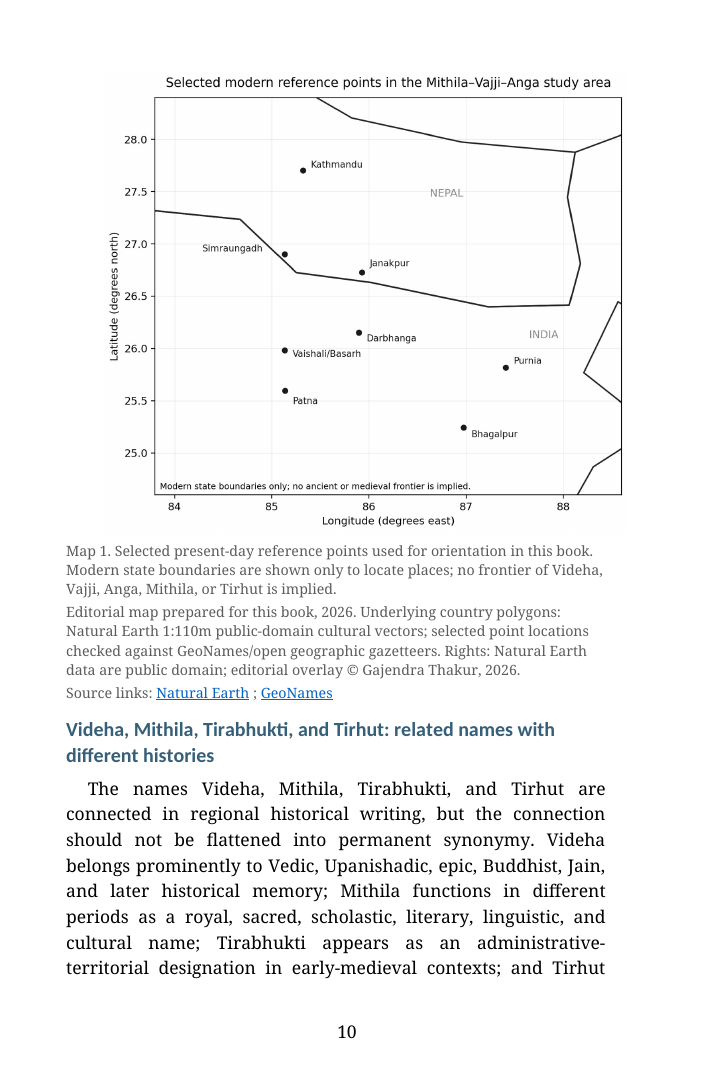
Mithila · Vajji · Anga
Chapter-specific source notes
- Primary chapter witness. Gajendra Thakur, Decoding the Panji of Mithila — Volume IV, formal Chapter 41, PDF pp. 422-430; formal Chapter 41. The HTML transcription is generated from the commit-pinned source PDF and retains the chapter boundary recorded in this edition.
- Internal structure. The repository source-heading inventory records no separately encoded subordinate heading for this chapter.
- Digital editorial method. The page keeps the preserved source text distinct from generated navigational, concordance, visual, and provenance apparatus. The synthetic reconstruction is explanatory only and is not evidence for an individual lineage or a determination of social or marital status.