Decoding the Panji of Mithila · Volume IV · Chapter 42
Vichadhi, Kua-Tisaut, Parhat-Baheradhi, Chanpura-Parihari, Malichham-Bhachhi, and Mangrauni-Khanam-Phandah, Entries (359)- (370)
Chapter 42
Vichadhi, Kua-Tisaut, Parhat-Baheradhi,
Chanpura-Parihari, Malichham-Bhachhi, and
Mangrauni-Khanam-Phandah, Entries (359)-
(370)
1. Scope of the chapter
This chapter begins exactly where the previous chapter
stopped: at entry (359), headed Vichadhi, also glossed as
Hulash. It then follows the source through entry (370). The
sequence includes Vichadhi; Kua under Tisaut; the
continuation marker (363); the Parhat-Baheradhi
gramarambh; Chanpura-Parihari and its two continuations;
Malichham-Baheradhi moving to Bhachhi; the Bhachhi
continuation; and finally the Mangrauni or Mangalavati entry
which opens the Khanam-Phandah register.
The governing method remains unchanged. Every person is
read through descent, place, marriage-route, title, and the
continuity of branches. The chapter also keeps the source
divisions intact. Entry (363), though effectively a heading
without a developed body, is preserved because such markers
often hold the place of a lost or suspended branch. Entry (371),
headed Khojpur, is not absorbed into the present chapter and
is reserved for the next chapter.
2. Entry (359): Vichadhi or Hulash
Entry (359), under the invocation to Rameshwar and the
heading Vichadhi or Hulash, opens with Anant and his sons
Baidyanath and Damodar. Baidyanath is connected through
Mandar-Mahesh-Matinath and Soderpur-Khedu; Baidyanath
also has a daughter-line through Dahibhat-Shiromani-Gatiram
and Darihara-Baninath. Damodar produces Lakshman and
Dinbandhu through Sakararhi-Baidyanath-Aniruddh and

Naraun-Mahesh. This beginning fixes the entry as a route
register, not merely a compact genealogy.
Dinbandhu gives Gonan, who is joined through Khaual-Ram-
Madhukar and Panichobh-Purushottam. Gonan gives
Vishnudatt through Satlakha-Prannath-Manhar and Belaunch-
Gokulnath. Lakshman, marked by a B-reference, gives
Khagapati and Hari through Darihara-Shrinivas-Narayan and
Pali-Chakor. The Khagapati branch then produces Meghnath,
Devnath, Hridaynath, and Premnath, tied through Khaual-
Jaykrishna-Giripati and Soderpur-Durmmil. Devnath is joined
through Soderpur-Narhari-Garibnath and Darihara-Narottam;
Hridaynath gives Yadunath, whose line runs through
Darihara-Mahesh-Mina and Alay-Bhikhnia. Yadunath then
gives Bhayalal, linked through Baliyas-Soni-Ishwardatt and
Ekhara-Hridaynandan.
Premnath gives Chaturanan through Mandar-Modi-
Bhairavdatt and Soderpur-Prem. Another son, Jhotan, goes
through Mandar-Padum-Nidhi and Budhwal-Jagannath.
Chaturanan gives Bhaiya and Chhotkani through Darihara-
Vanshidhar-Vidyanath and Pali-Jivan. The daughter-lines
attached to Bhaiya, Chhotkani, and Jhotan move through
Sarisab-Eknath-Bhola, Baliyas-Nath-Mukund, Belaunch-
Hridaysukh, Khori-Soderpur-Baburaiya-Ram, and Pali-Gonan.
Hari is separately linked through Khaual-Lakshman-
Purushottam and Pabauli-Purushottam. The closing line
brings in Shatanjiv and Bhaiyan. Bhaiyan gives Bhaiya, also
called Kulanand, through Darihara-Harikrishna-Dharadhar
and Sarisab-Chaturbhuj; Kulanand gives Gunanand through
Belaunch-Gangaram-Bhoranath and Jajival-Hiru; Gunanand
gives Apuch through Baliyas-Bhavi-Rudranath and Soderpur-
Jivan. Thus the Vichadhi entry is not a marginal appendix. It
establishes several active bridges between Mandar, Soderpur,
Khaual, Sarisab, Pali, and the Budhwal/Karmaha side of the
register.

3. Entries (360)-(363): Kua-Tisaut and the suspended
Kua marker
Entry (360) formally opens Kua under Tisaut. The source
states the Kua-Tisaut gramarambh and begins with Jagannath,
whose sons are Bhaiyo and Girdhari. Bhaiyo is placed through
Baliyas-Bhavesh-Sina and Khandbala-Durgadatt. Bhaiyo gives
Kamalnayan and Apuch through Soderpur-Vighneshwar-
Babujan and Sakararhi-Bachh. Kamalnayan produces
Ghanshyam Sundar through Belaunch-Ghaniram-Babunath
and Pali-Kamaladatt. The daughter-line of Ghanshyam Sundar
runs through Baliyas-Shyamlal-Raghunath and Soderpur-
Durmmil.
Girdhari gives Chiranjeev and Devkrishna through Soderpur-
Juraun-Moti and Karmaha-Kalanath. Chiranjeev produces
Kamalnarayan, Jagtanarayan, Shrinarayan, Bhagatanarayan,
and Modnarayan through Kujouli-Jhadula-Manbharan and
Mandar-Ramdhan. The named descendants then fan out into
Belaunch, Babhanigam, Soderpur, Netaur-Darihara, Hariamb,
Pali, and Baliyas. Modnarayan gives Bhuvneshwar,
Rameshwar, and Kameshwar through Baliyas-Ishwaridatt-
Bhul and Soderpur-Faturi; Bhuvneshwar gives Kalanand
through Kodariya-Keshav-Suresh and Darihara-Madhusudan.
Devkrishna gives Shobhanand through Khandbala-Mitrasinh-
Vishnusinh and Baliyas-Sonamani; Shobhanand’s daughter-
line passes through Mandar-Tufani-Krishnamohan and Jajival-
Ghogh-Faturi. The entry also preserves a Baghwa-resident
Khajuri-Panichobh line attached to Rai Rangalal, and the
Shrinarayan-Muktinath line through Soderpur-Bahoran-
Ishwari and Khaual-Bharu.
Entry (361), under the invocation to Kedarnath, continues the
same Kua-Tisaut movement. Parshuram gives Manai,
Baniram, and Chhabnu through Darihara-Rameshwar-
Ramapati and Karmaha-Raghu; an apara daughter-line goes

through Khaual-Parmanand-Hiranand and Soderpur-
Bachharu. Manai gives Dharmadatt, Khadagi, Shankardatt,
and Narayandatt through Baliyas-Dharadhar-Dhir and
Babhanigam-Bhaiya. Dharmadatt gives Thithar through
Sarisab-Khantar-Manik and Sakararhi-Bodh; Thithar gives
Lalji through Pabauli-Karu-Shambhu and Khaual-
Mangaladatt. Khadagi and Narayandatt then extend the
network toward Sakararhi, Soderpur, Khaual, Pali, Baliyas,
Belaunch, Mandar, and Alay.
The Narayandatt branch is especially important because it
carries titled and learned names. Narayandatt gives Gopal,
Vaiyakaran Manohar, Achhghar, and Shashidhar through
Khaual-Balkrishna-Chhata and Pali-Upe. Gopal produces
Vaiyakaran Madhusudan, Markandey, Sundar, and Kuli
through Khaual-Dhan-Jaydatt and Karmaha-Riddhi.
Vaiyakaran Madhusudan gives Upadhyay, also called
Shivnandan, through Baliyas-Girdhari-Manbharan and
Belaunch-Prayag Datt. Yashodhar, glossed under a B-
reference, gives Rame through Sakararhi-Anant-Hari and Pali-
Aniruddh; another line gives Bhola and Matinath through
Sakararhi-Basudev-Mahesh and Alay-Mohan. The ending of
the entry passes through Dukhabhanjan, Bhora, Mangaladatt,
Shyamlal, and Brajlal, closing with recurrent links to Ekhara,
Khaual, Sarisab, Baliyas, Pali, Soderpur, and again the
Budhwal/Karmaha field.
Entry (362), headed by the invocation to Somnath, is a
compact continuation. Haridev gives Sadianand through
Khandbala-Babu-Baidyanath and Pali-Mahadev. Sadi gives
Bacha, Thotha, and Nena through Pabauli-Gatiram-Dukharan
and Baliyas-Pashupati. Bacha gives Bhimdatt and Kasinath
through Ekhara-Nath-Rabadgapani and Karmaha-Prannath;
another son, Gopal, is partially blank but is still tied to Khaual
and then to Soderpur-Dayakar-Shambhu and Khaual-Bodh.
Bhimdatt gives Babuan through Sakararhi-Mayarama-Kariye

and Soderpur-Gopal. Babuan gives Mushan, Ravinath, and
Nakchhed, creating further passages through Kujouli,
Darihara, Pabauli, Karmaha, Mandar, Pali, Gangoli, Jajival,
and Panichobh. The final Anand and Bahudri line adds
Baliyas-Devanand-Pranapati and Soderpur-Purandar, while
Bahudri’s daughter-line goes through Jajival-Saday-Umapati
and Baliyas-Sadashiv.
Entry (363), “Kua se,” stands without a developed body. It is
therefore kept as a suspended Kua marker. The chapter does
not invent descent for it. It simply records that the Kua-Tisaut
complex had another heading or vacant place before the
source turns to Parhat.
4. Entry (364): Parhat-Baheradhi to Shivnagar-Purnea
Entry (364) shifts sharply to Parhat and opens the Parhat-
Baheradhi gramarambh, with the location further glossed
through Rashadh and Shivnagar-Purnea. The opening node is
Mahamahopadhyaya Bhikhi. His sons include
Mahamahopadhyaya Khagesh, marked also as Jyotishi, and
the route begins through Soderpur-Haridev-Anath and
Baliyas-Devanand. Mahamahopadhyaya Khagesh then gives
Mahamahopadhyaya Raja, also called Vidyanidhi, and
Hridaynidhi, through Sakararhi-Mahadev-Chiranand and
Soderpur. The entry deliberately combines high scholastic
titles with marriage-route documentation.
The Raja line gives Vaiyakaran Chudamani, Vaiyakaran
Nilamani, Jyotishi Krishnamani, Dijihma, and Shriman
through Sarisab-Pandit Krishnadev-Pandit Chan and
Sakararhi-Jaydatt. Vaiyakaran Chudamani gives Pauranik
Tekmani through Darihara-Hiraphool-Kanhai and Pali-
Sonama. Pauranik Tekmani gives Bandhumani, Daroga
Panchanand, Gehamani also called Babuan Ji, Ratnamani also
called Bachchan Ji, and Rudramani also called Sundar Ji. Their
alliance line runs through Pabauli-Kanhaiya-Divakant and

Budhwal-Fekan. Panchanand gives Amarnath, Trilottam, and
Devkinandan through Khaual-Vaiyakaran Hari-Krishnadev
and Soderpur-Nityanand. Gehamani gives Bhagwan Ji and
Ganesh through Soderpur-Vishwanath-Nehnath and Pali-
Raghunandan. The title-bearing and official-bearing side of the
register is thus strong: Mahamahopadhyaya, Jyotishi,
Vaiyakaran, Pauranik, Daroga, and modern B.A., B.Ed., B.A.
(Honours), M.A., and B.Tech references all appear in the same
continuation.
The later lines of entry (364) extend this scholarly line into
more recent individuals. Harishwar gives Ghoghan through
Baliyas-Yadunath-Mohan and Khandbala-Matinath; Ghoghan’s
daughter-line passes through Sakararhi-Mohan-Vanshi and
Hariamb-Bhagirath. Ratnamani, or Bachchan Ji, gives
Shyamanand, Bholanath, and Jagdish with modern education
markers. Shyamanand gives Divakar or Kunkun, and the note
points toward Khandbala and then to Rashadh-Ruchauli-
Ekhara. Bholanath gives Manoj Kumar, Bawlu or Sanjiv
Kumar, and Ajay or Chunna with B.Sc., M.A., and B.Tech
markers, while Manoj Kumar and Sanjiv Kumar continue into
Ayush, Raran, Jagatpur-Oini, Dr. Ravindranath Kumar, and a
Rashadh-Ruchauli-Ekhara-Parmeshwar link. This is one of the
places where the Panji explicitly extends a learned branch
into modern educational and professional titles.
5. Entries (365)-(367): Chanpura-Parihari and its
continuations
Entry (365), Chanpura-Parihari under Badri Thakur, begins
from Thakur Raghunath, whose sons include Maherman and
Tejan. Maherman is placed through Khaual-Parmanand-
Dinaram and Belaunch-Vir. Maherman produces Aankhi,
Lakshman, and Chhatrakar through Soderpur-Loknath-Khem
and Pali-Ram. Aankhi gives Sansadhar, Raja, Manmohan, and
Faturi through Pabauli-Dukharan-Bhavadatt and Hariamb-

Barju. Sansadhar’s line runs through Fochan, Jagatlal, Shivlal,
and Bhaiyo; Fochan is joined through Kujouli-Rudradatt-
Bhuvan and Satlakha-Vishnudatt, and the apara sons
Abhikant and Shridhar repeat the same Kujouli and Satlakha
channel.
Bhaiyo is linked through Khaual-Nehal-Faturi and Pali-Bauku.
Another son, Suresh, runs through Digho-Bachh-Ram and
Mandar-Vishnudatt. Suresh gives Lakshmikant and
Shobhakant through Soderpur-Shivkrishna-Buchu or
Hitkrishna and Darihara-Devkinandan. Badri, another son of
Bhaiyo, is linked through Sarisab-Govind-Munshi and
Budhwal-Govind. The Raja branch gives Lal and Vishwanath
through Satlakha-Sarvasv-Babujan and Budhwal-Bachh. Lal
gives Goshai through Jajival-Samar-Chandidatt and Kujouli-
Shivnath. The entry therefore creates a Parihari chapter
whose principal routes are through Khaual, Belaunch,
Soderpur, Pali, Pabauli, Hariamb, Kujouli, Satlakha, Digho,
Mandar, Sarisab, and Budhwal.
Entry (366) continues Chanpura. Lakshman gives Chhakori
through Darihara-Bachhas-Nidhi and Panichobh-
Madhurapati. Chhakori gives Yadunath, Durganath, Kirtinath,
and Baidyanath through Ekhara-Mangaladatt-Lal and Baliyas-
Girdhar. Yadunath produces Jivanath through Pabauli-
Dhairyi-Jagmohan and Darihara-Sanphool. Jivanath’s
daughter-line joins Gangoli-Jivanath-Nandkishor and Pali-
Hemnath. Baidyanath produces Rudranath and Ugranath
through Belaunch-Baknand-Meghnath and Jajival-Tulsidatt.
The Ugranath branch passes again to Sakararhi-Lanha-
Gokulanand and Pali-Chumman. Chhatrakar gives Babujan,
who gives Balbhadra and Jaybhadra through Khaual-Hemkar-
Motiram and Karmaha-Shrinath; Balbhadra’s line is tied
through Sarisab-Fakiran-Yugalkishor and Karmaha-Teknath.

The Tejan branch gives Baburam, Mathuranath, and
Batuknath through Darihara-Ganga-Dhani and Soderpur-
Dalpati. Baburam’s daughter-lines pass through Satlakha-
Abhiram-Ishannath and then through Pabauli-Chaturbhuj-
Paran and Karmaha-Jagan. Another son, Patak, is placed in
Dharora-Baliyas-Madansingh-Murlidhar and Pali-Manbodh.
Entry (367) then carries Chanpura through Chandidadatt,
Venidatt, Badhri, Bakura, Thithar, and later the Modi branch.
Chandidadatt gives Bhaiya and Jamahir through Pabauli-
Machal-Shyamlal and Naraun-Barju. Venidatt gives Bhayji,
Yadunath, Badri, Bakura, and Thithar through Darihara-
Chanan-Mohan and Pali-Hira. Bhayji produces
Chandrabhushan; Chandrabhushan’s route goes through
Mandar-Kunkun-Upadhyay Badrinath and Khandbala-
Shrimohan. The entry then continues through Amarnath,
Loknath, Doman, Jhothan, Gokulnath, Modi, Kari, and
Premnath, repeatedly binding the Chanpura-Parihari record
to Baliyas, Budhwal, Pali, Khaual, Panichobh, Soderpur, and
Karmaha.
6. Entries (368)-(369): Malichham-Baheradhi to
Bhachhi
Entry (368) opens the Malichham-Baheradhi gramarambh and
sends the branch toward Bhachhi. The first node is Thakur
Chhotai, who gives Parmanand or Bachha, Manasukh, and
Sonamani through Soderpur-Manhar-Sabhapati and Pali-
Shivram. Manasukh gives Bhikshuk, Vikal, and Vidyanath
through Soderpur-Janardan-Kamal and Khaual-Mahidhar.
Adinath is attached through Sakararhi-Ganapati-Dullah and
Karmaha-Bachharu. Bhikshuk gives Mathuranath through
Darihara-Garib-Mana and Belaunch-Yadav. Mathuranath
produces Bhayji, Gopal, and Chande through Baliyas-Bhayan-
Harisinh and Karmaha-Chitradhar. Bhayji gives Jankinath and
Dinanath through Pabauli-Machal-Natha and Pandua-Kedar;

Dinanath gives Dhairyanath through Pabauli-Garibnath-
Artinath and Pali-Hiralal. A further line runs through
Murajpur-Khaual-Shivdatt-Govinddatt and Baheradhi-Thithar.
Chande gives Purandar through Khaual-Raghunath-Dhanved-
Somdev and Soderpur-Chalabali-Bachan, and Purandar gives
Taranand through Sarisab-Visuni-Bhup and Mandar-Dular.
The Parmanand/Bachha side gives Shivnath through Khaual-
Abhiram-Chhotkani and Pabauli-Murli; Shivnath’s daughter-
line is attached through Sarisab-Ruchi-Chhabnu and Budhwal-
Madhusudan.
Entry (369) is the Bhachhi continuation. Vikal gives Vir and
Bholanath through Sarisab-Khantar-Eknath and Pali-Bodh.
Vir’s daughter-line moves through Darihara-Barju-Sanphool
and Sarisab-Machal; another son Manohar goes through
Khaual-Hema-Vanshamani and Kujouli-Bihari-Babulal.
Krishna Kumar is tied through Darihara-Prabhunath-
Shaktinath and Karmaha-Janki, while Krishna’s daughter-line
passes through Khaual-Prandhan-Nena and Jajival-Rajvanshi.
Bholanath gives Jagmohan through Darihara-Khadganarayan-
Kanhai-Shrinath and Soderpur-Nanu. Jagmohan gives Umesh
through Gangoli-Hiraphool-Shivlal and Pali-Keshav-Gumani.
Umesh is tied through Mandar-Baduki-Makebar and Sarisab-
Naubat Lal. Vidyanath has a daughter-line through Baliyas-
Pankaj-Mahesh and Sarisab-Ramanath. Finally, Adinath gives
Bhaiyo and Bachcha through Darihara-Shridatt-Brajnath and
Karmaha-Mayanidhi, with another line through Khaual-
Chaitu-Ravinath and Pali-Shivan. These entries show that
Bhachhi is not an isolated village tag; it is the visible outcome
of Malichham-Baheradhi descent passing through several
established alliance channels.
7. Entry (370): Mangrauni or Mangalavati and the
Khanam-Phandah register

Entry (370) changes the control again. It is headed Mangrauni,
also glossed as Mangalavati, and formally opens the Khanam-
Phandah gramarambh. The first named source person is
Sadupadhyay Ramabhadra. His sons are presented as a
strikingly learned cluster: Panditraj-padaankit
Mahamahopadhyaya Madhusudan, Mahamahopadhyaya
Baidyanath or Pitambar, Sadupadhyay Umanand,
Mahamahopadhyaya Bagish, and Mahamahopadhyaya Ratish
connected with the Tridandi-sannyasi tradition. Their
marriage route begins through Bhakharouli-Sakararhi-Gadu-
Shrikant and Panichobh-Kaviraj. The entry therefore marks
Khanam-Phandah as a high scholastic branch rather than a
mere locality.
Mahamahopadhyaya Madhusudan gives Mahamahopadhyaya
Goshai Madan and Baldev through Darihara-Umapati-
Bhikhari and Pali-Nandan. Goshai Madan gives Gangadatt
through Khaual-Umapati-Achyut and Ghusaut-Shivnath.
Gangadatt gives Shivdatt through Gangoli-Raman-
Lakshmikant, and a further Lakshmikant line is joined
through Uchati-Hingni-Madni and Jajival-Shivi. Baldev gives
Goshai Jivnath, Sonai or Ramanath, and Harinath through
Darihara-Bhavaninath-Sadanand and Soderpur-Aniruddh.
Goshai Jivnath is linked through Mandar-Parmanand-Hemai
and Khandbala-Gangaram. Sonai or Ramanath gives Ramnath
and Modnath through Darihara-Bharthi-Harijiv and Hariamb-
Mohan.
The same entry also carries a Ravinath branch. Ravinath gives
Amritnath, Gonan, Bharu, and Shyamnath through Khaual-
Purandar-Jayshiv and Karmaha-Mukunddev. A separate
Ravinath son, Raja, is linked through Jajival-Nitai-Kaladhar
and Khaual-Balkrishna. Amritnath gives Chunchun through
Sakararhi-Hemangad-Nilangad and Jajival-Padmapati;
Amritnath also gives Venidatt and Ishwaridatt through
Baliyas-Jivanath-Shobhanath and Karmaha-Soni. Chunchun

gives Lakshminath and Manmohan through Darihara-
Ghananand-Shambhu and Karmaha-Purushottam.
Lakshminath gives Balel and Raja through Soderpur-Dullah-
Girdhari and Pali-Ishwaridatt. Balel gives Radhanath through
Belaunch-Lakshmidatt-Keshav and Darihara-Raghu.
Radhanath gives Kalanath, Balanath, Shrinath, and Yadunath
through Pandua-Lakshman-Nathuni and Pabauli-Chaturbhuj.
Kalanath gives Kumudranjan and Vinayranjan through
Khandbala-Ravinandan-Baidyanath and Pali-Krishnalal. This
last chain is the transition into the Khojpur material that
follows in entry (371).
8. Branch-continuity and transition
Entries (359) to (370) form a deliberately mixed chapter. The
first part carries Vichadhi/Hulash and Kua-Tisaut, with entry
(363) left as a suspended Kua marker. The second part turns to
Parhat-Baheradhi and then to Chanpura-Parihari. The third
part follows Malichham-Baheradhi to Bhachhi. The closing
entry then opens Mangrauni-Mangalavati as Khanam-
Phandah, a learned branch full of Mahamahopadhyaya,
Sadupadhyay, Panditraj, Pauranik, Jyotishi, Vaiyakaran,
Daroga, and modern educational titles.
The chapter’s stopping point is exact. Entries (359), (360), (361),
(362), and the empty marker (363) have been decoded; entries
(364), (365), (366), (367), (368), (369), and (370) have also been
decoded. Entry (371), headed Khojpur, continues after the
Kalanath-Balanath-Shrinath-Yadunath branch and is reserved
for the next chapter so that the Khojpur continuation can be
read as its own unit.
Source structure and verification apparatus
Editorial source apparatus. This apparatus is descriptive, not interpretive. It records the source-controlled structure used to verify that this page corresponds to formal Chapter 42 of Decoding the Panji of Mithila — Volume IV. The chapter text above is preserved from PDF pp. 431-441; formal Chapter 42 in the commit-pinned authoritative source. It is not merged with a neighboring chapter, appendix, annexure, or independent front/back-matter unit. The internal headings below come from the repository’s source-heading inventory and are retained as navigational and audit evidence; showing them here does not turn those headings into separate publications or add claims that are absent from the source.
Internal source headings
No subordinate heading was separately encoded in the repository source-heading inventory for this chapter.
Source-text concordance
Vichadhi · Kua-Tisaut · Parhat-Baheradhi · Chanpura-Parihari · Malichham-Bhachhi · Mangrauni-Khanam-Phandah · Entries · Scope · begins · exactly · previous · stopped · entry · headed · glossed · Hulash · follows · sequence · includes · Tisaut · continuation · marker · gramarambh · continuations · Malichham-Baheradhi · moving · Bhachhi · finally · Mangrauni · Mangalavati · opens · Khanam-Phandah · register · governing · method · remains · unchanged · Every · person · read · descent · place · marriage-route · title · continuity · branches · keeps · divisions · intact · though · effectively · heading · without · developed · body · preserved · markers · often · hold · lost · suspended · branch · Khojpur · absorbed · present · reserved · next · invocation · Rameshwar · Anant · sons · Baidyanath · Damodar · connected · Mandar-Mahesh-Matinath · Soderpur-Khedu · daughter-line · Dahibhat-Shiromani-Gatiram · Darihara-Baninath · produces
Boundary verification. In the formal sequence this chapter follows Volume IV Chapter 41, “Pariyam, Gangaura, and Dumra: Budhwal Continuities, Entries (352)- (358)” and precedes Volume IV Chapter 43, “Khojpur, Mangrauni, Pilkhwar and the Khanam- Phandah Learned Branch: Entries (371)-(382) This chapter resumes exactly where the previous chapter stopped. Entry (370) had opened the Khanam-Phandah”. The chapter extractor begins at the verified formal Chapter 42 marker and stops at the next verified formal chapter marker; for a final chapter it stops before recognized book-level back matter. The concordance above is generated only from distinct terms already present in this chapter’s preserved source text. It is provided for discovery, comparison, and audit, not as an automated judgment about persons, lineages, status, kinship, marriage eligibility, or historical truth.
Illustrated research apparatus
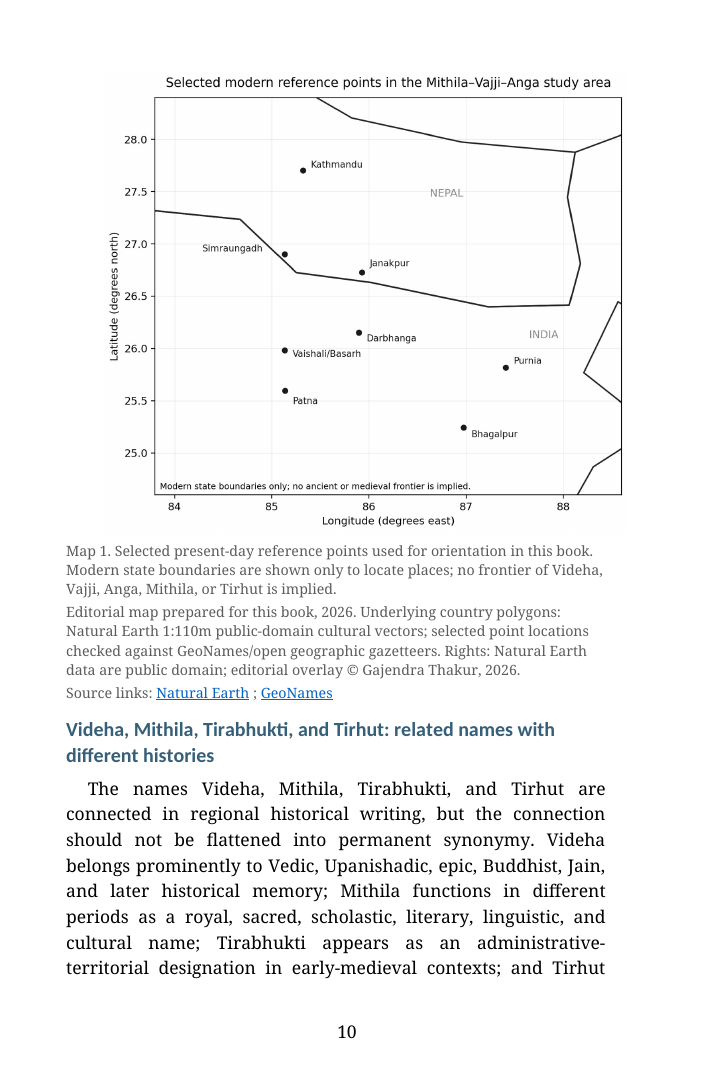
Mithila · Vajji · Anga
Chapter-specific source notes
- Primary chapter witness. Gajendra Thakur, Decoding the Panji of Mithila — Volume IV, formal Chapter 42, PDF pp. 431-441; formal Chapter 42. The HTML transcription is generated from the commit-pinned source PDF and retains the chapter boundary recorded in this edition.
- Internal structure. The repository source-heading inventory records no separately encoded subordinate heading for this chapter.
- Digital editorial method. The page keeps the preserved source text distinct from generated navigational, concordance, visual, and provenance apparatus. The synthetic reconstruction is explanatory only and is not evidence for an individual lineage or a determination of social or marital status.