Decoding the Panji of Mithila · Volume IV · Chapter 43
Khojpur, Mangrauni, Pilkhwar and the Khanam- Phandah Learned Branch: Entries (371)-(382) This chapter resumes exactly where the previous chapter stopped. Entry (370) had opened the Khanam-Phandah
Chapter 43
Khojpur, Mangrauni, Pilkhwar and the Khanam-
Phandah Learned Branch: Entries (371)-(382)
   This chapter resumes exactly where the previous chapter
stopped. Entry (370) had opened the Khanam-Phandah
gramarambh under the Mangrauni/Mangalavati heading;
entry (371) is therefore not a free-standing miscellany, but the
first continuation of that learned branch. The register now
moves through Khojpur, Mangrauni, Pilkhwar and the end of
the Khanam-Phandah sequence before a new Alay
gramarambh begins in entry (383). The governing method
remains descent first, then settlement, marriage route, title
and branch-continuity. The source is dense, with many
ellipses, but its structure is still clear: each cluster preserves a
father-to-son descent and then anchors that descent through
marriage exchanges with Kujouli, Mandar, Pabauli, Pali,
Soderpur, Khaual, Baliyas, Satlakha, Darbhanga-Darihara,
Jajival, Khandbala, Ghusaaut, Karmah and other recurrent
Panji houses.
   Entry (371), marked Khojpur, carries forward the line from
the close of entry (370). Balanath is recorded with Manoj
Kumar, whose marriage route is placed through Kujouli, from
Dwarikanath, son of Shashikant, and then through Mandar
with Munai. Raja stands beside Dinanath and Bhuvanath.
Dinanath and Bhuvanath are not merely named brothers;
their settlement and marriage affiliations differentiate two
active branches. The Pabauli marriage through Natha and
Juddhi, and the Pali route through Krishnamani, show that
this Khojpur register is already tied to older exchange houses.
Dinanath's sons Madanand, Vinodanand and Sharadanand
carry the line into the next stage: Madanand is linked to
Soderpur through Harihar and Shyamanand and then to
Suragan through Vijayanarayan; Vinodanand is linked to

Baliyas through Srishtidhar and Shakrinandan and then to
Digho through Shobhakant; Bhuvanath is tied to Khandbala
through Jagatkant and Lakshmikant and to Khaual through
Harinandan. The names therefore do not stand as a flat list;
they map a three-way dispersal from Khojpur into Pabauli-
Pali, Soderpur-Suragan and Baliyas-Digho circuits.
   The same entry gives another layer through Manmohan,
Venidatt and Ishwaridatt. Manmohan's daughters or
descendants are joined to Sarisab through Dinanath, son of
Aniruddha, and to Hariamb through Nandalal; a second line
moves to Pabauli through Musahad, son of Chaturbhuj, and
again to Hariamb through Manmohan. Venidatt creates a
Soderpur-Ghusaaut link through Jalpada and Nanu, while
Ishwaridatt leads to Ganeshdatt through the Soderpur line of
Bhaiyaram and Shankardatt, and further to Pali through
Somdatt. The closing note on Muchkund, with Vinodanand
and Promodanand, is important because it shows that the
branch was still capable of receiving later named persons and
even parenthetical Panji references. The Sushma-Bharam note
connected with Mahadev Jha and the Nahas-Khaual line
through Bheshnath and Amarnath is one of those late
insertions that preserves living branch-continuity rather than
only an older descent memory.
  Entry (372), Mangrauni-Khojpur, returns the register more
explicitly to Mangrauni. Gonon is followed by a separate
Gopinath branch and by the line of Bharu. Rajnath's sons
Sarinath, Gumani and Manmohan are arranged through the
Sakararhi route of Abhinandan and Bhawani and the Pali
route of Bachharan. Sarinath's sons Tilaknath, Janakinath and
Japinath then extend the branch. Tilaknath is tied to Narun
through Chhatir and Phalgun and to Hariamb through Khargi;
his collateral Rebnath is placed in Bithouli-Baliyas through
Jangali and Babua and then in Soderpur through Babujan.
Garibnath is attached to Darihara through Digambar and

Nandalal and to Kujouli through Krishnamani. Janakinath's
route through Satlakha, Jaylal and Hemnath, then to Hariamb
through Dwarikanath, is another example of the register using
marriage as a genealogical locator.
   Japinath's sons Taranand and Muchkund become the main
hinge of entry (372). Muchkund's sons Shardanand,
Ramanand, Vinodanand, Promodanand, Dayanand, Mayanand
and Vivekanand are grouped with a Satlakha-Parhat-
Sakararhi marriage route through Moti and Kantu and with a
Budhwal link through Chaudhary Nageshwar. Shardanand
continues through Vidyanand and Premanand into Ranti.
Ramanand's sons Chandranand, also called Subodh, and
Chaturanand, also called Pradip, are then carried by the
Ratoli-Darihara route, through the Tharhi/Maheramanth Panji
connection and Krishnadev, into Pindaruch-Paramgarh-Alay
through Balbhadra. This last movement anticipates the later
Alay material, but it does not yet begin the Alay register. It is
still functioning here as an outward marriage and continuity
marker within Mangrauni-Khojpur.
   Entries (373) and (374) form one of the most learned sub-
clusters in this part of the volume. Entry (373), headed
Mangrauni, places Mahamahopadhyaya Pitambar at the head
of a scholarly descent. His sons or successors include
Mahamahopadhyaya           Trilochan,      Mahamahopadhyaya
Dandapani, Dhananjay and the tikakar or commentator
Gokulnath. The register does not treat these titles as
ornamental. They are part of identity: a Mahamahopadhyaya,
a tikakar and a yajna-related scholar branch had public
intellectual status, and the Panji preserves that status while
also tying the same men to marriage routes. Trilochan goes
through Khaual and Pali; Dandapani through Pabauli and
Darihara; Gokulnath through Darihara and Jajival. The
learned house therefore remains a marriageable and locatable
house rather than an abstract scholastic lineage.

   The    Sarayantri    line    of    Gokulnath      leads   to
Mahamahopadhyaya          Sarvasvadata       Raghunath      and
Lakshminath. Raghunath's sons include Jaykrishna, the
Sarayantri Datt or Vishnudatt, and Mahamahopadhyaya
Bhavanidatt. The next generation is large: poet Shankardatt,
Nanu or Rudradatt, Pankhi or Battaha, Ramadatt, Manapur
Govinddatt and Faturi or Tirthadatt. Shankardatt, Kanhaiyalal,
Rukminidatt, Babua, Babuan, Bachchan and Lal form a
sequence in which scholarly titles, poetic identity and descent
are tightly folded together. In this entry the words kavi,
Mahamahopadhyaya and tikakar make clear that the branch's
prestige depended not only on ancestral purity but also on
intellectual production. Yet the line remains embedded in
Kujouli, Alay, Sarisab, Pali, Narun, Khaual, Khandbala and
Phanandah marriage circuits.
   Entry (374) continues the Mangrauni material through
Rudradatt. Mannulal and Sonelal form the next visible sons.
Mannulal's marriages connect Darihara, Pali, Baliyas,
Ghusaaut, Karmha and Khandbala; the repetition of Pali and
Ghusaaut confirms that this branch remained interwoven
with older Vatsa-line houses. Sonelal's sons Lala and Bala are
placed through Pandua, Chan and Vishwanath, and then
through Soderpur and Chandradatt. Lala produces Rampal
and Gopal. Rampal's son Shivji, also called Shivanandan, is
linked to Satlakha through Jyotishi Dwarikanath and Basudev
and then to Belauch through Sukeshwar. Gopal's route
through Baliyas, Gayadatt and Lakshmikant, and then to
Soderpur, keeps the branch within the same repeated
marriage field. Bala repeats the Khaual-Venidatt-Babua and
Khandbala-Kamal Singh connection, showing how collateral
sons could preserve parallel marriage signatures.
  Entry (375), written as Mangrauli, should be read as a
variant form within the same larger Mangrauni/Mangalavati
continuum rather than as a wholly unrelated branch. Pankhi

or Ishwaridatt leads to Nena, Gharbharan, Chandi and Hitti.
Nena's sons Bokan, Babulal, Parashmani and Shakrinath are
tied to Jajival through Mansukh and Bhimdatt and to Darihara
through Manik. Gharbharan produces Anand through Narun
and Chanchal, with a Panichobh link through Rabedan.
Chandi produces the Bagde or Baidyanath branch, linked to
Belauch through Maniram and Poshan and to Baliyas through
Hemnath. The Bengali branch through Sarisab and Baliyas
shows that the family memory preserved alternate names and
possibly alternate residence labels inside the same
genealogical stem.
   Hitti's branch is especially important. Hitti produces
Sridhar     and   then    Chandrakishor     and    Leelanand;
Chandrakishor gives Divakar, and Sridhar is tied to Kujouli
through Kirtinath and Vishwanath and then to Soderpur
through Mathuranath. Hitti's marriage with Mandar and the
Karmha link through Shitaladatt again demonstrate a familiar
pattern: a local branch is authenticated by both descent and
its exchange houses. Raveli or Ugradatt and Horildatt are then
given as additional collateral channels. Horildatt connects
Sarisab, Narun, Soderpur and Belauch, not as stray places but
as the continuation map by which this Mangrauni variant
could be recognized by later Panjikars.
   Entry (376), under the Bhimshankar invocation, begins with
Battaha or Ramadatt. His sons Kamalnath, Channa, Gosain and
Sadhumanohar are attached to Soderpur through Basudev
and Harpati and to Budhwal through Achal. Kamalnath
continues through Soderpur and Alay; Gosain produces
Sundar and Mangu through Khaual, Ramabhadra and
Jayabhadra, and then through Pabauli and Natha. Mangu's
sons Chintamani, Jagdhar and Madhakant create the next
large cluster. Chintamani leads to Indranath and
Mahendranath; Indranath gives Dhananjay, Dhirendra and
Virendra. The Darihara-Vamshidhar and Kodariya-Nunu

Prasad routes attached to these names are not incidental; they
identify which sub-branches married into which recognized
houses.
   The same entry places Yatadhar with Dharanidhar, Girdhar
and Vamshidhar. These names make a small but coherent
scholarly-administrative cluster, because each is linked
through high-status houses: Khaual with Mahamahopadhyaya
Babujan and Kunjan, Kujouli with Punyadatt and Taradatt,
Digho with Gayadatt, Basuadi-Baliyas with Jyotishi Mahidhar
and Pitambar, and Narun with Baidyanath. Madhukant leads
to Shubhkant and Shrikant, while Manohar gives Rameshwar.
The register's method is cumulative. It begins with one father
and several sons, but it never leaves the sons unnamed; it
follows them into titles, marriage routes and branch labels
until the line can be placed inside the broader Mithila
network.
   Entries (377) and (378) complete another major internal
branch. Entry (377), under Garibnath, begins with Faturi or
Tirthadatt, whose son Bhikhiya leads to Vamshmani and
Hansamani. Vamshmani's descendants - Tantramani,
Vijaymani, Jitendramani, Hitendramani and Upendramani -
are spread through Soderpur, Baliyas, Khaual, Pali, Jajival and
Digho. The names themselves show a deliberate manikya or
mani naming pattern, and the marriages show how that
pattern was distributed. Vijaymani gives Devendramani and
Chandramani, while Jitendramani leads to Ratnamani,
Shyamji, Nilam and Hira. Hitendramani gives Promodmani,
Vinodmani, Subodhmani and Lalanmani, with Digho and
Ghusaaut anchoring the branch.
  Entry (378), under Rajrajeshwar, continues the same mani-
named     line   through    Upendramani,     Shivendramani,
Prasannamani, Sukumarmani and Manojmani. Hansamani is
then traced into Krishnamani and Kedarmani or Kalika, and

Krishnamani into Rudramani and Indramani. Rudramani
gives Dhirendramani and Virendramani through Khandbala
and Kujouli, while Indramani gives Prakashmani and
Chintamani, with Sonlal and Bunlal as alternate names or
collateral designations. Kedarmani, through Jhalloo or
Vinayanand, returns to Pabauli and Sakararhi. These entries
are a good example of branch-continuity without a fresh
gramarambh: the sacred invocation changes, but the
genealogical material continues a named descent stream.
  Entries (379), (380) and (381) shift to Pilkhwar. Entry (379)
begins with Mahamahopadhyaya Padhyay Umanand and his
sons Dharmeshwar and Guneshwar. Guneshwar leads to
Gosain and Dharanath; Dharanath to Khagnath, Bhajat and
Jhonti. Khagnath's son Bhaylal is tied to Soderpur through
Umanand and Bhawan and to Darihara through
Mahamahopadhyaya Chitradhar. Bhaylal's sons Khelnath and
Son continue the branch. Khelnath gives Chiranjeev through
Soderpur and Pali; Son creates a larger set - Gunanand,
Paramanand and Fuchchi or Nityanand - through Khandbala
and Ghusaaut. Paramanand then produces Kirtyanand,
Brahmanand and Narayanji, and the next generation of
Kirtyanand includes Anand, Apooch and Ashok. This Pilkhwar
entry is therefore a high-status learned branch that still
remains dependent upon precise marriage placement.
  Entry (380) continues Pilkhwar through Fuchchi or
Nityanand. His descendants include Promod, Vinod, Subodh
and Kumod. Vinod gives Vimalanand through Mandar and
Khandbala; Promodanand gives Durganand, also called Riku,
through Mandar and Karmha; Subodh gives Chandranath
through Kanhauli-Soderpur and a Shardapur-Mandar-Baliyas
note. The Jhonti branch is no less important: Jhonti gives
Bhayyan, Babua and Shaktinath, and Bhayyan gives Srinath,
Bhul, Jayant and Subanta. Jayant produces Radhanath, whose
descendants Gaurinath, Siddhnath and Premnath carry the

line into Khaual, Hariamb, Soderpur, Ghusaaut and Haripur-
Pali. Siddhnath's sons Shashthinath and Tunmun, with later
Ramapur-Rajaura-Mandar and Madhubani-Bhaur-Khandbala
notes, show a late expansion of the same Pilkhwar branch.
   Entry (381) is the third Pilkhwar panel. Babua's son
Harinandan is placed through Satlakha and Pali-Soderpur.
Harinandan's line divides into Badrinath, Sumathuranath,
Baidyanath, Shobhanath and Vishwanath. Badrinath gives
Ugranath and Vikalnath through Khaual and Ghusaaut.
Mathuranath produces Prajnath, Namonath and Bhawanath
through Khaual and Khandbala. Baidyanath produces
Suryanath, Abhayanath, Ratan and Narnath through Darihara
and Babhaniyam. Shobhanath's sons Satishnath, Shashinath,
Prabhunath, Khaj-Santosh and Alakhnath take the branch into
Khaual, Ghusaaut, Belauch, Pandua and Khandbala.
Vishwanath's son Bholanath is tied to Navani and Ratoli-
Darihara through Shrikant and Fuchchi or Baidyanath, and
then to Pabauli through Shyamanand. The small note on
Shalin, Sauto, Shashipur, Sandahpur and Digho preserves a
late and partly incomplete continuation, but it is still within
the Pilkhwar descent frame.
   Entry (382), headed Mangrauni with the parenthetical
Yamsam-Mangrauni, returns to the learned Khanam-Phandah
line opened earlier. Mahamahopadhyaya Vagish gives Lal or
Girdhar and Mahidhar. Lal or Girdhar gives the
Chatushcharan Yajnakarta Mahamahopadhyaya Dhirendra.
The title is crucial: the branch claims ritual and scholastic
authority, and the Panji records the authority in the same
breath as marriages through Pabauli, Darihara and Budhwal.
The descent from Krishnapati to Gauripati and Ratipati, and
the Budhwal link through Narayan, show how the ritual
branch is domesticated through exchange networks.
Dhirendra's marriage through Narun and Sakararhi,
Mahidhar's through Khaual and Karmha, and Krishnaram's

through Soderpur and Pali extend the same learned family
into multiple recognized houses.
   The final part of entry (382) takes Mahamahopadhyaya
Ratish to Ishanath, and then Mahamahopadhyaya Ishanath to
Shobhanath and Rupnath. Shobhanath produces Mahapurush,
whose lines pass through Baliyas, Jajival, Darihara, Kujouli
and Mandar. One route runs through Bhagirth and Chhabnu
to Soderpur, Murlidhar, Devkrishna and Kujouli-Jagannath;
another runs through Chaturbhuj and Purushottam to Pali-
Harikrishna and Mandar-Vachaspati. Rupnath's two recorded
marriage routes, through Khaual-Purandar-Jayashiv and
through Baliyas-Shubhpat-Bhavesh to Khandbala-Bholanath,
close the chapter with the same rule that has governed the
entire sequence: descent must be read with place, and place
must be read with marriage. Entry (383) begins a new
Rajgram-Alay gramarambh and is therefore reserved for the
next chapter.
  Transition to the next chapter: Entry (383) opens a new Alay
gramarambh under the Rajgram heading. The next chapter
should therefore begin with that Alay register rather than
carrying it backward into the Khanam-Phandah or Pilkhwar
material.
Source structure and verification apparatus
Editorial source apparatus. This apparatus is descriptive, not interpretive. It records the source-controlled structure used to verify that this page corresponds to formal Chapter 43 of Decoding the Panji of Mithila — Volume IV. The chapter text above is preserved from PDF pp. 442-450; formal Chapter 43 in the commit-pinned authoritative source. It is not merged with a neighboring chapter, appendix, annexure, or independent front/back-matter unit. The internal headings below come from the repository’s source-heading inventory and are retained as navigational and audit evidence; showing them here does not turn those headings into separate publications or add claims that are absent from the source.
Internal source headings
No subordinate heading was separately encoded in the repository source-heading inventory for this chapter.
Source-text concordance
Khojpur · Mangrauni · Pilkhwar · Khanam · Phandah · Learned · Branch · Entries · resumes · exactly · previous · stopped · Entry · opened · Khanam-Phandah · gramarambh · Mangalavati · heading · therefore · free-standing · miscellany · first · continuation · register · moves · sequence · Alay · begins · governing · method · remains · descent · settlement · marriage · route · title · branch-continuity · dense · many · ellipses · structure · still · clear · cluster · preserves · father-to-son · anchors · exchanges · Kujouli · Mandar · Pabauli · Pali · Soderpur · Khaual · Baliyas · Satlakha · Darbhanga-Darihara · Jajival · Khandbala · Ghusaaut · Karmah · recurrent · houses · marked · carries · forward · line · close · Balanath · recorded · Manoj · Kumar · whose · placed · Dwarikanath · Shashikant · Munai · Raja · stands · beside
Boundary verification. In the formal sequence this chapter follows Volume IV Chapter 42, “Vichadhi, Kua-Tisaut, Parhat-Baheradhi, Chanpura-Parihari, Malichham-Bhachhi, and Mangrauni-Khanam-Phandah, Entries (359)- (370)” and precedes Volume IV Chapter 44, “Rajgram-Alay, Rashadh, Pilkhwar-Baligarh and Lagma: Entries (383)-(387)”. The chapter extractor begins at the verified formal Chapter 43 marker and stops at the next verified formal chapter marker; for a final chapter it stops before recognized book-level back matter. The concordance above is generated only from distinct terms already present in this chapter’s preserved source text. It is provided for discovery, comparison, and audit, not as an automated judgment about persons, lineages, status, kinship, marriage eligibility, or historical truth.
Illustrated research apparatus
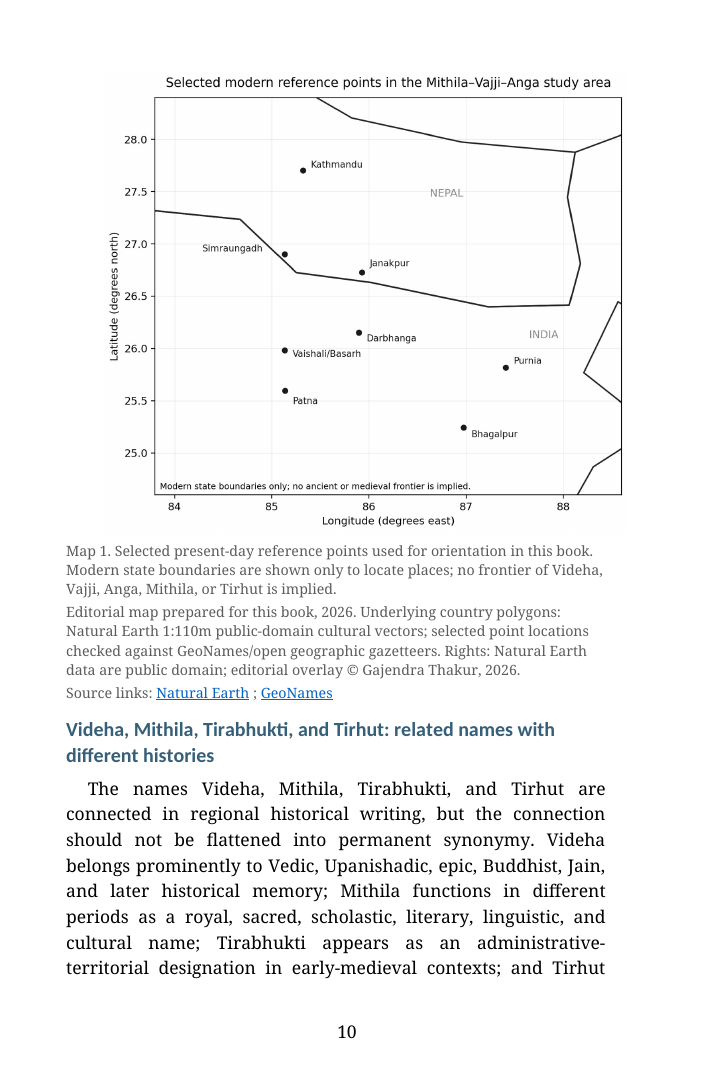
Mithila · Vajji · Anga
Chapter-specific source notes
- Primary chapter witness. Gajendra Thakur, Decoding the Panji of Mithila — Volume IV, formal Chapter 43, PDF pp. 442-450; formal Chapter 43. The HTML transcription is generated from the commit-pinned source PDF and retains the chapter boundary recorded in this edition.
- Internal structure. The repository source-heading inventory records no separately encoded subordinate heading for this chapter.
- Digital editorial method. The page keeps the preserved source text distinct from generated navigational, concordance, visual, and provenance apparatus. The synthetic reconstruction is explanatory only and is not evidence for an individual lineage or a determination of social or marital status.