Decoding the Panji of Mithila · Volume IV · Chapter 44
Rajgram-Alay, Rashadh, Pilkhwar-Baligarh and Lagma: Entries (383)-(387)
Chapter 44
Rajgram-Alay, Rashadh, Pilkhwar-Baligarh and
Lagma: Entries (383)-(387)
  This chapter begins at the point reserved by the previous
chapter. Entry (383) opens a new Alay gramarambh under the
Rajgram heading, and therefore the material has to be read as
a fresh local register rather than as an appendix to the
Mangrauni-Khanam-Phandah section. The chapter covers
entries (383) to (387) only. Its movement is from Rajgram-Alay
and Rashadh into Pilkhwar, Baligarh and Lagma, stopping
before the Baigani-Alay royal register of entry (388).

1. Entry (383): Rajgram and the Alay gramarambh
   Entry (383), invoked under Shitikantha and marked
Rajgram, formally opens the Alay gramarambh. The first
visible ancestor is Vamshi, whose children or branch-heads
are Purandar, Ratish, Chaturbhuj and Mahi. The marriage
framing already places the branch in a wide circuit: Belaunch,
Baliyas, Mandar, Soderpur, Jajival, Baliyas again, Hariamb,
Sarisab, Ekhara and Darihara all appear as alliance or
reference points. The name Rajgram thus functions as a local
entry-heading, while Alay is the operative moolgram frame.
   Purandar gives a set of descendants headed by Jhontu,
Chandrapati and Lala. Jhontu leads to Kamal and Balbhadra.
Kamal is attached to Baliyas through Vechu and Hemnath and
then to Hariamb through Bauk. The Chandrapati branch is
larger and more administrative in texture: Devidatt,
Shitaladatt, Narayandatt, Vishnudatt, Gauridatt, Lakshmidatt
and Parshi are grouped together through Jajival-Manhar-
Dharu and Mandar-Gonu. This is not merely a list of sons; it is
a compressed map of the house's alliance field.
  Devidatt's line produces Ramadatt and Bhayanath.
Shitaladatt gives Jagatbandhu, who then gives Dinbandhu.

Dinbandhu      produces      Harishchandra,     Lalitchandra,
Chandeshwar, Suryadev and Amarendra. These names are
attached through Baliyas-Sonamani-Mathuri and Soderpur-
Lakshminath. Harishchandra is separately linked through
Sarisab-Harkhi-Achyutanand and then to Jalay through
Bachcha or Harivansh Narayan, while Amarendra returns to
Soderpur-Durgadatt-Madhusudan and Baliyas-Raghunath.
Entry (383) therefore repeatedly folds one descent branch
back into multiple recognized marriage corridors.
   Parshi's branch closes the entry by moving through Ekhara-
Girdhar-Babunath and Mandar-Vamshidhar. This is a small
but important closing signal. It confirms that the entry is not
trying to exhaust every collateral line; rather, it records the
visible nodes needed to connect the Alay branch with the
houses through which its marriages and recognition were
preserved.

2. Entry (384): Rashadh and the Lal branch
   Entry (384), under the Singheshwarnath invocation and the
Rashadh heading, continues the same general Alay field but
changes the immediate branch-head. Lal gives Nena,
Ishwaridatt, Chandidatt and Girjadatt. Nena is attached
through Darihara-Mavadhan-Vamshidhar and Pali-Jivakarn.
Another Nena connection moves through Darihara-Gangesh-
Dharmadatt and Karmaha-Soni. The repeated Darihara and
Karmaha references show that Rashadh here is not isolated; it
is an outward-facing node in the same marriage ecology.
   Nena's son Bhul extends the line into Khaual through
Sanphool and Santosh. Santosh, in turn, is attached to
Badhwas-Sarisab through Jaykrishna and Pandit Eknath, and
to Baliyas through Khushihal. Bhul also gives Chiranjeev, who
is tied to Khaual-Narayandatt and then to Tilay through Rai
Mohan Singh. Ishwaridatt, Chandidatt and Ratishwar form
additional supports. Chandidatt passes toward Pabauli and

Pali through Machal and Pankhiya/Tota, while Ratishwar gives
Pitambar and Mandhar through Mandar-Batai-Ramdhar and
Jajival-Bachha.
   The Thakurdatt branch in entry (384) deserves separate
attention. Thakurdatt, son of Mahi, is placed through Jonki-
Sarisab-Raghunath-Bhramar          and       Mandar-Mahipati.
Thakurdatt gives Umadatt; Umadatt gives Thithar through
Mandar-Dhanad-Jayrudra and Belaunch-Bhaiya. Thithar then
moves through Pandua-Manik-Nityanand and Naroun-
Pankhiya. The final Thithar marriage through Baliyas-Nath-
Mukund and Belaunch-Hridaysukh closes the entry with
another strong link into established houses.

3. Entry (385): Pilkhwar-Baligarh and the Pathak
branches
   Entry (385), marked Pilkhwar-Baligarh, shifts the chapter
into a Pathak-centered cluster. Pathak Dubari gives Sarvasv,
Hridayanandan, Babnu and Yaddu. Sarvasv is connected
through Sarisab-Bhagirath-Machal and Mandar-Chhakori.
Hridayanandan gives Banamali, and Banamali gives Nena
through Soderpur-Bandhu-Basaun and Khaual-Jayan. The
Nena branch then passes through Ekhara-Poshan-Bhavan and
Khaual-Dullah, with a further Darihara-Bachchan-Nena and
Ghusaut-Matiram connection. This creates a tightly meshed
Pilkhwar network.
  Yaddu is attached through Soderpur-Jaydatt-Dayanath and
Pali-Vishwanath. Another Yaddu branch through Naroun-
Nani-Chhatri and Babhaniyam-Saheb leads to Beni. A further
Yaddu son, Badri, is linked through Khaual-Bhaiya-Gonor and
Karmaha-Bhaju. Entry (385) then opens a second major unit
through Pathak Krishnapati, whose sons are Ushapati and
Vidyapati. The Ushapati line gives Jagyapati, Hira, Dhira and
Poshan     through     Darihara-Nilkanth-Bhikhi   and    Pali-
Revatiraman.

   The Vidyapati side is especially important because it makes
the Pilkhwar-Baligarh entry a learned and genealogically
influential cluster. Bodhi gives Vamshmani, Kanhai,
Harihardatt and Umadatt through Belaunch-Bachan-Bhikham
and Pali-Bhavaditya. Vamshmani gives Nena through Khaual-
Nayan-Babunath and Pabauli-Pathak Bhavanath. Nena gives
Gangadhar, and Pathak Gangadhar gives Dharanidhar, Ratish,
Girish and Satish through Jajival-Shivrudra-Rajvanshi and
Darihara-Hiyan. This is the portion of entry (385) where the
Pathak identity becomes most explicit.
   Dharanidhar is linked through Ekhara-Gopal-Fuddilal and
Alay-Abhi's grandson Rupnath-Motilal, while Girish and
Vaidyanath continue through Ekhara-Fuddilal and Baliyas-
Keshav-Ramanand. The entry is dense, but its logic is clear: the
Pilkhwar-Baligarh branch records descent, learned status and
alliance together. It is not a mere enumeration of names, but a
genealogical tying of Pathak descent to several major
marriage houses.

4. Entry (386): Baligarh-Lagma as continuation
   Entry (386), Baligarh-Lagma, continues the previous
Pilkhwar-Baligarh material rather than beginning an
unrelated family. Pathak Ratish gives Rajmangal, also called
Buchan, through Kujouli-Shrinath-Ramakant and Mandar-
Rukminidatt. Pathak Satish is linked through Digho and
Mandar. Kanhai is tied through Soderpur-Baburaiya-Girdhari
and Mandar-Ratnapani. Bhavan gives Rajaram and
Narayandatt through Belaunch-Murlidhar-Sanphool and
Karmaha-Sanphool.
  The Vidyapati branch continues through Dukhbhanjan and
Kalar. Dukhbhanjan gives Manik through Ekhara-Mukund-
Manasukh and Khaual-Bhaiya. Manik then connects to
Satlakha-Hira-Bodh-Bhaiya and Pali-Lalbihari. Kalar is tied
through    Darihara-Rohini-Shridatt  and    Pabauli-Pathak

Raghuvir. These details keep the Baligarh-Lagma material
inside the same marriage grid of Ekhara, Khaual, Satlakha,
Pali, Darihara and Pabauli.
  Entry (386) also contains a Janardan branch. Janardan's
children or linked branches include Bapane, Anath and Bhora.
Bane, Madhurapati and Bhikhi are connected through Kujouli-
Param-Kamali and Khaual-Mukund. Madhurapati gives
Khelpati, Mahipati, Gauripati and Kalar through Ekhara-
Bhramar-Gangadatt and Pali-Dhani. Mahipati gives Gokulnath
through Khaual-Balkrishna-Bua and Gangoli-Vaidyanath.
Bhikhi gives Bhola, Dharmadatt, Poshan and Mangani through
Khaual-Harisut-Balkrishna and Soderpur-Dhani.
   The last part of entry (386) moves from Bhola to Bhangi and
Banamali, and then from Banamali to Jagannath, Baidyanath,
Kashi Nath and Girjanath. Jagannath gives Vidyanath through
Digho-Fatur-Krishnakant and Karmaha-Balel. This final detail
becomes the hinge for entry (387), where the Lagma register
starts with Vidyanath.

5. Entry (387): Lagma
   Entry (387), marked Lagma, opens with Vidyanath and his
sons or branch-heads Ashanand, Kamalanand and
Rudranand. These are placed through Baliyas-Bhikham-Bhup
and Hariamb-Sadanand. Baidyanath then gives Vindhyanath,
Tirthnath, Virendranath, Surendranath and Jitendranath
through Kujouli-Khagnath-Radhakant and Baliyas-Bhaiyo.
Vindhyanath is attached through Satlakha-Rameshwar-Bhola
and Alay-Fekanlal; Tirthnath gives Amarnath and Kripanath
through Baliyas-Bhikham-Dukhan and Karmaha-Bachchan.
  The Lagma branch then spreads through Virendra,
Surendra and Jitendra. Surendranath is linked to Sukhait-
Khaual through Mahamahopadhyaya Trilochan and to
Belaunch-Sudhakar. Jitendranath passes through Jajival-
Dinanath-Vishwanath and Karmaha-Amritnath. Girjanath

gives Muktinath through Pabauli-Shyamanand and Khaual-
Chaudhary Kalaru. This shows the same method as before:
lineal descent is recorded together with named alliance
houses, and learned titles are preserved where the source
gives them.
   The Dharmadatt and Anath branches complete entry (387).
Dharmadatt gives Girdhari through Darihara-Manbodh-Balah
and Sarisab-Khantar-Manik. Mangani is tied through
Soderpur-Diheshwar-Godhi and Darihara-Dukhiya. Anath
gives Bhikhni, Anand, Sanand and Shobhanath through
Sakararhi-Nityanand-Damodar and Karmaha-Achyut. Bhikhni
gives Dular, Kariya, Amol and Jhadula through Mandar-
Purandar-Hemangad and Hariamb-Ghoghan. Dular is linked
through Digho-Nath-Duleli and Karmaha-Kulanand.
   The final movements of entry (387) carry Kariya to Girdhari
and Kunjan; another Anath line goes through Soderpur-
Gangaram-Lakshman and Budhwal-Jagai. Jhadula gives
Umanath or Doman through Satlakha-Pitambar-Parmanand
and Babhaniyam-Bhani. Sanand gives Krishnadatt through
Soderpur-Dukharan-Dhira and Sakararhi-Umapati. Bhora
gives Pranpati, who gives Ratan through Mandar-Pashupati-
Mitrakar and Soderpur-Rameshwar, with further links to
Kujouli-Ganganand-Bachharu,       Kodariya-Gangaram       and
Ekhara-Kalidas-Ratanu-Karmaha-Lakshmipati. Entry (387) is
therefore a full Lagma register, not merely a postscript to
Baligarh.

6. Branch-continuity and transition
   Entries (383) to (387) form a compact but highly connected
chapter. The sequence begins with Rajgram-Alay and Rashadh,
then moves to Pilkhwar-Baligarh and Baligarh-Lagma, and
finally settles into Lagma proper. Across the entries, the same
recurrent alliance houses appear: Belaunch, Baliyas,
Soderpur, Jajival, Mandar, Darihara, Pali, Khaual, Karmaha,

Budhwal, Ghusaut, Satlakha, Naroun, Pandua, Pabauli and
Hariamb. Their repetition is not accidental; it is how the Panji
text converts descent into a recognized social map.
  The chapter stops deliberately before entry (388), where
Baigani-Alay begins with the Baneli, Ramgarh, Dyondhi, Garh-
Baneli and Sultanganj material. That next entry is a large
royal and estate-centered register and should be treated as a
separate chapter rather than compressed into the present
Alay-Pilkhwar-Baligarh-Lagma chapter.
Source structure and verification apparatus
Editorial source apparatus. This apparatus is descriptive, not interpretive. It records the source-controlled structure used to verify that this page corresponds to formal Chapter 44 of Decoding the Panji of Mithila — Volume IV. The chapter text above is preserved from PDF pp. 451-457; formal Chapter 44 in the commit-pinned authoritative source. It is not merged with a neighboring chapter, appendix, annexure, or independent front/back-matter unit. The internal headings below come from the repository’s source-heading inventory and are retained as navigational and audit evidence; showing them here does not turn those headings into separate publications or add claims that are absent from the source.
Internal source headings
- 1. Entry (383): Rajgram and the Alay gramarambh
- 2. Entry (384): Rashadh and the Lal branch
- 3. Entry (385): Pilkhwar-Baligarh and the Pathak branches
- 4. Entry (386): Baligarh-Lagma as continuation
- 5. Entry (387): Lagma
- 6. Branch-continuity and transition
Source-text concordance
Rajgram-Alay · Rashadh · Pilkhwar-Baligarh · Lagma · Entries · begins · point · reserved · previous · Entry · opens · Alay · gramarambh · Rajgram · heading · therefore · material · read · fresh · local · register · rather · appendix · Mangrauni-Khanam-Phandah · section · covers · movement · Pilkhwar · Baligarh · stopping · Baigani-Alay · royal · invoked · Shitikantha · marked · formally · first · visible · ancestor · Vamshi · whose · children · branch-heads · Purandar · Ratish · Chaturbhuj · Mahi · marriage · framing · already · places · branch · wide · circuit · Belaunch · Baliyas · Mandar · Soderpur · Jajival · Hariamb · Sarisab · Ekhara · Darihara · appear · alliance · reference · points · name · thus · functions · entry-heading · operative · moolgram · frame · gives · descendants · headed · Jhontu · Chandrapati · Lala
Boundary verification. In the formal sequence this chapter follows Volume IV Chapter 43, “Khojpur, Mangrauni, Pilkhwar and the Khanam- Phandah Learned Branch: Entries (371)-(382) This chapter resumes exactly where the previous chapter stopped. Entry (370) had opened the Khanam-Phandah” and precedes Volume IV Chapter 45, “Baigani-Alay and the Baneli- Ramgarh Royal Cluster”. The chapter extractor begins at the verified formal Chapter 44 marker and stops at the next verified formal chapter marker; for a final chapter it stops before recognized book-level back matter. The concordance above is generated only from distinct terms already present in this chapter’s preserved source text. It is provided for discovery, comparison, and audit, not as an automated judgment about persons, lineages, status, kinship, marriage eligibility, or historical truth.
Illustrated research apparatus
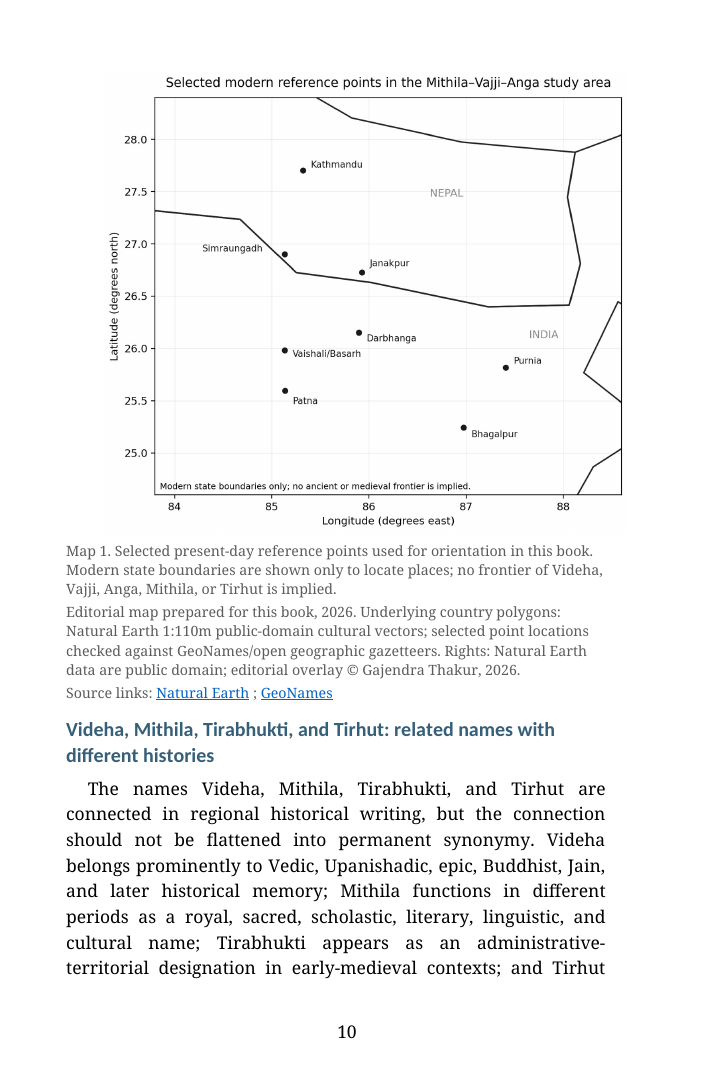
Mithila · Vajji · Anga
Chapter-specific source notes
- Primary chapter witness. Gajendra Thakur, Decoding the Panji of Mithila — Volume IV, formal Chapter 44, PDF pp. 451-457; formal Chapter 44. The HTML transcription is generated from the commit-pinned source PDF and retains the chapter boundary recorded in this edition.
- Internal structure. The repository source-heading inventory records 6 subordinate headings for this chapter: “1. Entry (383): Rajgram and the Alay gramarambh”; “2. Entry (384): Rashadh and the Lal branch”; “3. Entry (385): Pilkhwar-Baligarh and the Pathak branches”; “4. Entry (386): Baligarh-Lagma as continuation”; “5. Entry (387): Lagma”; “6. Branch-continuity and transition”.
- Digital editorial method. The page keeps the preserved source text distinct from generated navigational, concordance, visual, and provenance apparatus. The synthetic reconstruction is explanatory only and is not evidence for an individual lineage or a determination of social or marital status.