Decoding the Panji of Mithila · Volume IV · Chapter 45
Baigani-Alay and the Baneli- Ramgarh Royal Cluster
Chapter 45. Baigani-Alay and the Baneli-
Ramgarh Royal Cluster
   This chapter resumes exactly where the preceding chapter
stopped. Entry (388) opens a new Alay-controlled unit with the
formula "Baigani Alay gramarambh" and at once widens the
geography from Baigani to Banaili, Ramgarh, Dyondhi, Garh-
Banaili and Sultan Ganj. The next three entries continue the
same royal and estate-bearing complex: entry (389) is headed
around Madhav Ji and the descendants of Raj Bahadur
Kirtyanand Singh; entry (390) carries the Rudranand,
Shrinandan, Nityanand and Kamalanand-Kalikanandan
branches; and entry (391) extends the Kalikanand line toward
Srinagar-Amour. The chapter therefore covers only entries
(388) to (391). It stops before entry (392), where Paramgarh-
Alay and Pindaruch begin a different local register.

1. Entry (388): Baigani-Alay and the first Baneli-
Ramgarh frame
  Entry (388) begins with the invocation to Bhujangaloka-pati
and then gives the practical heading: Baigani to Banaili,
Ramgarh Dyondhi, Garh-Banaili and Sultan Ganj. The
operative formula is "Baigani Alay gramarambh." The entry
does not merely name a village. It places Baigani within the
Alay moolgram frame and uses the Banaili-Ramgarh estate
world as the social and territorial theatre in which the
subsequent genealogies are to be read.
    The first named ancestor of this section is Chaudhary
Devanand. His sons or branch-heads are Paramanand,
Parnamak Hazari and Maniknand. Devanand is placed
through Darihara by way of Ramakant, and the Chaudhary
title signals a landed or administrative dignity in addition to
ritual genealogy. The text then moves to Chaudhary
Paramanand, whose branch gives Rajadular Singh and Babu

Eklal, also known as Tejanand Singh. This branch is linked
through Pabouli-Tegri, while Rajadular Singh is attached to
Sarisab through Bhaiyan.
   The entry then opens an apara line from Rudranand Singh.
Rudranand is connected through Kujouli-Kulpati and Alay-
Mahi. This is important because the Alay label is not merely a
heading; it reappears as a marriage or relational route inside
the same entry. In Panji language this doubling means that the
register is keeping both the local place-name and the mool-
logic visible at the same time.
   Raj Bahadur Bedanand Singh follows in the next movement.
He is linked through Soderpur-Vighneshwar and Babhaniyam-
Saheb. The title Raj Bahadur gives the section a formal estate-
political colour. The following apara branch carries Lilanand
Singh Bahadur through Khandbala-Ugrasingh and Mandar-
Hareram. Raja Lilanand Singh is then linked through
Soderpur-Bhavanidatt-Maheshdatt and Karmaha-Loknath.
The repetition of honorifics such as Raja, Raj Bahadur and
Singh Bahadur marks the passage from ordinary village-
linked genealogy into a princely and estate-house genealogy.
   The most prominent line in entry (388) is the one that
names Kesare Hind Raja Padmanand Singh. The source places
him as a Kalikarnavata apara branch of Lilanand Singh, and
connects him through Khaual-Ankhi-Hemnath and Karmaha-
Riddhi. Another apara line moves through Baliyas-Mani-
Ishwaridatt and Digho-Hira. The entry then names Raja
Kalanand Singh and Raja Kirtyanand Singh Bahadur, with a
route through Ratauli-Darihara-Gopinath. By including both
Padmanand and Kirtyanand in the same Baigani-Alay cluster,
the Panji makes the Baneli line readable as a single
interconnected royal field rather than as disconnected named
rulers.

   The Padmanand line itself divides further. Raja Padmanand
Singh is connected through Khandbala-Yognath and Baliyas-
Mani. Another branch of Raja Chandranand Singh moves
through Soderpur-Vighneshwar-Badan and Pandua-Lakshmi.
A second Padmanand branch is connected through Baliyas-
Mani-Babe and Karmaha-Dayanath. Kumar Suryanand Singh
is placed through Soderpur-Hibharn-Bhuvaneshwaridatt and
Tankbal-Bachchelal, while Kumar Chandranand Singh is
placed    through   Khaual-Ishwaridatt-Ugri      and   Tisaut-
Kamalnayan. The pattern is dense but clear: every royal name
is anchored by two recognizable genealogical coordinates, one
often within a major mool and the other in another house or
village path.

2. Entry (389): Kirtyanand Singh Bahadur and the
learned royal descent
   Entry (389), introduced under the invocation to Dindibha-
pati and the heading Madhav Ji, continues the royal register
from Raj Bahadur Kirtyanand Singh. The named sons or
branches are Kumar Shyamanand Singh, Kumar Vimalanand,
also called Bholan Ji, Kumar Taranand, called Bhagwan Ji,
Kumar Durganand, called Madhav, Kumar Jayanand Singh,
and Kumar Adayanand, called Nunji. The register links this
group     through     Belaunch-Bhushan-Kumar     and    Pali-
Kapileshwar. The family therefore stands inside the Alay-
controlled royal frame but remains connected to the wider
Pali and Belaunch matrimonial networks.
  Kumar Shyamanand Singh receives a special learned title:
Sangit Shastra Martand. His descendants include Professor
Vivekanand Singh, called Mihirji; Balanand, identified with a
doctoral and professorial title; Subalji; and Sri Udayanand
Singh, called Nihari Ji. Their genealogical route is through
Kujouli-Son-Pinakar and Sarisab-Mahamopadhyaya Santgopal.
The combination of princely title and learned appellation is

significant. This is a royal line, but the register presents it
through scholarship, musicology, professorship and Sanskritic
learned prestige as much as through estate status.
   Professor Vivekanand Singh is followed by a line in which
Tapas or a related branch is placed through Naroun-Baliyas-
Yamunadhar and another route to Kripanath. Dr. Professor
Balanand Singh is connected through Tripuroli-Naroun-
Padmanarayan-Saraswati Baidyanath and Sukhait-Khaual-
Damodar. The text also preserves a remarkable domestic and
affinal note around Kumar Udayanand Singh: after his wife
had borne two children, the relation was attached to the child
of Professor Narnath Jha, grandson of Acharya Ramanath of
Pude-Naroun and also described through the maternal line of
Kumar Shyamanand Singh. This kind of note is rare in its
fullness and shows the Panji not only as a list of male descent
but as an archive of marital adjustment, adoption-like
relation, and household continuity.
   The Vimalanand branch gives Vinodanand Singh and
Girijanand Singh. They are linked through Darihara-Sahdev-
Govind Narayan and Soderpur-Bheshnath. Vinodanand Singh
then proceeds through Jagor-Mandar-Maharaj-Indranarayan
and    Khandbala-Harinandan.       Girijanand   Singh     gives
Varunanand and related descendants through Chanour-
Sihouli-Mandar and a Paramanand Singh line. The notation is
partly damaged by ellipses, but the branch remains intelligible
as a continuation of the same Kirtyanand royal group.
  Kumar Taranand Singh gives Kantanand Singh, Hiranand
Singh and Sharadanand Singh through Soderpur-Rajnidatt-
Padmadatt    and     Budhwal-Vaiya      Shiveshwar.   Kumar
Durganand Singh gives Premanand Singh through Pabouli-
Gunanand-Kalikanand and Mandar-Ramanand. Kumar
Jayanand Singh, called Yadavji, gives Yoganand Singh through
Digho-Chhedi-Bhairavkant and Khaual. In this single entry the

register thus combines landed titles, scholarly titles, modern
professional honor, and the standard double-route
matrimonial grammar of the Panji.

3. Entry (390): Rudranand, Shrinandan, Nityanand,
Kamalanand and Kalikanandan
   Entry (390), under the invocation to Shashishekhara, turns
first to Raja Rudranand Singh. His branches are attached
through Sarisab-Bhikhi-Bhavnath and Pandua-Pan Chan.
Another branch moves through Mandar-Ishannath-Shobhan
and Soderpur-Harpati. The entry then names Kumar
Keshavanand Singh, Kumar Modanand Singh and Raja
Shrinandan Singh, linked through Khandbala-Balah-Shyamu
and Belaunch-Raman. Raja Shrinandan Singh is then set
through Soderpur-Nandishwar-Murli and Ghusaut-Thakur
Ram.
  The next apara line names Raja Nityanand Singh, connected
through Sarisab-Nanu-Pan Jagaddhar and Pali-Kamaladatt.
After him the text names Sahitya Saroj Raja Kamalanand
Singh and Raja Kalikanandan Singh, again through Soderpur-
Nandishwar-Murli and Ghusaut-Ram. The title Sahitya Saroj is
a literary honor and should not be overlooked. It places
Kamalanand within the cultural history of the family, not only
within landed rank.
  Raja Nityanand Singh continues through Sakararhi-
Chandradatt-Markandeya and Pali-Khuda. Raja Kamalanand
Singh then gives Kumar Ganganand Singh and Kumar
Achyutanand, called Kanhaiya Ji, through Mandar-Ramdhan-
Thithar and Khandbala-Thakur Jirakhan. Kumar Ganganand
Singh gives Sachchidanand Singh, called Sanatanji, through
Khaual-Jankinath-Vaidyanath       and     Tisaut-Shrinarayan.
Sachchidanand Singh gives Ishanand, called Prakash; Ilanand,
called Vikash; Dr. Sumavad or a similarly read modern name;
and Ishwaranand, through Son-Pinakar and Sarisab-

Mahamopadhyaya Santgopal. The exact reading of one
modern name is uncertain, but the pattern of descent and
alliance remains unambiguous.
   The descendants of this modern branch are recorded with
unusual detail. Ishanand, called Prakash, gives Snehanand
through an incompletely recorded Koilakh connection.
Ilanand, called Vikash, gives daughters Shwetangi and
Shubhangi, whose marriage-link is through Patanuka-Mandar-
Hemkant-Chandrakant. Dr. Ishwaranand Singh gives
Shaivyanand Singh. A further female line through Kavita and
Ishita is linked to Subhash and then to Chanpura-Nahas-
Khaual-Tholhi-Jaykeshwar     and    Fanandah-Hitendramani.
These entries show that the modern additions preserved both
sons and daughters when the marital record was necessary
for Panji continuity.
  Kumar Achyutanand, called Kanhaiya Ji, gives Satyanand
Singh, called Vinodji, through Khaual-Jankinath-Vaidyanath
and Tisaut-Shrinarayan. Satyanand Singh gives Devanand
Singh, called Nanuji, through Sihouli-Mandar-Raghunandan.
Devanand Singh then gives Tipu, Sonu and Malangiya through
Kujouli-Vidyanath and Fanandah-Hitendramani. Entry (390)
therefore completes a long movement from older royal
naming to modern named descendants, while retaining the
same Panji grammar of place, mool, marriage and branch.

4. Entry (391): Kalikanand Singh and the Srinagar-
Amour continuation
   Entry (391), headed Baigani to Srinagar-Amour, continues
directly from Raja Kalikanand Singh. His descendants are
Kumar Abhayanand Singh, called Narayan Ji; Vijayanand
Singh, called Siheb Ji; Dhananand Singh, called Daman Ji;
Pramodanand Singh, called Pramod; and Sri Divyanand Singh,
called Jasmant Ji. The common route is through Pabouli-
Natha-Buddhi and Ghusaut-Thakur Durmmil. The entry keeps

the Baigani-Alay royal house tied to Ghusaut and Pabouli,
thereby extending the same multi-mool web seen in the
earlier royal entries.
    Narayan Ji gives Shankaranand Singh and Shaktyanand
Singh through Darihara-Achyutanand-Nutankrishna, called
Gulab, and Fanandah-Sundar. Shankaranand, called Putlam,
gives Roudranand Singh, Brahmanand Singh and Journalist
Chetananand Singh through Khaual-Jankinath-Indranath and
Sarisab-Santgopal. The word Journalist is a modern
occupational mark, like the earlier professor and doctoral
titles. Shaktyanand Singh, called Raj, gives Amritanand Singh
through      Khaual-Jagannath-Amarnath        and   Soderpur-
Indranand.
   A further branch, identified in the source around Mohan Ji,
gives Saketanand, Sambhavanand and Shraddhanand through
Belaunch-Vaidyanath-Shobhanath         and    Khandbala-Gudan
Singh. Daman Ji gives Shaileshwari, marked as Rani, through
Mandar-Thithar-Durganand         and     Khandbala-Jaynarayan
Singh. Divyanand Singh gives Sampurnanand through an
incomplete     Pandua      route    and    Soderpur-Bheshnath.
Pramodanand Singh gives Sanjiv and Sadhananand through a
Sarisab line that is partly damaged, and the entry also records
daughters, including Nageshwari, called Nandini, with a
Palamu association. These details show that entry (391) is as
much a modern family-history memorandum as a classical
Panji descent entry.
  The closing part of entry (391) places Chaudhary Manik
Nandan and Babu Harilal Singh in the same extended field.
Babu Harilal Singh is described through Soderpur-Garib-
Rojhan and Darihara-Babu. The text repeats a form of this
notice, which should be read not as a separate new lineage but
as a duplicated or reinforced recording of the same local
personage. Babu Harilal Singh gives Babu Kalitnath Singh;

Kalitnath gives Babu Tirthanand Singh through Khandbala-
Mahinath-Krishnaram and Sakararhi-Ghana. Additional apara
branches go through Khandbala-Balah-Shyamu and Satlakha-
Mathuranath, and another through Sarisab-Madhupati-Bachh
and Mandar-Kaladhar. The entry closes the Baigani-Srinagar-
Amour royal sequence and prepares the transition to the next
Paramgarh-Alay register.

5. Why entries (388) to (391) form one chapter
   The four entries covered here are not accidental
neighbours. Entry (388) establishes Baigani-Alay as the
governing local frame and connects it with Banaili, Ramgarh,
Dyondhi, Garh-Banaili and Sultan Ganj. Entries (389) and (390)
unfold the royal descendants of Kirtyanand, Rudranand,
Shrinandan, Nityanand, Kamalanand and Kalikanandan.
Entry (391) carries Kalikanand toward Srinagar-Amour and
closes with later modern descendants, including professional,
journalistic and female-line notices. The sequence is therefore
a coherent royal and estate-bearing cluster.
   The chapter also demonstrates how the Panji handles high-
status houses. It does not suspend ordinary genealogical rules
merely because a person is a Raja, Raj Bahadur, Singh
Bahadur, Kesare Hind, Professor, Doctor, Journalist or Rani.
Each name still requires moolgram logic, a recognized route,
and a remembered connection to another village or house.
The density of titles increases the historical interest of the
passage, but the underlying mechanism remains the same:
descent is made socially valid by being recorded through the
network of mool, village, affinal route and branch continuity.
  This chapter stops deliberately before entry (392). The next
entry opens Paramgarh-Alay and Pindaruch, which begins a
new Alay sub-register with a different local centre and should
be treated separately.
Source structure and verification apparatus
Editorial source apparatus. This apparatus is descriptive, not interpretive. It records the source-controlled structure used to verify that this page corresponds to formal Chapter 45 of Decoding the Panji of Mithila — Volume IV. The chapter text above is preserved from PDF pp. 458-465; formal Chapter 45 in the commit-pinned authoritative source. It is not merged with a neighboring chapter, appendix, annexure, or independent front/back-matter unit. The internal headings below come from the repository’s source-heading inventory and are retained as navigational and audit evidence; showing them here does not turn those headings into separate publications or add claims that are absent from the source.
Internal source headings
- 1. Entry (388): Baigani-Alay and the first Baneli-Ramgarh frame
- 2. Entry (389): Kirtyanand Singh Bahadur and the learned royal descent
- 3. Entry (390): Rudranand, Shrinandan, Nityanand, Kamalanand and Kalikanandan
- 4. Entry (391): Kalikanand Singh and the Srinagar-Amour continuation
- 5. Why entries (388) to (391) form one chapter
Source-text concordance
Baigani-Alay · Baneli · Ramgarh · Royal · Cluster · resumes · exactly · preceding · stopped · Entry · opens · Alay-controlled · unit · formula · Baigani · Alay · gramarambh · widens · geography · Banaili · Dyondhi · Garh · Sultan · Ganj · next · three · entries · continue · estate-bearing · complex · headed · around · Madhav · descendants · Bahadur · Kirtyanand · Singh · carries · Rudranand · Shrinandan · Nityanand · Kamalanand-Kalikanandan · branches · extends · Kalikanand · line · toward · Srinagar-Amour · therefore · covers · stops · Paramgarh · Pindaruch · begin · different · local · register · first · frame · begins · invocation · Bhujangaloka-pati · gives · practical · heading · Garh-Banaili · operative · merely · name · village · places · within · moolgram · uses · Banaili-Ramgarh · estate · world · social · territorial · theatre
Boundary verification. In the formal sequence this chapter follows Volume IV Chapter 44, “Rajgram-Alay, Rashadh, Pilkhwar-Baligarh and Lagma: Entries (383)-(387)” and precedes Volume IV Chapter 46, “Paramgarh-Alay and Pindaruch: The Shyamlal, Akshaylal, Harikant, and Bechanlal Lines This chapter begins with entry (392), exactly where the”. The chapter extractor begins at the verified formal Chapter 45 marker and stops at the next verified formal chapter marker; for a final chapter it stops before recognized book-level back matter. The concordance above is generated only from distinct terms already present in this chapter’s preserved source text. It is provided for discovery, comparison, and audit, not as an automated judgment about persons, lineages, status, kinship, marriage eligibility, or historical truth.
Illustrated research apparatus
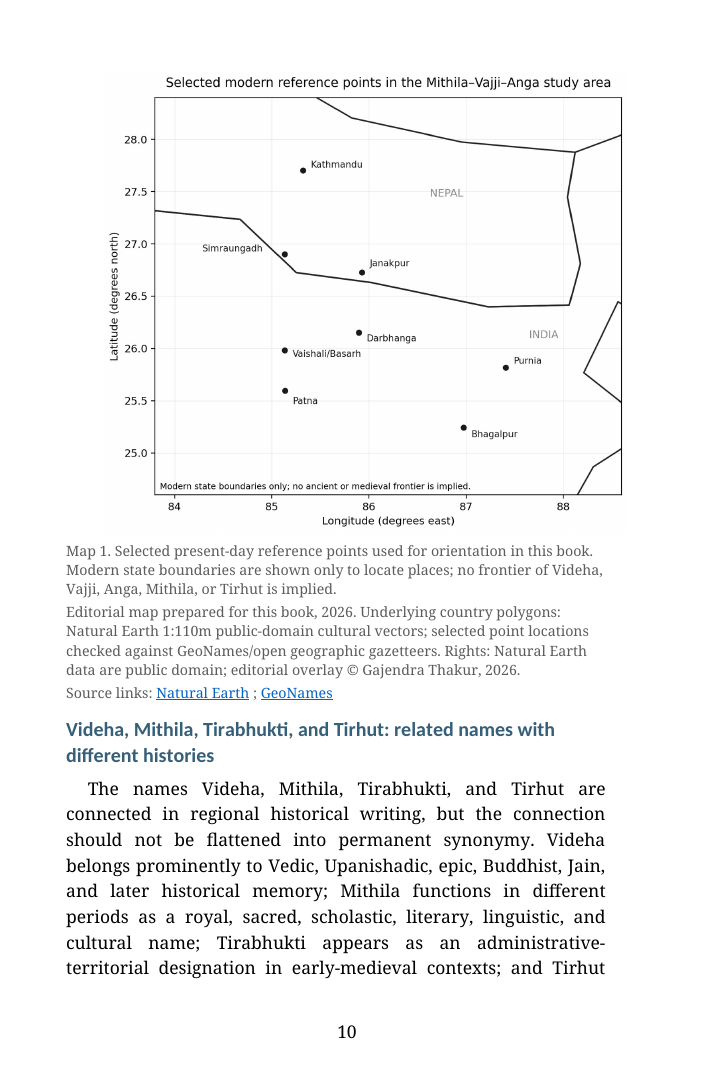
Mithila · Vajji · Anga
Chapter-specific source notes
- Primary chapter witness. Gajendra Thakur, Decoding the Panji of Mithila — Volume IV, formal Chapter 45, PDF pp. 458-465; formal Chapter 45. The HTML transcription is generated from the commit-pinned source PDF and retains the chapter boundary recorded in this edition.
- Internal structure. The repository source-heading inventory records 5 subordinate headings for this chapter: “1. Entry (388): Baigani-Alay and the first Baneli-Ramgarh frame”; “2. Entry (389): Kirtyanand Singh Bahadur and the learned royal descent”; “3. Entry (390): Rudranand, Shrinandan, Nityanand, Kamalanand and Kalikanandan”; “4. Entry (391): Kalikanand Singh and the Srinagar-Amour continuation”; “5. Why entries (388) to (391) form one chapter”.
- Digital editorial method. The page keeps the preserved source text distinct from generated navigational, concordance, visual, and provenance apparatus. The synthetic reconstruction is explanatory only and is not evidence for an individual lineage or a determination of social or marital status.