Decoding the Panji of Mithila · Volume IV · Chapter 46
Paramgarh-Alay and Pindaruch: The Shyamlal, Akshaylal, Harikant, and Bechanlal Lines This chapter begins with entry (392), exactly where the
Chapter 46. Paramgarh-Alay and Pindaruch:
The Shyamlal, Akshaylal, Harikant, and
Bechanlal Lines
   This chapter begins with entry (392), exactly where the
preceding chapter stopped. The governing movement changes
from the Baigani-Alay and Banaili royal cluster to Paramgarh-
Alay and Pindaruch. The entries are still within the wider Alay
zone, but their local emphasis is different: the source now
follows a Chaudhary house through Pindaruch, through
several modern named descendants, and then through a set of
branches that carry professional titles such as Justice, Judge,
Engineer and Chartered Accountant. The chapter covers
entries (392) to (397) only and stops before entry (398), where
a new Paramgarh heading appears without the Pindaruch
detail of this unit.

1. Entry (392): Paramgarh-Alay gramarambh and the
Shyamlal line
   Entry (392) opens under the invocation to Amarnath and
gives the local heading Pindaruch. The source then states the
operative formula: Paramgarh Alay gramarambh. This is not a
decorative phrase. It tells us that the following genealogy must
be read as an Alay-controlled local register, with Paramgarh
and Pindaruch functioning as the practical place-frame. The
first named ancestor is Chaudhary Shyamlal. His sons or
branch-heads are Shivalal, Raja, also styled Hridaylal, and
Nena, also styled Premlal. The first alliance marker joins
Bisphi, through Tula, son of Thakur Eknath, with Karmaha-
Dukhni. Thus the branch is placed at once between an Alay-
local identity and outside alliance controls.
  Shivalal gives Jaylal, Jagatlal and Jalli. Their route is written
through Baliyas-Dharadhar-Dukhiya and Jajival-Gonan. Jaylal
then gives two principal groups. The first group is Chumman,

styled Ritalal, and Bhayji, styled Hiralal; they are tied to
Mandar-Ishanath-Ramdhan and Soderpur-Sarvasva. The
second Jaylal apara group names Fekanlal, Akshaylal and
Lutka. This second group is connected through Digho-
Shivnandan-Sarvanarayan and Sakararhi-Shyamlal. By setting
these names in two clusters, the Panji preserves internal
branching without treating the house as a simple single line.
   Chaudhary Fekanlal is then developed in detail. His line
first gives Luchan, also called Parmanand, through Soderpur-
Babunath-Babulal and Hariamb-Lanha. A further Fekan
branch gives Viloch, called Chandranand, with Sushilchandra
and Baidyanath through Mandar-Manbharan-Yugalkishor and
Karmaha-Gudar.       Luchan      or  Parmanand      produces
Dhaneshwar, placed through Khaual-Umadatt-Jyotishi Apuch
and Belaunch-Chaudhary Babua. Viloch or Chandranand gives
Arun Kumar and Varun Kumar through Soderpur-Gosain-
Hridaynandan and Hariamb-Kunjbihari. Arun Kumar is then
connected by a further route through Baliyas-Harinandan-
Chandrashekhar and Ghusaut-Shivnandan.
   Dhaneshwar opens a modern named cluster: Lalit Kumar,
Vinay Kumar, Sanjeev Kumar, Tribhuvan Kumar and Amit
Kumar, also called Sukumar. Their marriage-route is given
through Baliyas-Bhay-Divakant and Pali-Phalgun. Lalit Kumar
is then continued through Soderpur-Bachchan-Ramkumar and
Satlakha-Vasudev. Vinay Kumar is left with an incomplete
Lalbagh-Naroun-Baliyas note, and Sanjeev Kumar is attached
to a Kailakh-Nahas-Khaual-Bhimnath route that is also left
with missing particulars. The entry therefore has two kinds of
evidence side by side: fully developed descent and dotted
modern additions where the scribe knew the affiliation but
did not preserve all intervening names.

2. Entry (393): Akshaylal and the next Pindaruch
continuation
   Entry (393), under the invocation to Nagesha, continues the
Pindaruch material through Vaiya Akshaylal. Akshaylal gives
Navinchandra and Vishwanath, with the alliance route
through     Soderpur-Babunath-Dukha       and    Baliyas-Babe.
Navinchandra then gives Lala, also called Purnachandra,
through Jajival-Jaydatt-Vishnukant and Pali-Devidatt. The
apara line of Navinchandra is much larger: Prafullachandra,
Nirmalchandra,      Vijaychandra,     Subhashchandra      and
Ishwarchandra are recorded through Khaual-Keshav-
Chaudhary Chandrakant and Khandbala-Thakur Hemdatt.
   Purnachandra gives Shatruchandra, Yogeshchandra,
Ajaychandra and Abhaychandra. Their connection runs
through Baliyas-Suga-Jaybhadra, also called Buchan, and
Khandbala-Hemai. Sushilchandra gives Rajchandra through
Soderpur-Madhusudan-Bhavnandan and Budhwal-Khuni.
Subhashchandra gives Mukund through Pandua-Gunanand-
Mathuranand and Soderpur-Vachananand. Ishwarchandra’s
line is less neatly recorded but includes a Rahua-connected
Vishwanath, whose son Ravindranath is linked through
Belaunch-Keshav-Girdhar Kishor and Baliyas-Vaiya Shrikant.
Ravindranath is then attached to Khandbala-Riddhinarayan
Singh-Durganath Singh and Pali-Tulanath.
  The entry then returns to the line of Lut or Luta. Lut gives
Moti, called Lakshmikant, Satu, called Satikant, and Bhagirath.
These are placed through Mandar-Parash-Jaynath and
Belaunch-Keshav. Prafullachandra gives Sanjeev through
Digho-Bhairavakant-Ramakant and Pandua-Jaybhadra, called
Bathu. Nirmalchandra gives Neeraj through Khaual-Madhav-
Naresh and Pawali-Singheshwar. Vijaychandra gives Vijayesh,
described as a poet, through Naroun-Shivshankar-Sundarkant,
called Jhotan, and Deuri-Khandbala-Kedarnath. The closing

line places Lakshmikant through Khandbala-Padmanabh
Singh-Artinarayan Singh and Tankbal-Shreenath, and then
gives a final note for Shatrughna through Darihara-Jatadhar-
Govind. This entry is especially important because it links
older Chaudhary descent with twentieth-century style
personal names and modern descriptive identifiers.

3. Entry (394): Hridaylal, Premlal and the
Chandrakant branch
  Entry (394), under the invocation to Mrigambara, develops
another side of the same Paramgarh-Pindaruch house. It first
records Chaudhary Chumman, called Ritalal, through Pandua-
Pan Buddhinath-Pan Thadu and Karmaha-Shyamnath. Bhayji,
called Hiralal, is linked through Naroun-Amritnath-Lalit and
Pandua-Atmaram. Jagatlal is attached through Naroun-
Bhairavdatt-Bachchi and Soderpur-Chhotkinma; another
apara route links the same field through Sarisab-Shobhan-
Bathan and Hariamb-Modnath. These repetitions show how
the Panji registers the same house through several marital or
validating lines.
   Chaudhary Raja, called Hridaylal, gives Mitralal. Mitralal is
attached through Sarisab-Pan Krishnadev-Chan and Baliyas-
Nath. Mitralal’s descendants then move in two directions. One
line is through Sarisab-Chandramani-Bhulan and Karmaha-
Vishnudatt. Another apara group names Bachcha, called
Ramakant; Feku, called Kashikant; Khushar, called Harikant;
and related sons through Khaual-Gosain-Nenmani and
Budhwal-Hemnath. Bachcha or Ramakant is continued
through     Soderpur-Maniknandan-Nityanand         and     Pali-
Shaktinath. A further line gives Balamu, called Chandrakant,
through Naroun-Chaichal-Jaymani and Darihara-Babue.
  Chandrakant gives Mannu, called Udaykant, and Nunu,
called Kalikant, through Darihara-Balle-Jatadhar and Pali-
Chunchun. Kalikant is placed through Belaunch-Sukeshwar-

Narendra Kishor and Pandua-Nathuni. Udaykant gives
Ashwinikant, Netinikant, Padmakant and Anojkant through
Kanhauli-Soderpur-Jaynandan, with the source preserving the
subsequent route toward Kujouli-Parmanand. This entry is a
good example of how modern given names were absorbed
into the older Panji grammar without changing its structure:
each modern name still requires a route, a mool relation and a
relational bridge.

4. Entry (395): Harikant, Justice Ratikant, Judge
Rukminikant, engineers and accountants
   Entry (395), again headed Pindaruch, begins with
Chaudhary Feku, called Kashikant. His son Chittu, called
Vishnukant, is linked through Belaunch-Lakshmikant-Keshav
and Darihara-Raghu. Vishnukant then gives Shachikant,
Hemkant, Vijaykant, Abhaykant and Maheshkant. Their route
runs through Baliyas-Babulal-Raghunath and Khandbala-
Jaykant. Shachikant is further attached through Darihara-
Govardhan-Tarakant and Sarisab-Lakshmikant. Hemkant is
linked through Satlakha-Hemnath-Madeshwar and Pawali-
Raghunath. Vijaykant appears through Mandar-Maharaj-
Shivanand. Abhaykant is tied to Khandbala-Devkinandan-
Pushkar and Pali-Gulli. Maheshkant is linked through Naroun-
Shaktinath-Amarnath and Hariamb-Purushottam.
   The entry then turns to Chaudhary Harikant. His sons are
Justice Ratikant and Devkant. They are placed through
Baliyas-Kanhai-Ishdatt and Pawali-Musahar. Justice Ratikant
gives Satikant through Darihara-Balle-Jatadhar and Pali-
Chanchal. An apara line then names Judge Rukminikant,
Engineer Nalinikant, Chartered Accountant Girishkant,
Engineer Madhukant, Chartered Accountant Sunilkant and
related modern branches. The route for this professional
cluster is through Mandar-Bodhu-Radhakant and Hariamb-
Babu. The title Justice, the title Judge, the abbreviation E. for

engineer and C.A. for Chartered Accountant are all recorded
inside the same genealogical syntax as the older titles
Mahamahopadhyaya, Jyotishi or Vaiya. This shows continuity
rather than rupture.
   Judge Rukminikant gives Engineer Anilkant, connected with
Ranipur in Betia through Soderpur-Sadhu-Kashikant.
Nalinikant gives Engineer Manish and Engineer Nitish,
connected with Chanaur in Katihar and the Girijanand Singh
line. Devkant gives Mahendrakant, Nishikant and Rajnikant
through a Pandua route involving Pan Raghunandan.
Mahendrakant        is   linked    through Darihara-Jatadhar-
Hrishikesh and Fanandah-Raja. Nishikant is connected
through Belaunch-Vimalakant and Soderpur-Nirsu. Rajnikant
is placed through Soderpur-Virbhadra and Vidyanath. Entry
(395) is therefore one of the clearest modern-professional
registers in this part of the volume.

5. Entry (396): Nena-Premlal, Nandalal, Shrikant and
the Mahant line
   Entry (396), under the invocation to Sarvanga-pritimurti,
returns to Chaudhary Nena, called Premlal. The source names
Nandalal and Bethanlal within this line and places them
through Darihara-Shivdatt-Visuni and Soderpur-Chalbal.
Nandalal gives Shrikant, Bir, also called Jateshwar, and other
related forms through Baliyas-Brajnath-Nanu and Soderpur-
Babjun. Shrikant is then associated with Darihara and Baliyas
in a partly damaged construction, and then with Ekhara-
Khadgamani. The apara Shrikant line gives Pradyumna and
Prayag through Sarisab-Kulanand-Pan Bambholi and
Hariamb-Shankar.
  Virbhadra is linked through Soderpur-Rambhadra-Babun
and Budhwal-Vishwanath. Prayag is attached through
Belaunch-Manmohan-Kanti Mohan and Karmaha-Jagannath.
The source then gives Pilusur and Mahant, called Lakshman,

through Baliyas-Bathaha-Shreenath and Pali-Govind. A further
line connects Baliyas-Dedhan-Devchandra and Jajival-
Deonath. The Mahant branch itself gives Harishankar,
Sapradshankar, Chandrashankar and Dayashankar through
Soderpur-Ramdatt-Babun and Budhwal-Vishwanath. A second
Mahant apara line gives Kripashankar, Udayshankar and
Vinay Shankar through Pandua-Nathuni-Batahu and
Soderpur-Ramanand. Individual continuations then place
Harishankar through Belaunch-Sukeshwar-Nandkishor and
Pandua-Nathuni,    Rudra    Shankar    through    Soderpur-
Jaynandan-Revatiraman      and     Khaual-Bhaiyaji,      and
Chandrashankar     and   Dayashankar     through    Baliyas-
Padmanath-Bhairav and Ghusaut-Durganath. The entry is a
compact but dense continuation of the Premlal side of the
family.

6. Entry (397): Bechanlal and the final Paramgarh-
Pindaruch branch of this chapter
  Entry (397), under the invocation to Vamadeva, explicitly
names Paramgarh to Pindaruch and gives the number 203. It
begins with Chaudhary Bechanlal. His sons or branch-heads
are Ramchandra, Chhakori, Ballu, Latdu and Lalji. Their route
is through Pawali-Khuni-Musahar and Ghusaut-Kalanath.
Ramchandra gives Trilochan and Surendra through Baliyas-
Nanu-Gudan and Budhwal-Nandalal. Trilochan gives
Shwetambar through Baliyas-Shriraman-Aniruddha and
Karmaha-Sadham. Surendra is linked through Jajival-Dinath-
Dinanath and Khaual-Bha Chumm. Shwetambar is then tied
through Khaual-Narottam-Chandranath and Khandbala-
Suryanandan.
   Chhakori gives Govind and Satishchandra through
Khandbala-Teknath-Chiranjeev and Ghusaut-Shyam. Govind
gives Bihari, Shikari and Bipin through Soderpur-Ramdatt-
Babun     and     Budhwal-Vishwanath.     Bihari,  called

Prithvichandra, is placed through Khandbala-Mahdev-Vaiya
Baldev and Mandar-Kandu, called Dinbandhu. The Shikari or
Shrichandra line is continued through Satishchandra, who
gives Bhuvanchandra and Janchandra through Khaual-
Jankinath-Vaidyanath         and       Tisaut-Shrinarayan.
Bhuvanchandra is linked through Naroun-Dharmanath-
Nityanath and Mandar-Shatanjiv. Janchandra is associated
with an Indranand-Ghananand route and Kujouli-Vidhanand.
   Ballu gives Bhagwannarayan, Prasannanarayan and
Bhikari, called Bheshdhari, through Sarisab-Gharmaran-
Janardan and Budhwal-Nandalal. Bhagwannarayan is linked
through Baliyas-Sugge-Buchan and Khandbala-Hemdatt. Latdu
is separately recorded through Khaual-Girdhari-Govind and
Baheradhi-Chudamani. Lalji gives Vishwambhar and Indrakar
through Digho-Raghunath-Damodar and Belaunch-Lalitnath.
Vishwambhar then gives Brajmohan through Soderpur-
Ramdatt-Sadhu and Baliyas-Tharanandan. This completes the
Paramgarh-Pindaruch section covered in this chapter.

7. Why entries (392) to (397) form one chapter
   The unity of this chapter lies in the Paramgarh-Alay and
Pindaruch axis. Entry (392) establishes the local register, entry
(393) continues the Akshaylal and Navinchandra side, entries
(394) and (395) preserve the Hridaylal, Premlal, Harikant and
modern professional branches, entry (396) develops the Nena-
Premlal and Mahant side, and entry (397) closes the unit with
Bechanlal and his linked descendants. The sequence is
internally coherent because each entry either names
Pindaruch, Paramgarh, or a branch that belongs to the same
Alay-controlled descent cluster.
  The chapter also shows the documentary range of late Panji
registration. It contains old-style relational terms, apara
branch notes, mool and village controls, dotted incomplete
names, and modern professions. The register can name Justice

Ratikant, Judge Rukminikant, engineers, a Chartered
Accountant and college or administrative-style modern
identities without abandoning the older grammar of descent
and alliance. This is why the chapter has been kept together as
a single unit rather than split at every invocation.
   This chapter stops deliberately before entry (398). Entry
(398) gives a fresh Paramgarh heading, and entry (399)
immediately turns toward Katma-Babhaniyam. That material
belongs to the next chapter, where the register moves away
from the Paramgarh-Pindaruch unit completed here.
Source structure and verification apparatus
Editorial source apparatus. This apparatus is descriptive, not interpretive. It records the source-controlled structure used to verify that this page corresponds to formal Chapter 46 of Decoding the Panji of Mithila — Volume IV. The chapter text above is preserved from PDF pp. 466-474; formal Chapter 46 in the commit-pinned authoritative source. It is not merged with a neighboring chapter, appendix, annexure, or independent front/back-matter unit. The internal headings below come from the repository’s source-heading inventory and are retained as navigational and audit evidence; showing them here does not turn those headings into separate publications or add claims that are absent from the source.
Internal source headings
- 1. Entry (392): Paramgarh-Alay gramarambh and the Shyamlal line
- 2. Entry (393): Akshaylal and the next Pindaruch continuation
- 3. Entry (394): Hridaylal, Premlal and the Chandrakant branch
- 4. Entry (395): Harikant, Justice Ratikant, Judge Rukminikant, engineers and accountants
- 5. Entry (396): Nena-Premlal, Nandalal, Shrikant and the Mahant line
- 6. Entry (397): Bechanlal and the final Paramgarh-Pindaruch branch of this chapter
- 7. Why entries (392) to (397) form one chapter
Source-text concordance
Paramgarh-Alay · Pindaruch · Shyamlal · Akshaylal · Harikant · Bechanlal · Lines · begins · entry · exactly · preceding · stopped · governing · movement · changes · Baigani-Alay · Banaili · royal · cluster · Paramgarh · Alay · entries · still · within · wider · zone · local · emphasis · different · follows · Chaudhary · house · several · modern · named · descendants · branches · carry · professional · titles · Justice · Judge · Engineer · Chartered · Accountant · covers · stops · heading · appears · without · detail · unit · gramarambh · line · opens · invocation · Amarnath · gives · states · operative · formula · decorative · phrase · tells · following · genealogy · must · read · Alay-controlled · register · functioning · practical · place-frame · first · ancestor · sons · branch-heads · Shivalal · Raja · styled
Boundary verification. In the formal sequence this chapter follows Volume IV Chapter 45, “Baigani-Alay and the Baneli- Ramgarh Royal Cluster” and precedes Volume IV Chapter 47, “Paramgarh, Babhaniam, Satlakha, Oini, Simraungarh, and Mahua-Khaual”. The chapter extractor begins at the verified formal Chapter 46 marker and stops at the next verified formal chapter marker; for a final chapter it stops before recognized book-level back matter. The concordance above is generated only from distinct terms already present in this chapter’s preserved source text. It is provided for discovery, comparison, and audit, not as an automated judgment about persons, lineages, status, kinship, marriage eligibility, or historical truth.
Illustrated research apparatus
Mithila · Vajji · Anga
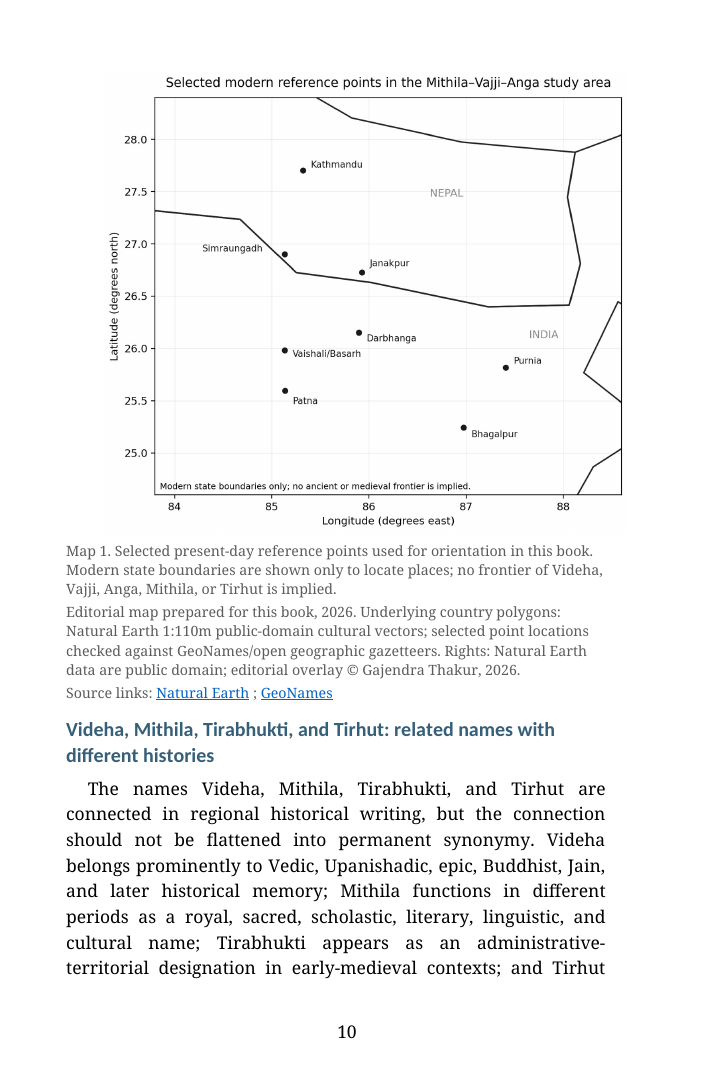
Chapter-specific source notes
- Primary chapter witness. Gajendra Thakur, Decoding the Panji of Mithila — Volume IV, formal Chapter 46, PDF pp. 466-474; formal Chapter 46. The HTML transcription is generated from the commit-pinned source PDF and retains the chapter boundary recorded in this edition.
- Internal structure. The repository source-heading inventory records 7 subordinate headings for this chapter: “1. Entry (392): Paramgarh-Alay gramarambh and the Shyamlal line”; “2. Entry (393): Akshaylal and the next Pindaruch continuation”; “3. Entry (394): Hridaylal, Premlal and the Chandrakant branch”; “4. Entry (395): Harikant, Justice Ratikant, Judge Rukminikant, engineers and accountants”; “5. Entry (396): Nena-Premlal, Nandalal, Shrikant and the Mahant line”; “6. Entry (397): Bechanlal and the final Paramgarh-Pindaruch branch of this chapter”; “7. Why entries (392) to (397) form one chapter”.
- Digital editorial method. The page keeps the preserved source text distinct from generated navigational, concordance, visual, and provenance apparatus. The synthetic reconstruction is explanatory only and is not evidence for an individual lineage or a determination of social or marital status.