Decoding the Panji of Mithila · Volume IV · Chapter 47
Paramgarh, Babhaniam, Satlakha, Oini, Simraungarh, and Mahua-Khaual
Chapter 47. Paramgarh, Babhaniam, Satlakha,
Oini, Simraungarh, and Mahua-Khaual
   This chapter continues from the Paramgarh-Alay material and covers
entries (398) through (409). The block is unusually mixed. It begins with
a suspended Paramgarh invocation, turns into two Babhaniam
gramarambh sections, pauses at Satlakha, then enters a historically
charged Jagatpur-Oini and Simraungarh register before returning
through Sarai-Sugauna and Mahua-Khaual to Ranitole. The chapter
stops before entry (410), where a new Cutka-Jatadhar Jha-Maheshpur
unit begins.

Entry (398): the suspended Paramgarh heading
   Entry (398) gives only the invocation to Anadi Purusha with the
heading "Paramgarh san". No genealogy follows in the available text. Its
placement, however, is meaningful. It comes immediately after
Bechanlal and the Paramgarh-Pindaruch line of the preceding entry and
before the next effective gramarambh. I have therefore treated it as a
preserved heading or ritual marker rather than as a lost descent to be
reconstructed. It signals that the Paramgarh register has not fully closed,
but the working genealogical continuation begins only at the next entry.

Entry (399): Karama heading and Katma-Babhaniam
gramarambh
   Entry (399) is headed "Karama san", but the operative formula inside
the entry is "ath Katma Babhaniam gramarambh". The distinction
matters: the outer heading records the source heading, while the
genealogical control is Katma-Babhaniam. The first named node is
Chhoke, whose sons are Bachhas and Lakshmi Narayan. Bachhas is
connected through Visfi, Achyut, and Lakshman on one side, and
through Ghusaut-Manhar on the other. The daughters of Bachhas are
Bhani and Bechana, and the register begins to extend their affiliations
through Darihara-Govardhan-Badtu, Soderpur-Yadupati, Sarisab-
Purushottam-Shulapani, and Satlakha-Mahesh.
   The line then records an apara branch of Bhani, including Gono and
Dukhiya, with a Belaunch-Hiraphool route and a Darihara-Gehanath
reminder. Bechana gives Babunath, Prabhunath, and Hrishinath; the
marriage or recognition route runs through Sakararhi-Yogi-Chakai and
Belaunch-Janakinandan. Lakshmi Narayan produces Anand, and Anand

produces Mahasadra. Mahasadra is tied to Satlakha-Sundar-Horil and to
Budhwal-Devakrishna. The entry is therefore not merely a Katma-
Babhaniam opening; it also lets Satlakha and Budhwal appear as
marriage and verification axes inside a Babhaniam-controlled descent.

Entry (400): Kadrain-Babhaniam and the Pathak
Mahathu line
   Entry (400) opens the Kadrain-Babhaniam gramarambh. The leading
figure is Pathak Mahathu. His sons are Chaturbhuj, Lakshmidatt,
Hardatt, and Kamal Nayan. The entry places them through a Sarisab-
Soderpur route involving Parmanand and Balli. Pathak Chaturbhuj then
gives Madhurapati, Nidhi, Bhanu, and Gujara, each drawing the branch
into Jajival, Darihara, Alay, Sarisab, and Ekahara connections.
   Madhurapati gives Vanshmani, with a Darihara-Dharapiti-
Dhananand line and an Alay-Purandar affiliation. Vanshmani gives
Pathak Ram, Vaiya Santosh, and Arjun. Pathak Ram gives Pathak Shivlal;
Shivlal gives Purushottam, Devottam, and Kamo. The Purushottam
branch runs through Balias-Teknath-Janakinath and Pali-Channa, and
then through Jajival-Rajvanshi-Govinddatt. The apara Purushottam
branch names Madrakant and Rohar-Soderpur links, while another
strand carries Ruprekant into Pabouli-Vindhyanath-Viveknath and
Balias-Damodar.
   Devottam produces Vijendra and Mahendra. Vijendra is tied to
Khaual-Teknath-Bheshnath and Ghusaut-Ramanand, while Mahendra
continues through Khaual-Damodar-Vireshwar. Santosh produces
Krishnalal and Govindlal; Krishnalal gives Upendra, Nathuni, and
Mohana through Digho-Chitradhar-Muktinath and Balias-Jayram.
Upendra then produces Ganesh Chandra, Jitendra Chandra,
Ramchandra, and Bhavesh Chandra through Rajanpura-Darihara-
Hiyan-Shrikant and Panichobh-Parshamani-Kapileshwar. This entry is
dense, but its logic is clear: a Babhaniam line is being validated by
recurring Pathak titles and by a wide network of marital paths.

Entry (401): Satlakha and the later Pathak
continuation
   Entry (401), under the invocation to Vrishabhavahana, turns to
Satlakha. It begins from Ganesh Chandra, whose sons are Shubh
Chandra and Prem Chandra, associated with Gohas-Adil-Khaual-

Mukund-Jagdish and Kujouli-Ramnandan. Pathak Jitendra Chandra
gives a Bhagwan Ji branch through Jajival-Umakant-Paltu and Karmah-
Sanu or Rudreshwar. Nathuni is linked through Bhedi-Bhad Jajival-
Rupnarayan-Jagdish and Darihara-Bachchi.
   Pathak Govindlal gives Vilambar and Kali Chandra. Vilambar then
produces Banish Chandra and Gauri Chandra, with the route Nahaas-
Khaual-Manohar-Upendra and Belaunch-Vishwanath. Pathak Arjun
gives Vishnulal, Damodar, and Dinesh through Pandua-Badrinath-
Kirtinath and Kujouli-Hemnath. Vishnulal gives Umakant at Satoli-
Satlakha; Umakant gives Nagendra, Rajendra, and Jagendra through
Balias-Dedhan-Harishchandra and Pali-Bhaiya. The register also notes a
Chanpura-Pabouli link for Nagendra, a Teldih-Parhar-Sakararhi line for
Damodar, and a Shivnagar-Belaunch connection for Kamalakant and
Shyamakant.
   The entry closes with Nidhi, Bachcha, Avadh Bihari, Kunjkant,
Harinandan, Jayanandan, and Singheshwar. It is a recognisable late
register: named personal descent is combined with practical locality
notes, and incomplete places or suspended "san" marks are retained
rather than smoothed away. The main interpretive point is that Satlakha
here functions as a continuing mool-based identity, but one whose
operative links spread through Pandua, Kujouli, Pabouli, Khaual,
Vabhaniam, Harianb, and Soderpur.

Entry (402): Jagatpur-Oini and the royal historical
register
   Entry (402) is one of the most historically loaded passages in this
stretch. It opens with Jagatpur and the figure Gunishwar, called
Mudrahastak, and then moves to Khan Parakram, Kumar Hasai, and
Koisi-Jalay connections. Khan Parakram gives Ram Singh, placed
through Karmah-Gangeshwar-Visho and Budanpur-Jajival-Govind.
Immediately after this, the text announces the Jagatpur-Oini
gramarambh and introduces a verse-like praise of Oini as a site of rulers
famous for giving, valour, and royal discipline.
   The Oini register begins from Rajpandit Kameshwar and moves to
Raja Bhogishwar, Mahamahattak Kusumeshwar, and Maharajadhiraj
Bhaveshwar. From Bhaveshwar come the lines of Bhav Singh and
Kumar Har Singh, with Kodli-Jalay and Ratnapur-Tilay links. The
register then brings in Maharaj Dev Singh and Rajballabh, followed by

the great royal names Rupnarayan, Maharajadhiraj Shiv Singh, and
Maharajadhiraj Padma Singh. The associations include Balay, Ghusaut-
Sakararhi, Rautkan-Raudh, Bhuthari, Bhatour, Ratwal-Jalay, Radhari-
Koiyar, Virnag, Digho, Darihara, and Son-Karmaha routes.
   The entry is not a linear modern family tree. It is a historical-royal
insertion into the Panji language, combining kings, queens, royal titles,
panchang-like time hints, and marriage or descent routes. Queens such
as Halini, Vishwas Devi, Sandhya, and Ratna are preserved as part of the
relationship matrix. The text also retains the remembered scholarly-
royal names Chandeshwar, Shoreshwar, Supeshwar, and Gunishwar.
The practical function of the passage is to anchor Oini-Jagatpur within
the same genealogical grammar used for ordinary lineages, even when
the material is dynastic and historical.

Entry (403): Simraungarh and Maharaj Lakshminath
   Entry (403) continues the royal register under the heading
Simraungarh, with a note of Mandar Bhool and the page-sequence
reference. It names Maharaj Lakshminath in the heading and then
returns to the line of Maharajadhiraj Shiv Singh and Maharani Lakhima.
The passage continues through Padma Singh, Ratna Singh, Narsingh,
Ratay, Vijay Narayan, Raghu Singh, Vir Narayan Singh, and Bhanu
Singh. These figures are connected through Phandah, Pabouli, Narun,
Pali, Chandaut-Pali, Mandar, and Vatswal-Narun.
   The text also turns back to Raja Bhogishwar and Raja Ganeshwar,
noting Andam resident Kadiyar, then Ganeshwar to Raja Vir Singh and
Kumar Kiti Singh, and also Govind as a sthanantarik branch. The Govind
line gives Madhav, Kumar Keshav, Kumar Bhurari, Rajan Singh, and
Kumar Damodar, with Bhusual, Jalay, Narun, and Khaual links. This
entry belongs with (402), but it is separately headed and therefore has
been treated as its own unit. It preserves the Simraungarh memory as a
royal continuation rather than as a new ordinary village opening.

The absent (404), and entries (405)-(406): Narayan
continuations and Sarai-Sugauna
   The source sequence moves from (403) directly to (405). I have not
supplied a reconstructed entry (404); the absence is part of the received
structure and is therefore recorded as a skip. Entry (405), with the
Kailashapati invocation, continues the post-royal Narayan line.
Hiranand gives Baiju through Belaunch-Ratan. The Chatur, Pranapati,

and Jivanath strands lead to Sanphool, Babunath, and then to
Indranarayan and his sons Doladhar Narayan, Sheshadhar Narayan,
and Ishadhar Narayan. Babu Damodar Narayan gives Jiveshwar
Narayan and Riddheshwar Narayan, with Ghusaut-Madhav-Gunjeshwar
and Balias-Chaturbhuj links. Jiveshwar Narayan reaches Narun-
Ratinath-Kapileshwar and Khandbala-Harinandan.
   The same entry records Riddheshwar Narayan through Khandbala-
Tulapati Singh and Shyamanand Singh, Sheshadhar Narayan through
Netradhar Narayan, and Ishadhar Narayan through Dharanidhar and a
Karmah route. It then names Govind, Vimal, Nirmal, and Rameshwar
Narayan, followed by Dharanidhar and Manoj Kumar. The entry
continues the elite or babu register of the previous royal block, but it
returns to the usual Panji method: named sons, apara branches, and
route-pairs.
   Entry (406), headed Sarai and Sugauna, follows with Babu Kush or
Shrimant Narayan. His sons include Tekdhar Narayan and Hemdhar
Narayan, linked through Ghusaut-Mukund-Keshav and Darihara-
Digambar. Tekdhar gives Bhojendra Narayan, Vinod Narayan, Pramod
Narayan, and Santon Narayan through a Phuldaha-Pali route and a
Balias-Arjun-Bhikham line; the text also gives a Soderpur-Manasukh-
Harikanath kasthut. Babu Bodh Narayan gives Badrinarayan, Yogdhar,
Undudhar Narayan, and Padmdhar Narayan, while later branches move
through Harianb, Ekahara, Soderpur, Dhondharia-Nanyapur-Visfi,
Vatswal-Narun, Karmah, Darihara, Pabouli, Balias, Jajival, Mandar,
Ghusaut, Sakararhi, Khandbala, and Rakhwari-Harianb. Entry (406) thus
completes the Narayan sequence before the register pauses.

Entry (407): rikta
   Entry (407) is explicitly marked rikta. No descent is supplied. Its
preservation in the numbering is important because it keeps the source
sequence intact and confirms that the numbering moves from the
Narayan-Sugauna material to the Mahua-Khaual gramarambh without
an intervening usable genealogy.

Entries (408)-(409): Mahua-Khaual to Narayan Patti,
Ranirol, and Ranitole
  Entry (408) opens "Mahua Khaual gramarambh" and is headed
Mahua to Narayan Patti and Ranirol. The first named line is Hemkar,
whose sons are Tularam and Motiram, with Sarisab-Bhramar-

Shobhanath     and    Panichobh-Loknath   routes. Motiram   gives
Radhavallabh and Ramavallabh through Pali-Bhaiya-Jiveshwar and
Satlakha links. A further Motiram branch moves through Karmah-
Shambhunath-Shrinath and Sakararhi-Ramanath. Radhavallabh gives a
Baheradhi-Aankhi-Sansadhar route and Belaunch-Sonmani, while
Aankhi gives Vaiya Hemnath, Vaiya Premnath, and Gopinath. The
Hemnath branch produces Jalpadatt, Bhana, and Vaiya Harinath
through Karmah-Chitradhar-Riddhi and Darihara-Bawanu; Jalpadatt
further touches Belaunch-Amresh-Ravinath and Phandah.
   The entry continues with Gunakar, Krishna Dev, Bhola, Loknath,
Tulanath, and Ghanshyam. Bhola gives Loknath, Tulanath, and
Ghanshyam through Digho-Gopal-Bawanu and Khaual-Abhiruddha.
Tulanath returns to Sarisab-Bhola-Shivkrishna and Karmah-Narsingh;
Ghanshyam moves through Bitto-Karmah-Bala-Lakshminath and
Khaual-Mukund. This is a Khaual-controlled register, but like other late
entries it is thick with cross-mool routes.
   Entry (409), headed Ranitole, continues the Mahua-Khaual line
through Krishnottam, Purushottam, and Narottam. Krishnottam is
linked    through     Harianb-Ugri-Kunjbihari   and    Sarisab-Gopal.
Purushottam gives Anandu, Mahanand, Nagendra, and Shantinath
through Soderpur-Purushottam-Jayanandan and Harianb-Musahar.
Anandu has a Digho-Thakur-Matr line; Mahanand is marked B.P.S.C. and
tied to Phandah-Vanshmani-Vijaymani and Digho-Babun. Nagendra
connects to Narun-Mukund-Jayanath and Alay-Raja Kalanand Singh.
Shantinath connects to Baigani-Alay, Raja Kalyanand Singh, Kumar
Vimalanand Singh, and Darihara-Govind Narayan. Narottam gives
Chandranath, Devendranath, Satyendranath, B.P.S.C. Upendranath, and
then the modern Amit Kumar and Viniet Kumar branches. The final
names point toward Ahil-Harianb, Digho, Navtol-Digaund-Soderpur, and
Shailesh Chandra Mishra. The chapter therefore ends with modern
educational and administrative identifiers integrated into the same
descent format as the older Panji materials.

Chapter conclusion
   Entries (398)-(409) form a bridge chapter. Paramgarh and Alay
remain in the background, but the register moves through Katma-
Babhaniam, Kadrain-Babhaniam, Satlakha, Jagatpur-Oini, Simraungarh,
Sugauna, and Mahua-Khaual. The most important internal shift is from
ordinary lineage registration into a royal-historical Oini and

Simraungarh memory, and then back into the modern branch style of
babu, Pathak, B.P.S.C., engineer, and locality labels. The next chapter
begins with entry (410), Cutka-Jatadhar Jha-Maheshpur.
Source structure and verification apparatus
Editorial source apparatus. This apparatus is descriptive, not interpretive. It records the source-controlled structure used to verify that this page corresponds to formal Chapter 47 of Decoding the Panji of Mithila — Volume IV. The chapter text above is preserved from PDF pp. 475-481; formal Chapter 47 in the commit-pinned authoritative source. It is not merged with a neighboring chapter, appendix, annexure, or independent front/back-matter unit. The internal headings below come from the repository’s source-heading inventory and are retained as navigational and audit evidence; showing them here does not turn those headings into separate publications or add claims that are absent from the source.
Internal source headings
- Entry (398): the suspended Paramgarh heading
- Entry (399): Karama heading and Katma-Babhaniam gramarambh
- Entry (400): Kadrain-Babhaniam and the Pathak Mahathu line
- Entry (401): Satlakha and the later Pathak continuation
- Entry (402): Jagatpur-Oini and the royal historical register
- Entry (403): Simraungarh and Maharaj Lakshminath
- The absent (404), and entries (405)-(406): Narayan continuations and Sarai-Sugauna
- Entry (407): rikta
- Entries (408)-(409): Mahua-Khaual to Narayan Patti, Ranirol, and Ranitole
- Chapter conclusion
Source-text concordance
Paramgarh · Babhaniam · Satlakha · Oini · Simraungarh · Mahua-Khaual · continues · Paramgarh-Alay · material · covers · entries · block · unusually · mixed · begins · suspended · invocation · turns · gramarambh · sections · pauses · enters · historically · charged · Jagatpur-Oini · register · returning · Sarai-Sugauna · Ranitole · stops · entry · Cutka-Jatadhar · Jha-Maheshpur · unit · heading · gives · Anadi · Purusha · genealogy · follows · available · text · placement · however · meaningful · comes · immediately · Bechanlal · Paramgarh-Pindaruch · line · preceding · next · effective · therefore · treated · preserved · ritual · marker · rather · lost · descent · reconstructed · signals · fully · closed · working · genealogical · continuation · Karama · Katma-Babhaniam · headed · operative · formula · inside · Katma · distinction · matters · outer · records · control
Boundary verification. In the formal sequence this chapter follows Volume IV Chapter 46, “Paramgarh-Alay and Pindaruch: The Shyamlal, Akshaylal, Harikant, and Bechanlal Lines This chapter begins with entry (392), exactly where the” and precedes Volume IV Chapter 48, “Cutka-Soderpur, Tarouni, and Ranti-Pilerwad: Jatadhar Jha, Khadik-Khaual, and the Pilerwad Continuations”. The chapter extractor begins at the verified formal Chapter 47 marker and stops at the next verified formal chapter marker; for a final chapter it stops before recognized book-level back matter. The concordance above is generated only from distinct terms already present in this chapter’s preserved source text. It is provided for discovery, comparison, and audit, not as an automated judgment about persons, lineages, status, kinship, marriage eligibility, or historical truth.
Illustrated research apparatus
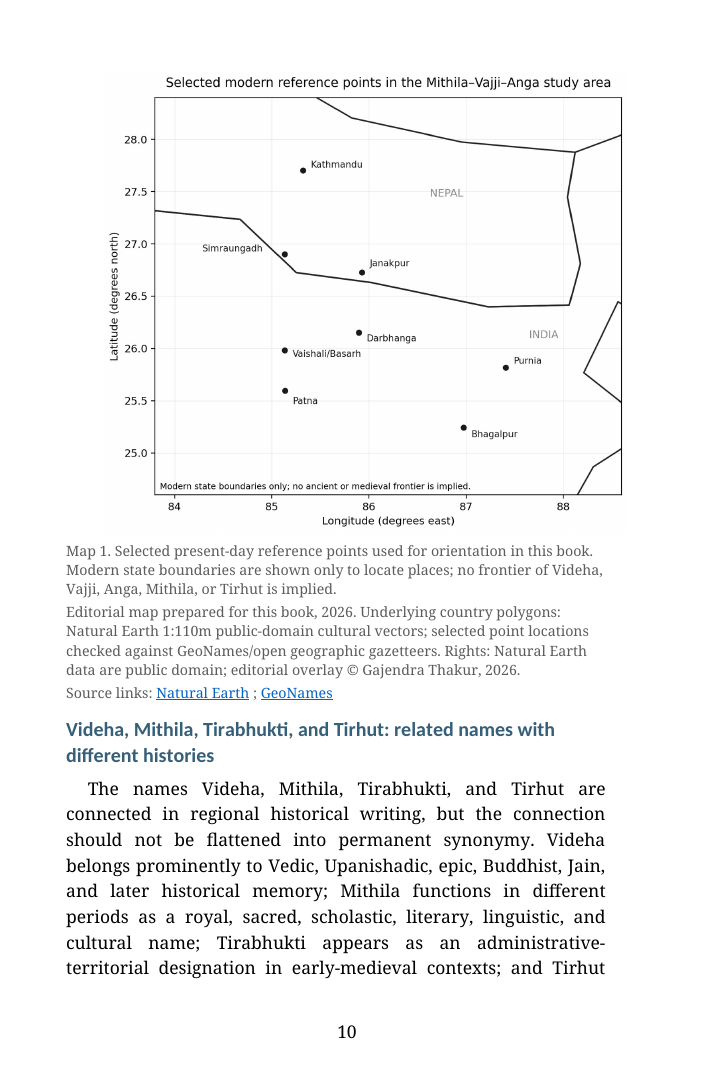
Mithila · Vajji · Anga
Chapter-specific source notes
- Primary chapter witness. Gajendra Thakur, Decoding the Panji of Mithila — Volume IV, formal Chapter 47, PDF pp. 475-481; formal Chapter 47. The HTML transcription is generated from the commit-pinned source PDF and retains the chapter boundary recorded in this edition.
- Internal structure. The repository source-heading inventory records 10 subordinate headings for this chapter: “Entry (398): the suspended Paramgarh heading”; “Entry (399): Karama heading and Katma-Babhaniam gramarambh”; “Entry (400): Kadrain-Babhaniam and the Pathak Mahathu line”; “Entry (401): Satlakha and the later Pathak continuation”; “Entry (402): Jagatpur-Oini and the royal historical register”; “Entry (403): Simraungarh and Maharaj Lakshminath”; “The absent (404), and entries (405)-(406): Narayan continuations and Sarai-Sugauna”; “Entry (407): rikta”; ….
- Digital editorial method. The page keeps the preserved source text distinct from generated navigational, concordance, visual, and provenance apparatus. The synthetic reconstruction is explanatory only and is not evidence for an individual lineage or a determination of social or marital status.