Decoding the Panji of Mithila · Volume IV · Chapter 48
Cutka-Soderpur, Tarouni, and Ranti-Pilerwad: Jatadhar Jha, Khadik-Khaual, and the Pilerwad Continuations
Chapter 48. Cutka-Soderpur, Tarouni, and
Ranti-Pilerwad: Jatadhar Jha, Khadik-Khaual, and
the Pilerwad Continuations
   This chapter continues exactly from entry (410), where the
preceding chapter stopped. The movement is no longer the broad
Paramgarh, Babhaniam, Oini, and Mahua-Khaual bridge. It turns
first to Cutka-Soderpur under the named figure Jatadhar Jha of
Maheshpur, then to a dense Tarouni continuation, and finally to
Ranti-Pilerwad, where the operative formula is Khadik-Khaual
gramarambh. The four entries covered here, (410) through (413),
are not a single simple family tree; they are a set of route-bound
continuations in which Soderpur, Karmaha, Khaual, Budhwal,
Pali, Hariamb, Khandbala, and other controls repeatedly mark
the legitimacy of descent and alliance.
  1. Entry (410): Cutka, Jatadhar Jha, and Maheshpur
   Entry (410), under the invocation to Shiva, is headed Cutka,
Jatadhar Jha, Maheshpur. The first movement is through
Premnath, whose line is connected with Phandah and
Mahamahopadhyaya Bhawanidatt, then to Ugradatt, called Kheli,
and onward through a Soderpur-Babunath line. The entry thus
begins by placing the named Cutka material inside a recognized
learned and route-linked network rather than treating Jatadhar
Jha as an isolated person.
   The next large cluster is organized through Gopinath. His sons
are given as Bhimnath, Drignath, Brajmohan, Yadunandan,
Raghunandan, and Shivnandan. The route is written through
Hariamb-Kashinath-Poshan and Soderpur-Madhav. Bhimnath is
separately linked through Pali-Jivan-Babujan and Pawali-
Dukhiya. Drignath gives Abhinandan, whose line is marked
through Karmaha-Rajju-Jagnath and Khandbala-Giridhar Singh.
Abhinandan then gives Ramchandra, connected through Pawali-
Rupnath-Vanshi and Khaual-Nena.
  Gopinath also has an apara line through Vishwanath, linked
with   Digho-Hiraphool-Feshan      and    Belaunch-Tulsidatt.

Vishwanath gives Jaradhar, placed through Budhwal-Mitradatt-
Mannu and Pawali-Kirtinath. Jaradhar is then expanded through
a Jajival-Keshav-Madhusudan route and a Hariamb-Shivshankar
route. The entry therefore uses a typical Panji method: the named
ancestor is not sufficient by himself; every branch is made legible
by the villages and mool-related affiliations that accompany it.
   Ramchandra’s line is continued through Ghusaut-Keshav-
Bachchan and Ekhara-Manmohan. The entry then introduces a
reference-marked cluster around Harihar, Balakrishna,
Lalkrishna, and Mahi. These names are tied to Belaunch-Mangu-
Aniruddha and Pali. Balakrishna, Sonma, and Chhata are then
attached through Soderpur-Ramanand-Ghani and a Sakararhi-
Jaykrishna note. Sonma gives Janakinath, called Bhaiya, through
Gangoli-Abhiram-Lochan and Ghusaut-Vanshidhar.
   The Sonma branch continues with Prannath, Ramanath,
Hemnath, Mathuranath, and Hridaynath, routed through
Baheradhi-Ratidhar-Chintu and Jajival-Bhaiyaram. Janakinath
gives Rudranath; another set gives Jaykrishna, Amritnath,
Matinath, and Bhavanath. Their connection through Tisaut-
Parashuram-Manai and Baliyas-Dhir is important because it
recalls earlier registers where Parashuram and his descendants
function as a controlling thread. The entry then develops
Amritnath and Bhavanath and closes with Ramanath’s sons
Girdhari, Badri, and Gudara. Girdhari is linked through Hari-Pali-
Bitari-Liladhar and Soderpur-Bhola, while an apara Vishwanath
branch passes through Pawali-Durganath-Mathuranath and
Mandar-Nityanand.
   Entry (410) is therefore a Cutka chapter in name, but in
practice it is a route-map across Soderpur, Hariamb, Karmaha,
Khaual, Budhwal, Pali, and Baheradhi. Its genealogical meaning
lies in the way it ties Jatadhar Jha and the Maheshpur material
into these older recognized channels.
  2. Entry (411): Tarouni and the Vishwanath-Gudar-
Hemnath continuation

   Entry (411), under the invocation to Nilakantha, is headed
Tarouni and bears the number 210. It begins from Vishwanath
and connects his line with Karmaha-Pyare-Narasinhdatt and
Mandar-Babulal. This does not reopen the earlier Tarouni-
Karmaha chapter; rather, it is a later Tarouni continuation
inserted after the Cutka material. The repetition of Tarouni
reminds the reader that Panji headings may reappear when a
branch, marriage route, or collateral line requires fresh
registration.
   The first portion names Gudar and Hemnath. Gudar is tied
through Soderpur-Lalit-Vanshidhar and Khaual-Hiralal. Hemnath
is placed through Pali-Nehal-Lal and Soderpur-Baudhi. Then
comes Bua, whose sons are Shambhunath, Jaynath, and
Dinanath. Their route runs through Gangoli-Sadan-Baidyanath
and Budhwal-Dukhni. Shambhunath is connected through
Sarisab-Brahmadatt-Babulal and Ekhara-Gunanidhi; Jaynath
gives Shankardatt through Naroun-Mani-Balbhadra and
Karmaha-Soni; Dinanath gives Motilal through Pali-Gunapati-
Brahmadatt and Soderpur-Mana.
   The Chhata line then gives Babunath, Ramnath, and
Lakshman. Babunath, called Manikrishna in the source sequence,
is joined with Pran and Bhaynath through Baheradhi-Sitaram-
Horil and Soderpur-Jagyapati. Ramnath is connected through
Hariamb-Chhatrapati-Parashmani        and     Jajival-Atmaram.
Lakshman gives Srinath through Jajival-Barju-Butan and Ekhara-
Brajnath; Srinath then continues through Budhwal-Chan-Shridatt
and Belaunch-Hanumandatt.
   A later sub-section records Bhikhari’s son Ram and his sons
Madhukar and Chan, with backward references in the source.
Madhukar is linked through Panichobh-Mangai and another
Hariamb route. Chan gives Yaduni through Soderpur-Jayram-
Harpati and Darihara-Shrinivas. Yaduni gives Hulash, called
Gunanidhi; Gunanidhi gives Vachh, called Batuknath, through
Soderpur-Bhagirath-Ramapati and Hariamb-Dhani. Batuknath
gives Kalikadatt through Pali-Jiut-Rudra and Darihara-Chanmani,

and Kalikadatt gives Balagopal through Karmaha-Bokan-Lal and
Baliyas-Bholanath.
   The end of entry (411) moves through Nayan, Shyamkrishna,
Mayaram, Raja, Dullar, Babunath, Babujan, and Ajit Narayan.
Shyamkrishna is linked with Hariamb-Lakshmikant-Barju and
Soderpur-Rameshwar. Mayaram gives Raja and Dullar through
Sarisab-Jayashiv-Bhaiyan and Sakararhi-Jayashiv. Raja is
attached through Soderpur-Sona-Hiralal and Mandar-Saheb.
Dullar is placed through Panichobh and a doubled
Soderpur/Khaual route. Babunath gives Babujan through Pawali-
Raghuvir-Pathak Bhavnath and Sakararhi-Bhainu. Babujan gives
Ajit Narayan through Belaunch-Baburaiya-Lanha and Bhataur-
Bhachal. This final chain makes the Tarouni entry a compact but
very dense bridge from old-style mool controls into late named
descendants.
  3. Entry (412): Ranti-Pilerwad and the Khadik-Khaual
gramarambh
   Entry (412) is headed Ranti Pilerwad, but the operative
formula inside the entry is "ath Khadik Khaual gramarambh."
This distinction is essential. Ranti and Pilerwad describe the local
heading of the register, while Khadik-Khaual gives the
genealogical control. The entry begins with Chaturbhuj, whose
sons are Dharadhar and Purandar. The text explicitly preserves
dotted blanks at the very beginning, showing that the copyist or
tradition did not supply all names in that initial route.
   Dharadhar’s line gives Nidhi, Chetharu, and Soni. Chetharu
gives Dullah through Phandah-Gokulnath-Raghunath and
Soderpur-Mohan. Dullah’s line passes through Pali-Mahi-
Bhawanidatt and Darihara-Manodhar, and an apara line through
Hariamb-Devkrishna-Machal and Soderpur-Chhotkani. Soni gives
Lotan, connected through Hariamb-Shivdash-Jagannath and
Soderpur-Lala. Lotan gives Narayandatt, Bhojilal, and Gopinath,
with Khandbala-Vir-Brajbhushan and Sakararhi-Harihar as one
route, and additional Pali, Digho, and Karmaha connections.

  Narayandatt gives Nanu through Dhenu-Pawali-Chaudhary
Madhurapati-Dharmadatt and Sakararhi-Bandhu. A further line
names Manohar through Budhwal-Nakat-Kamalpani and
Khandbala-Kuli-Mani, with Panichobh-Basaun also present. Leel
and In are recorded through Budhwal and Khandbala routes;
Manohar is then continued through Soderpur-Bhawanidatt-Bhatu
and Pali-Jhotan. Gopinath is linked through Karmaha-Soni-
Deonath and Darihara-Bachchan, and another Gopinath route
passes to Pali-Jagatbandhu. These repetitions of Soni, Karmaha,
Soderpur, Budhwal, and Khaual are not errors; they are the
proof-structure of the register.
   Purandar’s line gives Jayashiv, who is tied through Naroun-
Hari-Kavi Krishna and Mandar-Ghanshyam. Jayashiv then gives
Dayan, Kalar, and Rudla through Budhwal-Parmanand-
Devkrishna and Darihara-Harijiv. An apara line gives Jivan and
Yogi through Karmaha-Vamdev-Mukunddev and Soderpur-
Manidhar; another apara line goes through Phandah-Baldev-
Sonai and Darihara-Harijiv. Dayan gives Bachchi, called Bharu,
through Pali-Mahi-Bhawanidatt and Mandar-Yadav. Bharu is
linked with Khandbala-Brajbhushan-Ratneshwar and Hariamb-
Machal. The entry closes with Manmil through Soderpur-
Pashupati-Lal and Pali-Madhupati.
   4. Entry (413): Pilerwad and the continuation of Bharu,
Jivan, Yogi, and Harihar
   Entry (413), under the invocation to Maheshwara, continues
Pilerwad and carries the number 211. It begins as an apara
continuation of Bharu. One Bharu branch goes through Kharka-
Ekhara-Krishnadatt-Dharmadatt and Pawali-Thodhi. Rudal gives
Babujan through Pali-Mahi-Bhawanidatt and Mandar-Yadav.
Babujan is then attached through Sarisab-Prannath-Hridaynath
and Darihara-Urvvadhar.
  Another Bharu branch is routed through Hariamb-Dayaram
and a Jivan line. Jivan gives Badrinath and Bhainath through
Pali-Andi-Dukhbhanjan and Satlakha-Harijiv. Jivan also gives
Goshaim through Soderpur-Mahinath-Bachanu and Alay-

Nityanand, and another Jivan line gives Manik and Bhagat
through Pali-Hia-Veniram and Ekhara-Indrapati. Badrinath is
then linked through Khandbala-Sokhe-Khagesh-Kheli and
Darihara-Kala-Nand. The source also records a Pali-Madhupati
kasthut note, preserving a status or documentary marker rather
than a normal descent extension.
  Goshaim continues through Soderpur-Madhu-Umai and
Khaual-Dayaram. Manik is attached through Pawali-Dukharan-
Bhavadatt and Hariamb-Barju. Bhagat gives Hibhrahan, called
Basudev, and Govardhan through the same Pawali-Dukharan-
Bhavadatt and Hariamb-Barju route. Yogi gives Baiju and
Kashinath through Karmaha-Lakshmikant-Ghanshyam and
Ghusaut-Ram. This cluster shows how entry (413) completes the
Ranti-Pilerwad/Khadik-Khaual field begun in entry (412).
   The final part of the entry shifts to a Harihar line, with a
backward source reference. Harihar gives Ram and Chhotkani
through Jajival-Mohan-Purushottam and Budhwal-Pradyumna.
Ram gives Dukhiya, Bua, and Poshana through Belaunch-
Aniruddha-Amresh and Gangoli-Umanand. Dukhiya gives Garib
and Keval through Pali-Dharmapati-Rohini and Soderpur-
Bhaiyaram. Bua gives Grihimani and Gopal through Karmaha-
Budhai-Poshan and Naroun-Dhani. Grihimani gives Gonan, Barja,
and Ranglal through Sarisab-Khantar-Bhola and Karmaha-
Chitradhar. Gopal is linked through Soderpur-Harikrishna-Gauri
and Budhwal-Tekchand. The chapter therefore ends with a
return to the practical Panji grammar of repeated mool and
village controls.
  5. Why entries (410) to (413) form one chapter
   Entries (410) to (413) form a natural chapter because they sit
between two larger gramarambh zones. Entry (410) completes
the Cutka-Soderpur and Jatadhar Jha-Maheshpur material; entry
(411) gives a dense Tarouni continuation; entries (412) and (413)
then introduce and extend the Ranti-Pilerwad material under the
Khadik-Khaual gramarambh. The next entry, (414), opens
Simarwad-Khaual and Ranipur in Betia, which is a fresh local

register and should not be merged backward into the Pilerwad
chapter.
  The entries also show why Panji reading must separate outer
headings from operative controls. "Tarouni" in entry (411) does
not automatically mean that the earlier Tarouni-Karmaha
chapter is being reopened in full. "Ranti Pilerwad" in entry (412)
does not override the internal statement that Khadik-Khaual is
the gramarambh. Similarly, the names Cutka, Maheshpur, Ranti,
and Pilerwad are interpreted through Soderpur, Khaual,
Karmaha, Budhwal, Pali, Hariamb, and the other route-villages
that certify the branches. This chapter stops deliberately before
entry (414), where Simarwad-Khaual begins a different register.
Source structure and verification apparatus
Editorial source apparatus. This apparatus is descriptive, not interpretive. It records the source-controlled structure used to verify that this page corresponds to formal Chapter 48 of Decoding the Panji of Mithila — Volume IV. The chapter text above is preserved from PDF pp. 482-488; formal Chapter 48 in the commit-pinned authoritative source. It is not merged with a neighboring chapter, appendix, annexure, or independent front/back-matter unit. The internal headings below come from the repository’s source-heading inventory and are retained as navigational and audit evidence; showing them here does not turn those headings into separate publications or add claims that are absent from the source.
Internal source headings
No subordinate heading was separately encoded in the repository source-heading inventory for this chapter.
Source-text concordance
Cutka-Soderpur · Tarouni · Ranti-Pilerwad · Jatadhar · Khadik-Khaual · Pilerwad · Continuations · continues · exactly · entry · preceding · stopped · movement · longer · broad · Paramgarh · Babhaniam · Oini · Mahua-Khaual · bridge · turns · first · named · figure · Maheshpur · dense · continuation · finally · operative · formula · gramarambh · four · entries · covered · single · simple · family · tree · route-bound · Soderpur · Karmaha · Khaual · Budhwal · Pali · Hariamb · Khandbala · controls · repeatedly · mark · legitimacy · descent · alliance · Cutka · invocation · Shiva · headed · Premnath · whose · line · connected · Phandah · Mahamahopadhyaya · Bhawanidatt · Ugradatt · called · Kheli · onward · Soderpur-Babunath · thus · begins · placing · material · inside · recognized · learned · route-linked · network · rather · treating · isolated
Boundary verification. In the formal sequence this chapter follows Volume IV Chapter 47, “Paramgarh, Babhaniam, Satlakha, Oini, Simraungarh, and Mahua-Khaual” and precedes Volume IV Chapter 49, “Simarwad-Khaual, Ahil-Gotham, Mahnaura-Bindhi, and Damodarpur-Kakraud”. The chapter extractor begins at the verified formal Chapter 48 marker and stops at the next verified formal chapter marker; for a final chapter it stops before recognized book-level back matter. The concordance above is generated only from distinct terms already present in this chapter’s preserved source text. It is provided for discovery, comparison, and audit, not as an automated judgment about persons, lineages, status, kinship, marriage eligibility, or historical truth.
Illustrated research apparatus
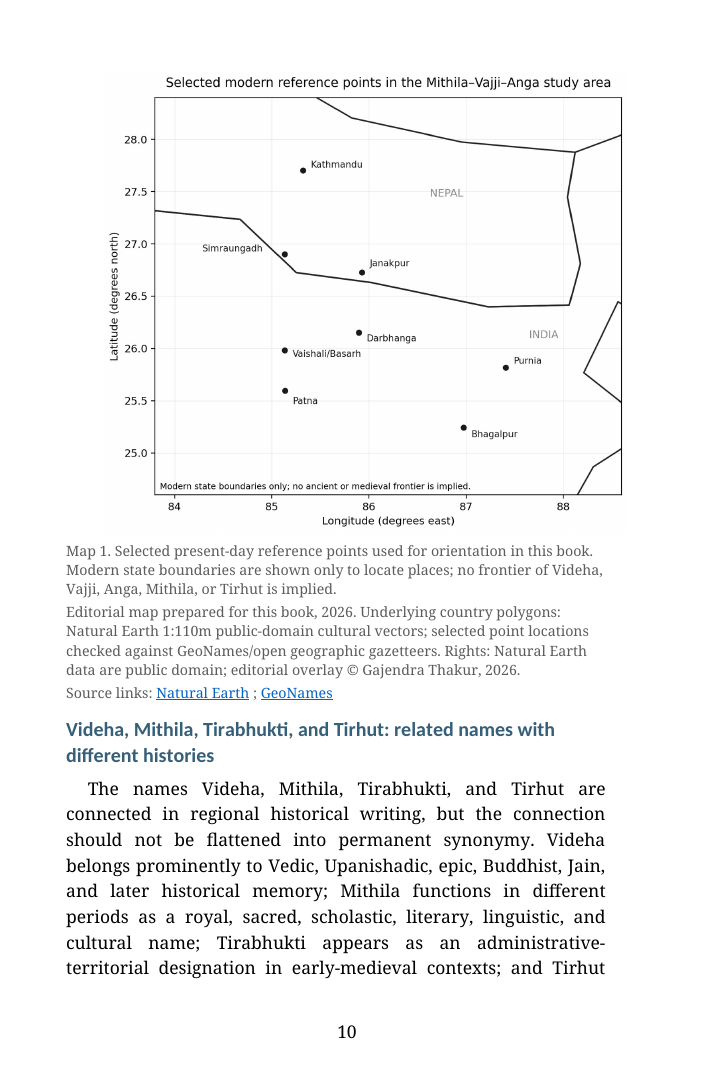
Mithila · Vajji · Anga
Chapter-specific source notes
- Primary chapter witness. Gajendra Thakur, Decoding the Panji of Mithila — Volume IV, formal Chapter 48, PDF pp. 482-488; formal Chapter 48. The HTML transcription is generated from the commit-pinned source PDF and retains the chapter boundary recorded in this edition.
- Internal structure. The repository source-heading inventory records no separately encoded subordinate heading for this chapter.
- Digital editorial method. The page keeps the preserved source text distinct from generated navigational, concordance, visual, and provenance apparatus. The synthetic reconstruction is explanatory only and is not evidence for an individual lineage or a determination of social or marital status.