Decoding the Panji of Mithila · Volume IV · Chapter 54
Sukhait-Pilkhwar and the Learned Khaual Line: Entries (447)-(450) This chapter takes up the sequence after the suspended
Chapter 54. Sukhait-Pilkhwar and the Learned
Khaual Line: Entries (447)-(450)
   This chapter takes up the sequence after the suspended
Kapileshwaram marker and covers entries (447) through (450)
only. The governing movement is from Sukhait to Pilkhwar,
but the operative village frame inside the first entry is Khaual
gramarambh. The register therefore does not merely shift
locality; it opens a learned Khaual-centred branch in which
M.M. titles, Jyotishi and Vaiyakaran designations, modern
academic style, and repeated apara routes are woven into one
Sukhait-Pilkhwar passage.

Entry (447): Sukhait to Pilkhwar, Khaual
gramarambh, and M.M. Nenan
   Entry (447), under the invocation to Vasuki Nath, begins the
Sukhait-to-Pilkhwar section and announces a Khaual
gramarambh. The ancestor is M.M. Nenan. His recorded
children are Lanhi, Jyotishi Dhurttaraj, Bhana, M.M. Babujan,
Jani, Gyani, and Dhyani. The opening route links this group
through Soderpur-Bandhu-Jivan on one side and Hariamb-
Umanath on the other. The combination is important: the
section is locally labelled Sukhait-Pilkhwar, but its first
genealogical logic is Khaual, and its first social register is
learned, with M.M. and Jyotishi markers placed at the head of
the branch.
  Lanhi is entered through Karmah-Chitradhar-Rajju and
Darihara-Nidhipani. The apara Lanhi line is also preserved
and is tied through Soderpur-Atmaram-Ratu and Darihara-
Nanu. The source thus records Lanhi not as a single linear
descent but as a branch with a second pathway, marked
apara, for a collateral or alternate marriage-route. Dhurttaraj
and Jyotishi Bhana are then represented through Bachchu.
Bachchu is connected by Belaunch-Medhan-Hridaybhurav and

Karmah-Shitaladatt, and his children are Jivanath, Buchchi,
and Gangadhar, whose route passes through Pali-Lal-Kalaru
and Pandua-Hridaymani.
   Buchchi gives Kalikant through Ghusaut-Mukund-Hiramani.
Kalikant is then tied through Jajival-Jaydev-Vijaykant and
Mandar-Thithar-Munai. Jivanath gives Shrinandan; here the
record deliberately keeps some fields blank, using the dotted
style rather than supplying a complete marriage-route.
Shrinandan’s own continuation includes an incomplete
Pandol-resident line and a Saraya-resident Jamdauli-Pali
notice. Gangadhar gives Tarakant, connected through Alay-
Mitralal-Harikant and Balias-Ishdatt. The entry therefore
moves across named scholarly and village channels while
preserving partial data where the Panji does not give full
detail.
    The M.M. Babujan segment records M.M. Babua, styled
Dukhmochan, M.M. Chumme, and Kunjan. Their route passes
through Karmah-Hemnarayan-Mandhan and Sarisab-Nanu.
M.M. Babua continues through Panichobh-Srishtidhar-Shital,
with Shital himself tied through Darihara-Hirphul-Kanhai and
Pali-Sonma. Apara issue then includes Chandranand,
Nityanand, and Vaiyakaran Trilochan, placed through Sarisab-
Pa Bachharan and Belaunch-Nehnath. This is a dense learned
node: M.M., Vaiyakaran, and Jyotishi titles all appear inside
the same register, and the source uses them as identifying
titles, not as decorative honorifics.
  Chandranand gives Shivanandan and Shashinandan
through Hariamb-Bhushan-Mushai and Khaual-Devaraj.
Shivanandan gives Anil Kumar and Arival Kumar through
Alay-Chhakori-Govind       and       Soderpur-Bachchan.
Shashinandan’s branch is represented through Badhiyam-
Pabouli-Suvansh-Dinambar    and   Hariamb-Shyamsundar.
Nityanand then gives Vidyanand and Shardanand through

Jajival-Babujan-Bhaiyo and Hariamb-Parmanand. Vidyanand
gives Mihir Kumar through Shilanath-Gangadhar and Kujouli-
Chandrabhooshan, while Shardanand gives Aditya Kumar
through Alay-Chhakori and Shashi. The entry’s ending shows
the same mixture of older learned titles and modern personal
names that characterizes this stretch of the register.

Entry (448): Vaiyakaran Trilochan and the Chumme
branch
  Entry (448), again under Sukhait to Pilkhwar, continues
with a short Khaual-related closing notice and then develops
the line of Vaiyakaran Trilochan. Trilochan’s children are
Baidyanath, Amarnath, and Dharmnath. Their route is
through      Belaunch-Bhushan-Sudhakar      and    Satlakha-
Rameshwar. Baidyanath is tied through Soderpur-Indranand-
Chandranand and Ghusaut-Durganath. Amarnath passes
through a Gangoli-resident Mahishi-Pali line, named with
Bhekhanath and Mokshanath, and is then linked to Sakararhi-
Lakshman. The entry thus preserves both learned identity and
residential qualification.
   The next major figure is M.M. Chumme. His children are
Pitambar, Damodar, Vaiyakaran Gunakar, and Lakshmidhar.
They are connected through Hariamb-Thedani or Chhotakni
and Balias-Bhulan. Pitambar gives Mahavir and Bhagwanji
through Ghusaut-Madhav-Gunjeshwar and Balias-Chaturbhuj.
Mahavir gives Acharya Dr. Shankar and Shubhe through Pali-
Balmukund-Umanand and Balias-Shrikant. Shankar’s line is
then tied through Malichham-Narun-Lootan-Pa Nirsu and
Balias-Harishchandra. Bhagwanji, also styled Jayvir, is
connected    through    Tripuroli-Narun-Leelanath-Saraswati
Premnath and Alay-Kumar Krishnanand.
  Damodar gives Rajeshwar, Vireshwar, and Gangeshwar
through Pali-Balmukund, Khushru or Kulanand, and Balias-
Dedhan. Rajeshwar gives Ganesh through Khandbala-

Harinandan-Suryanandan and Tisaunt-Bhagwat Narayan.
Vireshwar is tied through Belaunch-Manmohan-Shanti Mohan
and Ghusaut-Vidyanand, while Gangeshwar is placed through
Pabouli-Dukharan-Neelambar. The entry then returns to
Vaiyakaran Gunakar. Gunakar is connected through Ekhara-
Jhumkalal-Parmanand and Pandua-Bhaiyan; an apara
Gunakar branch gives Divakar, Prabhakar or Ramakar,
Hemkar, Padmakar, and Umakar through Ghusaut-Kumar-
Shripati and Jajival-Bhaiyo. Prabhakar receives a Ghusaut-
Damodar-Jaymohan and Belaunch-Shobhanath route, while
Divakar is left with a Behat-Hariamb-Narsingh pathway and
dotted blanks.

Entry (449): Lakshmidhar, Kunjan, Jani, Gyani, and
Yashodhar
   Entry (449) continues the Sukhait-to-Pilkhwar frame
through Lakshmidhar. Lakshmidhar’s children are Dannu,
styled Vanshidhar, Bhavan, Sajjan, Mohan, Manu, and Binu.
Their route is through Fanandah-Jayant-Radhanath and
Khaual-Divakar. Dannu’s own continuation is tied through
Khandbala-Durgeshwar-Jagdish and Karmah-Ramnarayan.
The entry then develops Kunjan, whose children are Janardan,
Lakshman, and Sudarshan. Their route runs through Ghusaut-
Kalanath-Jayvallabh and Balias-Kanhai. Janardan is linked
through Sarisab-Mukund-Kamalnath and Balias-Shrikant, and
Sudarshan gives Kameshwar through Alay-Nandalal-Shrikant
and Sarisab-Pa Bambholi.
   Jani gives Vasant through Sarisab-Babunath-Dinanath and
Narun-Babunath. Vasant gives Purushottam and Digambar
through Karmah-Dayanath-Chetnath and Belaunch-Nehanath.
Purushottam’s issue is named as Suryanand, Kameshwar, and
Sushila, linked through Ghusaut-Mukund-Hiranand. Digambar
is connected through Alay-Bechan Lal-Balbhadra and Sarisab-
Janardan. This portion is especially useful for showing how

the source carries forward the Sukhait-Pilkhwar line through
a sequence of personal names while repeatedly returning to
the stable village-route grammar.
   Gyani gives Batur, styled Dasharath, and Jagdish through
Baheradhi-Aankhi-Raja and Satlakha-Babujan. Batur gives
Ramchandra through Soderpur-Jegi-Bala and Satlakha-
Kirtinath. Ramchandra gives Udaychandra through Belaunch-
Keshav-Girdhar Kishor and Balias-Shrikant, and Udaychandra
is then tied through Fanandah-Vanshmani-Jitendramani and
Belaunch-Janakinath. Jagdish is placed through Soderpur-Son-
Devkinandan and Darihara-Luchmani. The entry also records
an apara Gyani branch through Soderpur-Brajdatt-Kirtinath
and Sakararhi-Lal. Finally, Gyani gives Yashodhar through
Pali-Ramnath-Govind and Sarisab-Pa Govind. This closes the
substantive Sukhait-Pilkhwar genealogy of the chapter.

Entry (450): suspended Sukhait-Pilkhwar invocation
   Entry (450), under the invocation to Gashutoshaya, is
headed Sukhait to Pilkhwar and numbered in the source, but
it gives no additional genealogy in the available line. I have
therefore treated it as a preserved suspended marker. Its
presence is meaningful because it confirms that the Sukhait-
Pilkhwar section continues as an indexed Panji unit even
when this particular numbered item carries only an
invocation and heading. The next substantive movement
begins only at entry (451), where the register shifts to Nahar
and then to Parhat-Sakararhi gramarambh.

Chapter conclusion
  Entries (447)-(450) form a compact but important learned
Sukhait-Pilkhwar chapter. They begin with M.M. Nenan and a
Khaual gramarambh, then develop the lines of Lanhi,
Dhurttaraj-Bhana, M.M. Babujan, M.M. Babua, Chumme,
Vaiyakaran Trilochan, Gunakar, Lakshmidhar, Kunjan, Jani,

and Gyani. The record is dense with scholarly titles, apara
branches, modern personal names, and dotted incomplete
routes. The chapter ends at entry (450), preserving the
suspended Sukhait-Pilkhwar invocation and deliberately
stopping before the Nahar and Parhat-Sakararhi sequence of
entry (451).
Source structure and verification apparatus
Editorial source apparatus. This apparatus is descriptive, not interpretive. It records the source-controlled structure used to verify that this page corresponds to formal Chapter 54 of Decoding the Panji of Mithila — Volume IV. The chapter text above is preserved from PDF pp. 527-532; formal Chapter 54 in the commit-pinned authoritative source. It is not merged with a neighboring chapter, appendix, annexure, or independent front/back-matter unit. The internal headings below come from the repository’s source-heading inventory and are retained as navigational and audit evidence; showing them here does not turn those headings into separate publications or add claims that are absent from the source.
Internal source headings
- Entry (447): Sukhait to Pilkhwar, Khaual gramarambh, and M.M. Nenan
- Entry (448): Vaiyakaran Trilochan and the Chumme branch
- Entry (449): Lakshmidhar, Kunjan, Jani, Gyani, and Yashodhar
- Entry (450): suspended Sukhait-Pilkhwar invocation
- Chapter conclusion
Source-text concordance
Sukhait-Pilkhwar · Learned · Khaual · Line · Entries · takes · sequence · suspended · Kapileshwaram · marker · covers · governing · movement · Sukhait · Pilkhwar · operative · village · frame · inside · first · entry · gramarambh · register · therefore · merely · shift · locality · opens · Khaual-centred · branch · titles · Jyotishi · Vaiyakaran · designations · modern · academic · style · repeated · apara · routes · woven · passage · Nenan · invocation · Vasuki · Nath · begins · Sukhait-to-Pilkhwar · section · announces · ancestor · recorded · children · Lanhi · Dhurttaraj · Bhana · Babujan · Jani · Gyani · Dhyani · opening · route · links · group · Soderpur-Bandhu-Jivan · side · Hariamb · Umanath · combination · important · locally · labelled · genealogical · logic · social · markers · placed · head · entered · Karmah-Chitradhar-Rajju
Boundary verification. In the formal sequence this chapter follows Volume IV Chapter 53, “Basaith, Baghdas-Chanpura, Nahas-Chanpura, Khojpur, and Mahinathpur” and precedes Volume IV Chapter 55, “Nahar and Parhat-Sakararhi: From Tharhi-Satlakha to Teldihā-Munger, Entries (451)-(460) This chapter continues immediately after the suspended”. The chapter extractor begins at the verified formal Chapter 54 marker and stops at the next verified formal chapter marker; for a final chapter it stops before recognized book-level back matter. The concordance above is generated only from distinct terms already present in this chapter’s preserved source text. It is provided for discovery, comparison, and audit, not as an automated judgment about persons, lineages, status, kinship, marriage eligibility, or historical truth.
Illustrated research apparatus
Mithila · Vajji · Anga
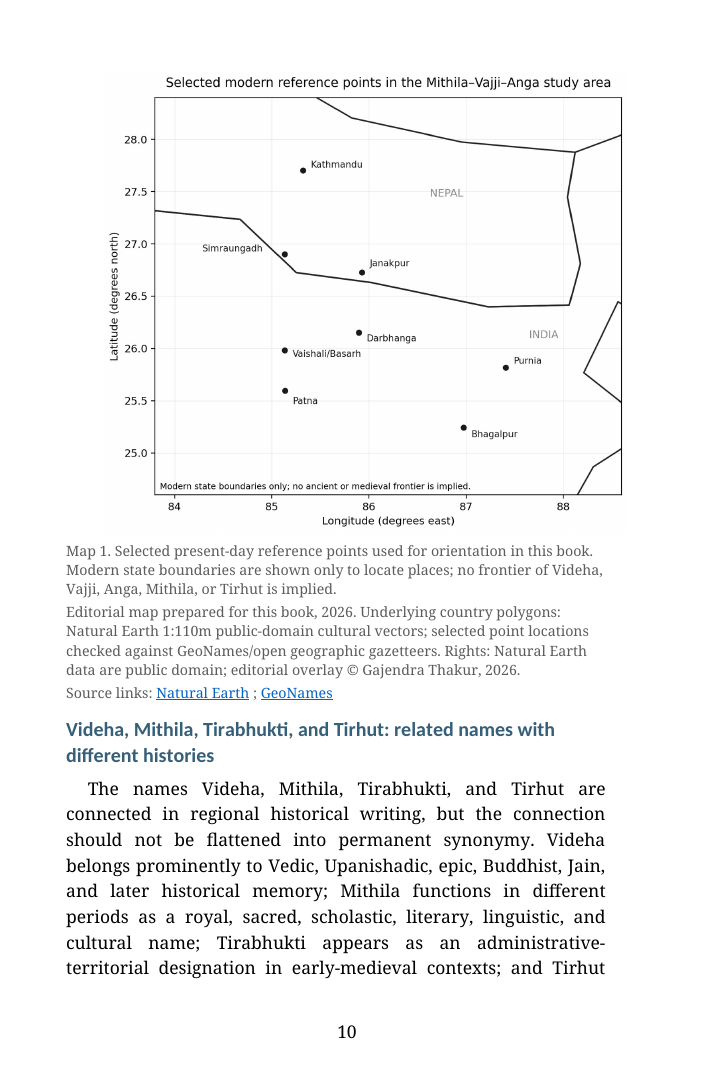
Chapter-specific source notes
- Primary chapter witness. Gajendra Thakur, Decoding the Panji of Mithila — Volume IV, formal Chapter 54, PDF pp. 527-532; formal Chapter 54. The HTML transcription is generated from the commit-pinned source PDF and retains the chapter boundary recorded in this edition.
- Internal structure. The repository source-heading inventory records 5 subordinate headings for this chapter: “Entry (447): Sukhait to Pilkhwar, Khaual gramarambh, and M.M. Nenan”; “Entry (448): Vaiyakaran Trilochan and the Chumme branch”; “Entry (449): Lakshmidhar, Kunjan, Jani, Gyani, and Yashodhar”; “Entry (450): suspended Sukhait-Pilkhwar invocation”; “Chapter conclusion”.
- Digital editorial method. The page keeps the preserved source text distinct from generated navigational, concordance, visual, and provenance apparatus. The synthetic reconstruction is explanatory only and is not evidence for an individual lineage or a determination of social or marital status.