Decoding the Panji of Mithila · Volume IV · Chapter 60
Ratauli-Dhadhi, Dih-Darihara, Bargam-Pilkhwar, and Sihouli: Entries (498)- (508) Opening note
Chapter 60. Ratauli-Dhadhi, Dih-Darihara,
Bargam-Pilkhwar, and Sihouli: Entries (498)-
(508)
Opening note
   This chapter continues directly after the Rajanpura-
Kaivalakh and Tharhi material and covers entries (498)
through (508) only. It begins with Ratauli-Dhadhi and the
Ratauli routes through Betia, Ranipur, Kakraud, and Tharhi; it
then turns to the Dih-Darihara gramarambh, including Baisi
Chakla, Dhanga, Rashady, Malapur, and Chakauti; it next
follows Bargam-Darihara into Pilkhwar; and it closes with the
Sihouli-Mandar cluster through Sugauna, Ranitole, Nahar,
Yamsam, Manikouli, and Janad. Entry (509), Rajoura-Sahpur,
opens a new Mandar-Rajoura sequence and is reserved for the
next chapter.

Entry (498): Ratauli to Dhadhi
   Entry (498) is headed Ratauli to Dhadhi and bears the
internal number (254). It resumes the Ratauli-Darihara
environment through Nandalal, whose descendants include
Vachaspati or Nirsu, Lakshmipati or Khokha, Pashupati, and
Rajendra. The register immediately proves these men by
route-pairings: Kujouli-Bhuvan-Krishnamani to Sarisab-
Aniruddha; Karmah-Radhanath-Shashinath to Jajival-Bhaiyo;
Karmah-Kheli-Bhavanand to Jajival-Bhaiyo; Fanandah-Balel-
Radhanath to Pandua-Nathuni; and Narun-Pa Lutan-Pa Nirsu
or Vishwanath to Balias-Harishchandra. The entry is not
simply a list of names. It is a compact proof of Ratauli-Dhadhi
descent by repeated checks across Kujouli, Karmah, Jajival,
Fanandah, Narun, Pandua, and Balias.
  The entry then turns to Shastri Vishnulal. His line is carried
through Hariamb-Basant-Vaiyakaran Suresh and Mandar-

Narsingh. Apara sons include Khelan or Kameshwar and
Gyan, connected through Soder-Raghunath-Shrikant and
Balias-Babua. Kameshwar is tied through Hariamb-Ram
Manohar, while Teknath gives Harshanath, Deonath, and
other sons through Tisaunt-Bacha-Kashinath and Satlakha-
Gonan. Harshanath gives Ganganath through Hariamb-Nenan-
Jamahir and Soder-Lal. Ganganath is further routed through
Pali-Ram-Haridev and Kujouli-Krishnadev. The tail of the
entry preserves Manodhar and Chitradhar branches through
Khaual-Sonma, Karmah-Chitradhar, Pabouli-Upendra, Ahpur-
Karmah-Gokulnath-Mangni, and Narun-Vanshidhar. The effect
is to join old Ratauli-Darihara substance with later scholar-
styled and Shastri/Vaiyakaran identities.

Entry (499): Ratauli to Betia, Ranipur and Kakraud
  Entry (499) shifts the same Ratauli stream toward Betia
country, Ranipur, and Kakraud. The head of the entry is
Indranand, whose sons are Achyutanand and Nandalal.
Achyutanand gives Nutankrishna or Nena through Soderpur-
Phul-Gadadhar and Hariamb-Rupnath. Nutankrishna gives
Harikrishna through Fanandah-Gosain-Sundar and Balias-
Mathuri. Harikrishna is then connected through Hariamb-
Abhayanath-Manmohan and Sarisab-Kulanand. This part
shows a movement from Ratauli into the Betia/Ranipur area
without abandoning the older proof-villages.
  A second strand begins with Vishnudatt, whose sons are
Gehnath and Bacha. Vishnudatt is tied through Sarisab-
Krishnadev-Chan and Sakararhi-Jayadatt. Gehnath gives
Gulab   through    Sarisab-Vishram-Kariye   and   Balias-
Brahmadatt; an apara Gehnath line goes through Ghusaut-
Bacha-Thothan and Mandar-Chilka. Gulab gives Shatanjiv,
Khataru or Satyadev, and related descendants through
Karmah-Rajju-Jaynath and Balias-Lanha. Additional apara
Gulab lines go through Alay-Shivlal-Jagatlal and Narun-

Bachhi, through Ghusaut-Kalanath-Mukund and Pabouli-
Siddhi, and through Jamdauli-Pali-Bholanath-Lal and Pabouli-
Bathan. Bacha is then tied through Soderpur-Parmeshwar-
Tufani and Vabhaniam-Ranjan, with another Hariamb-
Ramanath-Bhavanidatt and Oini-Babu Jagatnarayan route.
Satyadev gives Janakdev, Nilu, and Haridev through Belaunch-
Lakshmidatt-Mukeshwar and Mandar-Bhairavdatt. This entry
therefore builds a Betia-Ranipur-Kakraud extension from both
Achyutanand and Vishnudatt lines.

Entry (500): Ratauli to Tharhi
  Entry (500) returns to Ratauli-Tharhi. Garib is the first focus,
with Kirti, Medhakar, and Chanan connected through
Karmah-Bhavani-Budhai and Darihara-Hari. Apara Garib lines
are numerous. One gives Ishannath through Pali-Shivdas-
Yaduram and Balias-Pashupati. Another gives Mana and Nanu
through Jajival-Bhagirath-Nandalal and Darihara-Govardhan.
A further apara Garib line repeats the Pali-Ramkrishna-
Shulpani to Darihara-Govardhan route, and another goes
through    Alay-Narottam-Nityanand       to   Satlakha-Keshav.
Chanan gives Mohan through Pali-Ganapati-Harinandan and
Pandua-Kamalnayan; Mohan is tied through Pali-Bhikhari-
Hira and Balias-Hridaynandan.
   Ishannath’s descendants carry the theological and
Sanskritic naming pattern. His sons include Tulsidatt,
Parmeshwaridatt, Bhagwandatt, and a line reading
Ishwaridatt. They are proved through Karmah-Raghudev-
Juraun,    Ekhara-Lakshmidhar,     Dighoy-Narpati-Khushihal
Singh,   Ekhara-Chhatrapati,   Tisaunt-Manai-Khadgi,   and
Sakararhi-Kariye. Mana gives Girjadatt through Khandbala-
Doni-Shyam and Khaual-Balkrishna, and an apara Mana line
gives Parshamani through Belaunch-Bhavdev-Jadav and Pali-
Paran. Nanu gives Nayan and Muni through Pali-Gangadhar-
Nidhi and Belaunch-Rohini Raman. Muni gives Madhusudan

through Karmah-Juraun-Sanphul and Ekhara-Haripani.
Madhusudan gives Markandey and Chhedi through Ghusaut-
Mahindhar-Amoldatt and Belaunch-Neya. The final Jyotishi
Tulakrishna line continues through Batuknath and
Mathuranath, linking Ekhara-Jyotishi Harishwar-Sona to
Soderpur-Abhiram and then Ghusaut-Mansukh-Barja to
Soderpur-Kishornath. Entry (500) is one of the clearest Tharhi
continuations because it preserves a branching tree rather
than only a short marriage chain.

Entry (501): Dih-Darihara to Baisi Chakla, Dhanga and
Rashady
   Entry (501) opens a new unit with “ath Dih Darihara sam
gramarambh.” The first ancestor is Gang, whose descendants
include Abhiram, Dhani, and Bachharu through Alay-Babu-
Maddh and Sakararhi-Vishwambhar. Abhiram is connected
through Soderpur-Haridev-Anand and Darihara-Manhar.
Dhani is tied through Jajival-Shivani-Murali and Ekhara-
Aniruddha, with apara Dhani lines through Pali-Sundar-
Bhavesh and Pabouli-Mahesh, and through Soderpur-Bachhai-
Dalpati and Khaual-Ani. Bachharu gives Bhoranath and
Bhairavdatt through Narun-Manhar-Narpati and Pandua-
Jiveshwar. An apara Bachharu line goes through Karmah-
Budhai-Sadashiv and Jajival-Saday; another gives Nidhi
through Ekhara-Balli-Panai and Baheradhi-M.M. Bhikhi.
  Bhoranath gives Dharmnath, Manik, and Moti through
Belaunch-Lala-Balchandra         and     Karmah-Vanshidhar.
Dharmnath is routed through Gangoli-Kriparam-Sarvasva and
Darihara-Ghananand. Manik gives Jalpadatt, Ram, and
Lakshman through Ekhara-Bhavadatt-Bhaiyan and Gangoli-
Sarvasva. Jalpadatt is tied through Hariamb-Loknath-Venidatt
and Darihara-Gauridatt. Ram gives Gulli or Shri Narayan
through Karmah-Deonath-Doman and Balias-Raja. Gulli or
Lakshminarayan is then linked through Soderpur-Jagi-Bab

and Satlakha-Kirtinath, while an apara Gulli line gives
Satyadev, Suresh, and Jagdish through Karmah-Bachharan-
Saday and Sarisab-Yadu. Nidhi gives Narayandatt and
Shankardatt through Panichobh-Mahadev-Madhurapati and
Satlakha-Vaidyanath. Narayandatt gives Damodar and
Trailokyanath through Pali-Bodhi-Girdhari and Belaunch-
Saheb. Trailokyanath gives Harinandan through Budhwal-
Bhimdatt-Shambhu and Kujouli-Shambhu. This entry is a full
Dih-Darihara gramarambh with a wide Dhanga/Rashady
control field.

Entry (502): Dih to Malapur-Chakauti in Uttar Pradesh
  Entry (502) continues Dih into Uttar Pradesh, specifically
Malapur-Chakauti. Modi gives Mansukh and Prayagdatt
through Soderpur-Raghunath-Devidatt and Ghusaut-Vanshi.
Mansukh is routed through Belaunch-Shulpani-Dharmeshwar
and Panichobh-Prannath. Prayagdatt gives Jwaladatt,
Ganeshdatt, and Kirtidatt through Belaunch-Shulpani-
Dharmeshwar and Panichobh-Prannath. Jwaladatt gives
Murlidhar through Hariamb-Prannath-Rupnath and Balias-
Bhavnath. Murlidhar gives Chandranarayan and Rupnarayan
through Budhwal-Bhimdatt-Parmeshwaridatt and Jajival-
Fakiran. Apara sons Suryanarayan and Shrinandan are tied
through     Hariamb-Bhulan-Kunjan,      Dighoy-Chitradhar-
Shashinath, and Alay-Babulal. Chandranarayan is linked to
Mahishi-Budhwal-Keshav-Harinandan and Mandar-Mukund;
Ganeshdatt goes through Karmah-Buddhinath-Dharmnath
and Soderpur-Sheshdhar.
  The Umakant line adds Sita and Dhira through Narun-
Vishnupati-Sadhu and Kurumal-Ghasiram. Sita gives Devidatt
through Sarisab-Bhanjan-Hirai and Pali-Babi. Devidatt gives
Babue through Karmah-Soni-Deonath and Darihara-Bachan.
Babue then branches to Narsingh, Bhikhiya, Shatrughna,
Harishchandra,   and    Soni   through    Ekhara-Haripani-

Hridayapani and Budhwal-Ghananand. Shatrughna gives
Yogeshwar through Pali-Shyamlal-Rubi and Kujouli-Bhaiyalal.
Dhira gives Bhagwandatt, Gopal, and Raja through Gangoli-
Jagannath-Chonha and Khaual-Prannath. Bhagwandatt is tied
through Hariamb-Kashinath-Poshan and Sakararhi-Ramanath;
Gopal through Alay-Jhontu-Kamal and Balias-Harshanath; and
Raja through Alay-Dubari-Yadu and Narun-Chhatri. Balbhadra
and Shriraman conclude the entry through Dighoy-
Shivnandan-Sarvanarayan and Sakararhi-Shyamlal. This
entry is important because it explicitly carries the Nagram
Panji outside Mithila into a Uttar Pradesh place-name while
preserving the same formulaic proof system.

Entries (503)-(504): Bargam-Darihara to Pilkhwar
   Entry (503) begins the Bargam-Darihara gramarambh and
moves toward Pilkhwar. Narottam gives Purushottam and
Musan through Pali-Nahar-Dharani and Satlakha-Devki.
Purushottam gives Devidatt, Gauridatt, Shambhudatt, and
Ishwaridatt through Babhaniam-Chhoke-Bachharu and
Darihara-Badlu. Devidatt is linked through Soderpur-Dharani-
Gokulnath and Darihara-Bachharu. Ishwaridatt gives
Kalikadatt through Karmah-Jagan-Purushottam and Khaual-
M.M. Dayaram. Kalikadatt gives Lakshmikant through
Soderpur-Gokulnath-Shambhu and Belaunch-Prabhakar, with
apara       sons      Madhusudan,        Kantir/Yashodanand,
Luch/Devkinandan, and others through Hariamb-Rameshwar-
Bhikhan and Darihara-Nanu. Vaiyakaran Lakshmikant is tied
through Pali-Vishnudatt-Gopal and Soderpur-Maheshdatt.
  Madhusudan is routed through Hariamb-Kauskidatt-
Manmohan and the Soder/Pakshadhar-Babulal route. Apara
sons Paramanand and Ghananand pass through Digho-
Chitradhar-Shashinath and Satlakha-Arjun. Ghananand gives
Gokulanand through Ghusaut-Muni-Gangesh and Darihara-
Trailokyanath. Kantir or Yashodanand gives Jivanand through

Pabouli-Natha-Juddhi and Pali-Krishnamani, while apara
Lokanand goes through Kujouli-Bhuvan-Durganath and
Ghusaut-Lutan. Luch/Devkinandan is tied through Gangoli-
Vishwanath-Harihardatt and Alay-Aami-Deonath-Artinath.
Jivanand is then routed through Soderpur-Bhairav-Nirsu and
Balias-Ishdatt, with a Sarisab-Mushari-Jaykrishna and
Karmah-Pitambar apara line. Musan gives Ishannath through
Budhwal-Parmanand-Madhurapati        and    Soder-Bachharu.
Ishannath gives Nena, Jhingur, and Raghu through Pali-Rakni-
Keshav Narayan and Darihara-Khushihal. Nena gives Durmil
through Baheradhi-Maherman-Aankhi and Pabouli-Bhavadatt.
Durmil gives Dukharan through Ghusaut-Jhontu-Tarapati and
Mandar-Vanshamani. Jhingur gives Gopal and Jaypal through
Pali-Bhavanidatt-Ramanath and Darihara-Bhavdatt. Entry
(503) thus carries Bargam-Darihara into Pilkhwar through
multiple collateral proof routes.
   Entry (504) continues Bargam-Pilkhwar with Gangesh. His
descendants include Dullah, Manik, and Dharmadatt through
Soder-Abhinandan-Hari and Darihara-Abhinandan. Dullah
gives Bachha and Girjadatt through Sarisab-Bhramar-
Shobhnath and Panichobh-Loknath. Manik gives Bholanath,
Digambar, and Mathuranath through Sarisab-Shobhnath and
Panichobh-Loknath. Bholanath gives Parmeshwaridatt,
Someshwar, and Nena through Fanandah-Raja and Sakararhi-
Bhavani; apara lines include Narsingh through Pali-Upe-
Chhota and Sarisab-Matinath-Nanu, as well as Khaual-Gonau
and Hariamb-Ratnu controls. Parmeshwaridatt, Someshwar,
Nena, and Digambar continue through Budhwal, Balias,
Tisaunt, Khaual, Hariamb, and Ekhara checks. Mathuranath
gives Basudev and Phul through Pali-Dharu-Chhabna-Fakiran
and Satlakha-Vishnudatt; Basudev also receives a Mahia-
Soder-Gopinath-Premnath and Ekhara-Thakurdatt-Bhaiyan
connection. The entry closes with Sadavarti Nand, Purandar,
and Umapati, and then follows Nehal, Barju, Vanshamani,

Hiramani, Sanphul, Badan, and Lutan through Babhaniam,
Mandar, Kujouli, Pali, Jajival, Alay, Khaual, Ekhara, and
Narun. The numerous kasthut notes show the panchayat-like
memory of proof and restriction that accompanies this
branch.

Entries (505)-(506): Sihouli-Sugauna-Ranitole and
Sihouli-Ranitole-Mandar-Nahar
   Entry (505) opens the Sihouli-Mandar gramarambh and
places the branch through Sugauna and Ranitole. Bhavdev
gives    Dharmeshwar     through   Khandbala-Dharmapati-
Chaturbhuj and Mandar-Yashodhar. Dharmeshwar gives Soni
through Pali-Yogi-Chhabnu and Kodariya-Andi. Apara sons are
Premnath and Durganath through Budhwal-Gosain Das-
Chintamani and Gangoli-Ishannath. Premnath gives Brajlal
through Pali-Virsut-Krishnanand and Khaual-Chhotkani.
Rameshwar gives Chakrapani and Shulpani through Karmah-
Babu-Raghuram and Khaual-Gonai. Chakrapani is connected
through Karmah-Mohan-Yadunath and Khaual-Ramkrishna.
Shulpani gives Bechan and Rajiv through Tarauni-Karmaha-
Mahi-Tulakrishna-Devkrishna and Soder-Harihar. An apara
Shulpani line gives Nanu through Tisaunt-Ghanshyam-
Mahipati and Pandua-Ghani. Bechu gives Fekan and
Amritnath through Budhwal-Mahesh-Sanath and Sarisab,
while Fekan gives Meghnath through Tisaunt-Manai-
Dharmadatt and Sarisab-Manik. Vaiyakaran Amritnath gives
Bhuli, Buddhinath, and Lakshminath through Panichobh-
Dharmapati-Jagannath and Satlakha-Lochan.
  The second half of entry (505) follows Kaladhar, whose
descendants include Shambhunath, Ishwaridatt, and
Nandipati through Hariamb-Bhavkrishna-Prannath and
Shivdatt. Shambhunath gives Govardhan through Jajival-
Chhaknu-Sanphul and Pandua-Mohan. Govardhan gives
Shrikant and Lakshmikant through Sarisab-Bhavnath-Adinath

and Khaual-Venidatt. Shrikant gives Divakant, Chandrakant,
Kamalakant, Lalitkant, and related descendants through
Karmah-Haldhar-Janardan and Soder-Murali. Divakant gives
Gopalji    or Gaurikant     through   Tisaunt-Kamalnayan-
Ghanshyam Sundar and Balias-Raghunath. Gaurikant is tied
through Hariamb-Gangadhar-Hemdhar and Khandbala-Badu
Thakurpati Singh. Chandrakant gives Ugrakant, Rudrakant,
Lakshman, Raman, and Jadav through Hariamb-Parmanand-
Vedanand and Digho-M.M. Kulanand. This entry is a richly
layered Mandar-Sihouli register with Sugauna and Ranitole
endpoints.
  Entry (506) continues Sihouli into Ranitole, Mandar, and
Nahar. Kamalakant leads to Bhagwanji through Pali-
Balmukund-Umanand and Balias-Shrikant. Lalitkant links
through      Karmah-Harinath-Kamalnath      and    Khaual-
Ghanshyam. Lakshmikant has Pabouli-Vedanand-Ramanand
to Pali-Kapileshwar. Apara lines include Motikant through
Pali-Sadanand-Raghunandan and Kujouli-Krishnalal, and
Sarisab-Bhulan-Gangadhar to Budhwal-Nandalal. Motikant is
further tied through Hariamb-Manmohan-Anandi and Balias-
Bhai. Hakaru gives Avadhnarayan through Digho-Naraivatilal
and Alay-Chumman/Ritalal, with an apara Narayan line
through Ghusaut-Babujan-Lakshminarayan and Satlakha-
Manohar.
   Ishwaridatt and Nandipati then carry the entry forward.
Ishwaridatt is linked through Pali-Bhavanidatt-Deonath and
Soder-Nandishwar. Nandipati gives Shripati through
Khandbala-Krishnaram-Chunnilal       and    Khaual-Bathan.
Shripati gives Yash and Gonu through Soder-Vighneshwar-
Badan and Pandua-Lakshi. Yash gives Gitanand and
Firangi/Vinodanand through Sarisab-Kalidatt-Gopal and
Mandar-Bhaiyo. Gitanand gives Bhimanand and Rudal
through Hariamb-Brajbihari-Ghaneshwar and Khaual-Ganesh;
Bhimanand is tied to Khandbala-Krishneshwar-Durgeshwar

and Karmah-Narnath. Vinodanand moves through Soder-
Gopiraman and Karmah-Ramchandra. The end of entry (506)
also inserts Mahesh and his descendants Bhavesh, Gonga,
Bachnu, Chudamani, Vanshamani, and Rudramani, with
Budhwal, Jajival, Belaunch, Balias, Pali, and Pabouli checks. It
ends with Bachnu, Jhadula, Sudhakar, and Gopal, the latter
tied through Karmah-Jagan-Khagpati and Soder-Nehal.

Entries (507)-(508): Sihouli-Yamsam-Manikouli-Janad
and Sihouli continuation
   Entry (507) shifts the Sihouli line to Yamsam, Manikouli,
and Janad. Shobhakar gives Batuknath and Hiyan through
Pabouli-Krishnapati-Garib and Karmah-Gunakar. Batuknath
gives Pa Raghunath through Sarisab-Hemangad-Dahireshwar
and Ekhara-M.M. Gunishwar, with apara lines through
Budhwal-Shatanjiv-Bhaiyan and Darihara-Dharadhar, and
through Sarisab-Mahadev-Ratinath and Karmah-Dukhan.
Hiyan gives Sadupadhyaya Bholanath, Pa Dayanath, Pa
Bhavnath, and Teknath through Budhwal-Shatanjiv-Bhaiyan
and Darihara-Dharadhar. Another line gives Yadunath
through Ekhara-M.M. Gunishwar and Pandua-Pa Dhireshwar,
and Yadunath is tied through Soderpur-Basudev-Harpati and
Fanandah-M.M. Bhavanidatt. The entry also preserves a
Babhaniam-Saheb-Ranjan to Khaual fragment, showing an
incomplete but still meaningful proof trail.
   Sadupadhyaya Bholanath gives Siddhanath and Barja
through Budhwal-Ram-Lakshmidatt and Mandar-Manu.
Siddhinath gives Babe and Narsingh through Karmah-Jahli-
Mahapurush and Darihara-Badan. Babe is tied through
Kujouli-Rudradatt-Hemnath and Karmah-Rama; Narsingh
through Soder-Ste/Babue and Sakararhi-Bokan. An apara line
gives Chintamani or Bhuli through Rakhwari-Hariamb-Horil-
Bhagwandatt and Nagram/Soder-Lal. Pa Dayanath gives
Khagnath through Pali-Moti-Venimadhav and Kujouli-Dhir;

Khagnath returns to Khandbala-Krishnaram-Chunnilal and
Khaual-Bathan. Pa Bhavnath gives Pa Govind, Pa Shivdatt, and
Vishnudatt through Sarisab-Ghanshyam-Shyamnath and
Khaual-Ghan. Pa Govind is tied through Soder-Nandishwar-
Badri and Kujouli-Jhadula; Pa Shivdatt through Soder-Phul-
Gadadhar and Hariamb-Rupnath; Vishnudatt gives Kedarnath
through Soderpur-Manikanandan-Vidyanand and Belaunch-
Ajit Narayan. Kedarnath is then tied through Sarisab-Vishuni-
Bhup and Mandar-Dular.
   Entry (508) is a short Sihouli continuation. It begins with
Purandar, whose descendants include Vedik Gonu and
Vaiyakaran      Hemangad      through     Soder-Kamalnayan-
Ramchandra and Pali-Indrapati. Vedik Gonu gives Gangadatt,
Dharanidhar, Sanphul, and Hirphul through Khandbala-
Matinath-Dharu and Haripradyuman. Gangadatt is tied
through     Karmah-Harinandan-Bachharu         and     Khaual-
Parshuram. Vaiyakaran Hemangad is then connected through
Hariamb-Yashodhar-Ghoghan and a Nagram-Soder-Dukharan
route. The entry adds Mahiram, who gives Jivan through
Kujouli-Yadunandan-Mahadev and Pabouli-Gatiram. Jivan is
tied through Tisaunt-Sudarshan-Yashodhar and Sakararhi-
Madresh. Finally, Mahipati gives Manbodh or Hareram,
Maddu, and Aankhi through Soderpur-Mahadev-Banmali and
Pali-Maddu; Maddu gives a Karmah-Jivanath-Shambhunath
and Khaual-Bhaiya line. This short entry closes the Sihouli
sequence and leaves the next Rajoura entry for the following
chapter.

Chapter conclusion
   Entries (498)-(508) move from the Ratauli-Darihara world
into Dih-Darihara, Bargam-Darihara, and finally Sihouli-
Mandar. The internal geography is therefore not random:
Ratauli and Dih share the Darihara frame, Bargam extends
that frame toward Pilkhwar, and Sihouli shifts to the Mandar

frame while still keeping Khaual, Soderpur, Pali, Sarisab,
Karmah, Belaunch, Budhwal, and Jajival as recurring control
points. The chapter also preserves status markers such as
Shastri, Vaiyakaran, Sadupadhyaya, Mahamahopadhyaya, and
M.M.; these are not decorative titles but part of the
genealogical memory of the Panji. The next chapter begins
with entry (509), Rajoura-Sahpur, where the Mandar cluster
starts a new phase.
Source structure and verification apparatus
Editorial source apparatus. This apparatus is descriptive, not interpretive. It records the source-controlled structure used to verify that this page corresponds to formal Chapter 60 of Decoding the Panji of Mithila — Volume IV. The chapter text above is preserved from PDF pp. 580-591; formal Chapter 60 in the commit-pinned authoritative source. It is not merged with a neighboring chapter, appendix, annexure, or independent front/back-matter unit. The internal headings below come from the repository’s source-heading inventory and are retained as navigational and audit evidence; showing them here does not turn those headings into separate publications or add claims that are absent from the source.
Internal source headings
- Opening note
- Entry (498): Ratauli to Dhadhi
- Entry (499): Ratauli to Betia, Ranipur and Kakraud
- Entry (500): Ratauli to Tharhi
- Entry (501): Dih-Darihara to Baisi Chakla, Dhanga and Rashady
- Entry (502): Dih to Malapur-Chakauti in Uttar Pradesh
- Entries (503)-(504): Bargam-Darihara to Pilkhwar
- Entries (505)-(506): Sihouli-Sugauna-Ranitole and Sihouli-Ranitole-Mandar-Nahar
- Entries (507)-(508): Sihouli-Yamsam-Manikouli-Janad and Sihouli continuation
- Chapter conclusion
Source-text concordance
Ratauli-Dhadhi · Dih-Darihara · Bargam-Pilkhwar · Sihouli · Entries · Opening · note · continues · directly · Rajanpura · Kaivalakh · Tharhi · material · covers · begins · Ratauli · routes · Betia · Ranipur · Kakraud · turns · gramarambh · including · Baisi · Chakla · Dhanga · Rashady · Malapur · Chakauti · next · follows · Bargam-Darihara · Pilkhwar · closes · Sihouli-Mandar · cluster · Sugauna · Ranitole · Nahar · Yamsam · Manikouli · Janad · Entry · Rajoura-Sahpur · opens · Mandar-Rajoura · sequence · reserved · Dhadhi · headed · bears · internal · number · resumes · Ratauli-Darihara · environment · Nandalal · whose · descendants · include · Vachaspati · Nirsu · Lakshmipati · Khokha · Pashupati · Rajendra · register · immediately · proves · route-pairings · Kujouli-Bhuvan-Krishnamani · Sarisab · Aniruddha · Karmah-Radhanath-Shashinath · Jajival-Bhaiyo · Karmah-Kheli-Bhavanand · Fanandah-Balel · Radhanath · Pandua-Nathuni · Narun-Pa
Boundary verification. In the formal sequence this chapter follows Volume IV Chapter 59, “Rajanpura-Kaivalakh, Shivipatti, Kanhouli, Navani, Ratauli, and Bhatsimari-Tharhi: Entries (486)-(497)” and precedes Volume IV Chapter 61, “Rajoura-Sahpur and Rajoura- Tharhi: The Mandar Gramarambh Opening note This chapter begins where the preceding Sihouli-Mandar”. The chapter extractor begins at the verified formal Chapter 60 marker and stops at the next verified formal chapter marker; for a final chapter it stops before recognized book-level back matter. The concordance above is generated only from distinct terms already present in this chapter’s preserved source text. It is provided for discovery, comparison, and audit, not as an automated judgment about persons, lineages, status, kinship, marriage eligibility, or historical truth.
Illustrated research apparatus
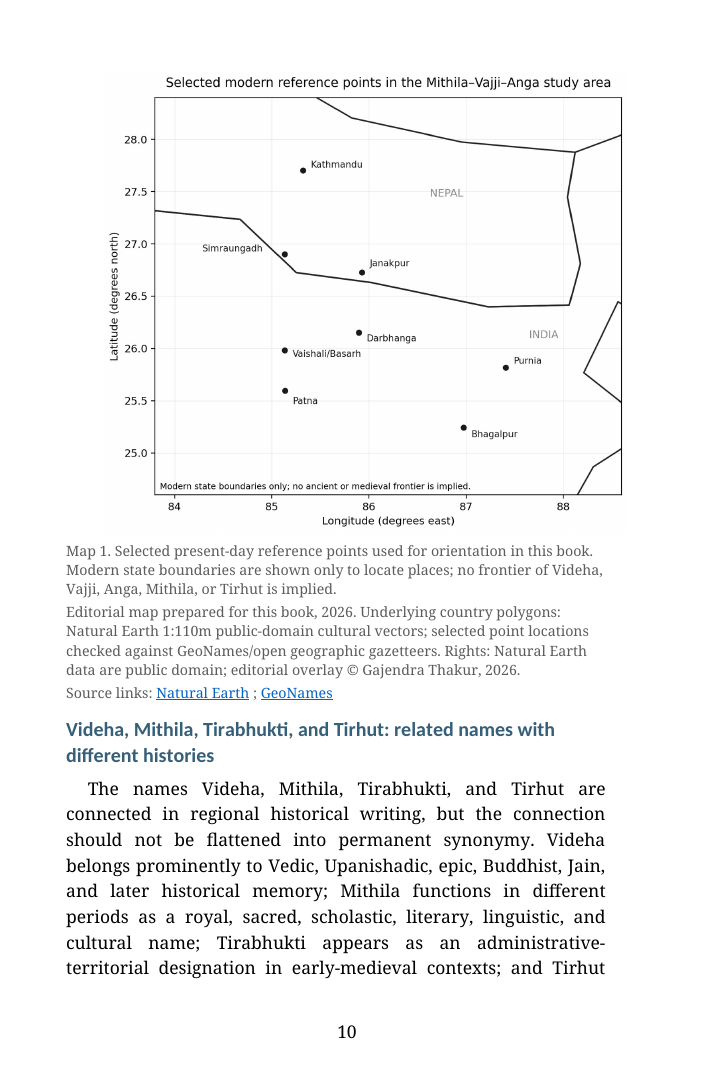
Mithila · Vajji · Anga
Chapter-specific source notes
- Primary chapter witness. Gajendra Thakur, Decoding the Panji of Mithila — Volume IV, formal Chapter 60, PDF pp. 580-591; formal Chapter 60. The HTML transcription is generated from the commit-pinned source PDF and retains the chapter boundary recorded in this edition.
- Internal structure. The repository source-heading inventory records 10 subordinate headings for this chapter: “Opening note”; “Entry (498): Ratauli to Dhadhi”; “Entry (499): Ratauli to Betia, Ranipur and Kakraud”; “Entry (500): Ratauli to Tharhi”; “Entry (501): Dih-Darihara to Baisi Chakla, Dhanga and Rashady”; “Entry (502): Dih to Malapur-Chakauti in Uttar Pradesh”; “Entries (503)-(504): Bargam-Darihara to Pilkhwar”; “Entries (505)-(506): Sihouli-Sugauna-Ranitole and Sihouli-Ranitole-Mandar-Nahar”; ….
- Digital editorial method. The page keeps the preserved source text distinct from generated navigational, concordance, visual, and provenance apparatus. The synthetic reconstruction is explanatory only and is not evidence for an individual lineage or a determination of social or marital status.