Decoding the Panji of Mithila · Volume IV · Chapter 61
Rajoura-Sahpur and Rajoura- Tharhi: The Mandar Gramarambh Opening note This chapter begins where the preceding Sihouli-Mandar
Chapter 61. Rajoura-Sahpur and Rajoura-
Tharhi: The Mandar Gramarambh
Opening note
  This chapter begins where the preceding Sihouli-Mandar
sequence stopped. The source now opens a fresh gramarambh
with the formula “ath Rajoura Mandar gramarambh.” That
formula is important: the chapter is not merely a list of
Rajoura persons, but a controlled Mandar mool register in
which Rajoura is the operative branch-name and Sahpur and
Tharhi mark the village-facing extension of the line. The
chapter covers entries (509) and (510) only, and stops before
the separate Rajoura-Pindaruch entry (511).
   The two entries should be read together. Entry (509) gives
the Rajoura-Sahpur base and entry (510) continues Rajoura
into Tharhi under the invocation to Digambara. The recurring
routes through Budhwal, Soderpur, Karmah, Pali, Jajival,
Sarisab, Alay, and Darihara show how the Rajoura-Mandar
house is validated through cross-mool marriage routes rather
than by a single locality alone.

Entry (509): Rajoura to Sahpur
  Entry (509) is headed “Rajoura to Sahpur” and opens with
the gramarambh declaration for Rajoura-Mandar. The first
named ancestor is Devai. Devai gives Dhani, Gonu, and
Ananta. Dhani is tied through Budhwal-Kamdev-Shubhankar
and Soder-Madhav, and then gives Saheb and Chilka through
Pali-Hingu-Haridash and Mandar-Lakshman. Chilka produces
Buddhinaath through Karmah-Ghanshyam-Badni and Jajival-
Dukhni. This first movement establishes a Rajoura house
whose legitimacy is secured at once by Budhwal, Soder, Pali,
Mandar, Karmah, and Jajival routes.

   A second, fuller strand begins with Ratipati. His
descendants include Chhatrapati and Karu through Soder-
Vamadev-Shivdev and Balias-Rai Vishwanath. Chhatrapati
gives Devan through Budhwal-Badi-Ram and Soderpur-
Bachhai. Devan is then expanded in multiple apara directions:
one route through Pali-Gonu-Hridi and Sarisab-Bana; another
through Hiranand and Ratnanand via Pali-Bhavanand-Bhuv
and Belaunch-Buddhinath; another through Jayadatt, Rudi,
and Bhavi via Budhwal-Paramanand-Madhurapati and Soder-
Bachharu; another through Kalikadatt and Mani via Pali-
Ganesh-Bhikhari and Pabouli-Ramakant; another through
Bachhar via Alay-Anu-Mahesh and Soder-Kamalapati; and
another through Vanshmani via Soderpur-Jai-Pati and Alay-
Anath. The repeated apara marking is therefore not a mistake.
It is the register’s method of keeping parallel recognized lines
in the same Rajoura-Sahpur frame.
   The Hiranand line supplies a compact but significant
scholarly-looking cluster. Hiranand gives Bani, Phani, and
Shankardatt through Jajival-Bhagwati-Hira and Sakararhi-
Uman. Bani gives Ramnath through Babhania-Bhaiya-
Jagyapati and Darihara-Chalbal. Apara Bani gives Chhakka
and Amritnath through Ekhara-Gunapati-Harinarayan and
Pali-Machal. Chhakka then gives Kishori, Janardan, and
Mahadev through Sarisab-Matinath-Chalbal and Balias-Jhaua;
Kishori is further tied through Alay-Bodhi-Kanhai and
Soderpur-Girdhari. Amritnath is represented by the Buchek
line through Hati-Pali-Chhatri-Madhurapati and Sarisab-
Durmmikh. Shankardatt closes the entry through Alay-Bhikhi-
Dharmadatt and Darihara-Balah.

Entry (510): Rajoura-Tharhi
   Entry (510) is introduced by “Om Digambaraya namah” and
is headed Rajoura-Tharhi. The entry begins with Jayadatt,
whose descendants include Mathuranath, Gopinath, and

Pritinath. Their route is Kujouli-Bachharu-Jayanand, with
Uchati-Thedhi as the corresponding ddau route. Mathuranath
then gives Siddhinath through Pali-Manbodh-Janaki and
Pabouli-Balli. This opening links the Tharhi continuation to
the same Rajoura-Mandar base but shifts the operative village
field from Sahpur to Tharhi.
   The Rudi branch gives the main body of entry (510). Rudi
gives Babudatt, Manrakkhan, and Kunja through Hariamb-
Dayaram-Jivan and Katai-Rakkan. Apara Rudi continues
through      Malichham-Baheradhi-Chhotai-Mansukh        and
Soderpur-Kalar. Another Rudi line gives Jalpadatt through
Karmah-Juraun-Chhatrapati and Kujouli-Karu. Vaiya Babudatt
gives Vaiya Ravinath through Soder-Chhakori-Jagni and
Karmah-Doman; Vaiya Ravinath is then linked through
Hariamb-Kauskidatt-Mushi and Soderpur-Raghunath. The
repeated use of Vaiya here should be preserved because it
marks internal relational or title nuance within the same
branch, not a mere personal-name embellishment.
   Bhavi carries the remainder of the entry. Bhavi gives Barja
through Belaunch-Bhavanath-Vidyanath and Mandar-Moti.
Apara Bhavi is also tied through Pali-Ganganand-Gunarnad
and Khandbala-Rup. A further line gives Tulakrishna through
Ekhara-Gunapati-Gokulnath and Balias-Ravad, and another
gives Vidyanath through Soderpur-Ramdev-Bachharu-Feku
with Shakti-Narun-Mushai as the counterpart route. Barja’s
own continuations include Hariamb-Machal-Kishornath and
Balias-Ramanath;      Malichham-Baheradhi-Bachha-Babunath
and Darihara-Sanath; and Karmah-Maniram-Badri with
Sakararhi-Durganath. Kalikadatt gives Saulek through Pali-
Harishiv-Nehali    and    Ekhara-Jaishiv-Chandrakar,     while
another line goes through Pali-Sukhari-Bechu and Pabouli-
Upendra. Vanshmani closes the entry through Jhotan, Pali-
Medhakar-Mana, and Sakararhi-Vedi.

Genealogical reading of the chapter
   The Rajoura entries make especially clear how a Panji
chapter must be read in two layers. At the surface level, the
headings say Rajoura-Sahpur and Rajoura-Tharhi. At the
structural level, the controlling identity is Rajoura within the
Mandar frame. The route-pairs are therefore not incidental
travel notes; they are the technical mechanism by which the
register ties Sahpur and Tharhi households back to a larger
Mandar genealogy.
   The dots, blanks, and kasthut-type closures must also
remain visible in interpretation. Where a person is left with
an incomplete partner-route, the record is not inviting
invention; it is preserving a known but textually suspended
relation. Where a kasthut-like closure appears, the register
signals that the line has been acknowledged as present in the
genealogical field even if the present entry does not expand it
fully. This is why the chapter stops at entry (510). Entry (511),
beginning Rajoura to Pindaruch, opens another locality
extension and must be treated separately.
Source structure and verification apparatus
Editorial source apparatus. This apparatus is descriptive, not interpretive. It records the source-controlled structure used to verify that this page corresponds to formal Chapter 61 of Decoding the Panji of Mithila — Volume IV. The chapter text above is preserved from PDF pp. 592-595; formal Chapter 61 in the commit-pinned authoritative source. It is not merged with a neighboring chapter, appendix, annexure, or independent front/back-matter unit. The internal headings below come from the repository’s source-heading inventory and are retained as navigational and audit evidence; showing them here does not turn those headings into separate publications or add claims that are absent from the source.
Internal source headings
- Opening note
- Entry (509): Rajoura to Sahpur
- Entry (510): Rajoura-Tharhi
- Genealogical reading of the chapter
Source-text concordance
Rajoura-Sahpur · Rajoura · Tharhi · Mandar · Gramarambh · Opening · note · begins · preceding · Sihouli-Mandar · sequence · stopped · opens · fresh · formula · important · merely · list · persons · controlled · mool · register · operative · branch-name · Sahpur · mark · village-facing · extension · line · covers · entries · stops · separate · Rajoura-Pindaruch · entry · read · together · gives · base · continues · invocation · Digambara · recurring · routes · Budhwal · Soderpur · Karmah · Pali · Jajival · Sarisab · Alay · Darihara · show · Rajoura-Mandar · house · validated · cross-mool · marriage · rather · single · locality · alone · headed · declaration · first · named · ancestor · Devai · Dhani · Gonu · Ananta · tied · Budhwal-Kamdev-Shubhankar · Soder-Madhav · Saheb · Chilka · Pali-Hingu-Haridash · Mandar-Lakshman · produces · Buddhinaath
Boundary verification. In the formal sequence this chapter follows Volume IV Chapter 60, “Ratauli-Dhadhi, Dih-Darihara, Bargam-Pilkhwar, and Sihouli: Entries (498)- (508) Opening note” and precedes Volume IV Chapter 62, “Rajoura-Pindaruch, Bihnagar-Kakraud, Bagahi- Kakraud, and Pindaschh: Entries (511)-(516)”. The chapter extractor begins at the verified formal Chapter 61 marker and stops at the next verified formal chapter marker; for a final chapter it stops before recognized book-level back matter. The concordance above is generated only from distinct terms already present in this chapter’s preserved source text. It is provided for discovery, comparison, and audit, not as an automated judgment about persons, lineages, status, kinship, marriage eligibility, or historical truth.
Illustrated research apparatus
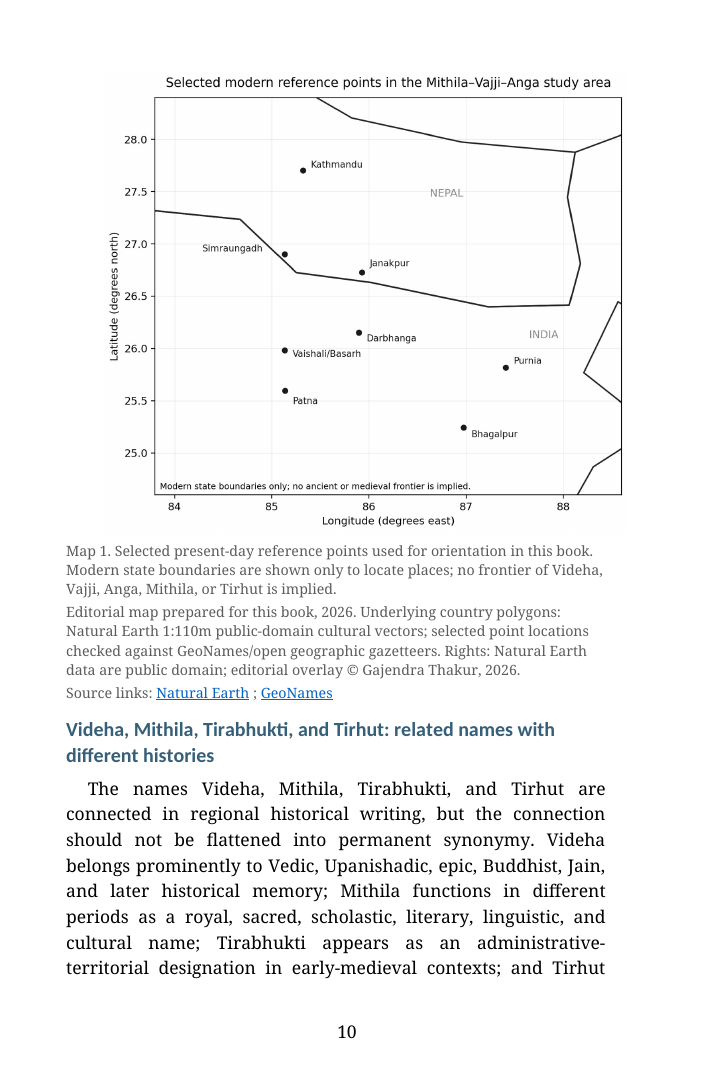
Mithila · Vajji · Anga
Chapter-specific source notes
- Primary chapter witness. Gajendra Thakur, Decoding the Panji of Mithila — Volume IV, formal Chapter 61, PDF pp. 592-595; formal Chapter 61. The HTML transcription is generated from the commit-pinned source PDF and retains the chapter boundary recorded in this edition.
- Internal structure. The repository source-heading inventory records 4 subordinate headings for this chapter: “Opening note”; “Entry (509): Rajoura to Sahpur”; “Entry (510): Rajoura-Tharhi”; “Genealogical reading of the chapter”.
- Digital editorial method. The page keeps the preserved source text distinct from generated navigational, concordance, visual, and provenance apparatus. The synthetic reconstruction is explanatory only and is not evidence for an individual lineage or a determination of social or marital status.