Decoding the Panji of Mithila · Volume IV · Chapter 62
Rajoura-Pindaruch, Bihnagar-Kakraud, Bagahi- Kakraud, and Pindaschh: Entries (511)-(516)
Chapter 62. Rajoura-Pindaruch,
    Bihnagar-Kakraud, Bagahi-
  Kakraud, and Pindaschh: Entries
            (511)-(516)
Opening note
    This chapter continues the Rajoura-Mandar gramarambh
after the Rajoura-Sahpur and Rajoura-Tharhi entries. It covers
entries (511) through (516) only. The controlling movement is
from Rajoura toward Pindaruch and then into a dense
Kakraud field, where Bihnagar, Jagaur-Mandar, Bagahi-
Kakraud, and Pindaschh are used as working labels for the
same extended genealogical environment.
    The chapter should not be read as a simple village list.
Rajoura remains the point of origin, but the register
repeatedly uses apara clauses, daughter-routes, and village
proofs through Soderpur, Pali, Karmah, Budhwal, Ghusaut,
Khaual, Jajival, Khandbala, and Mandar. These route names
are the working apparatus of proof. They show where a
person or branch is fixed, rather than merely where someone
lived.

Entry (511): Rajoura to Pindaruch
   Entry (511) is headed Rajoura to Pindaruch. It begins with
the Karu line. Karu produces Ramakant, who is connected
through Karmah-Mohan-Damu and Soderpur-Raghunath.
Ramapati then produces Hemapati and Manpuran through
Soderpur-Ratipati-Nanu and Alay-Chaudhary Nityanand. The
entry immediately adds apara Ramakant branches: Lekhnath
and Nandinath are routed through Pali-Ganesh-Bhikhari and
Balias-Dhani, while another apara Ramakant connection goes

through Kujouli-Ganganand-Bachharu and Darihara-
Indrapati.
   The same entry then turns to the wider Karu-Dharmapati-
Lala-Gangu frame. Kalara is attached through Pali-
Ramkrishna-Shulpani and Darihara-Govardhan. Dharmapati
gives Lala, and Lala gives Gangu and Ranjan through Alay-
Chaudhary Nityanand and Satlakha-Keshav. Apara Lala also
produces Subudhi through Soderpur-Bhavi-Bhikhari and
Khaual-Mahadev.
   Gangu is important because his descendants are listed in a
broad serial cluster: Narayandatt, Chandidatt, Kalikadatt,
Devidatt, Hridayram, and Venidatt. Narayandatt gives
Govinddatt through Soderpur-Kalar-Brahmadatt and Khaual-
Balkrishna. Govinddatt then gives Bhagwandatt and
Harivansh through Hariamb-Machal-Yogi and Sarisab-
Yadunandan. Bhagwandatt produces Lalitnath through
Khandbala-Chiti-Mukund and Ghusaut-Thakur Dhan.
Harivansh is routed through Sakuri-Pali-Jaynath-Gopal and
Ekhara-Teknath.
    Ranjan supplies another principal body of the entry. He
gives Thakurdatt, Jagmohan or Bhola, and Kavla through
Ekhara-Ratipati-Mahidhar and Satlakha-Pitambar. Thakurdatt
gives Prabhunath and Gadadhar through Pali-Kala-Gangadatt
and Soderpur-Tula. Prabhunath is then connected through
Ghusaut-Parivaya-Ratinath and Khaual-Jaynath. The use of
apara and the repeated Khaual links show that the entry is not
linear; it is a controlled cluster of multiple collateral proofs.

Entry (512): Rajoura continuation
    Entry (512) is a short Rajoura continuation under the
internal number (261). It begins with Bhola, who is connected
through Sarisab-Jayashiv-Bhaiyan and Karmah-Shambhunath.
Apara Bhola then gives Kavichanda through Chhadan-Sarisab-
Hemkar-Krishnaram and Khaual-Mansukh.

    The entry also records Keval, Madanlal, Ratikar,
Bholanath, and Baidyanath. Keval gives Madanlal through
Mahishi-Budhwal-Jhudama-Bhola-Harishwar and Mandar-
Dev-Kalikadatt. Ratikar gives Bhola through Babhania-
Kangali-Pitambar and Ekhara-Jagli. Bholanath produces
Deonath and Baidyanath through Sarisab-Sadashiv-Saheb and
Darihara-Keshav. Baidyanath then produces Batuki through
Budhwal-Jiv-Jaganki and Ekhara-Kalaram. The entry functions
as a bridge between Rajoura-Pindaruch and the
Kakraud/Jagaur material that follows.

Entry (513): Bihnagar-Kakraud and the Jagaur-
Mandar gramarambh
   Entry (513) is headed Bihnagar-Kakraud, but its operative
formula is the beginning of the Jagaur-Mandar gramarambh.
The first named ancestor is Ishanath. He gives Manik through
Ghusaut-Theghu-Chanan and Balias-Mahaval-Kashinath.
Apara sons include Shobhan and Mohan through Sarisab-
Mahadev-Ratinath and Karmah-Dukhan.
   The entry then gives a set of connected descendants:
Hiramani, Jamahir, Jhingur, Girdhari, and Ramdhan are tied
through Sarisab-Hedu-Dharmapati and Pandua-Nandishwar.
Manik is separately routed through Kujouli-Chhotku-Kulpati
and Alay-Mahi; another Manik route goes through Jajival-
Chhaknu-Hirphul and Balias-Rai Prannath.
   Shobhan’s line is one of the larger parts of the entry.
Shobhan gives Dular, Bhaiyo, Tufani, and Kamalakant through
Soderpur-Basudev-Harpati and Balias-Harinath. Dular is
connected through Soderpur-Bohoran-Vanshmani and
Sakararhi-Jayadatt; another apara line gives Ganesh through
Budhwal-Dharapati-Babujan and Balias-Amritnath. The entry
continues through Bhaiyo, Modan, Hibharan, Manbharan,
Kirtinath, Chandrakishor, Devkishor, and Krishnakishor, with

links through Tisaunt, Soderpur, Ghusaut, Khaual, Budhwal,
Karmah, Darihara, Jajival, Pandua, Alay, and Belaunch.
     The close of entry (513) is especially compressed. Kirtinath
is tied through Ghusaut-Jhontu-Tarapati and Khaual-
Bachharan. Hiramani is linked through Baheradhi-Ratidhar-
Kamalpani and Belaunch-Vighanath. Jamahir is left with
Parmeshwaridatt through Baheradhi-Kamalpani. The next
entry begins by completing this Jamahir material, so the
apparent break at the heading is a scribal and organizational
break, not a full family discontinuity.

Entry (514): Kakraud continuation
   Entry (514) is headed Kakraud and bears the internal
number (262). It first completes the Jamahir continuation by
adding a Belaunch-Vidyanath proof. Apara Jamahir then
produces Bhagwandatt through Phanandah-Dharanath-
Khagnath and Soderpur-Bhavan. Other apara routes include
Alay-Nehal-Chaudhary Shyamlal, Bisfi-Thakur Eknath, and
Rajdhari through Soderpur-Pashupati-Sanath and Panichobh-
Janaki.
   Bhagwandatt gives Maharaj through Hariamb-Modnath-
Bodhnath and Khaual-Mus. Rajdhari gives Mush through
Hariamb-Nidhi-Rudradatt-Mathuranath and Khaual-Jayadatt-
Gopal, with Soderpur-Lal-Matinath also present. Maharaj then
produces Shivanand, Jagannath, and Indranarayan through
Soderpur-Ghondhi-Dukhmochan and Tisaunt-Kamalnayan.
Apara sons or descendants include Suryanarayan,
Chandranarayan, Rupnarayan, and Bhupnarayan through
Soderpur-Matinath-Gangesh and Khaual-Pyare.
    The entry continues with the Indranarayan and Jagannath
lines. Indranarayan gives Premnarayan through Khandbala-
Krishnadatt-Harinandan and Ghusaut-Harihar. Premnarayan
is routed through Soderpur-Bheshnath-Buddhinath and Pali-
Ramashankar or Nanu. Shivanand gives Jagatanand through

Pabouli-Buddhi-Vindhyanath and Ghusaut-Gunjeshwar.
Jagatanand is proved through Alay-Phenku or Kashikant-
Chhitu or Vishnukant and Balias-Raghunath. Jagannath gives
Shambhunath through Khandbala-Padmanath Singh-Riddhi
Narayan Singh and Khaual-Aniruddh; another Jagannath line
passes through Digho-Bhaiyalal-Manganu and Alay-
Chhakaudhi. Shambhunath is tied to Hariamb-Revatiraman-
Madhusudan and Khandbala-Babu Gangapati Singh.
Chandranarayan ends the entry through Pali-Jhingur-
Tulanath and Mandar-Babujan-Abhayanath.

Entry (515): Bagahi-Kakraud
    Entry (515) is headed Bagahi-Kakraud. It begins with
Jhingur, whose sons include Bhairavdatt and Bhule through
Takbal-Bandhu-Bachh and Sarisab-Ratinath. Bhairavdatt is
routed through Pali-Ishwaridatt-Bhagwandatt and Darihara-
Ravadapani. Girdhari gives Gana through the same Takbal-
Bandhu-Bachh and Sarisab-Ratinath proof.
   The Girdhari and Gana material spreads widely. Apara
sons include Narsingh Datt and Kalyandatt through Kujouli-
M.M. Bagish-Hridaynath and Balias-Brajnath. Taradatt and
Chandradatt are proved through Pali-Bhavaditya-Ishwaridatt
and Belaunch-Juraun. Gana is further linked through
Soderpur-Chitradhar-Pupadhar and Oini-Maharaj Girdhar
Narayan. Apara Gana gives Jayadatt, Gopinath, Bulbul, and
Kaltu through Pali-Nath-Lal and Belaunch-Vidyanath. Taradatt
produces Jyotishi Shivanandan through Soderpur-Bali-
Bhagwandatt and Darihara-Hanumandatt; Jyotishi
Shivanandan is further tied through Hati-Pali-Shyam-Babue
and Narun-Hiramani. Chandradatt is joined to Khandbala-
Joki-Jirakkhan and Panichobh-Nehal-Chandidatt.
   The Ramdhan line gives another branch of the entry.
Ramdhan gives Raghunath and Thithar through Soderpur-
Basudev-Harpati and Pandua-Yogi. Apara daughters or lines

attach through Soderpur-Atmaram-Sarvasva and Hariamb-
Rameshwar, through Kujouli-Bagish-Hridaynath and Balias-
Brajnath, and through Soderpur-Sanath and Panichobh-
Janaki. Raghunath is linked through Phanandah-Jhoti-Bhaiyan
and Soder-Bachchu.
     Thithar produces Jaykishor, Thakku or Navalkishor, and
Durganath through Khandbala-Thothi-Jirakkhan and Pali-
Hibharan. Another Thithar branch gives Nunai and Yadu
through Alay-Shivlal-Jaylal and Narun-Bachchi. Jaykishor
gives Bilat or Anandkishor through Belaunch-Bhushan-Kumar
and Pali-Kapileshwar. Anandkishor is marked as
Dandadhikari Bhavnikishor, linked through Bachhara-Pali-
Bhaiyalal-Chhuran and Satlakha-Singheshwar. This official
title should be preserved because it records a professional-
public identity inside the genealogical frame.

Entry (516): Kakraud and Pindaschh
    Entry (516) continues the Kakraud line and adds the
Pindaschh heading under internal number (263). It first
carries forward Thakku/Navalkishor through a Digho-Bacha-
Chhedi and Phanandah-Ravellnath route. Durganand is then
connected through Ghusaut-Madhav-Gunjeshwar and
Sakararhi-Nena. Apara descendants include Badrinarayan,
Shankar, and Triyuginarayan through Khandbala-Padmanabh
Singh-Riddhinarayan Singh and Khaual-Aniruddh. Badrinath
is attached through Pabouli-Ramanand-Sachchidanand;
Shankar through Pali-Bachchan or Khagnath-Phaninath and
Narun-Badrinath-Baldev; and Triyuginarayan through
Khandbala-Babu Durgapati Singh-Babu Vidyapati Singh and
Pali-Bholanath.
   The closing section of entry (516) records Munai and Yadu.
Munai gives Kedarnatheshwar and Sanath through Sarisab-
Ramkrishna-Basudev and Balias-Rai Bhai. Parshnath is
connected through Ghusaut-Ramanand-Indranand and

Pandua-Nathuni-Jagdish. Yadu gives Indranath and
Mahendranath through Pali-Kapileshwar-Yaddu and Balias-
Bagish. Indranath is routed through Karmah-Kashinath and
Balias-Harinandan, while Mahendranath is connected through
Ghusaut-Guroshwar-Maheshwar and Khandbala-Ghuran
Singh.

Interpretive note on the chapter
   Entries (511)-(516) show a familiar but important Panji
pattern. A gramarambh may begin at Rajoura-Mandar, but the
proof-network quickly opens into Pindaruch, Bihnagar,
Kakraud, Bagahi, Jagaur-Mandar, and Pindaschh. These labels
are not contradictions. They are localizing devices within a
single genealogical record.
    The most important editorial rule in this chapter is to
retain all route markers and all apara distinctions. Names
such as Ramakant, Gangu, Shobhan, Jamahir, Maharaj,
Thithar, and Durganand become intelligible only because the
record keeps repeating the routes through Soderpur, Pali,
Karmah, Budhwal, Ghusaut, Khaual, Khandbala, Alay,
Mandar, and Darihara. The blanks and dots likewise remain
part of the record. They mark partial or compressed proof, not
material to be silently removed.
   The chapter stops before entry (517), where the source
opens Barauni under the Sakuri-Mandar gramarambh. That is
a new field and should be treated separately in the next
chapter.
Source structure and verification apparatus
Editorial source apparatus. This apparatus is descriptive, not interpretive. It records the source-controlled structure used to verify that this page corresponds to formal Chapter 62 of Decoding the Panji of Mithila — Volume IV. The chapter text above is preserved from PDF pp. 596-602; formal Chapter 62 in the commit-pinned authoritative source. It is not merged with a neighboring chapter, appendix, annexure, or independent front/back-matter unit. The internal headings below come from the repository’s source-heading inventory and are retained as navigational and audit evidence; showing them here does not turn those headings into separate publications or add claims that are absent from the source.
Internal source headings
No subordinate heading was separately encoded in the repository source-heading inventory for this chapter.
Source-text concordance
Rajoura-Pindaruch · Bihnagar-Kakraud · Bagahi · Kakraud · Pindaschh · Entries · Opening · note · continues · Rajoura-Mandar · gramarambh · Rajoura-Sahpur · Rajoura-Tharhi · covers · controlling · movement · Rajoura · toward · Pindaruch · dense · field · Bihnagar · Jagaur-Mandar · used · working · labels · extended · genealogical · environment · read · simple · village · list · remains · point · origin · register · repeatedly · uses · apara · clauses · daughter-routes · proofs · Soderpur · Pali · Karmah · Budhwal · Ghusaut · Khaual · Jajival · Khandbala · Mandar · route · names · apparatus · proof · show · person · branch · fixed · rather · merely · someone · lived · Entry · headed · begins · Karu · line · produces · Ramakant · connected · Karmah-Mohan-Damu · Soderpur-Raghunath · Ramapati · Hemapati · Manpuran · Soderpur-Ratipati-Nanu · Alay-Chaudhary · Nityanand
Boundary verification. In the formal sequence this chapter follows Volume IV Chapter 61, “Rajoura-Sahpur and Rajoura- Tharhi: The Mandar Gramarambh Opening note This chapter begins where the preceding Sihouli-Mandar” and precedes Volume IV Chapter 63, “Barauni, Bhadual, Belaunja, Katouna, and Satauli: Entries (517)- (528) This chapter resumes after the Kakraud-Pindaschh close”. The chapter extractor begins at the verified formal Chapter 62 marker and stops at the next verified formal chapter marker; for a final chapter it stops before recognized book-level back matter. The concordance above is generated only from distinct terms already present in this chapter’s preserved source text. It is provided for discovery, comparison, and audit, not as an automated judgment about persons, lineages, status, kinship, marriage eligibility, or historical truth.
Illustrated research apparatus
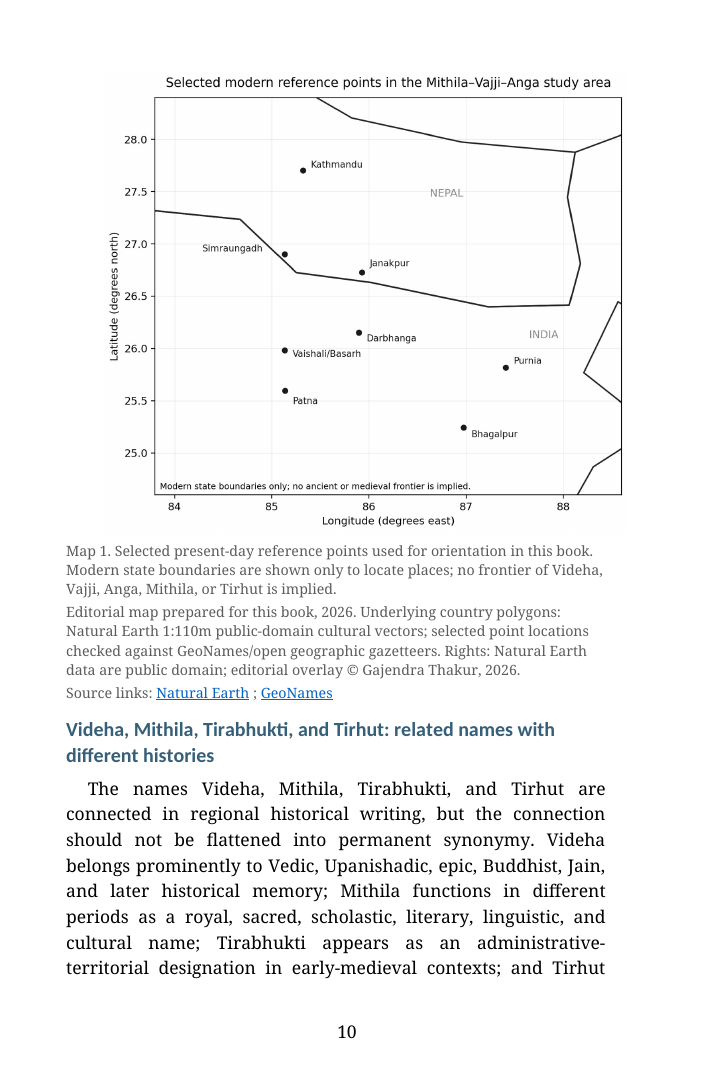
Mithila · Vajji · Anga
Chapter-specific source notes
- Primary chapter witness. Gajendra Thakur, Decoding the Panji of Mithila — Volume IV, formal Chapter 62, PDF pp. 596-602; formal Chapter 62. The HTML transcription is generated from the commit-pinned source PDF and retains the chapter boundary recorded in this edition.
- Internal structure. The repository source-heading inventory records no separately encoded subordinate heading for this chapter.
- Digital editorial method. The page keeps the preserved source text distinct from generated navigational, concordance, visual, and provenance apparatus. The synthetic reconstruction is explanatory only and is not evidence for an individual lineage or a determination of social or marital status.