Decoding the Panji of Mithila · Volume IV · Chapter 64
Satauli Continuations, Purnia, Jayanand, Virsayar, and Parihari: Entries (529)-(534)
Chapter 64
    Satauli Continuations, Purnia,
  Jayanand, Virsayar, and Parihari:
          Entries (529)-(534)
    This chapter continues the Satauli-Satlakha block which
began in the preceding chapter. It covers only entries (529)
through (534). The source keeps the frame at Satauli, but the
internal proof-lines move through Purnia, Ramnagar, Rudi,
Khojpur, Paramanand-Bathanay, Virsayar, and
Parihari/Tharhi. The chapter therefore treats the headings as
route controls, not as detachable anecdotes, and preserves the
repeated Panji devices: apara alternatives, incomplete dots,
kasthut closures, dau/ddau marriage-routing, titles such as
Jyotishi and Justice, and the exact function of village anchors
such as Soderpur, Khaual, Mandar, Darihara, Baliyas, and Pali.

Entry (529): Satauli continuation under the
Rishi-Bhanu line
   Entry (529) opens simply as Satauli and begins from Rishi.
Rishi gives Bhanu and Nennan through Soderpur-Krishnadas-
Harijiv and Karmaha-Raghu. Bhanu then gives Ratanu,
Girdhar, Vanshidhar, and Dharnidhar through a Soderpur-
Kamalapati-daughter-Chilka route and a Baheradhi-
Raghunath counter-route. The structure is typical of this
portion of the register: the named sons create the descent-
frame, while the two route clauses show how the line is
certified into separate village networks.
   Ratanu is the main carrier of the first half of the entry.
Ratanu gives Hibharan, Ramanath, Eknath, Badri, Devidatt,
and Jyotishi Arjun through Jajival-Bhaiyo-Hemu and the Pani-
Madhurapati route. Hibharan gives Chintamani through

Hariamb-Khushihal-Rudradatt and Mandar-Nidhi. The entry
then adds an apara daughter of Ratanu through Pabouli-Akhi-
Harinath and Sakararhi-Hira, and another apara daughter
through Karmaha-Jivanath-Shambhunath and Sakararhi-
Gujar. These are not decorative repetitions; they preserve
parallel certifying routes for the same Ratanu descent.
    Ramanath is represented through multiple daughter-
clauses. One daughter is tied by a Belaunch-Kulmani route,
another by Soderpur-Basaun-Dukhiya, and another by a Pani-
Pritam-daughter-Dukhiya clause which returns to Soderpur-
Badalu-Dharanath. Eknath gives Harinandan through
Soderpur-Chhotu-Devanath and Baliyas-Nath, and an apara
Eknath gives Muktinath through Karmaha-Gangadatt-
Sanphool and Mandar-Bhavi. Muktinath then sends a
daughter through Pali-Jiva-Shyamnath and the Rajanpura-
Darihara-Hibharan route. Badri gives Faturi through
Karmaha-Juraun-Bokan and Soderpur-Bhamaru, while a later
Badri daughter goes through Naroun-Balkrishna-Durgadatt
and Baliyas-Ramjiv-Dhir. The Soderpur-Juraun kasthut closes
the cluster as a verification marker.
    The Jyotishi Arjun branch is the most marked part of entry
(529). Jyotishi Arjun gives Lal through Budhwal-Khagpati-
Hridaynath and Darihara-Meena. Lal gives a daughter
through Sarisab-Eknath-Jadav and Darihara-Halli. An apara
Arjun gives Amritnath through Kujouli-Rudradatt-Eknath and
Satlakha-Vishnudatt. Amritnath gives a daughter through Pali-
Lal-Kalaru and Baliyas-Bhular. A further Lal line gives
Radhakant, Lakshmikant, and Kamalakant through Pali-
Harikrishna-Yadurai and Soderpur-Rudrir. Lakshmikant then
gives Justice Vaidyanath, Kashinath, Durganath, and Taranath
through Tarauni-Karmaha-Chhotkani-Khuni and Soderpur-
Jamahir. Justice Vaidyanath gives Shambhunath also called
Gopali Ji, Bholanath also called Kisunji, and Shankarnath
through Ghusaut-Bachharu-Brajmohan and Soderpur-

Gangadhar. The legal title Justice is therefore part of the
genealogical entry, not a modern interpolation to be removed.

Entry (530): Invocation to Somanath and
Satauli-Purnia
   Entry (530) invokes Somanath and extends Satauli toward
Purnia under internal number (270). Shambhunath gives
Shachindra and Shailendra through Karmaha-Nilambar-
Rupnath and Khandwala-Babu Thakurpati Singh. Bholanath
gives Sherwar Kumar and Samar Kumar through Karmaha-
Premnath-Lilanath and Sakararhi-Durganand. Shankarnath
gives Nahar and Digaunth through a Soderpur line connected
with Shankaranand and through Naroun-Shaktinath. These
clauses move the same Satauli material into a more modern
and regionally extended register without leaving the older
Panji grammar.
   The entry then introduces Vakil Kashinath, who gives
Mohaniji through Hariamb-Jaykrishna-Kumar and Sarisab-
Kartik. Durganath gives Keshavji, Mantruji, and Ratanji
through Karmaha-Premnath-Jagannath and Khaual-
Shivnandan. Taranath gives Harinath, Shaktinath, Bhaktinath,
and Kripanath through Anal-Karmaha-Nand Kishor and
Sakuri-Mandar-Rameshwardatt. The Sakuri-Mandar clause is
important because it pulls the Satauli register back into the
Mandar-linked field already active in the preceding chapters.
    Vanshidhar gives Ugari and Bhavan through Hariamb-
Bachharu-Loknath and Ekhara-Khadgapani. Kashi gives a
daughter through Pali-Umadatt-Shambhudatt and Soderpur-
Dhir, while Bhavan gives a daughter through Takbal-
Bodhkrishna-Gauridatt and Soderpur-Kamalapati-Bholanath.
Nennan gives Ratinath through Soderpur-Harijiv-Kuli and
Pali-Bachh. Ratinath gives a daughter through Naroun-Dhairji-
Rupnath and Soderpur-Indramani, and an apara Ratinath
gives Batah through Pali-Manbodh-Shobhnath and Jajival-

Hemu. Batah gives a daughter through Sarisab-Chhabban-
Boku and Khaual-Chaudhary Lakshminath. The close of the
entry gives Dharnidhar through a Belaunch-Chengan-
Bhairavdatt and Gangoli-Pakshadhar route, confirming again
that the Satauli-Purnia heading is held together by repeated
village-based proof.

Entry (531): Satauli to Jayanand, Ramnagar,
Rudi, Khojpur, and Paramanand-Bathanay
   Entry (531) carries Satauli into a wider route: Jayanand at
Ramnagar, Rudi, Khojpur, and Paramanand-Bathanay. Karu
gives Pitambar, Vidyapati, and Devkimana through Soderpur-
Vaidyanath-Jayi and Khaual-Sadanand. Pitambar then gives
Anand, Jayanand, Paramanand, Rudi, and Sadanand through
Soderpur-Purandar-Chhatu and Khaual-Ramdev. The entry
thus places Jayanand and Rudi not as separate origins, but as
branches produced inside the Pitambar continuation.
    Anand gives Tulsidatt through Pabouli-Kalar-Bandhan and
Phanandah-Mahipani. Jayanand gives Nanu, Babunath, and
Janakinath through Karmaha-Lakshmipati-Teki and Baliyas-
Yadupati. Janakinath gives Vishweshwar through Katka-
Soderpur-Garibnath-Venidatt and Tisaunt-Shyamlal.
Paramanand gives Bholanath, Rupnath, Hridaynath, and
Jivanath through Babhaniam-Bachharu-Bhali and Sarisab-
Shulpani; the Bholanath daughter line is left partly dotted
through Ekhara and Shankardatt, while Rupnath is tied
through Soderpur-Umai-Dharmdatt and Khaual-Shyamnath.
   The Rudi portion is dense and must be kept distinct. Rudi
gives Dayanath, Grihinath, Kashinath, Mathuranath,
Gokulnath, Raghunath, and Shivnath through Hariamb-
Chhabani-Manjan and Mandar-Devan. Dayanath gives a
daughter through Alay-Bhiravni-Kari, also written Kariye, and
Soderpur-Bhulan, and an apara daughter through Pani-Janaki-
Lanha with the destination partially unfilled. Raghunath gives

a daughter through Phuldaha-Pali-Gua-Shyamnath and
Sakararhi-Durganath.
   The latter half of entry (531) follows Bhainu. Bhainu gives
Kirtinath and Bechu through Sarisab-Chaturbhuj-Nityanand
and Karmaha-Saday. Kirtinath gives Mani and Jage through
Alay-Vanshi-Mahi and Sarisab-Bhramar; Jage gives a daughter
through Soderpur-Rameshwar-Nandishwar and a Sakararhi
reading left obscure in the source. Bechu gives Dharanidhar
and Banravandi through Pali-Bhavdev-Purushottam and
Sakararhi-Umanath. Dharanidhar then gives Batuki through
Khandwala-Mahinath-Manchit and Darihara-Subodh.
    A separate closing note records a Nepal extension: from
Janakpur, in Nepal deshe, the Satauli-Satlakha line formerly
associated with Nahas-Rupawli gives Mahakant with sons
Vidyanand and Sadanand. Vidyanand gives Dipendra and
Jitendra; a Babupali-Joki-Sarisab-Kedar route is attached, and
a daughter Sunita of Mahottari-Sahudiya, Vats gotra, is
recorded as wife of Sanjay. This sentence shows that the
register is not limited to an old village list; it extends the same
Panji control into cross-border kinship geography.

Entry (532): Satauli, second continuation
   Entry (532) is labelled as Satauli 2 and begins from
Ramapati. Ramapati gives Ramjiv through Soderpur-Rupai-
Mohan and Budhwal-Gauri, while an apara Ramapati gives
Manik through Budhwal-Sadanand-Balkrishna and an
incomplete Soderpur clause. Ramjiv gives Narayandatt
through Soderpur-Purandar-Dharani and Mandar-Badali.
Narayandatt gives Vishnudatt and Nanu through Naroun-
Kulpati-Raghupati and Darihara-Purandar. Vishnudatt gives a
daughter through Hariamb-Jagnath-Umanath and Pandua-
Chhoti, also called Devanand; Nanu gives a daughter through
Ghusaut-Ram-Manik and Baliyas-Harishankar.

    The Manik branch gives Mathuranath through Karmaha-
Parashuram-Bhaiyan and Baliyas-Bhagirath. Mathuranath
gives Nityanand through Hariamb-Bhaiya-Ramanath and
Darihara-Rohini, and an apara daughter through Manmohan
by way of Jajival-Chhakanu-Hirphool and Baliyas-Rai
Prannath. Nityanand gives Shyamanand; Shyamanand gives a
daughter through Jajival-Sanphool-Shobhnath and Pali-
Shatrughna. Manmohan gives a daughter Gopal through
Jajival-Manasukh-Manmohan and Belaunch-Parashmani.
    Abhiram gives Ishannath and Ranjan through Soderpur-
Purandar-Dhanapati. Dhanapati gives a daughter through
Baliyas-Vaidyanath-Vishweshwar and Pali-Krishna. Ishannath
gives a daughter Kanhai through Pali-Mahipati-Chhava and
Soderpur-Mahesh. Kanhai gives Nena through Gangoli-Raghu-
Jivu and Hariamb-Basudev; Nena gives a daughter through
Sarisab-Manik-Kanha and Nagram-Khaual-Mangaladatt.
Ranjan gives Jagmohan through Alay-Gunai-Saheb and
Khaual-Bhushan. Jagmohan gives Bhaiyan and Devidatt
through Pani-Govind-Anath and Jajival-Hemu. Devidatt gives
Parashmani, whose daughter is tied through Pali-Manbodh-
Janaki and Baliyas-Shivnath.

Entry (533): Satauli to Virsayar
    Entry (533) moves Satauli toward Virsayar. Kalar gives
Sarvasva and Chhota through Ekhara-Lala-Purushi and
Darihara-Dhani. Sarvasva gives Babujaan and Batah through
Soderpur-Dullah and Pani-Kisuni. Babujaan gives Jaylal,
Devlal, and Nandalal through Budhwal-Kulpati-Bachh. Jaylal
gives Manohar, Arjun, Narayan, and Hemnath through
Sarisab-Mana-Ishwardatt and Baliyas-Shravan. Manohar gives
a daughter through Khandwala-Gopinath-Narayandatt and
Pali-Shankardatt.
  Arjun gives a daughter through Madhusudan by Pali-
Mangani-Manu and Darihara-Pyare, and an apara Arjun

daughter through Soderpur-Phanipati-Bachchu and Baliyas-
Raja. Madhusudan gives Jagdish through Ekhara-Vidyanath-
Chaturanand and Hariamb-Ganeshdatt, and an apara
Madhusudan daughter through Takbal-Ravinath-
Shambhunath and Darihara-Raghuvar. Narayan gives a
daughter through Hariamb-Babunath-Abhayanath and
Mandar-Gana.
   Hemnath gives Maheshwar and Parmeshwar through
Soderpur-Yognath-Mangtru and Karmaha-Babulal. An apara
Hemnath gives Rupnarayan and Anupnarayan through
Hariamb-Babunath-Dwariki and Khaual-Babudatt.
Maheshwar gives Gopinath through Pabouli-Buddhi-
Raghunath and Hariamb-Babu; Gopinath gives Ratan Kumar
through Pali-Mukund-Umanand and Baliyas-Vaiya Shrikant.
Rupnarayan gives Lakshminarayan and Indranarayan
through Kujouli-Ravagnatha-Ramnandan and Baliyas-M.M.
Rajje. Both Lakshminarayan and Indranarayan have daughter
routes through Khojpur and Hariamb-Ramchandra-Umesh
Mishra, ending at Darihara-Nandalal. Karpur, also connected
with Anupnarayan, gives a daughter through Pali-Hemnath-
Harivansh and Khaual-Babuji.

Entry (534): Satauli to Parihari Jha and Tharhi
Jha
   Entry (534) continues Satauli and explicitly links the
material to Parihari Jha and Tharhi Jha under internal
number (272). Parmeshwar gives Adayanand, also called
Bhanuji, through Pabouli-Buddhi-Raghunath and Hariamb-
Babu. An apara Parmeshwar gives Gopal and Bhagwanji
through Phanandah-Mangu-Yatadhar and Khaual-Kunjan.
Adayanandan gives a daughter through Digho-Bhairav-
Gopikant and Ghusaut-Taranand.
   The entry then follows an apara Babujaan branch.
Babujaan gives Dhutar through Budhwal-Nakar-Nidhi and

Soderpur-Chhatrapati. Dhutar gives Chandramani and
Bhadramani through Soderpur-Baburaiya-Kanhai and
Belaunch-Noni. Battan, or Batthan, gives Manilal through
Panichobh-Bahoran-Kanhai and Sakararhi-Ghana. Manilal
gives Damodar, Keshav, and Badri through Takbal-
Hridaynath-Bachchelal and Darihara-Nayan. Damodar is tied
through Belaunch-Jagmohan-Bhagirath and Pali-Veni. The
final Chhota line gives a daughter through Kujouli-Chhotku-
Hridaysukh; Hridaysukh then gives a daughter through
Darihara-Bachharu-Bholanath and Belaunch-Ramchandra.
The entry closes the Satauli block by converting earlier branch
names into Parihari/Tharhi-linked proof-lines.

Interpretive note on the chapter
    Entries (529)-(534) demonstrate how a Satauli heading can
contain several distinct but connected genealogical zones. The
register begins with the Rishi-Bhanu line, moves into Purnia
through the Somanath invocation, expands through Jayanand,
Ramnagar, Rudi, Khojpur, and Paramanand-Bathanay, then
re-centres itself through Satauli 2, Virsayar, and
Parihari/Tharhi. The repeated use of apara shows that the
source is not linear narrative; it is a controlled map of
alternative authenticated branches.
   The editorial principle here is to preserve the marriage-
route grammar rather than silently modernize it. Every
dau/ddau clause is part of the proof mechanism. Kasthut
clauses are retained as closures or verification points. Dots
and blank destinations are treated as deliberate absences in
the transmitted text, not as material to be supplied by
conjecture. The chapter stops before entry (535), where the
source opens Mahindrapur-Pandua gramarambh and begins a
new major block formerly connected with Tatail. That new
block belongs to the next chapter and has not been included
here.
Source structure and verification apparatus
Editorial source apparatus. This apparatus is descriptive, not interpretive. It records the source-controlled structure used to verify that this page corresponds to formal Chapter 64 of Decoding the Panji of Mithila — Volume IV. The chapter text above is preserved from PDF pp. 614-621; formal Chapter 64 in the commit-pinned authoritative source. It is not merged with a neighboring chapter, appendix, annexure, or independent front/back-matter unit. The internal headings below come from the repository’s source-heading inventory and are retained as navigational and audit evidence; showing them here does not turn those headings into separate publications or add claims that are absent from the source.
Internal source headings
No subordinate heading was separately encoded in the repository source-heading inventory for this chapter.
Source-text concordance
Satauli · Continuations · Purnia · Jayanand · Virsayar · Parihari · Entries · continues · Satauli-Satlakha · block · began · preceding · covers · keeps · frame · internal · proof-lines · move · Ramnagar · Rudi · Khojpur · Paramanand-Bathanay · Tharhi · therefore · treats · headings · route · controls · detachable · anecdotes · preserves · repeated · devices · apara · alternatives · incomplete · dots · kasthut · closures · ddau · marriage-routing · titles · Jyotishi · Justice · exact · function · village · anchors · Soderpur · Khaual · Mandar · Darihara · Baliyas · Pali · Entry · continuation · Rishi-Bhanu · line · opens · simply · begins · Rishi · gives · Bhanu · Nennan · Soderpur-Krishnadas · Harijiv · Karmaha-Raghu · Ratanu · Girdhar · Vanshidhar · Dharnidhar · Kamalapati-daughter-Chilka · Baheradhi · Raghunath · counter-route · structure · typical · portion · register
Boundary verification. In the formal sequence this chapter follows Volume IV Chapter 63, “Barauni, Bhadual, Belaunja, Katouna, and Satauli: Entries (517)- (528) This chapter resumes after the Kakraud-Pindaschh close” and precedes Volume IV Chapter 65, “Mahindrapur-Pandua and its Kakarod, Dhagjari, Rashady, Singhwar, Lagama, and Kailakh Branches: Entries (535)-(547) This chapter begins a new major unit under the”. The chapter extractor begins at the verified formal Chapter 64 marker and stops at the next verified formal chapter marker; for a final chapter it stops before recognized book-level back matter. The concordance above is generated only from distinct terms already present in this chapter’s preserved source text. It is provided for discovery, comparison, and audit, not as an automated judgment about persons, lineages, status, kinship, marriage eligibility, or historical truth.
Illustrated research apparatus
Mithila · Vajji · Anga
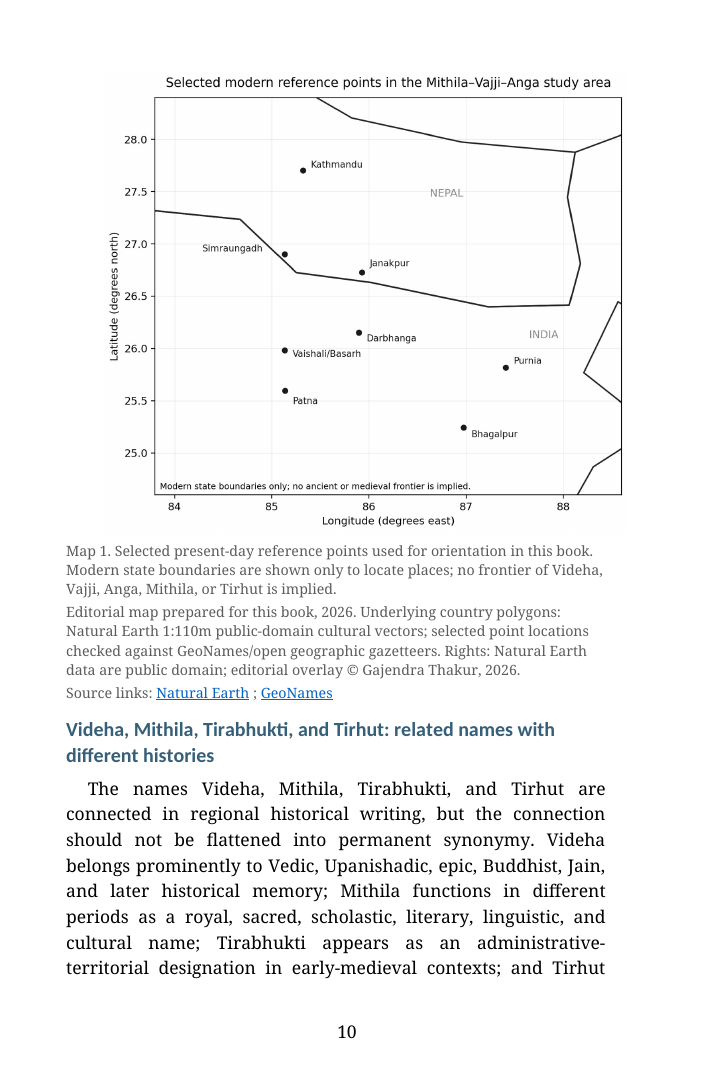
Chapter-specific source notes
- Primary chapter witness. Gajendra Thakur, Decoding the Panji of Mithila — Volume IV, formal Chapter 64, PDF pp. 614-621; formal Chapter 64. The HTML transcription is generated from the commit-pinned source PDF and retains the chapter boundary recorded in this edition.
- Internal structure. The repository source-heading inventory records no separately encoded subordinate heading for this chapter.
- Digital editorial method. The page keeps the preserved source text distinct from generated navigational, concordance, visual, and provenance apparatus. The synthetic reconstruction is explanatory only and is not evidence for an individual lineage or a determination of social or marital status.