Decoding the Panji of Mithila · Volume IV · Chapter 65
Mahindrapur-Pandua and its Kakarod, Dhagjari, Rashady, Singhwar, Lagama, and Kailakh Branches: Entries (535)-(547) This chapter begins a new major unit under the
Chapter 65
   Mahindrapur-Pandua and its Kakarod,
  Dhagjari, Rashady, Singhwar, Lagama, and
    Kailakh Branches: Entries (535)-(547)
    This chapter begins a new major unit under the
Mahindrapur-Pandua gramarambh. It covers only entries
(535) through (547). The chapter is deliberately stopped before
entry (548), where the record turns to the eastern Rashady-
Shivnagar continuation of Mahindrapur. The present chapter
therefore treats the first Mahindrapur-Pandua block as an
internally connected sequence: the opening Panji Panchanan
and Pa Raghudev register, the Nahar and Kakarod extensions,
the Dhagjari and Rashady movements, the Singhwar-
Pindaruch-Ehu branch, the Bharanam-Tharhi note, the
Lagama and Kailakh clauses, and the closing Maheshkram
invocation.

Entry (535): Mahindrapur-Pandua
gramarambh
    Entry (535) opens with the formula of Mahindrapur-
Pandua gramarambh and places the line under Panji
Panchanan Pa Raghudev. From Pa Raghudev are given Pa
Bhagirath, Pa Harishwar, Pa Mathuresh, and Pa Devkinandan
through Budhwal-Paran-Kamdev, with the corresponding
ddau route through Darihara-Vishnupati. This is not a small
side-note but the formal opening of a new village-and-mool
field; the repeated Pa title gives the line a clearly marked
Panji-authority register.
   An apara son of Pa Raghudev is Pa Anand, paired with
Ghanshyam through Pali-Larwai-Shankar and Mandar-
Raghunath. Pa Bhagirath then opens several routes. One
daughter is connected through Panichobh-Vanshmani and

Satlakha-Kav. Another route moves through Phanandah-Nikar
and the learned figure Mahamahopadhyaya Ramabhadra,
with Darihara-Damu as the responding side. A further apara
daughter of Pa Bhagirath is carried through Karmaha-
Balbhadra-Bachhai and Ekhara-Damodar. The entry is thus
built from parallel daughter-marriage statements rather than
from a single descending male stem.
    The Pa Pashupati branch is the main continuation. Pa
Pashupati gives Pa Nandishwar, Pa Vik or Ramanath,
Kedashan, and Rohan through Babhaniam-Pa Aniruddh-
Bhagirath and Khaual-Kamal. Pa Nandishwar gives Pa Chan,
also styled Badrinath, together with Pa Mansukh, Pa Garib and
Bhaiya, through Mahishi-Budhwal-Balgopal-Mahi and
Khandwala-Balkrishna. Pa Chan gives Vishwanath by Pabouli-
Jivakarna-Bavanu and Hariamb-Yadunandan.
   Vishwanath gives Madhav through Sarisab-Vishram-Kariye
and Kujouli-Panji. Madhav gives Jivachh through Pali-Mani-
Bavue and Sakararhi-Sudhakar-Poshi. Jivachh then gives
Radhakant, Vighnesh, and Ramchandra through Phanandah-
Sarinath-Jivanath and Tatail-Sakararhi-Gokulanand. These
routes show how the Mahindrapur-Pandua register borrows
and reuses several earlier moolgram links: Pali, Sakararhi,
Phanandah, and Tatail are not ornamental place names but
route controls.
   The Mansukh branch is also important. Mansukh gives Pa
Balbhadra and Lakshmi through Budhwal-Shatanjiv-Bhaiyan
and Darihara-Dharadhar. Pa Balbhadra is then tied through
Soderpur-Bechu-Parivaya and Takbal-Bachh. A further Pa
Balbhadra route uses Hariamb-Prannath-Rupnath and
Sarisab-Mod. Entry (535) therefore closes by showing that the
new Mahindrapur-Pandua field is already interlocked with
Budhwal, Darihara, Soderpur, Takbal, Hariamb, and Sarisab.

Entry (536): Mahindrapur to Nahar and
Kankarod
   Entry (536) is headed as Mahindrapur to Nahar, with
Kankarod also named. It begins from Lakshi, who gives Suga
through Sarisab-Balbhadra-Chandramani and Pali-Umadatt.
Suga then moves through Soderpur-Nandishwar-Badri and
Kujouli-Padula. The entry next follows Pa Garib, whose sons
are Jagatmani, Ratnamani, and Hridayamani through
Soderpur-Vasudev-Bhavanidatt and Hariamb-Prannath.
   Jagatmani is treated through several marriage links:
Soderpur-Rameshwar-Nandishwar and Pali-Jayadatt; Pali-
Purushottam-Jaynath and Sarisab-Jayshiv-Bhaiyan; Mandar-
Ratneshwar-Bammoli and Pali-Vaiya Chandradatt; Gangoli-
Dukhni-Nandi and Mandar-Bhairavdatt; and a longer route
involving Babujan, Pa Paltan, and Luche through Soderpur-
Lal-Vasti and Satlakha-Fekan. This accumulation makes
Jagatmani a branching node rather than a minor name.
    Lakshman gives Mukund, Damodar, and Hariddha through
Mahishi-Budhwal-Kamalpani-Govind and Pabouli-Bhaiyo.
Mukund gives Purnachandra through Pabouli-Manaranjan-
Shridhar and Pali-Banmali. Damodar gives Madan through
Pali-Gumani-Haldhar and Pabouli-Ravinath-Lakshmidatt, with
a Darihara-Parmeshwari clause. Ratnamani then produces Pa
Apooch, Dhani, Pa Jivi, and Pa Uma through Khandwala-
Durgadatt-Nidhi and Kujouli-Jhadula.
    Pa Apooch gives Pa Shivnandan and Pa Raghunandan by
Pali-Tota-Kanakmani and Soderpur-Girdhari. Apooch also
gives Madhav through Sarisab-Bavue-Tofir and Belaunch-
Nene. Pa Shivnandan gives Upendra and Sushil through Pali-
Jaleshwar-Gulli and Baliyas-Ram. The entry closes with Pa
Raghunandan giving Devkinandan and Pa Harinandan
through Pali-Shaktinath-Madhav and Baliyas-Ram, and with a
further cluster of Gopinandan, Yadunandan, Brajnandan, and

Janakinandan through Alay-Jaylal-Fekanlal and Mandar-
Yugalkishor. This continues the chapter’s dominant pattern:
the Pa-marked Mahindrapur line is repeatedly validated by
cross-mool routes.

Entry (537): Mahindrapur to Kakarod
    Entry (537) narrows the register to Mahindrapur-Kakarod.
It begins with Tirthanandan, then follows routes through
Mahishi-Pali-Yoganand-Mayanand and, by a doubled wording,
Raghunandan-Yoganand-Mayanand through Khandwala-
Jagatkant-Revatikant. Mayanand is associated with a
Kanhouli-Soderpur route involving the Ujan-vasi Girjadatt-
Pinakdatt line and the Ishahpur-Sihouli-Mandar response
through Jhontahu. The entry also records Abhinandan, styled
Bharat, through Pillawar-Sulhani-Narun-Banshidhar-
Ravindranath and the Kailar-vasi Balirajpur-Hariamb-
Karunakant route.
    Devinandan, styled Lal, is tied to Gangaura-Budhwal-
Girishwar-Govinddev and to Madari-Baliyas-Kamalapati-
Jivapati, with a Karmaha-Madhusudan-Shrinarayan kasthut.
Gopinandan and Yadunandan are then given through
Khandwala routes, including Devkinandan-Shankar and
Hembadatt-Sureshwar, with Pali-Kulanand and Ghusaut-
Parashmani responses. A Jhithakiya kasthut is noted, which
should be read as a deliberate register marker rather than a
narrative aside.
     The Pa Jivi branch is one of the most modern-looking
portions of the entry. Pa Jivi gives Gunanand and Indranand
through Digho-Bacha-Balmukund and Pandua-Thadu.
Gunanand gives Krishnanand, Mathuranand, Shyamanand,
Ishwaranand, and Satyanand through Soderpur-Manhar-
Bheshnath and Alay-Raja Padmanand Singh. The line then
records Major Krishnanand with Madan Ji, Raman Ji, Suman
Ji, and Devanand through Karmaha-Bholi-Narsingh and

Khaual-Banshmani. Mathuranand gives Sachchidanand,
Vijayanand, Ajayanand, Abhayanand, Prabhanand, and
Shaktyanand through Soderpur-Nityanand-Vachananand and
Ghusaut-Keshav. Shyamanand gives Manik, Vinayanand, and
Abhiyanand through Khandwala-Devkinandan-Pushkar and
Pali-Gulli; Ishwaranand gives Saketanand and Sanketanand
through Ghusaut-Keshav-Virendra and Belaunch-Harikrishna;
and Satyanand connects to Kujouli-Parmanand-
Sachchidanand and Khaual-Gonu. The professional and
modern personal names are preserved because they mark the
late accretion of the same Panji line.

Entry (538): Mahindrapur to Kakarod-Dhanga
   Entry (538) carries Mahindrapur toward Kakarod and
Dhanga. Pa Uma is first tied through Digho-Bacha-Balmukund
and Pandua-Thad. An apara Pa Uma gives Mahopadhyaya
Ugranand, Ganganand, and Durganand through Pali-
Shyamlal-Murlilal and Sarisab-Visuni. Ugranand gives
Meghanand, Lilanand, and Gitanand through Phanandah-
Bhaiyan-Jayant and Darihara-Durmil. Meghanand gives
Promodanand through Karmaha-Paltan-Kashinath and
Baliyas-Harinandan. Lilanand gives Dayanand, Sadanand, and
Ashanand through Alay-Pilu-Mahanth and Soderpur-
Bachchan.
   Gitanand gives Devanand through Khandwala-
Durgeshwar-Vinod and Karmaha-Vitu-Bhupnath, with a
Darihara-Balram kasthut. Ganganand gives Banshidhar,
Dharanand, Jayanand, and Gayanand through Tisaunt-
Kamalnayan-Sundar and Baliyas-Raghunath. Dharanand is
then routed through Belaunch-Keshav-Girdhar Kishor and
Baliyas-Shrikant. Jayanand and Gayanand have separate Pali-
Raghunandan lines. Durganand gives Vedanand, Kirtyanand,
and Shobhanand through Phanandah-Bhaiyan-Subant and
Khaual-Bauk. The closing clauses through Karmaha-Kheli-

Jivanand, Digho-Nenalal, Digho-Lal-Bachcha-Chandradev, and
Khandwala-Babu Gunapati Singh show that the Kakarod-
Dhanga heading has become a web of learned, professional,
and landed linkages.

Entry (539): Mahindrapur to Dhagjari
    Entry (539) moves to Dhagjari and begins from
Hridaymani. Hridaymani gives Devmani, styled Bhushi, and
Bhikhi through Soderpur-Nandishwar-Babuni and Pali-
Nityanand. A further Hridaymani daughter gives Ramsevak,
Awadhbihari, Rashbihari, and others through Kodariya-
Parmeshwari Datt-Nena, also styled Guhyeshwari Datt, and
Baliyas-Bacha. Another Hridaymani line goes through
Budhwal-Shripati-Durgapati and then Mandar-Mahipati-
Maddu, Karmaha-Jivanath-Shambhunath, Khaual-Mahesh-
Bhaiya, and Hariamb-Rambhadra. This is a striking example
of a chain in which the ddau side is itself unfolded into several
remembered stations.
   The entry next gives Bhaiya and Maddu under
Hridaymani, using Padmakar-Panichobh-Paltan-Nehal-
Chandidatt and Jajival-Bhanjan-Nehal. Devmani or Bhushi
gives Khuni through Hariamb-Jhauti-Gopal, while Dhaniram,
Thadu, and Jhauti lead to Sakararhi-Mahgi. Jhauti gives Gopal
through Rajanpura-Darihara-Shridatt-Brajnath and Karmaha-
Mayanidhi. The Dhagjari register then moves through Girju,
Narun-Hridaydatt, Baliyas-Manik, Mandar-Babua-Nanu, Pali-
Gauri, Pabouli-Manaranjan-Shridhar, and Parhi-Pali-Banmali.
   Ramsevak gives Chumman through Jajival-Mushari-
Ghoghai and Hariamb-Babuan. Chumman leads to a
Panichobh-Pujeri clause; Jagnath gives Gunanidhi through
Darihara-Narottam-Purushottam and Babhaniam-Bachharu.
Gunanidhi gives Parashmani through Satlakha-Purandar-Dillu
and Soderpur-Chhabnu. Parashmani then gives Kapileshwari,
Pujeri, Singheshwar, Bhagwandatt, Narsinghdatt, Dineshwar,

and Kalikadatt through Darihara-Shridatt-Jhalahu and Pali-
Baburaiya. The Pujeri/Singheshwar line closes through
Darihara-Parmeshwari-Nityanand and Karmaha-Nathe, which
ties the ritual title and the Dhagjari movement together.

Entry (540): Mahindrapur to Dhagjari,
Rambhadrapur, and Mangrauni
   Entry (540) continues Dhagjari and explicitly adds
Rambhadrapur and Mangrauni. Ramapati gives Shripati
through Pali-Govardhan-Chhotu. Chhotu is linked to
Sakararhi-Meghnath-Tirthmani and Soderpur-Thakurdatt.
Nilambar gives Gulab through Karmaha-Ghonghi-
Dukhmochan and Kodariya-Kumar. Rashbihari is tied to
Pabouli-Barju-Narsingh Datt and Budhwal-Fekan.
    A Pandua-nag clause then brings in Pa Bhaiya, whose sons
are Loknath, Dharmanath, and Bhikhari through Budhwal-
Ram-M.M. Padhyay Achal and Khandwala-Brajbhushan.
Loknath is represented through multiple routes: Soderpur-
Rameshwar-Nandishwar and Pali-Jayadatt; Soderpur-Lal-Barti
and Satlakha-Fekan; Pali-Anand-Rohinidatt and Soderpur-
Bhavanidatt; and Pali-Dukhbhanjan-Maniknandan with
Belaunch-Aankhi. The internal statement that another
Loknath son Panrath is under Pali in the presence of
Rohinidatt is preserved because it shows a procedural
clarification inside the Panji record.
   Dharmanath gives Son and Damodar through Pali-
Lalbihari-Mathuranath and Jonki-Sarisab-Karu; an apara
Dharmanath daughter goes through Pali-Tarapati-Kheli and
Darihara-Garib. Bhikhari gives Shashinath, Nandan, and
Ishdatt through Pabouli-Ratnapati-Durganath and Pali-
Dinanath. Shashinath is tied through Pali-Nena-Govardhan
and Baliyas-Parmeshwar. Nandan is linked to Tarauni-
Karmaha-Vidyanath-Ravinath and Baliyas-Shri Raman. A
further Nandan son, Pa Chiranjeev, is joined through

Belaunch-Dharmadatt-Mahgi and Nahas-Khaual-Jhumki. Thus
entry (540) ends by connecting Mahindrapur not only to
Dhagjari and Mangrauni but also to the earlier Nahas-Khaual
frame.

Entry (541): Mahindrapur to Rashady, Purnia,
Pilkhwar, and Vishnupur
    Entry (541) names Rashady, Purnia, Pilkhwar, and
Vishnupur. Pa Biku gives Shambhunath through Sarisab-
Saday-Bhagirath and Pali-Shubhankar. Shambhunath gives
Indramani, Rudramani, Ugramani, and another Rudramani
through Soderpur-Ghanai-Chanan and Baheradhi-M.M.
Khagesh. A further Shambhunath line gives Jivanath through
Pali-Bechu-Nityanand and Sakararhi-Nilangad.
    Jivanath gives a Soderpur-Bhavanidatt-Bhatu route and a
Pali-Jhotan response. Kedar gives Toti and Nonu through Pali-
Gunanand-Durgadatt and Gangoli-Lakshmikant. Kedar also
gives Thakurdatt through Gangoli-Lakshmikant-Kriparam and
Alay-Purandar, and Rudradatt through Pali-Hemai-Theghu
and Khaual-Narayan. Nanu gives Dhan and Bahor through
Pabouli-Raghu-Garibnath and Alay-Chandrapati; Dhan is then
connected with Ghusaut-Jhautu-Ram and Sakararhi-Jayanand.
    The closing part of entry (541) follows Rohan and
Rudramani. Rohan gives Rudramani through Pabouli-
Chandrapati-Kaladhar and Babhaniam-Bandhav. Rudramani
is repeated through Soderpur-Vasudev-Harpati and
Phanandah-M.M. Bhavanidatt, and then through Atma,
Nidhiram, Lakshman, and Hibharan by Soderpur-Vasudev-
Thothari-Raghupati and Pali-Jagatbandhu. Apara Rudramani
gives Nena through Pali-Padmapani-Tota and Baliyas-Bhavi;
another branch goes through Tholhi, Soderpur-Rameshwar-
Nandishwar and Pali-Jayadatt. Nandalal, Atmaram,
Shobhnath, and Kashinath close the entry through Pali-

Dinanath-Shaktinath, Soderpur-Girdhari, Hariamb-Yogi-
Narsingh, Pabouli-Premnath, and Jajival-Bhikhi-Govind.

Entry (542): Mahindrapur to Singhwar,
Pindaruch, and Ehu
   Entry (542) carries Mahindrapur toward Singhwar,
Pindaruch, and Ehu. Lakshman gives Nathuni, Babunandan,
Kantir, Shrinandan, and Vaiya Chandrashekhar through
Budhwal-Bhimdatt-Nidhi and Baliyas-Bahoran. Babunandan
gives Jagdish, Batah, Vaiya Sadu Anand, Trilochan, Arjun, and
Nilambar through Pabouli-Musahar-Chaturbhuj and Hariamb-
Manmohan. Jagdish uses Pali-Dukhmochan-Kui and Baliyas-
Rai Gangesh; Batah uses Soderpur-Mangu-Ramanand and
Darihara-Nandakumar.
    Sadu Anand is the principal carrier. He is joined to
Khandwala-Jagatkant-Lakshmikant and Khaual-Harinandan,
and also to Madan, Gopal, and Pankaj through Alay-Ramakant-
Balamu or Chandrakant and Darihara-Yatadhar. Madan is tied
to Khandwala-Babu Ganapati Singh-Babu Durganandan Singh
and to Alay-Raja Bahadur Kirtyanand Singh. Nilambar is
connected with Karmaha-Gangadhar-Krishnakant and
Baliyas-Buchan.
   Shrinandan gives Pitambar, Lalaji, Balaji, and Keshavji
through Pabouli-Musahar-Anant and Ekhara-Jhumkalal. The
Digambar clause uses Takbal-Bachchelal-Ganesh; Lalaji uses
Sarisab-Pa Luchai-Eknath and Khaual-Shrinath; Balaji uses
Karmaha-Khuni-Chandeshwar and Pandua-Bhaiyan. Vaiya
Chandrashekhar has a Ghusaut-Shyam-Gokul and Darihara-
Bholi route. Hibharan gives Babue/Govind through Budhwal-
Bhimdatt-Nidhi and Baliyas-Bahoran, and Babue gives Faujdar
through Alay-Shivlal-Jagat Lal and Sarisab-Bathan. Tholhi then
gives Bhalle through Jajival-Dharmnath-Babujan and Pali-
Horil, and Bhalle gives a Pali-Nena-Gudar and Sarisab-Bhaiya
route. The entry ends with Pa Dhireshwar tied to Pali-

Kumudanand-Jyotishi Sonmani, leaving the Singhwar-
Pindaruch-Ehu sequence open but complete enough for the
chapter.

Entry (543): Mahindrapur to Bharanam and
Jha-Tharhi
    Entry (543) shifts to a Bharanam and Jha-Tharhi label. Pa
Harishwar gives Krishnapati and Girpati through Sarisab-
Apooch-Lakshman, with a blank or suspended ddau side.
Krishnapati gives Bodh, styled Ratnapati, Mohan, Yogi, and Pa
Kurhai through Babhaniam-Aniruddh-Krishnanand and
Satlakha-Purushottam. Pa Bodhnath gives Badrinath through
Sarisab-Hendu-Chan and Sakararhi-Gangadhar; an apara
Bodhnath daughter goes through Belaunch-Hari-Chilka and
Soderpur-Banmali.
   Pa Buddh inath gives Pa Thadu through Baheradhi-Ratidh
ar-Kamalpani and Belaunch-Vidhanath. Pa Thadu gives
Kanhai through Karmaha-Kalanath-Shyamnath and Soderpur-
Nandishwar. Kanhai gives Bhaiya and Paltan through Pali-
Dinanath-Shaktinath and Soderpur-Girdhari. Bhaiya has a
Pabouli-Juddhi-Jaynath and Pali-Kapileshwar route; Paltan
gives Aniruddh and Jagatanand through Phanandah-
Chunchun-Manmohan and Pabouli-Chaturbhuj. Jagatanand
gives Shankar through Khandwala-Lakshminarayan Singh
and Pandua-Ugranand.
   Badrinath gives Kirtinath and Babujan through Pabouli-
Kaladhar-Machal and Belaunch-Durgadatt. Kirtinath gives
Mahavir and Ganesh through Kharka-Ekhara-Gokulnath-
Vishnudatt-Babue and Khaual-Jaga-Krishnaram. Apara
Kirtinath gives Jaykant and Madhav through Kujouli-
Rudradatt-Hemnath and Karmaha-Rama. Jaykant gives
Kapileshwar, Singheshwar, Kameshwar, and Balbhadra
through Belaunch-Soni-Ishdatt and Darihara-Ganeshdatt.
Kameshwar gives Vindhyanath through a Jehanpur-Ghusaut

route, but with the source leaving blanks; the chapter
preserves that incompletion because the dots and gaps are
part of the Panji evidence.

Entry (544): Lagama under internal number
(266)
    Entry (544) is headed only by an invocation and internal
number (266), with Lagama as the operative place. Mohan
gives a daughter through Soderpur-Murlidhar-Dukharan and
Pali-Vishweshwar; an apara Mohan gives Dharmadatt through
Belaunch-Govind-Durgadatt and Karmaha-Juraun. A further
apara Mohan daughter goes through Phanandah-Sonai-
Ravinath and Khaual-Jayshiv. Dharmadatt gives Banshidhar
through Karmaha-Nakah-Lalit and Jajival-Durmil. Banshidhar
gives Shukdev through Pali-Ramanath-Govind; Govind then
has a Mandar-Prabhudatt-Vishweshwaridatt and Soderpur-
Kamaladatt route.
    The Yogi branch gives Dina and Jaynath through Hariamb-
Bhavkrishna-Prannath and Darihara-Shivdatt. Dina gives
Babue through Soderpur-Pashupati-Manik and Babhaniam-
Malli; a daughter through Pali-Bhavanidatt-Phalgun and
Soderpur-Bhavan; and Taranath and Keshavnath through
Kujouli-Madhurapati-Panji and Pali-Mansukh. Another Dina
route goes through Ghusaut-Bacha-Dhan and Khaual-
Chaudhary Lakshminath; Latar is tied through Baheradhi-
Modi-Kari and Sakararhi-Vedi. Keshavnath gives Harivansh
through Kujouli-Rudradatt-Eknath and Satlakha-Vishnudatt.
Harivansh gives Ugranath and Yamuni through Jajival-
Tulsidatt-Shatanjiv and Hariamb-Dular. Kurhai gives Baldev
through Pali-Mahi-Bhavanidatt and Sakararhi-Gangadhar. The
entry closes with Baldev and Girpati routes that keep Lagama
inside the wider Mahindrapur branch.

Entry (545): Mahindrapur to Kailakh

    Entry (545) returns explicitly to Mahindrapur and carries it
to Kailakh. Pa Mathuresh gives Pa Banshidhar through
Panichobh-Shivnath-Shatanjiv, with an incomplete
counterpart. Pa Banshidhar gives Pa Achyut through Gangoli-
Raman-Lakshmikant and Baliyas-Shatanjiv. Pa Achyut gives
Pa Basudev and Pa Ramkrishna through Ghusaut-Thedhu-
Chhatrapati and Baliyas-Vidyanath. Pa Basudev gives Chhedi
through Phanandah-M.M. Bhavanidatt-Nanu/Rudradatt and
Sarisab-Dullah. Chhedi gives Bhaiyan through Budhwal-Achal-
Hemnath and Pabouli-Thothan. Bhaiyan then has a Belaunch-
Lakshmidatt-Keshav and Darihara-Raghu route, while another
Pa Basudev branch moves through Karmaha-Bhairav-
Aniruddh and Khaual-Dhan/Rudradatt.
    Pa Ramkrishna gives Pa Jiveshwar through Pali-
Bhavanidatt-Lohan and Baliyas-Jivan. Jiveshwar gives Pa
Kashinath through Soderpur-Ishannath-Gudar and Karmaha-
Horil. Pa Kashinath gives Danthath and Pa Kirtinath through
Narun-Dhirnath-Ganesh and Khandwala-Jhapati Singh. Pa
Kirtinath gives Shambhu through Sarisab-Jugalkishor-Nena
and Panichobh-Bhagwandatt. This entry is compact but
important because it shows how the Kailakh branch belongs
inside the same Pa Mathuresh-Pa Banshidhar-Pa Achyut
descent.

Entry (546): Mahindrapur-Kakarod, Chhoti
Jha, Rashady, Bagahi, Shivnagar, and
Khelanand Jha
    Entry (546) is one of the densest entries in this chapter. It
invokes Mahindrapur and names Kakarod, Chhoti Jha,
Rashady, Bagahi, Shivnagar, and Khelanand Jha under
internal number (278). It begins from Pa Anand, whose
daughters include Bhairav, Lakshmipati, and Pa Chhoti, with
Devanand through Ojhoul-Belaunch-Jagdish-Pranapati and
Soderpur-Gangadhar. Pa Chhoti, styled Devanand, gives Pa

Manik/Bhavanand, Pa Jhontu/Mitranand, Sadu
Shobhanand/Sadanand, and Pa Gunanand through Baheradhi-
Sundar-M.M. Bhikhi and Soderpur-Anath.
   Pa Manik or Bhavanand gives Nityanand, Pa Punyanand,
Babuan or Dharmanand, and Pa Ramanand through Hariamb-
Yashodhar-Ghani and Baliyas-Durgadatt. Nityanand gives
Kunjbihari, Awadhbihari, and Girdhari through Jajival-Um
pati-Aankhi and Baliyas-Machal; an apara Nityanand branch
moves through Narun-Durgadatt-Pakhiya and Darihara-
Manbodh. Pa Punyanand gives Chhatradhari, Fekan, and
Yoganand through Alay-Mahi-Thakurdatt and Mandar-
Jayarudra. Chhatradhari gives Shrinandan through Pali-
Ishwaridatt-Bhagwandatt and Darihara-Khadgapani;
Shrinandan gives daughter-routes through Jajival-Devidatt-
Jayadatt and Darihara-Kanhai, and also Ramnandan through
Budhwal-Chhakori-Jalli.
   Yoganand gives a Sarisab-Chakradhar-Pritinath and
Ghusaut-Kanhaiya route. Babuan/Dharmanand gives Lilanand
and Chaturanand through Soderpur-Nehal-Nathe and
Belaunch-Vidhanath. Chaturanand gives Basudev and Baldev
through Ghusaut-Meghnath-Chitradhar and Darihara-
Gokulnath. Baldev gives Bachnu/Jivanand, Sachnu/Khelanand,
and Digambar through Pali-Bauku-Rajje and Kujouli-Babulal.
Bachnu/Jivanand gives Kshamanand and Dinanand through
Budhwal-Nandishwar-Jhmaneshwar and Ekhara-Manmohan.
The entry then turns to Sachnu/Khelanand, Mahanand,
Raman, Ashok, Dinodanand, and Prabhakua, with the
Budhwal-Jhumne route. These late-generation personal names
must be preserved because they show a modern extension of
the same Panji grammar.

Entry (547): Invocation to Maheshkram
   Entry (547) invokes Maheshkram and continues the
Digambar branch left at the end of entry (546). Digambar gives

Pitambar, Nilambar, Indanand, Shivkumar, and
Shankarkumar through Ahil-Hariamb-Lal-Tirthanand and
Soderpur-Damodar. Pitambar gives Kundan and Nandan
through Ghusaut-Janardan-Narendra and Khandwala-
Muktinath. The chapter closes with Vinodanand giving Bharat
Kumar through a Gunamati route to Shukun-Lakshminarayan,
with a Patouri route left partly blank. The blank fields and
open ellipses are not to be normalized away; they show that
the final clause of this chapter is a recorded but incomplete or
partially suspended Panji statement.

Interpretive note on the chapter
   Entries (535)-(547) form a clearly bounded Mahindrapur-
Pandua chapter. The repeated Pa title, the many daughter-
marriage clauses, and the recurring route controls through
Pandua, Kakarod, Dhagjari, Rashady, Singhwar, Lagama,
Kailakh, and Bagahi all show that this is not a simple
patrilineal list. It is a route-based genealogical grid in which
each marriage statement locates the line in relation to a
recognized mool, village, professional title, or learned
household.
    The chapter also shows the late life of the Panji record.
Titles such as Mahamahopadhyaya, Major, Sadu, Vaiya, Babu,
and learned or ritual labels such as Pujeri and Jyotishi appear
alongside older village-route formulas. This combination
proves that the register was not static: it received later
additions while retaining the older dau/ddau and kasthut
grammar. The stopping point before entry (548) is intentional,
because entry (548) begins a new eastern Rashady-Shivnagar
continuation of Mahindrapur and should be treated
separately in the next chapter.
Source structure and verification apparatus
Editorial source apparatus. This apparatus is descriptive, not interpretive. It records the source-controlled structure used to verify that this page corresponds to formal Chapter 65 of Decoding the Panji of Mithila — Volume IV. The chapter text above is preserved from PDF pp. 622-635; formal Chapter 65 in the commit-pinned authoritative source. It is not merged with a neighboring chapter, appendix, annexure, or independent front/back-matter unit. The internal headings below come from the repository’s source-heading inventory and are retained as navigational and audit evidence; showing them here does not turn those headings into separate publications or add claims that are absent from the source.
Internal source headings
No subordinate heading was separately encoded in the repository source-heading inventory for this chapter.
Source-text concordance
Mahindrapur-Pandua · Kakarod · Dhagjari · Rashady · Singhwar · Lagama · Kailakh · Branches · Entries · begins · major · unit · gramarambh · covers · deliberately · stopped · entry · record · turns · eastern · Shivnagar · continuation · Mahindrapur · present · therefore · treats · first · block · internally · connected · sequence · opening · Panchanan · Raghudev · register · Nahar · extensions · movements · Pindaruch-Ehu · branch · Bharanam-Tharhi · note · clauses · closing · Maheshkram · invocation · opens · formula · Pandua · places · line · given · Bhagirath · Harishwar · Mathuresh · Devkinandan · Budhwal-Paran-Kamdev · corresponding · ddau · route · Darihara-Vishnupati · small · side-note · formal · village-and-mool · field · repeated · title · gives · clearly · marked · Panji-authority · apara · Anand · paired · Ghanshyam · Pali-Larwai-Shankar · Mandar · Raghunath · several
Boundary verification. In the formal sequence this chapter follows Volume IV Chapter 64, “Satauli Continuations, Purnia, Jayanand, Virsayar, and Parihari: Entries (529)-(534)” and precedes Volume IV Chapter 66, “Mahindrapur-Shivnagar, Bisfi- Saurath, Kabai, Vatswal, Shaktiraypur and Sagarapur: Entries (548)-(562) Opening note”. The chapter extractor begins at the verified formal Chapter 65 marker and stops at the next verified formal chapter marker; for a final chapter it stops before recognized book-level back matter. The concordance above is generated only from distinct terms already present in this chapter’s preserved source text. It is provided for discovery, comparison, and audit, not as an automated judgment about persons, lineages, status, kinship, marriage eligibility, or historical truth.
Illustrated research apparatus
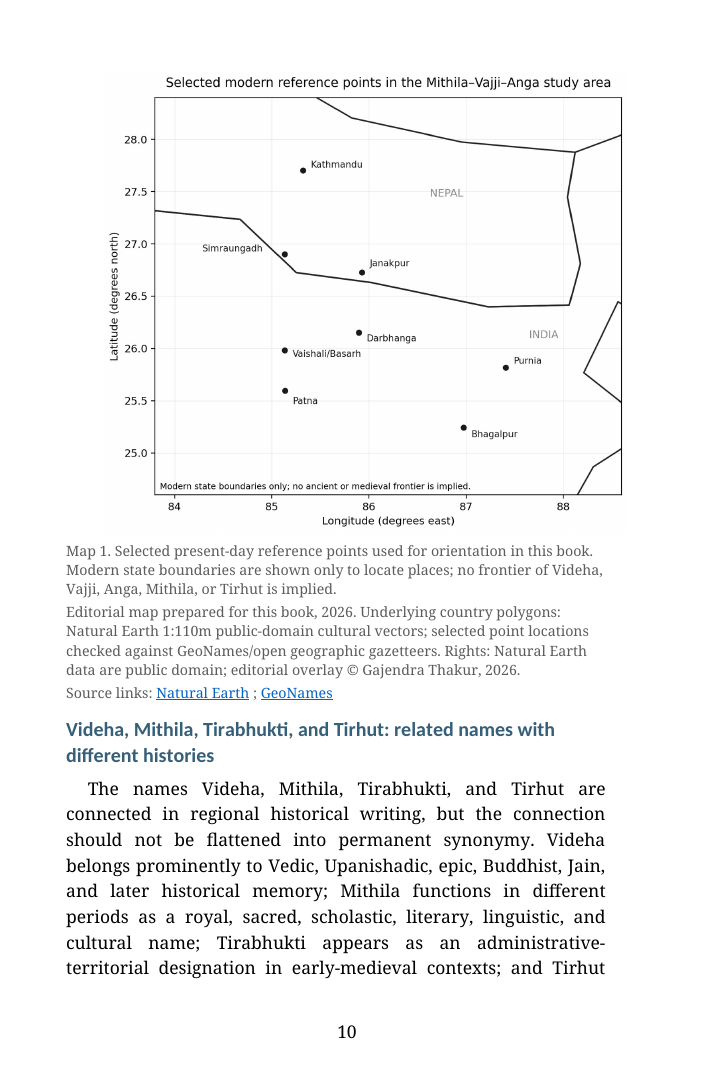
Mithila · Vajji · Anga
Chapter-specific source notes
- Primary chapter witness. Gajendra Thakur, Decoding the Panji of Mithila — Volume IV, formal Chapter 65, PDF pp. 622-635; formal Chapter 65. The HTML transcription is generated from the commit-pinned source PDF and retains the chapter boundary recorded in this edition.
- Internal structure. The repository source-heading inventory records no separately encoded subordinate heading for this chapter.
- Digital editorial method. The page keeps the preserved source text distinct from generated navigational, concordance, visual, and provenance apparatus. The synthetic reconstruction is explanatory only and is not evidence for an individual lineage or a determination of social or marital status.