Decoding the Panji of Mithila · Volume IV · Chapter 66
Mahindrapur-Shivnagar, Bisfi- Saurath, Kabai, Vatswal, Shaktiraypur and Sagarapur: Entries (548)-(562) Opening note
Chapter 66. Mahindrapur-Shivnagar, Bisfi-
Saurath, Kabai, Vatswal, Shaktiraypur and
Sagarapur: Entries (548)-(562)
Opening note
   This chapter continues the Mahindrapur-Pandua branch
after the Maheshkram closing of the previous chapter. It
covers entries (548) through (562) only. The chapter first
follows Mahindrapur into Purba-Rashady and Shivnagar, then
the Shivnagar and Khamra-Manbodh continuation, then Bisfi-
Saurath, Malichham-Saurath, Kabai-Narun, Tedhra-Narun,
Vatswal-Narun, Shaktiraypur-Narun, and Sagarapur or
Jhommeli-Narun. Entry (563), Ojholi-Sagarapur-Pandoli,
begins a new continuation after the Sagarapur passage and is
reserved for the next chapter.
  Several abbreviations and statuses are important in this
section. Pa continues to identify learned or pandit-styled
persons in the register; Th. marks the Thakur line in the Bisfi
portion; Jyotishi, Vaiyakaran, Sadupadhyaya, Panjishastra
Martanda, Parnaagarik, Sandhivigrahik, Mahamataka, and
Mahamahopadhyaya are preserved because they are part of
the genealogical memory, not decorative honorifics. The
repeated village pairs - Pali, Soderpur, Hariamb, Sarisab,
Khaual, Karmah, Balias, Budhwal, Darbhanga/Darihara,
Narun, Mandar, Pandua, and Sakararhi - are the control points
by which the Panji proves the movement of each branch.

Entry (548): Mahindrapur to Purba-Rashady and
Shivnagar
  Entry (548) keeps the Mahindrapur stream but turns it
toward Purba-Rashady and Shivnagar. Pa Jhontu or
Mitranand is the opening ancestor. His line gives Horil or
Gopinath through Ghusaut-Threghu-Tulakrishna and Ekhara-

Mahidhar. Apara Jhontu produces Pa Lakshminath through
Pali-Sonmani-Jhadula and Mandar-Bhola. Pa Horil or
Gopinath then gives Pa Bhuvanand, Pa Harshanand, and
Gokulanand through Mangrauni-Pali-Manbodh-Shobhnath
and Jajival-Hemu. This repeated pairing of a Pali-derived line
with a Jajival control keeps the Mahindrapur branch under
the older Pandua/Narun proof system even when the heading
names Shivnagar.
   Pa Harshanand gives two important apara lines. One is Pa
Bhikhiya or Dolanand through Karmah-Rama-Venidatt and
Darihara-Kanhai. The other is Pa Jhulanand through Karmah-
Thothan-Tilaknath and Khaual-Chaudhary Tulsidatt. The
Bhikhiya line is especially marked because it names the
Panjishastra Martanda and the learned group Pa Modanand,
Ambikanand, and Shyamanand, proved through Digho-
Sarvanarayan-Bhaiyalal and Satlakha-Jyotishi Dwarikanath.
The title Panjishastra Martanda shows that the register here is
conscious of its own scholarly custodians. Pa Modanand is
dated 1913-1998, and his descendants are Shardanand,
Lakshminandan, Vijayanandan, Krishnanand, Harinandan, Pa
Vidyanand, and Jankinandan. Pa Vidyanand is separately
dated 1957, which makes this one of the modernized passages
of the Nagram register.
  The same entry preserves marital and collateral notes for
daughters and later descendants. Rameshwari gives Meena or
Lalita and Navina; one route is through Adya-Madari-
Mangrauni-Pali-Ramanath/Ravatara to Acharya Dinanath,
while another identifies Navina with Balirajpur-Hariamb-
Satyanarayan and the Ashukavi Acharya M.Dr. Vishwambhar
Mishra Vagish line. The entry then follows Shardanand
through Gaurinandan, Vachaspati or Vidyapati, Divakar or
Mandu, Ratnakar, and Bhola Ji through Nagram-Ghusaut-
Damodar-Ugramohan and Ekhara-Shobhanand. Gaurinandan
is connected through Belaunch and Tripurauli-Narun-

Saraswati-Vaidyanath; Vidyapati goes through Jajival-Mishra
Balabhadra and Ghusaut-Brajmohan; Divakar is associated
with Maulam-Mahishi-Pali and again Tripurauli-Narun-
Saraswati-Vaidyanath. The entry therefore moves from an old
Mahindrapur proof to named twentieth-century family
members and learned titles.

Entry (549): Shivnagar and Pa Vidyanand Jha
   Entry (549), invoking Shiva, continues the Shivnagar branch
under the name Pa Vidyanand Jha. Lakshminandan gives
Niranjan Kumar and Chandrashekhar through Bhaur-
Khandbala-Durgeshwar-Vinod          and      Karmah-Bhupnath.
Vijayanandan gives Vikas and Prabhash through Analpur-
Karmah-Hitnath-Bhaktinath and Soderpur-Khelanand. Vikas
is then carried through Ahil-Hariamb-Satyadev-Narayanadev,
though the opposite side is left blank. Krishnanand is also left
partly blank, which is significant: the Panji records the
existence of the line even where the paired proof remains
incomplete.
   Krishnanand further gives Saketanand or Pindu,
Suryanandan or Tinku, and Vivekanand through Analpur-
Taranath-Ishannath      and   Nahas-Ravaal-Sushil  Kumar.
Harinandan gives Anand Kishor and Brajkishor through
Khanam-Fanandah-Vanshamani-Hilendramani               and
Sandahpur-Dighoy-Kamalakant. Pa Vidyanand gives Abhinav
and     Murari     through  Khanam-Fanandah-Krishnamani-
Indramani and Digaun-Soderpur-Bilat. The note on Gita
names sons Praja and Jaya; Jankinandan gives Gunjan,
Ranjan, Gulsana and related descendants through Fanandah-
Nityanand-Pramodanand         and      Mandar-Deonandan-
Dharmanandan. Ambikanand is joined through Bhadgam-
Jajival-Tirthdatt-Loknath and Karmah-Saday. Shyamanand
gives Santosh Kumar through Ahik-Hariamb-Lalji-Kalikadatt
and Soderpur-Khagnath, and Santosh Kumar carries a later

Balias-Hariamb-Satyanarayan line with blanks. This entry is a
direct modern family continuation of the Pa Vidyanand
cluster.

Entry (550): Mahindrapur to Khamra, Manbodh Jha
and Begusarai
  Entry (550) is headed Mahindrapur to Khamra, Manbodh
Jha, with the additional note Ehu-Begusarai. It begins with Pa
Jhulanand. His descendants are linked through Hariamb-
Abhayanath-Manmohan and Sarisab-Pa Kulanand. Cha
Lakshminath gives Devkinandan and Bathan through
Soderpur-Chalbal-Mohan and Alay-Thakurdatt. Sadupadhyaya
Shobha or Sadanand gives Vednath through Pali-Gangadhar-
Nidhi and Belaunch-Revati Raman. Vednath then gives
Badrinath, Nanu, Phani, Dihanand, and Shitalanand through
Soderpur-Rameshwar-Gunanidhi and Pali-Baukai.
   Badrinath gives Manbodh through Khamra-Tarauni-
Karmaha-Bhikshuk-Eknath and a broken Ura-Ekhara route. Pa
Manbodh gives Gaurikant and Suryakant. Gaurikant gives
Abhaykant     or   Nehrukant   through    Analpur-Karmah-
Mitranath-Kalpanath       and     Simar-Khaual-Nandkishor.
Suryakant gives Buchu and Sunil through Analpur-Karmah-
Badrinath-Sadanand and Mahia-Soder-Janardan. The entry
then inserts an older Ramdev line: Ramdev gives Narottam
through     Takbal-Godai-Ramdev    and    Sakararhi-Jaydev;
Narottam gives Kamalnayan through Panichobh-Rupnath-
Badrinath     and   Pabouli-Madhav.    Kamalnayan     gives
Bhairavdatt and Aankhi through Pali-Manhar-Nayan and
Jajival-Nityanand. Bhairavdatt gives Rudramani through
Kujouli-Govind-Gangadatt and Pali-Chhotku. Rudramani gives
Kulmani or Ravatara through Panichobh-Baburaiya-Lanha
and Sakararhi-Hira. Kulmani gives Ramji and Basudev, with
Sukhet-Soderpur-Machal-Vanshdhar,      Karmah-Shyamnath,
Pabouli-Bhaiyo-Babujan, Panichobh-Goni, Takbal-Hridaynath-

Bachchelal, Balias-Mukund, and Gangoli-Mahipani-Chumman
controls. The entry closes with Pa Ratidev and Pa Hadi,
preserving a still older scholarly proof through Pali-Murari-
Gopi, Belaunch-Mukund, Pali-Brahmapati-Kamal, Mandar-
Gop, Baheradhi-Shripati-Harihar, Sakararhi-Devanand, and
the broken Kulapati-Kala-Bhikham trail.

Entries (551)-(552): Bisfi to Saurath
   Entry (551) opens a Bisfi gramarambh and turns it toward
Saurath. Thakur Tula gives Eknath and Nathe through
Soderpur-Maddu-Bhavdev and Budhwal-Bani. Thakur Eknath
gives Bhaiya and Chetnath through Karmah-Raghudev-Dukhni
and Satlakha-Mahesh. Bhaiya gives Pyarelal and Babulal
through Sarisab-Dharmapati-Bodhan and Khaual-Lotan.
Apara lines give Dular, Nanu, and Phanilal through Sarisab-
Jayshiv-Bhaiyan and Khaual-Garib. Pyarelal is tied to Ghusaut-
Tarapati and Khaual-Bachharan. Babulal gives Lakshminath
through Karmah-Balah-Manik and Balias-Teni; other Babulal
lines go through Jajival-Gonan-Chalbal, Pali-Bhavadatt,
Soderpur-Neena, and incomplete paired routes. Lakshminath
gives Shrinath and Babuan/Raghunath through Jajival-
Mansukh-Bhavanidatt and Darihara-Hridaynath. Another
Lakshminath branch gives Yadunath and Baldev through
Khandbala-Thothi-Jirakkhan      and  Karmah-Raghav.       The
register preserves blanks here because the Bisfi-Saurath
migration is not a single clean tree but a braided set of
incomplete and complete lines.
   The same entry continues through Dular and Nanu. Dular
gives Apuch and Mohan through Karmah-Chitradhar-Rajju
and Darihara-Nidhipani. Nanu gives Banmali, Vishweshwar,
and Mahesh through Ghusaut-Jhonti-Hemkar and Khaual-
Bachharan. Vishweshwar or Poch gives Rameshwar and
Rajeshwar      through      Hariamb-Shyamnath-Babumani.
Babumani gives Ram and Manohar through Jonki-Sarisab-

Machal-Jalpadatt, while Jalpadatt is traced through Pali-
Madhupati-Bhavanidatt     and     Khaual-Bhaiya.    Jalpadatt
continues through Panichobh-Modi-Durgadatt-Jhau and a
broken Belaunch-Aankhi route; Jhau is tied through Balias-
Khadag and Tisaunt-Manai. Rameshwar goes through
Belaunch-Shorelal-Mukteshwar and onward to Hariamb-
Bodhnath-Harivansh,     Narun-Manbharan-Chumman,          and
Darihara-Ishwaridatt-Banmali. Rajeshwar is tied through
Panichobh-Avadhi-Pitambar       and     Sakararhi-Dharanath-
Bhairavdatt, while Pitambar enters a Khandbala-Radhakant-
Muni and Belaunch-Ishdatt line. A further Rajeshwar line goes
through Hariamb-Indradatt-Mahi and Mandar-Narsingh. The
final Mahesh passages connect Hariamb-Manmohan-Mukund
to Jajival-Babulal and Navani-Badhiyam-Pabouli-Babuan-
Suvansh.
   Entry (552) is headed with Rajarajeshwar and continues
Bisfi-Saurath. Thakur Phanilal gives Manhar, Badrinath, and
Dukhna through Karmah-Chitradhar-Ram and Hariamb-
Gauridatt. Badrinath gives Babua or Vishwanath through Pali-
Lal-Krishnamani and Balias-Lakshman, with apara sons
Vijaynath and Divyanath partly blank. Vijaynath gives Lutan;
Lutan gives Vasant through Hariamb-Basant-Vaiyakaran
Suresh. Vasant gives Vaiyakaran Umesh and Vaiyakaran
Suresh through Kujouli-Rudradatt-Eknath and Satlakha-
Vishnudatt. Vaiyakaran Suresh gives Tareshwar and
Deveshwar through Mandar-Siddhinath-Narsingh; Narsingh is
followed by broken Soder and Ratte/Babue trails, and Babue
gives Murali through Sakararhi-Shyamlal-Bokan and
Baheradhi-Lakhan.
  The closing of entry (552) is historically charged. Thakur
Shashidhar or Paltan gives Mahant through Ghusaut-
Akshadhar-Durgadhar and Sakararhi-Bhirvan, with another
Shashidhar line through Hariamb-Gulbadan-Krishna and the
Krishna sons Jaldeo and Lakshmikant through Kodariya-

Tulsiprasad-Manu Prasad and Mandar-Babulal. Thakur
Tejdhar has a Damori-Khandbala-Bachharan-Muktinath line
and a Kujouli-Ishdatt-Kamaladatt to Sarisab-Feku line. Thakur
Nagdhar or Nagendra gives Virendra through Pariyam-
Budhwal-Narsingh-Harikant, while the Babuji/Narsingh-
Harikant trail returns through Pandua-Bhaiya-Bhikhari and
Pabouli-Durganath. Nathe is tied through Budhwal-
Brahmapati-Bachharu and Khandbala-Bandhu. The final
remembered learned line names Parnaagarik Vireshwar,
Sandhivigrahik Chandeshwar, Mahamataka Ganeshwar, and
the Karmakandoddharakarak Mahamahopadhyaya Ramdatta.
This closing is not just family history; it preserves a scholastic
and administrative chain within the Bisfi-Saurath tradition.

Entries (553)-(554): Malichham-Saurath, Janta, Ladaur
and Chhitan Jha Kailakh
   Entry (553) opens Malichham-Narun gramarambh under
the heading Malichham to Saurath, Janta and Saurath. Gonod
gives Saheb and Bhairavdatt through Sakararhi-Gopal-
Pandhare and Soder-Praneshwar. Apara lines give Devi
through Khaual-Parmanand-Shivram and Hariamb-Madan;
another line through Sarisab-Parmanand-Rajaram and
Ekhara-Balli;   another    through     Darihara-Parmanand-
Kamalnayan and Soder-Mahesh; and another through
Satlakha-Madhu-Hardatt and Narun-Aniruddha. Saheb then
gives Vishnudatt, Pa Krishnadatt, Chanchal, Brahmadatt, and
Thakurdatt through Mandar-Mahesh-Bhavesh and Belaunch-
Bhaiya. Pa Krishnadatt gives Bholanath through Panichobh-
Ghani-Khedan and Balias-Shambhu. Chanchal gives Pa
Chintamani, Hiramani, and Pa Jaymani through the same
Panichobh-Khedan frame, while Hiramani is tied through
Fanandah-Amritnath-Chunchun and Darihara-Shambhu.
  Apara Chanchal gives Biharilal through Pali-Lal-
Krishnamani and Soderpur-Jankinath. Further sons Bhola,

Janardan, and Madhunandan go through Budhwal-
Shankardatt-Chhakauri and Soder-Horil-Munidatt. Biharilal
gives Murlidhar and Vanshidhar through Ekhara-Babunath-
Panchu and Soder-Durgadatt. Murlidhar gives Trilokinath,
Vibhutinath, and Pashupatinath through Kujouli-Nidhinath-
Jivanath and Soder-Girvar Kishor. Vanshidhar gives Harinath
and    Ishwarnath     through   Dighoy-Ayodhyanath-Thakur
Nandan and Balias-Shambhunath. Madhunandan gives
Lakshmikant through Pali-Shrilal-Markandey and Soder-
Hiralal; Lakshmikant is tied through Hariamb-Chumman-
Markandey and Narun-Mohan Lal. Pa Jaymani gives Pa Lutan
or    Aniruddha      through    Ghusaut-Thakure-Vaiyakaran
Raghunath and Sakararhi-Lal. His apara sons include
Shiveshwar, Maheshwar, Kameshwar, and Rameshwar
through Darihara-Gauridatt-Babue and Pali-Chandradev. The
line also preserves Pa Nirsu/Vishwanath, Gopikrishna, Dr.
Kalikadatt (M.A., Ph.D.), Ambikadatt, Vikas Kumar, Ashutosh
Kumar, Professor Vivekanand, and Parameshwari-linked
modern descendants. Entry (553) is therefore a long
Malichham-Saurath bridge between older Narun proof and
modern learned households.
   Entry (554), headed Saurath, Ladaur, Chhitan Jha, Kailakh,
and Kamalakant Jha, continues the same Saurath
environment. Maheshwar is tied through Jajival-Shobhnath-
Suga and Pandua-Pa Jiveshwar. Apara Maheshwar gives
Vishweshwar through Soder-Kodai-Dwarikanath and Pandua-
Ramsevak. Kameshwar gives Deochandra, Vidyanath,
Shilanath, and Buddhinath through Mandar-Ramdhan-Thithar
and Alay-Jagatlal. Apara Kameshwar gives Chhitun through
Balias-Singheshwar-Rameshwar and Karmah-Gudar. Chhitan
gives Dayanath through Darihara-Devkinandan-Harinandan
and Pali-Jhotan. Rameshwar gives Kamalakant through
Khaual-Umadatt-Jyotishi    Apuch     and    Belaunch-Babua.
Kamalakant gives Revatikant, Ashwinikant, Jayantikant, and

Ratikant through Balias-Shrikant-Raghunandan and Tisaunt-
Ghanshyam Sundar. Brahmadatt, Thakurdatt, Nidhi, Babnu,
and Guninidhi add Ghusaut, Jajival, Karmah, Balias,
Pani/Devki, and Belaunch proofs. The entry is short but dense:
it anchors the Chhitan Jha and Kamalakant Jha lines inside the
Saurath-Ladaur-Kailakh matrix.

Entries (555)-(556): Kabai-Narun to Dhanga, Navani
and Rashady
  Entry (555), under Trishulapani, opens Kabai-Narun
gramarambh and sends the branch toward Dhanga, Akaur,
Devshankar, Rashadh, and Apuch Jha. Durgadatt gives
Pakhiya, Bhikhan, and Mirivya through Budhwal-Lakshman-
Dinbandhu and Belaunch-Govind. Pakhiya gives Babunath,
Premi, and Amritnath through Darihara-Harijiv-Manbodh and
Soderpur-Kamalnayan. Babunath gives Bauku through
Hariamb-Machali-Kishornath and Sakararhi-Jyotishi Khakhnu.
Bauku gives Markandey and Chaturbhuj through Pali-
Bhavaditya-Ishwaridatt and Belaunch-Juraun. Markandey is
routed through Jajival-Dharmnath-Babujan and Pali-Horil.
Premi is tied through Soder-Kuli-Bhaiyan and Budhwal-
Padhyaya Bagish. Amritnath gives Manbharan and Lalit
through Pali-Bhavaditya-Ishwaridatt and Belaunch-Juraun;
another Amritnath branch goes through Digho-Bachha-
Chitradhar and Sakararhi-Shyamlal.
   Manbharan gives Luchai, Dwarikanath, and Muktinath
through Balias-Dukhiya-Lakshman and Pali-Horil. Muktinath
gives Devshankar through Ghusaut-Keshav Narayan-Jagani
and Pandua-Ramsevak. Lalit gives Bagru and Nirsu through
Pandua-Rohan-Rudramani-Atmaram and Hariamb-Narsingh.
Bagru is tied through Balias-Arjun-Bhikham and Alay-
Chaudhary Mitralal. Bhikhan gives Nathe through Panichobh-
Dhani-Khedan and Balias-Jivi. Bhikhiya gives Jyotishi
Vachaspati and Dhirnath through Ghusaut-Chanan-Thakure

and Jajival-Babnu. Jyotishi Vachaspati is connected through
Balias-Kaladhar-Amritnath and Sarisab-Pa Keval Krishna.
Dhirnath gives Vaiya Bachcha, Mahesh, Rajvallabh, Ganesh
Kaviraj, and Apuch through Sarisab-Eknath-Govind and
Darihara-Hema. Vaiya Bachcha gives Vaidyanath, Nirsan, and
Shankar through Sarisab-Fakiran-Nandalal and Balias-
Briddhinath. Shankar gives Jhotan or Sundarkant through
Soderpur-Babujan-Jaydev and Ekhara-Raiya; Sundarkant is
tied through Khandbala-Muktinath-Kedarnath and Samauli-
Pali-Jivu. The closing Apuch and Shubhankar lines include
Budhwal-Chhakauri-Jalli,       Darihara-Balle,     Ghusaut-
Chandrashekhar-Kalishankar, Pabouli, Soder-Madhusudan-
Bhavnandan, Khaual/Khallwal-Khuni, and Ahil-Lal-Gunanand.
This entry is a large Kabai-Narun proof network with
Devshankar and Apuch Jha as notable anchors.
   Entry (556) continues Kabai to Navani. Nandan gives
Ramkrishna through Pali-Vaidyanath-Juraun and Balias-
Shyam-Narpati. Apara Nandan gives Ratnu through Sakararhi-
Aniruddha-Hemai and Soderpur-Madhu. Ramkrishna gives
Harikrishna and Durgadatt through Kujouli-Ganganand-
Bachharu      and    Darihara-Indrapati.     Durgadatt    gives
Parmeshwaridatt through Balias-Ramjiv-Dhir and Soderpur-
Bachharu-Juraun, with a Karmah-Mahipani note. Ratnu gives
Babue, Tota, and Loknath through Pali-Sadanand-Nandan and
Darihara-Ramanand-Mahant, with Belaunch-Jagdish also
attached. Babue gives Bandhav, Bhairav, and Dharmadatt
through Pali-Govind-Sukhari and Khaual-Bhora. Bandhav is
tied through Karmah-Juraun-Bokan and Sakararhi-Bhainu;
Tota through Soder-Nanu-Chhotkani and Belaunch-Ritu; Bhola
through Pali-Manna-Bhavaditya and Soderpur-Chilka. Entry
(556) is shorter than (555), but it moves the Kabai branch into
Navani and preserves the same familiar control-villages.

Entry (557): Tedhra-Narun to Kakraud and Pilkhwar
   Entry (557), invoking Digambar, opens Tedhra-Narun
gramarambh and routes the branch to Kakraud and Pilkhwar.
Kulpati gives Govind, Narpati, and Raghupati through
Ghusaut-Bhavesh-Lakshminath     and     Mandar-Chaturbhuj.
Govind gives Fakir through Khandbala-Bachhaun-Juraun and
Mandar-Haridev. Fakir gives Lachhi through Darihara-
Madhan-Vanshidhar and Pali-Jivakarn. Lachhi is tied through
Karmah-Jagan-Mahapurush and Soder-Vighneshwar. Narpati
gives Foiyaya through Jajival-Bhagirath-Nandalal and
Darihara-Govardhan. Foiyaya gives Kanhai and Amritnath
through Soderpur-Kamalnayan-Balah and Uchati-Shukdev.
Kanhai is tied through Pali-Jhadula-Hiran and Pabouli-
Bandhav. Amritnath gives Janardan and Jayvallabh through
Takbal-Rudradatt-Hridaynath and Mandar-Raghan. Jayvallabh
is connected through Soder-Mohan-Bholi and Balias-Bhulan.
Raghupati gives Shridatt and Vitu through Darihara-Nand-
Purandar and Vabhaniam-Ghani. Vitu is tied through Pabouli-
Dukharan-Hemkar and Balias-Nakat. The entry is a compact
Tedhra-Narun gramarambh, proving the route to Kakraud
and Pilkhwar through a small number of collateral lines.

Entries (558)-(560): Vatswal-Narun to Pauna, Akaur
and Barha
  Entry (558), under Bhuvaneshwar, opens Vatswal-Narun
gramarambh and carries it toward Pauna, Akaur, and Barha.
Chaudhary Balli gives Krishnanand, Aniruddha, Bhagirath,
Ramkrishna, Hrishikesh, and Ramchandra through Kujouli-
Rupnath-Pritinath and Ganjhore-Babhan. Krishnanand gives
Basudev, Lala, and Nityanand through Ekhara-Umapati-
Mahipati and Kujouli-Vishwambhar. Basudev gives Eka and
Ramapati through Jajival-Kaviraj-Saday and Satlakha-Padum.
Eka Ramapati is tied through Soderpur-Govind-Anand and
Pandua-Maheshwar. Ramapati gives Khadgapani, Lal, and

Kanhai through Phuldaha-Pali-Nayan-Kashinath-Harinath and
Soder-Uhari-Madhu. Khadgapani is routed through Darihara-
Garib-Mana and Khandbala-Doni-Ranjan, with a Vabhaniam-
Balkrishna check. Lal gives Batuki and Dihlo through
Satlakha-Ramjiv-Narayandatt and Narun-Raghupati. Batuki
gives Bauk, Badan, and Shukdev through Darihara-Nidhi-
Shankardatt and Pali-Hiranand. Badan is tied through Balias-
Hriday Chand-Suvansh and Karmah-Mandhan. Shukdev gives
Lakshmikant through Darihara-Girdhari-Dular and Pabouli-
Siddhi; Lakshmikant is then tied through Gangoli-Jivanath-
Nandkishor and Pali-Hemnath.
   Aniruddha gives Ghanshyam through Khaual-Narayan-
Babu and Budhwal-Kune, with apara Ganapati and Kulpati
through     Baheradhi-Raghunath-Haridev     and    Sakararhi-
Yadunath. Ghanshyam gives Ratnapati through Kujouli-
Ramapati-Shubhankar and Digho-Shyam. Ratnapati gives
Kamalnayan and Vanshidhar through Khaual-Ravatar-
Bhavanand and Soderpur-Mahadev. Apara Ratnapati lines
give Balah, Jhotu, and Kashinath through Soderpur-
Ramanand-Ghani and Takbal-Jaykrishna. Vanshidhar gives
Shashishekhar, Nenan, Godan, and Purna through Ekhara-
Bhagirath-Lakshmidhar          and         Balias-Ghanshyam.
Shashishekhar gives Shankardatt through Jajival-Chhokar-
Babnu and Pali-Hemkar. Shankardatt gives Lal, Gulab, and
Nandalal through Kujouli-Daun-Nityanand and Soderpur-
Sona. Gulab is tied through Balias-Nika-Fakiran and Karmah-
Soni. Apara Nenan gives Jhotan, Girdhari, and Kishori through
Balias-Jivanath-Premnath and Khandbala-Durgadatt. Jhotan
gives Madhav and Digambar through Panichobh-Jagannath-
Dayanidhi and Balias-Gopinath. Entry (558) is one of the
largest Vatswal proofs and shows how Pauna and Akaur are
controlled through Narun, Kujouli, Satlakha, Soderpur, and
Balias.

  Entry (559) continues Vatswal-Pauna. Godan gives
Manbharan through Balias-Bhavesh-Hridaynandan and
Hariamb-Saheb. Manbharan gives Chumman through Pali-
Purushottam-Lal and Balias-Brahmadatt. Chumman gives
Hardatt, Chandradatt, Ramakant, Lakshmikant, and Gaurikant
through Sajan-Darihara-Ishwardatt-Banmali and Ekhara-
Babujan. Hardatt is tied through Balias-Jirakkhan-Yadunath
and a B-numbered Khandbala-Jirakkhan route. Ramakant
carries Mandar-Kunkun-Badrinath Upadhyay and Khandbala-
Shri Mohan. Ganapati gives Garib, Mora, Horil, Rakni,
Bhiravni, and Lakshmidatt through Jajival-Kaviraj-Saday and
Satlakha-Padum. Garib is tied through Pabouli-Kulpati-
Khagpati and Sakararhi-Jaykrishna. Bhora gives Bacha and
Barju through Karmah-Harinandan-Bachharu and Khaual-
Parshuram. Barju gives Dular and Rajmani through Khaual-
Shivram-Saheb and Ekhara-Bala. Dular gives Ramnarayan and
Faturi through Khaual-Bhuvan-Shivdatt and Panichobh-
Dharmapati. Ramnarayan gives Jaydev, Tantan, and Fuddi
through Ghusaut-Mahidhar-Amoldatt and Belaunch-Neya.
Jaydev gives Sarvendr and Shrisankar through Mahua-Khaual-
Gopinath-Vishwanath and Budhwal-Mannu. The entry closes
with Tantan or Kantir through Pandua-Hridaymani-Bhushi
and Hariamb-Gopal, and Fuddi through Pali-Bacha-Tejnath
and Balias-Deonath.
   Entry (560) is another Vatswal/Vatsbal-Pauna continuation.
Chaudhary Faturi gives Nanhaku through Ghusaut-Mahidhar-
Amoldatt and Belaunch-Neya; Nanhaku is tied through
Darihara-Jwaladatt-Murlidhar and Budhwal-Mannu. Rajmani
is linked through Balias-Jagannath-Lokeshwar and Ghusaut-
Jivan. Apara Rajmani gives Babua and Vishweshwar through
Hariamb-Ratnakar-Gunanand and Digho-Nehali. Babua is tied
through Darihara-Visuni-Hemnath and Karmah-Bhai. Rakni
gives Lal through Khandbala-Chaturbhuj-Doni and Khaual-
Hiranand-Ratish, with an Alay-Dharani note. Bhiravni gives

Manik, Soni, and Bechan through Karmah-Harinandan-
Bachharu and Khaual-Parshuram. Manik is tied through
Sarisab-Jayshiv-Pa Jhonti and Belaunch-Dharmadatt, and
another Manik line through Balias-Jivanath-Rupnath and
Sarisab-Vishram. Bechan gives Babek through Pabouli-Raghu-
Mana and Ekhara-Bhaiyaram. A later line links Pali-
Pradyumna-M.M. Krishnadatt to Soder-Sona. Lakshmidatt
gives Hira through Balias-Purandar-Nakat and Pali-Sadashiv.
Kulpati gives Anand through Soderpur-Ghanshyam-Gopal and
Balias-Shubhpat; apara Kulpati gives Hempati, Narpati, Dhir,
Hiya, and Manai through Mandar-Dharmapati-Lala and
Belaunch-Rai Jagannath. This closes the three-entry Vatswal-
Pauna cluster.

Entries (561)-(562): Shaktiraypur-Rahika and
Sagarapur/Jhommeli-Narun
   Entry (561) opens Shaktiraypur-Narun gramarambh and
moves toward Rahika. Bhairavdatt gives Anhi, Mushai, and
Machali through Vabhaniam-Gop-Kamal and Sakararhi-Vir.
Anhi is tied through Uchati-Pritam-Hiranand and Khaual-
Nandan. Mushai gives Manik, Kanhai, and Murali through
Sakararhi-Virbhadra-Andi and Belaunch-Ramapati. Manik
gives Babue and Chintamani through Belaunch-Madhav-
Baburaiya and Soderpur-Dhira. Babue gives Mohan Lal,
Hemkar, and Purushottam through Vabhaniam-Saheb-Ranjan
and Mandar-Madhu. Mohan Lal is tied through Jajival-Bechan-
Nathe and Khadka-Ekhara-Teknath. Purushottam gives
Bhagwat Narayan and Bhagwan Narayan; the latter is routed
through Sarisab-Mukund-Lakshminath or Dokai and Uchati-
Mukund. Machali gives Yare through Chhamu-Sakararhi-
Jagannath-Aankhi-Kala and Panichobh-Ratnu-Kulpati, with a
Soderpur-Chhatu-Machal continuation. This entry is short but
important because it fixes the Shaktiraypur-Rahika line within
the Narun frame.

   Entry (562) is headed Sagarapur and opens the Jhommeli-
Narun gramarambh. Hriday Ram gives Saheb or Balkrishna,
Chan      or    Shrikrishnamani,   Manikrishna,     and     a
Mahomodadhir-type reading through Balias-Ramapati-Devki
and Pali-Kishai. Saheb gives Narayan and Judi through Soder-
Ramdev-Bachharu and Mandar-Chhatrapati. Narayandatt
gives Abhinand through Balias-Shripati-Bandhu and Pabouli-
Narpati. The Mani line gives Balbhadra, Manik, Chhatri, and
Kanhai through Satlakha-Pitambar-Nenu and Pali-Vaidyanath.
Balbhadra gives Dharamsingh, Bhavani, and Kamla through
Karmah-Dukhan-Soni and Balias-Lakshmidev. Dharamsingh
gives Nena, Bihari, and Lakshmidhar through Khaual-
Bhushan-Guna and Ekhara-Abhiram-Datt. The continuation
after the main heading names Ramakar, Gunakar, Ratnakar or
Hira, and Kamalakar: Ramakar is tied through Soderpur-
Bachcha/Indrakrishna with blanks; Gunakar through Khaual-
Rudri-Bhirvar and Karmah-Babujan; Ratnakar/Hira through
Khaual-Govind-Suravdev and Alay-Chaudhary Shrikant; and
Kamalakar through Darihara-Harishankar-Vishwambhar and
Pabouli-Nityanand. This closes the present source file before
entry (563), where Ojholi-Sagarapur-Pandoli begins a new
Sagarapur continuation.

Chapter conclusion
  Entries (548)-(562) make the end of this Mahindrapur-
centered block especially rich. The early part is an explicitly
modernized Mahindrapur-Shivnagar section, naming dates,
sons, daughters, scholars, and twentieth-century family
continuations. The middle part moves into Bisfi-Saurath and
Malichham-Saurath, where older titles such as Thakur,
Jyotishi, Vaiyakaran, Panjishastra Martanda, Parnaagarik,
Sandhivigrahik, Mahamataka, and Mahamahopadhyaya
appear beside modern M.A., Ph.D., Professor and Doctor
designations. The later part shifts to Kabai-Narun, Tedhra-

Narun, Vatswal-Narun, Shaktiraypur-Narun, and Jhommeli-
Narun. Across all these movements, the Panji works by the
same discipline: every named branch is held in place by
paired villages, apara alternatives, kasthut notes, B-numbered
cross-references, and strategic blanks. Entry (563), Ojholi-
Sagarapur-Pandoli, must therefore be read as a new
continuation rather than as part of the present chapter.
Source structure and verification apparatus
Editorial source apparatus. This apparatus is descriptive, not interpretive. It records the source-controlled structure used to verify that this page corresponds to formal Chapter 66 of Decoding the Panji of Mithila — Volume IV. The chapter text above is preserved from PDF pp. 636-651; formal Chapter 66 in the commit-pinned authoritative source. It is not merged with a neighboring chapter, appendix, annexure, or independent front/back-matter unit. The internal headings below come from the repository’s source-heading inventory and are retained as navigational and audit evidence; showing them here does not turn those headings into separate publications or add claims that are absent from the source.
Internal source headings
- Opening note
- Entry (548): Mahindrapur to Purba-Rashady and Shivnagar
- Entry (549): Shivnagar and Pa Vidyanand Jha
- Entry (550): Mahindrapur to Khamra, Manbodh Jha and Begusarai
- Entries (551)-(552): Bisfi to Saurath
- Entries (553)-(554): Malichham-Saurath, Janta, Ladaur and Chhitan Jha Kailakh
- Entries (555)-(556): Kabai-Narun to Dhanga, Navani and Rashady
- Entry (557): Tedhra-Narun to Kakraud and Pilkhwar
- Entries (558)-(560): Vatswal-Narun to Pauna, Akaur and Barha
- Entries (561)-(562): Shaktiraypur-Rahika and Sagarapur/Jhommeli-Narun
- Chapter conclusion
Source-text concordance
Mahindrapur-Shivnagar · Bisfi · Saurath · Kabai · Vatswal · Shaktiraypur · Sagarapur · Entries · Opening · note · continues · Mahindrapur-Pandua · branch · Maheshkram · closing · previous · covers · first · follows · Mahindrapur · Purba-Rashady · Shivnagar · Khamra-Manbodh · continuation · Malichham-Saurath · Kabai-Narun · Tedhra-Narun · Vatswal-Narun · Shaktiraypur-Narun · Jhommeli-Narun · Entry · Ojholi-Sagarapur-Pandoli · begins · passage · reserved · next · Several · abbreviations · statuses · important · section · identify · learned · pandit-styled · persons · register · marks · Thakur · line · portion · Jyotishi · Vaiyakaran · Sadupadhyaya · Panjishastra · Martanda · Parnaagarik · Sandhivigrahik · Mahamataka · Mahamahopadhyaya · preserved · part · genealogical · memory · decorative · honorifics · repeated · village · pairs · Pali · Soderpur · Hariamb · Sarisab · Khaual · Karmah · Balias · Budhwal · Darbhanga · Darihara · Narun · Mandar
Boundary verification. In the formal sequence this chapter follows Volume IV Chapter 65, “Mahindrapur-Pandua and its Kakarod, Dhagjari, Rashady, Singhwar, Lagama, and Kailakh Branches: Entries (535)-(547) This chapter begins a new major unit under the” and precedes Volume IV Chapter 67, “Ojholi-Sagarapur-Pandoli and the Kapileshwar Pause: Entries (563)-(564)”. The chapter extractor begins at the verified formal Chapter 66 marker and stops at the next verified formal chapter marker; for a final chapter it stops before recognized book-level back matter. The concordance above is generated only from distinct terms already present in this chapter’s preserved source text. It is provided for discovery, comparison, and audit, not as an automated judgment about persons, lineages, status, kinship, marriage eligibility, or historical truth.
Illustrated research apparatus
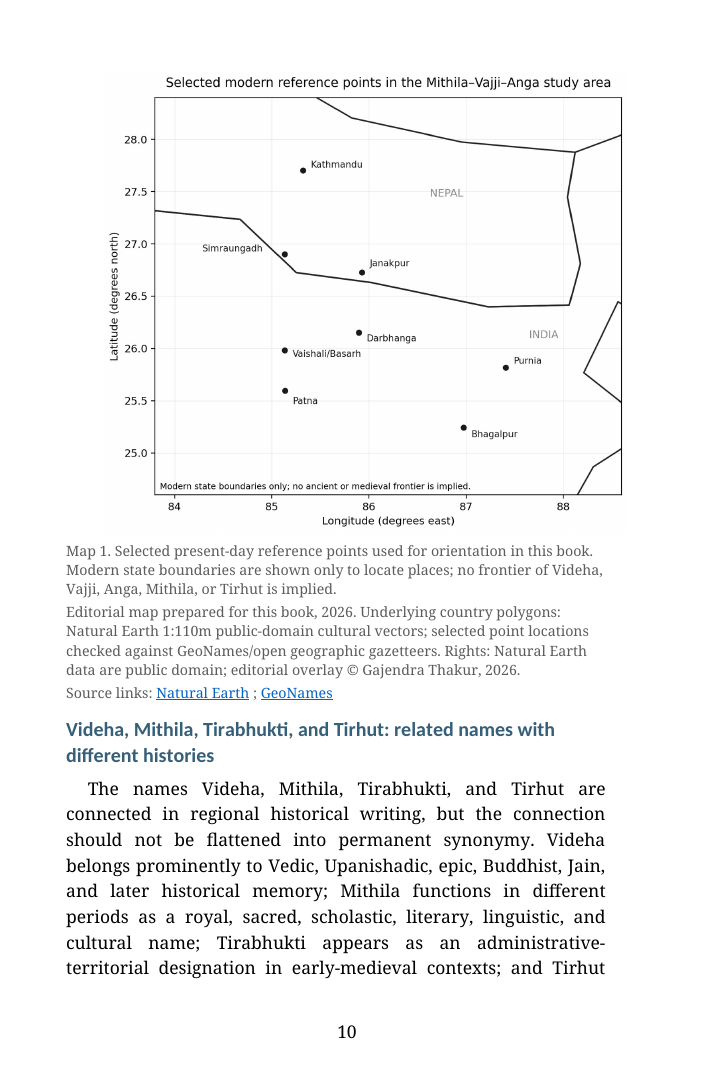
Mithila · Vajji · Anga
Chapter-specific source notes
- Primary chapter witness. Gajendra Thakur, Decoding the Panji of Mithila — Volume IV, formal Chapter 66, PDF pp. 636-651; formal Chapter 66. The HTML transcription is generated from the commit-pinned source PDF and retains the chapter boundary recorded in this edition.
- Internal structure. The repository source-heading inventory records 11 subordinate headings for this chapter: “Opening note”; “Entry (548): Mahindrapur to Purba-Rashady and Shivnagar”; “Entry (549): Shivnagar and Pa Vidyanand Jha”; “Entry (550): Mahindrapur to Khamra, Manbodh Jha and Begusarai”; “Entries (551)-(552): Bisfi to Saurath”; “Entries (553)-(554): Malichham-Saurath, Janta, Ladaur and Chhitan Jha Kailakh”; “Entries (555)-(556): Kabai-Narun to Dhanga, Navani and Rashady”; “Entry (557): Tedhra-Narun to Kakraud and Pilkhwar”; ….
- Digital editorial method. The page keeps the preserved source text distinct from generated navigational, concordance, visual, and provenance apparatus. The synthetic reconstruction is explanatory only and is not evidence for an individual lineage or a determination of social or marital status.