Decoding the Panji of Mithila · Volume IV · Chapter 67
Ojholi-Sagarapur-Pandoli and the Kapileshwar Pause: Entries (563)-(564)
Chapter 67. Ojholi-Sagarapur-Pandoli and the
Kapileshwar Pause: Entries (563)-(564)
  This chapter deliberately treats a short transitional unit.
Entry (563) closes the Ojholi-Narun and Sagarapur-Pandoli
material that follows the Shaktiraypur and Sagarapur blocks
of the preceding chapter. Entry (564) is not a developed
genealogy; it is an invocatory, suspended Kapileshwarnath
marker. The chapter therefore preserves both the active
genealogy and the empty rubric, and it stops before the new
Bhakhrauli-Kujouli gramarambh of entry (565).

Entry (563): Ojholi to Sagarapur and Pandoli
   Entry (563), under the invocation Ashutoshaya namah, is
headed Ojholi to Sagarapur and Pandoli. Its working frame is
not a large new panji province but a tightly compact route-
sheet. Madhav gives Shripati, with Shripati tied through
Mandar-Babudatt-Vaiya Ravinath and Hariamb-Muse. Govind
is then carried through Hariamb-Lakshminath-Shrinath and
Sarisab-Jhotan. Mahi is routed through Sakararhi-Haridev-
Basudev and Budhwal-Haridash. These three openings
establish the chapter as a connector between Ojholi,
Sagarapur, Pandoli, Hariamb, Sakararhi, and Budhwal lines
rather than as a simple single-village descent.
   The next operative node is Ghanshyam, marked by the
cross-reference B 49/6. Ghanshyam gives Buddhi, Dhairyi,
Sahib, and Horil through Khaual-Damodar-Chilka and Didho-
Bhaiya. Buddhi is then tied through Satlakha-Karu-Pitambar
and Soderpur-Chhatu. Dhairyi gives Rupnath, Harilal, Bholan,
Hridaynath, Chengan, and Ghonghan through Soder-Jay-Pati
and Alay-Anath. This is a characteristic panji passage: a
compact set of sons is followed by several marriage or
settlement routes, and the branch expands sideways through

the named houses rather than by one continuous linear
descent.
   Rupnath gives Lalit through Soderpur-Dubari-Indramani
and Darihara-Manbodh. Harilal gives Gopal through Pali-
Bhikhi-Naresh and Soder-Dukhbhanjan. Gopal gives Dwarika
through     Alay-Dubari-Yadu      and   Narun-Mani-Chhatri.
Hridaynath gives Nenan through Balias-Girish-Pritam and
Karmah-Mahant, while Chengan is linked through Pali-
Mansukh-Chandradev and Balias-Pritam. The repeated
alternation of Soderpur, Darihara, Pali, Narun, Balias, and
Karmah makes the record a map of relational movement
rather than a mere list of names.
   The Sahib branch carries the register into another dense
learned cluster. Sahib gives Baidyanath and Shambhunath
through Kujouli-Bachharu-Shivnand and Budhwal-Jangal.
Baidyanath gives Deonath and Kulanand through Pali-
Manbodh-Shobhanath and Jajival-Hemu. An apara Baidyanath
line gives Thakur, Govind, Vaiya Vishwanath, and Gokulanand
through Karmah-Mahant-Dullah. Dullah itself is routed
through Digho-Narpati-Kala and Belaunch-Chiranjeev. The
presence of Vaiya Vishwanath marks a learned or honorific
sub-identity within the branch, while the apara notation
protects a secondary line from being collapsed into the main
descent.
   The last lines of entry (563) complete the branch through
Thakur, Vaiya Vishwanath, Ramanand, and Shobhanand.
Thakur is tied through Darihara-Nanu-Muni and Karmah-
Sanphool. Vaiya Vishwanath gives Ramanand and
Shobhanand through Sakararhi-Hridaynath-Bachchu and
Baheradhi-Venidatt. Ramanand is connected through Bisfi-
Thakur Phanilal-Dukhan and Pali-Krishnamani. Shobhanand
closes the entry through Darihara-Gehenath-Gulab and
Karmah-Jaynath. The closing pattern is important: Bisfi

appears inside an Ojholi-Sagarapur-Pandoli register, and
Sakararhi and Baheradhi function as route controls, showing
how a geographically headed entry preserves much wider
marriage memory.

Entry (564): The Kapileshwarnath Marker
  Entry (564) reads as an invocation to Kapileshwarnath but
does not carry a developed genealogical body in the available
source. It should therefore be read as a suspended or
separating marker. The text moves immediately afterward to
entry (565), where a fresh Bhakhrauli-Kujouli gramarambh
begins. In the present decoding, entry (564) is preserved as a
meaningful blank: it marks a ritual pause and chapter
boundary without supplying names, sons, or route-pairs.

Chapter conclusion
   Entries (563)-(564) form a short but useful hinge. Entry (563)
finishes the Ojholi-Sagarapur-Pandoli material through
Madhav, Shripati, Govind, Mahi, Ghanshyam, Dhairyi, Sahib,
Baidyanath, and Vaiya Vishwanath, while preserving a dense
mesh of Soderpur, Hariamb, Sakararhi, Budhwal, Didho,
Satlakha, Alay, Narun, Balias, Karmah, Kujouli, Jajival, Digho,
Belaunch, Bisfi, and Baheradhi routes. Entry (564) then
supplies only an invocation, not a descent. The next chapter
must begin afresh with the Bhakhrauli-Kujouli gramarambh
of entry (565).
Source structure and verification apparatus
Editorial source apparatus. This apparatus is descriptive, not interpretive. It records the source-controlled structure used to verify that this page corresponds to formal Chapter 67 of Decoding the Panji of Mithila — Volume IV. The chapter text above is preserved from PDF pp. 652-654; formal Chapter 67 in the commit-pinned authoritative source. It is not merged with a neighboring chapter, appendix, annexure, or independent front/back-matter unit. The internal headings below come from the repository’s source-heading inventory and are retained as navigational and audit evidence; showing them here does not turn those headings into separate publications or add claims that are absent from the source.
Internal source headings
- Entry (563): Ojholi to Sagarapur and Pandoli
- Entry (564): The Kapileshwarnath Marker
- Chapter conclusion
Source-text concordance
Ojholi-Sagarapur-Pandoli · Kapileshwar · Pause · Entries · deliberately · treats · short · transitional · unit · Entry · closes · Ojholi-Narun · Sagarapur-Pandoli · material · follows · Shaktiraypur · Sagarapur · blocks · preceding · developed · genealogy · invocatory · suspended · Kapileshwarnath · marker · therefore · preserves · active · empty · rubric · stops · Bhakhrauli-Kujouli · gramarambh · Ojholi · Pandoli · invocation · Ashutoshaya · namah · headed · working · frame · large · province · tightly · compact · route · sheet · Madhav · gives · Shripati · tied · Mandar-Babudatt-Vaiya · Ravinath · Hariamb-Muse · Govind · carried · Hariamb-Lakshminath-Shrinath · Sarisab-Jhotan · Mahi · routed · Sakararhi-Haridev · Basudev · Budhwal-Haridash · three · openings · establish · connector · Hariamb · Sakararhi · Budhwal · lines · rather · simple · single-village · descent · next · operative · node · Ghanshyam · marked
Boundary verification. In the formal sequence this chapter follows Volume IV Chapter 66, “Mahindrapur-Shivnagar, Bisfi- Saurath, Kabai, Vatswal, Shaktiraypur and Sagarapur: Entries (548)-(562) Opening note” and precedes Volume IV Chapter 68, “Bhakhrauli-Kujouli: Chikni- Purnia, Porbarauni and Haripur, Entries (565)-(572) This chapter opens the Bhakhrauli-Kujouli gramarambh”. The chapter extractor begins at the verified formal Chapter 67 marker and stops at the next verified formal chapter marker; for a final chapter it stops before recognized book-level back matter. The concordance above is generated only from distinct terms already present in this chapter’s preserved source text. It is provided for discovery, comparison, and audit, not as an automated judgment about persons, lineages, status, kinship, marriage eligibility, or historical truth.
Illustrated research apparatus
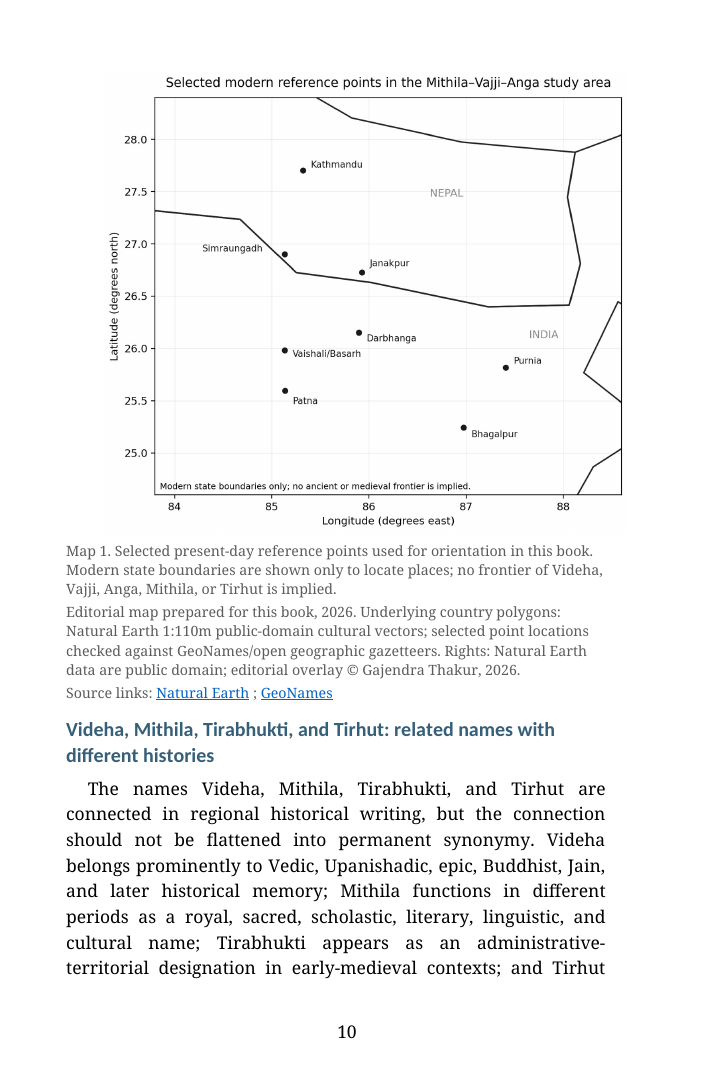
Mithila · Vajji · Anga
Chapter-specific source notes
- Primary chapter witness. Gajendra Thakur, Decoding the Panji of Mithila — Volume IV, formal Chapter 67, PDF pp. 652-654; formal Chapter 67. The HTML transcription is generated from the commit-pinned source PDF and retains the chapter boundary recorded in this edition.
- Internal structure. The repository source-heading inventory records 3 subordinate headings for this chapter: “Entry (563): Ojholi to Sagarapur and Pandoli”; “Entry (564): The Kapileshwarnath Marker”; “Chapter conclusion”.
- Digital editorial method. The page keeps the preserved source text distinct from generated navigational, concordance, visual, and provenance apparatus. The synthetic reconstruction is explanatory only and is not evidence for an individual lineage or a determination of social or marital status.